Entre em contacto com a BBP

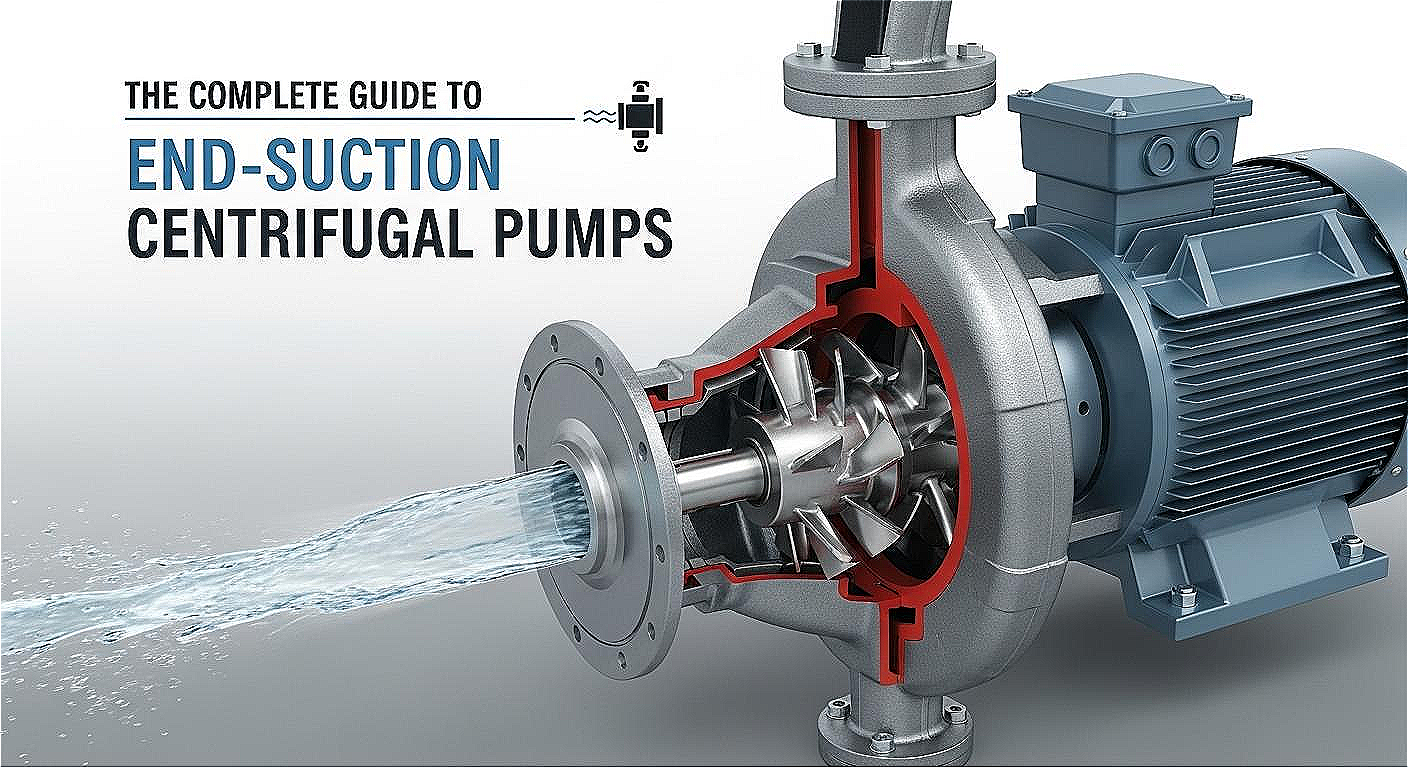
Especificações rápidas: bomba centrífuga de aspiração axial
| Classificação da bomba | Bomba centrífuga monocelular de aspiração axial |
| Princípio de funcionamento | A força centrífuga gerada pelo impulsor rotativo converte a energia do motor em velocidade e pressão do fluido |
| Intervalo de caudal habitual | 5–5 000 GPM (1–1 200 m³/h) |
| Intervalo habitual de altura manométrica | 15–650 ft (5–200 m TDH) |
| Opções de montagem | Sobre base (carcaça + acoplamento) / Acoplamento direto (montagem direta no motor) |
| Orientação | Horizontal (normal) / Vertical com acoplamento direto / Vertical em linha |
| Materiais comuns | Ferro fundido, SS304, SS316, bronze, aço inoxidável duplex |
| Principais normas | ISO 2858, ANSI/HI 1,1-1.5, NFPA 20 (bombas de incêndio), DOE 10 CFR 431 |
| Aplicações habituais | AVAC, abastecimento de água, distribuição municipal, proteção contra incêndios, processos industriais |
A bomba de aspiração axial é, sem dúvida, a principal força de trabalho dos sistemas industriais e comerciais de transporte de fluidos, representando a maior parte das instalações de bombas centrífugas em todo o mundo — quer esteja a dimensionar um circuito de água refrigerada para um centro de dados, um projeto de bomba elétrica de incêndio conforme a NFPA 20 ou a substituir uma unidade sobre base envelhecida numa estação municipal de aumento da pressão, as opções de projeto tomadas inicialmente influenciam a vida útil do empanque, os custos de energia e os intervalos de manutenção durante os próximos 10+ anos.
Este guia introdutório abrange os fundamentos de engenharia: como funciona a bomba, montagem sobre base face ao acoplamento direto, em que situações se destaca cada configuração, os 6 parâmetros de pressão considerados pelos engenheiros de processos na especificação de um projeto e o que exige realmente o regulamento de rendimento DOE 2020 — por que motivo a proteção contra incêndios constitui um caso especial? Não pretende promover uma bomba X, mas ser um recurso informativo que ajude a redigir uma especificação, verificar uma proposta ou colocar perguntas aos fornecedores com confiança.
O que é uma bomba de aspiração axial? (E como funciona)
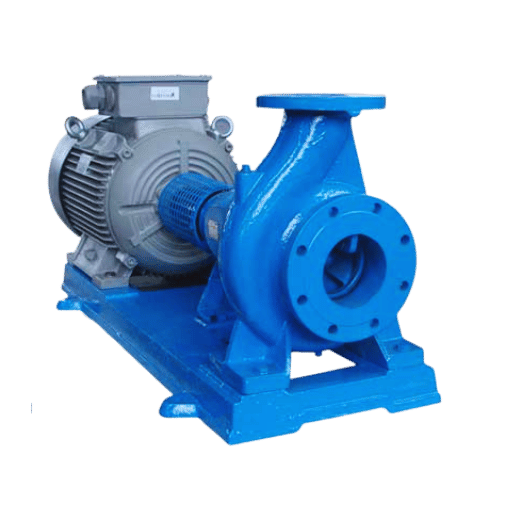
Uma bomba centrífuga de aspiração axial possui uma entrada central na parte frontal do corpo da bomba e um bocal de descarga perpendicular orientado lateralmente. O fluido entra pela aspiração ao longo do eixo do veio e segue diretamente para as rodas do impulsor montadas no veio. Depois de passar pelas pás do impulsor, acelera para o exterior por ação da força centrífuga e entra na voluta, onde a energia de velocidade é convertida em pressão. É esta disposição da aspiração na extremidade da bomba que define a configuração de aspiração axial, por oposição a uma bomba de dupla aspiração ou multicelular.
Como funciona uma bomba de aspiração axial?
Um motor de indução de CA aciona o impulsor a aproximadamente 1 450 a 3 600 rotações por minuto. Durante a rotação à velocidade de funcionamento, o impulsor transmite velocidade cinética ao fluido à medida que este atravessa a voluta. Essa velocidade é convertida em altura manométrica de pressão à medida que a secção transversal do corpo aumenta desde a saída do impulsor até ao bocal de descarga. No ponto de melhor rendimento (BBP), o percurso do caudal entre a entrada e a linha central do impulsor é uniforme e as perdas de carga são mínimas. O funcionamento muito afastado do BEP intensifica as forças radiais no veio, aumenta a velocidade no empanque e acelera a cavitação, razão pela qual a escolha do diâmetro correto do impulsor para a aplicação é mais importante do que uma grande potência indicada na chapa de características do motor.
📐 Nota de engenharia: anatomia de uma ESP — 5 componentes principais
| Impulsor | Disco rotativo com pás que transmite força centrífuga ao fluido; monocelular (um impulsor) na conceção ESP |
| Corpo da bomba / Voluta | Corpo em espiral que recolhe o fluido a alta velocidade proveniente da saída do impulsor e converte a velocidade em pressão |
| Veio | Transmite o binário do motor para o impulsor; é apoiado por rolamentos; está sujeito a cargas radiais e axiais |
| Empanque mecânico | Impede fugas de fluido ao longo do veio; é o componente mais sensível a falhas — a vida útil do empanque depende do alinhamento e da margem de NPSHa |
| Caixa de rolamentos | Suporta o veio radial e axialmente; as configurações sobre base possuem uma caixa de rolamentos própria; as configurações de acoplamento direto dependem dos rolamentos do motor |
A normalização dimensional é especificada pela ISO 2858:1975 para bombas métricas de aspiração axial, segundo as especificações ISO 2858, que estabelecem o sistema de designação por três números (diâmetro de entrada-diâmetro de saída-diâmetro nominal do impulsor, ou seja, 80-50-250), flanges de 50 mm a 250 mm e capacidade de pressão de 16 bar (232 PSI). A permutabilidade prevista na ISO 2858 permite aos engenheiros substituir a bomba de um fabricante pela de outro sem alterar a tubagem, desde que o ponto de funcionamento hidráulico seja compatível. A ferramenta de pesquisa de substituições ISO 2858 da BBP associa as dimensões da bomba instalada aos modelos BBP equivalentes.
Tipos de bombas de aspiração axial: versões sobre base, de acoplamento direto e verticais
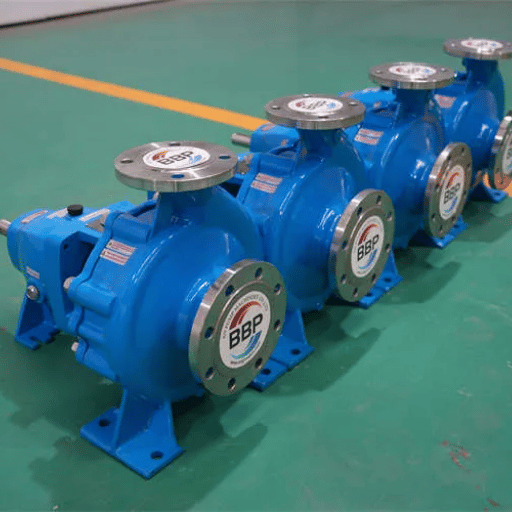
A mesma geometria hidráulica básica pode ser montada em quatro configurações de instalação diferentes. Selecionar uma configuração de montagem inadequada por uma interpretação incorreta dos requisitos da tubagem do processo é um dos erros mais comuns e dispendiosos na elaboração de especificações.
✔ Acoplamento direto: vantagens
- Não requer acoplamento nem alinhamento — instala-se em poucas horas
- Menor área de implantação — cabe em salas técnicas com espaço limitado
- Menor custo inicial (sem placa de base nem proteção do acoplamento)
- O impulsor pode ser rodado para alinhar a tubagem sem deslocar o motor
- Excelente opção para circuladores de AVAC, abastecimento de água em edifícios e rega (<50 HP)
⚠ Acoplamento direto: limitações
- Os rolamentos do motor suportam todas as cargas hidráulicas radiais e axiais — limita a potência máxima em HP
- Requer um motor com flange C — menor permutabilidade do que os motores normalizados com patas
- Uma falha do empanque pode permitir a entrada de líquido na carcaça do motor
- Na maioria das configurações, a manutenção da bomba exige que o motor seja desligado
- Não recomendada para funcionamento crítico contínuo 24/7 acima de ~50-75 HP
O que é uma bomba de aspiração axial com acoplamento direto?
Numa bomba de aspiração axial com acoplamento direto, o impulsor é montado diretamente no veio do motor (ou no adaptador de montagem à face). Esta disposição elimina o acoplamento flexível e o pedestal separado utilizados na construção sobre carcaça. É a opção com melhor relação custo-eficácia para serviço não crítico quando o espaço de instalação e a manutenção simplificada têm prioridade sobre a flexibilidade de escolha do motor. A experiência de campo relatada por engenheiros em diversos fóruns sugere que as grandes instalações de processo tendem a preferir motores com patas devido à sua permutabilidade, o que, por sua vez, indica que as especificações para serviço crítico tendem a favorecer a construção sobre base, mesmo com potências nominais inferiores.
| Configuração | Acesso para manutenção | Intervalo habitual de HP | Mais indicada para |
|---|---|---|---|
| Sobre base (carcaça) | Extração pela retaguarda: o impulsor + empanque são removidos sem deslocar o motor nem a tubagem | 20–500+ HP | Instalações de processo, redes municipais, serviço crítico 24/7 |
| Acoplamento direto | O motor tem de ser desligado para a maioria dos trabalhos na bomba | 0,5–75 HP (habitual) | AVAC, abastecimento de água em edifícios, rega |
| Vertical com acoplamento direto | Motor por cima da bomba — menor área de implantação | 0,5–50 HP | Salas técnicas em caves, poços de bombagem, altura vertical limitada |
| Vertical em linha | Motor por cima; a tubagem permanece em linha — área de implantação mínima | 1–150 HP | Aumento da pressão em AVAC, abastecimento de água em edifícios altos, circuitos de refrigeradores |
Regra para decidir a configuração: se a potência no veio exceder 75 HP, ou se a aplicação funcionar continuamente e for necessário acesso para manutenção sem a presença de um eletricista, escolha uma configuração sobre base com carcaça. Para circulação em AVAC abaixo de 50 HP, com motores facilmente disponíveis, a configuração de acoplamento direto oferece um desempenho equivalente com menor custo de investimento. Consulte as séries detalhadas de bombas de aspiração axial BBP para conhecer as opções de potência e configuração de cada modelo.
Aplicações das bombas de aspiração axial: AVAC, água municipal e proteção contra incêndios
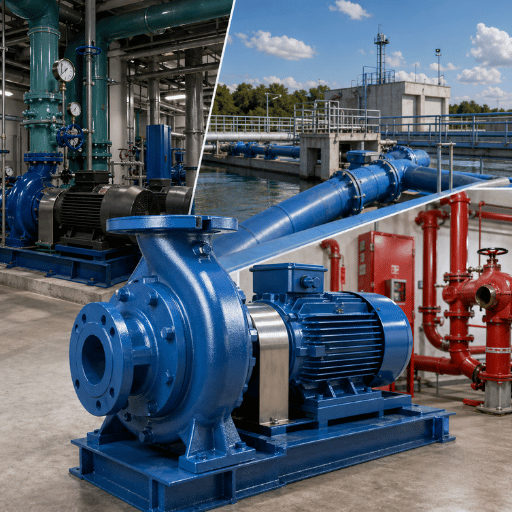
As bombas de aspiração axial são utilizadas em todo o tipo de necessidades industriais e comerciais de transporte de fluidos — desde a circulação de água refrigerada em centros de dados até à distribuição municipal de água com aumento da pressão. Nas dimensões mais comuns, as configurações monocelulares satisfazem os requisitos de caudal e altura manométrica da maioria das instalações técnicas de edifícios e aplicações industriais de pequena escala. Se forem necessários caudais superiores a 5 000 GPM ou alturas manométricas constantes acima de 650 ft., opta-se geralmente por uma configuração multicelular ou de carcaça bipartida.
| Aplicação | Intervalo de caudal habitual | Altura manométrica habitual | Norma principal / Nota |
|---|---|---|---|
| Água refrigerada / quente para AVAC | 50–3 000 GPM | 30–200 ft | ASHRAE 90.1 — rendimento do projeto do sistema |
| Sistema municipal de aumento da pressão da água | 200–5 000 GPM | 100–400 ft | AWWA C150 — conformidade com a classe de pressão |
| Proteção contra incêndios (NFPA 20) | 25–2 500 GPM nominais | 100–300 ft | NFPA 20 — exigidas certificação UL + aprovação FM |
| Água de refrigeração industrial | 100–4 000 GPM | 50–300 ft | Norma dimensional ISO 2858 ou ANSI/HI 1,1-1,5 |
| Rega / Abastecimento de água | 5–800 GPM | 30–150 ft | Serviço com água limpa; o acoplamento direto é geralmente adequado |
O que é uma bomba de incêndio de aspiração axial?
Uma bomba de incêndio de aspiração axial é uma bomba centrífuga com certificação UL e aprovação FM Global, definida pelos critérios de desempenho da NFPA 20 — Norma para a instalação de bombas estacionárias de proteção contra incêndios. A especificação em conformidade com a norma exige que a bomba seja ensaiada em três pontos obrigatórios — caudal nulo (0% de caudal, 101–140% da pressão nominal), caudal nominal (100%) e sobrecarga (150% de caudal com ≥65% da pressão nominal). As bombas comerciais normalizadas sem esta certificação não são substitutos aceitáveis; a certificação abrange o conjunto completo formado pela bomba, acionamento e controlador.
Situação: instruções iniciais de dimensionamento de uma bomba de incêndio de aspiração axial conforme a NFPA 20 para um hospital
Um engenheiro de proteção contra incêndios que especifica um sistema de 250 GPM e 115 PSI para a rede de sprinklers de um hospital de 6 pisos começa o projeto com a necessidade hidráulica resultante dos cálculos hidráulicos — 250 GPM no sprinkler mais desfavorável, acrescidos das perdas por atrito. Seleciona uma bomba de incêndio de aspiração axial com valores nominais de 250 GPM / 115 PSI, consulta a base de dados UL Product iQ para confirmar a certificação UL e verifica se a potência do motor em HP permite cumprir a curva de desempenho sem sobrecarga quando a bomba fornece 150% (375 GPM). O código exige um troço reto com 10 diâmetros de tubagem antes da entrada da bomba — um sistema de tubagem de 6 polegadas necessita de um troço reto de 60 polegadas (5 ft) — para eliminar a turbulência na entrada e evitar a cavitação durante a solicitação de incêndio com caudal máximo.
💡 Conselho profissional: ensaio semanal segundo a NFPA 20
O programa de ensaios de bombas de incêndio previsto na NFPA 20 inclui um ensaio semanal sem caudal (mínimo de 10 minutos) e um ensaio anual com caudal total nos pontos de caudal nulo, nominal e de 150% do caudal. Se o ensaio semanal não for realizado, a apólice de seguro será inválida na maioria dos municípios, sendo esta a deficiência #1 detetada durante as inspeções da AHJ. Preveja um caudalímetro ou coletor de ensaio separado durante a construção inicial, pois uma adaptação posterior custa 3-5 vezes mais.
Como selecionar a bomba de aspiração axial correta: 6 parâmetros de engenharia
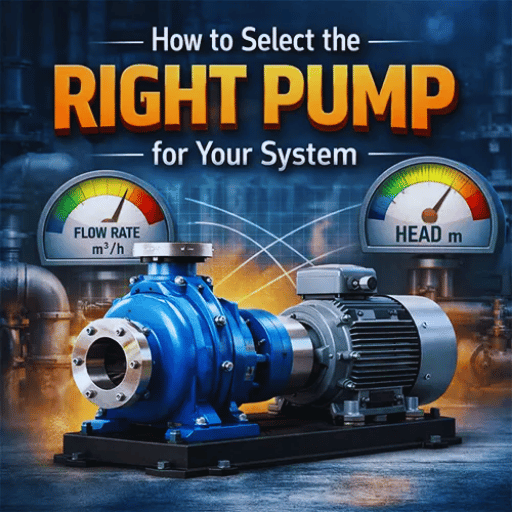
Todas as aplicações de bombagem podem ser reduzidas a seis parâmetros de projeto. Defina corretamente os seis antes de abrir um catálogo e a escolha resultante será simples. Se considerar menos parâmetros, arrisca-se a sobredimensionar a bomba (o custo de investimento aumenta e o rendimento diminui no ponto de funcionamento real), subdimensioná-la (falha nos primeiros 12 meses) ou escolher materiais incorretos (falha por corrosão em poucos meses). Os engenheiros de aplicações da BBP aplicam este método a todas as análises de especificações de bombas de aspiração axial.
Método de seleção de bombas de aspiração axial baseado em 6 parâmetros
- Caudal (Q) no ponto de funcionamento — defina-o em GPM ou m/h nas condições reais de funcionamento, não no pico nem na capacidade instalada. O dimensionamento para um caudal de pico que ocorre durante 2% do tempo afasta a bomba do BH em funcionamento normal e reduz a vida útil do empanque.
- Altura manométrica total (TDH) — soma da altura estática, das perdas por atrito e do diferencial de pressão no ponto de funcionamento, em pés ou metros. Utilize as interseções da curva do sistema com a curva da bomba, não apenas a altura manométrica indicada na chapa de características.
- Altura líquida positiva de aspiração disponível (NPSHa) — calcule a NPSHa com base nas condições de aspiração: pressão atmosférica + altura estática de aspiração − pressão de vapor − perdas por atrito. A ANSI/HI 9.6.1 estabelece que a NPSHa deve exceder a NPSHr em pelo menos 1.5 no ponto de funcionamento. Muitas falhas prematuras de bombas nos primeiros 3 meses de funcionamento são causadas pela desconsideração da margem de NPSHa, e os danos anulam a garantia.
- Propriedades do fluido — temperatura, densidade relativa, viscosidade, pH, sólidos em suspensão e teor de abrasivos. Para água limpa à temperatura ambiente ou outros fluidos newtonianos abrangidos pelas curvas de especificação do catálogo, utilize-as sem alterações. Para fluidos viscosos ou aplicações a temperaturas elevadas, aplique os fatores de correção de viscosidade do HI para reduzir os valores da curva habitual.
- Materiais de construção — determinados pela composição química do fluido (consulte a tabela de materiais abaixo). Ferro fundido para água limpa com pH neutro; aço inoxidável 316 para sistemas com cloro, água do mar ou produtos químicos de processo; bronze para AVAC marítimo e água potável quando se recomenda resistência à dezincificação.
- Tipo de acionamento — acoplamento direto para AVAC e serviço comercial ligeiro abaixo de 75 HP; construção sobre base com carcaça para instalações de processo, serviço crítico contínuo 24/7 ou qualquer aplicação em que se pretenda minimizar o custo de investimento, possivelmente segundo o princípio de que a melhor forma de evitar tempo de paragem é manter uma bomba sobresselente pronta a funcionar.
Seleção de materiais em função da composição química do fluido
| Material | Intervalo de pH | Temperatura máxima | Mais indicado para |
|---|---|---|---|
| Ferro fundido | 6.5–9.0 | 225°F (107°C) | Água limpa neutra, AVAC, rega |
| SS304 | 4.0–10.0 | 400°F (204°C) | Água ligeiramente corrosiva, processamento alimentar (sem cloretos) |
| SS316 | 2.0–11.0 | 400°F (204°C) | Água com cloro, água do mar, indústria farmacêutica, processos químicos |
| Bronze | 6.0–8.5 | 300°F (149°C) | AVAC marítimo, água potável (certificação NSF), ambientes salinos |
| Aço inoxidável duplex | 0–14 (dependente do serviço) | 450°F (232°C) | Água do mar com elevado teor de cloretos, bombas de incêndio marítimas NFPA 20 |
Cenário: seleção do material de construção para um circuito de água de refrigeração AVAC farmacêutico
Será utilizado glicol inibido num circuito de água refrigerada a 50 C (122 F) numa fábrica farmacêutica de Nova Jérsia: foi solicitado ao engenheiro da fábrica que selecionasse bombas de água de refrigeração resistentes à corrosão; partindo do ferro fundido, a adição de cloro para controlar o crescimento biológico àquela temperatura e dosagem exclui-o imediatamente — a água com cloro a temperatura elevada pode acelerar a corrosão por picadas do ferro fundido cinzento em 18-24 meses. Aço inoxidável de qualidade cromatográfica: será a classe 304 marginal quanto ao teor de cloretos? Aço inoxidável: parece promissor, mas demonstrou-se que o teor adicional de molibdénio de 2-3% no aço 316, agora normalizado, melhora significativamente a resistência à corrosão por cloretos face às classes com maior teor de molibdénio em ambientes com cloretos à temperatura de funcionamento.
📐 Nota de engenharia: método rápido de cálculo da NPSH
NPSHa (ft) = (Pa/γ) + Hs − hf − Pv/γ Em que: Pa= pressão atmosférica absoluta (ft),= peso específico do fluido (lb/ft), Hs= altura estática de aspiração (positiva se a bomba estiver abaixo da superfície do líquido), hf= perda de carga por atrito na linha de aspiração (ft), Pv= pressão absoluta de vapor à temperatura de bombagem. Regra prática: se o cálculo indicar uma NPSHa a menos de 2 ft da NPSHr publicada da bomba, encontra-se na zona de perigo. Segundo a ANSI/HI 9.6.1, procure obter NPSHa ≥ 1,5× NPSHr no ponto de funcionamento. Para água quente (acima de 140°F) ou serviço com hidrocarbonetos, a margem exigida aumenta normalmente para 2× ou mais.
Utilize o seletor BBP para comparar os seus requisitos de 6 parâmetros com as curvas das bombas e prever a NPSH necessária antes de enviar um pedido de proposta.
Aspiração axial face a configuração em linha e carcaça bipartida: escolha da configuração correta da bomba

Aspiração axial, vertical em linha, horizontal de carcaça bipartida. Todas são arquiteturas de bombas centrífugas, mas a questão é imediata: onde serão mais eficazes, onde serão menos eficazes e como se comparam os custos de manutenção durante uma vida útil habitual de 15-20 anos. A escolha tem muito pouco que ver com o desempenho hidráulico — depende do espaço disponível, dos operadores e da equipa de manutenção, bem como do custo adicional de uma configuração não otimizada.
| Atributo | Aspiração axial | Vertical em linha | Carcaça bipartida |
|---|---|---|---|
| Intervalo de caudal habitual | 5–5 000 GPM | 10–3 000 GPM | 200–30 000+ GPM |
| Intervalo habitual de altura manométrica | 15–650 ft | 20–500 ft | 20–1 200 ft |
| Área de implantação | Média (sobre base) / Pequena (acoplamento direto) | Mínima — tubagem em linha | Grande — requer placa de base completa |
| Configuração da aspiração | Aspiração simples (um lado) | Aspiração simples | Dupla aspiração (menor NPSHr com GPM elevados) |
| Custo inicial | Inferior | Inferior–médio | Superior (acréscimo habitual de 30–50%) |
| Tempo de paragem para manutenção | Curto (extração pela retaguarda) | Curto (o motor é retirado por elevação) | Longo (abertura completa do corpo, requer um especialista) |
| Rendimento com caudal elevado | Diminui acima de ~5 000 GPM | Diminui acima de ~3 000 GPM | Rendimento elevado e constante com GPM elevados |
Qual é melhor: bomba de aspiração axial ou de carcaça bipartida?
Com caudais abaixo de ~2000 GPM, trata-se de uma simples questão de custo: uma bomba de aspiração axial proporciona o mesmo desempenho hidráulico, com um investimento inicial substancialmente inferior e uma manutenção muito mais simples do que uma bomba de carcaça bipartida durante a mesma vida útil de 15-20 anos. A arquitetura de impulsor de dupla aspiração de uma bomba de carcaça bipartida apenas justifica o preço superior em dois cenários: um caudal existente e constante acima de 2000-3000 GPM (nesse caudal, a dupla aspiração reduz a NPSH necessária e a força radial nos rolamentos da bomba); e infraestruturas municipais, nas quais o investimento inicial adicional é diluído ao longo de uma vida útil de 40+ anos. Noutras aplicações, especificar uma bomba de carcaça bipartida constitui sobredimensionamento técnico: em muitos casos, é frequente especificar erradamente um produto com custo de aquisição superior, maior área de implantação e investimento inicial mais elevado, desnecessário para as condições de funcionamento.
Cenário: aspiração axial ou carcaça bipartida para a estação municipal de aumento da pressão de 1 800 GPM?
Um engenheiro de uma entidade gestora de águas no Texas está a especificar uma estação de aumento da pressão para uma zona suburbana em rápida expansão: 1 800 GPM a 185 ft TDH, 16 horas por dia. Uma bomba de carcaça bipartida é uma opção atraente para este caudal — mas a sala técnica tem pouco espaço: a entidade utiliza equipas de manutenção compostas por duas pessoas. Bomba de aspiração axial sobre base, 150 HP, impulsor SS316 para água com cloro, configuração com extração pela retaguarda. A opção de aspiração axial tem um custo de aquisição inicial 38% inferior, requer uma área de implantação do equipamento 40% menor e pode ser intervencionada por dois mecânicos em menos de quatro horas sem ferramentas especializadas. Mas que dizer da bomba horizontal de carcaça bipartida de substituição direta da BBP, especialmente com caudais superiores a 3 000 GPM ou quando a margem entre a NPSHR e a NPSH disponível é particularmente importante?
⚠️ Erro comum: optar por carcaça bipartida abaixo de 2 000 GPM
Os entusiastas do setor citam frequentemente a comparação entre bombas de aspiração axial e de carcaça bipartida para um serviço de 1 000-2 000 GPM, no qual os dois tipos são praticamente permutáveis, como motivo para especificar uma bomba de carcaça bipartida. As necessidades de substituição determinadas pelo mercado, as considerações relativas ao perfil de carga e os fatores de custo total de propriedade tornam as bombas de aspiração axial pouco competitivas face às bombas de carcaça bipartida durante uma vida útil de projeto de 20 anos.
Explore aqui a adequação da bomba vertical em linha a salas técnicas com pouco espaço que limitam as alterações da tubagem em linha e da bomba de dupla aspiração a condições de caudal elevado e NPSH reduzida.
Requisitos de instalação, opções de vedação e plano de manutenção

A causa mais comum de falha prematura em instalações de bombas de aspiração axial não reside em deficiências de fabrico inerentes, mas em práticas de instalação inadequadas. O desalinhamento dos veios da bomba e do motor devido ao assentamento do pavimento, à dilatação térmica ou às tensões da tubagem compromete os acoplamentos, destrói os empanques e reduz a vida útil dos rolamentos — correspondendo a 50% das falhas estatísticas na indústria em geral. Siga os cinco passos de instalação do equipamento para garantir a fiabilidade da bomba antes de iniciar o caudal e a descarga da bomba:
- Fundação e enchimento com grout: A placa de base da bomba deve ficar à face, nivelada e totalmente preenchida com grout para assentar uniformemente. Utilize uma mistura sem retração de 4 000 PSI. Deixe o grout curar durante um mínimo de três dias antes da bombagem, do enchimento ou do alinhamento.
- Tubagem de aspiração: Troço reto mínimo equivalente a cinco diâmetros de tubagem antes da flange de aspiração da bomba (10 em serviço de bomba de incêndio). Não utilize cotovelos nem redutores a montante.
- Suporte das tensões da tubagem: Utilize suportes independentes para a aspiração e a descarga — não apoie a tubagem no corpo da bomba; as tensões da tubagem deformam a carcaça, inclinam o veio e destroem os empanques em poucos meses.
- Alinhamento dos veios (montagem em base): Utilize alinhamento a laser, instale tubagem com ID integral até à bomba e efetue o alinhamento após a montagem final. A tolerância inicial da máquina deve situar-se dentro de 0.002″ de desvio paralelo e 0.001″ por pé/polegada de desvio angular (ANSI/HI 1.4). Verifique o alinhamento a quente 4 horas após o início do funcionamento, enquanto a tubagem dilata e a água quente circula livremente.
- Verifique o sentido de rotação antes de iniciar a circulação: Acione o motor por breves instantes para confirmar o sentido de rotação correto da bomba, a direção do caudal e o aperto do impulsor ao veio. A rotação inversa desenrosca os impulsores das bombas de aspiração axial.
- Escorvamento: As bombas de aspiração axial não têm autoescorvamento. No arranque, a linha de aspiração e o corpo da bomba não podem estar vazios, devendo a bombagem ocorrer com ambos totalmente inundados. Considere modelos autoescorvantes para serviços com altura de aspiração.
💡 Conselho técnico: conceção com extração pela retaguarda
Em aplicações de processo industrial com funcionamento 24/7, uma bomba de aspiração axial montada em base e com extração pela retaguarda permite retirar o conjunto do impulsor, veio, empanque e rolamentos como um único cartucho, sem desmontar a tubagem de aspiração ou descarga, desligar o motor ou chamar um eletricista. Assim, 2 mecânicos podem substituir um empanque ou adaptar um impulsor em menos de 2 horas durante um tempo de paragem planeado, em comparação com meio dia ou mais nas configurações monobloco ou sem extração.
📐 Nota de engenharia: normas de tolerância de alinhamento (ANSI/HI 1.4)
Segundo a ANSI/HI 1.4, para bombas de aspiração axial acopladas: • Desvio paralelo (radial): ≤ 0.002″ (0,05 mm) Desalinhamento angular (das faces): 0.001″ por polegada de diâmetro do acoplamento Volte a verificar o alinhamento após ligar a tubagem (as cargas da tubagem podem alterar a posição do motor) Volte a verificar após as primeiras 4 horas à temperatura de funcionamento (a dilatação térmica altera o alinhamento) Os dados do setor revelam que o desalinhamento acima destas tolerâncias explica a maioria das falhas dos empanques mecânicos aos 6 meses e dos rolamentos aos 12-18 meses em sistemas de bombas acopladas.
Plano de manutenção: bomba de aspiração axial (montada em base, serviço industrial)
| Intervalo | Tarefa | Verificação principal |
|---|---|---|
| Semanalmente | Verificação de vibrações e ruído; inspeção do gotejamento da gaxeta | 3–5 gotas/minuto em bombas com gaxeta; 0 em bombas com empanque mecânico |
| Trimestralmente | Temperatura e lubrificação dos rolamentos; medição do nível de referência das vibrações | Temperatura dos rolamentos < 180°F (82°C); vibração < 0.1 in/s segundo a ISO 10816 |
| Anualmente | Verificação do alinhamento; verificação da folga do impulsor; inspeção do empanque mecânico | Voltar a alinhar se for detetado algum desvio; folga conforme a tolerância do fabricante |
| 3–5 anos | Revisão completa por extração: rolamentos, empanque e anéis de desgaste do impulsor | Substituir preventivamente as peças de desgaste com base nas horas de funcionamento, não após uma falha |
Normas de eficiência energética e alterações previstas para 2025–2026

Atualmente, a energia é a maior despesa operacional isolada de uma instalação de bombas de aspiração axial, ultrapassando frequentemente os custos de investimento no prazo de 2 anos num sistema em funcionamento contínuo. Duas influências paralelas, uma regulamentar e outra tecnológica, estão a alterar a forma como os engenheiros especificarão a bomba de 2025 para a instalação: a imposição do índice de energia das bombas pelo DOE (aplicável nos Estados Unidos) e a crescente adoção de variadores de frequência com tecnologia de controlo inteligente.
O que a imposição do DOE de 2020 exige efetivamente
Desde 27 de janeiro de 2020, a norma de conservação de energia para bombas do Departamento de Energia dos EUA exige que as bombas de aspiração axial montadas em carcaça (ESFM) e as bombas de aspiração axial monobloco (ESCC), na gama de 1–200 HP, com caudal ≥25 GPM e altura manométrica máxima ≤459 ft no BEP, apresentem um índice de energia da bomba (PEI) ≤ 1.00. O PEI é uma relação entre o desempenho energético da unidade e o valor de referência estabelecido pelo DOE para uma unidade com o nível mínimo de conformidade. Se o valor for inferior a 1.00, a unidade consome menos energia do que o valor de referência mínimo de aprovação do DOE. Valores de PEI mais baixos significam maior eficiência energética do sistema de bombagem. Ao solicitarem propostas, os engenheiros devem pedir antecipadamente a documentação do PEI de cada modelo indicado, em vez de aceitarem apenas a classe de eficiência IE3 do motor — nos Estados Unidos, é a eficiência energética do sistema de bombagem, e não apenas a classe IE do motor, que determina a conformidade regulamentar.
Informação crítica para o aprovisionamento: as bombas de incêndio NFPA 20 estão especificamente excluídas do âmbito das classificações PEI do DOE. Continuam a ser regulamentadas pelas normas estabelecidas na NFPA 20, e não pelo programa de conservação de energia EPCA do DOE. Os engenheiros que aprovam simultaneamente bombas ESP normalizadas para água limpa e bombas de incêndio num determinado projeto trabalham ao abrigo de duas normas diferentes — um facto que passa frequentemente despercebido nas conversas com fornecedores.
—A seleção certa— e o dimensionamento das bombas são essenciais para maximizar a eficiência do sistema; a ferramenta HI Energy Saving Tool permite aos proprietários dos sistemas estimar o benefício económico das alterações previstas para o sistema de bombagem com base no valor de referência estabelecido pelo DOE.
A transição para VFD e bombas inteligentes: implicações para as especificações em 2026
Os variadores de frequência (VFDs) e as bombas de aspiração axial já não são uma opção exclusiva, sendo agora a norma ISO para sistemas de caudal variável. A física é incontestável — a potência da bomba é regida pelas leis de afinidade (a potência varia com o cubo da velocidade de rotação) — reduzir a velocidade de rotação em 20% reduz o consumo de potência em pouco menos de 50%.As orientações de 2024 da ENERGY STAR sobre motores para sistemas HVAC comerciais reconhecem que os motores IE5 de eficiência superior combinados com VFDs proporcionam «poupanças de energia ainda maiores» do que as duas abordagens tecnológicas aplicadas separadamente.
Excluindo os VFD, a tendência emergente para 2025-2026 que importa destacar é a manutenção preditiva baseada na IoT. Os sistemas de bombagem inteligentes — disponibilizados por todos os principais fabricantes como soluções instaladas de fábrica — monitorizam em tempo real a vibração, a corrente do motor e o estado do empanque, transmitindo os dados a algoritmos de inteligência artificial capazes de diagnosticar uma falha no empanque ou no rolamento com 2-4 semanas de antecedência. Nas instalações industriais cujas bombas de aspiração axial funcionam 24/7 em serviço crítico, a manutenção baseada no estado substitui as revisões programadas segundo o calendário e aumenta o tempo médio entre intervenções de manutenção planeadas.
O estudo do mercado mundial de bombas centrífugas confirma esta dinâmica de investimento: uma avaliação de $41,15 mil milhões em 2025, com crescimento projetado para $57,99 mil milhões até 2033 (taxa de crescimento anual composta de 4,5%), sendo a eficiência energética e a monitorização inteligente apontadas como os principais motores do crescimento. Ao especificar bombas de aspiração axial para um projeto cuja entrada em serviço esteja prevista para 2026 ou mais tarde, considere que os custos de adaptação posterior para compatibilidade com VFD e monitorização remota são cinco vezes superiores aos da sua inclusão direta na especificação do equipamento — utilize a calculadora do custo total de propriedade da BBP para comparar a eficiência energética de diferentes configurações de impulsores e motores.Perguntas frequentes sobre bombas de aspiração axial
P: O que é uma bomba de aspiração axial?
Ver resposta
Uma bomba de aspiração axial é uma bomba centrífuga de um único estágio na qual a entrada do fluido (aspiração) se situa na extremidade do corpo da bomba, alinhada axialmente com o veio do motor, e a saída de descarga é radial e perpendicular ao veio. É a configuração de bomba centrífuga mais utilizada para a bombagem de fluidos em aplicações industriais e comerciais.
P: Qual é a diferença entre bombas em linha e bombas de aspiração axial?
Ver resposta
Numa bomba de aspiração axial, a entrada situa-se na extremidade do corpo da bomba e a descarga é efetuada a 90° — a bomba fica instalada numa base ao lado da tubagem. Numa bomba vertical em linha, tanto a aspiração como a descarga ficam alinhadas no mesmo eixo central da tubagem, com o motor montado verticalmente por cima. As bombas em linha ocupam um espaço mínimo e são preferidas em circuitos HVAC de edifícios onde a disposição da tubagem não permite instalar uma unidade montada em base. As bombas de aspiração axial abrangem uma gama mais ampla de caudais e alturas manométricas e são mais fáceis de manter quando existe espaço de acesso disponível.
P: Como se dimensiona uma bomba de aspiração axial?
Ver resposta
O dimensionamento de uma bomba de aspiração axial segue quatro passos: (1) Definir o ponto de funcionamento do sistema — o caudal necessário (GPM) e a altura manométrica total (TDH em pés) nas condições de funcionamento. (2) Calcular o NPSHa a partir das condições de aspiração e confirmar que excede o NPSHr da bomba em pelo menos 1,5×, segundo a ANSI/HI 9.6.1. (3) Identificar as propriedades do fluido — temperatura, densidade relativa, pH e quaisquer substâncias abrasivas ou corrosivas que determinem a seleção dos materiais. (4) Selecionar uma bomba cuja curva passe pelo ponto de funcionamento ou próximo deste, dentro de 85–115% do caudal BBP e à altura manométrica necessária. Utilize o seletor de pontos de funcionamento da BBP para verificar a seleção antes de a submeter para aprovação.
P: As bombas de aspiração axial são autoescorvantes?
Ver resposta
As bombas centrífugas de aspiração axial convencionais não são autoescorvantes — o corpo da bomba e a linha de aspiração têm de estar completamente inundados com líquido antes do arranque. Tentar fazer funcionar uma ESP convencional com ar ou com a aspiração apenas parcialmente inundada provoca cavitação e danifica o impulsor e o empanque em poucos minutos. Se a aplicação exigir altura de aspiração — isto é, captar fluido a partir de um nível abaixo do eixo central da bomba — especifique uma bomba centrífuga autoescorvante concebida com uma câmara de escorvamento integrada.
P: Que fluidos podem ser bombeados por bombas de aspiração axial?
Ver resposta
As bombas de aspiração axial permitem bombear uma vasta gama de líquidos limpos e ligeiramente contaminados: água doce, água refrigerada, água quente (até aos limites de temperatura dos empanques e dos corpos das bombas), água do mar (com materiais resistentes à corrosão), soluções de glicol e fluidos ligeiros de processos industriais. A seleção dos materiais determina a compatibilidade com o fluido: ferro fundido para água limpa neutra, SS316 para serviços com cloro ou produtos químicos, bronze para água potável e sistemas HVAC marítimos e aço inoxidável duplex para ambientes com elevada concentração de cloretos ou produtos químicos corrosivos. As lamas muito abrasivas, os óleos viscosos acima de 500 cSt e os fluidos com mais de 2–3% de sólidos em suspensão, em peso, exigem bombas com conceções diferentes.
P: Com que frequência devem ser substituídos os empanques das bombas de aspiração axial?
Ver resposta
Num serviço contínuo com água limpa, a vida útil do empanque mecânico de uma bomba de aspiração axial bem instalada, corretamente alinhada e a funcionar no BBP ou próximo deste é de 3–5 anos. Os sinais de aviso de que a substituição do empanque está atrasada incluem: fuga visível de líquido na zona do bucim (para além do gotejamento controlado previsto em empanques com gaxeta), aumento dos valores de vibração ou subida da temperatura dos rolamentos. Uma falha prematura do empanque no prazo de 6–18 meses indica quase sempre uma causa de base: desalinhamento (a mais comum), NPSHa insuficiente, que provoca cavitação no impulsor, ou funcionamento muito afastado do BBP. Corrija a causa de base antes de substituir o empanque, caso contrário o novo componente falhará ao fim do mesmo intervalo. Para fluidos abrasivos ou quimicamente agressivos, a frequência de substituição do empanque deve seguir as recomendações do fabricante baseadas no estado do equipamento, em vez de um intervalo fixo de calendário.
Pronto para especificar a sua bomba de aspiração axial?
A BBP fabrica bombas centrífugas de aspiração axial conformes com os requisitos das normas ISO 2858, ANSI/HI 1,1-1.5 e NFPA 20, em ferro fundido, SS304, SS316 ou bronze, para toda a gama de desempenho de 5 a 5 000 GPM. Utilize as nossas ferramentas online para verificar a sua especificação antes de emitir um pedido de proposta (RFQ).
Sobre este guia
A BBP fabrica bombas centrífugas de aspiração axial para transferência de líquidos em aplicações industriais e comerciais, como bombas de incêndio certificadas segundo a NFPA 20, bombas de processo ISO 2858 e bombas de água limpa definidas pelo DOE. Este guia baseia-se no quadro de seleção, nas recomendações sobre materiais e nos critérios de funcionamento da NFPA 20, que incorporam as normas técnicas e a metodologia de engenharia utilizadas pela nossa equipa de aplicações durante a análise das especificações. Fornecemos informações de desempenho e dados regulamentares diretamente da ISO, do DOE, da NFPA e da ENERGY STAR.
Não aplicamos margens adicionais aos requisitos específicos de fabricantes presentes em normas de terceiros, nem destacamos apenas determinados dados regulamentares.Referências e fontes
- ISO 2858:1975 — Bombas centrífugas de aspiração axial (pressão nominal de 16 bar) — Designação, ponto de funcionamento nominal e dimensões — Organização Internacional de Normalização
- Normas de conservação de energia do DOE para bombas — 10 CFR Parte 431 (EPCA) — Departamento de Energia dos EUA
- NFPA 20 — Norma para a instalação de bombas estacionárias de proteção contra incêndios (edição de 2022) — National Fire Protection Association
- Motores HVAC e controlos de velocidade variável (2024) — ENERGY STAR / Agência de Proteção Ambiental dos EUA
- Programa HI de classificação energética — Classificações de eficiência das bombas e valor de referência do DOE — Hydraulic Institute (pumps.org)
- Eficiência das bombas em 2020, requisitos do DOE — Reece Robinson, Gestor de Conteúdos Técnicos, Grundfos — Pumps & Systems
Revisto pela equipa de engenharia da BBP — a BBP fabrica bombas centrífugas em conformidade com as normas ISO 2858, ANSI/HI e NFPA. A exatidão técnica deste guia foi verificada à luz dos requisitos da ISO 2858, da NFPA 20(edição de 2022) e do DOE 10 CFR 431.
Artigos relacionados
- Bomba horizontal de carcaça bipartida: guia completo de engenharia — para aplicações com GPM elevados e alta fiabilidade que exigem acesso através da carcaça bipartida.
- Bomba submersível de lamas: guia completo de engenharia — para a bombagem de fluidos abrasivos e com elevada concentração de sólidos.
- Guia de campo de bombas de lamas para a indústria mineira — para aplicações sujeitas a desgaste elevado na indústria mineira e no processamento de minerais.
- Bomba de lamas revestida a borracha: como selecionar e efetuar a manutenção — seleção de materiais para a bombagem de lamas corrosivas.