Póngase en contacto con BBP

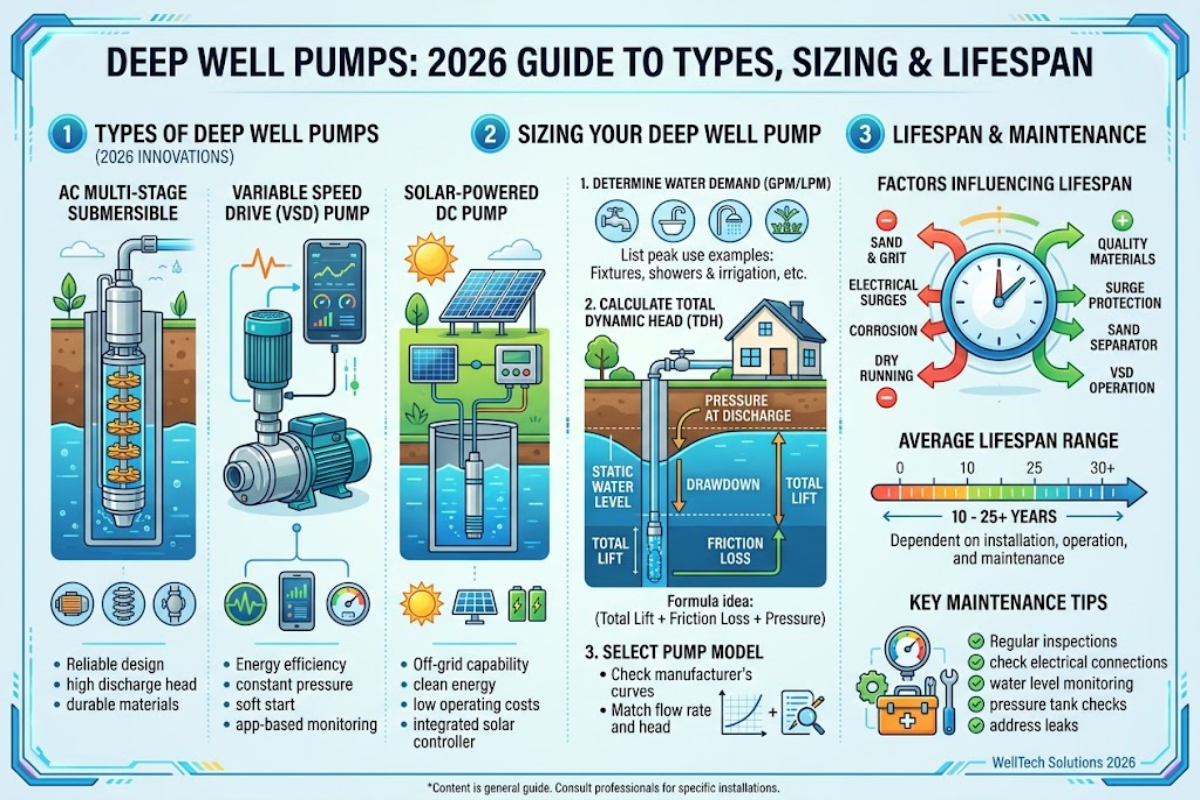
Especificaciones rápidas « Bombas de pozo profundo de un vistazo
| Rango de profundidad típico | 25-600 pies (8-183 m); sumergibles de múltiples etapas a 2500 pies (760 m) |
| Rango de flujo | 5-200 GPM (1-45 m³/h) para tareas residenciales y agrícolas |
| Voltaje | 230 V monofásico (la mayoría 0,5-2 HP); 230/460 V trifásico (5+ HP) |
| Vida de servicio | 8-15 años típicos; Más de 20 años con agua limpia y ciclismo equilibrado |
| Costo de reemplazo (EE. UU., 2025) | $1.500-$3.500 bomba + $800-$2.500 mano de obra |
| Fallos comunes | Sobrecalentamiento del motor, abrasión por arena, rayos, líneas congeladas, funcionamiento en seco |
¿qué es una bomba de pozo profundo?

Una bomba de pozo profundo es cualquier sistema diseñado para elevar agua desde un pozo donde el nivel estático del agua se encuentra a más de 25 pies bajo tierra. Ese umbral de 25 pies no es arbitrario «lo establece la física. A la presión atmosférica al nivel del mar (101,3 kPa), un vacío perfecto puede soportar una columna de agua de unos 34 pies de altura. Las pérdidas hidráulicas del mundo real, el margen de presión de vapor y los requisitos netos de cabezal de succión positiva (NPSH) reducen ese techo a aproximadamente 25 pies de elevación de succión práctica. Más allá de esa profundidad, levantar agua desde arriba ya no funciona, por lo que la bomba debe empujar desde abajo (arquitectura sumergible) o usar un eyector de dos tubos para crear elevación asistida (chorro de pozo profundo).
Son comunes tres arquitecturas de bombas de pozo profundo: las bombas sumergibles retráctiles, las bombas de turbina vertical de eje lineal con el motor en la parte superior o las bombas de chorro convertibles que integran hardware eyector para llegar aún más lejos. Cada aplicación (residencial, riego agrícola, riego de ganado, deshidratación minera, suministro geotérmico) seleccionará la arquitectura que sea apropiada para su profundidad, flujo y perfil de servicio. La mayoría de los sistemas modernos a esas profundidades utilizarán bombas de pozo sumergibles, dado que la arquitectura sumergible ofrece el rango de costo de energía de por vida más bajo, entre 25 y 600 pies.
¿es mejor tener un pozo poco profundo o profundo?
Mejor depende de tu geología, no de tu preferencia. Los pozos poco profundos (menos de 25 pies por agua) cuestan menos perforar y usar bombas de chorro más baratas, pero están expuestos a la contaminación de la superficie por sistemas sépticos, escorrentía de fertilizantes y sequías estacionales. Los pozos profundos llegan a acuíferos confinados debajo de capas de arcilla o roca, lo que proporciona agua más limpia y confiable y un rendimiento más estable, pero el costo de perforación es mayor y el sistema de bomba está más involucrado. En la mayor parte de los Estados Unidos, los datos del Servicio Geológico de Estados Unidos sitúan las profundidades de los pozos residenciales en el rango de 100 a 300 pies, donde las bombas sumergibles de pozos profundos son las predeterminadas prácticas.
Cómo funciona una bomba de pozo profundo
Mecánicamente, una bomba de pozo profundo es una pila hidráulica más un motor eléctrico, sellada dentro de una carcasa estanca y bajada por la carcasa del pozo en un tramo de tubería de caída. El agua entra por el fondo de la bomba, pasa por una o más etapas del impulsor y sale por la tubería de caída a alta presión. Los cables del motor pasan a una caja de control en la superficie, que gestiona la corriente de arranque y protege los devanados contra fallas monofásicas. Una válvula de retención en el cabezal de la bomba sostiene la columna de agua en la tubería de caída entre ciclos, y un tanque de presión en la superficie amortigua la presión del ciclo para que el motor no arranque cada vez que alguien abre un grifo.
Hidráulica centrífuga multietapa
Cada impulsor de una bomba sumergible añade aproximadamente 5-7 m (16-23 pies) de cabeza a la columna de descarga. Para levantar agua a 90 m (300 pies) de un pozo, una bomba apila de 12 a 18 etapas en serie (los impulsores giran a 2850 o 3450 RPM (50 Hz o 60 Hz, motores bipolares) y la fuerza centrífuga intensifica el agua radialmente hacia afuera a través de cada impulsor hacia el siguiente difusor. Cada difusor convierte esa velocidad en presión y el siguiente impulsor se activa justo donde lo dejó el último. Es por eso que un “sumergible de 1 HP” puede entregar 33 GPM a 305 pies de sustentación, mientras que una bomba de chorro de superficie de 1 HP supera los 80 pies (cada etapa agrega otro incremento de sustentación sin efectuar una pérdida de succión).
La arquitectura de varias etapas también es la razón por la que las bombas sumergibles funcionan silenciosamente. El sonido es absorbido por la columna de agua sobre el cuerpo de la bomba, razón por la cual los vecinos sobre el suelo rara vez escuchan una unidad de 1,5 HP salpicando 200 pies debajo. Compensación: costo de recuperación (contratar una bomba de un pozo a 400 pies de profundidad requiere más mano de obra y aparejo que instalar un nuevo sistema de chorro poco profundo desde cero).
Motor sumergible y cableado eléctrico
Los motores sumergibles están llenos de aceite o agua, sellados con sellos frontales mecánicos y clasificados según IEC 60529 IP 68 para inmersión indefinida. Dos convenciones de cableado cubren la mayoría de las instalaciones domésticas:
- Motores de 2 hilos 'negro + blanco + tierra. El condensador y el circuito de arranque son parte integral del motor, no se requiere caja de control. Típico de 0,5 HP y menor; más sencillo de cable pero más difícil de mantener en el campo.
- Motores de 3 hilos 'negro + amarillo + rojo + tierra. El condensador de arranque/funcionamiento y la protección contra sobrecarga viven en una caja de control externa en la superficie. Estándar para 0,75 HP y más; El condensador y el motor de arranque se pueden reemplazar sin tirar de la bomba.
Las cajas de control también albergan relés de sobrecarga y (en instalaciones más nuevas) protección térmica que desconecta la energía si la temperatura del devanado del motor se vuelve excesiva. Un condensador defectuoso o un contacto de arranque con hoyos es una solución de 30 minutos desde la superficie; un estator de motor quemado es un tirón y reemplazo completo de la bomba. Esto explica por qué los sistemas de 3 cables dominan por encima de 1 HP ; el modo de falla que ocurre con mayor frecuencia es el más fácil de reparar.
En qué se diferencian las bombas de chorro de pozo profundo
Una bomba de chorro de pozo profundo mantiene el motor en la superficie y hace funcionar dos tuberías por el pozo: una tubería de presión que fluye agua hasta un eyector y una tubería de succión que hace circular agua de regreso. El eyector genera una zona de baja presión que extrae más agua del pozo, luego la bomba de superficie eleva el flujo combinado. La arquitectura del chorro extiende la elevación práctica a alrededor de 80-120 pies, pero el sistema recircula aproximadamente 3-4 galones de agua por cada galón entregado, por lo que la eficiencia disminuye a 25-40%. Para pozos de menos de 110 pies, los costos de energía de por vida hacen que el sumergible sea la única opción razonable (los costos operativos de la bomba de chorro captan y superan el costo inicial más alto de un sistema sumergible dentro de 4-6 años en la mayoría de los ciclos de trabajo residenciales).
Cómo dimensionar una bomba de pozo profundo
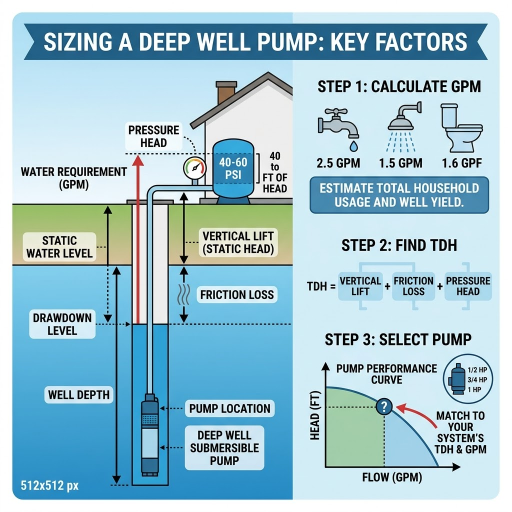
Dimensionar una bomba de pozo profundo significa hacer coincidir tres números con su pozo y su hogar: cabeza dinámica total (TDH), demanda de galones por minuto (GPM) y potencia del motor. Si se equivoca, la bomba no puede ejercer la presión que necesita (de tamaño insuficiente) o se reduce a un ciclo corto hasta fallar tempranamente (de tamaño excesivo). La siguiente metodología funciona para tareas residenciales y agrícolas ligeras; Los sistemas industriales y municipales utilizan la misma lógica con factores de seguridad diseñados y superposiciones de curvas de bomba.
Paso 1 « Calcular el cabezal dinámico total (TDH)
TDH es la resistencia total que debe superar la bomba, en pies (metros) de cabeza. Fórmula:
📐 Nota de ingeniería « Fórmula TDH
TDH = Nivel de agua de bombeo + Elevación vertical al tanque + Pérdida por fricción en la tubería + Ajuste del tanque de presión (en pies de cabeza)
Ejemplo: bombeo de nivel de agua 180 pies + altura del tanque 12 pies + pérdida por fricción en 200 pies de tubería de 1.25 « a 12 GPM ¦ 14 pies + tanque de presión ajuste de 40/60 psi (~138 pies de altura). TDH ¦ 344 pies. Agregue un factor de seguridad 10% → diseño TDH 380 pies.
Cuatro ingredientes importan por diferentes motivos. Bombeo del nivel del agua es la profundidad desde el nivel hasta donde se asienta la superficie del agua cuando la bomba está funcionando, siempre por debajo del nivel estático que se muestra en el registro del pozo. Pérdida por fricción crece con el cuadrado del caudal, por lo que la misma tubería tiene una fricción diferente a 8 GPM frente a 18 GPM; Las tablas de fricción de tuberías del fabricante dan la cifra exacta para cada diámetro y material de tubería. Ajuste del tanque de presión se convierte en cabeza dividiendo la presión (psi) por 0,433.
Paso 2 « Establezca el objetivo de GPM por caso de uso
Las diferentes demandas de hogares, riego y ganado requieren diferentes caudales. Los objetivos siguientes deben utilizarse como tamaño inicial; aumentar de tamaño si hay múltiples demandas simultáneas (por ejemplo, lavandería y ducha y una nueva zona de riego).
| Caso de uso | Objetivo máximo de GPM | Notas |
|---|---|---|
| Hogar, 2-3 baños | 8-12 GPM | Agregue 1 GPM por partido simultáneo |
| Hogar + riego por goteo | 12-18 GPM | La zonificación secuencial reduce la demanda máxima |
| Pequeña explotación + ganadería (50 cabezas) | 15-25 GPM | Las horas de funcionamiento sostenidas aumentan la calificación de los deberes |
| Riego comercial, 5-10 acres | 25-60 GPM | Tamaño a la tasa de aplicación horaria máxima |
| Minería o abastecimiento municipal | 60-250+ GPM | Energía trifásica y diseño de ingeniería |
Paso 3 « Seleccione caballos de fuerza y tipo de bomba
Con TDH y GPM en mano, la curva de la bomba del fabricante apunta a una clasificación de HP específica. La matriz de decisión a continuación proporciona un soporte inicial; Haga coincidirlo con la curva de la bomba en su TDH para confirmar el flujo en su punto de servicio.
| Profundidad del pozo × Demanda | Hp recomendado | Voltaje | Tipo de bomba |
|---|---|---|---|
| <100 pies, residencial 5-10 GPM | 0,5-1 HP | 230 V monofásico | Sumergible de 4 «, clase 1HP |
| 100-300 pies, residencial 8-15 GPM | 1-1,5 HP | 230 V monofásico | Sumergible de 4 «, multietapa |
| 300-600 pies, ag/casa grande 15-25 GPM | 2-13 HP | 230 V monofásico o trifásico | Sumergible 4®-6® |
| 600+ pies o >25 GPM | 5+ CV | 230/460 V trifásico | Sumergible 6®-12®, multietapa |
Para tamaños personalizados por OEM en carcasas de 4 «-12 «, el Serie de bombas de pozo profundo sumergibles BBP en carcasas de 4®-12® cubre toda la gama residencial a minera con curvas de bomba de fábrica y coincidencia de motores incluidos en el paquete de cotización.
¿las bombas de pozo profundo son de 110 V o 220 V?
La mayoría de las bombas sumergibles residenciales de pozos profundos de América del Norte funcionan con monofásico de 230 V, no con 110 V. La instalación de 230 V reduce la corriente de línea para cualquier potencia determinada a la mitad, lo que permite que el cableado se salga de un panel de servicio opcional de 200 A y baje por un 200. línea de ′ sin caída de voltaje molesta ni disparo del disyuntor. Una distribución de 110 V puede hacer funcionar una bomba de 0,50 HP desde un pozo corto y poco profundo; la mayoría de los contratistas utilizan 230 V, ya que permite cableado de menor calibre y minimiza los problemas de caída de voltaje que se amortizan por sí solos en un año; Las instalaciones de más de 5 HP deben funcionar en 3 fases de 230/460 V mediante un electricista que verifica los amplificadores de carga completa de la placa de identificación del motor con el código local.
Instalación de bomba de pozo profundo « Paso a paso
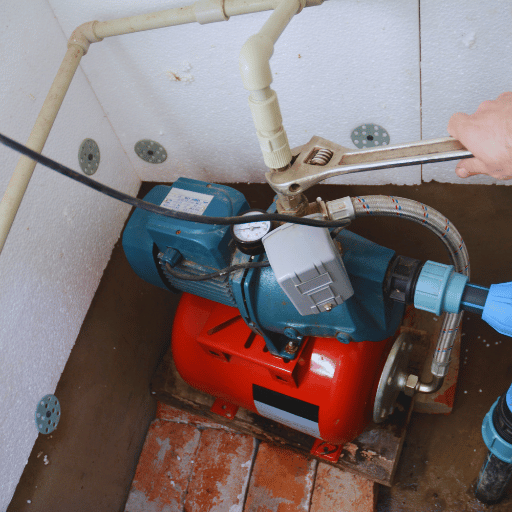
La instalación adecuada es lo que separa una vida útil de 12 años de una falla temprana de 4 años. Los pasos a continuación cubren la lista de verificación previa a la instalación, la secuencia de caída real y la conexión a tierra. Siempre trabaje según los requisitos de conexión a tierra del Artículo 250 de NEC y cualquier especificación local de permisos de pozo; En muchos estados de EE. UU., el trabajo de pozos tiene licencia y se inspecciona mediante código.
Lista de verificación previa a la instalación
- ✔Confirme el registro del pozo: profundidad total, diámetro de la carcasa, material de la carcasa, niveles de agua estática y de bombeo, rendimiento en GPM
- ✔Verifique el ajuste físico de la bomba: el OD de la bomba debe eliminar el ID de la carcasa al menos 1/2 « por cada lado para el flujo de agua de refrigeración
- ✔Haga coincidir el voltaje del motor y el calibre del cable con la longitud de caída (consulte una tabla de caída de voltaje NEC; para 1 HP a 200 pies, lo típico es #10 AWG; las caídas más largas necesitan #8)
- ✔Equipo de escenario encima del pozo: tubo de caída (poli o galvanizado), pararrayos, kit de empalme, cuerda de seguridad, cinta aislante, abrazaderas de manguera
- ✔Realice una prueba más grande en los cables del motor antes de reducir la resistencia de aislamiento por debajo de 1 megaohmio, lo que significa un motor defectuoso y una instalación desperdiciada
La secuencia de caída «tubería, alambre, pararrayos, empalme
La tubería de caída soporta la columna de agua; también toma el peso estático de la bomba más el par dinámico del arranque del motor. Vaya al programa 80 de PVC o acero galvanizado para cualquier caída de más de 100 pies, o polietileno de 200 psi para pozos menos profundos. Los tramos de cableado siguen el tubo de caída, sujeto con cinta aislante cada 10 pies para que no pueda envolver el cuerpo de la bomba con el par de arranque. Empalme los cables del motor con el cable de caída en un kit de empalme termocontraíble clasificado para inmersión continua; la causa más común de fallas en los motores es un empalme de tuercas de alambre barato en los sistemas instalados por el propietario.
El supresor de torsión se encuentra a 1-2 pies sobre la bomba, centrado en la carcasa. Absorbe la patada giratoria al arrancar para que el cuerpo de la bomba y el tubo de caída no queden golpeados contra la pared de la carcasa. Baje la sección de la pila 1 a la vez, pasando cada junta de tubería con el cable de seguridad y comprobando que el cable no se pellizque en ninguna junta. El cabezal del pozo está sellado con un adaptador sin foso o un sello sanitario para mantener la superficie desechada.
Componentes sobre el suelo “Tanque de presión, interruptor, cableado
Los tanques de presión almacenan 6-20 galones de agua a presión y configuran el ciclo de encendido/apagado de la bomba. Un interruptor de presión de 40/60 psi es estándar para el servicio residencial; la precarga del tanque debe estar 2 psi por debajo de la presión de corte. La caja de control (en instalaciones de 3 cables) se atornilla dentro de la casa del pozo o sótano, cerca del interruptor de presión, con la desconexión del disyuntor a la vista de la caja según los requisitos de NEC. Conecte la carcasa a la tierra de servicio según NEC Artículo 250 « Las carcasas de pozos cerca de los servicios de energía son puntos de entrada comunes para rayos y una conexión a tierra perdida limpia los motores durante la temporada de tormentas.
Vida útil de la bomba de pozo profundo y costo total de propiedad
Una bomba sumergible de pozo profundo, bien equipada y de tamaño adecuado, durará en promedio entre 8 y 15 años, y los modelos de calidad instalados en agua no agresiva durarán más de 20 años de servicio. Los datos de toda la industria de los proveedores de servicios de pozos y de la Asociación Nacional de Aguas Subterráneas muestran que el ciclo promedio de reemplazo de propietarios es de aproximadamente 10 a 12 años. Esa amplia distribución no es una coincidencia: estos cuatro factores explican casi toda la variación.
📐 Una ecuación de vida útil de 8 a 15 años
Vida útil Vida base (12 años) agua Química Ciclo factor Frecuencia Tamaño factor Factor Precisión
- Multiplicador de química del agua (0,5-1,2): el agua subterránea limpia con TDS bajo empuja el multiplicador hacia 1,2, el agua arenosa, el hierro alto o el pH agresivo hacia 0,5.
- Multiplicador de frecuencia de ciclo (0,6-1,0): una bomba que arranca 4 veces al día con un tanque de presión del tamaño correcto funcionará con un multiplicador de 1,0; una unidad de ciclo corto 30 veces al día con un tanque de tamaño insuficiente o anegado funcionará a 0,6.
- Multiplicador de precisión de tamaño (0,7-1,1): la posición del ciclo de trabajo de la bomba en el punto óptimo de la curva obtendrá un multiplicador de 1,1; las unidades que sean sobredimensionadas o insuficientemente dimensionadas en los extremos de la curva obtendrán un multiplicador de 0,7.
¿cuánto dura normalmente una bomba de pozo profundo?
La mayoría de las bombas sumergibles de pozo profundo duran entre 8 y 15 años, con una instalación residencial media de poco más de 12 años. Las marcas de calidad en agua no agresiva con tanques de presión del tamaño adecuado durarán habitualmente más de 15 años; Las bombas económicas en agua arenosa o con alto contenido de hierro a menudo fallan entre 5 y 7 años. La frecuencia del ciclo es el factor controlable más grande: el ciclo corto mata los cojinetes, condensadores y contactos de arranque más rápido que cualquier otro modo de falla.
Costo de energía « Lo que una bomba de pozo profundo agrega a la factura de energía
Considere una bomba de pozo profundo de 1 HP que funciona a toda velocidad, con un rendimiento de 8 amperios a 230 voltios. Esto equivale aproximadamente a 1,84 kW. Para aproximadamente 4 horas por día de tiempo total de funcionamiento (lo cual es típico de un hogar residencial con 2-3 baños), esto da como resultado un consumo de energía anual de aproximadamente 2690 kWh, lo que cuesta aproximadamente $323 dado el promedio estadounidense de $0,12/kWh. Ampliar este tiempo de funcionamiento a 8 horas diarias para fines de riego aumentaría el coste por encima de $640. Los sumergibles que funcionan con energía solar, que analizaremos en la sección de perspectivas, esencialmente eliminan este costo cuando se usan durante las horas del día, aunque con una mayor inversión inicial y almacenamiento adicional de batería si se requiere operación nocturna.
Fallos comunes y solución de problemas
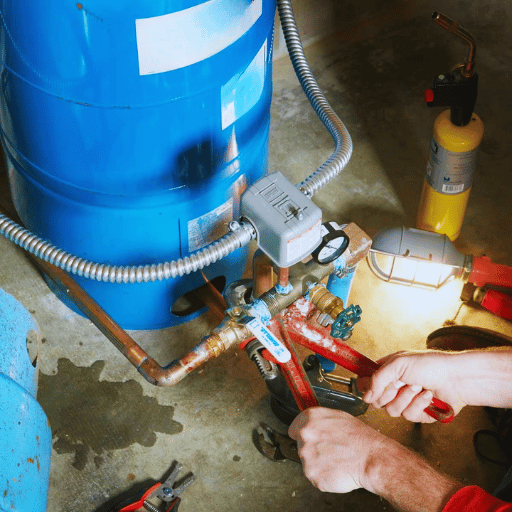
Los síntomas comunes cuando falla una bomba de pozo profundo generalmente indicarán una de las pocas causas fundamentales específicas. Los cinco modos de falla que se enumeran a continuación representan aproximadamente 80% de llamadas de servicio en el sitio; otras causas (aislamiento deteriorado del cable, orificio en la tubería de caída, vejiga desgastada del tanque de presión) son poco comunes y generalmente pueden ser diagnosticadas por un técnico de pozos experimentado en menos de una hora usando una pinza amperimétrica y un manómetro.
| Modo de falla | Causa típica | Síntoma diagnóstico | Primera acción |
|---|---|---|---|
| Quemado del motor | Sobrecalentamiento por baja inmersión, funcionamiento en seco o ciclo corto | Sin flujo + disyuntor disparado; megger lee <0,5 megaohmios | Bomba de tracción; reemplace el motor o la unidad completa |
| Abrasión de arena | Acuífero arenoso, falla de pantalla, bomba colocada demasiado baja en la carcasa | Caída del flujo durante semanas; arena en los grifos | Bomba de tracción; cambiar a serie de bombas de pozo profundo de acero inoxidable o modelo resistente a la arena |
| Rayo | Sobretensión a través de cableado enterrado; falta conexión a tierra | Fallo total repentino durante la tormenta; daño visible en la caja de control | Probar los devanados del motor; reemplace la caja de control y/o el motor |
| Líneas congeladas | Tubería de caída o línea aérea por debajo de la profundidad de la escarcha | No hay flujo en invierno; presión normal en el interruptor | Línea expuesta de trazas de calor; enterrar debajo de la línea de escarcha local |
| Prime perdido/bloqueo de aire | Válvula de retención fallida o fuga en la tubería de caída | La bomba funciona continuamente, baja presión | Pruebe la válvula de retención; tire de la bomba si falla el tubo de caída |
Los fallos relacionados con el ciclismo dominan los datos. Un tanque de presión que pierde su precarga hace que la bomba se ponga en marcha cada vez que se abre un grifo «en el transcurso de un año, un tanque de tamaño insuficiente o anegado puede multiplicar los ciclos de la bomba por 5×, lo que comprime la vida útil del rodamiento y del condensador por un factor similar. Los ingenieros de foros de la industria describen constantemente esto como la falla evitable más común que diagnostican en los sistemas instalados por el propietario.
“La mayoría de las bombas de pozo profundo que tiro temprano no son bombas malas ”son buenas bombas que han sido sometidas a ciclos cortos hasta la muerte. Lo primero que comprobo en cualquier sistema temprano fallido es la precarga del tanque de presión”
Programa de mantenimiento para una vida útil de 15 años
Una bomba de pozo profundo que dura 15 años suele ser una bomba que se revisa una vez al año. Nuestra lista de verificación anual a continuación toma 30 minutos y detecta pequeños problemas antes de que caigan en cascada en territorio de extracción de bombas. NGWA recomienda una inspección profesional anual de cualquier sistema de pozo privado. Esta visita también cubre las pruebas de calidad del agua, que es la otra mitad del panorama de mantenimiento.
- ✔Anual: verifique la precarga del tanque de presión (2 psi por debajo del corte); escuche el patrón de ciclo corto en los grifos
- ✔Anual: verificación visual de los contactos del interruptor de presión (las picaduras indican envejecimiento); limpiar el espacio de contacto
- ✔Anual: inspeccione la tapa del pozo o el sello sanitario en busca de grietas y daños a los roedores
- ✔Anual: prueba de agua para detectar bacterias coliformes, nitratos y pH (la química del agua subterránea cambia año tras año)
- ✔Cada 3-5 ani: reemplace el capacitor de inicio/funcionamiento en cajas de control de 3 cables (los capacitores se degradan silenciosamente)
- ✔Cada 5-8 ani: reemplace el tanque de presión si la vejiga muestra signos de saturación; tire e inspeccione la válvula de retención
- ✔10+ ani: considere una extracción e inspección proactivas de la bomba si la calidad del agua se ha degradado; reemplazar una bomba a tiempo es más barato que reemplazarla de emergencia durante los picos de demanda de verano
Costo de bomba de pozo profundo « CapEx y OpEx en 2026
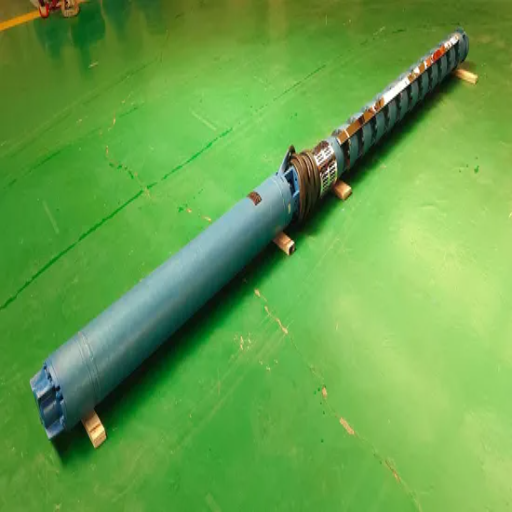
El costo total de un nuevo sistema de bomba de pozo profundo se divide en tres cubos: la bomba y el motor (CapEx), la mano de obra de instalación y los accesorios (tuberías de caída, cableado, tanque de presión, permisos) y la factura continua de energía más mantenimiento (OpEx). Los soportes a continuación reflejan los precios minoristas de EE. UU. a principios de 2026; Las adquisiciones internacionales y directas de OEM son 30-50% más bajas, especialmente en pedidos por volumen.
Nueva bomba CapEx (venta minorista de EE. UU., 2026)
| Clase de bomba | Precio típico de bomba | Adecuado para |
|---|---|---|
| Sumergible de 0,5 CV y 4® | $400-$700 | Residencial poco profundo, <100 pies |
| Sumergible de 1 HP y 4 « (el más común) | $700-$1.400 | Residencial estándar, 100-300 pies |
| Sumergible de 2 CV y 4® | $1.200-$2.200 | Residencial profundo o granja ligera |
| 5 CV, 6® multietapa trifásico | $2.500-$5.500 | Riego comercial, minería |
| 15+ HP, 8«-12® industrial | $8.000-$25.000+ | Municipal, minería profunda |
Los precios se basan en el comercio minorista de EE. UU. para el primer trimestre de 2026 y están sujetos a cambios con los precios de los insumos de cobre, acero inoxidable y acero para motores.
Trabajo y permisos de instalación
Los sistemas de pozos poco profundos instalados por el propietario pueden aterrizar al precio de la bomba más $200-$400 en tuberías, cables y tanques. La instalación profesional de un sumergible de 1 HP a 200-300 pies normalmente ejecuta $800-$2,500 en mano de obra dependiendo de las tarifas regionales y de si se incluye un nuevo tanque de presión. Las tarifas de permisos e inspección varían ampliamente según el estado «California y Massachusetts añaden $150-$500 por permiso; Muchos condados rurales cobran menos de $100. Para compradores de volumen OEM directos de fábrica, Precios de bombas de pozo profundo directos a la fábrica BBP y personalización OEM sirve a distribuidores, propietarios de marcas y compradores de proyectos de ingeniería con integración vertical de extremo a extremo que elimina el margen de beneficio de varios niveles.
¿cuánto cuesta reemplazar una bomba de pozo profundo?
El reemplazo completo de la bomba de pozo profundo residencial a 200-400 pies de profundidad del pozo generalmente ejecuta $2,000-$5,500 en 2026, incluida la bomba, la tubería de caída (más barata si se reutiliza, más si se reemplaza), el cableado y la mano de obra. La división es aproximadamente 40% de bomba y 60% de mano de obra en un trabajo de rutina; Los trabajos que descubren una carcasa de pozo corroída o un adaptador sin hoyos enterrado que necesita excavación pueden aumentar el total por encima de $7,000. Obtenga dos cotizaciones para cualquier reemplazo por encima de $3,000 « la dispersión de precios entre los contratistas locales es alta.
Perspectivas de la industria de bombas de pozo profundo para 2026
Tres turnos están remodelando la adquisición de bombas de pozos profundos en 2026: variadores de frecuencia que pasan de precios industriales a residenciales, sumergibles solares directos que participan en aplicaciones agrícolas y fuera de la red, y requisitos de eficiencia de motores de clase IE3 que llegan para nuevas instalaciones en las principales exportaciones. mercados. Ninguno de estos cambia la física, pero cada uno cambia el argumento económico lo suficiente como para que los compradores que planean una nueva instalación fijen el precio tanto de las cotizaciones convencionales como de las de nueva arquitectura.
Adopción de variadores de frecuencia. Se estima que el mercado mundial de VFD crecerá de $23,85 mil millones en 2025 a aproximadamente $41 mil millones para 2034, y los VFD de bombas sumergibles representarán una parte importante de ese crecimiento. Un VFD permite que una sola bomba entregue para igualar una carga fluctuante sin ciclos de encendido/apagado, lo que prolonga la vida útil al minimizar la tensión de arranque en los devanados y condensadores del motor. La prima de costo sobre una caja de control tradicional ha disminuido de aproximadamente $800 en 2020 a $300-$500 en 2026 para un sistema de 1 HP, lo que hace que las actualizaciones de VFD sean una inversión justificada en cualquier nueva construcción donde la variabilidad de la presión sea una preocupación.
Bombas de pozos profundos alimentadas por energía solar directa. Los sumergibles solares directos ahora capturan alrededor de 6% de nuevas instalaciones de bombas de pozo en los EE. UU., con aproximadamente 85 000 sistemas instalados para fines de 2024 y un crecimiento del segmento de 12,5% al año. Las aplicaciones económicamente más viables son aquellas en las que el servicio eléctrico no está disponible (fuera de la red, riego agrícola, monogástrico, ubicaciones situadas remotamente en pastos) y donde la carga diurna coincide con la producción solar. La incorporación de almacenamiento en batería para el suministro nocturno aumenta el costo inicial en aproximadamente 40%, pero para uso diurno únicamente, los períodos de recuperación se encuentran dentro del rango de 5 a 7 años en los estados del suroeste de EE. UU.
Estándares de eficiencia IE3. IEC 60034-30-1 Define clases de eficiencia de motores desde IE1 (estándar) hasta IE5 (ultrapremium). La Unión Europea y otras entidades han aplicado estándares mínimos de eficiencia IE3 para nuevas instalaciones de motores industriales a partir de 2024, y el progreso en la ampliación de la aplicabilidad a motores más pequeños y sumergibles continúa a buen ritmo. Los compradores que estén considerando sumergibles para exportar a la UE, el Reino Unido u otros mercados regulados de manera similar deberían buscar documentación de IE3, pero en 2026, este cambio afecta principalmente a los requisitos de documentación, ya que el motor ya cumple con los estándares de IE3 en la mayoría de las ofertas de sumergibles modernos.
Implicaciones para los planes de instalación de 2026. O cotice la caja de control tradicional o el panel de control integrado en VFD, según los requisitos del cabezal de presión del sitio. Si no hay energía de red disponible dentro de la distancia de excavación, obtenga una cotización adicional utilizando el sistema solar directo. Si planea exportar a la región de la UE, obtenga una garantía por escrito del cumplimiento de la clase de eficiencia IE3.
Preguntas frecuentes
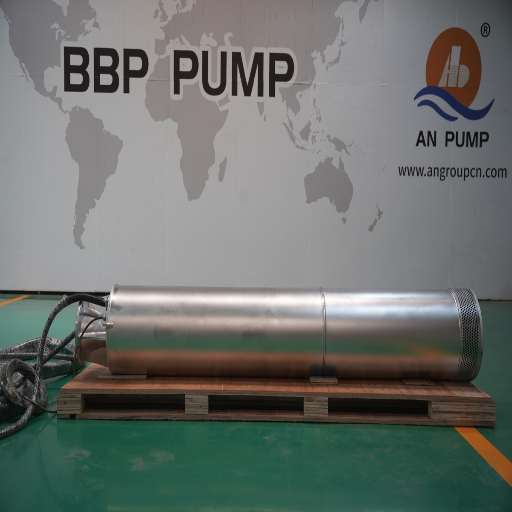
P: ¿Puedo usar una bomba de pozo profundo en un pozo poco profundo?
Ver respuesta
Técnicamente sí, pero de manera ineficiente. Un sumergible de pozo profundo funciona a alta presión de cabeza diseñado para más de 200 pies de elevación. En un pozo poco profundo, opera lejos de su punto óptimo de curva, desperdicia energía en forma de calor y se corta en ciclos hasta provocar una falla temprana. Haga coincidir el cabezal de la bomba con el TDH real dentro de un margen de seguridad de 15%.
P: ¿Las bombas de pozo profundo tienen válvulas de retención?
Ver respuesta
Sí, cada sistema sumergible de pozo profundo está equipado con al menos una válvula de retención, generalmente integrada en el cabezal de la bomba (o en el tubo de caída cada 200 pies (61 m) de elevación). Las válvulas de retención retienen la columna de agua entre ciclos para que la bomba no tenga que volver a cebarse en cada arranque. Una válvula de retención defectuosa hará que la bomba funcione directamente con un desequilibrio de presión.
P: ¿A qué profundidad debe colocarse la bomba del pozo en el pozo?
Ver respuesta
Coloque la bomba entre 3,0 y 6,1 m (10 y 20 pies) por encima del fondo de la carcasa del pozo y al menos 1,5 m (5 pies) por debajo del nivel de agua de bombeo más bajo previsible. Demasiado cerca del fondo expone la entrada de arena; demasiado alto por encima de los niveles de bombeo conduce a funcionamiento en seco durante los picos de demanda o sequías estacionales.
P: ¿Se pueden congelar las bombas de agua de pozo?
Ver respuesta
La propia bomba sumergible se encuentra debajo de la línea de escarcha y no se congela. Las tuberías de descarga sobre el suelo, los tanques de presión en espacios sin calefacción y el área de la tapa del pozo pueden congelarse en climas fríos. Enterre las líneas de suministro por debajo de la profundidad local de las heladas, aísle o trace las secciones expuestas al calor y mantenga la casa del pozo por encima del punto de congelación.
P: ¿Puedo usar una bomba de pozo de 300 pies de profundidad en un pozo de 100 pies?
Ver respuesta
Funcionará, pero funcionará mal. Una bomba con capacidad para 300 pies de elevación produce aproximadamente tres veces la presión que su pozo de 100 pies necesita en el punto de servicio. Al operar a lo largo de su curva, la bomba gasta energía en exceso de presión que se estrangula con el interruptor de presión y funciona caliente. Tamaño correcto de la bomba al pozo « Haga coincidir el diseño TDH con el TDH real dentro de un margen de seguridad de 15%.
P: ¿Cuál es el mejor tipo de bomba para un pozo profundo?
Ver respuesta
Las bombas de pozo sumergibles de múltiples etapas siguen siendo las predeterminadas para pozos de más de 34 m (110 pies) y brindan un flujo de agua confiable al costo de energía del ciclo de vida más bajo. Las bombas de turbina vertical controlan el nicho agrícola grande y municipal muy profundo y de muy alto flujo. Las bombas de chorro tienen sentido sólo para pozos poco profundos de menos de 7,6 m (25 pies). Las bombas manuales son un respaldo para emergencias fuera de la red. Lea la tabla comparativa de tipos en la sección de mecanismos anterior.
¿obtener una bomba de pozo profundo para un proyecto, pedido OEM o canal de distribución?
Detalles del fabricante de Beijing Beibangpu Co., Ltd: bombas sumergibles de pozo profundo ensambladas en 4-12 carcasas con integración vertical de extremo a extremo (fundición interna, mecanizado, ensamblaje de motores, prueba hidráulica y personalización OEM). Certificado ISO 9001:2015 + CE.
Solicite una respuesta de solicitud de cotización de 30 minutos →
Compara el completo catálogo de bombas de pozo profundo BBP para especificaciones de serie y curvas de rendimiento.
Acerca de esta guía
Los datos incluidos en este documento sintetizan los publicados Instituto Hidráulico Datos de clasificación, orientación bien alojada de la Asociación Nacional de Aguas Subterráneas, estándares de eficiencia de motores IEC 60034-30-1 e informes de la industria de bombas y contratistas de servicios de pozos 2024-2026. Las tablas de comparación de tamaños, la ecuación de vida útil de la bomba y los rangos de precios de 2026 se calibran con respecto al mercado actual de bombas sumergibles residenciales y comerciales de EE. UU. Cuando parecen faltar conjuntos de datos de la industria, utilizamos lenguaje suave (“normalmente”, “los datos de la industria sugieren”) en lugar de precisión inventada. Revisado oficialmente por el equipo de ingeniería de Beijing Beibangpu para determinar la precisión técnica en la arquitectura de bombas sumergibles y el abastecimiento de OEM.
Referencias y fuentes
- Instituto Hidráulico « clasificación de bombas, guía NPSH y estándares de bombas centrífugas
- Asociación Nacional de Aguas Subterráneas « Wellowner.org «recomendaciones anuales de inspección y mantenimiento de pozos
- Servicio Geológico de EE. UU. « Recursos hídricos « estadísticas nacionales de profundidad de pozos y aguas subterráneas
- IEC 60034-30-1 «clases de eficiencia del motor (IE1-IE5)
- IEC 60529 (clasificación IP) « códigos de protección de ingreso que incluyen inmersión continua IP 68
- NFPA 70 (Código Eléctrico Nacional), artículo 250 « requisitos de conexión a tierra para sistemas de pozos
- Revista Bombas y Sistemas « cobertura de ingeniería de modos de falla de bombas y práctica de mantenimiento
Artículos relacionados
- Bombas de pozo profundo « OEM sumergibles y de acero inoxidable | BBP « página central principal con especificaciones de la serie completa e información de adquisiciones
- Bomba sumergible de pozo profundo « Serie BBP « especificaciones específicas del sumergible, curvas de rendimiento y opciones OEM
- Bomba de pozo profundo de acero inoxidable « Serie BBP resistente a la arena «para acuíferos arenosos, agresivos o de agua caliente

![Cavitación en bombas de lodos Inicio de sólidos NPSH [Guía de campo]](https://bbpmfg.com/wp-content/uploads/2026/07/cavitation-in-slurry-pumps-featured-1-150x150.png)