
Póngase en contacto con BBP

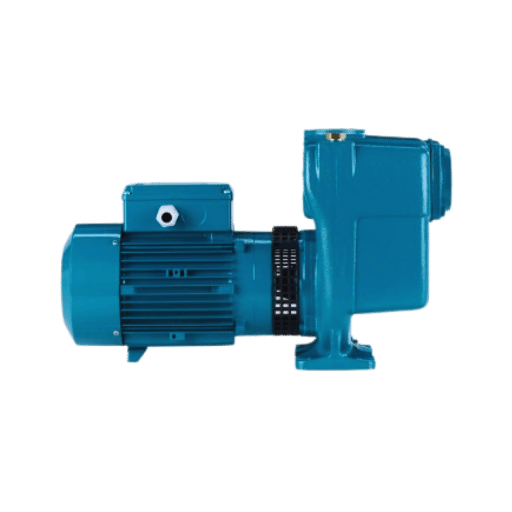
Seleccionar un industrial bomba de agua de mar se encuentra entre las decisiones de mayor riesgo en infraestructura costera: instalar la aleación incorrecta convierte su compra de capital a 10 años en un pasivo de corta duración. Este manual de ingeniería neutral para proveedores lo guía a través de su análisis de agua, desde decisiones de aleación de primer orden hasta la redacción de una especificación y una solicitud de cotización diseñada para proteger sus mejores intereses.
Instantánea de especificaciones rápidas
| Rango de flujo | ³ « 50.000 m³/h (cubre centrífuga de una sola etapa a través de una entrada de flujo ×ial) |
| Rango de cabeza | ³ -600 m (la etapa múltiple alcanza un máximo de ~600 m para el servicio de impulso de RO) |
| Sobre de cloruro | ³5.000 ppm (establece el suelo de aleación) |
| Temperatura de funcionamiento | 0 ñan 70°C (salmuera RO + tomas tropicales impulsan el extremo superior) |
| Materiales comúnmente considerados | Hierro fundido → Bronce → ³16L → Duple× ²205 → Super Duple× 2507 → Titanio |
| Estándar de prueba | ISO 9906:2012 Grado 2B (valor predeterminado industrial; flujo ±8% / cabezal ±5%) |
| Plazo de entrega típico | 2 ñan 10 semanas dependiendo de la aleación y el utillaje |
¿qué es una bomba de agua de mar? Definición, categorías e industrias atendidas

Una bomba de agua de mar distribuye salmuera cargada de cloruro (aproximadamente de 5000 a 50 000 ppm) mediante procesos industriales o servicios marítimos, empleando materiales de grado de corrosión e hidráulica específica del agua de mar. Cuatro tipos de servicios distintos comparten este desafío de corrosión por cloruro, pero divergen casi por completo en otros lugares.
- ✔
Industriales costeros. Refrigeración por condensador de central eléctrica, admisión de desalinización, alimentación petroquímica con intercambiador de calor. - ✔
Servicio offshore. Servicio de plataforma de agua, anillo de extinción de incendios principal, lastre y descarga de sentina. - ✔
Agua cruda de motores marinos. Refrigeración de camisas de motores diésel en embarcaciones comerciales (una subcategoría distinta que normalmente se sirve con diseños de desplazamiento positivo de impulsor flexible). - ✔
Acuicultura costera. Bombas de circulación para granjas y criaderos en crecimiento sobre toma de agua salada.
Rápido: ¿definir bomba de agua de mar? Una bomba industrial especialmente diseñada con aleaciones resistentes al cloruro (materiales de “agua comercial”, por ejemplo, bronce, ³16L o doble×) para convertir de manera confiable un flujo continuo de agua salada en un activo aceptable para toda la vida. Las bombas de ingeniería para barcos para aficionados son un segmento de mercado diferente al que atiende Mercury, los tres grandes fabricantes de equipos originales en propulsión marina.
Por qué las bombas centrífugas dominan el servicio de agua de mar (y por qué no el equipo)
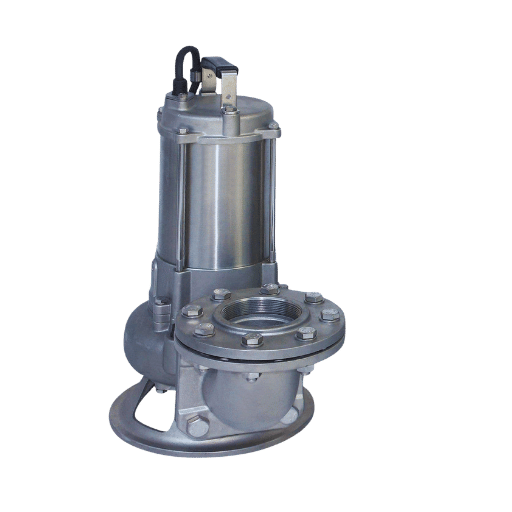
Para servicio continuo y 10 m/h, las bombas centrífugas califican en cuatro factores: alta eficiencia en cascada para salmuera de baja salinidad, sellos resistentes a fallas libres de espacios finos que se erosionan, geometría de sellado rotativo que supera las disposiciones de ejes deslizables en un ambiente de cloruro, servicio en campo. piezas de desgaste.
P: ¿Por qué bomba centrífuga en bomba de agua de mar en lugar de bomba de engranajes?
Las bombas de engranajes fallan en la salmuera porque los dientes de malla generan sitios locales de corrosión galvánica/crevice y la holgura de los dientes finos se erosiona rápidamente a medida que el cloruro inducido por la salmuera devora la cara. Los dispositivos centrífugos producen el mismo desgaste al arrastrar a través de un impulsor diseñado, donde la pérdida de masa de 5% sería manejable hidráulicamente.
El desplazamiento positivo aún asegura la venta por debajo de 1 m/h -condosis de agua salada con biocida, antical o concentrado de salmuera. Por debajo de ese rango de flujo, la recirculación acelerada por corrosión calienta las caras del impulsor de acero inoxidable lo suficiente como para atacar las picaduras. “flujo mínimo continuo estable de ...”?00:00 -gn alrededor de 40% del mejor punto de eficiencia!
💡 Consejo profesional
Si el servicio de agua de mar exige una desalinización de cabezal súper alto o un servicio entre procesos por encima de 150 mH, vea cómo las disposiciones horizontales de cajas divididas se adaptan a rendimientos de alto flujo con un diseño de soporte de rotor diferente.
Arquitecturas de bombas para agua de mar: 5 categorías, cuando cada una encaja
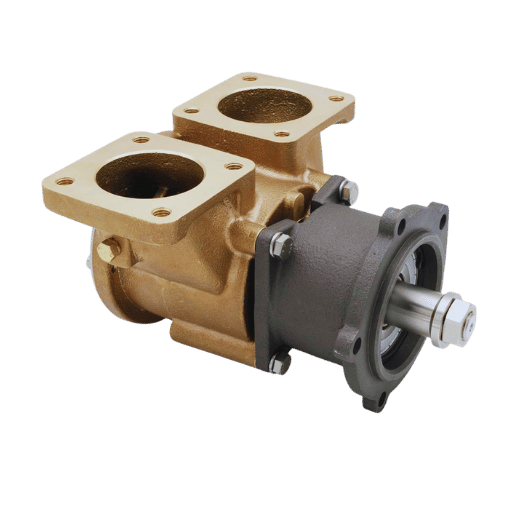
En cuanto al catálogo, la mayoría de los proveedores impulsan una configuración única y la mayoría de las publicaciones generales sobre bombas se comparan 2 o ³. La mayoría de los servicios de agua de mar en realidad utilizan uno de cinco tipos de configuración; La elección está impulsada por el diseño de la admisión y el ciclo de trabajo, no por el caudal.
P: ¿Cuáles son los cuatro (en realidad cinco) tipos de bombas de agua para el servicio de agua de mar?
Los te×ts de referencia enumeran los subtipos centrífugos, la turbina vertical, el flujo ×ial y el sumergible, siendo el flujo mi×ed un híbrido que aparece a menudo en el servicio de toma costera. La mayoría de los textos sobre bombas publicados, enumeran cuatro; Sin embargo, en el trabajo con agua de mar, la elección de la categoría de cinco vías refleja la configuración de admisión.
| Arquitectura | Rango de flujo | Rango de cabeza | NPSHr típico | Acceso de mantenimiento |
|---|---|---|---|---|
| Centrífuga de succión final horizontal | 3 «1.000 m³/h | a 125 m | 3 -ñon 5 m | Extractor trasero a nivel |
| Centrífuga multietapa | 5 -200 m³/h | a 600 m | 2 -contra 4 m | Extracción de componentes, más compleja |
| Eje de línea de turbina vertical | 50 «2.500 m³/h | a 300 m | 0 m (tazón sumergido) | Retiro de grúas |
| Succión final sumergible | 5 «1.500 m³/h | a 100 m | 0 m (totalmente sumergido) | Grúa o buzo |
| Flujo axial/mixto | 200 «50.000 m³/h | a 25 m | 1 ñan 3 m | Retiro del conjunto del cuenco |
Los rangos reflejan la disponibilidad industrial real de los catálogos mecánicos. Las convenciones de nomenclatura y los límites de capacidad varían según el fabricante; Piense en lo siguiente como un esquema de categoría, no como una especificación de adquisición.
Lógica simple: si la estructura de admisión es de subrasante (pozo húmedo, sumidero al nivel del mar), vaya con estos; Si el sumidero es imperceptible por encima de la elevación de la carretera y hay mucha succión neta positiva, la succión final es efectiva tanto para el ciclo de vida como para el capital. Si la altura demanda por encima de 150 m (refuerzo de membrana de ósmosis inversa; condensador de ebullición largo E.), gana en varias etapas. Si el flujo muy alto y muy bajo (inicie la entrada de enfriamiento para una planta costera), el flujo axial o mixto con recubrimientos protegidos catódicamente es rentable.
Una tendencia a tener en cuenta siempre: desde los archivos de correo electrónico de las comunidades de ingenieros por experiencia de los profesionales, las turbinas verticales funcionan bien con el flujo nominal, pero el margen NPSH se puede perder rápidamente cuando se operan por encima de 130% del punto de mejor eficiencia. Los criterios de instalación sumergible siguen un cálculo de acceso alternativo que tiene en cuenta los tiempos de grúas y buzos.
Hidráulica centrífuga en agua salada: por qué las matemáticas en agua dulce engañan
Cuatro variaciones distinguen el agua de mar de los sistemas de bomba de agua dulce. Si se pierde uno de ellos, su motor es de tamaño insuficiente, el margen NPSH de verano evaporta o el impulsor de bajo flujo cavita.
Corrección de densidad (la que más comúnmente se pasa por alto)
El agua de mar estándar, como en 35 PSU, pesa 1.025 kg/m frente a 1.000 para el agua dulce. La potencia del eje aumenta en proporción directa a la densidad, por lo que una bomba de agua dulce de 100 kW se convierte en una bomba de agua de mar de 102,5 kW con una carga idéntica. Los ingenieros hacen referencia cruzada a los mapas de rendimiento del fabricante de agua dulce y, a menudo, se conforman con un motor de tamaño insuficiente de 2,51 TP3T.
NPSH disponible con presión de vapor de agua salada
La presión de vapor del agua de mar a 30 °C es aproximadamente igual a la del agua dulce. Los cambios estacionales están dictados más por las temperaturas de ingesta: en los niveles tropicales (35 °C), el margen de NPSH disminuye aproximadamente 121 °T3 en relación con la curva probada de 20 °C. Los informes de los profesionales en los grupos de correo electrónico de Eng-Tips coinciden en que operar a 150% de lo mejor. El punto de eficiencia hace que la bomba pierda el margen de NPSH incluso en cálculos teóricos.
📐 Nota de ingeniería: Cálculo de potencia del eje para agua de marLa potencia del eje de la bomba centrífuga se obedece a P (kW) = (gQH) / (1000 ). Donde = 1.025 kg/m (agua de mar 35 PSU @ 20 C), g = 9,81 m/s, un punto de servicio de 200 m/h a 50 m de altura con una eficiencia de bomba de 0,78. luego se absorben 36 kW, con el agua a la densidad estándar de agua de mar. En agua dulce, exigiría 35 kW. Compruebe que siempre esté retransmitiendo el rendimiento con densidades de mar, ya que las bombas de los proveedores publican sus curvas en unidades de agua dulce.
Leyes de afinidad con densidad
Las leyes de afinidad mantienen la similitud hidráulica para el agua de mar, pero al aplicar la corrección de la densidad del agua de mar a la relación de afinidad, la relación de potencia es menor que la relación del impulsor y la relación de afinidad del sistema. Vuelva a aplicar el resultado del cálculo de potencia.
Flujo mínimo estable
Correr por debajo del flujo mínimo continuo y estable recircula el agua dentro de la carcasa de la bomba. El calor se acumula en el ojo de la succión y, en los impulsores de acero inoxidable, esto provoca picaduras tempranas debido a la concentración de cloruro. Nunca especifique un sistema que deba funcionar constantemente por debajo del nivel de funcionamiento del fabricante, que suele ser de aproximadamente 40% de BBP para una centrífuga de agua de mar industrial.
Ingeniería de materiales: cómo leer su análisis de agua para la selección de aleaciones

La mayoría de las matrices de fabricantes de proveedores proporcionan el flujo de pH de temperatura del cloruro en archivos, que son muy convenientes pero marginalmente peligrosos para los valores atípicos. Los cálculos del proceso subyacente utilizan más de tres parámetros.
Cuatro números que realmente impulsan la elección de la aleación
Cl (ppm), temperatura máxima en verano, pH fluctuante según la estación y la hora del día, y formación de sulfuro de hidrógeno (HS). Los sólidos totales y la carga de limo en la fuente de alimentación son comunes en los informes de laboratorio, pero solo Cl es la relación de aleación. El oxígeno disuelto por debajo de 5 ppm favorece el dúplex debido a la cinética de la capa pasiva; el CO disuelto acidifica el agua que necesita un mínimo PREN más alto; HS superior a 50 ppm pertenece a NACE MR0175, por lo que se hace necesario un súper dúplex o titanio de grado sólido.
PREN explicado
Número de equivalencia de resistencia a picaduras = %Cr + 3.3%Mo + 16%N (cálculo de referencia de la Asociación Británica de Acero Inoxidable). Valores de ejemplo: 316L ~ 25, Duplex 2205 ~ 35, Super Duplex 2507 ~ 42. En agua de mar abierta por debajo de 40C, el piso PREN de 35 es el mínimo de ingeniería conservador para la replicación de la experiencia.
⚠¦ Crítico: Super Duplex tiene un límite superior de 40°C en agua de mar clorada
La temperatura superior del servicio de agua de mar para super dúplex en servicio clorado suele ser de 40 °C, según lo publicado Investigación de NeoNickel sobre la corrosión súper dúplex en agua de mar. Y el eslabón débil son las soldaduras, no el metal base. Si su servicio funciona más caliente (aumento de la concentración de salmuera RO, enfriamiento del condensador tropical en el pico del verano o bucles de enfriamiento clorados por encima de 40 C), el súper dúplex no es automáticamente más resistente a la corrosión que las aleaciones superausteníticas 6Mo o el titanio para esas condiciones de trabajo.
Método, no matriz
Cuando un proveedor publica una tabla de búsqueda de temperatura de cloruro, la lógica utilizada para seleccionar la aleación implica el valor de cloruro de una muestra de 12 meses, estrés por temperatura en capas, modificadores de contaminantes, límites químicos NACE cuando se aplica el servicio amargo y pruebas ASTM A923 si es dúplex. está en alcance. Las tablas de matriz de acceso directo son posibles para uso común. Para condiciones no nominales, por ejemplo, alta temperatura, alto HS, flujo abrasivo, agua de refrigeración dosificada con biocidas, verifique la lógica usted mismo.
Un ejemplo que demuestra el atajo de matriz: la matriz de decisión de aleación QIZ de BBP destila cuatro entradas en una de las seis opciones de aleación en 80% de servicio común. Para el otro 20%, el Herramienta de selección de aleaciones QIZ está aceptando entradas de análisis de agua directamente.
Diseño del sistema: desde el cofre marino hasta el colector de descarga

Finalmente, la bomba es sólo una de las siete decisiones de vida útil que se toman. No considere los otros seis problemas del sistema circundante, incluida la geometría del cofre marino, la tensión de admisión, la combinación de materiales de brida, el registro de protección catódica, el análisis de sobretensiones, la interacción de la curva de la bomba paralela y la limitación del flujo de salida, y su bomba no cumplirá con el objetivo de vida útil. a pesar de las especificaciones adecuadas.
Geometría del cofre marino
Un cofre marino es una cámara interna o externa del casco que evita que los desechos o el arrastre de aire fluyan hacia la entrada de la bomba. La práctica de diseño comúnmente dimensiona la capacidad volumétrica a tres veces el caudal de la bomba por segundo (una regla general informada por la industria, no un estándar de control). La regla del potencial galvánico es más conservadora: el material de la brida de la interfaz en el cofre marino debe compartir el mismo grupo de potencial de electrodo que la succión de la bomba. El bronce al acero al carbono formará una batería contra la corrosión en la junta de interfaz sin ser visto por los inspectores.
Dimensionamiento del colador de admisión
Los valores predeterminados de 200 m son apropiados para tomas en alta mar. Para aplicaciones cercanas a la costa que atraviesan agua de mar rica en limo, 80-150 m evitan que la arena cargada de sílice golpee el impulsor. Los filtros autolimpiantes con opciones de descarga inversa extienden el intervalo de inspección únicamente de 2 semanas a 6 meses, lo que compensa el costo de mano de obra para la mayoría de las instalaciones costeras.
Circuito de Protección Catódica
Los ánodos de zinc de sacrificio se combinan con hierro fundido y bronce; Los ánodos de magnesio se combinan con acero inoxidable dúplex. Los sistemas anticorrosión de corriente impresa tienen prioridad una vez que la tubería de acero al carbono tiene una longitud aproximada de 50 m. Los intervalos de mantenimiento son el tema que la mayoría de los operadores no consideran: inspección visual a los seis meses, estudio de pérdida de masa anualmente, reemplazo por calendario, no agotamiento.
Martillo de oleaje y agua con agua de mar
El módulo de volumen del agua de mar es aproximadamente 3% más alto que el fresco, por lo que la velocidad de las ondas de presión y la presión transitoria máxima están ligeramente elevadas. El análisis de sobretensiones mediante disparo de bomba necesitará una válvula de descarga de cierre lento (con un mínimo de 10 segundos si ninguna tubería excede los 150 m (contrapadora de aire) o un supresor de sobretensiones de cámara de aire dimensionado para transitorios volumétricos. El golpe de ariete, que arranca las juntas de las bridas los lunes por la mañana, se anticipó generalmente en el mantenimiento del sábado por la tarde, cuando una tripulación cerraba una válvula para apagarla.
Mostrar más
Funcionamiento de bomba paralela
El funcionamiento simultáneo de 2 bombas paralelas del mismo tamaño da como resultado un poco menos del doble de flujo debido a la interacción sistema-curva (normalmente de 1,6 a 1,7 veces el flujo de una sola bomba en la intersección combinada). Confirme el punto de intersección real en la curva combinada, no después de realizar el pedido.
Modos de falla en servicio: seis diagnósticos que la mayoría de los operadores pasan por alto

La bomba fallida que se activaba alrededor de las 2 de la tarde de un martes, a menudo expiraba el lunes anterior por la mañana y, a menudo, mucho antes. Seis diagnósticos recogen la alerta temprana.
Los materiales seleccionados para las bombas de agua de mar están influenciados por una variedad de consideraciones, como la calidad del agua de mar, las limitaciones del material y las propiedades de procesamiento, así como el costo y la disponibilidad. Numerosos sistemas y equipos incorporan ahora aceros inoxidables de alta aleación de nueva generación, que no se utilizaban habitualmente hace unos treinta años.
« Stephen J. Morrow, metalúrgico jefe y director global de tecnología de materiales, ITT Corporation Industrial Process, en su Tutorial del Texas A&M Turbomachinery Laboratory sobre selección de materiales para bombas de agua de mar (miembro de la NACE, 21+ años)
1. Deriva curva de rendimiento
La pérdida de eficiencia > 5% en el punto de servicio estable generalmente se debe a una erosión del impulsor 1 en el frente o a una acumulación de 2 biopelículas dentro de la carcasa. Detectarlo mediante una prueba de rendimiento trimestral en comparación con la primera fecha de referencia ISO 9906: tres pruebas en el punto de trabajo estable, BBP y 80 por ciento de BBP.
2. Cambio del espectro de vibración
Un pico de velocidad de carrera de 2 que aparece en el espectro de vibración es el indicador de desequilibrio del impulsor debido a picaduras unilaterales. Ejecutar una línea de base en el momento de la puesta en servicio proporciona el punto de referencia. Una vez que ya no está disponible, el diagnóstico es, en el mejor de los casos, aproximado.
3. Patrón de llanto del sello mecánico
Si la cara se desgasta solo un cuadrante, el eje está desalineado, no falló el sello. Saqué el sello y lo puse correctamente, después de 2 meses del mismo resultado.
4. Aumento de la presión de descarga al inicio
Las repetidas fluctuaciones de presión al arrancar sugieren aire arrastrado en el fondo marino causado por un cebado inadecuado o una obstrucción incremental del filtro. La tendencia de la presión diferencial del colador es el instrumento de alerta temprana.
5. Aumento de la temperatura del rodamiento sin cambio de carga
La corrosión previa de las zonas estancadas adyacentes transfiere calor hacia el eje desde la transferencia de calor hacia adelante desde el evaporador. La pata muerta en el lado de entrada colonizada por una bacteria anaeróbica reductora de sulfato puede atacar el acero inoxidable estándar 316L en unas pocas semanas, no años, como suelen esperar los compradores según el conjunto de estudios publicados sobre la corrosión del acero inoxidable del agua de mar acuosa12
6. Corrosión galvánica en los pernos de las bridas
El producto de corrosión se producirá en las cabezas de los pernos antes de que el producto de corrosión se produzca en la superficie de la tubería. Por lo tanto, una inspección circular basada únicamente en la superficie de la tubería visible para el inspector no lo hará durante muchos meses. Consulte los intervalos de servicio de los componentes de desgaste en las bombas de alta erosión para conocer una cadencia de inspección similar.
Tco del ciclo de vida: un marco de modelado de bricolaje (8 categorías de costos)
El precio de compra inicial es un mal ancla para las bombas de agua de mar de alta utilización. Según la junta NREL / DOE / Instituto Hidráulico / Guía de costos del ciclo de vida de la bomba Europump, los sistemas de bombeo representan alrededor de 20% de la electricidad utilizada en todo el mundo, de 25 a 50% de la utilizada en las plantas de fabricación y de 30 a 50% de la energía del ciclo de vida útil que podría ahorrarse mediante modificaciones del equipo o del sistema, lo que significa que la energía domina con creces el costo del ciclo de vida. cuando las bombas funcionan más de 2000 horas por año, lo que la mayoría de los fabricantes de equipos originales de bombas de agua de mar considerarían un servicio a largo plazo.
La ecuación LCC de 8 categorías
Ecuación LCC publicada: LCC = Cic + Cin + Ce + Co + Cm + Cs + Cenv + Cd.
| Categoría | Lo que captura | Entrada de modelado |
|---|---|---|
| Cic « Costo inicial | Bomba, motor, tuberías, servicios auxiliares | Paquete de cotizaciones de proveedores |
| Cin « Instalación y puesta en marcha | Cimentación, cableado, instrumentación, puesta en marcha | ~15 a 25% de Cic |
| Ce « Energía | Electricidad para conductor y servicios auxiliares | kW × horas anuales × tarifa × corrección de densidad |
| Co « Operación laboral | Supervisión y controles rutinarios | Horas × tasa de mano de obra cargada |
| Cm « Mantenimiento y reparación | Programa de sellado, rodamientos, revisión planificada | Costo por evento × número de eventos |
| Cs « Tiempo de inactividad | Producción perdida por falla no programada | MTBF × horas × tasa de pérdida de producción |
| Cenv « Ambiental | Manipulación de contaminación, eliminación de lubricantes | Específico del servicio, a menudo pequeño |
| Cd « Desmantelamiento | Remoción, recuperación de chatarra, restauración del sitio | ~1 a 4% de Cic |
Sensibilidad « ¿Qué entradas mueven más el TCO a 10 años?
Tres insumos dominan la superficie de sensibilidad: la carga de cloruro (que establece la clase de aleación y, por lo tanto, Cic y Cm), las horas de trabajo por año (que determina si Ce domina) y la tarifa eléctrica en la región operativa. Ejecute la sensibilidad 20% en cada uno de esos tres antes de bloquear la decisión de aleación. El cuarto insumo más sensible suele ser la tasa de costo del tiempo de inactividad, que puede rivalizar con la energía en industrias donde la pérdida de producción excede los $5.000 por hora.
Para ver un ejemplo trabajado de análisis de LCC utilizando los supuestos QIZ dúplex/superdúplex de BBP, consulte la tabla de TCO de 5 años de QIZ publicada o ejecute sus propios cálculos la calculadora interactiva de TCO QIZ.
Ingeniería de Adquisiciones: Especificación de RFQ y Validación de Proveedores

Una RFQ flexible da como resultado proveedores flexibles. Una RFQ estricta excluye a los proveedores que de otro modo terminarían consumiendo su proyecto. Veintidós líneas de especificación es el mínimo informado.
El esqueleto de RFQ de 22 líneas
Siete secciones de RFQ “22 líneas en total
- Servicio hidráulico (4 líneas) gneflujo en el punto de trabajo, cabezal dinámico total, NPSH disponible, especificación de fluido con análisis de agua adjunto
- Envoltura operativa (3 líneas) -rango de temperatura, rango de ppm de cloruro, contaminantes (HS/O/CO)
- Especificación del material (5 líneas) ñan las caras del impulsor, la carcasa, el eje, el manguito y el sello mecánico ñan cada uno según el grado ASTM o UNS, no el nombre genérico
- Especificación del controlador (3 líneas) «clase de motor (NEMA/IEC), gabinete (zona IP/TEFC/ATEX), arrancador (DOL o VFD)
- Documentos de calidad (4 líneas) «Certificado de material EN 10204 3.1, informe de prueba de rendimiento ISO 9906 Grado 2B, informe de prueba hidrostática, informe de equilibrio dinámico ISO 21940-11 G6.3
- Aceptación de prueba (2 líneas) 'Derechos de prueba de testigo-gnición, banda de tolerancia de aceptación
- Comercial (1 línea) « plazo de entrega, período de garantía, INCOTERMS
Terminología entre proveedores « La trampa oculta
Duplex 2205 puede aparecer en las cotizaciones de proveedores como UNS S31803, UNS S32205, EN 1.4462 o como una marca específica del proveedor. Super Duplex 2507 aparece como UNS S32750, EN 1.4410 o LDX 2507. Incluya la designación UNS o EN en la solicitud de cotización y solicite la certificación del molino con la designación correspondiente. Cualquier otra cosa abre una ambigüedad que surge durante la inspección entrante, el peor momento para descubrir que “duplex” significaba algo más para el proveedor.
Validación de proveedores de cuatro niveles
Primer paso -revisión en papel - informes de auditoría ISO 9001 de tres años, no solo la copia del certificado. Segundo paso - llamada de referencia- dos clientes anteriores con el mismo sobre de cloruro y temperatura, no referencias genéricas. Tercer paso -auditoría de fábrica -fundición interna versus fundición subcontratada, solicite certificados de fábrica de tres trabajos aleatorios que no tengan más de 6 meses. Paso final 'test de testigo-mira la prueba ISO 9906 en tu primera unidad con tu ingeniero allí mirando.
Para el abastecimiento específico de BBP, la herramienta de selección de aleaciones QIZ toma información de análisis de agua directamente y proporciona aleación candidata más el tamaño del modelo en una sola consulta.
Los verdaderos límites del bombeo de agua de mar
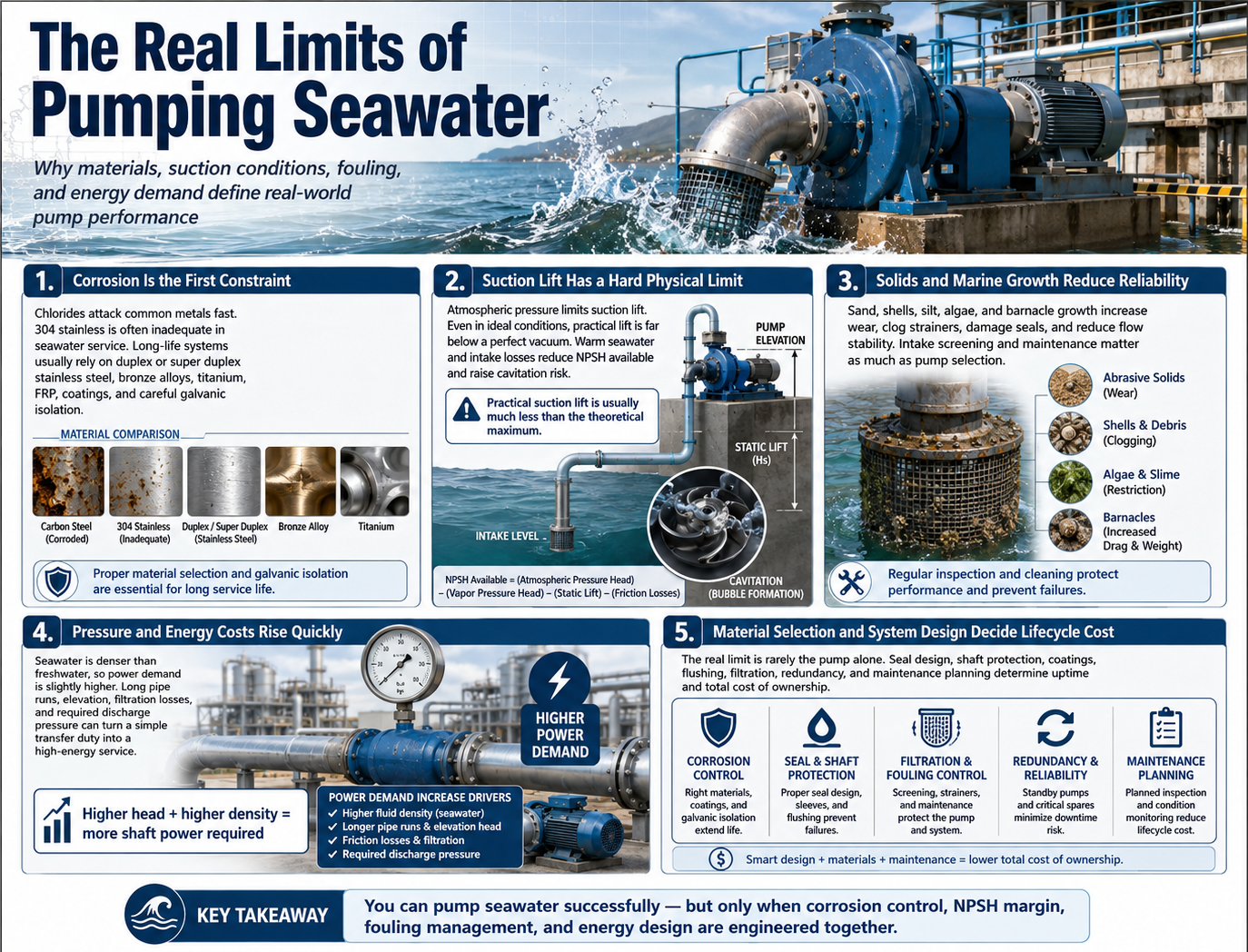
P: ¿Por qué no bombeamos agua de mar más de lo que ya bombeamos?
Tres barreras estructurales limitantes para el agua de mar donde de otro modo sería la elección fácil: costo de energía por m entregado, permisos regulatorios para estructuras de admisión, descarga ambiental de la salmuera resultante.
Costo de energía. Una toma de refrigeración costera de 1.000 m/h que funciona con 8.000 horas al año a 50 metros cuesta alrededor de $135 MWh más al año que el agua dulce debido únicamente a la densidad. Durante diez años a 0,10/kWh, eso es $13.500 en costo adicional de energía por bomba pequeña en relación con el costo del equipo de la bomba en sí, mucho mayor escalado a una estación de enfriamiento de 12 bombas.
Regulación. Las estructuras de admisión en las aguas costeras de EE. UU. requieren mejoras según la Ley de Agua Limpia 316 (b), que se abordan tanto por la velocidad de impacto por debajo de 0,5 pies por segundo como por el control del entrelazamiento de la vida acuática nacida en el agua. Los nuevos permisos de “cumplimiento ambiental” en el estado de California han programado directamente pasar a un proceso de 18 a 24 meses según los ciclos de solicitud más recientes. La cadencia de adquisiciones domina el cronograma del proyecto más que el tiempo de entrega del equipo en la mayoría de los proyectos térmicos.
Ambiental. La descarga ambiental de la concentración de salmuera por ósmosis inversa aumenta la salinidad local de 5 a 15 % en el punto de descarga. La investigación de ecosistemas publicada durante las últimas dos décadas refleja cambios en las comunidades bentónicas distribuidas alrededor de cinco instalaciones de desalinización importantes. Un análisis energético-económico de la práctica del bombeo de alta densidad similar al nuestro guía de campo de bombas de lodo minero aplica compensaciones comparables al transporte de lodos de alta viscosidad.
Normas y perspectivas regulatorias 2026
Cuatro factores impulsores están rediseñando la matriz de especificaciones de las bombas de agua de mar a lo largo del horizonte temporal 2026-2027.
- ✔
MARPOL Anexo VI « 1 de agosto de 2025 modificaciones ya vigentes. Los informes del Plan mejorado de gestión de la eficiencia energética de los buques (SEEMP) requieren que los buques de más de 5.000 GT informen el consumo de combustible con una granularidad más fina. Indirectamente, esto impulsa los informes de eficiencia del motor en las bombas de enfriamiento de motores para embarcaciones de nueva construcción. Acción: solicitar al proveedor la opción de motor IE3 o IE4 en cualquier nueva aplicación marina. Referencia: OMI MEPC-ES.2-2 Proyecto de Anexo VI revisado del MARPOL 2025. - ✔
Actualización del cumplimiento de la Ley de Agua Limpia de EE. UU. 316(b). La revisión del cumplimiento de la estructura de admisión para instalaciones que bombean más de 2 millones de galones por día está pasando a un ciclo de 18 meses. La documentación del perfil de velocidad es cada vez más demandada en el momento de la puesta en servicio. Acción: incluya el perfil de velocidad de impacto en su informe de puesta en servicio. - ✔
Actualización de normas eléctricas marinas IEC TC 18 en curso. La serie IEC 60092 para clases de aislamiento de motores de bombas a bordo está bajo revisión de la industria, y se prevé su ratificación en la ventana 2026-2027. Acción: especificar motores en una clase de aislamiento por encima del mínimo actual en embarcaciones de larga duración. - ✔
Presión en la cadena de suministro de materiales. La volatilidad del índice de níquel en la Bolsa de Metales de Londres en 2024-2025 hizo subir los precios de la fundición dúplex de 18 a 22%, citada por la industria. Las cotizaciones de precios bloqueados de más de 90 días son escasas. Acción: obtener ventanas de precios firmes por escrito en cualquier pedido superior a $50.000.
Preguntas frecuentes «Ciclo de vida y preguntas operativas
P: ¿Cuál es la diferencia entre una bomba de agua de mar y una bomba de agua cruda?
Ver respuesta
“La ”bomba de agua cruda“ se define mejor como una clase de motor marino de bomba de agua de mar que se extrae de la tubería que transporta agua hasta las camisas de los motores diésel. La mayoría de los diseños de bombas de agua cruda marinas son diseños de doble bomba P de impulsor flexible. ”Bomba de agua de mar” es un término de connotaciones amplias para cualquier bomba industrial de manipulación de agua de mar con arquitectura centrífuga predominante.
P: ¿Puedo modernizar una bomba de agua dulce para el servicio de agua de mar?
Ver respuesta
Si solo las partes mojadas (impulsor, carcasa, manguito del eje y caras del sello) fueran reemplazables solas con una aleación de molinillo de agua de mar y luego se realizara una nueva prueba ISO 9906 en la unidad puesta en servicio; El motor y la casa de rodamientos se mantendrán con el diseño de agua dulce correspondiente. El precio habitual de modernización es 60-80% de uno original, y es extraño que se instale, si no, una bomba de agua dulce por encargo recién instalada en los últimos años.
P: ¿Con qué frecuencia debo inspeccionar el sello mecánico en servicio de agua de mar?
Ver respuesta
Inspección visual diaria para detectar fugas dentro de los primeros 90 días de funcionamiento, semanalmente a partir de entonces. Verificación de los puertos de descarga de agua de refrigeración cada 90 días. Plan de evolución para el reemplazo de la purga del cartucho de sellado en 18 meses para el diseño de cartucho único y en 36 meses para el diseño de cartucho doble con API Plan 53. Los manguitos del eje deben cambiarse según el mismo cronograma que los cartuchos de sellado.
P: ¿Qué suele significar una caída repentina de la presión de descarga?
Ver respuesta
Primero revise el filtro: alrededor de 80% de las caídas repentinas de presión se deben a desechos que bloquean la cara del filtro o a la acumulación de crecimiento marino. Si el filtro está limpio, revise la válvula de succión y el sistema de cebado. Si ambos están bien y la presión se mantiene baja, entonces el impulsor ha perdido material debido a picaduras o erosión por cavitación. Retirar e inspeccionar dentro de las 48 horas; reanudar la operación acelerará la falla.
P: ¿Es aceptable el revestimiento de caucho para el servicio de agua de mar?
Ver respuesta
El revestimiento de caucho es adecuado para agua de mar con sólidos “dragado, emisarios de alcantarillado en suspensión, relaves de minas al mar, transferencia de limo salobre ”donde la erosión se ven superpuesta a la corrosión. Para el servicio de toma o enfriamiento de agua de mar salobre, el revestimiento de caucho no proporciona ninguna ventaja significativa sobre el acero inoxidable dúplex y requiere un mayor mantenimiento. Seleccione el revestimiento para que coincida con el modo de falla principal, no con una etiqueta genérica de “agua de mar”.
P: ¿Cómo evito la bioincrustación en una bomba de reserva?
Ver respuesta
Las bombas de agua de mar de reserva desarrollan una infestación de SRB y percebes en un plazo de 7 a 14 días. Tres técnicas previenen la acumulación: rotación automática en horario semanal entre el servicio y el modo de espera; puertos de inyección de biocidas en la línea de succión de reserva; Protección catódica extendida para cubrir todo el circuito de espera, incluida la válvula de aislamiento de descarga.
P: ¿Por qué mi nueva bomba cavita con un flujo bajo pero no con un flujo alto?
Ver respuesta
La cavitación de bajo flujo es la cavitación de recirculación en la succión de la bomba; el impulsor gira contra la pared de la carcasa, en lugar de mover el fluido. Mantenga la bomba funcionando por encima del flujo estable continuo mínimo publicado en todo momento. La mayoría de los tipos de agua de mar especifican MCSF en aproximadamente 40% del punto de mejor eficiencia; Los bucles de derivación o las válvulas de recirculación pueden mantener la bomba dentro del alcance, incluso cuando la demanda de la planta cae por debajo de MCSF.
P: ¿Cuál es la lista de verificación de puesta en servicio típica para una instalación de una nueva bomba de agua de mar?
Ver respuesta
Seis pasos secuenciales: determinar la dirección de rotación con el motor desconectado; cebar la línea de succión y establecer el nivel del pecho marino; correr con la válvula de descarga cerrada y luego abrir lentamente hasta el punto de servicio; registrar la línea base de vibración en el punto de servicio para una comparación posterior; confirmar el margen NPSH frente a la tubería de succión construida; y ejecute la prueba de aceptación ISO 9906 si se especificaron los derechos de los testigos en el contrato. Anatomía de los componentes del extremo húmedo se proporciona para explicar qué buscar en cada paso.
Referencias y fuentes
- Costos del ciclo de vida de las bombas: una guía para el análisis de LCC para sistemas de bombeo -departamento de Energía de EE. UU. / Instituto Hidráulico / Europump (archivo NREL)
- Selección de materiales para bombas de agua de mar por Stephen J. Morrow Tutorial del Laboratorio de Turbomaquinaria A&M de Texas
- ISO 9906:2012 -bombas rotodinámicas: pruebas de aceptación del rendimiento hidráulico, grados 1, 2 y 3 -- Organización Internacional de Normalización
- Proyecto de Anexo VI revisado del MARPOL 2025 (MEPC-ES.2-2) -onomia Marítima Internacional
- NACE MR0175 / ISO 15156 y la industria del acero inoxidable «ñape el mundo del acero inoxidable (esquemas NACE MR0175-2015 Tablas A24 a A26 para grados dúplex)
- La corrosión del acero inoxidable súper dúplex en diferentes tipos de agua (papel técnico de NeoNickel (referencia del límite superior de agua de mar clorada 40C)
- Bombas Rotodinámicas ANSI/HI 14.6 para Pruebas de Aceptación del Rendimiento Hidráulico -instituto Hidráulico (equivalente armonizado en EE. UU. de ISO 9906
- Cálculo de Números Equivalentes de Resistencia a las Picaduras (PREN) ñan Asociación Británica de Acero Inoxidable
Artículos relacionados
- Bomba horizontal de caja dividida-Guía de ingeniería para el diseño, operación y selección
- Firma bajo ’Bomba de lodos sumergibles’ «datos de Tekniske hasta afvanding, deriva de la mina og sandpumpe:
- Piezas de desgaste de bombas de dragado « Guía de materiales e intervalos de reemplazo
- Partes de una bomba de lodo, conjunto de extremo húmedo, sello y cojinete Específicamente los conjuntos de extremo húmedo, sello y cojinete de una bomba de lodo.
- Bomba de lodos revestida de caucho-Cómo elegirla, usarla y mantenerla
- La guía de campo de bombas de lodos para minería
Acerca de esta guía
Las envolventes de cloruro, el esquema LCC de 8 categorías y el límite superior súper dúplex de 40 C citados aquí provienen de literatura técnica disponible públicamente (NREL/DOE, Texas A & M Turbomachinery Laboratory, NeoNickel, NACE) más la práctica de ingeniería de la serie QIZ de BBP en la industria costera. servicio de bombas desde 2005. Cuando se proporcionan ejemplos específicos de proveedores, simplemente hacen referencia a la serie BBP QIZ como una ilustración: los datos de sus propios proveedores deben informar sus decisiones sobre aleaciones y TCO. Los datos de costos de energía y ciclo de vida son estimaciones; Vuelva a calcular la ecuación utilizando su tarifa y ciclo de trabajo antes de la especificación.
Solicite una revisión de ingeniería para su análisis del agua →

![Cavitación en bombas de lodos Inicio de sólidos NPSH [Guía de campo]](https://bbpmfg.com/wp-content/uploads/2026/07/cavitation-in-slurry-pumps-featured-1-150x150.png)