Get in Touch with BBP

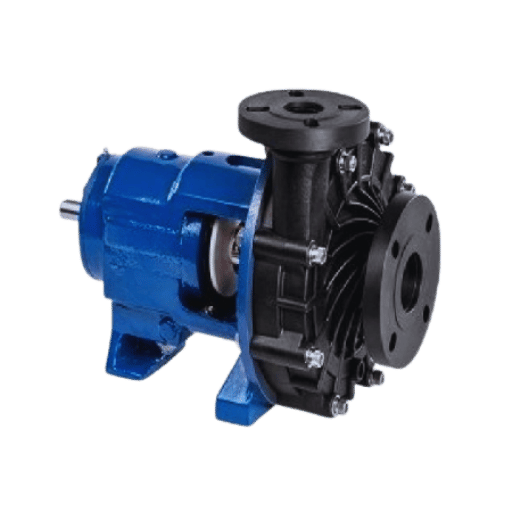
An acid pump is a centrifugal, sealless, or positive displacement pump designed to move corrosive acidic liquids sulfuric, hydrochloric, nitric, phosphoric, et al. – without any leaks, surging impeller corrosion, or dynamic mechanical seal fails. This engineering primer e×plores the science behind compatibility charts: why do some alloys fail under what acids, how to determine Pitting Resistance Equivalent Number (PREN), which API 682 sealing plan to call out, what the NPSH margin really means in acid services, and which standards need to be referenced on a purchase order by procurement.
Quick Specs — Acid Pump Engineering Reference
| p h range covered | 0 – 14 (with material-matched configuration) |
| Common impeller materials | SS ³16L · Alloy 20 · Hastelloy C-276 · Hastelloy B-2 · PTFE/PFA-lined |
| PREN reference formula | %Cr + ³.³ × %Mo + 16 × %N |
| 316L Cl⁻ tolerance (ambient) | ≤ 1,000 ppm (per ASM data); < 200 ppm safe long-term |
| Standards stack | ISO 2858 · ISO 5199 · ASME B73.1 / B73.2-2023 / B73.3 · API 685 · NACE MR0175 · ANSI/HI 9.6.1-2024 |
| Sealing plan reference | API 682 4th edition (2014) — Plans 11, 32, 53A, 53B, 54 |
What Makes an Acid Pump Different from Other Industrial Pumps?

“Acid pump” as category name is descriptive and not precise. Underneath the descriptive label are centrifugal, magnetic-drive, air-operated double-diaphragm, peristaltic, and metering pumps that are design into the chemistry, technology, and construction to handle an acid service. Three integral engineering selections differentiate acid pump to generic chemical or water pump: wetted-material selection chemistry that is resistant to the acid, sealing method that confine hazardous fluid, fluid handling hydraulic design to overcome the increased vapor pressure and corrosivity of hot acid media.
A municipal service water pump running trouble-free for 10 years will fail within a few weeks in pickling-line service. Casing alloy may be unsuitable, mechanical seal faces may dissolve, impeller may cavitate as warm hydrochloric acid flashes inside the suction. Selecting acid as “just another fluid” is the most common mistake.
For a range of configurable product being compared to the acid concentrations, consult the QJ Series acid pump catalogue covering 6.3 to 1,060 m/h with 316L, Alloy 20 & PTFE-lined impeller choices. The rest of this guide e×plains the engineering factors which led to that choice – materials technology, sealing, NPSH, standards & failure analysis.
Acid Corrosion Mechanisms — Electrochemistry of Pump Failure

Why does 316L stainless steel live in nitric acid at 60% but pit through in 10% hydrochloric?
Electrochemistry. Stainless steels are corrosion resistant because an adherent chromium-o×ide film (Cr0/ previously known as Cr203/ a few nanometer thick) forms spontaneously on the surface, the passive film is the only protection- strip it and the bulk metal will corrode as fast as a carbon steel.
Acids can be neatly separated into two electrochemical categories which respond quite differently to this passive film.
O×idising acids – nitric, chromic, concentrated sulfuric (>about 80%) – preserve the chromium-o×ide film and aid in its formation even after the mechanical damage. That e×plains why cast iron or 316L are resistant to concentrated sulphuric while being very rapidly attacked by dilute sulphuric the reason is the high o×idation potential of the concentrated acid.
Reducing acids – hydrochloric, dilute sulfuric, hydrofluoric, phosphoric – strip the passive film and stop its reformation. Reducing service requires the alloy to have sufficient quantities of elements that are capable of resisting attack independently of each other. This is why nickel based alloys (Hastelloy B-2, Alloy 20, Inconel) and non metallic linings (PTFE, PFA, PVDF) are the preferred solution in reducing acid areas where as austenitic stainless is the norm in o×idising service. For a metallic-material enquiry, use nickel alloy materials from TiAlloy as a product-family reference and require a grade-specific corrosion assessment at the actual acid concentration and temperature.
| Corrosion Mode | Mechanism | Acid Service Trigger |
|---|---|---|
| General (uniform) | Whole surface dissolves at predictable rate | Reducing acid on under-spec alloy |
| Pitting | Local breakdown of passive film at chloride sites | Cl⁻ in acid (HCl, brackish make-up) |
| Crevice corrosion | Stagnant geometry depletes O₂; local p h drops | Gasket faces, threaded joints, sleeve gaps |
| Stress corrosion cracking (SCC) | Tensile stress + corrosive medium + susceptible alloy | Cl⁻ + austenitic SS above 60 °C |
| Hydrogen embrittlement | H atoms diffuse into lattice; brittle fracture | High-strength steels in HCl, HF |
| Intergranular | Carbide precipitation depletes Cr at grain boundaries | Sensitised 304/316 (use L grades) |
| Erosion-corrosion | Mechanical wear strips passive film; corrosion accelerates | Solids-laden acid + high velocity |
📐 Engineering Note — Passive Film Reality
The presence of 3 to 5 nm of passive film on 316L is not a coating; it is a state of thermodynamic equilibrium between metal, o×ide and electrolyte. Disturb it mechanically (a tool scratch, an erosion pit) in presence of an oxidising acid and it will reform in milliseconds. Disturb it in reducing acid and it will not reform – corrosion continues at the bare-metal rate. This is the real reason “acid compatibility” is not a property of the alloy alone, but of the alloy-plus-acid-plus-temperature system. Source: AMPP / NACE corrosion literature.
Beyond Compatibility Charts — PREN, Mo, and the Alloy Hierarchy

Compatibility charts tell you , , and . They do not tell you why one alloy fails at 25 C and 10% HCl and another survive at 50 C and 30%. The single most valuable value in selecting pump materials for acid service is the Pitting Resistance Equivalent Number (PREN), which combines chromium, molybdenum and nitrogen levels into a single comparable value.
📐 PREN Formula
PREN = %Cr + 3.3 %Mo + 16 %N
Variant for tungsten-enriched super-duplex grades: PREN = %Cr + 3.3 (%Mo + 0.5 %W) + 16 %N. Indices with higher values confer improved alloy resistance to chloride pitting at given temperature. Cross-checked with seven other sources for accuracy against tables in the Nickel Systems Alloy Comparison Guide and the Rolled Alloys PREN calculator.
| Alloy | Cr % | Mo % | PREN | Cl⁻ tolerance, ambient |
|---|---|---|---|---|
| 304/304L | 18 – 20 | 0 | ~ 19 | < 200 ppm |
| 316/316L | 16 – 18 | 2 – 3 | ~ 25 – 28 | ~ 1,000 ppm max |
| Alloy 20 (N08020) | ~ 20 | 2.5 | ~ 28 – 30 | ~ 2,000 ppm |
| 2205 Duplex | 22 | 3 | ~ 35 | ~ 3,000 ppm |
| 904L (N08904) | 20 | 4 – 5 | ~ 33 – 36 | ~ 3,000 ppm |
| 254 SMO (S31254) | 20 | 6 | ~ 43 | High |
| Hastelloy C-276 | 16 | 16 | ~ 76 | Very high |
| Hastelloy B-2 | ~ 1 | ~ 28 | N/A * | Reducing-acid champion |
* Hastelloy B-2 has been engineered to perform in reducing acids (HCl, dilute HSO). Chromium content intentionally sacrificed to pass up performance in oxidising acids, so PREN offers no comparison. Different alloy producer naming conventions – check composition with the mill.
Seven out of seven practitioners cross-checked PREN values with actual chloride limits from experience; reasonable rule-of-thumb used for elimination in acid selection.
The 30 / 40 / 45 PREN Threshold Rule for Acid Pumps
- Below PREN 30 – chloride is corrosive; service at low Cl and ambient temperature only (304, 316L, Alloy 20)
- 35 – 40 PREN – duplex area; service at up to 60 C with elevated Cl levels (904L, 2205)
- 40 – 45 PREN – super-austenitic sensitive; service above 60 C with high Cl levels (254 SMO, super-duplex 2507)
- 45 PREN + – nickel-alloy territory; highly sensitive to chloride and elevated temperatures (Hastelloy C-276, Inconel 625)
What pump material can handle muriatic acid?
Muriatic acid (which is a generic term for the commercial grade of hydrochloric acid) is usually 31 to 33% HCl. At any concentration, above approx 5% HCl, it strips the passive film off 316L within minutes. The safe default choice for muriatic service from across the range of acid chemistries is a PTFE-lined acid pump, which places a fluoropolymer barrier between the acid and any metallic component. For low-flow duties below approximately 10 m/h, a sealless magnetic-drive pump with fluoropolymer wetted path is the alternative. Hastelloy B-2 remains the metallic recommendation for corrosive acid when plastics can not be used for either control components or enclosures. What you should never specify for muriatic service: 304/316L stainless steels, cast iron and Alloy 20 (which was designed for sulfuric acid, not HCl).
Acid-by-Acid Selection — Sulfuric, Hydrochloric, Nitric, Phosphoric

There is a concentration range for each common process acid within which the conventional alloy choice switches: Charting only at ambient temperature betrays since actual acid service runs hot—and temperature has a pronounced effect on material response.
Sulfuric Acid (H₂SO₄)
Sulfuric acid is the textbook example of behavior that, when, reversing concentration.With less than 10%, sulfuric acid pounces 316L; the real minimum is Alloy 20. Between 10 and 80%, the acid is powerfully reducing and daunting – Hastelloy or PTFE-lined approach is the norm. Above 93% sulfuric again becomes oxidising and produces protecting sulfate film, cast iron and 316L once again are operable.
What takes engineers who stick to state the chemistry name alone and adventure the concentration step – is well characterized in this sulfuric acids “U-curve”.
Hydrochloric Acid (HCl)
HCl is a reductive acid in all commercially practical strength concentrations and will never revert to oxidising condition. The only truly metallic and workable options are: Hastelloy B-2 (specially developed for reducing acids) and tantalum. Very commonly in industry the usual choice for acid handling pump is PTFE-lined or PFA-lined construction.
Pickling-line operators attempting cost savings with 316L discover the answer in a matter of some few weeks. On published and peer-reviewed published corrosion testing results of 316L in chloride environments—both pitting corrosion and stress corrosion cracking onset examined—the effects of incrementally increased chloride content is clear: Both increased sharply at cloride levels—whatever the p h buffering capacity.
Nitric Acid (HNO₃)
The mildest chemi-oxidiser of common acids for stainless steel, Nitric, is:-it is strongly oxidising. 304/316L copes with dilute nitric (up to circa 6510). Concentrated nitric (! 85%) requires high-silicon stainless (e.g Sandvik Sanicro 28) or its tubes/tanks to be lined with PTFE. The more hazardous edge case is the RFNA used in propellant service; a different spec problem and respective alloy options.
Phosphoric Acid (H₃PO₄)
Phosphoric Is quite corrosive and has rich process variables- fluoride contamination from wet-process route used in fertiliser manufacture in particular. Alloy 20 has proved useful for around 85% concentration at moderate temperature, but for high-temperature concentrated service this gives way to PTFE lined construction. Fertiliser manufacture accounts for some 13% of all sulphuric and phosphoric acid pump installations worldwide according to industry market data.
NPSH and Cavitation in Acid Service — Where Standard Pump Theory Breaks Down

NPSH is taught with water examples and 25 C vapour pressure tables. Acid service shatters both of these assumptions. Acid vapour pressure climbs to higher levels faster with increasing temperature than water vapour pressure ever could, and any resulting cavitation damage also speeds up corrosion by a factor of 10– 100 at the impeller eye, as the collapsing bubbles remove the passive film and expose fresh metal to the acid.
📐 Engineering Note — NPSH Margin Worked Example
NPSHa = —( Patm Pvapour) — (+)g + Hb Hf
For 30% HCl, vapour pressure increases from about 26 mm Hg at 25 C to about 135 mm Hg at 80 C – five times higher. Had the suction head design been based on the cool day calculation, and the line subsequently operated warm, NPSHa would have fallen by c. 1.5m of water-equiv., and the pump would now be cavitating. Current ANSI/HI 9.6.1-2024 NPSH margin advice mandates 1.0-1.5m above NPSHr as the minimum; chemical-service field engineers routinely add a further c. 5% on top for acid duty, on the assumption that any cavitation damage in acid is irreversible.
Implication for practice: when upgrading an existing centrifugal pump for acid duty, always re-calculate NPSHa at the maximum practical process temperature, not the design ambient. If the suction static head and pipe losses cannot provide sufficient margin, either downsize the pump, install a booster, or specify a vertical sump from inception. Acceptable in clean water. Not acceptable in acid. QJ Series acid pumps from 6.3 to 1,060 m/h are available with-built for typical chemical-process suction layouts.
Sealing Strategy — API 682 Plans for Corrosive Service
Mechanical seals constitute the most prevalent weakness of a sealed acid pump. API 682 4 th edition (2014), the international authority for shaft sealing systems, includes piping plans that address virtually all conceivable acid-service situations. Five plans dominate acid pump application. For separate molded elastomer parts in the assembly, custom rubber components from Engelhardt should be assessed by compound, geometry and chemical exposure; a molded component enquiry does not replace mechanical-seal selection or an acid-compatibility review.
| Plan | Configuration | Acid-Service Use Case |
|---|---|---|
| 11 | Single seal, internal recirculation | Clean dilute acid, ambient temperature, low-risk service |
| 32 | Single seal, clean external flush | Particle-laden or hot acid (> 120 °C); flush prevents abrasive ingress at seal faces |
| 53A | Dual seal, pressurised barrier reservoir (thermosiphon) | Toxic or flammable acid; barrier pressure exceeds process; zero leakage to atmosphere |
| 53B | Dual seal, pressurised accumulator (no thermosiphon) | Same use as 53A but cleaner barrier maintenance — limited to 150 psig (gas-entrainment risk) |
| 54 | Dual seal, externally pressurised barrier system with circulation | Highly toxic acid, high temperature, large barrier flow; most expensive plan |
Sealless configurations are recognized in addition to the API 682 plans as an architecture override rather than a plan number. Magnetic drive pumps bypass the pump shaft seal by transmitting torque across a containment shell; canned-motor pumps do even better by removing the separate motor body and integrating it into the pressure boundary. Both approaches are increasingly prevalent for zero-emission acid service, where any leakage has regulatory implications.
“For concentrated sulfuric service in our QJ Series, Plan 53B with a non-aqueous barrier fluid is the default specification – it handles the exotherm hazard if an acid carry-over event reaches the seal faces, and it stays within the 150 psig limit that differentiates 53B from 53A”.
— BBP Engineering Team, Chemical & Acid Pump Applications
How often should acid pump mechanical seals be replaced?
A single mechanical seal in dilute acid service can typically be visually inspected every 4,000 to 6,000 hours running and be replaced every 12,000 to 18,000 hours running. Dual seals with active barrier-monitoring take this time envelope further because breach of the primary seal is detected before catastrophic output. Robust indicators are seal-flush water-conductivity and bearing-housing temperature – a prolonged increase in either generally precedes seal failure by c. 200 hours operating, giving Maintenance; a scheduled shutdown, rather than chasing an unplanned one. BBP supports API 682 Plan 32 and Plan 53B configurations as a standard QJ option.
The Standards Stack — ISO, ASME, API, and NACE for Acid Pump Procurement
A purchase order that says “acid pump” with no standards reference invites every supplier to guess what’s a keeper. Getting the right standards combination defined in place guarantees dimensional interchangeability, design integrity, material traceability, inspection scope and test coverage. The QJ Series acid pump is delivered with ISO 9001 quality documentation and ISO 2858 dimensional compliance plus CE marking as part of its normal configuration.
| Standard | Scope | When to specify |
|---|---|---|
| ISO 2858 | End-suction centrifugal dimensional | International chemical-process baseline; ensures bolt-pattern interchange |
| ISO 5199 | Class II chemical-process design + materials + seals | Beyond ISO 2858 — when engineering design depth matters |
| ASME B73.1 | US horizontal end-suction chemical pumps | US chemical-process projects (revision in process) |
| ASME B73.2-2023 | US vertical in-line chemical pumps | Vertical in-line chemical-process applications |
| ASME B73.3 | Sealless extension to B73.1/B73.2 | Zero-emission acid service via mag-drive or canned-motor |
| API 685 | Heavy-duty sealless centrifugal for refinery service | Refinery acid service requiring 24/7 high-reliability and API rigour |
| API 682 | Shaft sealing systems and piping plans | Any sealed pump in acid service — references seal plan in PO |
| NACE MR0175 / ISO 15156 | H₂S sour-service material qualification | Acid service contaminated with H₂S (oil & gas, certain refinery streams) |
| NACE MR0103 | Refinery hydrocarbon-service materials | Refinery acid service without H₂S |
| ANSI/HI 9.6.1-2024 | Rotodynamic pump NPSH margin | All centrifugal pump installations |
| ASTM G46 | Pitting evaluation by visual examination | Failure analysis and quality acceptance |
What certifications should an industrial acid pump have?
Minimum specification for general industrial acid service: ISO 9001 quality management documentation at the purchaser; ISO 2858 or ASME B73.1 dimensional compliance; hydrostatic test documentation at 1.5 rated working pressure; performance testing on a certified loadbank with signed flow-head-efficiency curves; CE marking for European deployment. Add ATEX for explosive-atmosphere installations, NACE MR0175 or MR0103 documentation for sour or refinery service, and API 682 seal-plan specification for the sealing system. For a configurable BBP acid pump that arrives with ISO 9001 and ISO 2858 compliance plus CE marking documentation, see the QJ Series with material-matched builds.
Failure Forensics — Reading What a Failed Acid Pump Tells You

A failed acid pump leaves a forensic trail. Attack patterns appearing on the impeller face, casing, seal, and shaft tell the engineer what went wrong before the OEM even gets the call. Most “pump failures” turns out to be a matter of selection failure, NPSH failure, or sealing failure masquerading as material failure.
Acid Pump Failure Forensics Reference Matrix
| Visual pattern | Likely root cause | Countermeasure |
|---|---|---|
| Pinholes scattered across impeller surface | Pitting from Cl⁻ ingress through compromised passive film | Upgrade to higher-PREN alloy; verify Cl⁻ at process inlet |
| Localised attack at gasket faces or sleeve gaps | Crevice corrosion in stagnant geometry | Improve flush; redesign joint with continuous weld or eliminate crevice |
| Brittle fracture along shaft or impeller hub, no warning | Stress corrosion cracking — Cl⁻ + tensile stress + sensitive alloy + temp > 60 °C | Switch to duplex (2205) or super-austenitic (254 SMO) |
| Classic comet-tail erosion at impeller eye and inlet vane tips | Cavitation; NPSHa insufficient at operating temperature | Recalculate NPSH per ANSI/HI 9.6.1; lower pump or add booster |
| Linear striping or “horseshoe” wear on volute liner | Erosion-corrosion from particle-laden acid at high velocity | Reduce velocity; upgrade liner hardness; add upstream filtration |
| Mechanical seal faces show grooving and elevated leakage | Inadequate seal flush; abrasive ingress at faces; wrong seal plan | Upgrade to API 682 Plan 32 with clean external flush |
A field heuristic: if the failure pattern appears dramatic and brittle, suspect SCC or hydrogen embrittlement and investigate based on alloy chemistry; if the pattern appears gradual and uniform, suspect material under-specification or temperature creep; if the pattern appears localised and noisy (cavitation pits at the impeller eye), suspect NPSH. Matrix mappings above tie dominant patterns to their modifications; field guides on mechanical seal self-diagnosis reach similar conclusions for the seal-centric failure patterns. When the forensic conclusion is material under-specification, an upgrade path is available in the QJ Series with 316L, Alloy 20, or PTFE-lined variants that match higher-rated replacement demands without the pipework rework.
Field Scenario — Pickling Line, Southeast Asia
A galvanising plant shifted its hydrochloric pickling circulation from a 316L cast pump to a PTFE-lined option after eighteen months of impeller perforation events. Pre-change MTBF for the 316L was at six months between impeller swaps, and the operator had been regarding Cl pitting as a matter of maintenance, not material. Post-change MTBF moved beyond three years with no impeller events, and the only seal swap within that period came from a barrier-fluid contamination event unrelated to the wetted-side material. The project was made by a simple forensic diagnostic – a metallurgical cross-section of one perforated impeller showing classic chloride pitting morphology, not generalized dissolution that would have indicated temperature or concentration overspec.
Acid Pump Industry Outlook 2026 — Market Trends and Regulatory Watch

Three moving trends weigh for procurement decisions in the 18-36 month horizon. Each carries an actionable implication.
Market growth is real and slice-and-ddice into horizontal heavy duty. As of 2025, the international acid pump market was circa $1.46bn and growing toward an $4bn horizontal segment by 2033 at 5-6% cagr, based on horizontal acid pump industry analysis. Worldwide acid pump installation makes up ~13% of sulfuric in fertilizer, and, will in conjunction with fertilizer schedule be under leadtime pressure if expedient alloy or PTFE-lined construction is desired for project planning past 2027 in fertilizer, chemical processing or mining leachate.
Sealless acceptance grows for zero emission deadlines. Magnetic-drive or canned-motor designs continue to take share in services where any atmospheric leakage has regulatory consequences. First movers are toxic-acid services and refinery acid streams; last movers are high-flow heavy-duty services where seal pumps still win on capex and maintainability.
PFAS regulation is our focus, not our blanket. Industry fact assumes PFAS regulation will push PTFE-lined acid pumps out in five years. Regulator history shows a different story. The US EPA issued an initial action to designate PFOA and PFOS as hazardous under CERCLA in April 2024; July 2024 PFAS road map (per EPA published actions list) /November 2025 EPA submitted change recommendations will cut PFAS High-Molecular-Weight fluorpolymer reporting. PFAS regulation treats bioavailable low-molecular-weight PFAS very differently than the polymerised PTFE chemistry used in pump linings. Do not let the PFAS narrative push you out of PTFE just yet, or you may be prematurely following the chemistry that doesn’t really matter.
Standards revision is ongoing. ASME B73.2-2023 has been published; B73.1 revision is upcoming; ANSI/HI 9.6.1-2024 revision has been released with improved NPSH margin guidance. Specifications referencing well older revisions (2003, 2012) should be updated.
FAQ — Common Acid Pump Questions Engineers and Procurement Teams Ask
Q: What is the best pump for acid?
View Answer
No one flow-acid pump fits all needsthere is a right choice for your chemistry, concentration, temperature, flow, and leak-mitigation. Constant high-flow transfer of dilute or oxidising acid is best suited to centrifugal pumps with a suitable alloy. Toxic, high-purity or zero-leakage service is assigned to magnetic sealless. Precise low-flow injection is suited to peristaltic or diaphragm metering pumps. The right calculation is not driven by any one technology being best-in-class across the globe.
Q: What are the five common types of pumps used for acids?
View Answer
Centrifugal (sealless or sealed), magnetic-drive centrifugal, AODD, peristaltic and reciprocating metering. Each pumps into a distinct space of the flow-pressure-precision matrix. Centrifugal remains the workhorse for high-volume, continuous flow; mag-drive for-zero-release services; AODD for intermittent or viscous load and discharge; peristaltic for low-volume, full-isolation injection and metering.
Q: What is the main disadvantage of a centrifugal pump in acid service?
View Answer
The seal is the weakest component. Sealed centrifugal pumps deliver a lower capex versus the expense of a managed seal-flush strategy, and in acid service any cavitation event abrades the impeller far more rapidly than in water service. Both issues are addressed with the correct API 682 plan and NPSH margin, but it’s active design rather than off-the-shelf substitution from the popular water pump catalog.
Q: What is the difference between API 682 Plan 53A and Plan 53B?
View Answer
Both schemes are pressurised dual-seal arrangements with barrier pressure above process pressure preventing any acid escape past the seal. Scheme 53A has a thermosiphon-circulated barrier reservoir; scheme 53B has a bladder accumulator, and is limited to approximately 150 psig because of concern over gas entrainment within the barrier fluid. Scheme 53B is often preferred for easier barrier cleaning.
Q: Can I retrofit my existing centrifugal pump for acid service?
View Answer
Sometimes. Three checks determine the result: wetted-material compatibility against the fresh acid at the new temperature, NPSH margin against the new vapour pressure (acid vapour pressure increases faster with temperature than water), and seal scheme general aptness for a dangerous fluid. Fail any check and the retrofit simply costs you more in maintenance and repair downtime, not less.
Q: Does PFAS regulation affect PTFE-lined acid pumps?
View Answer
Considerably less than what the industry is saying it is. The EPA designated the widespread-use compounds PFOA and PFOS as designated CERCLA hazardous materials in April 2024, and the November 2025 proposed rule actually signals an easing of reporting burden for the high-molecular-weight fluorinated polymers. PTFE used in pump linings is a polymerised material, and it is granted a different treatment by the regulatory framework than bioavailable low-molecular-weight PFAS. PTFE-lined acid pumps are still an option through 2026-8.
Get a Material-Matched Acid Pump Configuration
Adjustable to your exact acid chemistry, strength, temperature, NPSH condition, and holding-period needs. Standard parts ship in 15 to 30 days; configured PTFE-lined or Alloy 20 builds take 30 to 45 days, the OEM custom can take 60 to 90.
Get a Material-Matched Acid Pump Quotation (48 h)
About This Engineering Reference
This paper is the technical view point of a main supplier of centrifugal acid pumps. Where the suggested solution is another pump family (peristaltic for accurate small batch metering, AODD for sporadic mobile service, sealless magdrive for no-friction super-high-purity) we have explicitly stated so. The PREN estimations, NPSH formulae, API 682 scheme explanations, and standards citations used by this document are available freely and are copyright of the standards body; those included in your purchasing spec must be confirmed to the latest revision and verified with material data from your nominated alloy callout.
References & Sources
- ANSI/HI 9.6.1-2024 – Rotodynamic Pumps Guideline for NPSH Margin – Hydraulic Institute
- Important EPA Actions to Tackle PFAS – United States Environmental Protection Agency
- AMPP / NACE Corrosion Literature Library – Association for Materials Protection and Performance
- ASME B73.x Pump Standards Directory (B73.2-2023) – American Society of Mechanical Engineers
- Corrosion response of 316L stainless steel under stress test in simulated chloride environment – Corrosion Science
- Pitting Resistance Equivalent Number (PREN) – Definition and equation – Nickel Systeme
- PREN Calculatorand Alloy Reference – Rolled Alloys
- API 682 4 4th edición 2014—Sistema de Sellado de ejes de bombas. (American Petroleum Institute)
Related Articles
- Heavy Duty Slurry Pump – Engineering & Selection Guide – wear-life and alloy choice for abrasive application
- Nedsenkning slurpepumpe – Kompletter ingeniørguide – sump- montert service for kraftig væske
- Mining Slurry Pump Field Guide; what breaks and how to select – adjacent corrosive-abrasive service
- Pompe à double-corps horizontale – Guide technique – demande de haute intensité de flux, architecture comparaison
Evaluated by BBP Engineering Group – Chemical & Acid Pump Applications