Get in Touch with BBP

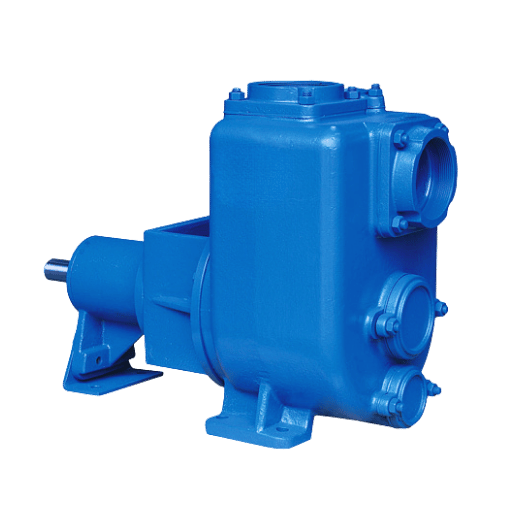
A self-priming sewage pump is a centrifugal pump that pumps out all air from its suction line after each start, then raises liquid from a wet well below – without operator-entered fill, foot valves on the suction side, or operators crawling into a pit. This primer guide e×plains the physics of the priming cycle, compares self-priming to three competing pump architectures, overviews sizing math, and presents a 10-year TCO formula for end users to support during a purchase review.
Quick Specs — Self-Priming Sewage Pump Envelope
| Theoretical ma× suction lift | 10.³³6 m / ³³.9 ft (atmospheric ceiling at sea level) |
| Practical suction lift in sewage duty | 6.0–7.6 m / 20–25 ft (after grit-wear derating) |
| Solids passage capability | 40–60% of outlet diameter (architecture-dependent) |
| Re-prime time (warm pump) | 30–90 seconds |
| Service life — sewage duty | 8–12 years (vs 4–6 yr submersible non-clog) |
| Hydraulic acceptance test grade | ISO 9906 Grade 2B (8% flow / 5% head bilateral) |
What Is a Self-Priming Sewage Pump? Working Principle Deep-Dive

Every centrifugal pump imparts momentum to the fluid by turning an impeller wheel – so much momentum that fluid is pushed outward. That leaves a vacuum inside the impeller eye, something we are told (but not proven) that the atmospheric pressure on the pump case inlet port rushes in and pushes the fluid up the pipe. Conventional centrifugal pumps can’t do that because air is about 800 times less dense than water, and its pressure differential can’t overcome gravity and drive fluid into the pump core.
A self-priming sewage pump gets around this problem by having a very clever impeller seat built into the casing. It forms a simultaneous vorte× chamber and water reservoir that allow air and water to pass through each other, separate, then cocurrently re-prime the pump. On stroke one, the impeller turns a turbulent ring of residual water in the casing, then pushes that water mi×ture into the vorte× chamber – driving the water ring up and the air out of the pump drain. Air bubble by bubble, the centrifugal takes over just like a conventional pump, while water from the well pushes up the abandoned pipe.
📐 Engineering Note — The 10.3 m Atmospheric Ceiling
Absolute 101.3 kPa is the pressure of a 10.336 m head of water, which is the ma×imum height a vacuum pump—workhorse of any pump—is physically capable of sucking water to. As a practical matter, friction losses, vapor pressure of warm sewage, available NPSH margin for the impeller, and dimpled grit-wear in seal faces all combine to make 6-8 m of suction height your typical ma× (whereas some of the special high-tech submersible options can go up to 10-12 m).
How does a self-priming pump work — the three-stage cycle?
Stage one: Reservoir. To prepare for closure, the pump is started then shut off with a check valve locked closed in discharge. The gear bo× and piping are empty, having retained dislodged grit. Stage two: Evacuation. Pump starts and creates a turbulent ring of rejected matter that spins itself into a vortex chamber, rips loose the last few ounces of its moisture into a blow-by air-water mix, then vents it via the discharge, while the water part circulates back into the water part. Once the vortex is purged, the little bit of air remaining in the casing gets drawn straight up the dry, empty pipe. Stage three: Prime. With no vapor in the line, atmospheric pressure builds accordingly, then builds the water column in the pipe and lifts it into the case impeller-eye, to flow out again as a suspended water vortex. This endures until the casing is vacuumed dry, or the pump over loads, or the impeller-to-wear plate clearance widens, or whatever causes laypeople to refer colloquially to a plugged pump as “worn out.”
On a tube you’re charging for hot water, prime time would be 30-90 seconds, but running a pump that has worn impeller-to-wear-plate clearance might take more than 5 minutes before the inlet is primed.
Self-Priming vs Submersible vs Jet vs Trash Pump — 4-Way Architectural Comparison
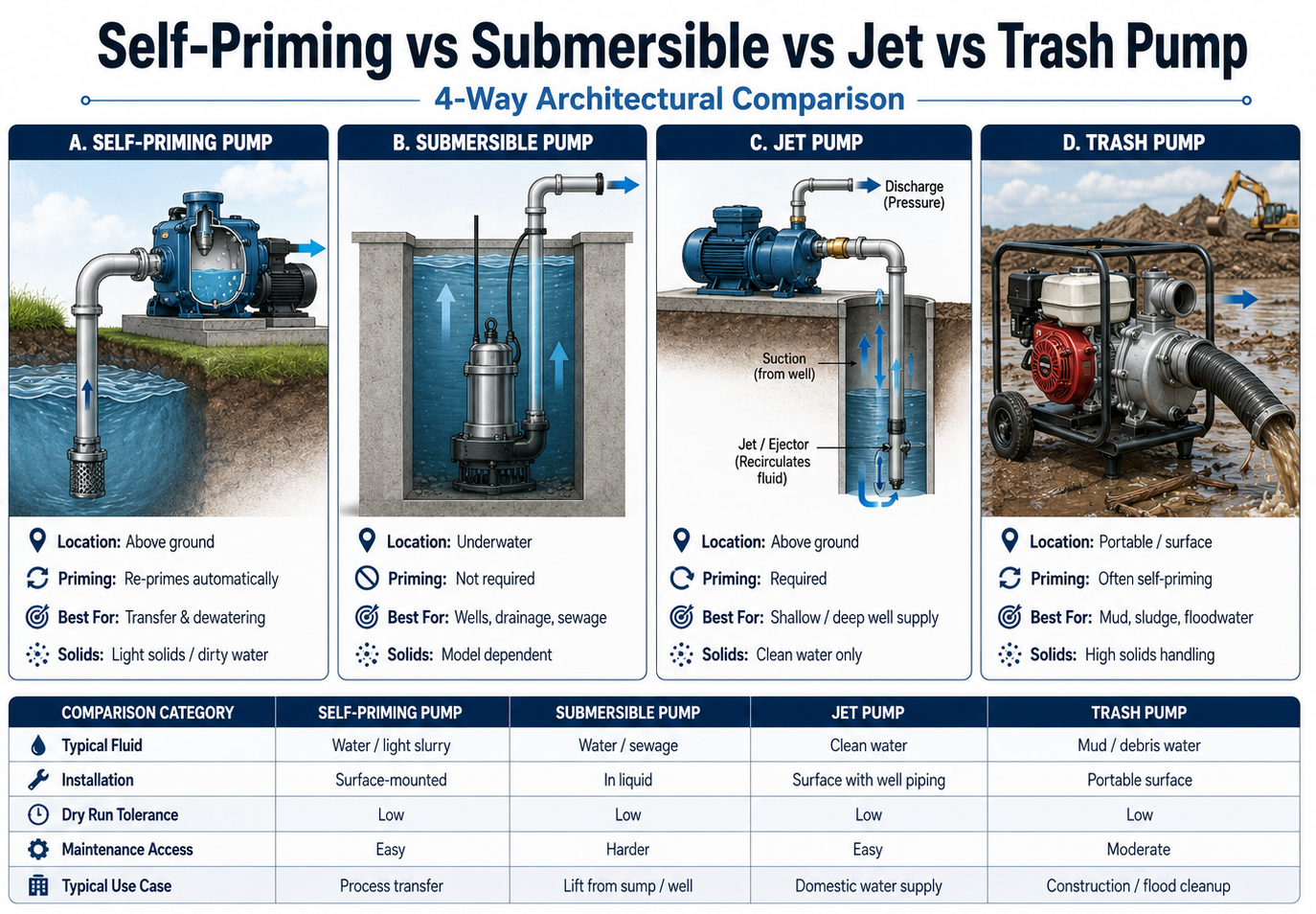
Buyer guides tend to present this as a two-choice: self priming or submersible sewage pump. That presentation neglects two neighboring architectures (jet pumps and traditional trash pumps) for which the applications overlap and operating envelopes differ substantially. Here is a four-architecture comparative table on seven variables (using typical industry parameters rather than vendor parameters).
| Dimension | Self-Priming | Submersible | Jet Pump | Trash Pump (non-self-priming) |
|---|---|---|---|---|
| Priming method | Automatic, vortex chamber | No priming — submerged | Ejector creates suction | Manual fill + foot valve |
| Max practical suction lift | 6–8 m / 20–26 ft | N/A (submerged) | 25–80 m with deep-well jet | 5–7 m / 16–23 ft |
| Solids handling | 40–60% of outlet diameter | 40–50% (chopper variants higher) | Clean water only | 50–75% (largest passage of the four) |
| Service access | Above grade — open clean-out port | Confined-space entry per OSHA 1910.146 | Above grade — single rotating part | Above grade — full disassembly to clear |
| Typical service life — sewage | 8–12 years | 4–6 years (motor seal failure) | Not used in sewage | 5–8 years |
| Capital cost ratio (vs self-priming) | 1.0× (baseline) | 0.85–1.10× (similar) | 0.5–0.7× (lower) | 0.6–0.8× |
| Best for | Municipal lift stations, food/beverage, mining dewatering | Deep wet wells, residential basement ejectors | Domestic well water, irrigation booster | Construction site dewatering, intermittent use |
The naming conventions differ from one manufacturer to the next – these envelopes show typical industry ranges. Vendor-specific maximums for suction lift, solids passage, and lifespan may fall outside of the envelopes shown depending on impeller geometry, seal materials, and duty cycle.
Decision Matrix — Which Architecture Wins by Application
- Municipal sewage lift station with surface space available Self-priming. No OSHA 1910.146 confined-space permit cycle.
- Dry well deeper than 8m (suction lift exceeds the atmosphere ceiling) Submersible. self-priming can not reach the surface of the liquid
- Construction site dewatering. 1-2 weeks per project Trash pump cheaper capital cost. Manual prime acceptable for short duty cycle.
- Residential well water from 30-60 m. (100-200 FT).Deep-well jet pump. This is the sole architecture with the capability to draw water beyond the limits of the atmosphere using ejector physics.
What’s the difference between a self-priming pump and a submersible pump?
Both can pump sewage with similar flow and head. The advantages and disadvantages are in three areas: deployment, service, lifespan. Self-priming pumps are installed above grade and suck in through a suction line-service crews open a port on the wall at floor level to clear a jammed impeller.
Submersible pumps are installed submerged-in order to service them, the pump (unfortunately) must be hoisted out of a wet well. (The HAZWOPER regulations, OSHA 29 CFR 1910.146, require permit-required confined-space procedures be followed.)
Interestingly, service-life data points to self-priming having roughly double the life as a self-priming in sewage duty. The closer to the bottom of a wet-well (year 4-6), submersible motor seal failure dominates end-of-life, compared to self-priming units with replaceable wear plates and dry-mounted motors, which tend to see 8-12 years of use before wholesale refurbishment required. Should a buyer compare-and-contrast these two flow sheet architectures, they will want to wrestle when mapping the decision back to wet-well depth (the physical hard limit), service-crew labor cost, and tolerance for confined-space compliance drag.
Self-Priming Centrifugal Pump Mechanics — How It Differs From Standard Centrifugal

Labeling a self-priming pump as a centrifugal pump is correct, but glosses over the element of the pump that makes it innovative. In a typical centrifugal pump, you need some liquid in the casing in order to start pumping—an operator has to fill the casing through a fill port and bleed air via the discharge in order for the impeller to generate a vacuum and begin drawing in liquid. In a self-priming centrifugal, there are three extra parts that make this possible:1. a balliform or larger vacuum reservoir casing2. a chamber that separates the air from the liquid located in the area above the water volute3. a check valve4
Impeller geometry in a self-primming sewage pump differs from that of clean-water centrifugal pumps. In sewage pumping there are three main impeller types; single-vane (highest solids passage, lowest efficiency 45-55%), multi-vane semi-open (moderate efficiency 60-70% with moderate solids handling) and vortex (recessed impeller pumps fluid by the induced vortex flow, lowest efficiency 35-45% and large solids handling). The shape of the impeller vane is directly responsible for what the pump is able to pass, more aggressive vane angles forces components through more easily, but has lower head per stage.
💡 Pro Tip — When to Spec Each Impeller Type
Specify single-vane for raw municipal sewage containing rags and wipes (60% outlet-diameter passage). Specify multi-vane semi-open for industrial waste water carrying moderate suspended solids – makes back the efficiency. Specify vortex impeller only when fibrous loads dominate (paper-mill effluent, slaughter house waste) accept the efficiency penalty, it’s the price for zero clogging.
How to Size a Self-Priming Sewage Pump — Methodology, Not Catalog Lookup

Sizing a self-priming sewage pump involves deriving four numbers before you can check a single catalog: required flow (GPM or m/h), total dynamic head (TDH meters or ft), available NPSH at pump suction, and fluid nameplate. All four are needed before the quoting process; otherwise a quote arrives without critical parameters or – worse – a pompous pump arrives and cavitates at the bottom of its operating curve.
Below is a five-step programme that leads to a duty-point spec sheet in around a half-hour each project.
5-Step Sizing Framework
- First define required flow. For lift stations, peak flow is the average daily flow multiplied by a peak factor (3-4 for small towns, 1.5-2 for urban). For dewatering estimate inflow from the static groundwater table and pit dimensions.
- Second determine total dynamic head (the pump head required at the duty point). TDH equals static lift plus friction losses plus velocity head plus pressure head at discharge. Friction losses are significant where the discharge pipe is long – select pipe diameter to keep velocity below 2.4 m/sec (8 ft/sec).
- Third make sure NPSH available exceeds NPSH required. NPSHa: atmospheric pressure (-10.33 m at sea level) minus four subtractions: vapor pressure of the liquid at operating temperature, static suction lift (distance between wet-well surface and pump center line), friction loss in the suction line, and a safety excess. NPSHr is a pump curve attribute. A margin of NPSHa NPSHr + 0.6 m / 2 ft prevents cavitation.
- Fourth match the material to chemistry of fluid. Iron cast handles pH 6-9 (most municipal sewage), SS304 mild corrosion. SS316L for chloride or low pH service. specify duplex stainless for more chloride, abrasive slurry or marine service.
- Finally ensure operating point remains in the Best Efficiency Point (BBP) 15%. Pumps operate at highest reliability and lowest energy consumption in the BBP band; moving duty away from the BBP shortens their service life through shaft deflection and bearing load.
How do I calculate NPSH for a self-priming pump?
NPSH available at pump suction equals the vacuum at the wet well surface minus four subtractions: vapor pressure of the fluid at operating temperature, static incoming head (vertical distance between wet-well surface and pump center line), friction loss in the suction pipe, a margin of safety. Worked example: a self-priming pump in a 4 meter high=wet-well located 6 meters from the suction source through 150 mm (6 inch) pipe with a single elbow.
NPSHa =10.33m (atmospheric) 0.24m (vapor pressure at 20°C)4.0m (static lift) 0.55 m (friction in 6m of pipe + elbow at60m/h)0.6m (safety margin) = 4.94m available. However, if the pump curve has NPSH required 4.0m at the duty point this installation has only 0.94m of headroom, not a lot. Pump suction pipe length could be reduced, or pipe diameter increased, or total pump installation height reduced.
📐 Engineering Note — Material Selection Quick Reference
Cast iron with bronze impeller (best buy for pH 6-9 sewage). SS304 (light oxidation, mild chemistry). SS316L to ASTM A276 (chloride service, food & beverage CIP).
Duplex 2205 (chloride + abrasive slurry, marine). Allow for ASTM A351 grade CD4MCu when encountering both severe corrosion & abrasion in the same fluid stream – common in acid-mine drainage or aggressive industrial wastestream.
Common Problems & Troubleshooting Tree — When Self-Priming Pumps Fail

Self-priming sewage pumps give five standard failure modes. Published field-survey stats of pump failures from operator forums all resonate with the same handful of root causes air leaks in the pump’s inlet line, foot-valve failure, obstructed inlet strainers, damage caused by dry-running during long shut-downs, and wear-plate-abrasion‐a steadily worsening clearance loss. Each failure type has its characteristic diagnostic signifier and also learning how to diagnose the appropriate root cause in the first thirty minutes of any pump-repair call.
| Symptom | Most Likely Root Cause | First Diagnostic | Field Fix |
|---|---|---|---|
| Pump runs, slowly loses prime over 10–30 minutes | Air leak in suction line or fitting | Pressurize suction with shaving cream on joints — leak draws cream into pipe | Tighten or replace the leaking joint; check gasket condition |
| Pump cycles repeatedly, never holds prime | Failed foot valve (where installed) or check valve | Pull and bench-test foot valve fully on the ground; fill and inspect | Replace foot valve; modern self-primers often eliminate it entirely |
| Slow re-prime, eventually recovers | Dirty inlet strainer or upstream filter | Inspect strainer; check pressure differential across filter | Clean strainer; replace clogged filter element |
| Mechanical seal weeping or grinding noise | Dry-run damage to seal faces (silicon carbide can survive brief dry intervals; longer intervals score) | Disassemble and inspect seal faces under magnification | Replace seal cartridge; install float-switch protection upstream |
| Effective suction lift drops over years | Wear-plate clearance opened by grit abrasion | Measure clearance per O&M manual; compare to factory spec | Adjust wear plate per service procedure; replace when adjustment range exhausted |
Arranged series of engagements the OP is aware of: on Eng-Tips and in operator subreddits, around 2/3 of a “pump won’t prime” phone calls lead to suck side, not the pumps. An experienced pump tech posted on Eng-Tips the “rule” that field tech crews now use as a quick first-pass triage: pump runs and slowly stalls (mins) suck, check leak; pump can’t get suck and recovers after a few cycles, check dirty filter; pump never primes, check foot/check valve.
Operators with over five years experience using self-priming sewage pump mention loss of prime due to wear—debris in the sewage erodes the internal clearances and decreases the effective suction lift by approximately three feet in the first year of use. Wear is a fact—plan for it instead of ignoring it.
Why does my self-priming pump keep losing prime?
Four distinct root causes would be responsible for almost all field cases. One: a minor air leak in the end of the suction piping or a loose joint continuously entrains air on all cycles until the pump is unable to “out-speed” the steady state vertical lift. Two: a failed foot valve (if installed) allows the suction line to drain back during shut-down and requires a complete re-prime — never a quick restart.
Three: a dirty strainer or filter element indicates insufficient flow so that the pump cavitates (empty’s) and breaks suction during operation. Four: internal wear-plate clearance has exceeded the over centre point of afford able adjustment – the pump is no longer able to create the vacuum to lift the residual liquid against the slug of Leakage.
⚠️ Important — Silicon Carbide Is Not Unlimited Dry-Running
Manufacturer datasheets often say “silicon carbide mechanical seal faces can run dry.” That tolerance is finite-typically less than two minutes. That’s all you’ve got. After that minute-marks, even silicon carbide fails. If your pump will run dry longer( upstream gate-valve failure, level switch error, extended power outage), be prepared to replace the seal cartridge regardless of face material. Use float-switch or pressure transducers as a designed-into feature.
Application Selection — When Self-Priming Sewage Pumps Win (and When They Don’t)

Self-priming sewage pumps dominate in six of the eight application archetypes, and lose in two. Choosing the right design for the right application is an exercise in finding the sweet spot; mis-applying the self-priming base design costs capital when it’s over-specified (deep wet well, pristine clean water, high-pressure continuous service), and pays for confined-space permits when it’s under-specified for a duty (shallow wet well, raw sewage, intermittent duty) over its lifetime.
| Application | Suitability | Why |
|---|---|---|
| Municipal sewage lift station | ✔ Strong fit | Eliminates OSHA 1910.146 confined-space permit cycle; reduces lifecycle labor by 20–30 hours per station per year |
| Food & beverage wastewater (CIP cycles) | ✔ Strong fit | 316L wetted parts handle caustic chemistry; oil-bath seal tolerates brief dry intervals during clean-in-place cycles |
| Paper & pulp effluent (fibrous suspensions) | ✔ Strong fit | Open or vortex impeller passes stringy material without wrap; service access at floor level handles inevitable fiber-driven clogs |
| Construction site dewatering (heavy grit) | ✔ Conditional | Self-primer handles grit better than submersible non-clog; consider dedicated trash pump for very short duty cycles where capital matters more than service life |
| Aquaculture pond circulation | ✔ Conditional | Single-vane low-shear impeller minimizes biological damage during fish transfer; suction lift accommodates pond bank height |
| Wet wells deeper than 8 m | ✘ Hard mismatch | Atmospheric pressure ceiling is 10.3 m theoretical, ~7 m practical — physics rules out self-priming, submersible is the only architecture that works |
| Pristine clean-water continuous duty | ✘ Inefficient | Standard centrifugal or end-suction pump runs 5–10 efficiency points higher; self-priming carries cost and capability the duty doesn’t need |
✔ Advantages
- Surface-grade service access — no confined-space permit
- Automatic re-prime on every restart
- Above-water motor — extends seal and bearing life
- Single-person field service for routine clog clearance
- Tolerates intermittent duty (storm bypass, batch transfer)
⚠ Limitations
- Suction lift is limited around 7 m practically-physics, not engineering
- Slight efficiency penalty versus submerged- equivalent duty point (3-8 points efficiency)
- Requires above-grade real estate and weather protection
- Initial charge at first installation (foot-valve-free designs simplify this step)
- Wear-plate clearance loss eats suction lift over years
For prospective buyers reducing down toward self-priming, the next logical step is matching duty point to a model envelope. BBP offers a line of self-priming sewage pumps, with 36 model configurations, covering 3-800 m/h of flow rate, up to 60 m head, and optioned from cast iron to SS 316L for chloride and chemical services.
Maintenance & Service Life — What 8–12 Years Looks Like in Practice

Service-life data on industrial pumps comes from authoritative published sources. The Hydraulic Institute publishes a 15-20 year typical industrial pump life in lifecycle-cost analyses, with the caveat that initial purchase price is only about 10 percent of total cost over that span. California State Water Resources Control Board guidance lists typical pumping plant service life at 30-50 years for the structure and 35-40 years for valves and ancillaries — multi-decade durations that reflect well-maintained installations under moderate duty.
Sewage duty is harder than industrial-pump-average. Grit abrasion, intermittent dry-running during low-flow periods, and corrosive sulfide chemistry all shorten components. Field-realistic service life for a self-priming sewage pump under continuous municipal lift-station duty falls in the 8-12 year range before major refurbishment — wear plate replacement around year 5, mechanical seal replacement at year 5-7, and bearing service at year 10. Submersible non-clog pumps in the same duty often see end-of-life at year 4-6, driven by motor seal failure under continuous wet-well immersion.
Maintenance Schedule — Self-Priming Sewage Pump (Continuous Municipal Duty)
| Frequency | Task | Time |
|---|---|---|
| Monthly | Inspect oil bath level; check vibration signature; verify priming time | 15 min |
| Quarterly | Inspect impeller through clean-out port; clear any rag accumulation | 30 min |
| Semi-annual | Change oil bath fluid; verify wear-plate clearance against factory spec | 60 min |
| Annual | Replace mechanical seal cartridge if leak detected; inspect motor bearings | 3–4 hr |
| Year 5–7 | Replace wear plate when adjustment range exhausted; rebuild mechanical seal | 1 day |
Total Cost of Ownership — A 10-Year Lifecycle Math Walkthrough

In a 10-year operating budget for a sewage pump, capital cost is usually the least-effective line. Operating costs added together-energy, scheduled maintenance, unscheduled downtime, and labor-about nine times capital costs in total, including the OSHA premiums necessary for confined-space entry of submersible sewage pumps, over the 10-year lifespan. Most procurement specs comparing options only quantify capital cost, and TCO scheduling only becomes an issue after a retrofit related facility-wide retrofit.
~10%
Capital cost as share of TCO over 15–20 yr
(Hydraulic Institute)
(Hydraulic Institute)
$2,750
Annual savings per station — surface-access vs submersible architecture
(53-station municipal study)
(53-station municipal study)
36,096 kWh
Annual energy savings via booster-pump retrofit at one municipal lift station
(US DOE case study)
(US DOE case study)
In formal cost analysis, the US Department of Energy’s guide to pump life-cycle costs describes the six different line items that make up the total cost per pump that include each one-through-life.
10-Year TCO Formula — 6 Line Items
- Capital cost — pump, motor, baseplate, controls, freight
- Installation cost — concrete pad, piping, electrical, commissioning labor
- Akeness – energy charge – annual kWh tariff 10 years (the biggest line for continuous duty)
- Maintenance out of service; component hours X hourly charge + parts (oil, seal cartridge, wear plates)
- Corrective maintenance – unscheduled joint blocking, seal renewal, equipment servicing. Cost of confined-space permit on submersibles enters here.
- Downtime cost – value of waiting for service (regulatory penalty for sewage overflow or loss of production for industrial waste water)
One report documented a comparison of 53 municipal systems that studied the cost-efficiency of above-grade self-priming facilities versus submersible stations, both owned and operated by a single utility for a ten-year period. The cost of a surface-penetrated system was 56% less, resulting in a savings of about $2,750 per station per year, and reduced the annual operating cycle by roughly 30 hours of labor, primarily due to the removal of confined-space permit cycles required for routine maintenance of submersibles. A municipal system of 50 stations therefore generated a 10-year savings of over $1.3 million.
📐 Engineering Note — How OSHA 1910.146 Costs Compound
A confined-space entry permit cycle has: atmosphere testing, written permit, retrieval equipment, / standby attendant outside of the space. Industry averages indicate 90-180 min / permit cycle with 2 workers – call it $200-$400 in fully loaded labor prior to any actual pump work – – before equipment costs. 2-4 week service intervals for the submersible stations are equivalent to $5,200-$10,400 in permit-only costs/station/yr. Self-priming surface architecture eliminates the permit entirely.
Engineering Standards & What They Mean for Buyers

Standards are categorized into three families in the pump procurement specifications. Each family deals with a distinct level of compliance, and purchasers who write contract conditions without drawing the distinction fall into the trap of receiving a record which can’t control anything they want to control.
ISO 9001:2015 is a system for a quality-management system standard. Knowing a pump was shipped by an ISO 9001-certified factory tells you that the supplier had documented procedures and audit trails—it doesn’t tell you a thing about the pump’s hydraulic performance. The certification is valuable for traceability and corrective-action handling but cannot replace product-level acceptance testing.
ISO 2858 Standardizes the dimensions of all end-suction centrifugal pumps on the market. Pumps constructed to ISO 2858 specifications will match in mounting dimensions, shaft heights, and flange locations, ensuring compatibility with current piping and base plates—even when sourcing replacement equipment from other manufacturers. Incorporate ISO 2858 into your RFQ if you may need to substitute a pump in five or ten years and desire multiple supplier options.
ISO 9906 is responsible for the hydraulic performance acceptance tests. The standard gives three grades — 1B, 2B, and 3B — each with a wider tolerance band for flow, head and power consumption.
| Grade | Flow tolerance | Head tolerance | Power tolerance | Use when |
|---|---|---|---|---|
| 1B | ±5% | ±3% | +4% | Critical service — power generation cooling, regulated chemical transfer |
| 2B | ±8% | ±5% | +8% or −5% | Standard industrial duty — most municipal sewage and industrial wastewater specifications land here |
| 3B | ±9% | ±7% | +9% | Commodity pumps, dewatering, intermittent service |
Most municipal sewage and industrial wastewater plants will have demands that require a Grade 2B in the contract to ensure evidence of a factory acceptance test report with no additional cost burden of a Grade 1B test. Care should be taken to specify a Grade 1B only if regulations or process demands require the tighter control.
💡 Pro Tip — Spec Material Standards Separately From Performance Standards
Reference ASTM A276 for stainless steel bar stock used in shafts and impellers – the spec establishes compositional limits and mechanical properties of SS304, SS316 and SS316L wrought bar. Reference ASTM A351 for stainless steel castings used in the casing – different chemistry tolerances apply because cast structure differs from wrought. Material chemistry does not by itself constrain the hydraulic performance – pair material specs with ISO 9906 Grade 2B for full protection.
Industry Outlook 2026 — Where Self-Priming Sewage Pumps Are Headed
Three forces will press self-priming sewage pump selection toward a new set of standards between now and 2027. Buyers writing 2026 specifications would do well to bake the regulatory and technological trajectories into RFQs now to avoid retrofit costs two or three years from now.
1. IE3 → IE4 motor mandate. European Union MEPS regulations have required IE3 efficiency since 2021 for motors from 1 kW to 1,000 kW; IE4 has been mandatory since 1 July 2023 for motors in the 75–200 kW range. The US Department of Energy Direct Final Rule on Electric Motors published in 2023 sets a compliance year of 2027 for new federal efficiency standards. Buyers procuring pumps in 2026 with motors in the 75–200 kW band should specify IE4 now — the small efficiency premium today avoids forced retrofit when the standard takes effect.
2. Energy system optimization trumps pump replacement. The Department of Energy case study on a municipal sewage lift station recorded 36,096 kWh of annual energy savings by adding a small booster pump to the existing system rather than replacing the main pumps. System design – variable frequency drives on the main pump, booster augmentation for peak load events, and pressure control – typically beats pump-level retrofits on capital efficiency. Specify variable-frequency-drive ready motor controls and instrumentation hooks in new pump procurement documents to leave the system-optimization door open.
3. IIoT condition monitoring moves from option to expectation. Predictive maintenance using vibration signature, motor current draw, and bearing temperature has fallen to a cost where it can be justified on any sewage pump in excess of $5,000 life. The sourcing spec writer in 2026 should incorporate sensor-mountable bearing housings, current measuring shunts on motor leads, and either a wired or wireless data interface. Condition-monitoring contracts – based on the data rather than calendar-based intervals – cut out unnecessary preventative maintenance and emergency service calls from missed degradation.
Practical next step for spec writers looking to take advantage of all three trends is to go back and retrofit their procurement boilerplate now. Specification a IE4 motor for any continuous-duty pump between 75 and 200 kW shipped after 2025. Incorporate a Variable-Frequency-Drive control language into your procurements of pumps destined for hard-to-access locations. Specification condition-monitoring hooks in every make-up water well serviced by a maintenance contract.
FAQ — Engineering Questions Buyers Ask
Q: How long does it take a self-priming pump to prime on first start?
View Answer
The priming method first-start priming is by has to open the fill port to normally hand fill the pump casing—usually about 5-10 minutes for 100 mm to 200 mm pump on a 6 m suction lift. Following that initial fill, every start-up subsequently re-primes auto-magically in 30-90 seconds, using of liquid in the casing reservoir that remains between operating cycles. Re-prime times of over 2 minutes indicate an air leak in the suction line or wear-plate clearance opening by more than the adjustment range.
Q: Can I retrofit my submersible station to a self-priming surface station?
View Answer
Yes (but 3- caveats) 1) wet-well depth (finished grade to low-water level) must remain below 7 m ( at reasonable suction lift – deeper wells make the retrofit impossible due to physics). 2) Above-grade (transformer pad) real estate is available for the pump skid + weather enclosure. 3) Will need to install new suction piping between wet well and surface, and re-route discharge piping. Retrofit costs usually will be recovered in 4-7 years for a constantly running municipal station by removing confined-space permit cycles and extending equipment service life, and so should be cost-effective.
Q: What flow rate should I size my self-priming sewage pump for?
View Answer
Design to peak-hour flow for municipal lift station with duplex or triplex pumps that can operate independently for peak loads. Peak hour flow in small communities (<5000 population) is about 3-4 ADWF, 2-2.5 for mid-size system and 1.5-2 for Urban stations with flow equalization pond ahead of it. Allow margin of 15-20% for future development.
Design to peak inflow for dewatering and industrial transfer plus margin for fluid property variation.
Q: Why does my self-priming pump lose prime over time?
View Answer
The four typical root causes of progressive prime loss are: Air leak in the suction piping or fittings – most common — pressurize and test all joints or fittings; failed foot or check valves – replace or pull and bench-test as installed; dirty inlet strainer – inspect and clean out of direction of flow; and wear-plate opening up, undiscovered for a period of years, by grit abrasion past the recoverable adjustment range – measure once, replace wear plate if adjustment exhausted.
Q: Are self-priming sewage pumps appropriate for residential basement applications?
View Answer
In most cases no – typical residential sewage ejectors use submersible pump(s) in a sump basin of 50-100 gallon capacity. Residential service is not large enough to warrant the capital expenditure on the additional self-priming architecture and confined-space provisions will not apply to basement equipment servicing residents. Only self-priming pumps triumph in commercial and municipal settings – where service crews have many opportunities to climb into and work around wet wells.
Q: How much does a self-priming sewage pump cost?
View Answer
S 2026 reference range small self-priming sub- 7.5Kw ( 10 HP) would typically fall in the $1,500-$4,000 cast-iron with conventional mechanical-seal range. Industrial pumps of intermediaterecommended 11-22KW range would fall in the $4,000-$12,000 range. Municipal lift-station pumps above 30 KW and stainless wetted parts and engineered controls would fall in the $15,000-$45,000 (per pump) range.
Pump capital cost is on the order of 10% of a 10-year TCO-focus procurement decisions on energy efficiency, service-intervals, material match to fluid chemistry rather than capital. Quoted prices vary with raw-material costs; prices more than 6 months old might not be a valid reflection of current marketplace.
About This Guide
Written by the BBP engineering team drawing on field service records from the AZX self-priming sewage pump series for the years 2010-2025, covering municipal lift stations, food & beverage wastewater, and mining dewatering applications. Standards and regulatory references cite currently published documentation; procurement specification writers should confirm version date against the issuing organization.
Request a Self-Priming Pump Spec Sheet →
References & Sources
- 29 CFR 1910.146 Permit-required Confined Spaces – U.S. Occupational Safety and Health Administration
- Pump Life Cycle Costs: A Guide to LCC Analysis for Pumping Systems – U.S. Department of Energy / Hydraulic Institute
- Pump Pros Know – Lifecycle Cost Analysis – Hydraulic Institute
- Energy Conservation Standards for Electric Motors – Final Rule 2023 – U.S. Department of Energy / Federal Register
- Case Study: Saving Energy at a Sewage Lift Station – U.S. Department of Energy
- Energy Use Assessments at Water and Wastewater Systems – U.S. Environmental Protection Agency
- Typical Equipment Life Expectancy – California State Water Resources Control Board
- ISO 9906:2012 Rotodynamic Pumps – Hydraulic Performance Acceptance Tests – International Organization for Standardization
- ASTM A276 Standard Specification for Stainless Steel Bars and Shapes – ASTM International
- ASTM A351 Standard Specification for Castings, Austenitic, for Pressure-Containing Parts – ASTM International
Related Articles
- AZX self-priming sewage pump series – 36 models, 3-800 m³/h flow envelope
- Sewage pump category – full BBP product range
- Submersible slurry pump engineering guide
- Sewage grinder pump – when to choose grinder over non-clog architecture
- Horizontal split case pump engineering guide
- Mining slurry pump field guide – selection and TCO