Get in Touch with BBP

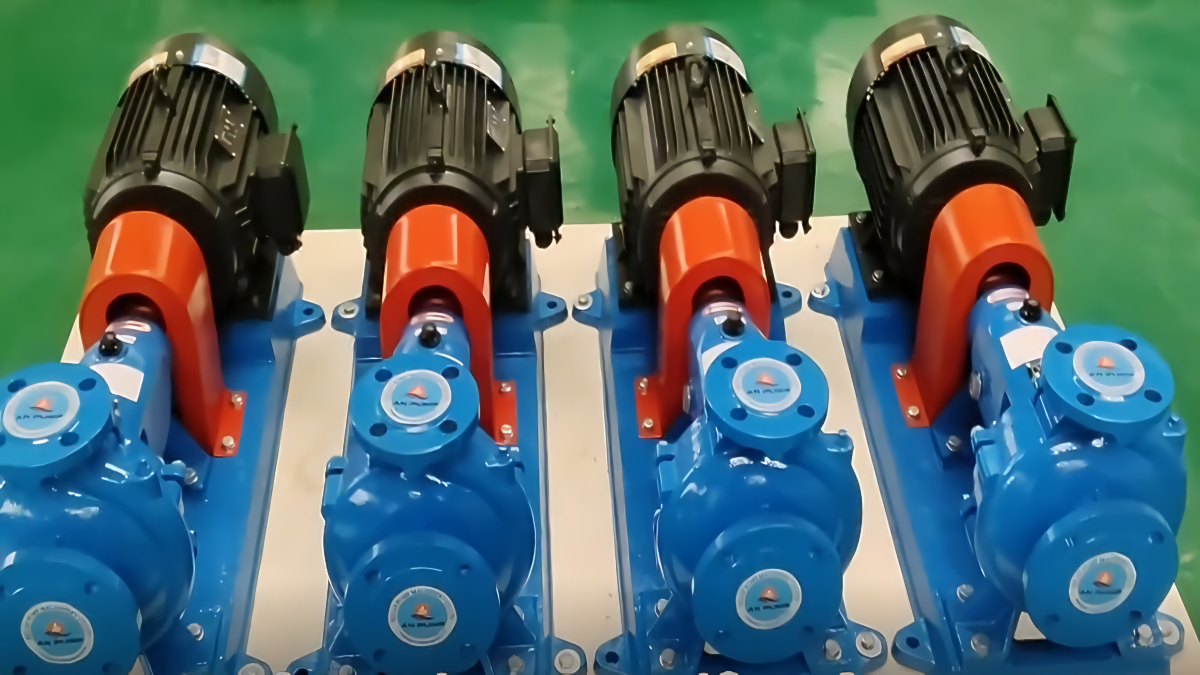
Specifying a chemical pump is a different problem from buying any other pump. Wetted material must survive the fluid chemistry, seals must contain whatever leaks past those wetted parts, and the motor has to live in the corrosive vapours surrounding it — every one of those choices interacts with the others. This guide walks through what makes a pump a chemical pump, the two operating principles to choose between, the five common pump families, wetted-material trade-offs, how to use a chemical compatibility chart in practice, the sealing-strategy decision, and a six-step framework for going from a blank requirement to a defensible RFQ.
Quick Specs — Chemical Pump Reference Targets
| Wetted material baseline (most chemicals) | PVDF up to 135 °C; PTFE up to 260 °C |
| Sealless reference standards | API 685 (heavy duty) / ASME B73.3 (process) |
| Compatibility chart authority | Cole-Parmer database; ASTM D543 test method |
| Centrifugal vs positive-displacement split | Centrifugal: thin fluids, moderate pressure; PD: viscous, high precision, high pressure |
| 5 common pump families covered | Mag-drive centrifugal, sealed centrifugal, AODD, peristaltic, metering diaphragm |
What Is a Chemical Pump? Definitions, Anatomy, and How It Differs from Water and Slurry Pumps
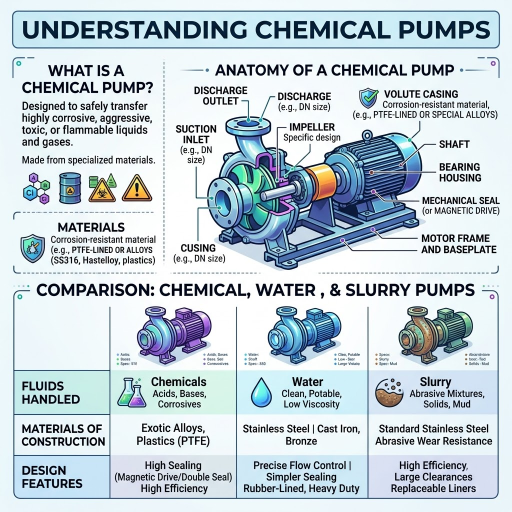
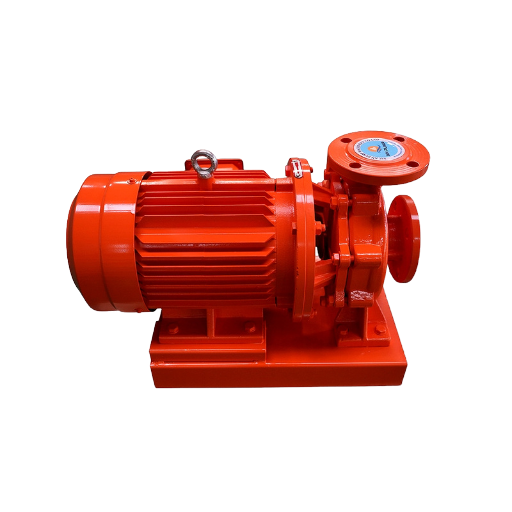
A chemical pump is a pump designed specifically to move corrosive, hazardous, or chemically aggressive liquids with the wetted parts, seals, or surrounding enclosure not subject to attack by the fluid. Three things set a chemical pump apart from a general purpose water pump or slurry pump: chemically resistant wetted parts (PVDF, PTFE, 316 stainless steel, Hastelloy, polypropylene), a seal or sealing approach compatible with the same corrosive liquids, and a motor enclosure rated for whatever vapour atmosphere will be present over and around the pump in actual operations.
| Pump Family | Primary Service | Wetted Parts | Failure Driver |
|---|---|---|---|
| Water pump | Clean water, low chemical attack | Cast iron, bronze | Cavitation, dry run |
| Slurry pump | Abrasive solid-laden liquid | Hardened steel, rubber-lined | Wear, impeller erosion |
| Chemical pump | Corrosive or hazardous fluid | PVDF, PTFE, 316 SS, Hastelloy | Chemical attack, seal leakage, vapour corrosion |
How Chemical Pumps Work — Two Operating Principles: Centrifugal vs Positive Displacement
Every chemical pump operation on the planet is based on just one of two operating principles. Simply understanding which family a pump belongs to tells you almost everything you need to know about its flow versus pressure relation, its tolerances for viscous fluids, and its accuracy as a dosing machine.
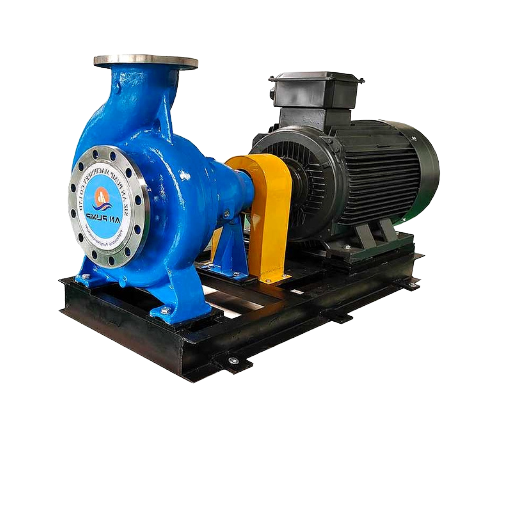
Centrifugal pumps add kinetic energy to the fluid through a spinning impeller and change that to pressure in the volute or diffuser. As discharge pressure rises, flow rate diminishes. Centrifugal pumps perform best on dilute, water-like fluids at moderate pressures (up to 10 bar), reaching peak efficiency on low-viscosity liquids below 200 cP because the impeller can accelerate them with less slip.
Positive-displacement pumps trap a fixed volume of liquid each cycle and push it out regardless of downstream pressure (within mechanical limits). Diaphragm, peristaltic, gear, and screw pumps all belong to this family. Flow stays nearly constant as pressure climbs, which is why positive-displacement is the right pick for high-pressure dosing, viscous chemicals, or any application that needs precise repeatable volumes per stroke. Trade-off versus centrifugal: pulsating flow and lower maximum flow rates at equivalent equipment size.
Simple rule: thin fluid, moderate pressure, high flow → centrifugal. Viscous fluid, high pressure, precision dose, low flow → positive displacement.
The Five Main Types of Chemical Pumps — When to Use Each
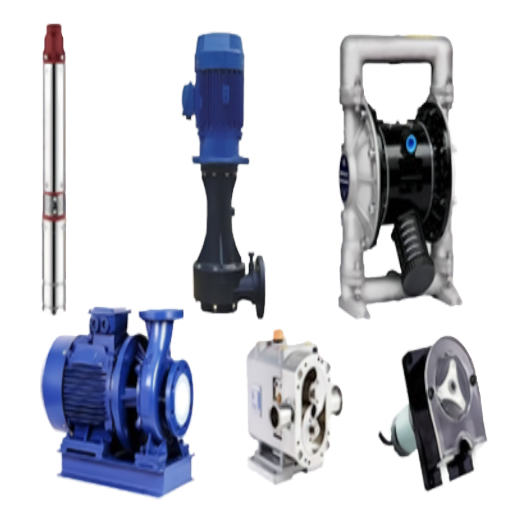
Almost every industrial chemical-handling application is taken care of one of these five general-purpose pump families. The following decision matrix translates your fluid properties and duty cycle into the right one for the task.
📐 The 5-Type Chemical Pump Decision Matrix
Five common chemical pump families mapped to flow range, pressure, fluid type, and the dominant failure driver each one carries.
| Type | Flow Range | Best For | Watch Out For |
|---|---|---|---|
| Magnetic-drive centrifugal | 5–500 GPM | Hazardous fluids, no leak path tolerated | Bearing wear if dry-run; magnet de-coupling on solids |
| Sealed centrifugal | 10–2000+ GPM | High-flow transfer, lower CapEx | Mechanical seal leakage; flush-fluid plan required |
| AODD (air-operated double diaphragm) | 1–250 GPM | Solids tolerance, intrinsically safe (air drive) | Low efficiency; pulsation; compressed air cost |
| Peristaltic (hose pump) | 0.1–500 GPM | Abrasive slurries, sanitary, gentle shear | Hose life is the maintenance cost driver |
| Metering diaphragm | 0.001–10 GPM | Precision dosing, stroke-length controlled | Diaphragm fatigue; turndown ratio limits |
For full-catalog browsing across all five families with each build available in PVDF, PTFE, 316 stainless steel, and Hastelloy wetted parts, see BBP Manufacturing’s complete chemical pump catalog. For dedicated sub-product lines, see the chemical dosing pump line and chemical transfer pump line.
Wetted Material Selection — PVDF, PTFE, 316 Stainless Steel, Hastelloy, Polypropylene: Chemistry and Service Limits
Wetted-material choice is the one decision most often responsible for whether a chemical pump makes it through its first year. Five materials account for most industrial chemical pump applications, and all five have service envelopes that matter more than their theoretical chemical resistance.
📐 Material × Service Limit Map
Five workhorse wetted materials compared to maximum continuous service temperature, acid class fit, base class fit, solvent compatibility, and the pragmatic procurement trade-off.
| Material | Max Service Temp | Strong Acids | Strong Bases | Solvents |
|---|---|---|---|---|
| Polypropylene (PP) | ~80 °C | Good (dilute) | Good | Limited |
| PVDF (Kynar) | ~135 °C | Excellent | Limited (avoid hot caustic) | Good |
| PTFE (Teflon) | ~260 °C | Excellent (universal) | Excellent | Excellent |
| 316 Stainless Steel | 200+ °C | Limited (no chlorides) | Good | Excellent |
| Hastelloy C-276 | 400+ °C | Excellent (incl. chlorides) | Excellent | Excellent |
Three handy rules-of-thumb to remember.
1. PVDF is the default budget fluoropolymer for corrosive service up to 135 C- however avoid using it in hot concentrated caustic which it cannot stand, use PTFE instead. 2. in the presence of chlorides (hydrochloric or ferric chloride or brine) 316 stainless is a weak link- ask for Hastelloy or PTFE instead. 3. Polypropylene is the cheapest of the wetted plastics but is limited by its low temperature limit for most hot-process or steam cleaned processes.
Reading a Chemical Compatibility Chart Without Getting Burned
Most engineers using a chemical pump will begin by consulting a compatibility chart – either the free Cole-Parmer Chemical Compatibility Database, or a vendor-published counterpart. These show the material in the pump in accordance with the chemical as an A / B / C rating. Treating that A / B / C as a definitive answer rather than a baseline hypothesis is the trap that catches engineers.
Four conditions disqualify nearly all chart ratings. Concentration: a rating for “sulfuric acid” generally refers to a level of roughly 30% aqueous solution other than that, 98% oleum is a chemically entirely different material. Temperature: with most ratings, be sure to use the somewhat mild (20 °C); the very same chemical at 80 °C could—indeed, is likely to—drop two or three grades.
Mixed streams: a fluid rated individually may behave aggressively when blended with a second chemical from an upstream tank or valve (acid plus chloride salt is a common surprise). Dynamic vs static contact: charts derived from immersion testing such as ASTM D543 do not predict erosion or stress-cracking under the high-velocity flow inside a pump.
A defensible workflow: pull the rating, then validate against your actual concentration, peak temperature, and any second chemicals in the stream. For high-consequence service (concentrated acids, hot caustic, chlorinated solvents), confirm with the wetted-part material supplier that the rating still applies under your specific conditions, and request a coupon test if no published data covers your blend.
Sealing Strategy — Magnetic Drive vs Mechanical Seal vs Sealless Diaphragm
Prevention of leakage of the fluid from the wetted chamber is the second most important for design decisions after the selection of material(s) to be wetted. there are three main approaches:
| Sealing Strategy | Leak Path | Failure Mode | Standard Reference |
|---|---|---|---|
| Magnetic drive (sealless) | None (containment shell) | Bearing wear, magnet de-coupling on dry-run or solids | API 685 / ASME B73.3 |
| Mechanical seal | Shaft / face interface | Face wear, flush-fluid contamination | ASME B73.1 |
| Sealless diaphragm (AODD / metering) | None (diaphragm separates fluid from drive) | Diaphragm fatigue, stress-crack at flexure | FDA / 3-A sanitary on consumables |
📐 Engineering Note
Sealless magnetic-drive pumps are about 30-60 % more expensive to buy upfront than mechanical-seal mirrors at the same flow rate rating, but avoid the recurring labour costs for seal replacement, and the coincident cost of any fugitive emission. This is the default procurement convention for any hazardous, listed-air-toxic, or just plain leak-sensitive fluid. For the bulk transfer of chemically low-hazard chemicals, mechanical seal is still optimal on lifecycle cost.
Both pump types should be run near their ‘Best Efficiency Point’-running chemical pumps far from their Best Efficiency Point aggravates seal wear, bearing fatigue, and impeller cavitation no matter how they’re sealed.
The Six-Step Chemical Pump Selection Framework
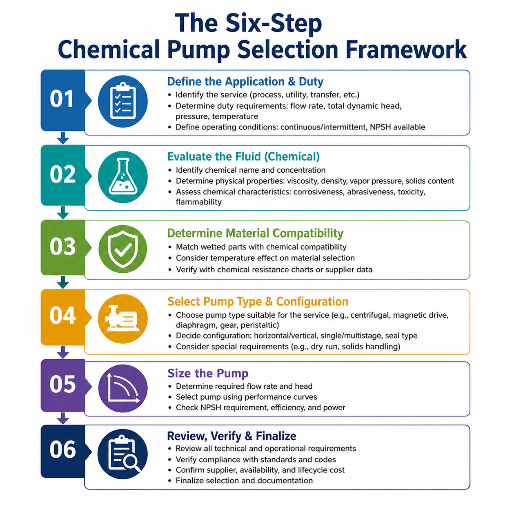
Working forward from blank requirement to a defendable RFQ is faster and safer when they are done in the right order. Each step “applies the lock” to the inputs of the next.
📐 The 6-Step Chemical Pump Selection Framework
- Characterise the fluid – chemistry, concentration, temperature range, viscosity, suspended solids, vapour pressure, and any second chemicals present in the stream.
- Set flow and pressure targets — required flow rate (GPM), discharge head (PSI or bar), suction conditions at the pump inlet including NPSH available, and required dosing precision if applicable.
- Choose the wetted material – pull the chart rating, validate against your actual concentration plus temperature plus stream chemistry (per H2.5), then commit.
- Choose the sealing strategy – sealless mag-drive for hazardous or fugitive-emission-controlled fluids, mechanical seal for bulk transfer of low-hazard chemicals, sealless diaphragm where solids tolerance or precision dosing dominates.
- Specify motor and drive – voltage, phase, area classification (Class I Div 1 / 2 / Zone 1 etc), motor enclosure rating against the local vapour environment, premium-efficiency motor (IE3 / IE4) where regulations require it.
- Plan operations and maintenance access – spare-parts strategy, recommended maintenance interval, monitoring (vibration, current, pressure), and the supplier’s documentation pack (TDS, SDS, CoC, ASTM / API / ASME compliance certificates).
For build-to-spec chemical pump procurement that combines wetted material, sealing strategy, motor configuration, and complete documentation pack — including OEM customisation when stock configurations do not match the application — request a custom chemical pump spec sheet with the six-step output attached.
Download the 6-Step Selection Framework (PDF) →
Industry Outlook — Smart Sensors, Sustainability, and Material Innovations (2026 Onward)
Three shifts are worth tracking over the next twelve to twenty-four months because each one is likely to change a chemical pump procurement decision currently on the table.
Smart-sensor pump diagnostics moving from option to default
Embedded sensors monitoring vibration, motor current, and ambient temperature now ship as a baseline option on most premium chemical pump lines. Predictive maintenance pilots in process plants report 20-40 % reductions in unplanned downtime when correctly tuned. Action this quarter: ask shortlisted suppliers whether their proposed pump model can stream sensor data through industry-standard protocols (Modbus TCP, OPC-UA), and whether the data integrates with the plant historian without bespoke middleware.
Sustainability and energy efficiency regulation tightening
The EU Ecodesign extension regulation and parallel North American DOE rules push minimum efficiency requirements upward across pump motor sizes; IE3 is now the floor and IE4 is increasingly specified for new installations. Action this quarter: confirm any chemical pump quoted for a 2026 or 2027 install includes an IE3-or-better motor; the price delta over IE2 has narrowed to roughly 5-8 % and the operating-cost saving recovers it inside two years for continuous-duty service.
PFAS regulatory pressure on fluoropolymer wetted parts
PVDF, PTFE, and other fluoropolymer wetted materials sit in scope of evolving PFAS regulation in both the EU and several US states. While industrial uses of these polymers in chemical pumps remain permitted under most current proposals, supplier roadmaps are increasingly mentioning alternative high-performance polymers (PEEK, fluoropolymer-free elastomer blends). Action this quarter: ask wetted-material suppliers about their multi-year roadmap and whether 2027-2030 stock continuity is guaranteed for current PVDF and PTFE part numbers.
Frequently Asked Questions
Q: What is the difference between a chemical transfer pump and a chemical metering pump?
View Answer
A chemical transfer pump is sized for moving fluid between vessels at a controlled flow rate; precision is secondary. A chemical metering pump is engineered for delivering a specified volume per stroke or per minute with high repeatability — typically diaphragm or solenoid-driven, with adjustable stroke length and turndown ratio. Use a transfer pump for bulk handling and a metering pump for dosing into a process or chemical injection where exact volume matters.
Q: Can a centrifugal pump handle highly viscous chemicals?
View Answer
A centrifugal suffers a steep drop in efficiency above approx. 200 c P because the impeller is practically unable to impart velocity to fluid that is resisted by viscosity. For viscosities above 500 c P use a positive displacement pump (gear, screw, peristaltic or progressive cavity). When run on viscous fluid, a centrifugal pump is still capable of functioning but it will draw higher currents, flow less and run hotter.
Q: What pump material handles concentrated sulfuric acid?
Show Answer
Hot concentrated sulphuric acid (>~80 %) is piggy-backed by PTFE-lined or all-PTFE wetted parts; Hastelloy C-276 and Alloy 20 are common alternatives to SS 316 when chemical compositions demand. Diluted sulphuric acid (<~50 %) is attacking 316 at a ferocious rate, so PVDF or PTFE is the plastics material of choice here. Always verify prior to procurement based on the acid concentration plus operating temperature since sulphuric acid chemistry changes relentlessly across its concentration range.
Q: How long does a magnetic-drive chemical pump typically last?
Read Answer
A properly selected magnetic-drive chemical pump operating at or near its Best Efficiency Point on a clean fluid stream will every 5 to 10 years require a major overhaul to replace effected shaft and other wetted materials. Service life shatters if the pump runs dry (bearing destruction in minutes), if solids have been processed within the chamber (magnet de-coupling, bearing scoring), or if the pump is run off-curve, on continuous duty, at very low flow (recirculating, heat generation, bearing fatigue).
Q: When should I specify air-operated double diaphragm (AODD) over an electric pump?
Expand Answer
Choose AODD when any of the following conditions exist, as they make centrifugal or other sealless pumps a hazard: solids damaging to a centrifugal impeller, dry-run conditions destructive to a sealless pump, intrinsically safe process area designating the electric motor prohibited, intermittent use that are more effectively served using an air-driven device. Trade-off: lower efficiency, plus the requirement of a continuous compressed-air supply.
Q: What is the safest pump for handling acetone or other flammable solvents?
See Details
Where solvent is flammable, the two main options are air-operated diaphragm pumps (no electric ignition source on the wetted side) and magnetic drive centrifugal pumps with explosion proof or intrinsically safe motor enclosures appropriate to the Area of classification. PTFE is suitable wetted material for acetone and most ketone or alcohol solvents, though confirm suitability when in the presence of any chlorinated co-solvent.
Related Resources
- BBP Manufacturing Chemical Pump Catalog – PVDF, PTFE, 316 SS and Hastelloy American generic product coverage
- Chemical Dosing Pump – metering, high-accuracy
- Chemical Transfer Pump – bulk process flow
- Heavy Duty Slurry Pump – solids-laden process flow
How We Researched This Guide
Material temperature limits and chemical compatibility information obtained from the Cole-Parmer Chemical Compatibility Database, ASTM D543 plastics chemical resistance test procedure and manufacturer specifications compiled against AMPP corrosion guidance. API 685 tips on the use of sealless centrifugal pumps and ASME B73.3 for sealless metallic pumps. This information reviewed by the BBP Manufacturing engineering team.
Specifying a Chemical Pump?
Send the six step output above along with your fluid characterisation, flow + pressure target and area classification – BBP Manufacturing will send back a wetted material and sealing method and configuration of motor along with a supporting documentation pack