Get in Touch with BBP

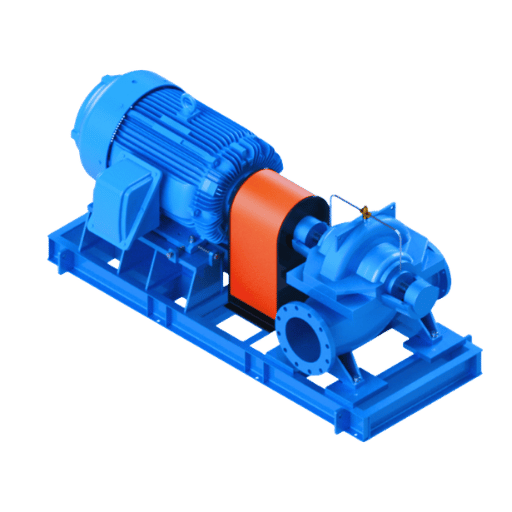
Quick Specs: Double Suction Pump Fit
- Best-fit duty: high-flow clean or raw water service where axial thrust balance and top-cover maintenance are important.
- Typical BBP QS range: 120-14,400 m3/h flow, 6-140 m head, 150-1200 mm inlet, fluid temp up to 80 degrees C.
- Common services: municipal water, HVAC loops, fire protection, cooling water, irrigation, flood control, and low-pressure boiler feed.
- Main tradeoff: needs more baseplate and pump-room planning space than compact end-suction or vertical in-line pumps.
What Is a Double Suction Pump?
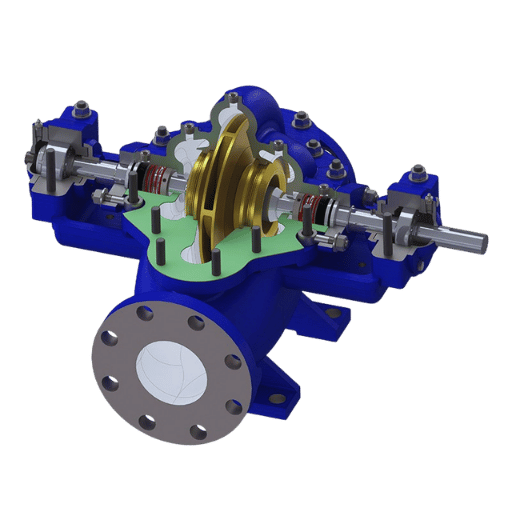
A double suction pump takes a different approach to flow entry than the common single-stage pump. Public pump references describe the same basic reason: at higher flow, one impeller eye may become the limiting cross-section, while dividing flow across two eyes can reduce inlet velocity and cavitation risk.
It should not be confused with a package that has two separate pumps; a double suction impeller is still one hydraulic element, it just can be fed from both sides. This difference is worth noting when a buyer uses pump curves, bearing loads, suction piping, and service access as comparison criteria.
How a Double Suction Centrifugal Pump Works
In this layout, the impeller adds velocity and pressure to the flow. With double suction, the fluid enters both ends of the impeller, meets the vanes from two directions, then exits into the volute or casing. Two-sided entry helps offset the hydraulic thrust forces that would normally push the rotor in one direction. The advantage is better hydraulic balance at higher flows, not automatic efficiency.
Key takeaway: Use “double suction” to describe the impeller flow path. Use the pump curve, NPSH margin, and casing construction to decide whether it fits the job.
Double Suction Pump vs Split Case Pump: Casing, Not the Same Thing

They are related, but not identical. Double suction relates to how the liquid is delivered to the impeller, while split case refers to the design of the casing. Many horizontal split case pumps are of double suction construction, but the terms are not interchangeable.
| Term | What it describes | Buyer check |
|---|---|---|
| Double suction pump | Flow enters both sides of the impeller. | Ask for impeller arrangement, NPSHR curve, and shaft/bearing layout. |
| Horizontal split case pump | Casing splits along a horizontal plane for rotor access. | Check lifting clearance, top-cover access, and foundation layout. |
| Vertical split case pump | Casing service access differs; piping orientation can save floor area. | Check motor removal path and service clearance. |
| Radially split casing | Casing split is perpendicular to shaft axis, often for higher pressure service. | Do not assume it gives the same top-access benefit. |
Within the BBP QS range, the double suction design is represented by the BBP double suction pump model range. However, this blog is focused on the engineering decision process so the dedicated product page remains the quote and model selection page.
Single Suction Pump vs Double Suction Pump: 7 Engineering Differences

This choice usually emerges once the high-volume duty begins to test the limits of single-suction designs like the vertical in-line and end suction pumps. Here’s the 2-Eye Pump Selection Framework: if several rows of the comparison table favor double suction, the larger pump footprint begins to justify its use.
| Decision factor | Single suction / end suction | Double suction / split case |
|---|---|---|
| Impeller entry | One eye, one-sided hydraulic load. | Two eyes, more balanced axial force. |
| Flow range pressure | Good for smaller and medium clean-water duties. | Better fit for high-flow water transfer. |
| NPSH behavior | Higher inlet velocity can narrow suction margin on large duties. | Two-sided entry can reduce inlet velocity per eye. |
| Bearing load | Axial force can become a larger concern as duty increases. | Hydraulic symmetry reduces net axial thrust. |
| Maintenance access | May require more piping or driver disturbance by model. | Horizontal split case designs can expose the rotor from the top. |
| Footprint | Usually smaller base footprint. | Needs baseplate, alignment, and service-lift planning. |
| Best buyer question | “Can this pump meet duty without running near the edge?” | “Does high flow justify the larger frame and service layout?” |
Advantages
- Balanced axial thrust helps protect bearing life.
- Two-sided impeller entry supports high flow.
- Split case construction can cut service disruption.
Limits
- Not the right default for every small water duty.
- Baseplate and access space need early layout planning.
- A bad suction system can still create cavitation.
If your decision process leaves you choosing between this configuration and an end suction pump alternative, consider service access and duty stability ahead of initial cost.
How to Size a Double Suction Pump: Flow, Head, NPSH, Speed, and Efficiency

Sizing begins with a duty point, but it should not end there. A pump that mathematically meets flow and head can still fail early when suction conditions, BEP distance, driver speed, or fluid condition are wrong.
” pump away from its best operating region needs increased suction margin and gives away reliability earlier.”
Hydraulic Institute guidance defines NPSH, preferred operating region (POR), allowable operating region (AOR), and the historic NPSH3 basis of a 3 percent head drop. It also notes that operation away from POR can increase the needed NPSH margin. That gives buyers one plain rule: do not ask for a model until the suction side is known.
Engineering Note: Minimum Sizing Packet
- Rated flow and acceptable operating range; in m3/h or GPM.
- Rated head and static suction condition; in m or ft.
- NPSHA at location and NPSHR from proposed pump curve.
- Fluid temperature, density, vapor pressure, and solids condition.
- Driver speed, voltage, enclosure, and control method.
- Acceptance test grade, witness requirement, and standards package.
Specification language that changes the pump model
A useful specification does more than name a suction centrifugal pump. It states the flow rate, flow rate of the medium, large flow condition, pump inlet size, discharge orientation, suction and discharge flange needs, large pump inlet and outlet limits, and any diameter constraint that affects the pump shaft, pump casing, base mount, or bearing (mechanical) arrangement.
Service wording matters too. Feed water service in a power station or power stations package may need different materials, high efficiency guarantees, and volumetric efficiency checks than municipal HVAC duty. A vertically split case layout or close-coupled mounted pumps can solve a footprint issue, but they should not be treated as a direct substitute for a horizontal split case double suction design without checking access and curve data.
10-Point QS Specification Matrix
Use the matrix below as a scoping format, not as a final selection sheet. The example values show the type of unit-level detail that keeps a high-flow pump review from turning into a guess.
| Specification type | Useful RFQ detail | Why it changes selection |
|---|---|---|
| Flow and head | Example format: 500 m3/h at 80 m head, with normal/minimum/maximum flow. | Keeps the pump curve away from unstable operating edges. |
| Suction margin | Example format: 12 m NPSHA against 9 m NPSHR at the rated point. | Shows whether cavitation margin is real or only assumed. |
| Nozzle and inlet diameter | Example format: 300 mm suction and 250 mm discharge; BBP QS range lists 150 mm to 1200 mm inlet diameter. | Large nozzles affect piping stress, reducers, and pump-room layout. |
| Fluid temperature | Example format: 20 °C clean water; BBP QS page lists fluid temperature up to 80 °C. | Temperature changes vapor pressure, seal choice, and NPSH margin. |
| Driver package | Example-only format: 75 kW motor or 110 kW alternate, 380 V or 415 V supply, 50 Hz or 60 Hz frequency, fixed speed or VFD. | Motor speed changes the curve, power draw, vibration, and control method. |
| Fire-pump duty | NFPA 20 discussion cites 150% flow / 65% rated-head curve logic for fire pumps. | Fire service needs AHJ, listing, driver, and suction-piping review. |
| Acceptance testing | ISO 9906:2012 includes hydraulic performance acceptance testing and grade groups 1, 2, and 3. | The buyer should name the grade before the test report is generated. |
| Factory capability | BBP lists an 8 m x 7 m x 2.5 m heat-treatment furnace, 6.4 m machining length, and 30,000 kg assembly cranes. | Large castings need machining and lifting capacity, not only catalog fit. |
| Production and lead time | BBP lists 600,000 kg/month parts capacity, 4-6 weeks standard QS lead time, and 8-12 weeks for OEM configurations. | Schedule risk changes when drawings, first-article checks, or OEM materials are added. |
| Maintenance limits | Example-only format: bearing-temperature alarm at 80 °C, vibration watch at 4 mm/s, shutdown review at 8 mm/s, seal plan, and spare-parts list. | Early limits make commissioning and warranty conversations less subjective. |
During BBP QS review, the QS selection helper is the faster first pass. If energy cost or maintenance labor is a major part of the decision, run the lifecycle TCO estimator before asking for final price.
Why the Double Suction Impeller Changes Bearing and Seal Risk

Double suction impeller makers care because it affects the load path. Liquid feeding both sides of the rotor sometimes cancels out the hydraulic forces on the rotor rather than pushing hard at one side. That is why serious double suction pump literature mentions axial thrust and bearing load.
This does not mean bearings and seals become a nonissue. Off-BEP operation, poor suction piping, misalignment, and wear-ring clearance growth can still damage the machine. In a pump room, the failure pattern is usually not “wrong pump name.” It is a mismatch among curve, suction condition, installation, and maintenance discipline.
Scenario: A chilled-water retrofit team can be tempted to reuse an older end-suction layout because the flange sizes look familiar. If the new duty point pushes flow much higher, the replacement may run near the edge of its curve and make suction pressure alarms routine. In that case, the correct decision is not a larger motor. It is a fresh duty-point review, NPSH check, and casing/service-access decision.
For a horizontal frame decision, compare this guide with BBP’s horizontal split case pump guide. If pump-room layout is tight, a vertical split case pump may deserve a layout check.
Where Double Suction Pumps Fit Best: HVAC, Water Supply, and Fire Protection

Double suction pumps find a good duty where high flow, raw or fresh water, steady conditions and service access are common. Heating, ventilation, and air conditioning (HVAC) loops are one common fit, but the pump is not a slurry pump by definition, nor is it automatically the default solution for every fire-pump and air-handler application.
| Application | Why it fits | Check before RFQ |
|---|---|---|
| Municipal water supply | High flow, continuous duty, service access. | NPSHA, redundancy, test curve, coating. |
| HVAC chilled or heating water | Large building loops and long ownership cycles. | BEP, motor speed, vibration, maintenance clearance. |
| Fire protection | Listed fire-pump duties often need reliable high flow. | NFPA 20 edition, AHJ, driver, curve, suction piping. |
| Power plant cooling water | Large steady flow at controlled head. | Parallel operation, duty standby, material package. |
| Irrigation and flood control | Seasonal high-volume water transfer. | Solids, debris, corrosion, and start-stop pattern. |
For fire protection, Consulting-Specifying Engineer summarizes NFPA 20 design logic, including the 150 percent flow / 65 percent rated-head curve point and suction-piping restrictions for horizontal split case pumps. BBP also provides an NFPA 20 fire pump sizing check for early screening.
Standards and Test Documents Buyers Should Ask For

For buying the standards are not just decoration. They determine the testing of the pump, acceptance of the curve and submittal package approval.
| Document or standard | Why it matters | Buyer action |
|---|---|---|
| ISO 9906:2012 | Covers hydraulic performance acceptance tests for rotodynamic pumps and grades 1, 2, and 3. | Specify the acceptance grade instead of asking for a generic test report. |
| ISO 5199:1986 | ISO 5199:1986 covers technical specifications for centrifugal pumps, Class II. | Use it as specification context when a project asks for a pump standard beyond a curve test. |
| NFPA 20 | Current edition is 2025 and covers stationary fire pumps. | Confirm edition, local AHJ requirements, listing path, and driver type. |
| ANSI/HI NPSH and operating-region guidance | Ties NPSH margin and POR/AOR to reliability. | Review NPSH and BEP position before approving the curve. |
| Factory performance curve | Shows actual flow, head, power, and efficiency at test points. | Ask whether the test is witnessed and what tolerance grade applies. |
| ASME B31.1 / ASME B31.3 | ASME B31.1 and ASME B31.3 can govern connected power or process piping around the pump. | Separate pump acceptance testing from the piping code used by the project engineer. |
On large orders, ask for the test-curve package at the RFQ stage, not after the pump is ready to ship. When life-cycle cost matters, pair the test curve with the split case pump lifecycle cost estimator.
Maintenance Checks That Protect a Split Case Double Suction Pump

The Hydraulic Institute’s pump FAQs list several maintenance checks that fit double suction pumps well: leakage from seals and gaskets, bearing lubricant, operation inside the allowable region, vibration, noise, bearing surface temperature, and coupling alignment. These are not afterthoughts. They are how a high-flow pump keeps its curve after installation.
| Symptom | Likely area to check | Next action |
|---|---|---|
| Rattle, pitting, unstable suction pressure | NPSH margin and suction piping | Check liquid level, vapor pressure, pipe losses, and inlet turbulence. |
| Bearing temperature or vibration increase | Alignment, lubrication, off-BEP load | Verify coupling alignment and operating point against curve. |
| Falling head at same speed | Wear rings, impeller, internal clearances | Inspect clearances during planned shutdown. |
| Frequent seal work | Shaft movement, vibration, seal material | Review seal plan and fluid condition with supplier. |
If mixed or solids service is involved, do not force a clean-water split case pump into the wrong job. BBP’s heavy duty slurry pump range is a better starting point when abrasion controls the design.
RFQ Checklist: What to Send Before Asking for Price

If “flow and head” is all you have when you ask for an engineering purchase quote, then you do not have enough data on which to proceed. The supplier needs the conditions that influence the curve, materials, driver, testing, and installation risk.
12-Point RFQ Packet
- Rated flow and normal/minimum/maximum flow.
- Rated head and system curve, if available.
- NPSHA at site, including liquid temperature.
- Fluid: clean water, raw water, seawater, solids, chemicals, or temperature limits.
- Material preference for casing, impeller, shaft sleeve, seal, and coating.
- Here are the driver details you have given us: motor power, voltage, frequency, or diesel/electric if fire duty.
- Pump orientation and available pump-room footprint.
- Piping limits: suction angles, reducers, elbows, valves, and access space.
- Applicable standard: ISO 9906, NFPA 20, HI guideline, GB/T, or project spec.
- Witness test, inspection, certificates, and document language.
- Spare-parts expectation and any commissioning support requirement.
- Incoterms, lead time, packaging, and destination port.
If the project also uses booster or loop pumps, compare the double suction choice with a vertical inline pump for HVAC and water circulation or a pipeline pump for booster service. The cheapest quote is often the quote with the most missing assumptions.
What Is Changing in High-Flow Pump Selection?

The search data behind this guide shows stable demand for the exact term, while related split case and NPSH terms carry stronger educational demand. That matches what buyers feel in project work: the product name matters, but the selection risk sits in system energy, suction margin, testing, and compliance.
The U.S. Department of Energy keeps pump-system tools, efficiency tip sheets, and a DOE/HI pump sourcebook in one pump-systems resource hub, and it frames pump savings as a system-management issue rather than a single equipment label. ISO 9906 is still the main acceptance-test reference found in public source research, while NFPA lists the 2025 edition of NFPA 20 as current for stationary fire pumps. For 2026 projects, that means a buyer should ask for the curve, the test grade, and the suction-side assumptions before negotiating paint, price, or spare-parts bundles.
Ready to Review a Duty Point?
Send flow, head, fluid, temperature, NPSH information, standard requirements, and destination terms. BBP can compare your duty point with the QS double suction pump selection review path and return the next technical step.
FAQ
What is the difference between single and double suction pumps?
View Answer
A single-suction pump receives the flow into the impeller from one side; a double-suction pump receive the flow into the impeller from both sides, balancing the axial hydraulic force and supporting larger flows for a given frame size.
What are the advantages of a double suction impeller?
View Answer
The main benefit of double suction is the symmetry of flow. Both sides are loaded, so axial thrust is likely to be significantly lower than a single-suction pump. That can reduce bearing workload and improve high flow stability.
Are all split case pumps double suction?
View Answer
No, many single stage horizontal split case pumps are double suction, but these are not synonyms. Split case refers to how the casing opens. Double suction refers to how the liquid enters the impeller.
When should you choose a horizontal split case pump?
View Answer
Choose it for high flow, clean or raw water service, long hours of operation, and access to the rotor top cover outweighing compact foot-print. Confirm working clearance, baseplate space, NPSH margin, and final pump curve.
Can double suction pumps be used for fire protection?
View Answer
Yes, fire pumps are usually horizontal split case, but the project must adhere to NFPA 20, listing, AHJ review, suction piping, driver, and fire-pump curve limits. Do not specify a fire pump from a general water-transfer pump.
What information is needed to size a double suction pump?
View Answer
Provide rated flow, head, NPSHA, fluid, temperature, solids condition, materials, seal, driver, code, test, installation, spare-parts, and destination.
Is a double suction pump more efficient than an end suction pump?
View Answer
It can be a better high-flow selection, but efficiency depends on BEP match, system curve, NPSH margin, motor/drive, and piping losses. A well-sized end-suction pump can beat a poorly selected double suction pump.
Related Articles
References & Sources
- The Fundamentals of NPSH & Pump Operating Regions – Hydraulic Institute / Pumps.org
- Pump FAQs – Hydraulic Institute / Pumps.org
- ISO 9906:2012 Rotodynamic Pumps – International Organization for Standardization
- ISO 5199:1986 Technical Specifications for Centrifugal Pumps – International Organization for Standardization
- ASME B31.1 Power Piping – ASME
- ASME B31.3 Process Piping – ASME
- NFPA 20 Standard for Stationary Pumps for Fire Protection – National Fire Protection Association
- NFPA 20: Fire Pump Design – Consulting-Specifying Engineer
- Pump Systems – U.S. Department of Energy