Get in Touch with BBP

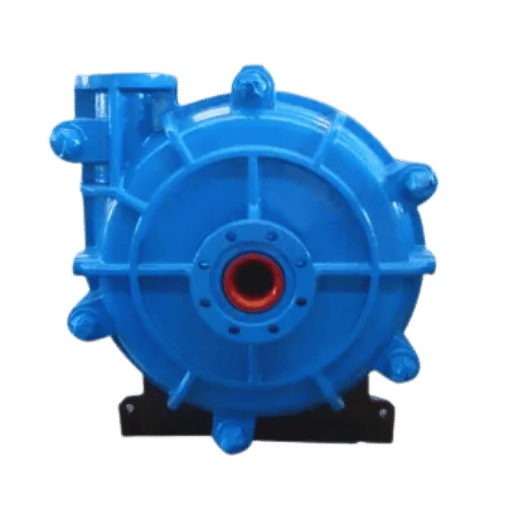
A High Chrome Slurry Pump is a centrifugal pump that has wetted wear parts cast from high chromium white iron – usually an ASTM A532 Class III Type A alloy containing 25-30% Cr plus a hardened matrix greater than 600 Brinell (approximately HRC 58-62). This alloy was specifically designed to withstand the highly erosive cyclone feed in the mining industry, the highly erosive mill discharge from mineral processing plants, gold reefs, tailings transport, dredging & power plant lime pigging that would annihilate ductile iron or Ni-Hard 4 wear parts within months. This article goes well beyond the marketing hype: why the metallurgy performs, how each erosive wear mechanism attacks the steel, how to spot failure modes, when high chrome loses out to rubber or ceramic, and what a five year cost curve looks like.
Quick Specs
| Governing standard | ASTM A532 / A532M Class III Type A |
| Chromium content | 25 to 30 percent (27 percent typical) |
| Matrix hardness after heat treatment | HRC 58 to 62 (above 600 BHN) |
| Dominant carbide phase | Primary (Cr,Fe)7C3 — M7C3 at 1,025 to 1,500 HV |
| Typical wear life vs ductile iron | 3 to 6 times longer in quartz-bearing slurries |
| Primary applications | Mining cyclone feed, highly abrasive mill discharge, tailings, FGD, dredging |
| Unsuitable service | pH below 4 acidic slurries; fine sub-50 micron abrasive where rubber wins |
| Warman AH interchange | AM frame wet-end parts are dimensionally compatible |
What Makes a Slurry Pump “High Chrome”? The Metallurgy Behind ASTM A532 Class III

A high chrome slurry pump get this name because the impeller, throat bushing and casing liners are made of a special family of abrasion resistant white irons which are casting apecific family of abrasion resistant white irons by ASTM A532 / A532M which includes:
- 1st Class-NC 80 —medium hardness, older type of alloy, chromium ussually only about 4%, limited by mass, used for high producing, impact applications.
- Class II – chromium-molybdenum at 12 to 20% Cr (A, B, D). More ductile than Class III, but has less carbon in it.
- Class III Type A–25-30% Cr high chromium white iron. This is usually what the industry refers to as “high chrome slurry pump”.
The component of this alloy that generates useful work is the principal chromium carbides – separate, inert particles of (Cr, Fe)7 C3, normally expressed as M7 C3, which form as the liquid phase cools, prior to the remainder of the cast iron. There are peer-reviewed X-ray diffraction indications, on the M7 C3 component of high chromium white cast iron, of hardness values of approximately 1,025 to 1,500 HV; the Secondary M23 C6 carbides are approximately 800 HV, with the rare M6 C carbide phase being as hard as 1,800 HV. Comprising angular particles, and forming around 25% by volume of the alloy in Class III Type A, the carbides are contained within an austenitic matrix, which can after heat treatment, be more readily transformed to a martensitic matrix.
Raw-as-cast structure is not the service structure. The high chrome slurry pump castings are subjected to a destablization heat treatment, usually 950 to 1,050 degrees Celsius to precipitate the secondary carbides from the austenite and convert most of the matrix to martensite on cooling. A subcritical temper (about 450 to 500 degrees Celsius) to relieve internal stress with no examination of the hard carbides. as a finished part is produced a foundry at HRC 58 to 62 the trade (industry) abbreviation for “hard enough that quartz will not scratch a way to the softer matrix.”
Engineering Note
ASTM A532, Class III Type A chemistry, wt%. C 2.0 – 3.3, Mn 0.5 – 1.5, Si up to 1.0, Cr 23.0 – 30.0, Mo up to 3.0, Ni up to 2.5. In general the casting requirements for the slurry pump wear components specify a heat treated matrix hardness with a minimum of HRC58 tested by Brinell on each heat and a M7C 3 volume fraction of 25 % minimum.
How Abrasive Slurry Destroys Pump Metal: Three Wear Mechanisms Explained

A wear resistant slurry pump is not wear-proof. High chrome prolongs service life by retarding a set of physical mechanisms that still take place at each impact and each shear pass. Slurry erodes pump metal through 3 related means, and each one varies differently with carbide volume, matrix hardness and the shape of the wetted surface.
How do abrasive particles erode slurry pump surfaces?
Erosion in a slurry pump conforms to the general shape first theorized by Finnie and by later points of emphasis, Bitter: rate of wear scales to the kinetic energy of the particle at impact, times a correction for impact angle. The hard brittle target of course does best at a shallow impact angle (15 30) where particles gouge chips rather than crater craters. The typical front face of an impeller vane is exactly in this angle range, and that is where the earliest wear appears.
Three pathways run in parallel:
- Gouging abrasion. Coarse angular (over- about 2mm) particles have enough particle momentum to gouge a visible track through the matrix. If the gouge passes through a carbide band, the carbide keeps the depth below the surface. If the gouge passes between carbides, the matrix is undercut and a carbide can actually fall out whole.
- Sliding, or three-boby, erosion. Between the casing working faceand the impeller shroud, at the throat-ring gap and at the casing tongue, small particles are trapped between the two parallel surfaces. Relative velocity in excess of 25 m/sec is not unusual. Particles abrade both surfaces simultaneously, which is the reason those two locations have an 18 month to 24 month wear pattern regardless of material, composition or hardness.
- Corrosion-accelerated erosion. When the chemistry of the slurry attacks the matrix (think low pH mine drainage or chloride-laden FGD), a thin passive film develops and then is stripped by the next impact, then reforms. Each repetition lifts a few micrometers of metal away. This is the effect that causes rubber to seem like a good idea on paper and the Australian concept of a cyclone-feed to fail in the plant.
“It is a perfect storm of constant abrasion, high pressure and heat that causes pump components to quickly degrade. With typical materials, the parts wear out like they are being sanded. First there are holes, then it is basically eroded itself to nothing”.
A misconception is that rubber always beats metal on abrasion because the elastomer really does distort under impact. At a copper concentrator fed with 18% solids flotation tailings at pH 9.2, a 4/3 pump with a cast-iron liner was converted to a rubber-lined version for this reason. Six months later, the rubber was severed through where 3mm silica particles impacted the tongue over a high angle. A high chrome liner was reinstalled and the site adopted a 12 month change-out cycle. Rubber wins when particles are small and round enough to bounce; high chrome wins when particles gouge.
What the HRC Rating Actually Means for Your Slurry Pump’s Wear Life

Hardness is an elegant surrogate for a more insistent question: can the wear surface best the mineral which will also ensue?
Mining slurries are seldom a mono-mineral grind-they consist of a dominant abrasive and a bed of generalized ground. Pairing the wear material to the selected abrasive-mineral combination is the crucible of service life and the published hardness value is of secondary importance in an absolute sense.
Quartz, found most frequently in mined ore, dredged sand, and abrasive blasting; falls at Mohs 7 and between about 900 and 1,100 HV on the Vickers. Garnet, at Mohs 7.5, is between approximately 1,100 and 1,300 HV. Alumina, and its cousin corundum, surpass a Mohs 9, on the Vickers 1,800 2,000 HV.
The range shared with quartz and garnet, 1025 to 1500, overlaps the aluminas rival, chrome, but not enough to gain an edge against alumina-heavy dredged ore. That margin is precisely what makes Class III Type A the np1/default material in copper, gold, iron and, of course, sand dredging and reaffirms the fact that ultrafine alumina grinding discharge is closely aligned with the ceramic market and not high chrome.
The Mohs-HRC Gap Rule (editorial synthesis)
Based on published tribology studies of white iron wear response: for erosion resistant slurry pumping, wear-surface hardness must be at least about 2 Mohs levels above the matrix or what you get is, near or at the loss-of service life point—that the matrix fails out more quickly than the carbides can pull the load of wear.
This is a working framework, not the defining named industry code. Use this as a first pass filter, before performing the complete set of selection calculation.
| Dominant mineral | Mohs | Approx. HV | Fit wear material |
|---|---|---|---|
| Coal, gypsum | 2 to 3 | 120 to 200 | Ductile iron is adequate |
| Calcite, limestone | 3 | 150 to 200 | Ductile iron or Ni-Hard 4 |
| Feldspar | 6 | 600 to 750 | High chromium white iron (Cr 15 percent and up) |
| Quartz, silica (most common) | 7 | 900 to 1,100 | High chrome Class III (Cr 25 to 30 percent) |
| Garnet | 7.5 | 1,100 to 1,300 | High chrome Class III Type A or WC-Co cermet |
| Corundum, alumina | 9 | 1,800 to 2,000 | Zirconia or alumina ceramic only |
In other words: the alumina-grinding slurry isn’t destroying the Class III Type A impeller because the alloy is inferior, it’s because the dominant mineral/abrasive is superior. First check the Mohs, second the HRC, and third the product trade-name. BBP has developed a mineral to wear-life comparison chart for most mined minerals.
High Chrome vs Alternative Wear Materials: A Decision Framework Beyond Rubber and Ni-Hard

If I were searching for a slurry pump for a mine, the majority of selection guides would abort the search at the three clear “yellow” options high chrome, Ni-Hard, and rubber. But it leaves you “money” on the table if the slurry profile drifts to either extreme. Shown below is a “conditional” recommendation “table” that would add ceramic lining, WC-Co cermet, and duplex stainless as “nominal” choices four, five and six for particular niches.
| Slurry profile | Recommended wear material | Expected life vs ductile iron | Why it wins |
|---|---|---|---|
| Coarse angular quartz 2 to 25 mm, pH 5 to 12, SG up to 1.6 | High chrome A532 Class III Type A | 3 to 6 times | M7C3 volume plus matrix HRC 60 matches quartz hardness; toughness survives impact |
| Fine abrasive below 5 mm, solids below 30 percent, rounded particles | Natural rubber or polyurethane liners (hard metal impeller optional) | 2 to 4 times | Elastic rebound absorbs particle energy before it cuts |
| Highly corrosive pH below 4, moderate abrasion, chloride-heavy | Duplex stainless or CD4MCu | 1.5 to 3 times | Chromium in austenite-ferrite matrix fights pitting when abrasion is secondary |
| Ultrafine aggressive sub-1 mm abrasive (alumina, zircon sand), high SG | Zirconia or alumina ceramic liners | 5 to 10 times | Ceramic HV 1,500 to 2,000 outranks alumina Mohs 9 mineral |
| Large rock impact over 50 mm (coal washing, coarse aggregate) | Ni-Hard 4 or Class III Type B (Cr 20 percent) on impact-critical parts | 2 to 3 times | Higher toughness than Type A avoids brittle spall under rock strike |
| Very high velocity sharp fines (centrifuge discharge, cyclone overflow) | Tungsten carbide cobalt cermet inlay on high chrome substrate | 6 to 12 times | WC-Co at 1,400 to 1,700 HV with higher toughness than bulk ceramic |
✔ Advantages of High Chrome
- 3 to 6 times duted iron in quartz-based slurry the longest life
- ASTM A532 standardized chemistry and hardness, audit-grade traceability
- Warman AH wet-end wear parts are dimensionally interchangeable across suppliers.
- Stable performance across pH 5 to 12 service window
- Peer reviewed benchmarks which are all published, Jokari-Sheshdeh et al. in Wear in 2022 shows 20 to 77 percent life increase, depending on mode of testing, over Ni-Hard 4
⚠ Limitations
- Splintret ved direkte slag mod blok over 50 mm – risiko for skjoldspand i skovlsvingekant
- Matrix corrodes below pH 4 to 5; A49 at 30 percent Cr or duplex stainless preferred
- Not suitable for high chloride seawater above 30,000 ppm without upgrade
- Heavier than rubber-lined equivalents, higher shipping and handling cost
- Welding repair is restricted — standard arc repair cannot be done on Class III castings without compromising the matrix
When should you choose ceramic-lined slurry pumps over high chrome?
Crossover occurs when the most abrasive hardness of chromium carbide is crossed by hardness of the tailings being processed – whether the dominant abrasive has been accelerated in a regrind discharge with Mohs 8.5-9 particles or whether alumina rich tailings, zircon sand process or regrind discharge is reprocessing 8.5-9 particles or thereby, the chromium carbides will be worn about the same rate as the matrix. Ceramic liners – zirconia toughened alumina or pure alumina – are at HV 1,500-2,000 and resumes the balance back in the pump’s favor. Disadvantages of this solution are brittle fracture of the sintered component should pipe scale impact on it, significantly higher unit cost – 2-4 times the comparable high chrome component – and significantly longer lead-times.
Typical field installation pattern is ceramic where the grit is finest and hardest and high chrome from there, outside the pipe, down to the finest coarser medium grit refuse. Usually within the same circuit.
In cases where your slurry profile appears uncertain—shifting mineralogy, fluctuating pH, or seasonal solids swings—begin by using the BBP high chrome material selector tool, which matches slurry chemistry to a list of potential wear materials. For rubber-centric comparisons, consult the rubber-lined slurry pump lineup.
Common High Chrome Slurry Pump Failure Modes: Diagnosis from Wear Patterns

Generally if a high chrome slurry pump fails in service, it will leave a trail visible in the geometry of the wear. Interpreting that trail will enable you to conclude whether the cause is the material, hydraulics, chemistry, or the operator. Five of those trails accounts for a huge percentage of ‘unanticipated standstills’.
Vane leading-edge gouging
Signature:45′ scalloped erosion on the outer third of every vane until it gets a little deeper the he shroud; root cause -is typically oversize solids, large than the published passage size for the pump or a step change in feed density that increased particle momentum. Corrective action:ahead of pump- verify your feed screen and cyclone underflow density- not a material upgrade.
Throat bushing and casing tongue washout
Signature: a bell-shaped wear pattern down the contours of the blades where the particle stream reaccelerates beyond design velocity (usually located at 5 to 7 o’clock position on a horizontal volute) Reason Root-Cause is a duty-point shift to the right of the best efficiency point which increases tip-speed and gap velocities. On a BBP AM-series casing this is usually evidenced by accelerated wear of the throat bushing prior to the impeller.
Suction liner pitting without abrasion scars
Signature: gouge-shaped craters concentrated close to the eye, lack of directional grooves. This is cavitation, not abrasion – the slurry flashed to vapor in low-pressure spots and the collapsing bubbles struck the metal (accelerating wear). Correct hydraulics: increase available NPSH, decrease suction lift, speed down the pump, oversize the suction piping, not chasing a metallurgical upgrade.
High chrome is more cavitation-proof than cast iron but no wear material is cavitation-proof indefinitely.
Gland seal leak with axial shaft-sleeve wear
Nameplate: axial streak wear marks on the shaft sleeve, packing was compressed asymmetrically, flush water flow much lower than the nameplate. In fact the root cause was flush-water pressure was too low to keep slurry away from the stuffing box. An often field encounter FGD lime-slurry pump anamoly is “premature gland wear” as the flush-water supply is blocked.
Matrix softening after high-temperature exposure
Signature:.Brinell hardness value degrades 5 to 8 points from the asshipped value without wear visible to the Naked eye. Most likely root cause: a subcritical temper event in which the casting was thermally treated above 500C long enough to register a start of transformation of martensite toa ferrate-plus carbide matrix: fire incident, welding repair in the field, breakout upsetting the process. Affected parts cannot be re- hardened in the field should be scrapped.
⚠️ Important
Afterservice Brinell hardness testing reveals a material softening with a hardness degression of more than 5 points, the matrix has been thermally damaged; parts exhibiting that degression should be scrapped, not reinstalled. Sheetmetal parts that have been exposed to a weld repair or processupset has subcritical temper would be impossible to reemploy even when hot in the field, and installing it falsifies the hanging inspection, then logs just fine, then fails weeks later in-service.
Engineering Note
Monitoring of centrifugal pump vibration performance per ISO 10816-7 vibration bands: log the baseline RMS velocity at commissioning, then trend daily. A rise of 1.5 times baseline sustained after 200 hours of operation is a sign of impeller imbalance due to asymmetric wear — inspect before the imbalance wears out the bearings. Published TAMU rotordynamics guidance notes that impeller wear ring geometry variations alone can drift the pump vibration signature past a published threshold without any externally observable change.
When wear parts reach end of life, BBP’s slurry pump wear parts inventory keeps impellers, throat bushings, casing liners, and shaft sleeves ready for dispatch, and the liner material decision tool helps decide whether to reorder the same spec or upgrade.
Operational Best Practices: Extending Service Life in High-Density Slurries
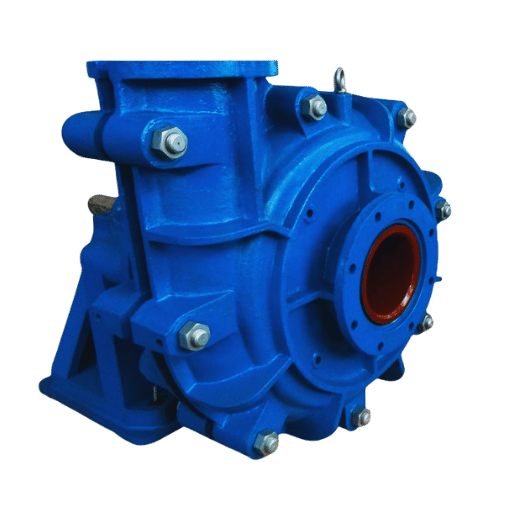
Most heavy duty slurry pump failures are avoidable with a small set of operating practices that cost almost nothing to implement. A pump that is primed correctly, started on clear water, commissioned against a vibration baseline, and re-torqued on schedule will run 30 to 50 percent longer than the same pump installed by the book but operated without discipline.
How do you prime a high chrome slurry pump?
A horizontal slurry pump is not self-priming. Pump body and suction line must be filled with liquid before startup — normally clear water, not the process slurry. Sequence: close the discharge valve, open the suction valve, fill the volute through the priming connection until liquid overflows the air-release valve, close the air release, start the motor at reduced speed if the drive allows, ramp to design RPM over 30 seconds, then gradually open the discharge to design duty. For remote sites without clean water, expeller or suction-side priming chambers are viable alternatives, but the first principle holds: solids should never enter a dry casing.
An initial 30 minutes of pumping with clear water provides opportunity to log bearing temperature trend from ambient, to verify just-off-gland pressure from the gland drain line (usually 0.35 to 0.5 bar above suction supply drain pressure), then to establish a baseline vibration signature.
NPSH margin for slurry service
NPSH requirement in the manufacturer’s curve assumes clean water. For high-density slurry, add a correction — typical industry practice sees 0.5 to 1.5 meters of NPSH margin per unit of specific gravity above water. A slurry at SG 1.4 pumping to a 4 meter published NPSH_r should have at least 5 to 6 meters available. Undersized suction piping and a tight sump geometry are the usual culprits when a site claims “unexplained cavitation” on a pump that tested fine at the factory.
Re-torque schedule for tapered-joint liners
Tapered mating faces on AM-series liners, depend upon interference fit held by through-bolts. By 100 hours service, re-torque to OEM spec – the interference beds in and relaxes a little in the break-in. A second re-torque at 500 hours captures any slow relaxation before liner migration produces gap-wear. External impeller adjustment, a feature on BBP AM frames, allows the front clearance to be re-adjusted without disassembly; keep track of adjustment turns so bearing alignment can be monitored separately.
pH monitoring and material-grade tipping points
Class III Type A 27 percent Cr stainless steel performs well to about pH 4.5 in continuous service. Above that, the matrix experiences a passivating dissolution between carbides, hence why A49 at 30 percent Cr is available for acid-mine drainage and FGD systems that can dip below pH 4. If process chemistry trends acidic seasonally, logging pH at the pump suction quarterly is less expensive than a premature wear-parts change-out.
Commissioning checklist
- Pre-start inspection: external impeller adjustment clearance 0.8 mm or OEM spec, whichever is tighter
- First 30 minutes on clear water – check gland flush pressure 0.35 to 0.5 bar above suction
- Ramp to design SG over minimum 2 hours, avoid step change in density
- Log bearing house temperature at 1, 8, and 24 hours; alarm above 70 degrees C
- Re-torque tapered-joint fasteners at 100 and 500 hours
- Quarterly Brinell samples on accessible wear parts when process fluid temperature exceeds 80 degrees C
- For lime slurry duty, flush with clear water before every long shutdown to prevent calcium scale setting inside the volute
For sizing questions, the BBP high chrome slurry pump sizing tool prompts for duty point entry and returns candidate AM frames.
Total Cost of Ownership: The Lifecycle Math for High Chrome Slurry Pumps

A high chrome slurry pump is initially more expensive than a ductile iron equivalent, but significantly less over five years. A TCO curve is where the procurement argument is won or lost. Three factors dominate the calculation: how often the pump is replaced, parts cost for every change-out and the production benefits of downtime for every changeout.
Peer-reviewed slurry-pump component wear prediction work by Sellgren (TexasAM, 2005) and academic follow-ups all agree: your lifecycle cost will be driven by maintenance and induced downtime, not parts. One very useful practical way of splitting out where your projected costs will come from is 70 percent downtime value, 15 percent parts, 15 percent labor a useful refinement of the 70 percent lifecycle cost figure that ends up labeling ‘cost’ sometimes three times over, first in parts, and second in labor.
| Material class | Annual changeouts | Parts per changeout | 5-yr cost at $200/h downtime | 5-yr cost at $2,400/h downtime |
|---|---|---|---|---|
| Ductile iron | 4 to 6 | $1,800 | ≈ $62,000 | ≈ $298,000 |
| Ni-Hard 4 | 2 to 3 | $2,600 | ≈ $47,000 | ≈ $176,000 |
| High chrome Cr 27 percent | 1 to 2 | $3,600 | ≈ $32,000 | ≈ $96,000 |
| Ceramic-lined composite | 0.5 to 1 | $9,200 | ≈ $58,000 | ≈ $84,000 |
These numbers are representative of mid-size (4/3 to 8/6 frame) cyclone-feed service. That pattern generalizes: at low downtime value, ductile iron to Ni-Hard to high chrome is the logical progression because parts cost dominates. At high downtime value (around $2,400 per hour and above, typical of continuous concentrator operations), ceramic and high chrome converge because saved downtime outweighs higher parts cost. For most mining sites at $500 to $1,500 per hour downtime value, high chrome Class III Type A is the absolute winner.
Engineering Note
Breakeven analysis: a high chrome Class III Type A impeller at 3 times the parts cost of ductile iron pays back its premium in month 8 at $200 per hour downtime value, and in month 2.5 at $2,400 per hour. Downtime value, not parts cost, is the decision variable. Before signing a procurement, calculate your production value per unit time and plug it into the interactive TCO calculator — a one-hour shift in assumed downtime cost can move the recommendation by one material class.
For mining-specific benchmarks that factor ore hardness, cyclone feed density, and site labor rates, see the mining-specific TCO comparison tool.
Frequently Asked Questions
Q: Are high chrome slurry pumps worth it?
View Answer
No, in all situations in which quartz or higher mineral hardness, larger particle size, or downtime value exceeds roughly $500 per hour, high chrome parts cost 2 3 times as much as ductile iron on day 1 but replace themselves only 2 4 times as often, reducing the five-year lifecycle cost by 40 to 70 percent. A case in which this doesnamp t be the case: in slurry are some dominant applications, based on size, shape, and mixture of particle hardness, in which rubber or polyurethane parts prove to last longer at lower cost.
Q: What is the difference between a slurry pump and a centrifugal pump?
View Answer
A slurry pump can be defined as: ‘a subclass of centrifugal pump designed and manufactured for the transfer of abrasive, solids laden liquids.’ As with any other centrifugal pump, the hydraulic principle will be the same an impeller pulling fluid from the eye and throwing it radially around and outward. Its application to a specific slurry will differ somewhat in: Features such as the shape and number of impeller vanes (in order to pass larger particles); Or the use of high-wear, replaceable liners (rather than castings which relies on a liner wear surface).
Q: What is ASTM A532 Class III Type A and why does it matter?
View Answer
ASTM A532/A532M is the abrasion-resistant cast iron spec. Class III has the high-chromium white iron family. Type A details 25-30% chrome, primary M7C3 carbide microstructure, heat-treated matrix hardness median HRC 58-62. It matters because A532 is a foundry-buyer chemistry/hardness contract – no A532 reference, no certified chromium alloy or WC hardness grade – no “high chrome” marketing shortcut you can secretly budget an other type of alloy against, blended to the metallurgical prejudice of the specifier.
Q: Can high chrome slurry pumps handle acidic slurries below pH 5?
View Answer
Class III Type A at 27% chrome is rated for continuous service to about pH 4.5. Below that, the matrix preferentially dissolves between carbides, hastening abrasive removal. More aggressive acid exposure can be achieved with higher chrome alloys (A49, 30%) or duplex types ( stainless steels, 00Cr13). Lower pH defines abrasion dominant in the media, not in the wear mechanism.
Q: How do you prime a high chrome slurry pump for startup?
View Answer
Close the discharge valve, open the suction valve, fill the volute and suction line with clear water from the priming line until liquid overflows the air release valve, then shut the release. Startup, bring to design RPM in 30 seconds, then gradually open in sequence to design duty. Running on clear water for 30 minutes provides logging of bearing temperature, a strip chart of gland flush pressure at 0.35-0.5 bar above suction, and a baseline for vibration in case slurry noise imposes a real-time blind spot.
Spec a High Chrome Slurry Pump for Your Operation
Survey the full BBP AM-series range – inflows from 3.6-1,620 cubic meters/hr, Warman-compatible wear parts, ASTM A532 Class III Type A castings.
About This Analysis
This primer was compiled to condense the metallurgical and operational experience behind a high chrome slurry pump choice – ASTM A532 Class III Type A chemistry, carbide hardness ranges, comparison to Ni-Hard benchmarks, and duct-pattern hints. Citations are from peer-reviewed research (Jokari-Sheshdeh 2022 in Wear; Sellgren TAMU 2005), the ASTM A532 spec, and Texas A&M University authors of rotordynamics lessons. Where a factoid could not be validated by a Tier 1 source – for example the “Mohs-HRC Gap” framed in section three – it is presented as a writer’s choice, a second-generation synthesis of the information. This primer is reviewed by the BBP engineering team, a group of metallurgy and hydraulic engineers working on ASTM A532 white iron casting and centrifugal slurry pump design.
References & Sources
- ASTM A532 / A532M-10(2019) Standard Specification for Abrasion-Resistant Cast Irons – ASTM International
- Jokari-Sheshdeh, M. et al. (2022). Comparing the abrasion performance of NiHard-4 and high-Cr-Mo white cast irons: The effects of chemical composition and microstructure. Wear, 492-493 – Elsevier peer-reviewed journal
- Sellgren, A. (2005). Prediction of Slurry Pump Component Wear and Cost – Texas A&M Turbomachinery Laboratory / Western Dredging Association
- Bradshaw, S. The Effect of Impeller Wear Ring Geometry on the Effect of Sucction Recirculation- Texas A&M University OAKTrust (Quality for centrifugal pumps is ID dialed
- Hgans AB. Hardness of Carbide Design on Wear Resisant Powder Materials- Industry technical paper on M7C3 and M23C6 carbide hardness relationships
- Rivera, J. & Phillips, M. 2023, Using High chrome pumps in mining wastewater industry, Pumps & Systems magazine, Industrial Flow Solutions engineering team
- – high chromium white cast irons: M7C3 / M23C6/ M6C carbide hardness research- Baztech peer-reviewed collection
Related Articles
- Slurry pump selection- vertical slurry pump for sump and pit service
- Slurry pump configuration- horizontal pipeline transportation
- Rubber-lined and metal-lined slurry pump configuration matrix
- Mining slurry pump application guide
- Warman AH slurry pump wear parts cross reference – part of aquatech pump parts cross reference database.