Get in Touch with BBP

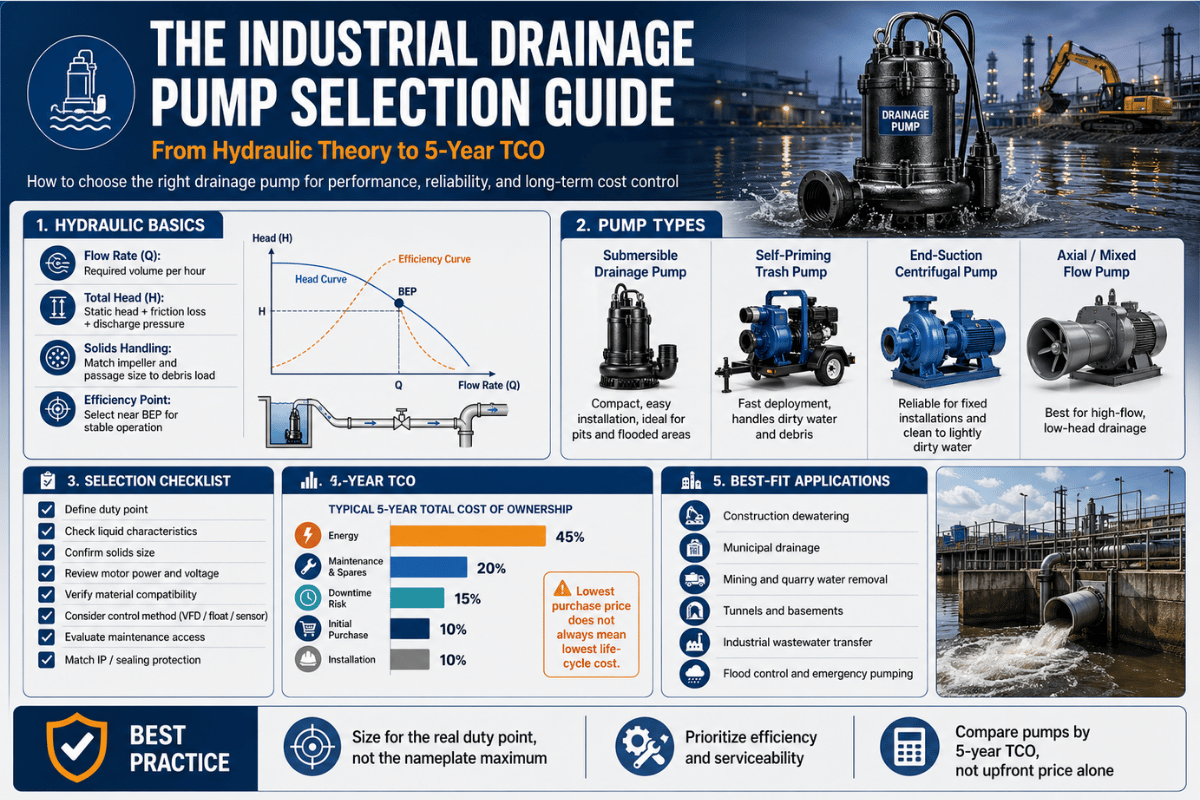
The Industrial Drainage Pump Selection Guide: From Hydraulic Theory to 5-Year TCO
A drainage pump is the workhorse that decides if a construction excavation remains dry, a stormwater station manages an entire city to the 6-month average, or the irrigation district gets the water moving on time. Use the wrong one and you get parallel-stack maintenance, energy cost above your forecast, and unscheduled outage during that flood you most need uptime. This little pocket guide takes an engineering buyer through what the drainage pump is, the 4 pump classes competing for it, how to size one with real Total Dynamic Head and NPSH math, and what 5-year Total Cost of Ownership really looks like when you stop counting invoices. For projects combining pumped drainage with runoff attenuation, compare stormwater attenuation systems from Storm Manage against the required storage volume and controlled discharge, then size the pump for the resulting hydraulic duty.
Quick Specs — Industrial Drainage Pump (Reference Envelope)
| Flow range | 500 – 35,000 GPM (industry-wide envelope; single pump) |
| Head range | 10 – 70 ft per stage (mixed-flow); higher with multistage |
| Efficiency | 45 – 82% (varies by hydraulic class and duty point) |
| Service life | 5 – 25 years (varies by motor location and abrasive duty) |
| Solids handling | Up to 50 mm (suspended, depending on impeller design) |
| Reference standards | ISO 9906:2012 Grade 2B (performance test) · ISO 21940-11 G6.3 (impeller balance) · ANSI/HI 9.6.1-2017 (NPSH margin) · ASTM A48 Class 35 (cast iron volute) |
What Is a Drainage Pump? Working Principle and Where It Sits in the Pump Taxonomy
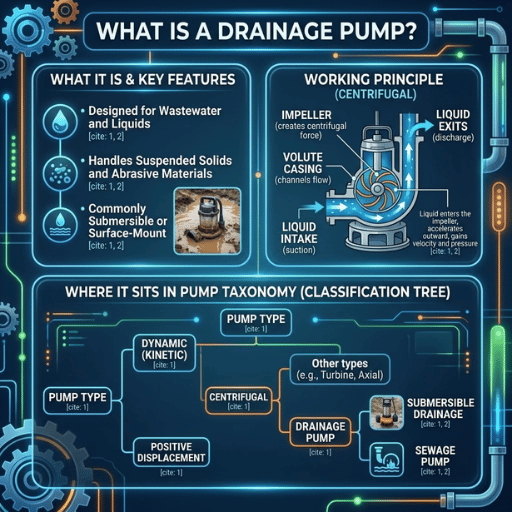
A drainage pump is a “rotodynamic — that is, a centrifugal” machine designed for high-flow, low-to-medium head application to remove water. KSB’s Centrifugal Pump Lexicon defines it as a pump used for “draining pits and deep roadway underpasses, as well as for dewatering basements and courtyards subject to a flooding risk or groundwater” — started automatically via float switches, handling water whose particle size depends on the impeller geometry, while using the usual impeller spinning inside a volute to convert rotational motion into velocity then pressure head.
Two basic families dominate: the dry-installed motor assembly suspended over the impeller by a long column with the motor air-cooled above, or the submersible motor pump entire assembly sunken into the medium, with an oil-filled motor sealed using a set of mechanical seals and A rings in an intermediate chamber filled with oil or grease for inventory and leak detection. According to that same lexicon, dry motor pumps are “increasingly being replaced by submersible motor pumps” as the choice for portable applications like dewatering large excavations, though an above-ground motor-pump combination has advantages for long-stroke, abrasive duty in permanent deployments.
In the larger pumpduty taxonomy, drainage pumps handle medium to high flows at a range of moderate head, falling athwart axial flow propeller pumps running at very high flow rates at near-zero head, and end-suction centrifugal pumps handling moderate flow rates at high head. That high-flow, moderate-head intermediate band is where drainage pumps live, and where you have the greatest variety of submersible horizontals and in-line mixed-flows to pick from.
Drainage Pump vs Sump Pump vs Dewatering Pump vs Trash Pump: A 4-Class Decision Matrix
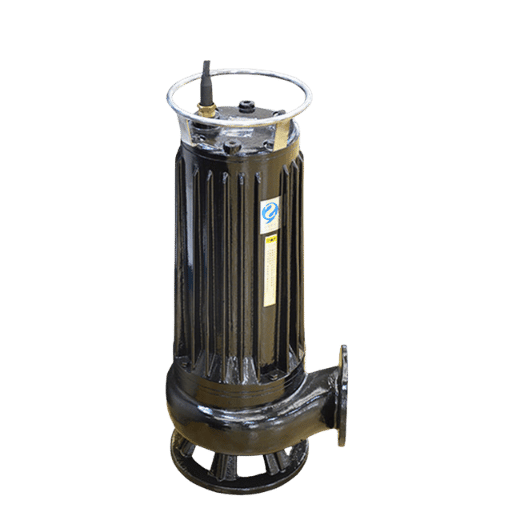
Though the names get bandied about interchangeably in market talk, they are separate pump families duty-bound to different places. Picking the wrong one accounts for the single most procurement problems on public and private projects, especially when teams treat drain pumps and dewatering pumps as interchangeable. A matrix below helps separate them by the variable that actually influences the purchase decision: duty point and duration.
| Attribute | Drainage Pump | Sump Pump | Dewatering Pump | Trash Pump |
|---|---|---|---|---|
| Typical flow ceiling | 500 – 35,000 GPM | Up to 80 GPM (residential) | 60 – 6,100 GPM | Up to 2,000 GPM |
| Typical head ceiling | 10 – 70 ft per stage | 15 – 25 ft | 40 – 325 ft | Up to 100 ft |
| Solids handling | Up to 50 mm | Clean water only | Up to 12 mm | Up to 75 mm (semi-trash) |
| Continuous duty | Yes — designed for 24/7 | Cycling only | Yes with derating | Project duty (3-36 mo) |
| Best fit | Municipal stormwater · permanent industrial | Residential basement · light foundation | Construction sites · short-term mine | Debris-laden flood response |
The 4-Class Decision Rule
- Long-term duty (about 6 months, continuous) of above 1,000 GPM drainage pump (horizontal mixed-flow or large submersible drainage)
- Long-term duty (about 6 months, continuous) of residential basement or light foundation drainage sump pump (residential category, not what this guide is about)
- For project-bounded construction (3-36 months) on relatively clean groundwater dewatering pump (often submersible drainage of similar hydraulic class)
- For debris-laden water – leaves, sticks, mud chunks >25 mm trash pump or semi-trash pump (different impeller geometry, lower efficiency, but won’t clog)
One surprisingly counterintuitive gem: one single, 8,000 to 19,000 GPM trailered horizontal mixed-flow drainage pump frequently replaces a four-to-six-pump submersible array on a construction dewatering job of comparable duty. A dry-motor setup avoids submerged windings, removes annual hoist-and-inspect cycles, and runs from a single electrical starter instead of four – fewer cables, fewer thermal overloads, fewer single-points-of-failure during a heavy rain. This is not the average site super’s first instinct when running parallel-stack submersibles, but it can matter.
Drainage Pump Types by Hydraulic Geometry: Submersible, Horizontal Mixed-Flow, Axial-Flow, End-Suction
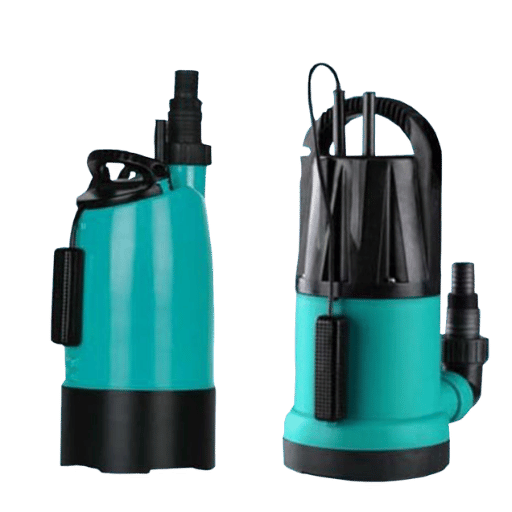
Drainage pump suppliers tend to sell by configuration (submersible vs surface-mounted), but the real engineering discriminator is hydraulic shape – how the impeller re-directs the water. Each shape has a different flow-vs-head dimenisonality, a different efficiency column, and a different fit for the solids or abrasives load. Four shapes represent roughly 95% of the market.
1. Submersible Drainage Pump
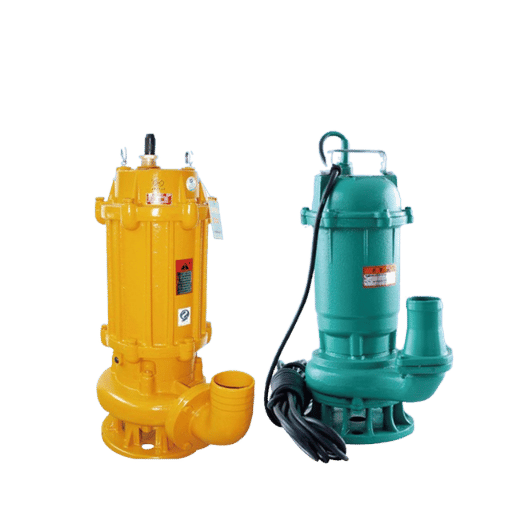
Impeller and motor come out of the factory as one sealed unit, and drops directly into the water. Industry data shows a clear trend for deployment of the submersible pump in these environments: search demand for “submersible drainage pump” soared from 2025 onwards, Atlas Copco offers 23-model WEDA D-series ranges covering 60-6,100 GPM and 40-325 ft of head, and reliability is not an issue, because these are the fastest to deploy – drop, plug, run – and has native portability. A downside surfaces in the 5-10 year service life, because of the hostile environment for the windings, and the additional cost of annual drop-and-lift inspection.
2. Horizontal Mixed-Flow Drainage Pump
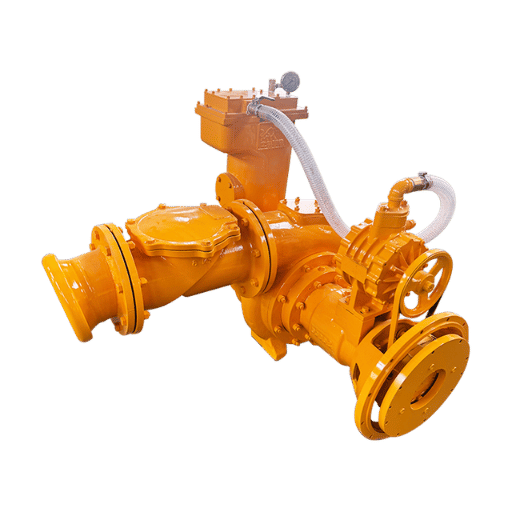
Impeller re-directs flow at an angle to the shaft, loading the inlet with axial thrust and the outlet with radial pressure. Motor is situated on a steel baseplate out of the water, above the impeller. This shape yields higher flow than an end-suction centrifugal of the same head dimension, and more head than a plow propeller pump. Industry references suggest four covers from roughly 500 to 100,000 GPM at up to 70 ft per stage – broad enough to cover most municipal drainage stations and floater deployment. BBP’s AHW horizontal mixed flow series covers an 8-model band from 150AHW (634-2,378 GPM, 12-34 ft of head), to 600AHW-5 (12,680-34,870 GPM, 19-28 ft of head), efficiency 72-82.1%, and the typical service life is 15-25 years when the dry motor not in contact with the abrasive environment.
3. Axial-Flow Propeller Pump
Pure axial geometry – flow lives in the tube like an airplane propeller in a tube. It flows with near-perfect parallel alignment to the shaft, kind of project-specific with lots of flow and very little pressure (current industry trend is sub 25 ft per stage). It is ideal for the outfall station that empties into a navigable location like a river or navigation canal, but not when the discharge piping effectively pushes the water back up the river.
4. End-Suction Centrifugal
End-suction is the most common pump geometry overall: water enters at the impeller eye and exits through a tangential volute. End-suction Centrifugals can go much higher head/stage(stages up to 500 feet) with better efficiency but blow their wad in terms of suspended solids. They show up in drainage lineups for clean-water transfer (HVAC condensate return, industrial process water) but are out performed by mixed-flow for stormwater duty.
✔ When Mixed-Flow Wins
- Continuous duty 3+ months on one job
- Flow above 3,000 GPM (parallel submersibles become a logistics burden)
- Abrasive water with silt or grit: the dry motor stays out of the wear environment
- Head requirement of 20-60 ft, the band where submersible efficiency drops off
⚠ When Mixed-Flow Loses
- Heads over 70 ft: a multistage submersible or an end-suction centrifugal pump
- Single small flooded basement under 300 GPM – compact submersible is less expensive and easier to install
- Deep wells: air pressure can lift water only about 30 ft in practice (34 ft in theory); beyond that, surface pumps cannot prime, so a wellpoint or borehole pump is necessary.
- Chemically aggressive fluids: choose a chemical pump or duplex stainless steel construction.
📐 Engineering Note: Impeller Balance
Minimum specification for industrial drainage pumps to specify ISO 21940-11 G6.3 impeller balance. Unbalance level below G6.3 accelerates bearing damage and kills service life during continuous duty. Mill Test Certificates from the equipment OEM should specify the actual measured residual unbalance, not the spec class – request the report at quote stage.
Where Industrial Drainage Pumps Excel: 5 B2B Application Profiles
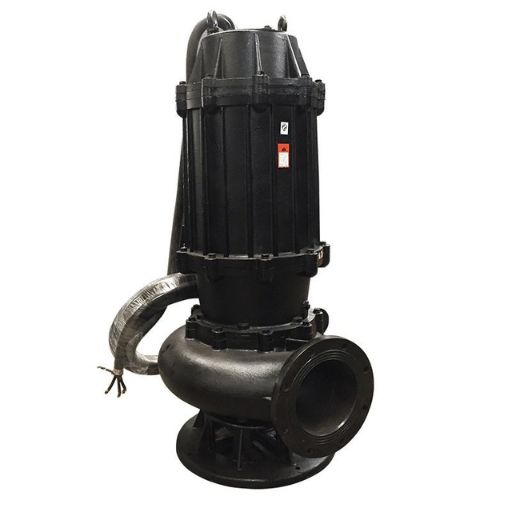
Industrial drainage pumps appear in five recurring duty profiles. Each has a different flow-head envelope, a different relevant standard, and a different tolerance for downtime. Knowing which one your project belongs to is the single fastest way to narrow the model shortlist.
What Is a Drainage Pumping Station?
A drainage pumping station is a permanent civil-works installation that lifts collected stormwater, sanitary overflow, or combined-sewer flow from a low-elevation collection point over a hydraulic obstacle — often a levee, an outfall box, or a discharge pipe to a river or canal. Stations exceeding 1,000 cubic feet per second are governed by Water Environment Federation Manual of Practice FD-4. Typical capacity for a municipal stormwater station runs 5,000-25,000 GPM with 15-40 ft of lift to outfall, served by two or more redundant pumps to ensure 24/7 availability during storm events. Modern stations include variable-frequency drive controls, level-sensing automation, and trash-rack pretreatment to extend impeller life.
1. Municipal Stormwater & Flood Control Stations
Continuous 24/7, fixed installation. Typical envelope: 5,000-25,000 GPM at 15-40 ft head. Permanent stations dedicated to city drainage networks, storm drain trunk lines, sanitary sewage overflow relief, levee districts, and river-outfall boxes. Design references include WEF FD-4 and the San Diego Stormwater Pump Station Design Guidelines (January 2024). NOAA’s National Centers for Environmental Information reported in late 2025 that several US locations experienced “1-in-1,000-year rainfall recurrence intervals” during the year, which is rapidly outpacing the design assumptions in older stations and accelerating capacity expansion programs nationwide.
2. Mine, Quarry & Pit Dewatering
Intermittent duty, hybrid trailered + fixed. Typical envelope: 3,000-15,000 GPM at 20-55 ft head. Aggregate quarry pits, coal mine face rooms, and open-cut sediment dams where surface runoff has infiltrated subsurface aquifers. Sand and silt content make submerged impeller faces a poor choice – dry-motor mixed-flow extended the service interval by a factor of five. Mine dewatering procurement schemes, however, stress field performance over lab-centered curves, because abrasive duty makes the published efficiency optimistic.
3. Agricultural Irrigation & Drainage
Seasonal, fixed installation. Typical envelope: 2,000-8,500 GPM at 15-31 ft head. Headworks stations to rice paddies, district irrigation canals, and field drains during monsoons. Peak efficiency for the 250AHW class hits up to 82.1% over the 2,378-8,560 GPM window where most mid-sized irrigation headworks exist. Over a twenty year life cycle, the differential between a 65%-efficient station and an 82%-efficient station accumulates to six-figure grid power savings per installed unit.
4. Construction Site Dewatering
Project duration 3-36 months, trailered. Typical envelope: 8,000-19,000 GPM at 21-34 ft head. Construction sites and civil project excavation dewatering, foundation pit water reduction, trench drainage. Civil engineers participating on Eng-tips have documented that dewatering a 15’15’10’ excavation produces lateral water table response and drawdown that impacts neighboring foundations – pumping capacity alone does not define the dewatering duty; soil hydraulic characteristics and neighboring infrastructure responses also limit the task. A single trailered AHW station on a 10,000 GPM duty substitutes for a quad-valve submersible arrangement, trimming the wire runs, starter panels, and hoist work that thereupon silently swells the project budget.
5. Industrial Cooling Circuits & Process Water
Continuous, fixed installation. Typical envelope: 2,500-12,000 GPM at 25-50 ft head. Industrial process cooling loops, product transfer means, power plant heat dumping, food preparation – process wastewater switching and rerouting. Over ninety-five percent uptime is possible with packing replacement and bearing renewal conceived into planned plant trips rather than considered a surprise outage.
How to Size a Drainage Pump: Flow, Total Dynamic Head, NPSH, and Duty Cycle
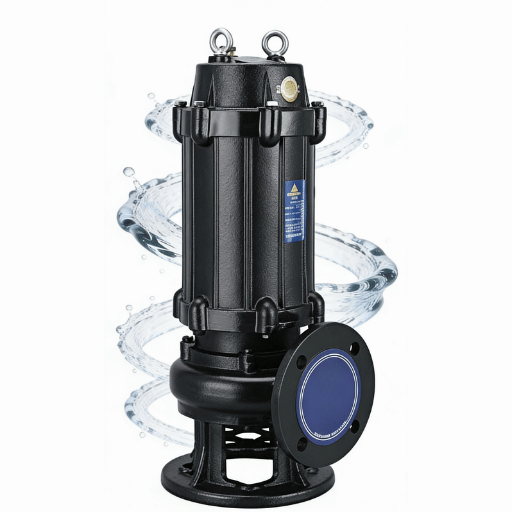
Pump selection is reduced to two integers which the supplier asks only for and one that he hopes you will ignore: required rate of flow, Total Dynamic Head (TDH), and Net Positive Suction Head Available (NPSHa). Providing all three will ensure that your pump will run on the efficiency curve for fifteen years. Underestimating NPSHa or misjudging the hydraulic head balance will generate cavitations within months, regardless of the manufacturer brand sticker on the frame.
Total Dynamic Head — The Sizing Workhorse
Total Dynamic Head is what the pump actually has to lift, and it has three components. A generic formula goes:
TDH = Static Head + Friction Head Loss + Pressure Head
Static Head is the vertical distance from the reservoir surface in the suction basin to the discharge point. Friction Head Loss is the power the water uses to slam on the pipe wall with its collision with pipe wall, components, valves, and the outfall discharge nozzle to to field – derived from pipe length, internal diameter, roughness coefficient, and velocity through the Hazen-Williams or Darcy-Weisbach relationships. Pressure Head is valid when the discharge enters a pressurized receiver (a header pipe, a cooling tower distribution box, or a closed tank), and is zero when the outflow is to the open air below.
A worked example: a stormwater station lifts water 25 ft from sump bottom to outfall (Static=25 ft), through 800 ft of 12-in ductile-iron pipe with two 90 elbows and a check valve at 5,000 GPM (Friction Loss 13 ft using standard Hazen-Williams tables for C=120 pipe), discharging to atmosphere at the river bank (Pressure Head=0 ft). Total Dynamic Head=25+13+0=38 ft. Duty point lands at 5,000 GPM and 38 ft TDH- squarely in the 250AHW or 300AHW range.
NPSH and Why It Matters More Than Anyone Mentions
Net Positive Suction Head Available (NPSHa) is the absolute pressure available at the pump inlet, expressed as feet of water column, deducting vapor pressure and friction on the suction side. Required NPSH (NPSHr) for any pump is published on the manufacturer’s curve at every flow rate. ANSI/HI 9.6.1-2017 (updated to 2024), issued jointly by the American National Standards Institute and Hydraulic Institute, defines the NPSH margin- the safety buffer between available and required – and recommends margin ratios from 1 to 5 the NPSHr value depending on suction energy level. Translation: for a typical municipal duty plan NPSHa to exceed NPSHr by at least 3 feet, and ideally more for high-suction-energy installations such as long suction pipe runs or hot water service.
Sizing Checklist (Take to RFQ)
- Required flow rate at peak storm or maximum project demand (GPM, with motor HP/kW assumption noted)
- Static head: vertical lift from sump bottom to discharge point ft
- Discharge pipe: total length, internal diameter, material, fitting count
- Suction conditions: flooded suction or suction lift; pipe length, diameter
- Water temperature and specific gravity (clean water = 1.0; abrasive sediment higher)
- Solids description: maximum particle size, abrasive vs neutral, fibrous vs granular
- Duty cycle: continuous, intermittent, emergency standby
- NPSHa calculated for worst-case suction (lowest sump level + highest water temperature)
- Available power: voltage, three-phase electric power, frequency, generator vs grid
- Local code or design standard (WEF FD-4, ASCE, state stormwater code)
What Type of Pump Is Best for a Basement-Class Lift Station?
That phrase “basement drainage” usually means residential- and there a sump pump suffices, often a simple submersible cycling 15-25 GPM. A B2B equivalent surfaces in the basement-class lift station: a small commercial or institutional building (parking garage, hospital sublevel, data center mechanical room) where graywater or fire-sprinkler discharge needs to be lifted to grade-level sewer. For these, a paired submersible drainage pump installation with float switches, check valves, and a redundant secondary pump is the pattern. Flow runs 50-200 GPM at 20-40 ft of head, well below industrial drainage pump territory but above what a residential sump pump can sustain. Key spec: continuous duty rating (residential pumps are intermittent only), and an automatic transfer switch so the secondary pump activates when the primary fails.
Drainage Pump Cost & 5-Year TCO Framework: Where the Money Actually Goes
Procurement teams that price-shop on initial pump cost will tend to pay for the same pump twice. Hydraulic Institute pump-pros lifecycle data-from industrial pumping system surveys-show that “the initial price of a typical medium size industrial pumping system is only about 10 percent of its total cost” over a 15-to-20-year service life. Roughly 90 percent of TCO is energy, maintenance labor, downtime cost, and spares logistics. Five components matter enough to model.
| TCO Component | Typical Share | What Drives It |
|---|---|---|
| Initial purchase | ~10% | Pump body + motor + baseplate + ancillary controls |
| Energy | 40-60% | Hours of operation × kW (1 kW = 1,000 watts) absorbed × $/kWh; efficiency at duty point matters more than nameplate rating |
| Maintenance labor | 15-25% | Bearing replacement, packing reseat, seal service, inspection cycles, hoist labor for submerged units |
| Downtime cost | 10-20% | Project delay, regulatory fines for overflow events, emergency rental fees |
| Spares logistics | 5-10% | Lead time on impellers, motor assemblies, bearing kits; warehouse stocking decisions |
Energy is usually where the wrong pump quietly throws away the largest amount of money. A pump at 60% efficiency versus one at 82% efficiency has a 37% greater electrical power penalty at equal duty. On a 100 kW continuous duty, 8,000 hours/year at $0.10/kWh that efficiency differential equates to roughly $30,000 of preventable energy cost per year — and the differential multiplies out across the 15+ year service life of a properly-designed dry-motor unit.
“On a 24/7 storm water duty, the dry-motor horizontal mixed-flow pump’s largest TCO advantage isn’t capex-It’s that the operations team stops hoisting submersibles out of the wetwell twice a year for seal inspection. Labor and downtime delta pays back the price premium inside 18 months in our experience”.
Regulatory factors are magnifying the energy line. On the US side, DoE rulemaking for pump efficiency (10 CFR Part 431) mandates Pump Energy Index (PEI) labelling on scope clean-water pumps. In Europe, Commission water-pump regulation (EU 547/2012) bars sale of pumps with a Minimum Efficiency Index below MEI 0.4 in the EU — in force since January 2015 and tightening across product categories. Separately, EU Regulation 2019/1781 mandates IE3 minimum efficiency class for electric motors of 0.75 kW or higher (since July 2021) and IE4 class for electric motors of 75 kW or higher (since July 2023). Thus all pump packages brought into the EU inherit those motor requirements, regardless of the status of pump regulation.
Common Drainage Pump Problems: Cavitation, Seal Failure, and the Maintenance Schedule That Prevents Them
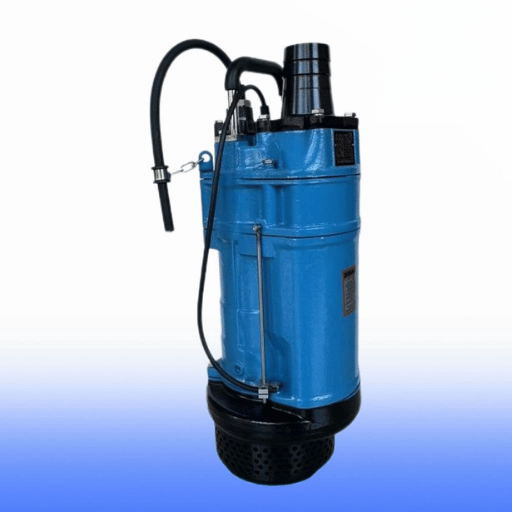
Failure modes dominated industrial pump failures. According to Pump & Systems trade analysis, the canonical industrial pump failure modes are cavitation, gasket or seal leaks, bearing failure, impeller damage or wear, and motor burnout. Of those, four are preventable through deployment of a correct maintenance regime. One mode that isn’t-can’t-be-prevented: cavitation. That can only be avoided if the pump was correctly sized at the outset—which is where proper understanding of pump application and load dynamics is more relevant that warranties lifetime.
What Is Pump Cavitation and How Do You Avoid It?
Cavitation occurs when a drop in pressure at the impeller eye falls below water’s vapor pressure, vapor bubbles form, then implode violently as they hit higher pressure regions of the volute. This implosion erodes the impeller and casing surfaces. Two main causes drive it: inadequate downstream pressure (discharge cavitation) and unacceptable recirculation within the pump (discharge cavitation). Avoidance method-cavitation mitigation- is structural. Maintain Net Positive Suction Head Available(Versus Net Positive Suction Head Required) margin as defined by ANSI/HI9.6.1-2017 (usually 1 to 5 net positive suction head required depending on upstream energy level); operate the pump on or just downstream of your Pump’s Best Efficiency Point on the performance curve; don’t throttle the discharge more 30% of your pump’s design flow for extended periods. Mechanical-eating indicators gravel-in-the-volute, vibration, and premature impeller pitting-show up long before disaster-Theimminent falling apart-making it clear you need to stop operation until you’ve intervened, if someone was watching
How Long Do Drainage Pumps Last?
Service life depends primarily on motor environment and abrasive duty. Industrial dry motor horizontal pumps in clean stormwater duty will, with a state-of-the-art seal arrangement, hold up approximately 15-25 years before you have to consider a full overhaul or new replacement, provided you pay attention to your bearing service interval. Those same OEMs delivering clean stormwater duty will provide submersible drainage pumps that will hold up approximately 5-10 years in the same abrasive media in before they will require you to destroy and replace, again assuming you keep up with your bearing service interval. Mileage in between depends on duty cycle, water chemistry, loading of solids, discipline of the maintenance program. As a conservative procurement estimate assume 15-20 years for a dry-motor on clean water, 6-8 years for a submersible on abrasive duty, and negotiate with your supplier accordingly. Keep a wear-trend service agreement that catches problems not long after they occur, not months or years after.
📐 Engineering Note: Maintenance Interval Reference
A conservative schedule for a dry-motor continuous-duty drainage pump (assumed horizontal, ground mounted) – daily visual inspection, monthly vibration and bearing temperature, best practices for packing reseat – 3,000-5,000 hours, best practices for bearing grease – 4,000-6,000 hours, full bearing replacement – 30,000-50,000 hours, best practices for impeller inspection – 5-year overhaul plan. For submersibles, add an annual hoist-and-inspect cycle and a seal-chamber oil check every 1,500-2,000 hours. Calibrate this schedule to the duty others observe – abrasive water feeds, frequent starts, and longer off-curve operation all tend to increase wear.
Common Errors That Cause Premature Failure
- ✔
Error #1: stacking parallel submersibles when one larger drainage pump fits the duty — power cord runs, cable channels and starter panels accumulate failure points; one parallel unit dies during a storm and the others overload - ✔
Error #2: NPSHa miscalculated for worst-case suction lift — lowest sump level combined with highest water temperature produces the actual minimum NPSHa, not the nameplate condition - ✔
Error #3: mechanical seal specified for abrasive duty when packing-gland is the right answer — fine silt and sand destroy mechanical seal faces; packing gland tolerates the abrasive duty with periodic adjustment - ✔
Error #4: soil-type ignored in dewatering sizing — clay-heavy soils with low hydraulic conductivity make pump capacity meaningless; the field constraint is how fast water moves through the soil to the pump intake, which the pump cannot fix - ✔
Error #5: check valve undersized or installed backward — water hammer on shutdown destroys impellers within months; the valve has to open at the design flow without flutter
Procurement Checklist: 12 Specs Every Drainage Pump Buyer Should Verify Before Signing
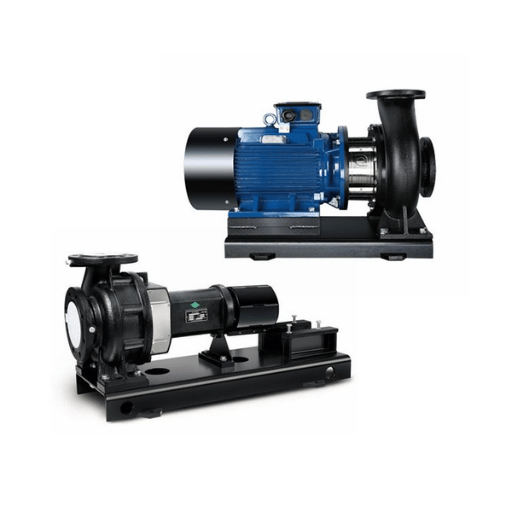
Specification points that make the difference between a 15-year pump and a 5-year pump are often 12 questions that the buyer asks on the RFQ or fails to ask, and later finds out. Each of these points has a quantifiable answer documented on the Mill Test Certificate, on the performance curve, and in the applicable standard. Demanding the conditions for procurement.
The 12-Spec Drainage Pump Buyer’s Audit
- Performance test grade: ISO 9906:2012 Grade 2B (16%flow / 10%head tolerance) is the modern minimum; Grade 3B (18%/14%) is acceptable for low-criticality duty but ask why
- Impeller balance: ISO 21940-11 G6.3 minimum for industrial duty; demander measured residual unbalance on the test report, not just the spec class
- Impeller material: ASTM A48 Class 35 cast iron equivalent for general duty; duplex stainless 2205 or CF8M if chemical or marine duty
- Electric motor efficiency class: IEC 60034-30-1 IE3 minimum (IE4 for 75 kW if you are in the EU); request copy of nameplate
- Seal arrangements: packing gland for abrasive silt; mechanical seal for clear water; double mechanical for chemical duty, match medium, not price point
- Bearing series & arrangement: same specific brand and number for both bearings; custom bearing grease specified – the spare availability not just spec
- Minimum NPSH margin requirement: ANSI/HI 9.6.1-2017 (2024 update) compliance, with NPSHa-vs-NPSHr margin documented at design point and similar worst-case suction configuration.
- Performance curve at design point: not just shutoff and shutout, but the actual measured curve through the operating band.
- Mill Test Certificate fields: material composition, hardness testing, wall thickness measurements, hydrostatic test results, factory acceptance test sign off.
- Machined spare parts kit and delivery lead time: impeller, bearings, seal, packing, gaskets.
- Warranty terms in writing: what is covered, what causes voids, what the supplier’s response time is for failure events.
- Reference installations: three references in your duty band, with permission to call.
Industry Outlook 2025-2026: Climate Drivers, Standards Evolution, and Energy-Efficiency Rules
Three forces are converging to transform the industrial drainage pump market through 2026. For capital project managers specifying drainage equipment in the next 12-18 months, the practical move is to bake each one into the specification up front rather than discover them after installation.
Climate Driver: Storm Intensity Outpaces Design Standards
NOAA National Centers for Environmental Information tracked that 2025 produced”1-in-1,000-year rainfall recurrence intervals” in various US locations, delivering an infrastructure deluge built to meet 20 th century/old world design assumptions. Academic independent climate research (Nature Scientific Reports, 2023) concluded that’more than three-quarters of the US population will likely be exposed to the upward trend in extreme-precipitation regimes as the new norm’. Translation for stormwater designers:the design flow that justified an existing pumping station ten years ago is probably the new’typical storm’ and the design flow for the next station should be anchored to the modified NOAA Atlas database and not the legacy assumption.
Regulatory: Energy Efficiency Floors Tightening Globally
US Department of Energy pump efficiency rules under 10 CFR Part 431 mandate Pump Energy Index nameplate marking on clean-water pumps in scope, which functions as procurement transparency. In the European market, the EU water-pump Ecodesign Regulation (547/2012) maintains the MEI 0.4 floor that was adopted in 2015 and the concurrent European Union (EU 2019/1781) requires IE4 minimum efficiency class for motors ≥75 kW from July 2023. Practical impact: pump packages for European install already work from a far higher energy-efficiency baseline, and buyers in unregulated market segments are experiencing closer-to-normal energy-efficiency savings, albeit absent of the mandated levels of compliance overhead, by voluntarily specifying these floors.
Market: Dewatering Pump Demand Accelerating
Market analysis projects the global dewatering pump segment to grow from approximately 3.78 billion dollars in 2024 to 6.27 billion dollars by 2032, on a CAGR of close to 7.7%. In North America industry market analysis, the overall US pump market is projected to grow from an estimated 25.9 billion dollars in 2025 to an estimated 54.9 billion dollars by 2035, accelerated by green infrastructure modernization programs and climate resilience capital deployment. Practical impact: industrial drainage pump bodies will have longer lead times due to demand exceeding existing capacity. Capital equipment procurement managers deploying in 2026 should therefore aim to ‘spec and order’ pipelines 4-6 months in advance of historic lead times.
Standards Evolution: ANSI/HI 9.6.1 and ISO 9906
In 2024, American National Standards Institute and the Hydraulic Institute jointly,improved the American standard NPSH margin standard ANSI HI 9.6.1 and optimized suction-energy classification methodology and recommended margin ratios. Manufacturers delivering in 2025-2026 should check to ensure the updated standard is called out explicitly in the performance curves and acceptance tests. ISO 9906:2012 remains the rotodynamic pump performance test standard across diverse jurisdictions with Grade 2B being the procurer-default tolerance class; buyers must check the test grade is correctly called out in the contract documents.
FAQ: Drainage Pump Questions Buyers Actually Ask
Q: Are drainage pumps required by code?
View Answer
It depends on jurisdiction and application. International Plumbing Code requires drainage pumps for any fixture located below the gravity-flow sewer level. Stormwater pumping stations are governed by state stormwater management codes plus local design guidelines such as the San Diego Stormwater Pump Station Design Guidelines (January 2024). For fire-suppressing buildings, NFPA Regulations and local codes add specific procedure in the fire-pump and sub-grade dewatering environment. Check with the authority having jurisdiction before you size.
Q: What’s the difference between a drainage pump and a stormwater lift station?
View Answer
A drainage pump is the mechanical equipment. A stormwater lift station is the civil-works facility that contains one or more drainage pumps plus sump, intake screening, controls, generator backup, and discharge piping. One station can contain two to six drainage pumps for redundancy.
Q: Can a drainage pump run continuously?
View Answer
Industrial drainage pumps are rated for continuous duty. Residential sump pumps are not – they are rated as intermittent-duty and burn out if run continually. Look at the manufacturer’s data sheet for the duty classification, then look for “S1” continuous duty, on industrial units, or “S3” or “S2” for intermittent or short time duty.
Q: How is drainage pump efficiency tested?
View Answer
Factory acceptance tests (FAT) under ISO 9906:2012. Standard specifies three tolerance classes: Grade 1B/1E/1U (tight, 10% flow / 6% head), Grade 2B/2U (broad, 16% flow / 10% head) and Grade 3B (18% flow / 14% head). Industrial procurement assumes a modern minimum of Grade 2B.
Test reports should be supplied with the Mill Test Certificate at delivery and must include the actual performance curve.
Q: What spare parts should I stock for a 24/7 drainage pump?
View Answer
A stock list tested in the field of one single primary duty unit: an entire impeller, a bearing kit (front and rear), a mechanical seal kit, a gasket kit, an electric motor coupling assembly, a float switch with power cord. For mission critical stations without a backup pump, include an entire rotating element assembly (shaft+impeller+bearings pre-assembled) in the expect rebuild time of 4 hours not 4 days
References & Sources
- Understanding the 2024 Updates to ANSI/HI 9.6.1 Rotodynamic Pumps Guideline for NPSH Margin — Hydraulic Institute
- Pump Pros Know — Lifecycle Cost Analysis — Hydraulic Institute
- ISO 9906:2012 Rotodynamic Pumps — Hydraulic Performance Acceptance Tests, Grades 1, 2 and 3 — International Organization for Standardization
- 10 CFR §431.466 — Pumps Labeling Requirements — U.S. Department of Energy / eCFR
- Water Pumps Ecodesign Regulation (EU 547/2012) — European Commission
- Commission Regulation (EU) 2019/1781 — Ecodesign Requirements for Electric Motors (IE4) — International Energy Agency / European Commission
- Assessing the U.S. Temperature and Precipitation Analysis in 2025 — NOAA National Centers for Environmental Information
- Exposure of the US Population to Extreme Precipitation Risk — Nature Scientific Reports
- Cavitation: A Sign of an Inadequate Pump or System Design — Pumps & Systems
- How to Quickly Calculate a Centrifugal Pump’s Total Dynamic Head — Pumps & Systems
About This Selection Guide
This guide draws on BBP’s AHW horizontal mixed-flow drainage pump production data, ISO 9906:2012 Grade 2B factory acceptance testing discipline, and the field-deployment patterns observed across stormwater, mine dewatering, and construction site projects. Where regulatory frameworks (US DOE 10 CFR 431, EU 547/2012, EU 2019/1781) or technical standards (ANSI/HI 9.6.1-2017 updated 2024) apply, we cite the source documents directly so buyers can verify before committing capital.
Related Articles
- Horizontal split case pump engineering guide for HVAC and firefighting duty
- Submersible slurry pump applications and selection
- Mining slurry pump field guide
- High chrome slurry pump metallurgy and wear performance
- Rubber lined slurry pump selection for abrasive duty
- Dredge pump wear parts and replacement intervals
There are many factors that would go into a sizing recommendation, be a performance curve, or a 5 year TCO comparison for your particular duty point.
Send the duty profile (flow, head, runtime, current pump configuration), the BBP engineering team will then send the duty-point sizing and TCO comparison back in 48 hours. Performance tables for the AHW horizontal mixed-flow drainage pump can also be seen.