Get in Touch with BBP

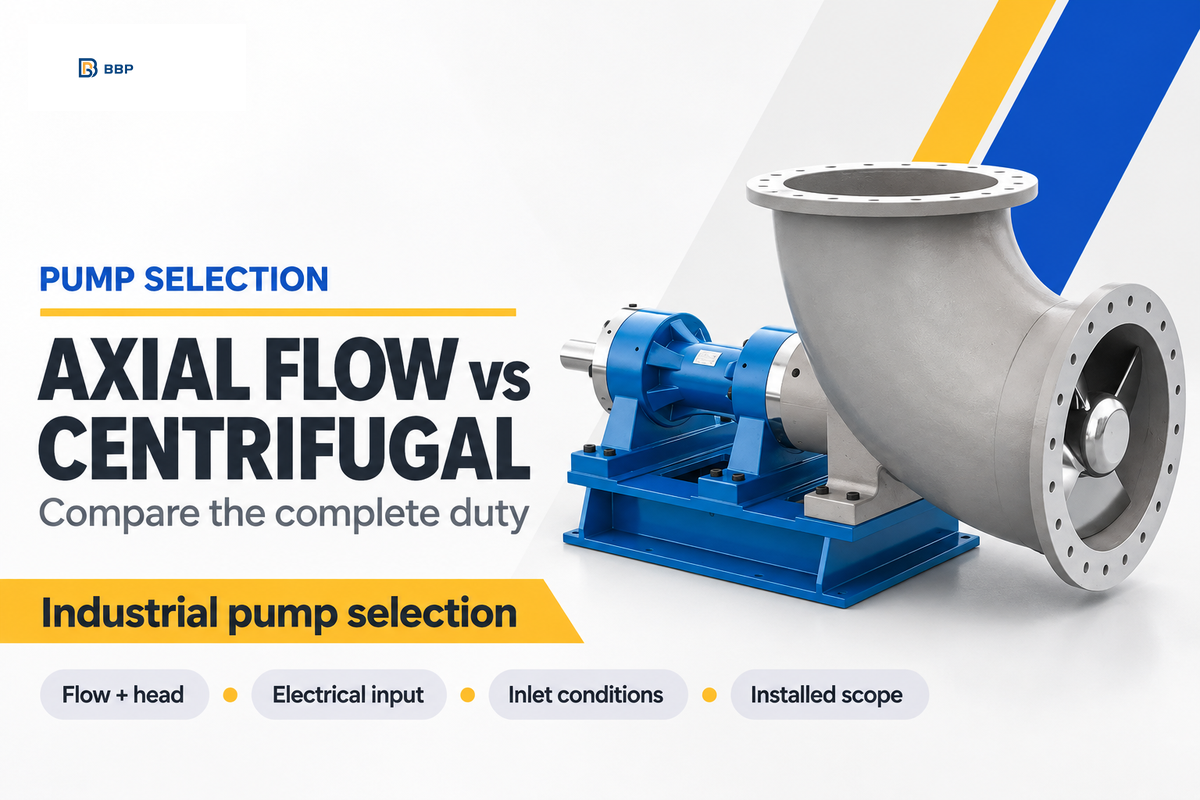
A comparison of axial flow pump vs centrifugal pump begins with the water you have to convey (flow, total head) and changes that occur during operation. Axial styles work for higher flow rates at low pressure. Radial centrifugal styles cover many pressure duties. The purchasing decision is made based on how well offered curves cover the complete service.
Quick selection brief
- Axial: high flow capacity at relatively low head, with impeller flow mainly along the shaft.
- Radial: impeller discharge primarily across the shaft. Strong consideration when pressure requirements are dominant.
- Compare: simultaneous flow and head, input power, inlet conditions and permitted operating range.
- Keep separate: hydraulic family, installation layout and the electrical efficiency boundary.
Selection of axial flow pump vs centrifugal pump is a comparison of hydraulic fit. Start with axial for high flow at lower total heads and radial for pressure duties. The selected configuration has to cover all the required duties with proper inlet conditions and electrical load.
Key takeaways
- Reducing discharge flow can increase the load on an axial pump at fixed speed and blade pitch.
- A changing river level doesn’t automatically make mixed flow the better choice.
- Compare electrical kilowatts at equal water delivery before estimating annual cost.
- A certified curve identifies the purchased pump configuration more closely than a product-family curve.
Axial vs Radial Flow: What Changes Inside the Pump
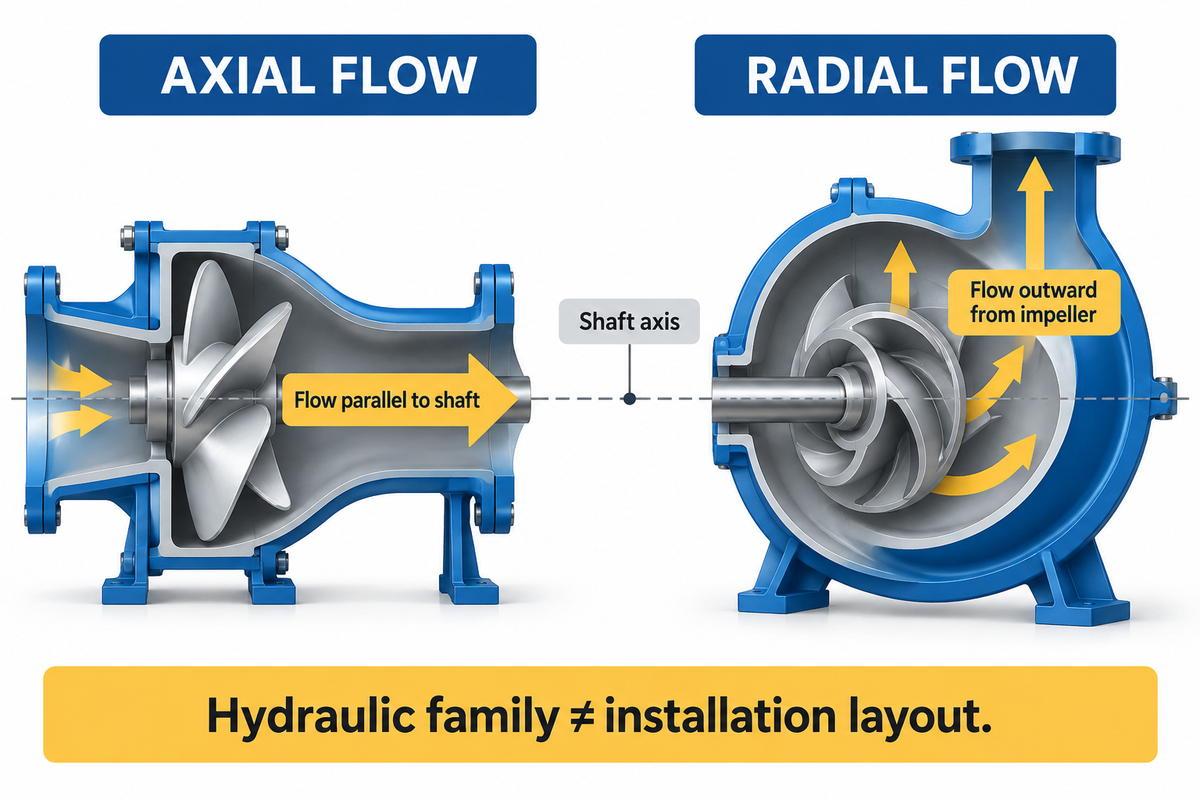
Axial and radial flow describe how liquid leaves the impeller relative to the pump shaft. An axial flow pump moves fluid parallel to the pump shaft; a radial pump discharges outward. Axial and radial flow pumps transfer rotational energy to liquid, but their impeller geometry produces different combinations of flow, head and absorbed power.
Terminology varies. Some suppliers classify an axial flow centrifugal pump as a type of centrifugal pump; others use centrifugal for radial designs. This article uses radial centrifugal for the comparison. The University of Florida’s pump classification includes radial, axial and mixed flow in the centrifugal family. For the basic construction, see BBP’s axial flow pump working principle and layouts.
What is the difference between radial and axial centrifugal pumps?
The difference is the flow direction through the impeller: radial impellers discharge outward, while axial impellers move liquid along the shaft. Radial centrifugal pumps use a rotating impeller and a volute or diffuser to develop useful pressure. An axial pump’s propeller-like impeller produces lift through its blades and commonly handles high flow rates at low head.
The working principle of axial pumping resembles a propeller in a water passage. Fluid enters upstream, gains energy through the rotating blades and passes downstream through guide vanes. Rotodynamic pumps move fluids by converting shaft work into hydraulic energy. Radial centrifugal flow moves liquid outward under the action of centrifugal force. A volute or passages surrounding the impeller recover part of the velocity energy as pressure. Both pumps push fluid through the system, but outlet-pipe orientation alone doesn’t identify the hydraulic family.
| Category | Axial flow | Radial centrifugal |
|---|---|---|
| Impeller-exit flow pattern | Mainly axial | Mainly radial |
| Usual selection starting point | Large volume, relatively low head | Greater pressure requirement |
| Energy transfer | Blade lifting action | Radial acceleration and pressure recovery |
| Head-flow evidence | Offered pump curve | Offered pump curve |
| Driver selection | Power across permitted duty range | Power across permitted duty range |
| Flow control | Speed/pitch strategy matched to design | System and pump curve matched to control |
| Inlet review | Submergence, approach flow and NPSH | Suction arrangement, priming and NPSH |
| Installation layout | Vertical, inclined or other designed arrangement | Horizontal, vertical or submersible arrangement |
| Typical application direction | Drainage and bulk water transfer | Water supply and pressure service |
Hydraulic family and installation layout differ. Pumps are classified by flow characteristics, while vertical or submersible describes construction. A vertical pump may have radial or mixed-flow hydraulics. Narrowing a shortlist from a photograph of the discharge elbow doesn’t account for what happens inside the pump.
Head and Flow: Compare the Whole Duty Range
A helpful pump comparison pairs each required flow rate with total dynamic head. Total head accounts for elevation, pressure and friction losses, and any net velocity-head requirement in the system. Normal operation, low intake level and changed discharge conditions may call for different pump duties. So the right pump should cover actual conditions, not unrelated catalogue maxima.
Build a 2-State Duty Envelope prior to comparing bids. Include regular duty and the most onerous altered condition, then include other operating states if necessary. Each state must include a flow, a head, the expected hours, and the inlet conditions. A maximum capacity and a maximum head listed separately seldom describe simultaneous delivery.
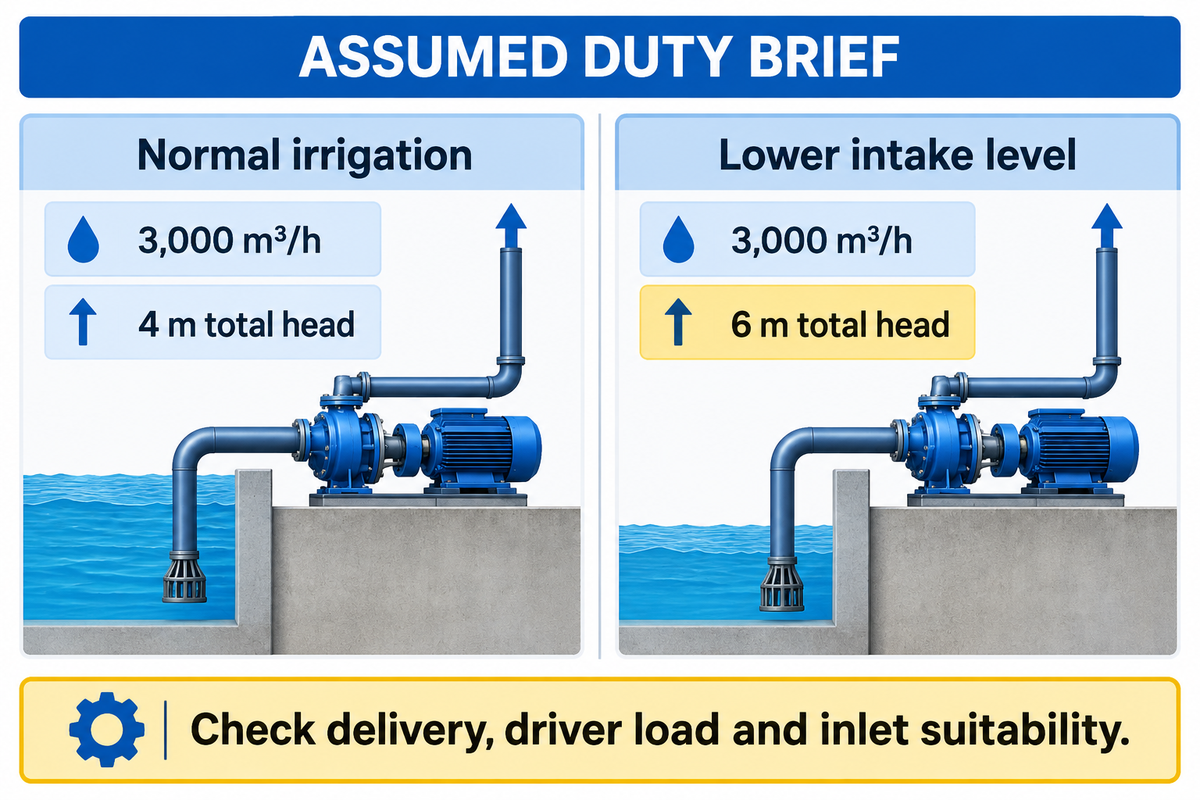
Example: A normal irrigation requirement of 3,000 m³/h at a total head of 4 m describes a condition that may be met by axial pumps, a family of pumps. Lower river level raises the required head to 6 m while the delivery requirement remains 3,000 m³/h. An offer that reaches the changed head only at a much smaller flow has not met the brief. An axial offer that covers both conditions, as well as mixed flow and radial offers, should be considered. The canal operator can now compare input power and the water delivered to the two defined conditions instead of paying for a family label or an impressive, high maximum flow offer.
| Operating state | Required flow | Total head | What the offered curve must show |
|---|---|---|---|
| Normal irrigation | 3,000 m³/h | 4 m | Duty intersection, efficiency and input power |
| Lower intake level | 3,000 m³/h | 6 m | Delivery at changed head, driver load and inlet suitability |
In their 2021 review of axial-pump performance, Moifatswane, Madushele and Ahmed show why focusing on best-efficiency-point operation alone doesn’t account for system demand changes. A family comparison is useful when the candidates in consideration all face the same service requirements.
Duty rule: 3,000 m³/h at 4 m and 3,000 m³/h at 6 m are two distinct obligations. Each pair should be maintained in the bid documentation. A proposal that meets only the first pair needs a different configuration or a revised operating plan before price comparison.
Efficiency and Power: Compare at Equal Duty
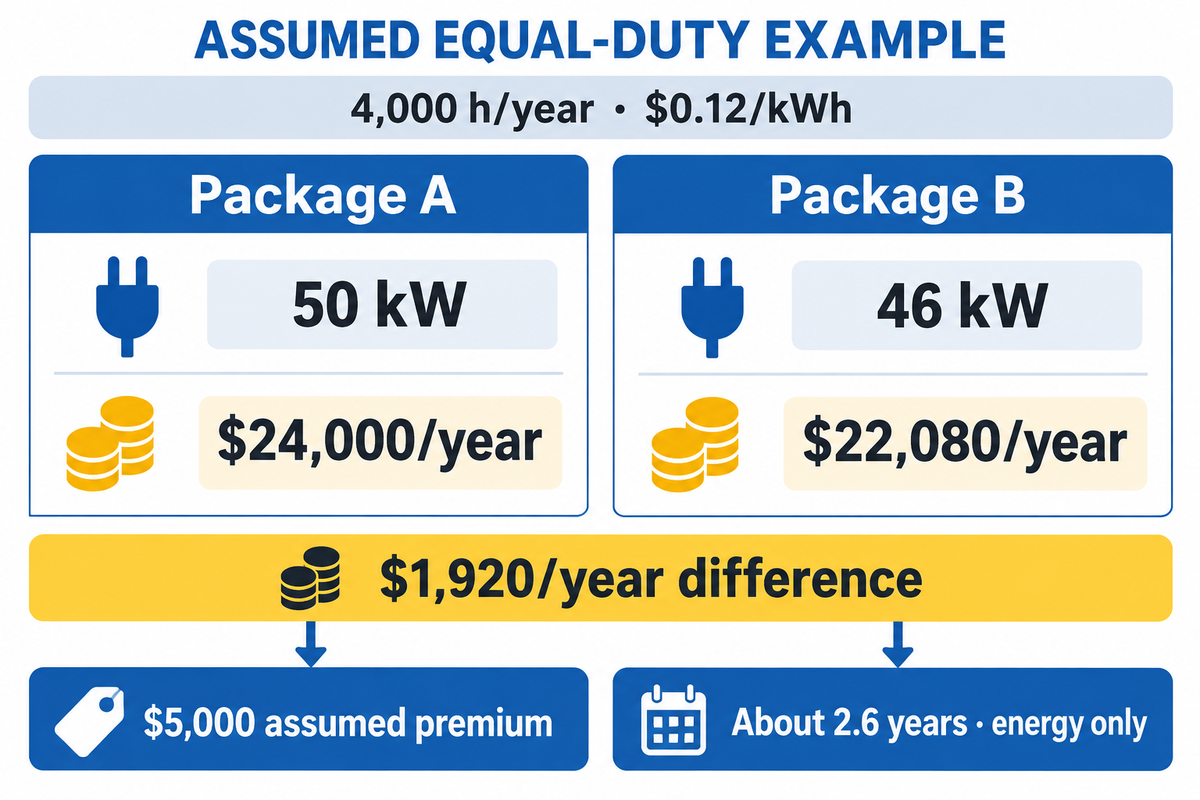
Compare efficiency for identical required flow rate and head, using a stated input boundary. Pump efficiency measures hydraulic output against pump input; wire-to-water efficiency includes the electrical equipment supplying that output. Equal duty with less electrical input results in a lower energy bill, even when a pump only efficiency percentage appears less favorable.
The Hydraulic Institute’s curve tutorial explains head, efficiency, input power, and suction curves. Peak pump efficiency is tied to a particular speed and impeller diameter. Unlike candidates can run at different speeds and still perform the same function; forcing the same RPM on unrelated machines would distort selection.
Which type of pump is better?
Axial is a better starting candidate for large-volume, low-head transfer; radial centrifugal is a better starting candidate for pressure duties. When both cover the full duty range, compare electrical input, installation cost, and service access. The better offer delivers the required water for the full operating range at the lower total cost.
The Wire-to-Water Cost Ledger provides money value for the comparison. Annual energy is electrical input in kW multiplied by operating hours. Multiply the resulting kWh by the electricity price. The Arkansas Extension pumping-plant series informs why a whole-system approach along with pump performance is important.
Assumed inputs: two feasible candidate packages deliver 3,000 m³/h at 4 m. Package A draws 50 kW from the electrical supply; B draws 46 kW. At 4,000 h/year and $0.12/kWh, A uses 50 × 4,000 = 200,000 kWh/year, costing $24,000. B uses 184,000 kWh/year, costing $22,080. The difference is $1,920/year. A $5,000 purchase-price premium for B would therefore take about 2.6 years to recover from this energy difference alone. Finance still needs installation, maintenance and tariff details. Procurement also needs the changed-duty comparison: a saving at the normal point has little value if the package misses the required delivery when the river falls.
| Input or result | Package A | Package B |
|---|---|---|
| Delivered flow | 3,000 m³/h | 3,000 m³/h |
| Total head | 4 m | 4 m |
| Electrical input | 50 kW | 46 kW |
| Annual operation | 4,000 h/year | 4,000 h/year |
| Electricity price | $0.12/kWh | $0.12/kWh |
| Annual electricity | 200,000 kWh/year | 184,000 kWh/year |
| Annual energy cost | $24,000/year | $22,080/year |
| Energy-cost difference | Baseline | $1,920/year lower |
| Energy-only recovery of $5,000 premium | Baseline | About 2.6 years |
Operating hours can reverse the purchasing priority. At 150 h/year, the same 4 kW difference saves just 600 kWh/year, or $72/year at the stated tariff. A flood-response station may gain more from availability and access than from a small efficiency advantage that rarely earns back its premium.
Cost rule: a 4 kW input reduction is worth $1,920/year at 4,000 h/year and $0.12/kWh, but only $72/year at 150 h/year. Put annual duty hours beside the efficiency comparison so a seldom-used drainage pump is evaluated differently from continuous water circulation equipment.
Why Reducing Flow Can Increase Axial Pump Load
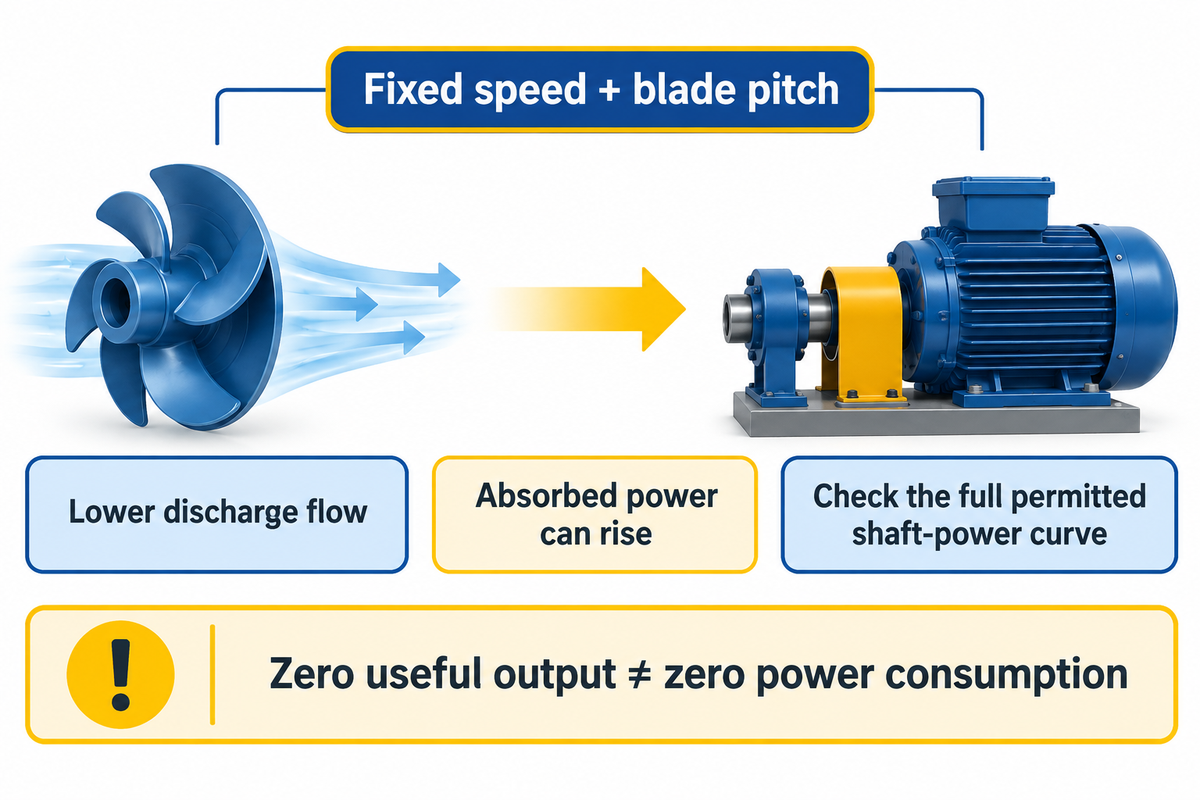
At a given speed and blade pitch, decreasing axial pump discharge flow can increase absorbed power. The head-flow relationship and falling efficiency can outweigh the smaller delivered flow. As such, motor selection should take permitted operation and the offered power curve into account, rather than assume less flow means lighter load.
NDSU’s propeller-pump guidance warns against throttling discharge to reduce flow and identifies rising total dynamic head as a power concern. Radial designs can have different loading behavior; some overload toward high flow. The actual curve is more useful than a universal “axial versus centrifugal” motor rule.
“Propeller pumps are not suitable under conditions where the discharge must be throttled to reduce the flow rate.”
A zero flow condition provides zero useful hydraulic output; however, internal circulation and mechanical losses still consume power. Substituting a zero flow condition in an expression for output power doesn’t set the driver size and doesn’t describe shutoff condition.
Are VSDs compatible with all pump types?
It’s possible to vary motor speed using a drive for radial, axial, and mixed flow pumps, depending on the suitability of the drive and the pump and motor for the required speed range. Compatibility includes cooling of the motor and hydraulic operating limitations. A drive changes the offered curves; it does not remove the need to deliver the required head or maintain suitable intake conditions.
Manufacturer controls and starting instructions are with the specified configuration. Generic discharge valve starting procedures copied from other pump types can conflict with the intended load curve. Ensuring the pump operates, within the limits allowed, requires the load curve, driver, and control sequence to operate on the same duty basis.
Load rule: reducing delivery from 3,000 m³/h to 1,500 m³/h doesn’t establish a 50% reduction in driver load. For fixed-speed, fixed-pitch axial service, use the full permitted shaft-power curve. Flow alone can’t determine motor loading, and particularly, when the change of operating point alters the head and reduces the efficiency of the unit.
Where Mixed Flow and Alternative Layouts Fit
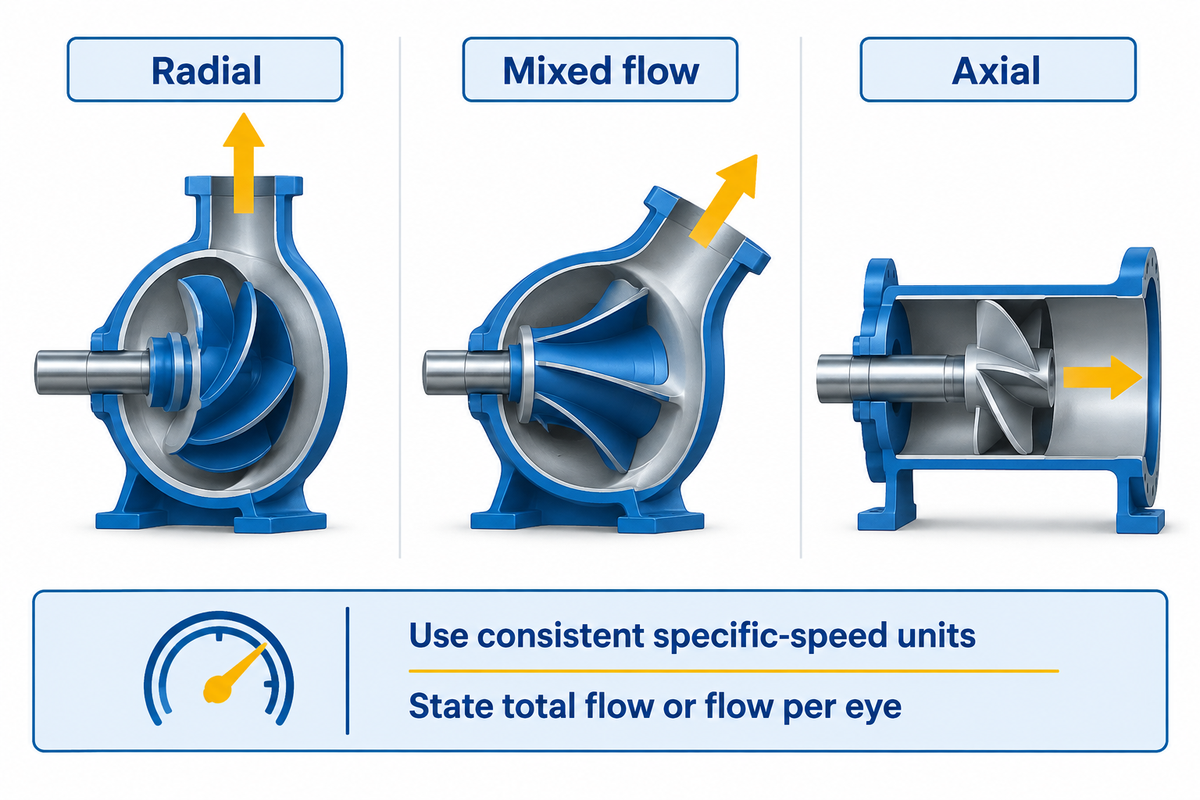
A mixed flow pump combines elements of both axial and radial energy transfer with an impeller discharge in an intermediate direction. Mixed-flow pumps are used for substantial discharge with intermediate head. A changing water level is a reason to compare multiple duties, rather than an automatic instruction to choose that family.
The balance between flow rate and head comes from the selected pump design. Centrifugal pumps and axial flow pumps can also have overlapping application ranges. A mixed-flow label does not establish a broader efficient range, better solids passage or a lower inlet requirement for every model. A pump operates efficiently, when its hydraulic selection fits the actual duty; the label alone can’t validate that fit.
Specific speed explains the difference between axial and radial impeller shapes. The Hydraulic Institute’s pump-principles reference distinguishes US and metric conventions and total-flow versus per-eye calculations. The familiar rpm-gpm-ft index can’t be directly compared to an rpm-m³/s-m index. A threshold without units and basis is an unreliable purchasing shortcut.
For the first shortlisted products compare BBP’s mixed flow pump options to its radial centrifugal pump range. Keep vertical-turbine or submersible designs in the discussion if the source level or maintenance arrangement requires it.
Suction Conditions and Installation Constraints
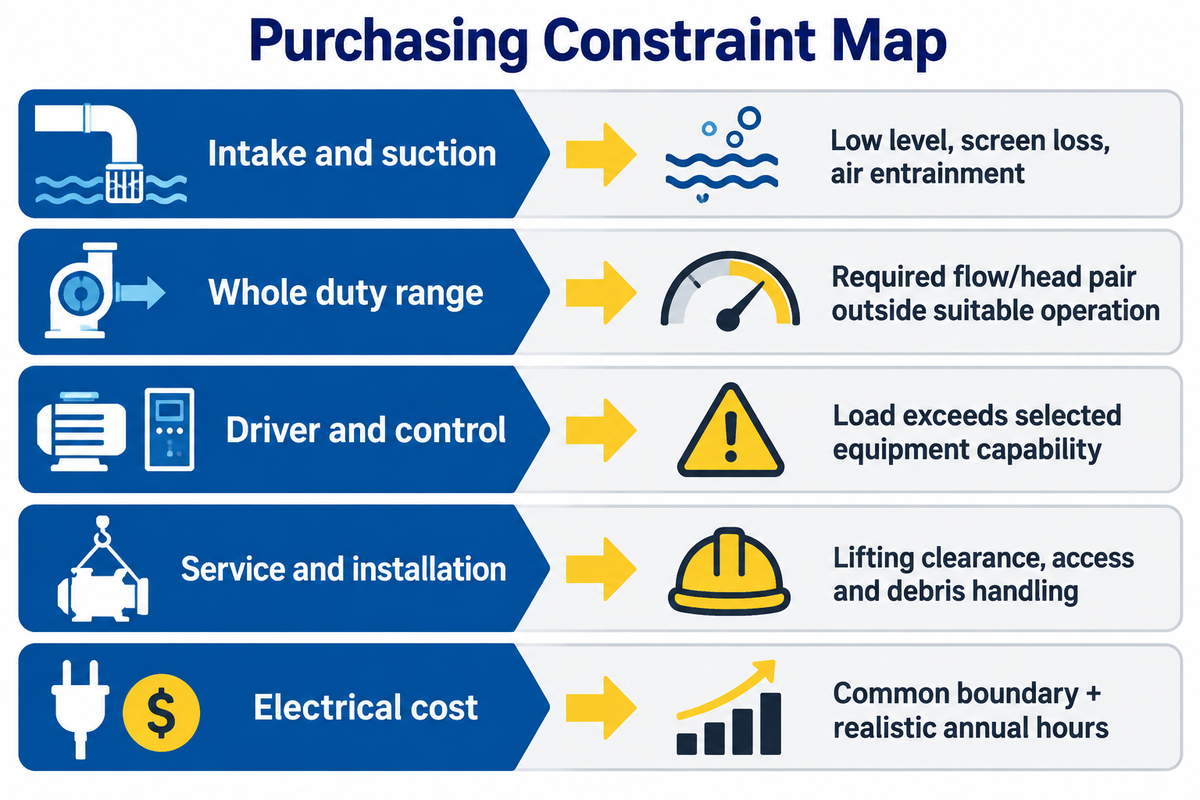
Inlet conditions can eliminate a pump before efficiency becomes the deciding factor. Available and required suction head and physical intake submergence describe different conditions or constraints. The lowest source level, screen losses and approach flow geometry must be compatible with the offered installation. Debris and water temperature and properties also belong with the service conditions.
NPSH3 identifies a cavitation test condition associated with a 3% head reduction. Minimum submergence describes the water depth required around an intake or impeller arrangement. Adequate submergence limits vortices and air entrainment; a satisfactory NPSH calculation alone doesn’t settle intake geometry. NDSU analyzes submerged propeller installations and manufacturer-specific submergence recommendations.
| Constraint | What can invalidate an offer | Responsible decision |
|---|---|---|
| Intake and suction | Low level, screen loss, air entrainment or unsuitable approach flow | Site designer resolves inlet arrangement |
| Whole duty range | Required flow/head pair falls outside suitable operation | Application engineer revises selection |
| Driver and control | Load exceeds selected equipment capability at a required state | Electrical and pump teams reconcile the package |
| Service and installation | Insufficient lifting clearance, access or debris-handling provision | Plant team compares installed arrangements |
| Electrical cost | Unlike boundaries or unrealistic annual hours | Finance normalizes feasible offers |
Xylem’s El Paso project case study describes axial propeller pumps used with formed suction intakes and a siphon arrangement in a restricted footprint. The case illustrates why inlet geometry and station arrangement can matter as much as the pump family’s usual head-flow tendency.
Water service also needs definition. Sand, fibrous debris or corrosive constituents change the selection problem. A common pump intake problem is air entrainment when submergence or approach flow is unsuitable. A clean-water radial flow centrifugal pump curve needs appropriate liquid-property treatment when density or viscosity differs; the Hydraulic Institute’s pump FAQs explain those effects. Solids passage and material suitability require their own specification.
Inlet rule: NPSH3’s 3% head-drop criterion and an intake’s required submergence are separate design inputs. Record both on the same duty sheet, including the lowest water level and screen losses. A proposal can meet its head-flow duty while still requiring a different inlet arrangement.
Application Choices for Irrigation, Drainage and Circulation
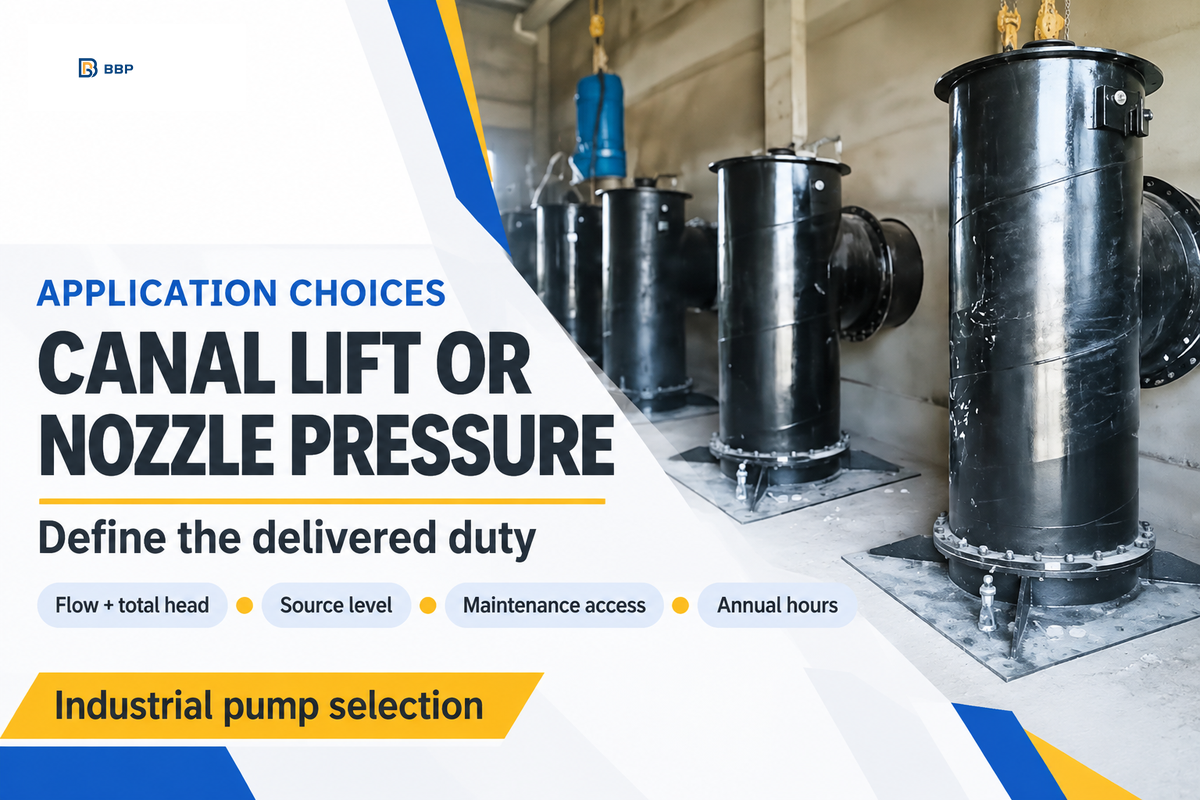
Both axial and radial pumps find applications in irrigation, drainage and circulation; however, the duty determines the hydraulic choice. Irrigation may mean a short lift in a canal or nozzle pressure. In drainage, emphasis is on readiness and changing levels; cooling systems and water circulation systems require a clear discrimination between elevation lift and resistance in the circulating system.
In irrigation, the total head includes pressure at the equipment. NDSU gives 20 psi as equivalent to 46.2 ft of water head, before the other system requirements are added. A short elevation lift therefore does not necessarily mean a low-head pump duty when the discharge feeds pressurized equipment.
Example: a plant needs to compare circulation proposals to meet a duty of 1,000 m³/h at 8 m total head. The existing quotation describes a “high flow” pump, with the operating hours and intake arrangement left vague. Maintenance expects regular access without system draining; Finance expects 6,000 h/year service. An axial candidate can remain on the shortlist only if its offered curve covers that duty and its installation meets the access requirement. Access and other requirements need to be met by radial or mixed-flow alternatives. The decisive comparison is the installed service, rather than whether the catalogue calls the machine a circulation pump.
Scenarios requiring high flow rates also include wastewater treatment and bulk water management, but those labels do not specify solids or liquid chemistry. Propeller pumps typically are on the shortlist for low-lift transfers. Positive displacement pumps will move fluid by enclosing and transferring volumes repeatedly, with internal leakage affecting the actual transfer. The types of pumps used for injection, bulk drainage and pressure boosting should be distinguished.
Use the irrigation pump selection from BBP to organize the discussion, and then narrow the offered axial flow pump alternatives within the scope of the duty.
Application rule: a 20 psi delivery-pressure requirement adds about 46.2 ft of water head before elevation and friction are considered. Therefore, for the same canal flow, canal transfer and pressurized irrigation may require different pump selections. Include outlet pressure explicitly when classifying a duty as low head.
A Supplier Comparison Built Around Verified Curves
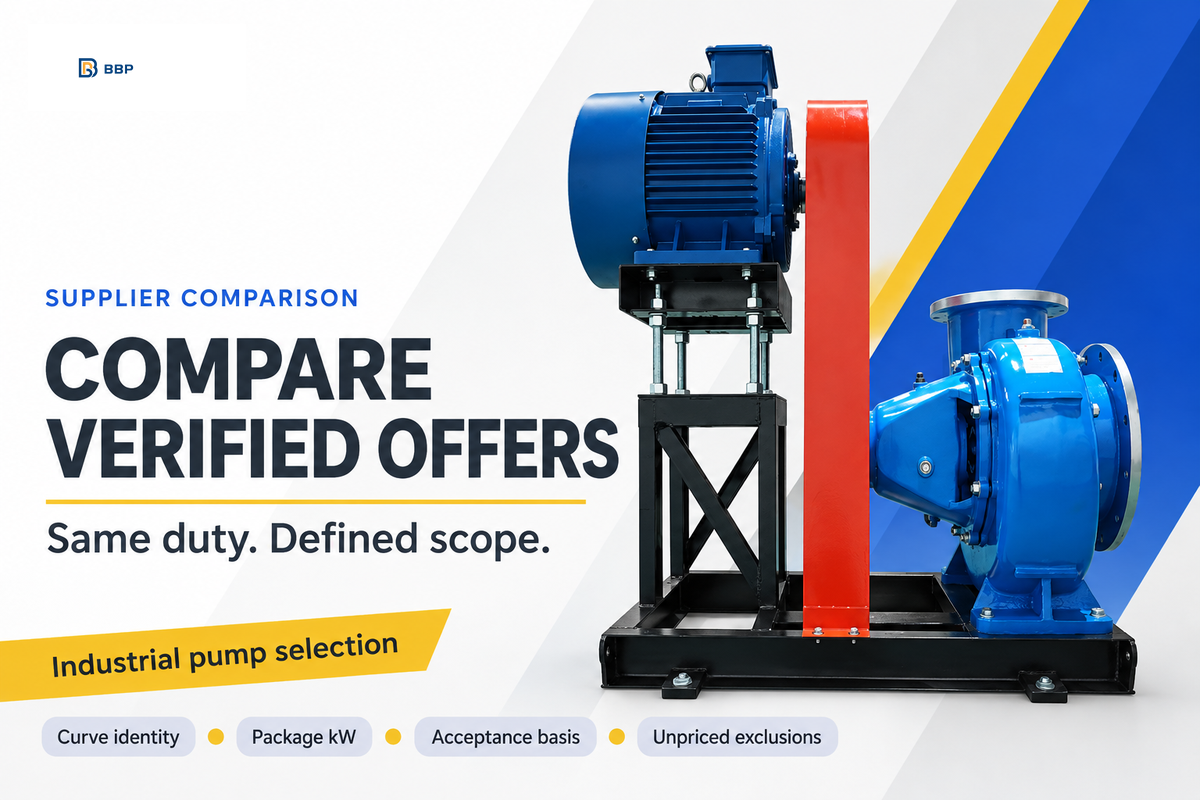
A similar quotation distinguishes the customer’s service requirements from the supplier’s performance evidence. Begin with paired duties and the liquid specification, then identify the exact pump configuration and test basis. Selection charts delimit a product range; published curves describe that range more closely. Certified curves pertain to the purchased pump and impeller trim.
The Hydraulic Institute differentiates these curve types. The difference between centrifugal pumps in a product range may include impeller trim and size. Through the table below, procurement can transform a plausible selection into a defined offer. “Verified” should mean a stated configuration and evidence type, rather than a broad marketing chart.
| Comparison field | Customer requirement or example | Supplier response to request |
|---|---|---|
| Normal duty | 3,000 m³/h at 4 m | Mark intersection on the offered configuration curve |
| Changed duty | 3,000 m³/h at 6 m | Show delivery, load and permitted operation at this state |
| Liquid | Water service, temperature and debris description | State curve-test liquid and any service corrections |
| Curve identity | Offered pump, speed, diameter or pitch | Identify selection, published or certified curve |
| Electrical input | Common electrical-supply boundary | Give package kW at each duty, including drive losses |
| Driver loading | All required operating states | Provide input-power curve and selected driver basis |
| Inlet arrangement | Lowest source level and screen/layout details | Separate NPSHR, recommended margin and submergence |
| Operating limits | Normal and changed conditions | State allowed range and control restrictions |
| Acceptance testing | Specified performance and configuration | Name test standard, acceptance grade and witness scope |
| Installed scope | Access, lifting, civil work and controls | List inclusions, exclusions and unpriced items |
ISO 9906:2012 specifies hydraulic performance acceptance tests for rotodynamic pumps. The purchase agreement needs the selected acceptance grade and test arrangement alongside its performance requirements. Pump acceptance testing and manufacturer quality certification are different procurement activities.
Amounts missing in a bid remain unpriced. For example, an offer that excludes the intake structure cannot be treated as a lower installed price until that scope is costed. Simultaneously ask suppliers for the missing curve identity, changed-duty performance and exclusions. Then, compare complete proposals.
Industry Outlook: NPSH Margins and Control Choices
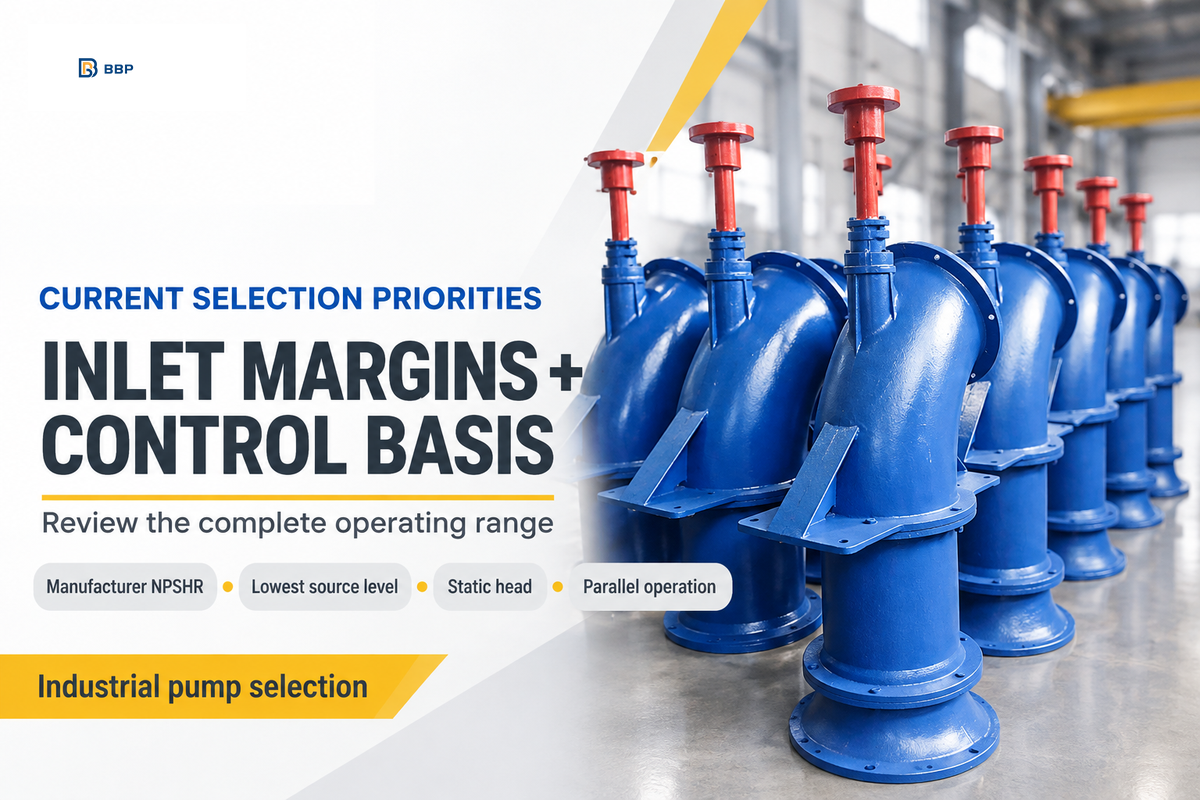
The 2024 revision to the Hydraulic Institute’s NPSH-margin guideline makes application-specific review of inlet conditions a more useful procurement priority than a fixed margin copied between jobs. It’s good practice to include the manufacturer’s supplied NPSHR reference and consider liquid conditions, pump and site conditions. This is especially applicable when water level or water control strategy is different.
In its March 2025 explanation of ANSI/HI 9.6.1:2024, the Hydraulic Institute discusses the change from the 2017 edition to recommendations based on manufacturer NPSHR which is at least the tested NPSH3. This review includes factors such as pumpage, wear, inlet conditions, transients and parallel operation. A 1 meter additional height on every job misses this application-specific approach.
For the 2026 project, pair the manufacturer’s suction requirement with the lowest available value and the required duty range. Maintain physical submergence and screen design, as well as any site-specific environmental intake requirements, in the scope of work. Updating the margin basis is a reasonable change to the scope, even when the same pump family is selected.
Controls must have an equally clear system basis. A variable-speed drive can reduce wasted control losses, but static lift remains part of the head requirement as speed falls. The FAQ by the Hydraulic Institute states that, with a system curve and a static head in the system, the benefits of variable-speed control are diminished. Applying the cubic speed-power relationship to predict annual electricity use can, therefore, overstate benefits.
Parallel arrangements provide another decision. Starting a second pump generally moves the operating point along the combined pump and system curves; it does not automatically double delivered flow. The control package must include the relevant combination of pumps running, as well as the individual operating areas and input power. A lower unit price can lose its advantage if staging moves a pump to an operating area that isn’t suitable.
Fixed pitch, adjustable pitch, and speed control describe various design alternatives. Their values depend on required service, control range, and maintenance. The next useful step is a quote with those choices reconciled against the whole duty envelope, followed by an installed-cost comparison at realistic annual hours.
Frequently Asked Questions
What is a mixed flow pump?
Read the answer
A mixed flow pump is a rotodynamic pump whose impeller gives the liquid both axial and radial movement. The discharge direction is between the two families. Mixed-flow designs usually end up on a short list to handle large volume flows with more head than an equivalent axial design. However, the actual duty and efficiency depend on the offered curve.
Can a Mixed Flow pump be installed vertically?
Read the answer
Yes, mixed flow pumps can be offered in a vertical arrangement (like a turbine). Vertical refers to the shaft and installation, and mixed flow refers to the impeller hydraulics. The desired arrangement does require adequate inlet depth and supports, and access for lifting and operating conditions of the manufacturer. The hydraulic type alone does not define those installation dimensions.
Which pump is best for high pressure?
Read the answer
A radial centrifugal pump is usually the starting choice for high-pressure water service, and if more head is needed, a multistage arrangement can be made. Start from the required pressure at the actual flow, and include other system losses. A larger motor or a high maximum flow doesn’t mean that the offered pump meets the pressure duty.
What is a positive displacement pump?
Read the answer
Displacement pumps transfer liquid by enclosing and transferring volumes. Rotodynamic pumps add energy through an impeller. These mechanisms suit different duties; displacement designs are often considered for metering or viscous service rather than as direct substitutes for bulk, low-head water transfer.
How does specific speed relate to pump type?
Read the answer
Specific speed relates pump speed, BEP flow and head per stage to impeller geometry. Radial forms of pump are generally associated with lower specific speed, and axial forms are generally associated with higher specific speed, and mixed forms are in between. State the unit convention and whether the calculation uses total flow or flow per impeller eye, before making comparisons. An index computed in US customary units is different from its counterpart in metric units for the same pump.
What is the difference between self-priming and non-priming pumps?
Read the answer
A self-priming design clears air through its intended priming arrangement, thus restoring liquid delivery. A conventional non-self-priming centrifugal installation needs its hydraulic passages filled before pumping. A surface-pump priming label does not establish sufficient submergence for the axial impeller.
What are the advantages of an axial flow pump?
Read the answer
An axial flow pump provides high flow capacity for low-head transfer and is useful for irrigation lifts, drainage and water circulation. The predominantly axial flow of an axial flow pump supports the movement of large volumes of water in the pumping installation. The best result is attained when the offered hydraulic design matches the required duty range. Inlet geometry, driver load, trash conditions and access still determine whether the complete installation is a more appropriate choice compared with the radial or mixed-flow pumps.
Bring BBP normal and changed flow-head pairs, source levels and conditions of liquids for your project. Use the irrigation pump range to start the discussion and compare configurations with a common electrical boundary and installed scope. A complete duty brief makes the radial centrifugal vs axial choice easier to price and easier to review.
By GW. Technical guidance is drawn from the sources below. The worked cost comparison uses the stated assumed inputs; the El Paso installation is attributed to Xylem. Pump selection and installation limits remain specific to the offered equipment and site.
References & Sources
- Pumps for Florida Irrigation and Drainage Systems Dorota Z. Haman, University of Florida IFAS Extension.
- Irrigation Water Pumps Thomas F. Scherer, North Dakota State University Extension, reviewed February 2022.
- Improving the Performance of an Axial Flow Pump: An Overview Moifatswane, Madushele and Ahmed, 2021; University of Johannesburg repository.
- Pump Curves Hydraulic Institute Engineering Data Tool.
- Pumping Plant Efficiency University of Arkansas System Division of Agriculture Cooperative Extension Service.
- Pump Principles Hydraulic Institute Engineering Data Tool.
- Pump FAQs Hydraulic Institute.
- ISO 9906:2012: Rotodynamic pumps, Hydraulic performance acceptance tests, Grades 1, 2 and 3 International Organization for Standardization.
- Understanding the 2024 Updates to ANSI/HI 9.6.1 Rotodynamic Pumps Guideline for NPSH Margin Alex Moser, Hydraulic Institute, March 18, 2025.