Get in Touch with BBP

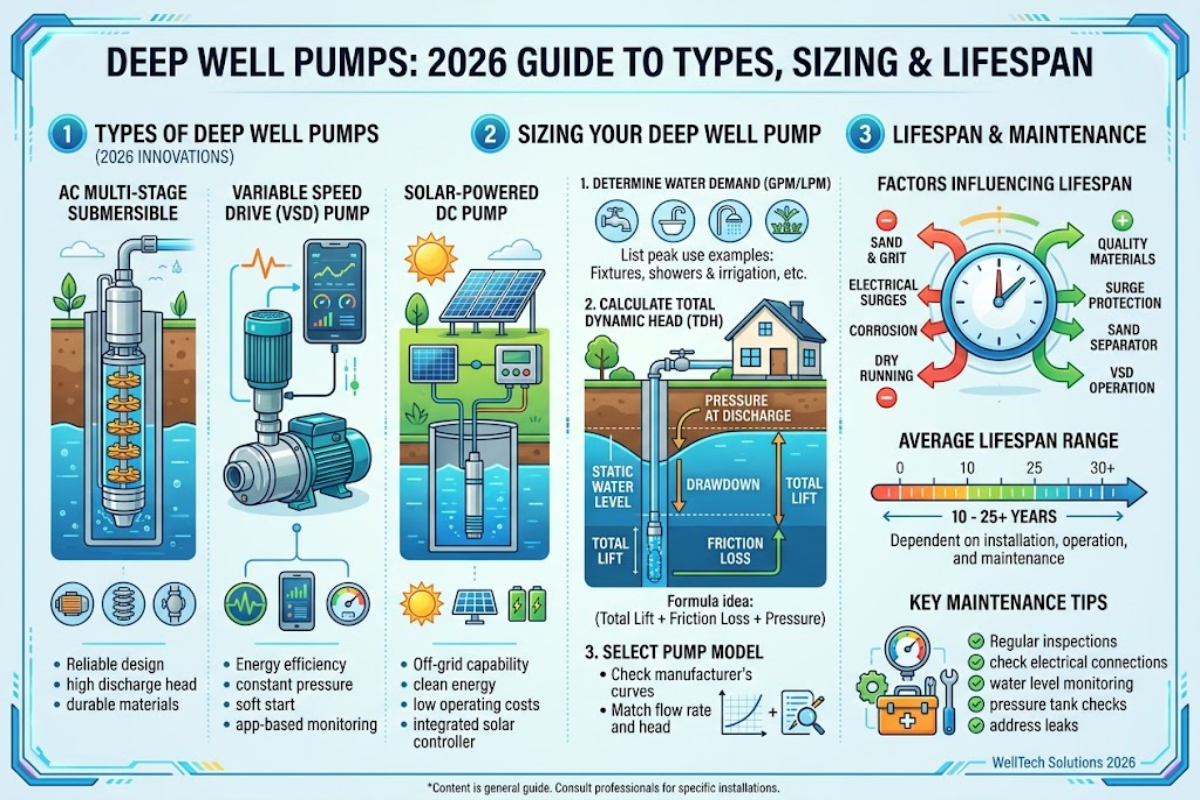
Quick Specs — Deep Well Pumps at a Glance
| Typical Depth Range | 25–600 ft (8–183 m); multistage submersibles to 2,500 ft (760 m) |
| Flow Range | 5–200 GPM (1–45 m³/h) for residential and farm duty |
| Voltage | 230 V single-phase (most 0.5–2 HP); 230/460 V three-phase (5+ HP) |
| Service Life | 8–15 years typical; 20+ years with clean water and balanced cycling |
| Replacement Cost (US, 2025) | $1,500–$3,500 pump + $800–$2,500 labor |
| Common Failures | Motor overheating, sand abrasion, lightning, frozen lines, dry running |
What Is a Deep Well Pump?

A deep well pump is any system designed to lift water from a borehole where the static water level sits more than 25 feet below ground. That 25-foot threshold is not arbitrary — it is set by physics. At sea-level atmospheric pressure (101.3 kPa), a perfect vacuum can support a column of water about 34 feet high. Real-world hydraulic losses, vapor-pressure margin, and net positive suction head (NPSH) requirements cut that ceiling down to roughly 25 feet of practical suction lift. Past that depth, lifting water from above no longer works, so the pump must either push from below (submersible architecture) or use a two-pipe ejector to create assisted lift (deep-well jet).
Three architectures of deep well pumps are common: the retractable submersible pumps, line-shaft vertical turbine pumps with the motor at the top, or convertible jet pumps that integrate ejector hardware to reach even further. Each application – residential household, farm irrigation, livestock watering, mining dewatering, geothermal supplying – will select the architecture that is appropriate for its depth, flow, and duty profile. Most modern systems at those depths will utilize submersible well pumps, given that submersible architecture delivers lowest lifetime energy cost range between 25 and 600 ft.
Is It Better to Have a Shallow or Deep Well?
Better depends on your geology, not your preference. Shallow wells (under 25 feet to water) cost less to drill and use cheaper jet pumps, but they are exposed to surface contamination from septic systems, fertilizer runoff, and seasonal drought. Deep wells reach confined aquifers below clay or rock layers, which gives cleaner, more reliable water and a steadier yield, but the drilling cost is higher and the pump system more involved. Across most of the United States, U.S. Geological Survey data puts residential well depths in the 100–300 foot range — where deep well submersible pumps are the practical default.
How a Deep Well Pump Works
Mechanically, a deep well pump is a hydraulic stack plus an electric motor, sealed inside a watertight housing and lowered down the well casing on a length of drop pipe. Water enters at the bottom of the pump, passes through one or more impeller stages, and exits up the drop pipe at high pressure. Motor leads run to a control box at the surface, which manages start-up current and shields the windings against single-phase faults. A check valve at the pump head holds the column of water in the drop pipe between cycles, and a pressure tank at the surface buffers cycling pressure so the motor does not start every time someone opens a tap.
Multistage Centrifugal Hydraulics
Every impeller in a submersible pump adds about 5-7 m (16-23 ft) of head to the discharge column. To lift water 90 m (300 ft) from a well, a pump stacks 12-18 stages in series – the impellers spin at 2,850 or 3,450 RPM (50 Hz or 60 Hz, two-pole motors), and centrifugal force intensifies water radially outward through each impeller into the next diffuser. Each diffuser converts that velocity into pressure, and the next impeller picks up right where the last one left off. That’s why a “1 HP submersible” can deliver 33 GPM at 305 ft of lift while a 1 HP surface jet pump struggles past 80 ft – every stage adds another lift increment without effecting suction loss.
Multistage architecture is also why submersible pumps run quietly. Sound is absorbed by the water column above the pump body, which is why neighbors above ground seldom hear a 1.5 HP unit splashing 200 ft below. Trade-off: retrieval cost – pulling a pump from a well 400 ft down takes more labor and rigging than installing a new shallow jet system from scratch.
Submersible Motor and Power Wiring
Submersible motors are oil-filled or water-filled, sealed with mechanical face seals, and rated to IEC 60529 IP 68 for indefinite submersion. Two wiring conventions cover most domestic installations:
- 2-wire motors – black + white + ground. Capacitor and starting circuit are integral to the motor, control box is not required. Typical of 0.5 HP and smaller; simpler to wire but more difficult to service in the field.
- 3-wire motors – black + yellow + red + ground. Start/run capacitor and overload protection live in an external control box at the surface. Standard for 0.75 HP and larger; capacitor and starter can be replaced without pulling the pump.
Control boxes also house overload relays and (in newer installations) thermal protection that disconnects power if motor winding temperature becomes excessive. A failed capacitor or pitted starter contact is a 30-minute fix from above ground; a burned motor stator is a full pump pull and replacement. This explains why 3-wire systems dominate above 1 HP – the failure mode that occurs most often is the one easiest to repair.
How Deep Well Jet Pumps Differ
A deep well jet pump keeps the motor at the surface and runs two pipes down the well: a pressure pipe flowing water down to an ejector, and a suction pipe circulating water back up. The ejector generates a low-pressure zone that pulls more water in from the well, then the surface pump lifts the combined flow. Jet architecture extends practical lift to around 80-120 ft, but the system recirculates approximately 3-4 gallons of water for each gallon delivered, so efficiency diminishes to 25-40%. For wells lower than 110 ft, lifetime energy costs make submersible the only reasonable option – the jet pump’s operating costs catch and surpass the higher initial cost of a submersible system within 4-6 years on most residential duty cycles.
How to Size a Deep Well Pump
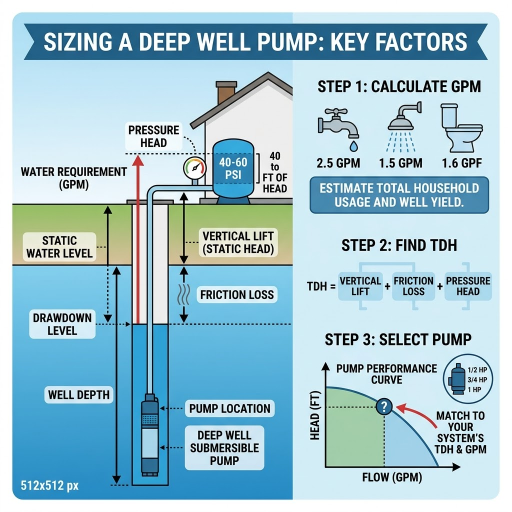
Sizing a deep well pump means matching three numbers to your well and household: total dynamic head (TDH), gallons per minute (GPM) demand, and motor horsepower. Get one wrong, and either the pump cannot deliver the pressure you need (undersized) or it short-cycles itself into early failure (oversized). Methodology below works for residential and light agricultural duty; industrial and municipal systems use the same logic with engineered safety factors and pump-curve overlays.
Step 1 — Calculate Total Dynamic Head (TDH)
TDH is the total resistance the pump has to overcome, in feet (meters) of head. Formula:
📐 Engineering Note — TDH Formula
TDH = Pumping Water Level + Vertical Lift to Tank + Friction Loss in Pipe + Pressure Tank Setting (in feet of head)
Example: pumping water level 180 ft + tank height 12 ft + friction loss in 200 ft of 1.25″ pipe at 12 GPM ≈ 14 ft + pressure tank 40/60 psi setting (~138 ft of head). TDH ≈ 344 ft. Add a 10% safety factor → design TDH 380 ft.
Four ingredients matter for different reasons. Pumping water level is the depth from grade to where the water surface settles when the pump is running — always lower than the static level shown on the well log. Friction loss grows with the square of flow rate, so the same pipe carries different friction at 8 GPM versus 18 GPM; manufacturer pipe-friction tables give the exact figure for each pipe diameter and material. Pressure tank setting converts to head by dividing pressure (psi) by 0.433.
Step 2 — Set the GPM Target by Use Case
Different household, irrigation, and livestock demands require different flow rates. Targets below are to be used as the beginning size; size up if there are multiple simultaneous demands (e.g. laundry and shower and a new irrigation zone).
| Use Case | Peak GPM Target | Notes |
|---|---|---|
| Household, 2–3 bathrooms | 8–12 GPM | Add 1 GPM per simultaneous fixture |
| Household + drip irrigation | 12–18 GPM | Sequential zoning lowers peak demand |
| Small farm + livestock (50 head) | 15–25 GPM | Sustained run hours raise duty rating |
| Commercial irrigation, 5–10 acres | 25–60 GPM | Sized to peak hourly application rate |
| Mining or municipal supply | 60–250+ GPM | Three-phase power and engineered design |
Step 3 — Select Horsepower and Pump Type
With TDH and GPM in hand, the manufacturer pump curve points to a specific HP rating. Decision matrix below gives a starting bracket; match it against the pump curve at your TDH to confirm flow at your duty point.
| Well Depth × Demand | Recommended HP | Voltage | Pump Type |
|---|---|---|---|
| <100 ft, residential 5–10 GPM | 0.5–1 HP | 230 V single-phase | 4″ submersible, 1HP class |
| 100–300 ft, residential 8–15 GPM | 1–1.5 HP | 230 V single-phase | 4″ submersible, multistage |
| 300–600 ft, ag/large house 15–25 GPM | 2–3 HP | 230 V single or 3-phase | 4″–6″ submersible |
| 600+ ft or >25 GPM | 5+ HP | 230/460 V 3-phase | 6″–12″ submersible, multistage |
For OEM-customized sizing across 4″–12″ casings, the BBP submersible deep well pump series across 4″–12″ casings covers the full residential-to-mining range with factory pump curves and motor matching included in the quote package.
Are Deep Well Pumps 110 V or 220 V?
Most North American residential deep well submersible pumps are running on 230 V single phase, not 110 V. Installing 230 V reduces line current for any given horsepower in half, allowing the wiring to run off of an optional 200 A service panel and down a 200′ line without nuisance voltage drop or breaker tripping. A 110 V distribution can run a 0.50 HP pump from a short, shallow well; most contractors use 230 V as it allows smaller gauge wiring and minimizes voltage drop issues which pay for themselves in a year; installations above 5 HP must run on 230/460 V 3-phase by an electrician verifying the motor nameplate full load amps against local code.
Deep Well Pump Installation — Step by Step
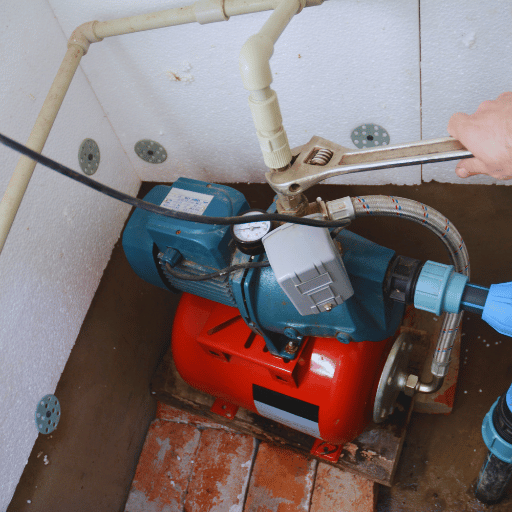
Proper installation is what separates a 12-year service life from a 4-year early failure. Steps below cover the pre-install checklist, the actual drop sequence, and the above-ground hookup. Always work to NEC Article 250 grounding requirements and any local well-permit specifications; in many U.S. states, well work is licensed and code-inspected.
Pre-Install Checklist
- ✔Confirm well log: total depth, casing diameter, casing material, static and pumping water levels, yield in GPM
- ✔Verify pump physical fit: pump OD must clear casing ID by at least 1/2″ on each side for cooling water flow
- ✔Match motor voltage and wire gauge to drop length (consult an NEC voltage-drop table; for 1 HP at 200 ft, #10 AWG is typical; longer drops need #8)
- ✔Stage gear above the well: drop pipe (poly or galvanized), torque arrestor, splice kit, safety rope, electrical tape, hose clamps
- ✔Run a megger test on the motor leads before lowering — insulation resistance under 1 megohm means a defective motor and a wasted install
The Drop Sequence — Pipe, Wire, Torque Arrestor, Splice
Drop pipe bears the water column; it also takes the static weight of the pump plus the dynamic torque kick of the motor start-up. Go Schedule 80 PVC or galvanized steel for any drop over 100 ft, or 200 psi polyethylene for shallower wells. Runs of wiring follow the drop pipe, strapped with electrical tape every 10 ft so it can’t wrap around the pump body on start-up torque. Splice the motor wires to the drop wire in a heat-shrink splice kit rated for continuous submersion- the most common cause of failed motors is a cheap wire nut splice on owner-installed systems.
Torque arrestor sits 1-2 ft over the pump, centered in the casing. It absorbs the rotational kick at start-up so the pump body and drop pipe aren’t slapped back against the casing wall. Lower the stack 1 section at a time, passing each pipe joint with the safety rope and checking the wire for pinching at any joint. The well head is sealed with a pitless adapter or sanitary seal to keep surface junk out.
Above-Ground Components — Pressure Tank, Switch, Wiring
Pressure tanks store 6–20 gallons of pressurized water and set the on/off cycle of the pump. A 40/60 psi pressure switch is standard for residential service; the tank pre-charge should be 2 psi below the cut-in pressure. Control box (in 3-wire installations) bolts inside the well house or basement, near the pressure switch, with the breaker disconnect within sight of the box per NEC requirements. Bond the casing to the service ground per NEC Article 250 — well casings near power services are common lightning entry points, and a missed ground connection wipes out motors during storm season.
Deep Well Pump Lifespan and Total Cost of Ownership
An adequately sized, well-serviced deep well submersible pump will last 8-15 years on average, and quality models installed in non-agressive water will last 20+ years of service. Industry-wide data from well service providers and the National Ground Water Association show that the average homeowner replacement cycle is approximately 10-12 years. That wide of a spread isn’t a coincidence—these four factors account for almost all of the variation.
📐 An 8–15 Year Lifespan Equation
Service life Base Life (12 yr) water Chemistry Factor Cycle Frequency Factor Sizing Precision Factor
- Water Chemistry Multiplier (0.5-1.2): Clean groundwater with low TDS pushes multiplier toward 1.2, sandy water, high iron, or aggressive pH toward 0.5.
- Cycle Frequency Multiplier (0.6-1.0): A pump that starts 4 times a day with a correctly sized pressure tank will operate at a 1.0 multiplier; a short-cycling 30 times a day unit with an undersized or waterlogged tank will operate at 0.6.
- Sizing Accuracy Multiplier (0.7-1.1): pump duty cycle position at the curve sweet spot will score a multiplier of 1.1; units that are oversized or undersized at the curve extremes will score a multiplier of 0.7.
How Long Does a Deep Well Pump Usually Last?
The majority of deep well submersible pump last 8-15 years, with the median residential installation at just over 12 years. Quality brands in non-aggressive water with properly-sized pressure tanks will routinely last more than 15 years; budget pumps in sandy or high-iron water will often fail at 5-7 years. Cycle frequency is the single largest controllable factor — short-cycling kills bearings, capacitors, and starter contacts faster than any other failure mode.
Energy Cost — What a Deep Well Pump Adds to the Power Bill
Consider a 1 HP deep well pump running at full speed, pulling 8 amps at 230 volts—this equates to roughly 1.84 kW. For approximately 4 hours per day of total run time (which is typical for a residential household with 2-3 bathrooms), this results in an annual energy consumption of about 2,690 kWh, costing roughly $323 given the U.S. average of $0.12/kWh. Extending this run time to 8 hours per day for irrigation purposes would increase the cost above $640. Solar-operated submersibles, which we will analyze in the outlook section, essentially eliminate this cost when used during daylight hours, albeit with a higher initial investment and additional battery storage if operation at night is required.
Common Failures and Troubleshooting
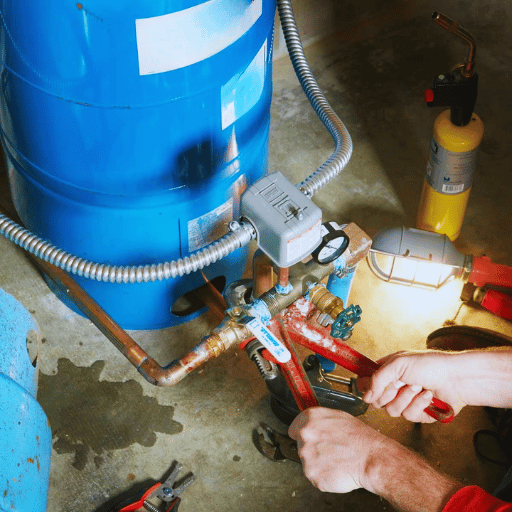
Common symptoms when a deep well pump fails will generally indicate one of a few specific root causes. The five failure modes listed below account for approximately 80% of on-site service calls; other causes (deteriorated wire insulation, pinhole in the drop pipe, worn pressure tank bladder) are uncommon and can usually be diagnosed by an experienced well technician in less than an hour using a clamp meter and pressure gauge.
| Failure Mode | Typical Cause | Diagnostic Symptom | First Action |
|---|---|---|---|
| Motor burnout | Overheating from low submergence, dry running, or short-cycling | No flow + tripped breaker; megger reads <0.5 megohm | Pull pump; replace motor or full unit |
| Sand abrasion | Sandy aquifer, screen failure, pump set too low in casing | Falling flow over weeks; sand at faucets | Pull pump; switch to stainless steel deep well pump series or sand-resistant model |
| Lightning strike | Surge through buried wiring; missing ground bond | Sudden total failure during storm; control box damage visible | Test motor windings; replace control box and/or motor |
| Frozen lines | Drop pipe or above-ground line below frost depth | No flow in winter; pressure normal at switch | Heat trace exposed line; bury below local frost line |
| Lost prime / air lock | Failed check valve or drop pipe leak | Pump runs continuously, low pressure | Test check valve; pull pump if drop pipe failed |
Cycling-related failures dominate the data. A pressure tank that loses its pre-charge causes the pump to start every time a tap opens — over the course of a year, an undersized or waterlogged tank can multiply pump cycles by 5×, which compresses bearing and capacitor life by a similar factor. Engineers on industry forums consistently describe this as the most common avoidable failure they diagnose in homeowner-installed systems.
“Most of the deep well pumps I pull early are not bad pumps — they are good pumps that have been short-cycled to death. The first thing I check on any failed-early system is the pressure tank pre-charge.”
Maintenance Schedule for a 15-Year Service Life
A deep well pump that lives 15 years is usually a pump that gets checked once a year. Our annual checklist below takes 30 minutes and catches small problems before they cascade into pump-pull territory. NGWA recommends annual professional inspection of any private well system — that visit also covers water quality testing, which is the other half of the maintenance picture.
- ✔Annual: verify pressure tank pre-charge (2 psi below cut-in); listen for short-cycle pattern at faucets
- ✔Annual: visual check of pressure switch contacts (pitting indicates aging); clean the contact gap
- ✔Annual: inspect well cap or sanitary seal for cracks and rodent damage
- ✔Annual: water test for coliform bacteria, nitrate, and pH (groundwater chemistry shifts year over year)
- ✔Every 3–5 years: replace start/run capacitor in 3-wire control boxes (capacitors degrade silently)
- ✔Every 5–8 years: replace pressure tank if bladder shows signs of saturation; pull and inspect the check valve
- ✔10+ years: consider a proactive pump pull and inspection if water quality has degraded; replacing a pump on schedule is cheaper than emergency replacement during peak summer demand
Deep Well Pump Cost — CapEx and OpEx in 2026
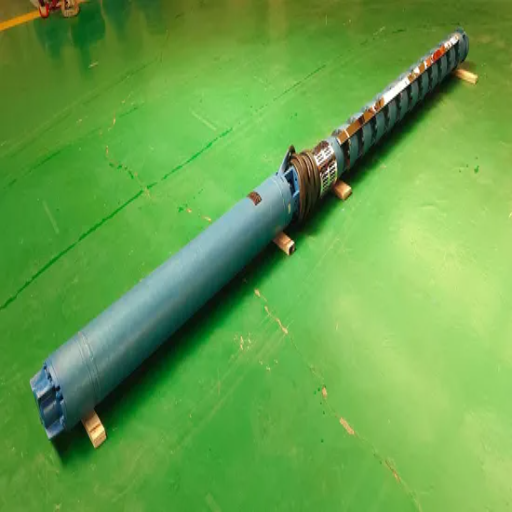
Total cost of a new deep well pump system breaks into three buckets: the pump and motor (CapEx), the installation labor and ancillaries (drop pipe, wiring, pressure tank, permits), and the ongoing energy plus maintenance bill (OpEx). Brackets below reflect U.S. retail pricing as of early 2026; international and OEM-direct procurement runs 30–50% lower, especially on volume orders.
New Pump CapEx (US Retail, 2026)
| Pump Class | Typical Pump Price | Suitable For |
|---|---|---|
| 0.5 HP, 4″ submersible | $400–$700 | Shallow residential, <100 ft |
| 1 HP, 4″ submersible (most common) | $700–$1,400 | Standard residential, 100–300 ft |
| 2 HP, 4″ submersible | $1,200–$2,200 | Deep residential or light farm |
| 5 HP, 6″ multistage 3-phase | $2,500–$5,500 | Commercial irrigation, mining |
| 15+ HP, 8″–12″ industrial | $8,000–$25,000+ | Municipal, deep mining |
Prices are based on the U.S. retail for Q1 2026, and are subject to change with copper, stainless steel, and motor steel input prices.
Installation Labor and Permits
Owner-installed shallow-well systems can land at pump price plus $200–$400 in pipe, wire, and tank. Professional installation of a 1 HP submersible at 200–300 ft typically runs $800–$2,500 in labor depending on regional rates and whether a new pressure tank is included. Permitting and inspection fees vary widely by state — California and Massachusetts add $150–$500 per permit; many rural counties charge under $100. For factory-direct OEM volume buyers, BBP factory-direct deep well pump pricing and OEM customization serves distributors, brand owners, and engineering project buyers with end-to-end vertical integration that strips out the multi-tier markup.
How Much Does It Cost to Have a Deep Well Pump Replaced?
Complete residential deep well pump replacement at 200–400 ft of well depth typically runs $2,000–$5,500 in 2026, including the pump, drop pipe (cheaper if reused, more if replaced), wiring, and labor. Split is roughly 40% pump and 60% labor on a routine job; jobs that uncover a corroded well casing or a buried pitless adapter needing excavation can push the total above $7,000. Get two quotes for any replacement above $3,000 — pricing dispersion among local contractors is high.
Deep Well Pump Industry Outlook for 2026
Three shifts are reshaping deep well pump procurement in 2026: variable frequency drives moving from industrial to residential price points, solar-direct submersibles taking share in off-grid and agricultural applications, and IE3-class motor efficiency requirements arriving for new installations in major export markets. None of these change the physics, but each one shifts the economic case enough that buyers planning a new install should price both the conventional and the new-architecture quotes.
Variable frequency drive adoption. The global VFD market is estimated to grow from $23.85 billion in 2025 to roughly $41 billion by 2034, with submersible pump VFDs accounting for a significant portion of that growth. A VFD allows a single pump deliver to match a fluctuating load without on/off cycling, which prolongs service life by minimizing start-up stress on the motor windings and capacitors. Cost premium over a traditional control box has declined from roughly $800 in 2020 to $300-$500 in 2026 for a 1 HP system, making VFD upgrades a justified investment on any new-build where pressure variability is a concern.
Solar-Direct powered deep well pumps. Solar-direct submersibles now capture about 6% of new well pump installs in the US, with roughly 85,000 systems installed by the end of 2024 and segment growth at 12.5% annually. The most economically viable applications are where electrical service is unavailable (off-grid, agricultural irrigation, monogastric, locations remotely situated on pasture) and where daytime load coincides with solar output. Incorporating battery storage for night time supply increases the upfront cost by roughly 40%, but for daytime-only use, payback periods are falling within the 5-7 year range in southwestern US states.
IE3 efficiency standards. IEC 60034-30-1 defines motor efficiency classes from IE1 (standard) up to IE5 (ultra-premium). European Union and other entities have enforced IE3 minimum efficiency standards for new industrial motor installations starting in 2024, with progress in extending applicability to smaller and submersible motors continuing apace. Buyers considering submersibles for export to EU, UK, or other similarly regulated markets should seek IE3 documentation, but in 2026, this change primarily affects documentation requirements since the motor already conform to IE3 standards in most modern submersible offerings.
Implications for 2026 installation plans. Either quote traditional control box or VFD-integrated control panel, depending on site pressure head requirements. If no grid power is available within trenching distance, obtain additional quote using solar-direct system. If planning to export to EU region, obtain written assurance of IE3 efficiency class compliance.
Frequently Asked Questions
Q: Can I use a deep well pump on a shallow well?
View Answer
Technically yes, but inefficiently. A deep well submersible runs at high head pressure designed for 200+ feet of lift. In a shallow well, it operates far off its curve sweet spot, wastes energy as heat, and short-cycles itself into early failure. Match pump head to actual TDH within a 15% safety margin.
Q: Do deep well pumps have check valves?
View Answer
Yes—Each deep well submersible system is equipped with at least one check valve, usually integrated into the pump head (or in the for a second on the drop pipe every 200 ft (61 m) of lift). Check valves retain the water column between cycling so that pump need not re-prime on every start. A bad check valve will cause the pump to run straight through with a misbalance of pressure.
Q: How deep should the well pump be set in the well?
View Answer
Set the pump 10-20 feet (3.0-6.1 m) above the bottom of the well casing and at least 5 feet (1.5 m) below the lowest foreseeable pumping water level. Too close to the bottom exposes the sand intake; too high above the pumping levels leads to dry-running during peak demand or seasonal drought.
Q: Can well water pumps freeze?
View Answer
The submersible pump itself sits below the frost line and does not freeze. Above-ground discharge piping, pressure tanks in unheated spaces, and the well cap area can freeze in cold climates. Bury supply lines below local frost depth, insulate or heat-trace exposed sections, and keep the well house above freezing.
Q: Can I use a 300 ft deep well pump in a 100 ft well?
View Answer
It will run, but it will run badly. A pump rated for 300 feet of lift produces roughly three times the pressure your 100 ft well needs at the duty point. Operating far up its curve, the pump spends energy on excess pressure that gets throttled at the pressure switch, and runs hot. Right-size the pump to the well — match design TDH to actual TDH within a 15% safety margin.
Q: What is the best type of pump for a deep well?
View Answer
Multistage submersible well pumps remain the default for wells over 110 ft (34 m), they deliver reliable water flow at the lowest life cycle energy Cost. Vertical turbine pumps control the very-deep, very-high-flow municipal and large agricultural niche. Jet pumps make sense only for shallow wells under 25 ft (7.6 m). Hand pumps are a backup for off-grid emergencies. Read the type comparison table in the mechanism section above.
Sourcing a Deep Well Pump for a Project, OEM Order, or Distribution Channel?
BBP Manufacturing Co., Ltd. manufacturer details: deep well submersible pumps assembled in 4-12 casings with end-to-end vertical integration – in-house casting, machining, motor assembly, hydraulic test, and OEM customization. ISO 9001:2015 + CE certified.
Request a 30-Minute RFQ Response →
Compare the full BBP deep well pump catalog for series specifications and performance curves.
About This Guide
Data included herein synthesizes published Hydraulic Institute classification data, National Ground water Association well-hosted guidance, IEC 60034-30-1 motor efficiency standards, and 2024-2026 well service contractor and pump industry reporting. The size-comparison tables, pump lifespan equation, and 2026 price ranges are calibrated against the current U.S. residential and commercial submersible pump market. When industry data sets appear lacking, we use soft language (“typically”, “industry data suggests”) rather than made-up accuracy. Officially reviewed by the BBP Manufacturing engineering team for technical accuracy on submersible pump architecture and OEM sourcing.
References & Sources
- Hydraulic Institute — pump classification, NPSH guidance, and centrifugal pump standards
- National Ground Water Association — Wellowner.org — annual well inspection and maintenance recommendations
- U.S. Geological Survey — Water Resources — national well depth and groundwater statistics
- IEC 60034-30-1 — motor efficiency classes (IE1–IE5)
- IEC 60529 (IP rating) — ingress protection codes including IP 68 continuous submersion
- NFPA 70 (National Electrical Code), Article 250 — grounding requirements for well systems
- Pumps & Systems Magazine — engineering coverage of pump failure modes and maintenance practice
Related Articles
- Deep Well Pumps — OEM Submersible & Stainless Steel | BBP — main hub page with full series specs and procurement information
- Deep Well Submersible Pump — BBP Series — submersible-specific specifications, performance curves, and OEM options
- Stainless Steel Deep Well Pump — BBP Sand-Resistant Series — for sandy, aggressive, or hot-water aquifers