Get in Touch with BBP

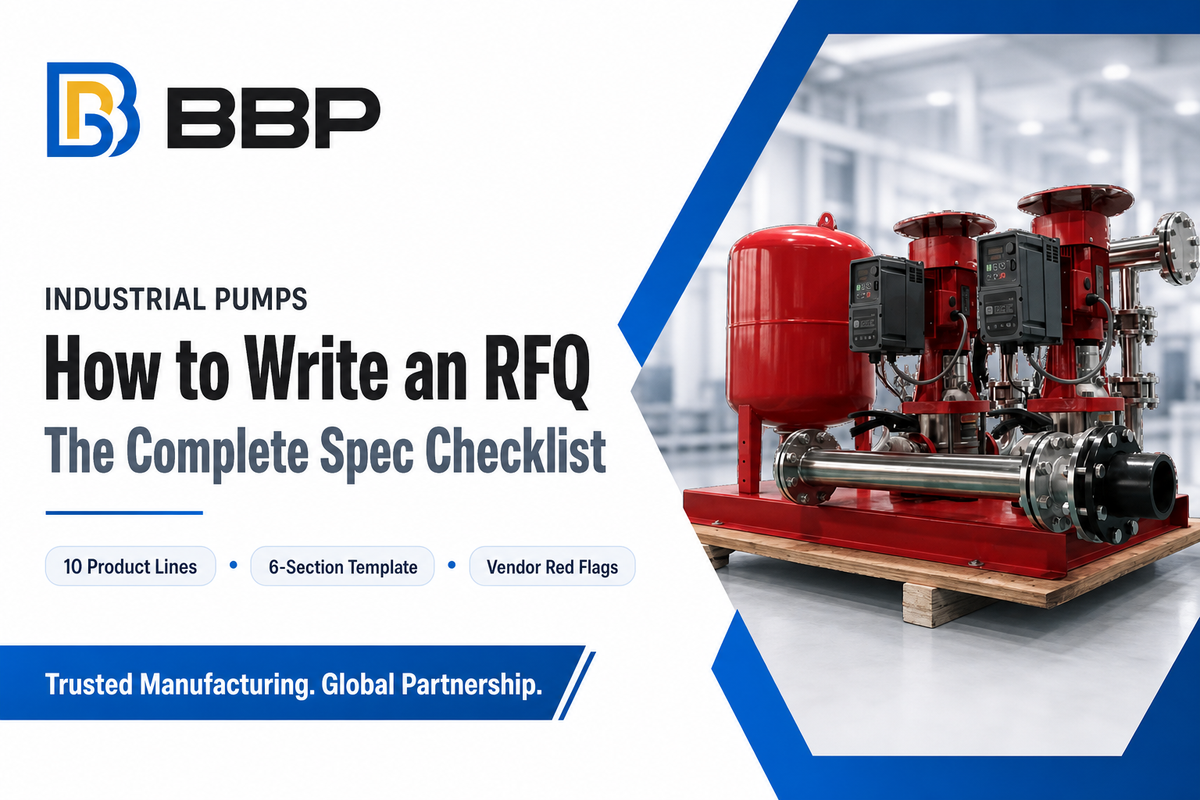
An RFQ is a formal document that asks every supplier to quote the exact same pump specification, so their bids can be compared fairly. Learning how to write RFQ industrial pumps buyers can actually use comes down to one habit: replacing every vague word in your request with a number a vendor can price against. Reviewing quotes from industrial buyers and engineers shows the same pattern again and again, you end up in the “late and wrong quote” situation when your RFQ calls for a “high-quality” motor instead of a stated duty point, material grade, and testing standard, or when you leave the pump type up to the bidder based on process data nobody actually spelled out. This guide walks through precisely what to include, section by section, using real field data from a working pump manufacturer’s own product lines, with the goal of a request for quote that respects both your time and the vendor’s and saves time on both sides of the deal.
Quick Specs: RFQ at a Glance
| Sections a complete RFQ needs | 6 (scope, standards, technical data, QA/testing, documentation, commercial terms) |
| Typical supplier response window | 5-7 business days for standard pumps, 10-14 days for custom/engineered units |
| Standards most often cited | API 610, ISO 2858/5199, ANSI/HI B73.1, NFPA 20, ISO 9906 |
| Minimum vendor count for a healthy comparison | 3-5 suppliers per RFQ round |
| Single biggest cause of delayed quotes | Vague qualifiers replacing numeric specs (see Common Mistakes below) |
What Your RFQ Needs to Accomplish (Before You Write Anything)
Every Request for Quotation exists to ensure all potential suppliers quote the exact same thing. If two different suppliers read your RFQ and picture two different pumps, one of those quotes will be wrong, even if the price looks good. The Federal Transit Administration’s equipment specification guide is direct about this failure: each vendor prices its own guess at the uncertainty.
Don’t “use open-ended requirements such as: as directed, subject to approval, satisfactory to” — and don’t “make ambiguous statements, i.e., the highest quality, in accordance with industry practices, acceptance per industry practices.”
— U.S. Federal Transit Administration, Equipment Specification Scope of Service Guide
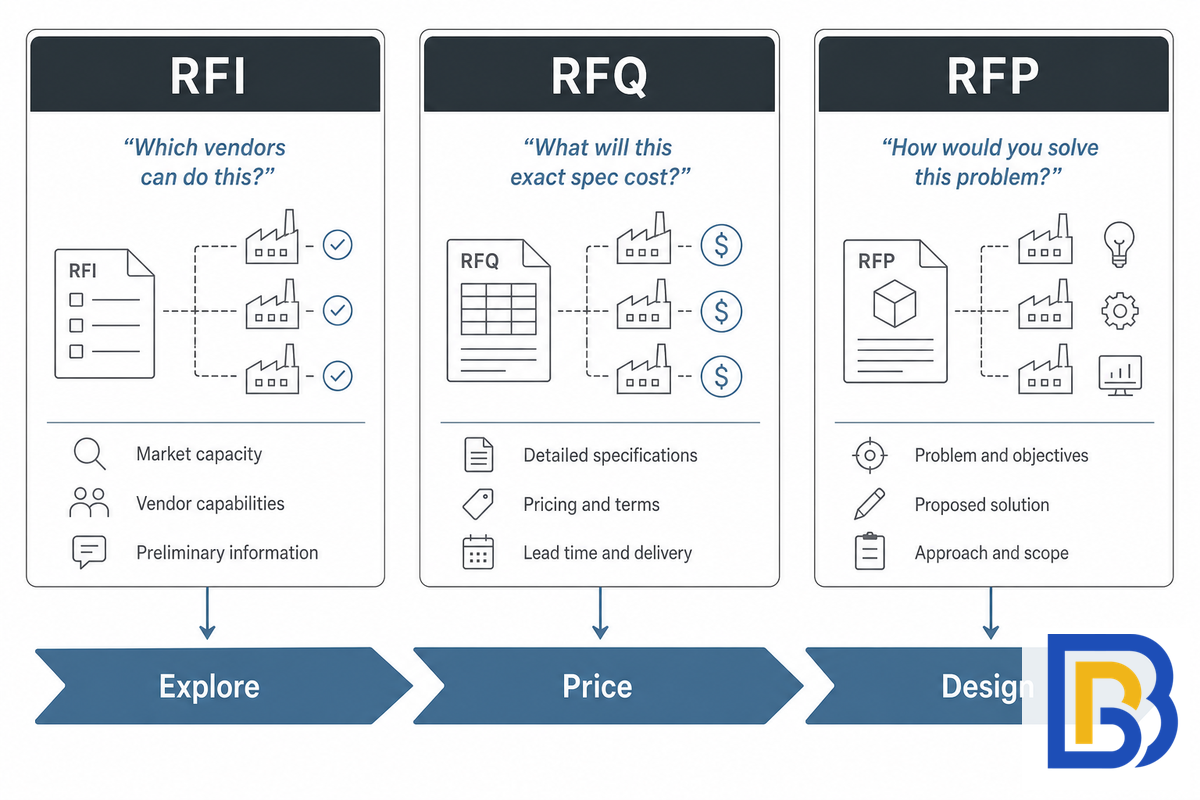
First things first. Before you write a single line of the actual document, take a minute to ask yourself which type of document is appropriate. Use a Request for Quotation (RFQ) when you know precisely what product or service you want to purchase and you’re asking vendors to compete on price and delivery time. Send a Request for Proposal (RFP) instead when the problem statement is clear but the solution itself isn’t, and you’re seeking vendors to propose an approach to solving it.
RFQ vs. RFP vs. RFI: Which One Do You Actually Need?
Use an RFQ if your process parameters (flow, head, fluid properties, temperature), materials, and quantity are already finalized and price and lead time are the only open questions. Send a request for proposal instead if you’re not sure what pump configuration or system layout fits your process and want suppliers to propose solutions. Request for information (RFI) documents sit earlier still, gathering vendor capabilities before any scope is set.
Most repeat purchases, standard-catalog pump replacements, and applications with well-defined parameters belong with an RFQ; genuinely new or system-integrated projects need an RFP instead. Some public sector buyers use an Invitation to Bid (ITB), a Sealed Bid, or even a reverse auction for simple commodities, but for complex engineered products like pumps, a properly drafted RFQ backed by a solid technical specification beats a broadly advertised Invitation to Tender.
The RFQ Process, Step by Step: From Sending to Purchase Order
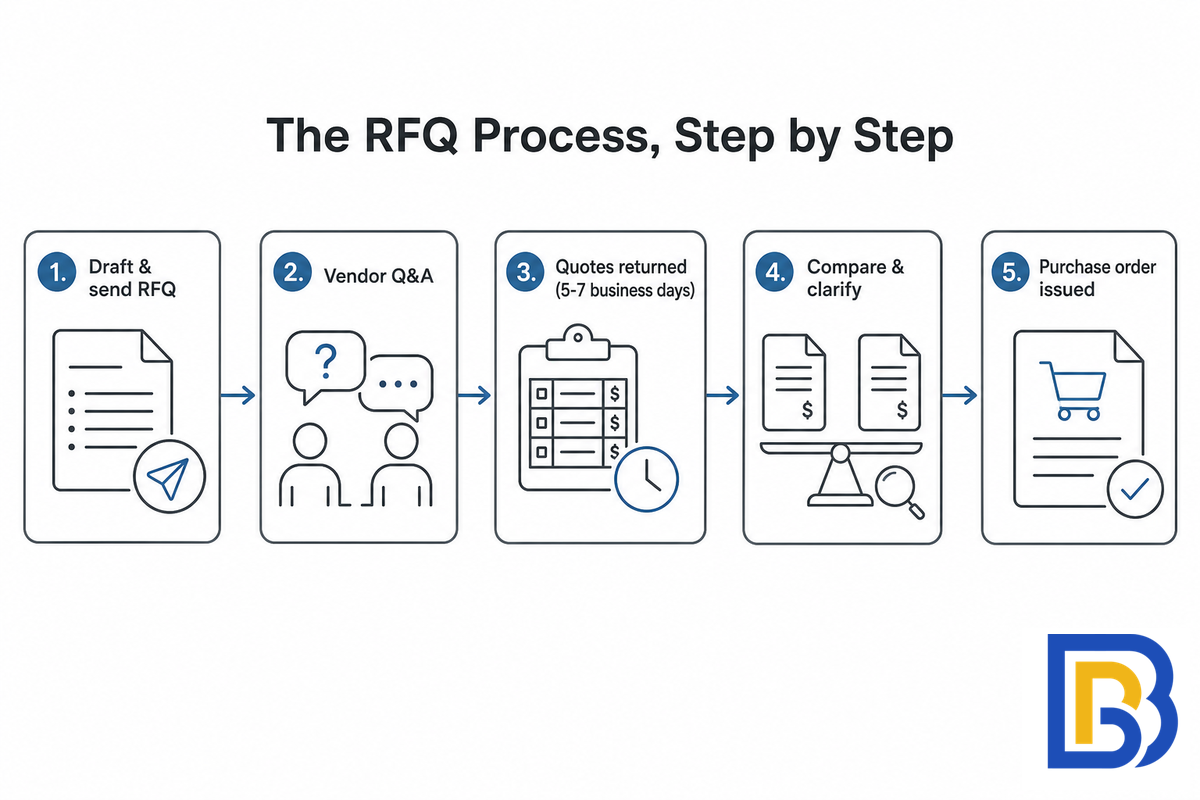
Writing the actual RFQ document is only one piece of the puzzle. Everything around it determines whether that well-crafted document ultimately results in a timely, accurate, and cost-effective purchase order. Good RFQ preparation follows the same workflow every time, making the procurement cycle for industrial pumps predictable rather than reactive — the same discipline visible in real public-sector examples like a municipal water pump station parts RFQ. Picture it as an RFQ process flow chart with seven boxes: skipping one is where a two-week purchase quickly becomes a six-week endeavor.
- Prepare the formal document. Pull project details, timeline, and deadline into the six-section skeleton below — an Excel template works fine — before you send the RFQ to any party; a procurement team that sends an incomplete draft “to get the ball rolling” just invites more clarification questions down the road.
- Share the RFQ with a shortlist of potential vendors. Three to five suppliers per round, screened for prior experience with your pump type and construction standard, yield higher quality proposals than blasting the RFQ to every known vendor or supplier — this is what separates a successful RFQ from a bidding process that just generates noise.
- Vendors submit their proposals against the due date. An adequate lead time (see the FAQ below) at this stage contributes to both the quality and quantity of bid responses received; writing an effective RFQ up front is what earns better bids at this step.
- Review the bids against defined selection criteria. Set your evaluation criteria before proposals arrive, not after — technical compliance, lead time, and post-sale support ahead of price and cost per unit — and route the full number of bids received through whatever bid evaluation committee or stakeholder review process your organization uses for capital equipment. A documented evaluation process, not an ad-hoc gut check, is what makes the decision defensible later.
- Compare offers and select the vendor whose response is the best fit based on cost, technical compliance, and delivery together, not competitive pricing or a bulk-order discount alone — every acceptance document used in the comparison should trace back to the original RFQ.
- Notify the other bidders. They don’t need to hear it for free — the buyer sends a prompt notification, thanks them for their participation, and keeps the relationship open for a future RFQ.
- Issue the purchase order against the winning proposal, with the commercial and technical terms carried through from the original RFQ unchanged.
These are the same steps in the RFQ process however your organization formalizes them, and running them as a repeatable procurement process — using a stored RFQ template rather than drafting a fresh document each time — is what the research behind this guide identifies as the single clearest best practice. An effective RFQ is one where the buyer can confidently select the best solution because several comparable proposals all addressed the same set of specifications.
The Complete Pump Specification Checklist, by Pump Type
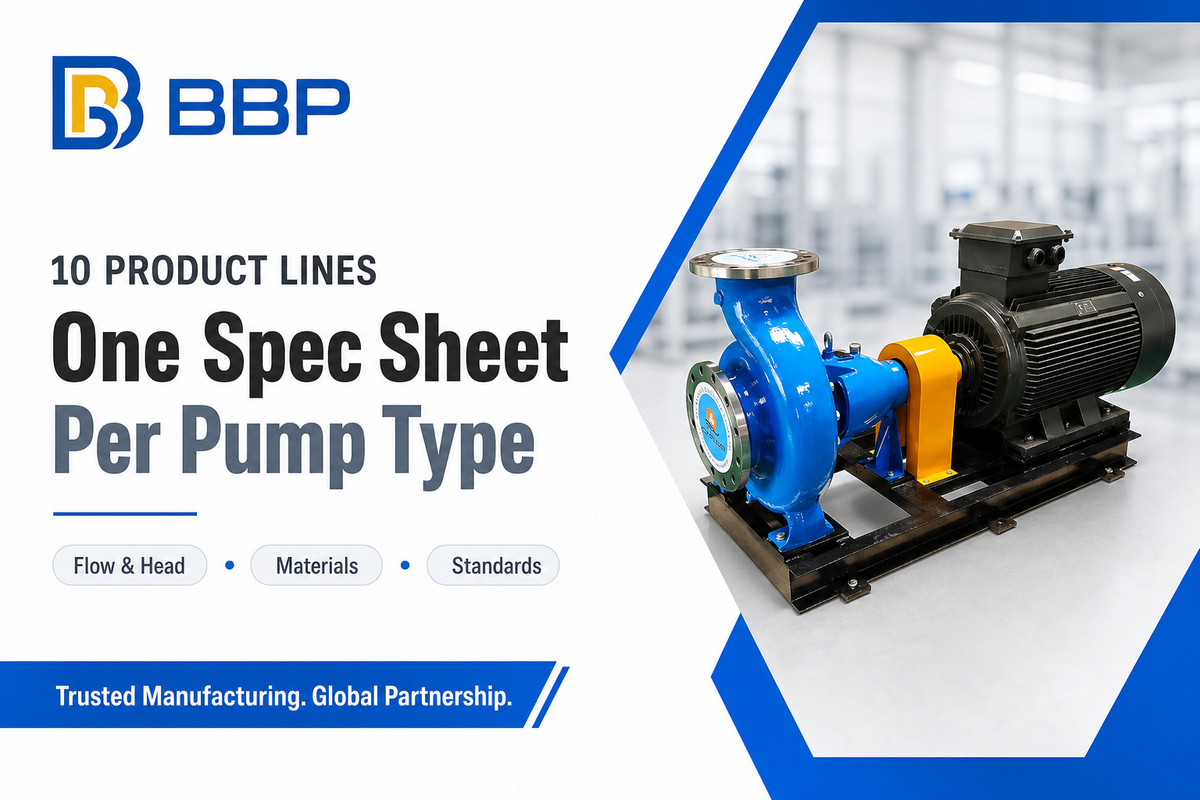
RFQs don’t translate from one pump type to the next. One and the same RFQ template can never work for all ten different industrial pump categories. For instance, solids percentage and a grade of wear material are critical to slurry pumps but are irrelevant to a chemical process pump, while the maximum depth that’s essential to a deep-well pump has absolutely no relevance to a split-case fire pump RFQ. Below is a general starting template, followed by the specific information required by application and pump type.
Universal RFQ checklist — copy these into any pump request for quotation:
| Parameter | Recommended range | Why it matters | How to verify |
|---|---|---|---|
| Flow rate (duty point) | Rated + min/max, in m3/h or GPM | Sets impeller and casing size | Vendor performance curve at quoted point |
| Total head | Rated head in m or ft, not just a distance guess | Wrong head is the top cause of an oversized or cavitating pump | Vendor curve cross-check against your system curve |
| Fluid and solids content | Fluid name, specific gravity, % solids, temperature range | Drives material and seal selection | Material compatibility chart from vendor |
| Materials of construction | Casing / impeller / shaft / seal, named by grade | Prevents corrosion or wear failure in service | Mill test certificate at delivery |
| Applicable standard | API 610 / ISO 2858 / ANSI B73.1 / NFPA 20 (pick one, see next section) | Fixes construction class and test method | Vendor’s compliance statement or certificate |
| Motor and power | Voltage / phase / frequency / enclosure type | Wrong motor spec is a common install-day surprise | Nameplate data on vendor’s data sheet |
| Acceptance test grade | ISO 9906 Grade 1, 2, or 3 | Controls tolerance and inspection cost | Test report, witnessed or certified |
The universal fields should be completed first; the table below then shows what changes across BBP’s ten pump families, drawn from the actual specification range each product line is built to. Match the row to your pump application and confirm you aren’t missing a category-specific field the universal checklist above doesn’t cover.
| Pump type | Extra field to specify | Typical production range |
|---|---|---|
| Slurry pumps | Solids % and D85 particle size, wear-liner material | Flow to 12,000 m3/h, head to 90m, solids to 60%, HCCI ASTM A532 Class III liners |
| Sand & dredge pumps | Max particle size and abrasive content | Flow to 10,000 m3/h, solids to 70%, particle size to 200mm (AMG/AWN series) |
| Sewage pumps | Solids-passing diameter (free-passage rating) | Flow to 5,000 m3/h, head to 80m, 100mm solids passing, cast iron or 316SS |
| Centrifugal water pumps | Suction configuration (end suction / double suction) | Flow to 3,000 m3/h, head to 150m, built to ANSI B73.1 / ISO 2858 |
| Split case pumps | Fire-service listing requirement (NFPA 20), if applicable | Flow to 8,000 m3/h, head to 220m, NFPA 20 listed variants available |
| Multistage pumps | Number of stages and wetted material grade | Flow to 1,000 m3/h, head to 800m, 2-20 stages, SS304/SS316/Duplex |
| Booster & pipeline pumps | VFD control requirement | Flow to 2,500 m3/h, head to 200m, built to ISO 5199 / API 610 OH3 |
| Deep well pumps | Borehole diameter and set depth | Set depth to 500m, flow to 500 m3/h, SS304/SS316/2205 Duplex wetted parts |
| Irrigation / mixed-flow pumps | Specific speed (Ns) for the intended head range | Flow to 30,000 m3/h, head 3-30m, specific speed 4,000-13,000 |
| Chemical pumps | Chemical compatibility rating for wetted materials | PTFE / PVDF / Hastelloy wetted parts, built to API 675 / ISO 5199 |
📐 Engineering Note
A recent slurry pump impeller patent from a major minerals-processing pump maker features tapered shroud designs that can reduce wear-plate thickness loss by 50-85% at the highest-wear area by deflecting high-velocity fluid away from the side liner. If your application is processing a highly abrasive slurry with more than about 40% solids, ask the vendor directly whether their impeller and liner geometry addresses this particular wear pattern; it’s a perfectly legitimate technical clarification question for an RFQ, not just a spec sheet entry.
Fluid and Operating Condition Data Your Supplier Can’t Quote Without
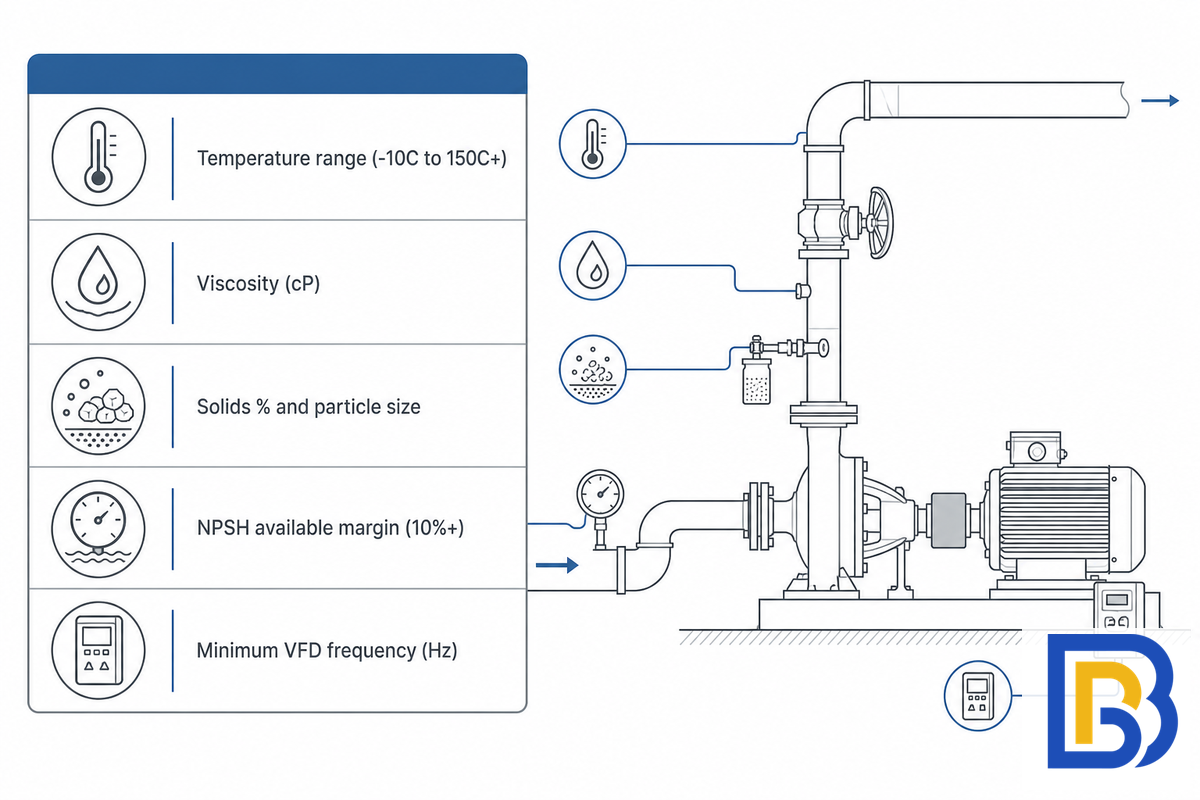
Flow rate and head define what the pump is expected to do; fluid and operating condition data describe the environment it must survive. Leave this section out, and the vendor is left to guess the materials of construction, seal type, and safety margin – guesses that lead to a conservative, expensive price tag for equipment you won’t need. Government RFQ templates for rotating equipment require the available utility conditions needed for the vendor to correctly size the drive train, such as supply voltage and phase, frequency, and the required compressed air pressure — none of which a vendor can extract from a simple flow and head number. A 2025 pump-design patent from Hohai University confirms the payoff of complete data: giving the manufacturer full duty-point figures up front let their engineering team cut design-cycle time by more than 40% versus the older trial-and-error approach.
Specify the temperature range as a specific number, not just “ambient,” such as -10°C to 80°C for a typical standard application or 150°C or more for hot-process fluids; after about 100°C, your seal and material selections will start to differ. Available net positive suction head should typically be provided to be at least 10% greater than the net positive suction head required — a conventional minimum margin used to accommodate both pump wear and unavoidable real-world system losses; failure to include this margin in the RFQ is one of the most common ways a properly sized pump ends up cavitating in the field. If your pump is controlled by a variable frequency drive, specify the minimum operating frequency too, because below approximately 35 Hz, the cooling fans of standard motors run too slowly to effectively cool the motor; if the vendor is unaware of your minimum operating frequency, they won’t be able to warn you about the need for auxiliary cooling.
One nuance of wording is far more significant than it may seem at first: engineers who professionally evaluate competing pump bids report that while API 610’s “preferred operating region” covers a 70%- to 120%-flow range around the pump’s best efficiency point, many owner specifications arbitrarily limit this to 70%- to 100%-flow, effectively confining the pump’s operation to the left side of its curve. Simply specifying “API 610 standard” isn’t enough; a one-word difference between specifying “preferred operating region” and “operate left of BEP” changes the scope of what the vendor designs and bids.
✔ Advantages of a Structured RFQ
- All vendors bid the same pump, so the price is truly comparable
- Fewer clarification emails and less schedule slippage before award
- Fluid and operating data upfront lets vendors avoid over-engineering
⚠ What an RFQ Can’t Do For You
- This can’t replace the need for knowing your actual duty point – garbage in still results in garbage bids
- This can’t correct an improper pump type selection – the RFQ prices what you specified, not what you need
- This can’t replace a technical call with the vendor in the case of an application with highly unusual operating conditions
Standards and Certifications to Cite for Each Pump Type
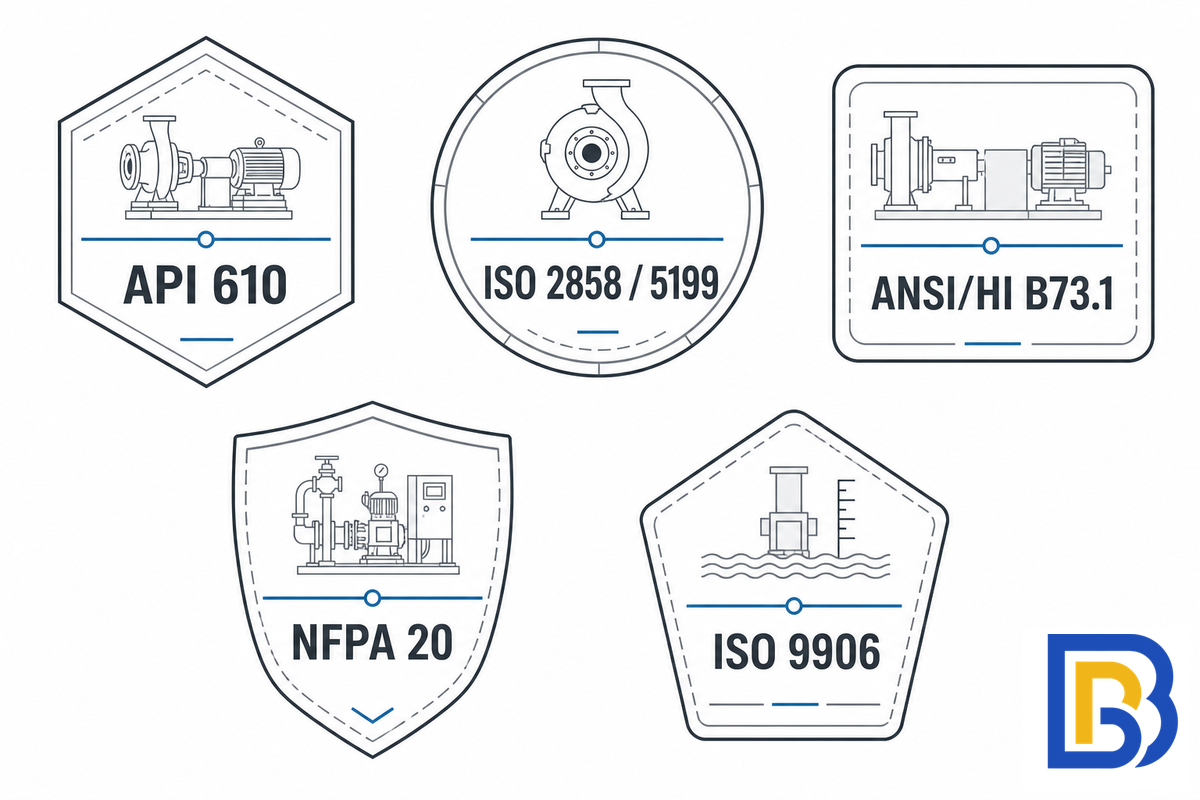
Citing “API 610” on an RFQ without a construction-type code is still vague, because API Standard 610, now in its 12th edition (released January 2021, replacing the 11th edition of 2010), organizes centrifugal pumps into three construction types, overhung (OH), between-bearings (BB), and vertically suspended (VS) — and the type code you cite is what actually tells a vendor which pump to design. The table below maps nine common API 610 type codes to typical service and BBP’s closest equivalent product line.
| Type code | Construction | Typical service | Nearest BBP line |
|---|---|---|---|
| OH1 | Foot-mounted, overhung impeller | Light general process service | Centrifugal water pumps |
| OH2 | Centerline-mounted, overhung impeller | Most common process-plant duty | Centrifugal water pumps |
| OH3 | Vertical inline, overhung impeller | Space-constrained piping runs | Booster & pipeline pumps |
| BB1 | Axially split, between bearings | High flow, moderate pressure | Split case pumps |
| BB2 | Radially split, between bearings | Higher pressure than BB1 | Split case pumps |
| BB3 | Axially split, multistage | High-head multistage service | Multistage pumps |
| BB4 | Radially split, multistage | Boiler feed, high pressure | Multistage pumps |
| BB5 | Barrel/double-casing, multistage | High-pressure pipeline injection | Multistage pumps |
| VS1 | Vertically suspended, single casing | Wet-pit and sump service | Deep well / sand & dredge pumps |
Besides API 610, there are four other standards that BBP addresses in RFQs. The Hydraulic Institute’s centrifugal slurry pump standards (ANSI/HI 12.1-12.6) and its submersible pump acceptance testing standard (ANSI/HI 11.6) are good to have if you’re not looking for a standard API 610 pump.
NFPA 20 covers fire pumps and should always be cited when your requirement is a split-case unit for a fire-fighting application rather than for process use. ANSI/HI B73.1 and ISO 2858 covers the standardized end-suction centrifugal pumps while API 675 — the same chemical-dosing standard referenced in the pump-type table above — applies to positive displacement metering pumps for chemical dosing.
A good place for your acceptance-test grade is this section too, and not lost within your commercial terms and conditions. There are three acceptance test grades according to ISO 9906:2012: grade 1 with a ±2-3% tolerance (most accurate, usually requiring laboratory-grade flow-measuring instrumentation), grade 2 (with a ±4-5% tolerance; acceptable for most commercial applications) and grade 3 (with a ±8-10% tolerance; suited only to a quick factory check on standard catalog items). For witnessed tests (when the purchaser or their representative travels to the factory and observes the test), count on an additional $500-$2,000 for the inspector’s expenses and another two to three weeks to the delivery schedule for grade 1 performance work.
This is a real tradeoff to address up front in the RFQ.
Commercial Terms and Documentation That Prevent Re-Quotes
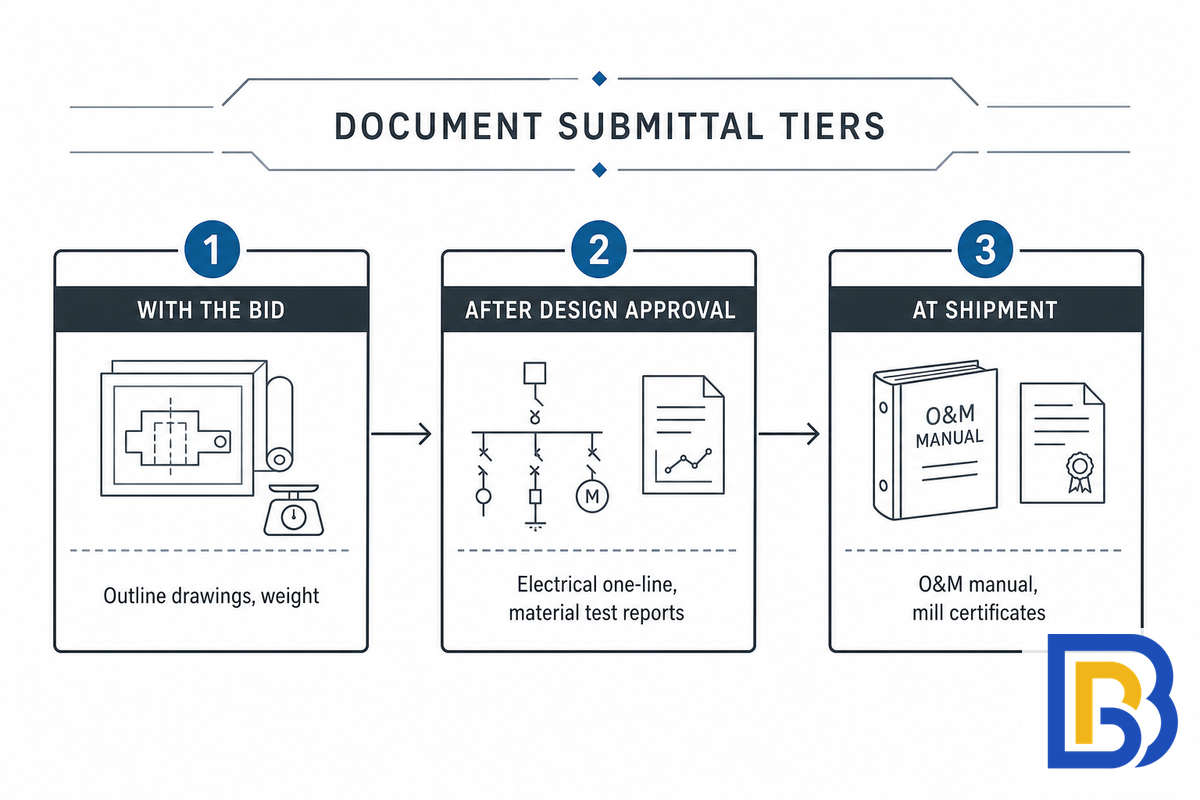
Your technical specifications will correctly size your pump, but your commercial terms and conditions will deliver your pump to you on the date and according to the standard you expect. Government contract data-requirements lists divide vendor submittal documents by tiers — those submitted with the bid, those required after design approval, and those certified at delivery — and your pump RFQ should have its own set of tiers for document submissions. An RFQ for pumps might require outline drawings and weight for your bid submission, followed by an electrical one-line diagram and material-test reports at the design-approval stage and an operations and maintenance manual at shipment.
Include current quantity required as well as your best estimate of any future needs, because pumps are volume-sensitive and one quote might be for a single unit and another for thousands of pumps under a framework agreement. Specify a firm warranty period, response time commitment and lead time for spares, and ensure repair records are provided in accordance with API RP 697 (pump-repair standard) or another recognized framework — this matters more than it sounds, since pump repairs happen more often than new-pump purchases over a unit’s service life.
Last, name the incoterms, payment milestones and certifications, and write out the terms and conditions associated with the specific goods or services covered – scope of warranty, liability limitations and cancellation options. Don’t generalize; a quote request that states “commercial invoice, packing list, certificate of origin and mill test certificates for all pressure-wetted parts” doesn’t mean the same thing to all suppliers, whereas a request for “standard export paperwork” does. Every acceptance document (drawings, data sheets, test reports) and deliverable should be an individual line item, instead of bundled under a catchall, so it doesn’t get lost from quote to purchase order.
Common RFQ Mistakes That Delay Your Quote
All mistakes in this list boil down to a vague word replacing a number — precisely the pattern federal procurement guidance warns buyers to strip out before an RFQ ever goes out. One real example makes the impact of such vagueness concrete: an RFQ asking for unspecified “stainless steel brackets” received quotes from $2 to $15 a unit, because suppliers independently assumed standard 304 grade with standard finish, high-grade 316 with electro-polishing, or base-grade 430. This same pattern occurs any time a pump RFQ asks for “corrosion-resistant materials” in lieu of 316SS, Duplex 2205 or some specific alloy grade.
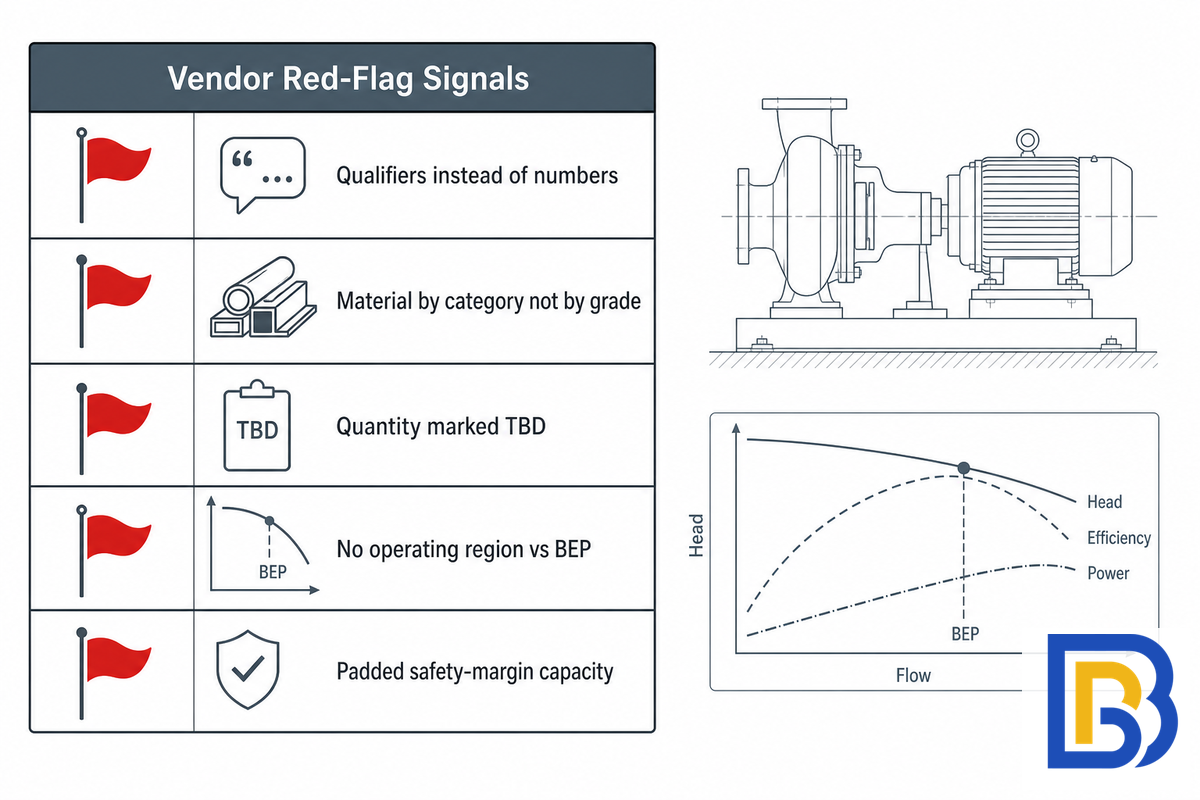
Reviewing quote requests from the supplier side turns up five signals that indicate a bid will come in slow, overpriced, or simply wrong.
Red flags a vendor watches for
- Qualifiers like “high quality” or “as needed” instead of a number
- Material called out by category (“corrosion-resistant”) not by grade
- Quantity stated as “TBD” or left blank entirely
- No stated operating region relative to best efficiency point
- A capacity number padded “for safety margin” with no duty-point data behind it
What it costs the buyer
- Vendor prices in a margin for the risk instead of quoting tight
- Quotes across suppliers price different specs, not the same pump
- Per-unit price swings hard between small and volume orders
- Efficiency numbers look “wrong” when they were never comparable
- An oversized pump that recirculates, wastes energy, and wears faster
The last item on this list deserves a second look, as it counters a common buying instinct. Oversizing a pump to be “safe” isn’t the safe approach; the excess fluid recirculates, forcing the pump out of its optimal range, and may cause water hammer once in service. The same over-engineered “safety” often occurs with parallel-pump setups — installing a second pump on a system plumbed for a single working pump plus one spare can actually reduce usable flow (because the undersized pipe system wasn’t designed to carry two flow rates) rather than boost it. By contrast, oversizing a pump to meet a duty point can decrease overall energy efficiency up to 20% compared with one properly sized for the application. Wear cost follows the same pattern on abrasive slurry duty: published wear-life studies on cyclone-feed pump service report an estimated 30-70% reduction in wear rate, and roughly 1,500-4,000 additional hours between wear-part changeouts, for units held inside a 75-110% best-efficiency-point flow window versus units run well outside it — a gap wide enough that the duty point belongs in the RFQ as a number, not an estimate.
How to Compare Vendor Quotes Once They Come Back
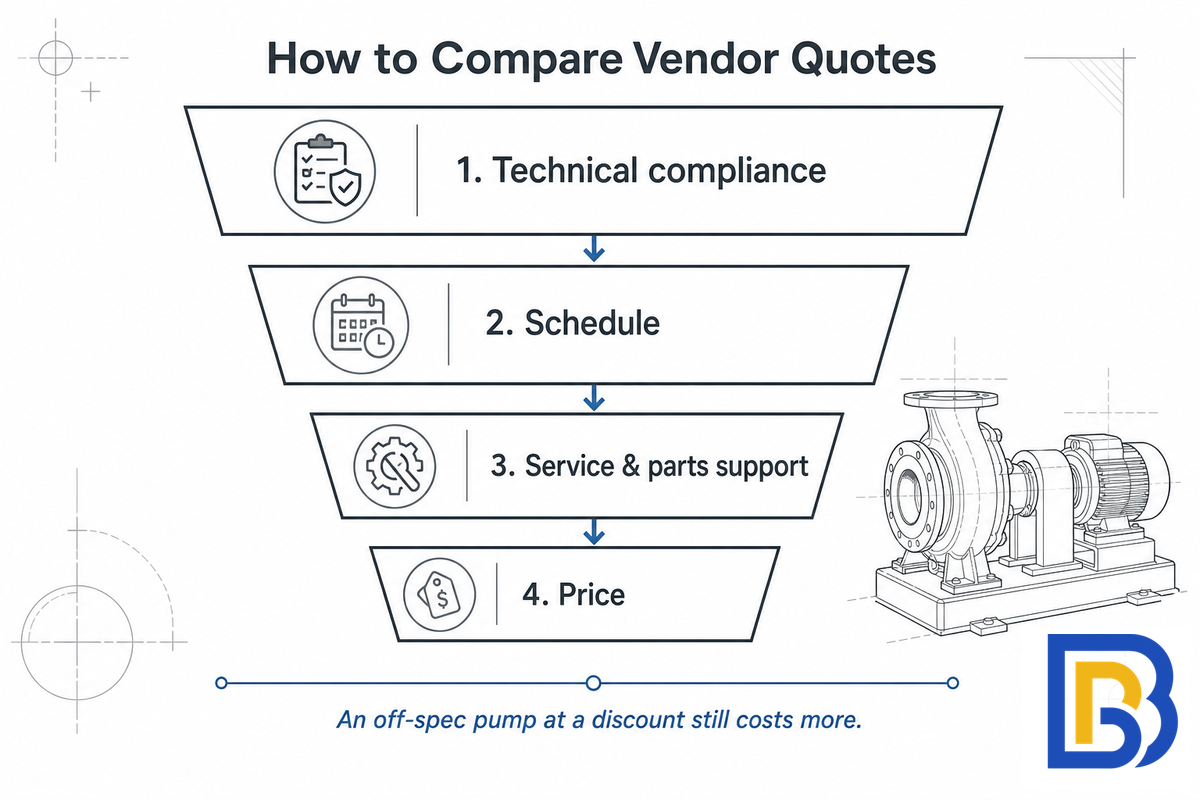
Comparing pump quotes solely by lowest price doesn’t answer the question engineers who specialize in technical bid evaluations ask: they compare according to technical compliance (starting with the ISO 9905 severity class the pump was actually built to), then schedule, then service and parts support, then finally price, since an off-spec pump at a discount still ends up costing more than a pump that works correctly.
Vendor quote comparison matrix — what to prioritize by scenario:
| If this is true… | …prioritize this | Because |
|---|---|---|
| One quote fails a stated technical requirement (duty point, material, standard) | Disqualify it, regardless of price | Practitioner consensus ranks technical compliance above price every time |
| Price gap under roughly 10%, lead-time gap under 2 weeks | Service and spare-parts support | Downtime cost over the pump’s life dwarfs a small price gap |
| Price gap under 10%, lead-time gap 2+ weeks | The faster vendor | Schedule slippage usually costs more than the price difference it avoided |
| Quotes otherwise tied on compliance, schedule, and support | Total cost of ownership over list price | Purchase and installation cost is a minority of lifecycle cost on most pump systems |
The value in that last row can be easily quantified. An industry estimate frequently quoted for multi-decade pump lifecycle cost shows just how small the impact of purchase and installation can be by comparison, with energy and maintenance costs far dominating the total picture – effectively a bid evaluation based on invoice value focuses on the minor expense while overlooking the major one. Organizations that run this kind of criteria-based comparison instead of scanning the invoice price report sourcing cycles up to 24% shorter, according to 2025 procurement benchmarking research.
A Quick RFQ Template You Can Copy: The 6-Section RFQ Skeleton
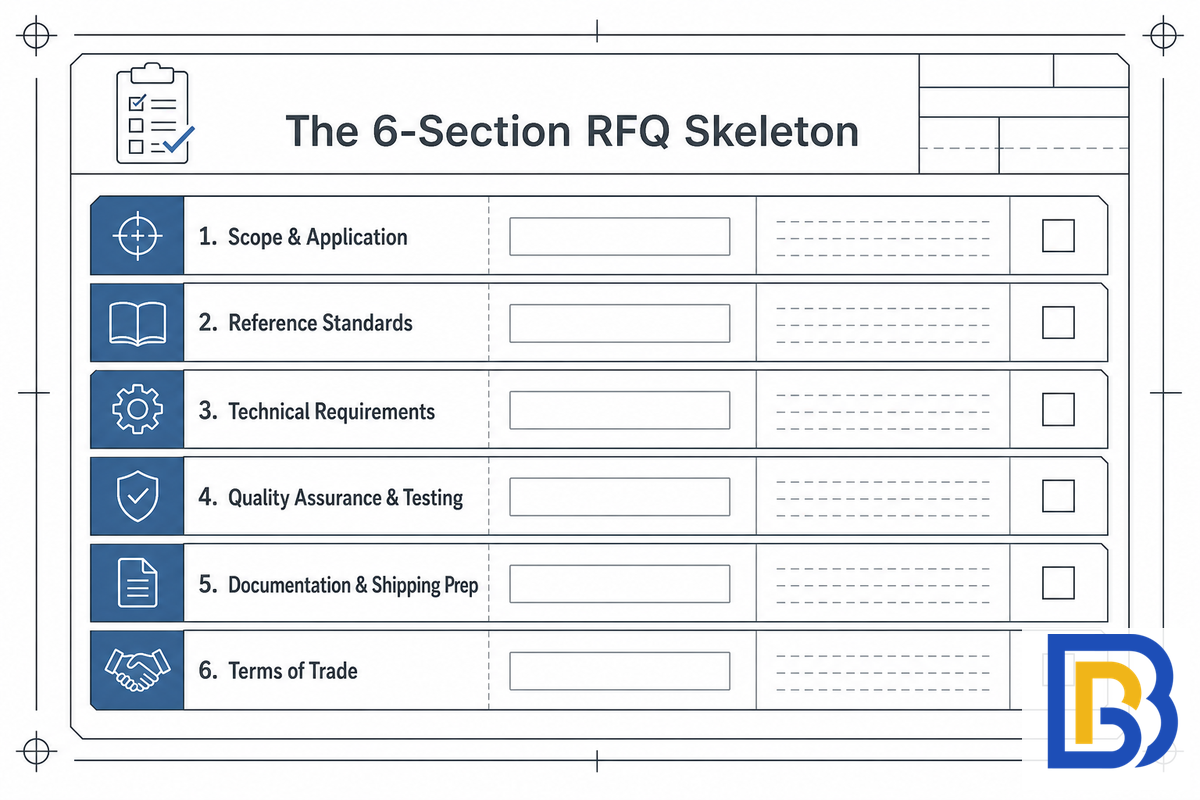
Every section covered above maps onto a document skeleton you can reuse for any pump RFQ. What follows adapts the six-section equipment specification format used in U.S. federal transit procurement guidance, restated for a pump purchase — it isn’t a BBP invention, it’s a proven government-procurement skeleton that happens to fit pump RFQs cleanly.
The 6-Section RFQ Skeleton
- Scope & Application – what the pump does, whether it will be a new or replacement pump, number needed.
- Reference Standards – the actual type of standard (API 610 OH2, NFPA 20, etc.) and method of construction
- Technical Requirements – duty point, fluid data, materials, motor, per the checklist above
- Quality Assurance & Testing – acceptance grade (ISO 9906 Grade 1/2/3), observed vs. approved test
- Documentation & Shipping Prep – drawings, datasheets, export packaging requirements
- Terms of Trade – payment terms, delivery conditions, guarantee/warranty terms, and reply deadline.
Copy this six-section frame into an RFQ template Word document or an Excel spreadsheet, then pull the field-level detail for sections 2-4 from the checklists earlier in this guide; the commercial side needs little more than a simple pricing template with one row per line item. A buyer who fills all six sections before sending gets a real quote back inside the 5-7 business day window standard pumps warrant, instead of the multi-round clarification cycle that a one-paragraph inquiry usually triggers. A plain, complete RFQ consistently outperforms a well-formatted, incomplete one; completeness is what shortens the timeline, not polish.
Frequently Asked Questions
Q: How do I write a good RFQ for an industrial pump?
A good pump RFQ states duty point, fluid data, materials, applicable standard, acceptance test grade, and commercial terms as specific numbers, not general descriptions, so every vendor prices the same pump.
Start from the six-section skeleton above: scope, reference standards, technical requirements, QA/testing, documentation, and commercial terms. Fill each section with the field-level checklist earlier in this guide — flow and head from the universal checklist, then the extra field from the Pump-Type Spec Field Matrix for slurry, sewage, chemical, or whichever line applies to your project. The RFQs that get fast, accurate quotes back are the ones where a vendor never has to ask a clarifying question before pricing, because every ambiguous word costs a round-trip email and a day or more of delay. If you are not sure which construction type or standard applies, the API 610 classification table above and the standards section that follows it will point you to the right citation before you send anything to a supplier.
Q: What comes first, RFQ or RFP, when buying a pump?
Send an RFQ when your specification is already fixed and only price and lead time are open; send an RFP when the pump type or system design itself is still an open question.
For most follow-on industrial pump purchases, replacement pumps, and off-the-shelf catalog items, the RFQ is the correct approach. You know your duty point, your materials, and your standards, so all you need from suppliers is a quote. For genuinely new or system-level projects, the Request For Proposal is the right fit, since you need suppliers to recommend the pump design rather than quote one you have already specified.
For a preliminary search where you do not have a spec yet, use the Request For Information.
Q: What’s an example of a pump RFQ?
A complete example follows the 6-Section RFQ Skeleton above, with real numbers filled into scope, standards, technical data, testing grade, documentation, and commercial terms for a specific pump type.
Rather than one all-purpose sample PDF, pick and choose from the skeleton below and fill it in using field-level values from checklists corresponding to your pump type, fluid, and standard. You’ll find that a slurry pump RFQ and a chemical pump RFQ share the same skeleton at the six-section level but vary greatly in the technical requirements, with a slurry pump requiring D85 particle size and wear-liner grade while a chemical pump requires chemical compatibility rating. Keep an RFQ response template PDF on hand for logging vendor answers side by side once quotes start coming back.
Q: How many suppliers should I send my pump RFQ to?
Three to five suppliers per round is a practical range for most industrial pump RFQs, wide enough for a real price comparison without an unmanageable evaluation load.
Sending to fewer than three limits your ability to comparison-shop on price and lead time, and sending to more than about eight turns comparison into an evaluation exercise that adds little value, since a good RFQ has already narrowed the response spread between capable suppliers. For a genuinely new or highly engineered pump design, three specialists usually beat quotes from a half-dozen generalist pump builders.
Q: What payment terms should I include in a pump RFQ?
State payment milestones by name (deposit, pre-shipment, on delivery), delivery terms by Incoterm, and required certifications by document name so every vendor’s quote stays directly comparable.
Typical examples include a deposit at order confirmation, progress payment upon successful factory test completion, and balance upon delivery or shipment — but how it’s divided is less important than having the term clearly specified, because unclear payment terms just add one more item quotes can’t be compared on. Ensure that your payment terms are defined alongside a specified delivery basis (FOB, CIF, DAP, etc.) so responsibility for freight and insurance are clear as well.
Q: Do I need to specify an acceptance test standard like ISO 9906 in the RFQ?
Yes — without a stated ISO 9906 grade, vendors default to their own standard test practice, which varies and makes competing quotes hard to compare fairly.
State ISO 9906 grade 1, 2, or 3. These different grades test in different tolerance bands with correspondingly different costs, if no grade is specified, the vendor’s default test practices are assumed, which, in this area can give very different values and make it difficult to compare with other vendors, assuming that all other parameters are in order.
Q: How long should I give suppliers to respond to a pump RFQ?
Five to seven business days for standard catalog pumps, ten to fourteen days for custom or engineered units, is a realistic window for an accurate quote.
If there is anything less than three days, it can result in lower quality of quote as a vendor’s engineering department will not have adequate time to assess duty point data before quoting on.
References & Sources
- Equipment Specification Scope of Service Guide — U.S. Federal Transit Administration
- RFQ for Water Pump Station Parts — City of Rocky Mount, NC
- API Standard 610 and RP 697 Announcements — American Petroleum Institute
- Pump Industry Standards — Hydraulic Institute
- ISO 9905:1994 Technical Specifications for Centrifugal Pumps — International Organization for Standardization
- Slurry Pump Impeller Wear-Reduction Patent CA3217525A1 — Google Patents / USPTO filing
- Centrifugal Pump Blade Wrap-Angle Design Patent CN120911368A — Google Patents (Hohai University, 2025)
- API Standard 675 — Positive Displacement Pumps – Controlled Volume, for Petroleum, Chemical and Gas Industry Services — American Petroleum Institute
The Team Behind This Report
The specification ranges in the Pump-Type Spec Field Matrix above come from BBP’s own ten product lines, running through in-house foundry, heat-treatment, CNC machining, and an ISO 9906 Grade 1U/2B hydraulic acceptance test on every unit before it ships. We wrote this guide from the vendor side of the RFQ desk, because most sourcing guides are written entirely from the buyer’s side and miss what actually slows a quote down on our end. Reviewed by the BBP Manufacturing Co., Ltd. technical team.
Related Articles
- Pump Industry Standards Guide — full cross-reference of API/ANSI/ISO/HI/NFPA 20 standards, one level deeper than this RFQ-focused summary
- Slurry Pump Total Cost of Ownership — the full lifecycle-cost breakdown behind the TCO comparison factor above
- Slurry Pump vs. Centrifugal Pump — which category to specify before you start the RFQ
- Multistage Pumps — BB3/BB4/BB5-class high-head product line
- Deep Well Pumps — VS1-class submersible product line
- Chemical Compatibility Selector Tool — determine your wetted-material field before writing the RFQ