Get in Touch with BBP

Reviewed by: BBP Manufacturing Co., Ltd. technical team. Updated: July 2026.
A self-priming pump for construction site dewatering is only half the problem facing a contractor. Manufacturers and trade literature already cover the pump itself in exhaustive detail-how it primes, what it can lift, how many gallons per minute it moves. Missing from that picture, and the more difficult half for most contractors, is how to procure it.
The question for many is: Do I rent or buy?
Which discharge permit do I need before I remove a single gallon of water from my site?
How do I find a dewatering vendor who can deliver a job-appropriate pump?
How many units does the job require once storm events are considered?
This guide addresses the second half of the issue.
A self-priming pump for construction site dewatering is a centrifugal pump that evacuates air from its own suction line on startup using the liquid in its casing, which permits it to lift water from an excavation without a flooded suction inlet or a foot valve.
Although dewatering capabilities are relatively well documented, more than “how does it prime,” the real contractors’ concerns are acquisition: whether to rent or buy, what discharge permit is relevant to the site, how to vet a supplier, and the total number of pumps the project demand.
Key Takeaways
- Determining whether to rent or buy isn’t just a simple utilization-percentage formula.
You might decide to buy and own a pump if it serves as the ideal backup unit, even if it sits idle most of the year in your region.
- Federal dewatering requirements set the bar at one acre of disturbed land for compliance with the Construction General Permit, but it’s important to know whether the state your project is in runs its own authorized stormwater program instead.
- You won’t trip an immediate violation of the 2022 Construction General Permit for exceeding 50 NTU on your discharge. That number only apply to discharges to “sensitive” or “impaired” waters, not nationwide.
- OSHA mandates that any dewatering equipment operating in an excavation be attended by a competent person. Worker safety regulations mandate this.
- You’ll find it hard to pass many municipal pump permits without providing a “standby pump.” These requirements aren’t suggestions; they’re mandated by contract.
- It’s important to recognize that online search queries for dewatering are moving toward broader terms related to compliance (rather than “wellpoint” for instance), indicating a growing shift among contractors towards seeking outcome-oriented solutions and away from simply identifying equipment types.
Quick Specs
| Function | Evacuate air from suction line at startup; lift water from excavation without flooded suction, functioning as a self-priming water pump for dewatering duty |
| Flow range | 20–2,800 GPM depending on frame size (2″–8″) |
| Practical suction lift | Up to 25 ft (atmospheric ceiling ~33.9 ft at sea level, less friction/altitude losses) |
| Prime time | 30–120 seconds, healthy units typically under 60s |
| Solids passing (trash variant) | Up to 3″ spherical |
| Drive options | Electric · Diesel · Gas · Submersible |
What a Self-Priming Pump Actually Solves on a Job Site
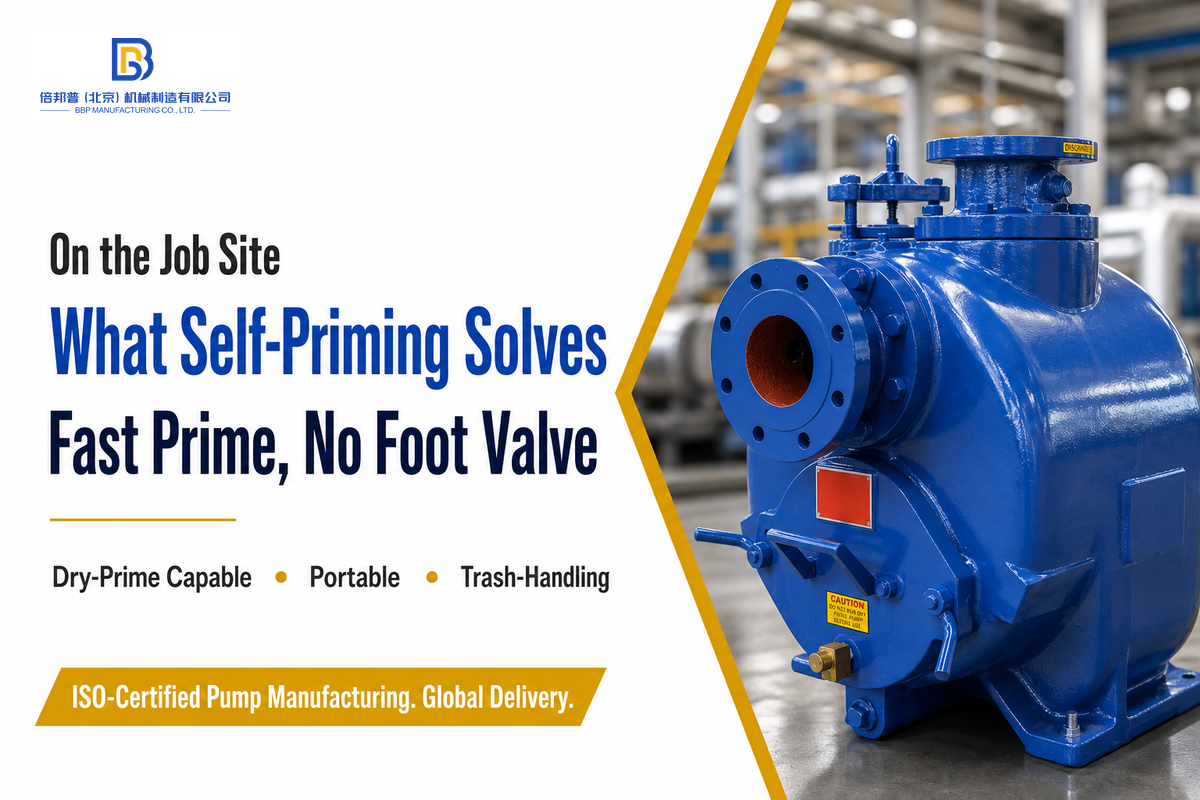
A self-priming pump solves one core engineering problem: because of the internal reservoir in its casing, the impeller fills itself and creates a vacuum that evacuates air from the suction line without assistance, so it needs no flooded suction inlet or foot valve on startup. Conventional pumps stall the instant air enters the line; a self-priming centrifugal pump clears that air on its own after the first fill-up, eliminating the need for manual priming on subsequent startups.
Diaphragm pumps use a separate mechanism to achieve the same outcome on chemical or abrasive dewatering duty, while the trash-frame variant is built to pass solids-laden water and debris rather than clog on it-self-priming technology has even been adapted into dredge systems that integrate a self-priming pump to convey dredged material to a receiving vessel, a sign of how far the same basic priming mechanism extends beyond a standard jobsite frame. Named engineers at Godwin, Wacker, Gorman-Rupp, and Tsurumi, interviewed on this exact selection physics, frame the same wet-prime-versus-dry-prime tradeoff as the deciding factor once a site’s suction lift starts pushing toward the upper end of what a self-priming frame can pull. A pump that handle removing water well on one job site can be the wrong frame entirely on the next, which is exactly why the range of dewatering pumps built for construction dewatering applications spans so many sizes and drive types. Our self-priming pump engineering guide and our trash pump guide for solids-heavy dewatering duty cover the full story in depth: that priming cycle, the range of self-priming dewatering pumps, the range of self-priming centrifugal pump types, and the tradeoffs between drive types (including dewatering pumps powered by electricity).
Under two minutes is the mark of a healthy priming time. Longer is usually indicative of an issue with the air management system of the suction line itself and not a problem with the pump; and the most efficient way to troubleshoot priming issues in a new setup involve ensuring proper installation-not blaming the equipment. Eliminating priming issues on a fresh installation almost always comes down to the suction-side plumbing, not the pump itself. Check out our engineering guide for that sequence and a description of what running without manual priming looks like after a self-priming pump’s reservoir is charged. BBP Manufacturing’s in-house casting and machining hold the reservoir and impeller-clearance tolerances that keep that repeatable, because a casing that seals consistently across production runs is what turns a “usually primes fine” pump into one a crew can trust on a rain-event callout. That build quality is why these pumps are used on everything from a single footing pour to a full basement excavation-electric dewatering pumps for grid-powered sites, diesel or gas frames where power isn’t available.
This guide picks up where those guides left off. Once you’ve decided that the right self-priming pump is the hardware class you need, the decisions are less about the specifics of the hydraulics-those have been handled in our self-priming pump product literature-and more about: What’s the most appropriate dewatering method for your specific application? Would it be better to rent or buy your equipment? How should you screen suppliers and manufacturers of the pumps and other hardware components? What permit is needed for the water being discharged from your site? And how many units will be required to get the job done in the event of a storm? Getting those five things right-not selecting the correct type of pump itself-is what separates successful pump operation on an actual construction site from an expensive educated guess. Here’s how to do that.
Choosing a Dewatering Method Before You Choose a Pump
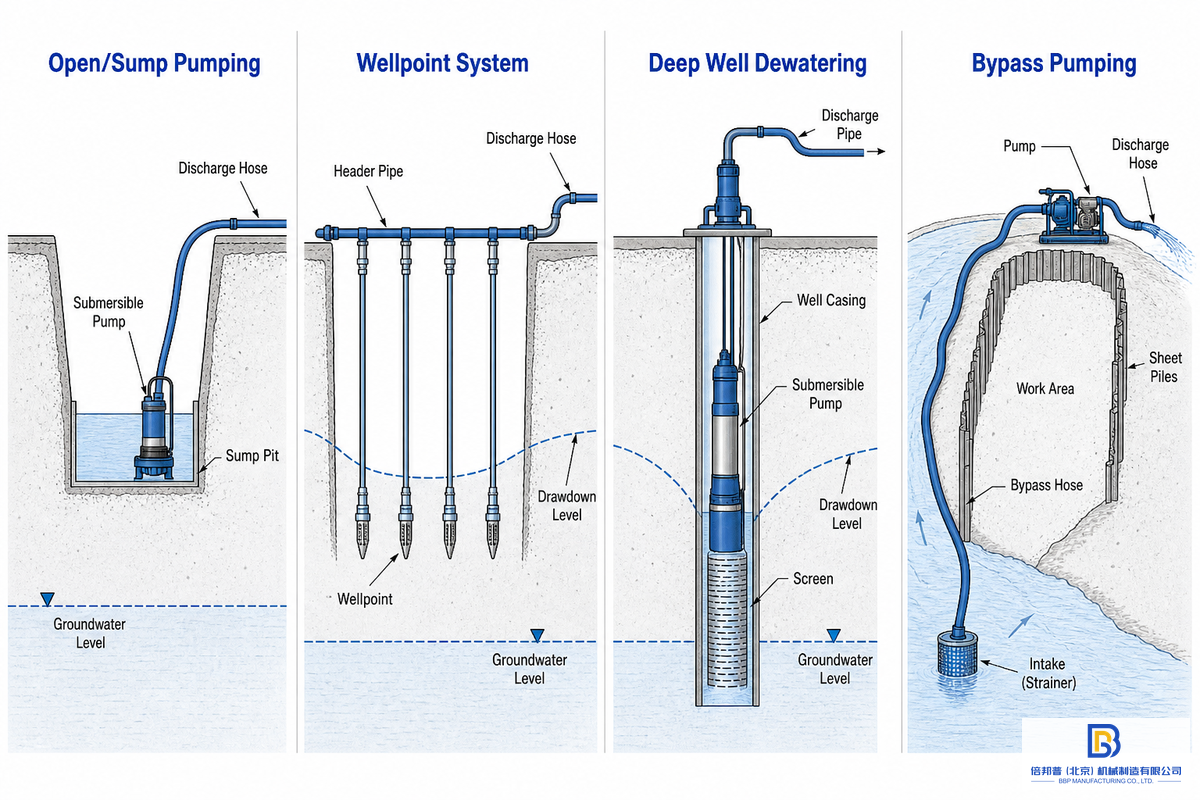
Before a site even begins to select a particular pump model, it’s important to first decide on the best dewatering method for the situation. Soil permeability, depth of excavation, and position of water table are the primary deciding factors-not personal preference, or a company’s existing brand loyalty. Sites drawing from a shallow water supply with light sediment can often be adequately handled with the same high-flow self-priming frames typically used to pump water for general water transfer applications, because they remove water at a rate that matches inflow, rather than trying to work against it. Sites bordering natural bodies of water, or handling substantial volumes of water, need a method selected for containment first and flow rate performance second. Applications involving high-solids conditions that start encroaching into the territory of slurry pumps-which are capable of moving materials well beyond what a standard self-priming trash frame can manage-are outside the scope of this guide and covered in separate content on slurry pumps. Choosing the most appropriate dewatering method isn’t a catalog-browsing exercise. Instead, as described in Caltrans’ Field Guide to Construction Site Dewatering, the first step should be to fully characterize the water being removed, then determine the appropriate method of removal. Choosing the right self-priming pump only matters once that method decision is settled-a well-built frame does little good on a site where the method itself was the wrong call, and efficient dewatering on repeat dewatering projects usually traces back to getting this sequencing right the first time. Where the permanent drainage design also needs runoff storage or attenuation, assess stormwater management systems from Storm Manage separately from temporary excavation pumps, using the site's approved storage volume and discharge limits.
The Dewatering Method Type Fit Card
Nine method types-three primary, two stepped variations, two combination scenarios derived from actual jobsites, and two edge cases-are correlated to the actual soil condition each is intended to match.
| Method type | Best soil condition | Notes |
|---|---|---|
| Open pumping (direct) | Permeable soils, light inflow | No engineered sump; pump draws straight from the low point |
| Sump pumping (engineered) | Sand, gravel | Cheapest, simplest; loses effectiveness at high water table |
| Single-stage wellpoint | Sandy soils, shallow excavations | Vacuum drawdown limited to roughly 5–6 m without re-staging |
| Multi-stage (staged) wellpoint | Sandy soils, deeper excavations | Stacks stages to exceed the single-stage drawdown limit |
| Deep well | Highly permeable — sand, gravel, fractured rock | Large, long-duration projects; highest install cost, needs skilled crew |
| Eductor system | Low-permeability clay, silt | Can achieve drawdown to roughly 30 m where vacuum systems cannot reach |
| Wellpoint + sump combination | Soft clay with high groundwater | Used on urban high-rise excavations per documented case studies |
| Deep well + sump combination | Rocky, landslide-prone terrain | Used on highway-expansion excavations per documented case studies |
| Bypass pumping | Not soil-driven | Different problem — reroutes existing pipe flow, not a water-table method; do not size against this card |
Method selection criteria and combination-system case studies compiled from Pile Buck Magazine’s 2026 Services Guide and SafetyCulture’s construction dewatering guide, cross-referenced.
Bypass pumping earns its place at the bottom of that table as a flag, not a peer. It reroutes an existing flow-typically a pipe- or sewer-repair scenario-around an active work zone, rather than lowering a water table by soil type. Size a bypass job against the pipe’s existing flow rate and pressure, not against soil conditions.
How to Dewater a Construction Site: The Field Sequence
Field-workflow guidance from the construction dewatering handbook flows from water source evaluation (water origin and contamination issues), through application for discharge permitting (required before starting work), then the construction process to implement the appropriate dewatering method (as determined from the chart above), and then on to filtering or settling water containing harmful elements before it’s safely discharged from the site while monitoring soil conditions and vegetation at nearby locations. Underestimating the importance of the discharge permit process-often only a day or two for a smaller project, but one that often get pushed off until after work is already underway-is a common error. It’s considerably more expensive to halt operations mid-project, than it’s to take a day or two at the beginning of it to get proper approval for all phases of dewatering activity, from a small footing to a full basement excavation. Tracking water levels at each stage of the dewatering process, rather than assuming the initial pump setup will hold for the duration, is what keeps a crew from being caught out when a storm event push inflow past the original plan.
Rent or Buy: The Contractor’s Breakeven Math
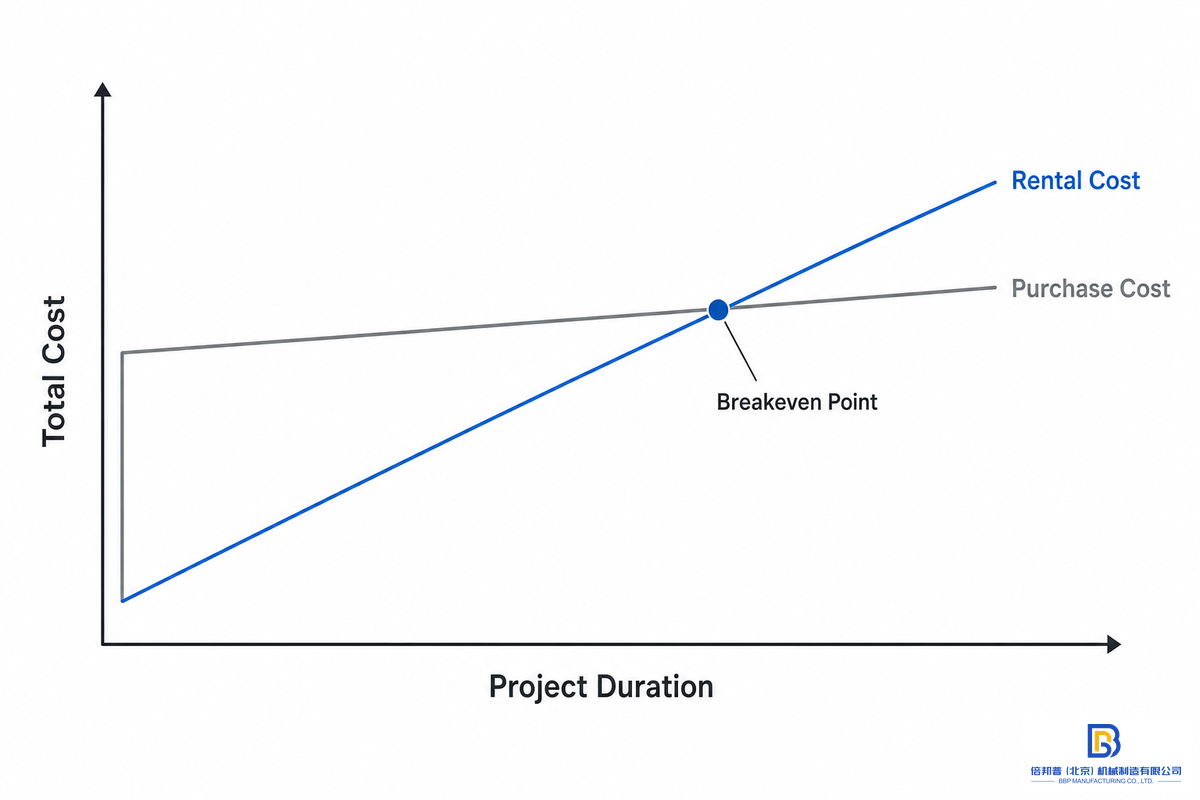
Rental versus ownership of a dewatering pump is generally based on a hunch (“it would just sit there idle”) rather than on a thorough economic analysis. No dewatering-pump-specific economic calculation model is available to the general public, the closest to it’s guidance on the Federal Highway Administration’s general construction-equipment rate structure, which typically prices standby equipment at roughly 50% of the ownership rental rate, and 176 hours of work for a pump as its monthly ownership baseline rate. This guidance will serve as a reasonable benchmark, if somewhat crude, in the economic assessment to follow-even if not formulated to fit pumps precisely.
The Rent-or-Buy Breakeven Curve
A worked example using a mix of actual market rates and a verified labor benchmark, rather than a rule of thumb.
Let’s assume a diesel trash pump measuring four inches. Current construction estimating information from April 2026 puts this model at around $220–$420 per day or $650–$1,350 per week, or, on average, $1,000 per week. A comparable self-priming pump purchased outright, from our extensive centrifugal pump line, runs an approximate $4,000–$5,000 for that frame and material class. Here’s how the accumulating cost of renting that same size pump stacks up against the cost of buying one outright over time.
| Weeks of use | Cumulative rental cost (~$1,000/wk) | Purchase price (this frame class) | Sticker-price lean |
|---|---|---|---|
| 2 weeks | $2,000 | $4,000–$5,000 | Rent |
| 4 weeks | $4,000 | $4,000–$5,000 | Rent, approaching crossover |
| 5 weeks | $5,000 | $4,000–$5,000 | Crossover zone |
| 6 weeks | $6,000 | $4,000–$5,000 | Buy, on sticker price alone |
| 8 weeks | $8,000 | $4,000–$5,000 + reserve | Buy |
| 10 weeks | $10,000 | $4,000–$5,000 + reserve | Buy |
| 12 weeks | $12,000 | $4,000–$5,000 + reserve | Buy |
| 16 weeks | $16,000 | $4,000–$5,000 + reserve | Buy, clearly |
| 20+ weeks / year-round | $20,000+ | $4,000–$5,000 + reserve | Buy, not a close call |
Reading the Curve
The sticker price will just about go above the line at about five weeks- but that’s not a complete comparison. Once storage, insurance and a maintenance reserve fund are brought in to the ownership side (FHWA uses a generic construction-equipment approach where standby capacity is charged at about 50 percent of ownership’s rental rate; it’s a reasonable proxy for the ongoing cost of carry), the effective crossover point many contractors observe is at about ten to twelve weeks a year. Under that point, renting makes more sense for cash-flow.
Do your own math for the field-service labor and replacement cost part of that comparison in our Construction Dewatering ROI Calculator. Above the break-even point, and certainly if you’ll use the pump as your storm event backup machine, buying makes sense not necessarily on runtime, but on having a unit doing double duty: dewatering in action, and on standby as backup.
Here’s the second point most rent-vs-buy advice gets wrong. Writing in Tunnel Business Magazine, a pump industry executive makes the case directly: equipment can be worth owning even at low calculated utilization, if the cost of not having it the one week you need it would be enormous. A pump that sit idle 90% of the year but is the only thing standing between a storm event and a flooded foundation isn’t measured in runtime hours – it’s measured in what happens the week you don’t have it. Field accounts back this up from the other direction: one contractor on a public forum described buying an $800-$900 name-brand trash pump that needed rebuilding twice, each rebuild costing roughly half the purchase price, before switching to a cheaper unit and adopting a simple rule – buy anything that fits in an 8-inch line, rent everything larger.
Getting the best dewatering ROI often boils down to fitting equipment commitment to a specific construction project schedule, not simply to whichever one looks easier. Rental fleets aren’t a disappearing piece of this pie, and dewatering pumps actually show up in the rental channel much more often than many contractors realize: a little less than half (about 41%) of all dewatering pumps are expected to come to market in 2026 through the rental channel as opposed to a direct purchase, a single-source estimate from a 2026 Future Market Insights report (and one not verified by any other published source, though it aligns with the broader growth trajectory for the construction rental market). For a project under a few months, that rental infrastructure is usually the more capital-efficient path, though if a dewatering contractor consistently has ongoing projects across multiple locations throughout the year, the ownership calculation shifts.
Labor is the other piece of the puzzle contractors usually fail to account for. According to the U.S. Bureau of Labor Statistics, the median annual wage for Operating Engineers and Other Construction Equipment Operators in May 2024 was $58,710 – about $28.23 an hour – even before factoring in the cost of equipment overhead, insurance and burden.
If your rented pump breaks and a rebuild or replacement takes a machine operator off other tasks, that labor cost must be figured into the calculation, not left on the invoice for a rented machine.
Evaluating a Dewatering Pump Supplier or Rental Fleet

Choosing a pump is the easy part. Much of the risk actually lies with the vendor standing behind it – the right unit, backup capacity, and quick response to failure. Municipal dewatering specifications, born from experience, often feature highly detailed requirements outlining what constitutes a proper dewatering operation.
The 6-Point Dewatering Vendor Fitness Checklist
The six criteria below are adapted from actual municipal specifications and discussions with pump-division managers, rather than general advice. These two sample municipal specs are illustrative examples of what a qualified dewatering operation looks like on paper, but their core requirements (experience minimum, backup units, contractor design responsibility) appear in specifications nationwide.
- ✔ Track record. For dewatering, the City of La Porte specification dictates a minimum of five years of proven experience – a reasonable prerequisite for any potential supplier.
- ✔ Standby equipment, contractually. That same specification mandates the presence of a pre-connected, diesel-powered spare pump on standby. Inquire if the quote include a standby pump or only the main unit.
- ✔ Independent verification, not just your numbers. Inaccurate contractor-provided flow and pressure data is the most common cause of pump sizing failures on bypass work, according to a twenty-year veteran of the bypass and sewage pump industry. Reputable vendors will perform their own site survey and calculate the total dynamic head, rather than relying solely on the client’s numbers.
- ✔ They ask why, not just what. Pump division managers at multiple major rental companies report the same recurring mistakes: wrong-sized suction hoses, pumps too small or too large for the task, or the incorrect pump type. If the vendor doesn’t ask why you need the pump, the pump they hand you is compromised before it ships.
- ✔ Site-restriction fit. If your site is sound-restricted, ask the vendor to what extent their pump fleet is sound-attenuated. More than half of the units in one major national fleet, for instance, now feature attenuation. For emission-restricted sites, determine if the vendor’s diesel pumps comply with EPA’s nonroad diesel Tier 4 and ultra-low-sulfur-diesel standards.
- ✔ Reliability beyond the spec sheet. Hydraulic Institute standard ANSI/HI 9.6.3-2024 defines a pump’s preferred and allowable operating region, bearing and seal life, and NPSH margin – a standards-based way to judge whether a specific model will deliver reliable performance under continuous duty, not just whether its nominal flow and head match your duty point.
There’s one other caveat: picking a good vendor doesn’t abdicate contractor responsibility. San Diego’s dewatering specification demands that a contractor submit an engineered dewatering plan (estimated rate, volume, and equipment) and holds the contractor responsible for the design and operation of the system, standby equipment included. Picking a well-vetted supplier may mitigate risk, but it doesn’t excuse the contractor’s job of first properly designing the system. The reason that division of responsibility holds up is structural: a vendor can only size a standby pump against the numbers a contractor hands over, so a design error at the front end becomes an equipment-fit error at the back end, roughly $4,000-$5,000 of the wrong pump sitting on site instead of the right one.
Permits and Compliance: What Contractors Get Wrong About Discharge Water
On a construction site, water management must be carefully controlled since these aren’t small volumes – one active dewatering operation can move large volumes of water off a site per day and the construction sector overall is one of the largest dischargers under stormwater regulations. If unmanaged, these industrial water volumes, carrying their loads of sediment that public agencies have struggled for decades to control, could reach adjacent water bodies. Discharges from construction site operations are federally regulated as such, though details are often not as clearly conveyed. A permit is needed under the Clean Water Act whenever the work would disturb 1 or more acres, or even less if the work is part of a common plan of development that eventually will disturb 1 or more acres. Underneath the trigger for this threshold, an explicit federal regulation addresses dewatering operators: 40 CFR 450.21 prohibits dewatering discharges altogether unless managed using appropriate controls. On a one-acre urban infill excavation pushing 500 gallons per minute of groundwater toward a municipal storm drain, that sediment load is exactly what the permit system exists to intercept. BBP Manufacturing’s engineering team builds discharge-side filtration sizing into a dewatering pump package at the quote stage, precisely because retrofitting compliance after mobilization is what turns a two-day permit delay into a two-week one.
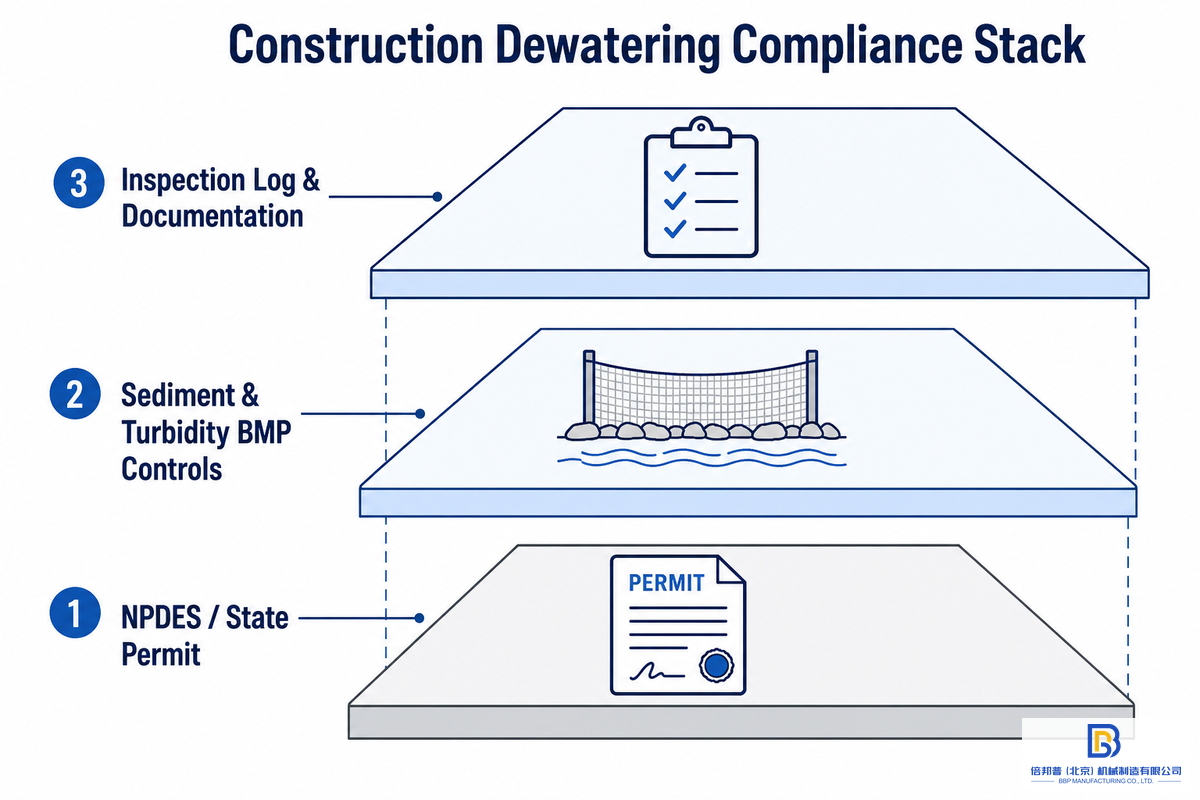
The Construction Dewatering Compliance Stack
The three-layered system that regulates pump discharge-the permit layer, the best-management-practice layer, and the documentation layer.
Permit layer. In the United States, the federal Construction General Permit (CGP) establishes a baseline for all permitted storm water discharges-but it’s not universal, since most states have EPA-approved storm water programs. Most construction in any given state is subject to that state’s construction storm water permit rather than the federal CGP, so always check the requirements before assuming the federal regulations are all you need. (For example, Washington State reissued its own Construction Stormwater General Permit, effective January 2026 through 2030, with provisions layered on top of the federal baseline.)
Best-management-practice layer. The 2022 CGP introduces a numeric benchmark for dewatering discharge of 50 Nephelometric Turbidity Units (NTU), which must be measured at least once during the day of any discharge and must be less than a weekly average. (Note that the benchmark only applies to discharges that are entering sediment-impaired waters or Waters with a designation of Tier 2/2.5/3 or more sensitive.) EPA clearly states that exceeding the benchmark doesn’t itself constitute a violation; a violation would be failing to comply with sampling, reporting, and corrective action procedures. Other cities take this further. Portland, Oregon for example restricts batch discharges to 50 gpm, 25,000 gallons/day unless other permits are obtained, bars discharges during actual rain events, and disallows any solids > ¼ inch diameter to enter pump system.
Documentation layer. Federal reporting occurs quarterly via the EPA electronic system, with records required to be kept for at least three years. Oregon’s construction stormwater permit was updated in late 2025 and includes not only the state requirements, but a pH and turbidity monitoring guideline document that provides a useful template for the kind of information that might go in a contractor’s compliance file, regardless of jurisdiction.
Equipment insurance purchased from a rental vendor doesn’t apply to the discharge permit compliance requirements of the contractor-the permit and associated responsibilities rest with whoever’s name is on the permit, not whoever supplied the pump. Taking the 5 minutes to verify who has the permit before the first drop is put to use is money and time well spent.
A readily forgotten compliance cost on any dewatering operation is worker safety. OSHA’s excavation standard, 29 CFR 1926.651(h)(2), is direct on this point:
“If water is controlled or prevented from accumulating by the use of water removal equipment, the water removal equipment and operations shall be monitored by a competent person to ensure proper operation.”
The reason that requirement exists as its own line item, separate from the discharge permit, is structural: a permit governs where the water goes once it leaves the site, while this rule governs whether the pump keeping the excavation dry is being watched while it runs. The same section requires a competent-person inspection after any heavy-rain runoff event before work resumes. In short, dewatering isn’t just a discharge compliance issue, but an OSHA issue as well, with its own requirements for monitoring regardless of the water discharge destination permit.
Job-Site Redundancy and Multi-Phase Pump Planning
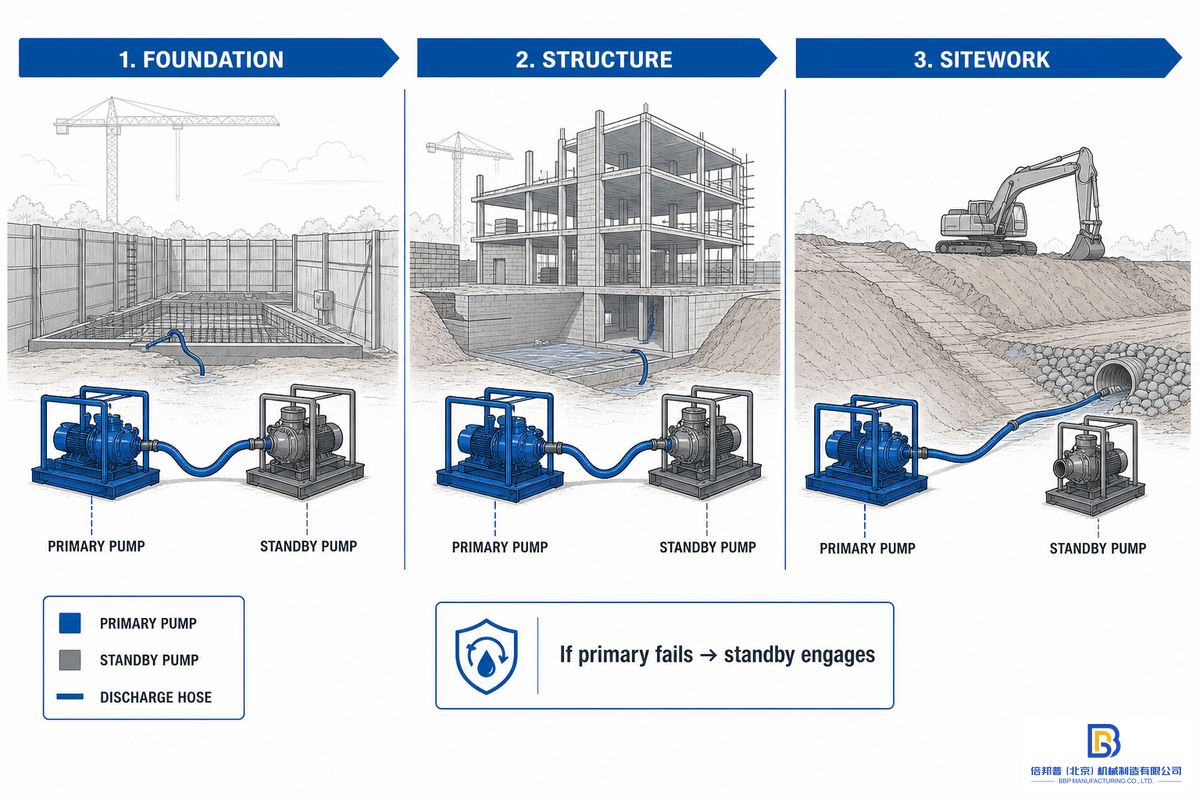
The commitment of a single pump to handle all dewatering load is a bet that there won’t be any trouble over the course of the project. As field reports indicate, this bet doesn’t always pay off. Pumps are designed for their rated duty point, not to absorb the multitude of site stresses a day can impose upon them, and a pump body designed for the average inflow has no additional capacity when the water load grows under a rain event. An efficient and reliable redundancy plan treats that margin as part of the initial sizing decision, not something bolted on after the first near-miss.
One contractor, in discussing his own 700 linear foot box culvert job, related starting out with a 6” diesel pump working around the clock, supplemented with a 4” gas pump during the workday, and still requiring an additional 6” diesel pump as the actual water volume became clear. In the discussion thread, peers noted that a redundancy strategy involving multiple smaller electric submersible pumps connected to a generator, backed up by one larger diesel unit for overnight operation, may have been more resilient than concentrating the entire water load into one or two large pumps. This tendency toward multiple smaller units versus one or two large ones comes down to the reduced impact of any single failure.
📑 Redundancy Decision Rule
Standby for What? If a single pump failure would result in a permit violation, an inability to pour concrete, or inundation of the foundation, a standby unit is a necessity, not an option, if you want to avoid greater losses. If a failure would simply cause delays and can be repaired within a normal window of service, the choice comes down to how far away a vendor replacement unit is.
Municipal-grade work generally raises the stakes compared to most private work on its own. An industry veteran with roughly two decades in bypass and sewage pump service reports insisting on 100% redundancy on municipal bypass jobs-a full-capacity duplicate pump standing by at every pump point, not a smaller emergency unit-specifically because of the public-health exposure a failure would create, and notes that most major municipalities contractually require exactly that. On a smaller, non-municipal site the redundancy ratio can be lower, but the underlying logic holds: the standby unit’s capacity should match what happens if the primary fail at the worst possible moment, not an average one.
That worst-case framing matters because storm events, not average inflow, are what break under-provisioned systems. Forum accounts describing a permanently below-water-table basement excavation describe contractors independently converging on a three-tier backup stack: a primary electric pump, a battery-backed secondary pump for power loss, and a water-pressure-driven tertiary pump that needs no electricity at all. Sizing standby capacity for the average day rather than the worst storm event on the calendar remains one of the most frequent and most costly planning mistakes on multi-phase sites, and it’s for that exact reason that OSHA mandates a site inspection after a heavy rain event.
Multi-phase jobs also bring a layer of complexity related to the schedule. Since the capacity and size requirements of the work on a foundation-level dewatering are often not the same as on the sitework or structural phases that follow, maintaining capacity on a consistent, stage-appropriate level rather than simply setting one configuration to work through the entire project become important.
Frequently Asked Questions
What is the most common method of dewatering at a construction site?
View Answer
“Sump-pit pumping” (also called open pumping) is the most commonly applied form of excavation pumping because it’s usually the least costly to implement, and generally straightforward. A shallow hole is excavated in the excavation floor at the low spot and a pump, which sits on the bottom and draws water up, empties it out when gravity fills the hole. The system is most effective on well-draining sites like sand or gravel, or on smaller, shorter duration tasks where the groundwater doesn’t encroach much into the work area. If the excavation water table is too close to the work area, the wellpoint or deep-well technique is often implemented instead.
How much does a dewatering system cost?
View Answer
Daily rental rates for medium diesel trash pump models typically range between about $220 to $650 and $650–$2,200 for a week, according to 2026 construction cost-estimating data, although actual rates may vary by rental house and contract term, since most major rental companies quote rather than publish fixed rates — so consider it a general planning figure. Buying outright eliminates monthly rental costs, but requires a larger initial capital outlay; refer to the “Rent vs. Buy” curve graphic in this section to figure out the optimal financial solution based on the anticipated duration of your job.
Do I need a permit to discharge water from a construction site?
View Answer
Typically yes. If a project is going to involve disturbing 1 or more acres of land, then coverage for the stormwater and dewatering will be required under Clean Water Act permit rules and specifically 40 CFR 450.21 prohibits dewatering discharges outright unless they are managed by appropriate controls. The permit required will vary by state since many states operate under their own EPA-approved stormwater program instead of under the federal Construction General Permit.
Review your state environmental agency.
What are the disadvantages of self-priming pumps?
View Answer
Self-priming pumps generally operate at 10-20% less efficient at the same duty point as a comparable standard centrifugal pump due to greater internal clearances needed by the priming system.
They are also generally more costly upfront and require more physical space than non-priming equipment of the same rating.
Is it cheaper to rent or buy a dewatering pump?
View Answer
Depends on the number of weeks per year the pump actually runs, not whether it’s “used often.” Under ~10-12 weeks per year of use, rentals are usually the better bet on a cash flow basis.
Higher, or if the pump is doubling as storm standby, even at lower recorded utilization rates owning can be the better option, as standby value doesn’t necessarily correspond to hours of run time.
Can a self-priming pump run dry?
View Answer
For a short duration, specifically during the priming process.
Excessive dry running for an extended time period can cause failure of the mechanical seal as the pumped liquid serves to cool and lubricate the seal.
How long does a self-priming pump take to prime?
View Answer
Standard Industrial self-priming pumps prime between 30-120 seconds at rated suction lift; healthy units will usually be primed within 1 minute.
If it takes longer than four minutes to prime, the unit has a likely suction-side air leak or is running with an undersized priming charge and should be turned off to prevent running dry.
Industry Outlook: From Equipment Specs to Compliance-Ready Sourcing
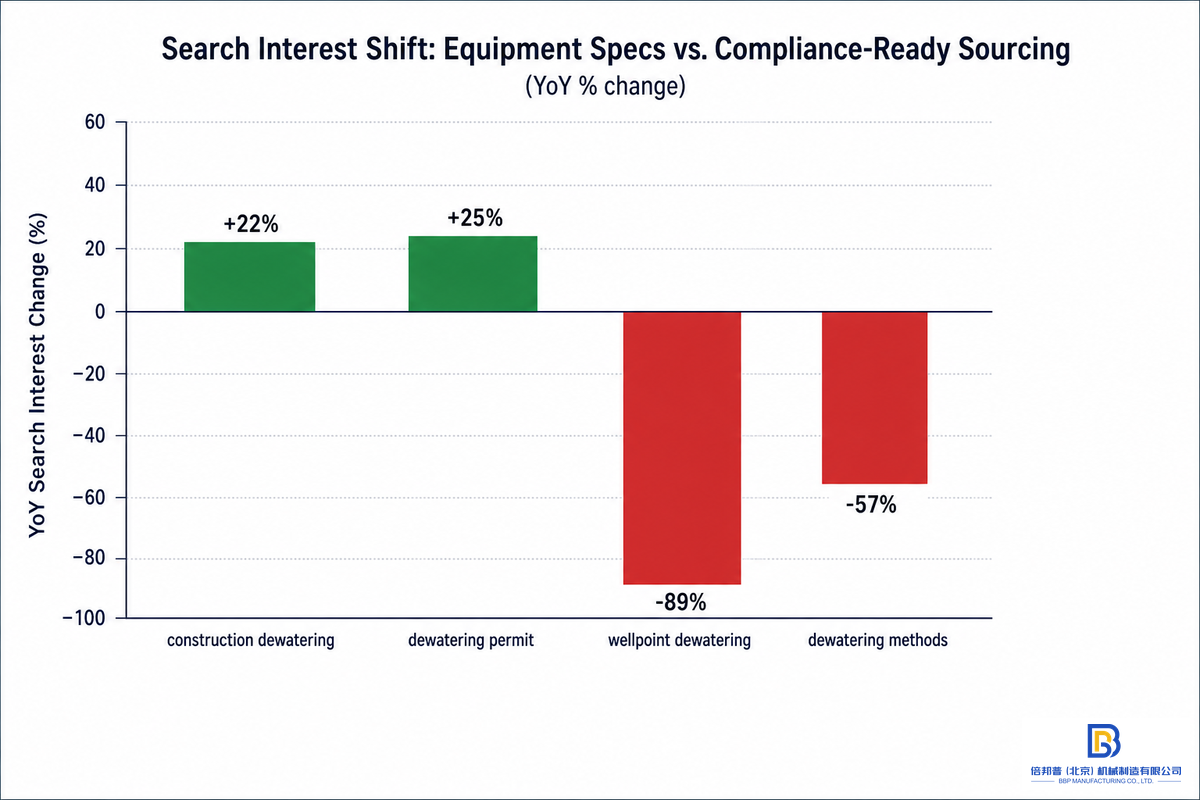
Broad, compliance-focused searches related to dewatering are increasing, while searches using specialized equipment jargon are decreasing – a disparity more indicative of how buyers approach research than any market size indicator.
Search interest in “Construction dewatering” has increased about 22% Y/Y and for “dewatering permit” is up about 25% Y/Y, while interest in “wellpoint dewatering” has declined about 89% Y/Y and in “dewatering methods” is down about 57% Y/Y. In combination, these search trends suggest contractors exploring this topic are shifting from asking about equipment taxonomy to asking about dewatering solutions that solve problems and achieve compliance. For vendors and rental fleets, the implication is clear: those that publish real compliance documentation (beyond spec sheets) are now in a stronger position to influence buyers earlier in their decision-making process.
And that evolution is reflecting itself in the way equipment is sourced. The global dewatering pump market is growing-about $8.79 billion in 2026 and forecast to reach the mid-teens of billions by the mid-2030s-and the rental channels will represent a growing segment of that market and a significant source of contractor access to equipment. That market sizing information serves primarily as order-of-magnitude context for these discussions, not a justification for changing the way you would source a pump for your next job. A specific pump’s compliance requirements and the fitness criteria for a supplier will matter more to you in any given situation than will overall market size trends. Meanwhile, technology isn’t stagnant either-on the technology side of things, the self-priming pump design is continuing to mature, as shown by the November 2025 U.S. patent granted to Xylem for an electronically controlled self-priming procedure that will automatically cycle the impeller through the device to locate and clear the residual air lock, replacing previous passive vent technology.
Sizing a self-priming or trash pump for construction dewatering?
The Team Behind This Report
The content of this guide was compiled by engineering and technical personnel of BBP Manufacturing Co., Ltd., which is a vertically integrated pump manufacturing company that handles everything from casting to finished testing. This guide’s rent-vs-buy break-even model, supplier assessment list, and compliance checklist were developed in conjunction with dewatering municipal specifications, federal and state government agencies, and interviews with identified professionals in industry press, rather than sales material. This guide was reviewed technically by BBP Manufacturing Co., Ltd.
References & Sources
- NPDES Stormwater Discharges from Construction ActivitiesU.S. Environmental Protection Agency
- Turbidity Benchmark Monitoring for Dewatering Under the Construction General PermitU.S. Environmental Protection Agency
- NPDES Stormwater Program (state-authorization overview)U.S. Environmental Protection Agency
- 29 CFR 1926.651, Specific Excavation Requirements (water accumulation, 1926.651(h))U.S. Occupational Safety and Health Administration
- Construction Equipment Operators, Occupational Outlook HandbookU.S. Bureau of Labor Statistics
- Additional Guidance on 23 CFR 635 A, Equipment Rental RatesFederal Highway Administration
- Guide to Construction Dewatering PermitsCity of Portland Bureau of Environmental Services
- Construction Stormwater NPDES/WPCF General Permit (1200-C)Oregon Department of Environmental Quality
- Construction Stormwater General PermitWashington State Department of Ecology
- Well-Pointing Dewatering SpecificationCity of La Porte, Texas
- Construction Water Pollution Prevention, Dewatering Specification (Section 02140)City of San Diego
- ANSI/HI 9.6.3-2024, Rotodynamic Pumps, Operating RegionHydraulic Institute
- US12460646B2, Method for Performing Priming of a Submersible PumpXylem Europe GmbH, USPTO / Google Patents
Related Articles
- Self-Priming Pump: How It Works, Types & Selectionfull mechanism and material-selection guide
- Trash Pump Guide: How They Work, Sizing & Selectionsolids-handling frame sizing and drive-type comparison
- Self-Priming Sewage Pump: The Complete Engineering Guide
- The Industrial Drainage Pump Selection Guide
- Sewer Lift Station: The Complete Guide