Get in Touch with BBP

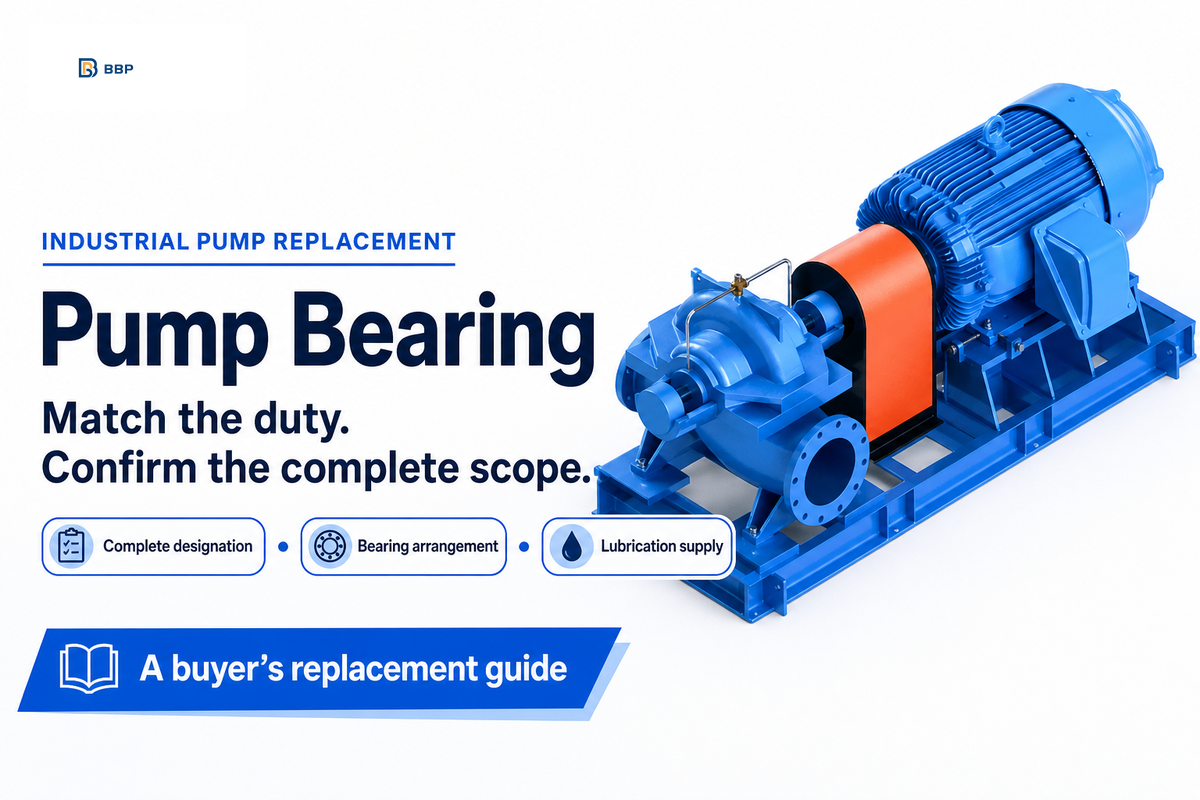
The function of the pump bearing is to help the rotating shaft, and support the impeller in its proper position. Replacing a damaged bearing requires determination of its duty, complete designation, and surrounding assembly. A correct match of bore size leaves several options to buy a part that can fit in the space, but doesn’t meet the pump requirements.
This handbook deals with maintenance and acquisition of industrial centrifugal-pump units. Most replacement examinations concern rolling element bearings, including roller bearings; water-lubricated sleeve bearings require a different approach to maintenance. Integrated shaft-bearing units are often used in automotive water pumps, but their engine-coolant repair procedure shouldn’t be applied to an industrial water or irrigation pump.
This has been updated in October 2026. Examples are derived from public sources. The cost example is hypothetical.
Quick replacement checks
- Identify the pump position before ordering a bearing type.
- Preserve every suffix and the specified single or paired arrangement.
- Check the shaft seat, housing and lubricant supply before reassembly.
- Compare complete repair scopes, including work outside the bearing itself.
What does a pump bearing do?
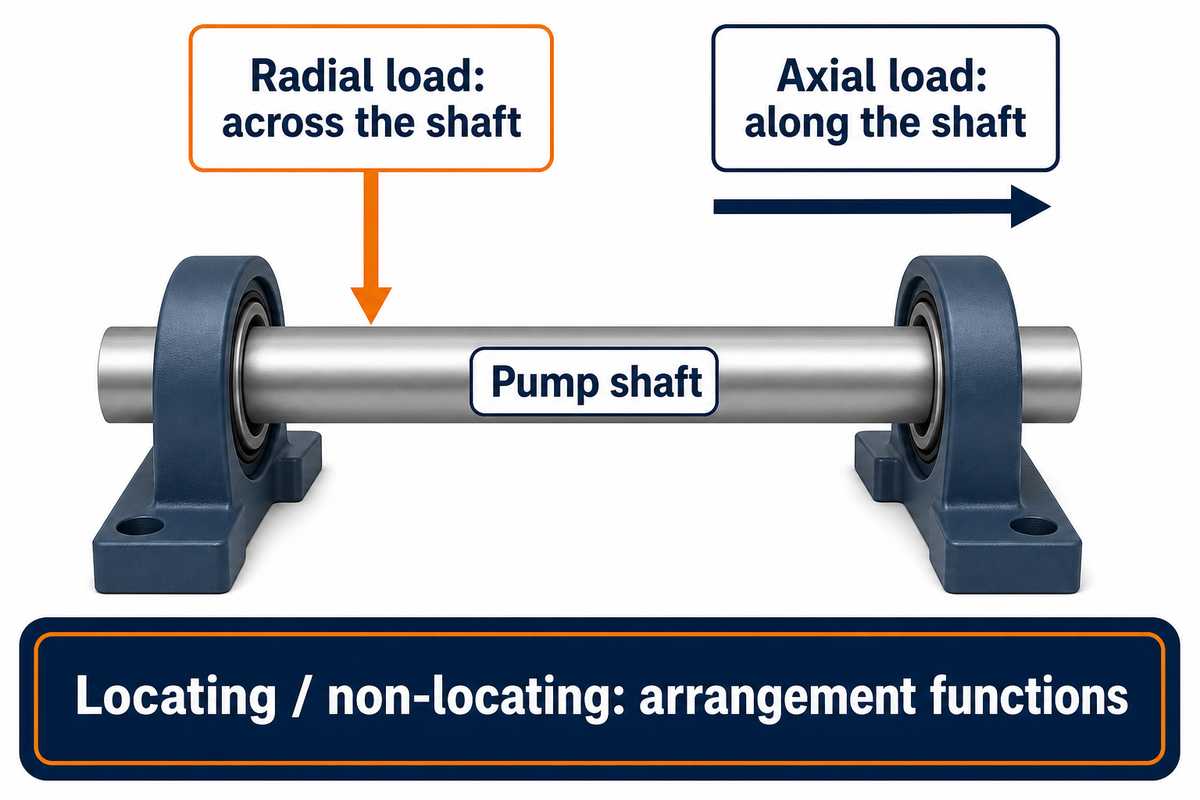
Pump bearings transfer loads while restraining movement of the pump shaft. Radial loads act across the shaft, while axial loads act along it. The arrangement must take thermal movement where required in the design. Locating supports and non-locating supports define different functions in the arrangement rather than two alternative directions of force.
Hydraulic forces, rotating weight and the drive arrangement contribute to the load of the pump. Excess movement can affect adjacent clearances and the seal. A 1996 pump-bearing lecture published by Texas A&M’s Turbomachinery Laboratories describes how double-row angular-contact ball bearings carry combined radial and axial loads and limit shaft-system displacement.
When referring to both a pump and a motor, identify which part is defective. To obtain a motor bearing, the motor identity is required. A pump-frame bearing requires the pump drawing and bearing position. Use the sectional drawing of the actual end-suction pump arrangement rather than assuming two machines have the same support arrangement.
Ordering mistake to avoid: the enquiry for “drive-end bearing” is incomplete. The motor or pump identity, drawing position and full marking should be included.
Which bearing types are used in centrifugal pumps?
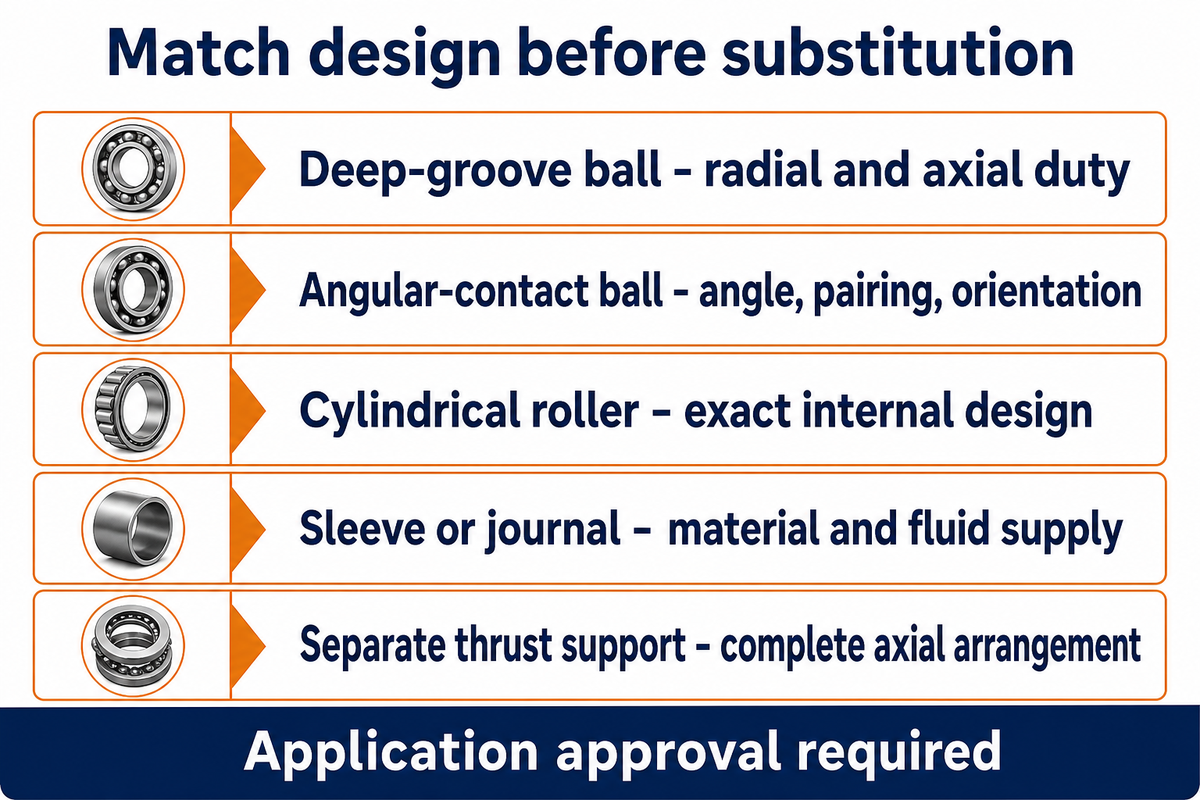
Centrifugal pumps usually incorporate different types of bearings to account for difference in radial duty, axial stability and the surrounding design. Ball and roller bearings support rolling contact while a sleeve bearing supports a shaft through a lubricating film. A catalogue entry stating one design can handle a higher load doesn’t mean it can fully replace another.
What are the centrifugal pump bearing types?
Common bearings used in pumps for industrial applications are deep-groove and angular-contact ball bearings, cylindrical roller bearings, and sleeve or journal designs. Some pumps use separate thrust-bearing arrangements. Treat material choices, such as hybrid ceramic rolling elements, as a second decision within a given design, not as another load direction. A hybrid bearing uses a ceramic rolling element with a metal ring. A full ceramic design changes the ring material also. Bearing choice requires application approval rather than an assumption of improved longevity.
| Design | What to identify | Replacement limitation |
|---|---|---|
| Deep-groove ball | Required radial and axial duty, speed and clearance | Do not assume its thrust capacity matches an angular-contact design. |
| Angular-contact ball | Contact angle, single or paired use, and mounting orientation | A loose bearing is not automatically a matched set. |
| Cylindrical roller | Exact internal design and locating or non-locating duty | The NU arrangement in the published example below permits axial displacement; identify other designs separately. |
| Sleeve or journal | Bearing material, running clearance and lubricating-fluid supply | Water-lubricated designs do not follow grease-bearing instructions. |
| Separate thrust support | Axial load direction and the pump’s complete thrust arrangement | High axial loads require the specified arrangement, not a generic radial-part substitution. |
In the bearing selection discussion in Pumps & Systems, SKF USA’s David R. Mikalonis says the selection depends on the application.
“bearings (types, designs and arrangements) should be evaluated in the context of their anticipated operating environment.”
Complete pump bearing assemblies may include housing and shaft as well as bearings. The bearing and drive assembly in a slurry pump illustrates a larger component scope. Prior to approval, request a bill of materials for “bearing assembly.”
Can a bearing with the same dimensions replace the original?
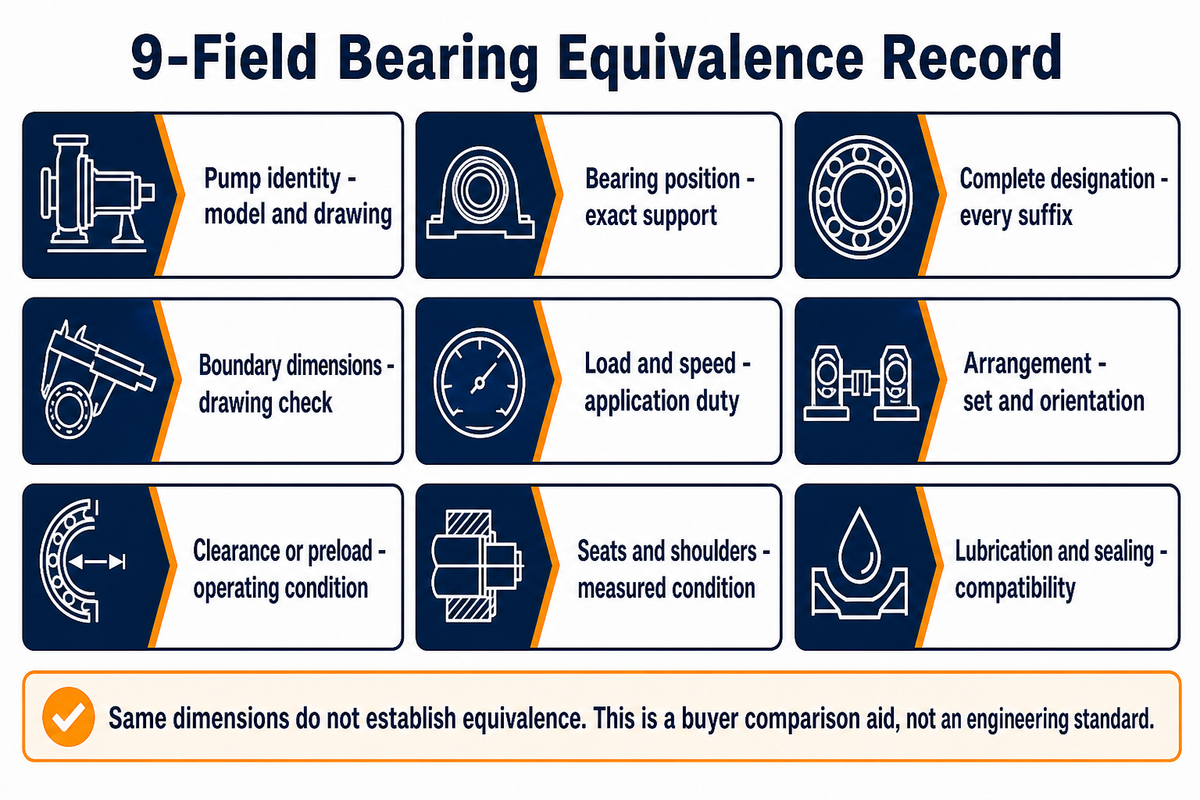
Equal limits on boundary dimensions show physical size matching only. Full replacement equivalence isn’t ensured. Other factors like internal design, clearance or preload, paired arrangement and the fit of the shaft and housing must also be checked. Allow an alternate only after the supplier verifies that his specification is equivalent to the requirement of the original equipment and states the differences, if any, which may affect service.
Engineering note: two supports, two different duties
SKF’s published centrifugal-pump selection example reviews an existing arrangement after an impeller change. At 3,000 r/min, an NU 311 ECP provides non-locating support and a back-to-back pair of 7312 BECBP bearings provides locating support. The example checks loads, fits and operating clearance separately. Its numbers describe that calculation only.
| Parameter | NU 311 ECP support | 7312 BECBP pair | Limitations |
|---|---|---|---|
| Bore | 55 mm | 60 mm | Example dimensions, not an interchange rule. |
| Outside diameter | 120 mm | 130 mm | Housing geometry differs. |
| Radial load | 3.29 kN | 1.45 kN | Loads calculated for this pump duty. |
| Axial duty | Non-locating | 11.5 kN axial load | The complete locating arrangement carries the specified thrust. |
| Estimated operating temperature | 70 °C | 85 °C | Calculation inputs, not alarm or trip limits. |
| Common speed | 3,000 r/min | 3,000 r/min | Different temperatures remain possible at equal speed. |
| Shaft-seat surface roughness Ra | 0.8 µm | 0.8 µm | Specified for the example seats; not a universal repair finish. |
| Housing-seat surface roughness Ra | 3.2 µm | 3.2 µm | Use the actual housing drawing for another pump. |
| Initial clearance: minimum / average / maximum | 40 µm / 55 µm / 70 µm | 22 µm / 27 µm / 32 µm | Radial values; the pair’s axial values were converted to radial in the source. |
| Assumed inner-to-outer ring temperature difference | 10 °C | 10 °C | Used to calculate thermal clearance reduction. |
| Mean bearing diameter used in that calculation | 87.5 mm | 95 mm | Derived from the example boundary dimensions. |
| Advanced-analysis operating clearance: minimum / average / maximum | 3 µm / 34 µm / 59 µm | -10 µm / 11 µm / 24 µm | These calculated ranges include different effects from the simpler hand calculation. A negative value denotes preload; do not transfer the pair’s result to the cylindrical bearing. |
Note what a size-only purchase would overlook. Equal shaft speeds don’t imply equal loads or bearing temperatures. Fits and expansion due to change of temperature alter the clearance in operation. A larger initial-clearance class isn’t always an improvement. The specified initial clearance must produce the desired running condition. In this case, the advanced calculation supports Normal initial clearance. Smaller operational values, however, explain why an initial clearance number, when entered into an installed clearance requirement, is incorrect. These are manufacturer’s calculation results, not site acceptance limits.
9-Field Bearing Equivalence Record
This record should be copied into the purchase file using a buyer’s comparison method. This comparison record isn’t a new engineering standard, and the existing part should be kept available for comparison. The drawing should be used to decipher markings that are no longer visible.
| Field | Evidence to obtain | Decision | Limitations |
|---|---|---|---|
| Pump identity | Model, serial number and drawing revision | Use the original equipment manufacturer (OEM) parts list. | A family name alone may cover several revisions. |
| Bearing position | Item number and pump or motor location | Identify the exact support. | “Drive end” alone is ambiguous. |
| Complete designation | All letters, numbers and suffixes | Resolve every changed specification. | Suffixes are not necessarily identical across brands. |
| Boundary dimensions | Bore, outside diameter and width in mm | Check the drawing and proposed part. | Dimensions do not prove functional equivalence. |
| Load and speed duty | Radial and thrust duty; speed in r/min | Confirm application suitability. | A higher rating alone is insufficient. |
| Arrangement | Single, double-row or paired set; orientation | Supply the specified set and quantity. | Do not mix unmatched parts into a required matched pair. |
| Clearance or preload | Specified class and installed setting | Confirm the intended operating condition. | Initial clearance differs from running clearance. |
| Seats and shoulders | Measured shaft and housing condition against drawing | Include repair if dimensions or surfaces fail acceptance. | A new bearing does not repair a damaged seat. |
| Lubrication and sealing | Method, lubricant specification and sealing arrangement | Check compatibility with the installed system. | Sealed, grease, oil and water-lubricated designs differ. |
The published explanation of paired bearings and running clearance (see link) provides the necessary information. A written equivalence is required from the supplier. “Same size” isn’t an adequate answer.
What changes between grease and oil lubrication?

Different quantities, delivery methods, and maintenance schedules are required for grease and oil systems. Use the specification for the installed pump, taking into consideration lubricant compatibility and contamination control. Water-lubricated sleeve bearings are of a separate branch. Their lubricating and cooling water supply is to be maintained, and instructions for greasing aren’t applicable to them.
Grease quantity, service conditions and operating temperatures affect relubrication. Service conditions that are harsh, like the presence of dust or washdowns, require verification for contamination control. An oil bath, oil ring, oil mist, or a circulating system requires its own level and delivery controls. Adding a circulating supply doesn’t merely change how often the housing requires topping off. Follow the approved design that allows the oil to circulate.
How often should pump bearings be re-greased?
Use the manufacturer’s intervals for pumps and bearings as approved, then review changes in speed, load, temperature and contamination with the responsible engineer. Keep a record of the grease type and the actual amount delivered. A grease gun’s stroke count is only useful when its output is known. For a sealed unit, there may be no regular relubrication provision.
A recent investigation by NASA 2022 illustrates the importance of establishing lubricant supply. Two newly refurbished pumps at a ground test facility suffered early bearing failures. The 2,000 hp vertical turbine pumps have metallic sleeve bearings cooled and lubricated by pumped water. It was found that thermal seizure occurred due to insufficient cooling flow. Assembly grease is suspected of plugging the flow and making the situation worse. The reported fix was a dedicated bearing lubrication water feed. This design is water lubricated and not a grease recommendation for rolling bearings. Prior to ordering another part after repeat failure, establish how the design removes heat and lubricates the system.
Record before changing lubricant
- Identify the approved product and compatibility requirements.
- Measure the delivered quantity and retain the service time.
- Check the intended supply and discharge paths.
Avoid these assumptions
- Do not treat more grease as better protection.
- Do not infer compatibility from colour or consistency.
- Do not add grease to a water-lubricated design without its approved procedure.
How should you investigate heat, noise and vibration?
Heating, noises and vibrations indicate a change which requires further investigation. Relate changes to maintenance activities, lubricant condition and the operating duties of the pump. Invoke the machine alarm and shut down procedure. Isolate equipment and preserve observations before invasive tests and dismantling which can remove evidence.
Why do pump bearings fail?
Lubrication problems, contamination, overload and installation damage can also affect the service life of a bearing. Contact between rolling elements and raceways in ball and roller bearings can be disturbed by a poor fit or due to incorrect adjustment. The surrounding pumping system can also play a part. The Hydraulic Institute’s explanation of the operating region links off-design flow to recirculation, additional loading and cavitation.
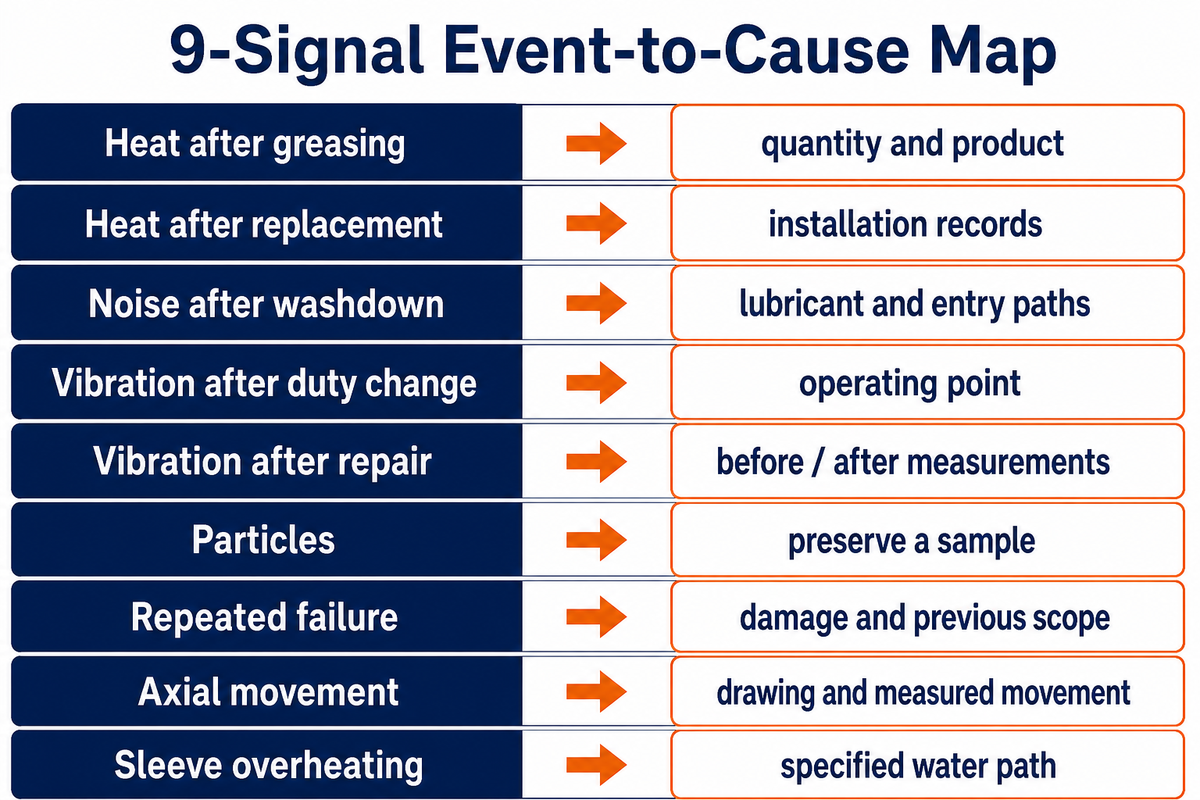
9-Signal Event-to-Cause Map
| Signal group | Possible causes to compare | Discriminating check | Limitations |
|---|---|---|---|
| Heat after greasing | Churning, wrong product, blocked discharge | Compare service time, quantity and specification. | A temperature rise alone does not prove overgreasing. |
| Heat after replacement | Wrong setting, fit, part or alignment | Review designation and installation records. | Use specified acceptance values, not a generic temperature. |
| Noise after washdown | Water entry, seal damage, other coincident damage | Inspect lubricant and entry paths. | Noise alone does not establish corrosion. |
| Vibration after duty change | Hydraulic loading, recirculation, cavitation | Compare flow, suction conditions and operating point. | Replacing a bearing cannot correct system duty. |
| Persistent vibration after repair | Alignment, seat damage, remaining component damage | Compare measurements before and after the work. | Diagnosis may require frequency analysis. |
| Particles in lubricant | Wear debris or contamination from another component | Preserve a sample and locate the material source. | Particles do not identify their origin by themselves. |
| Repeated failure at one position | Unresolved fit, lubrication, sealing or loading issue | Compare damage location and prior repair scope. | No single cause follows from recurrence alone. |
| Unexpected axial movement | Setting, retention or thrust-arrangement problem | Compare measured movement with the pump drawing. | Some non-locating movement is intentional. |
| Water-lubricated sleeve overheating | Restricted cooling or lubrication flow | Check the specified water path and supply. | Do not apply a rolling-bearing grease remedy. |
Use the map to choose the next measurement, not to declare a diagnosis. ISO 15243:2017’s public scope distinguishes damage appearances and possible causes for rolling bearings made of standard bearing steels, and recognises that further investigation may be needed. The edition remains current as checked in October 2026; a listed working draft is not a published replacement.
Noria’s explanation of overgreasing describes lubricant churning and heat. That mechanism is relevant after a service event, but changing flow or suction conditions needs a different line of enquiry. Review changes in the pump operating point alongside the bearing observations.
When does the housing need attention too?
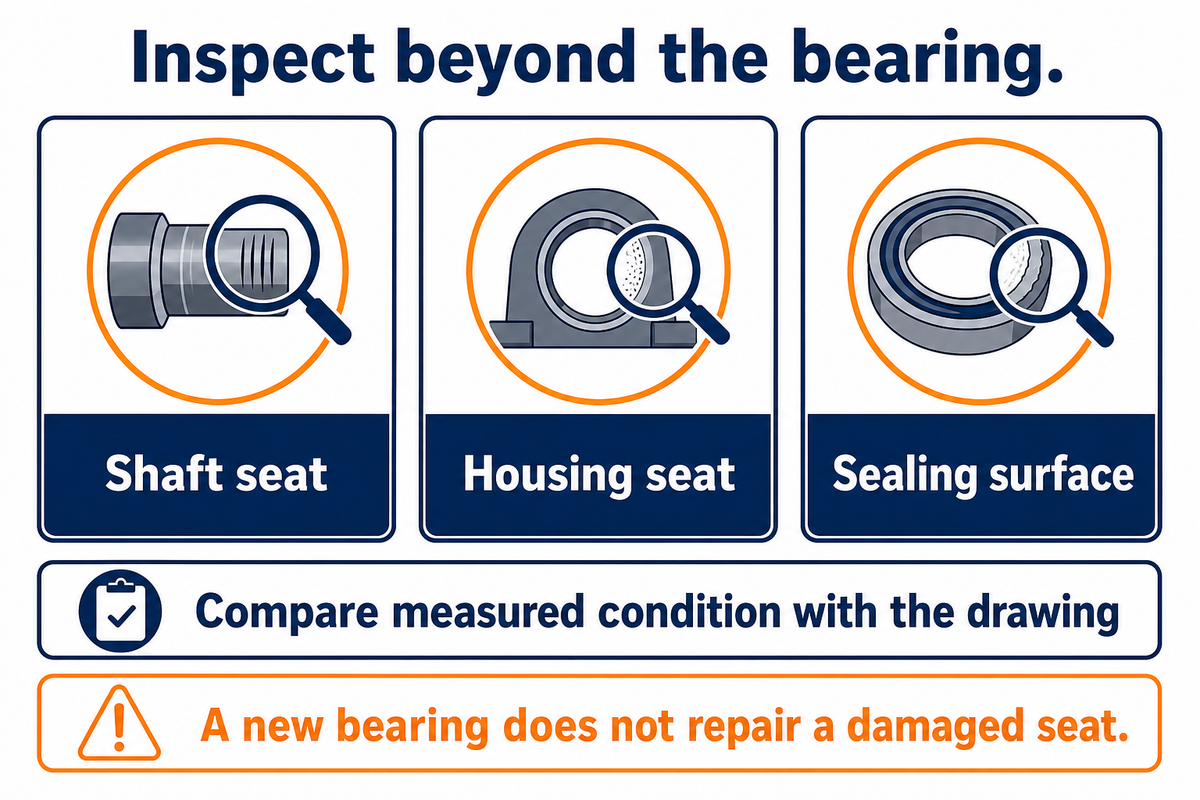
A housing needs attention when the bearing seat, shoulders or sealing surfaces don’t conform to equipment drawings. A new bearing can’t restore the required conformity and also can’t filter out contamination if the seal is damaged. Include the shaft seat and alignment in the inspection, especially if the same position has failed repeatedly.
The inner and outer rings depend on specified support at their seats. A gouge can leave a raised edge in a seat. This local high spot can deform the outer ring and focus contact stress. Accepted repairs need to bring the specified part geometry back to form. Filing until a part feels easier to fit isn’t an acceptance method. The assembly retrofit discussion in Design World by Sulzer shows why housing work can extend beyond replacing rolling components.
- Record seat measurements and surface condition before agreeing a bearing-only scope; smooth rotation by hand doesn’t verify those dimensions.
- Avoid directing high-pressure washdown at seals unless the equipment cleaning procedure allows it. Separate bearing-housing seals from the process-side mechanical seal arrangements.
- Keep wear-ring clearance checks distinct from bearing-seat fits; both can matter to the repair.
What does replacement really cost?

Replacement cost includes supplied parts, labor and associated work to return the pump to service. Downtime and lost production depend on the installation, including standby capacity. Compare the same repair scope before price comparison; a loose bearing and an engineered assembly retrofit are two very different products.
Direct repair example: equal totals, different scopes
Consider two hypothetical offers, both in US dollars. Offer A lists a loose bearing at $120, labour at $480 and consumables at $60: $120 + $480 + $60 = $660. Offer B lists an assembly at $450, labour at $180 and consumables at $30: $450 + $180 + $30 = $660. The arithmetic gives the same direct total, despite different part prices. It doesn’t establish equivalent fit, reliability or included components. Ask each bidder whether machining, seals, alignment and testing are included. Freight, tax and downtime are excluded from this example and must be added where applicable. A housing rejected during inspection could change either offer.
The Hydraulic Institute’s cost framework separates downtime and lost production. A functioning standby pump can change that exposure. Compare expected outage duration and the plant’s documented loss rate without including the same lost production twice in the comparison. For component scope, use slurry pump spare-parts planning, along with the quote, and identify downtime and lost production.
What should a pump bearing quotation include?
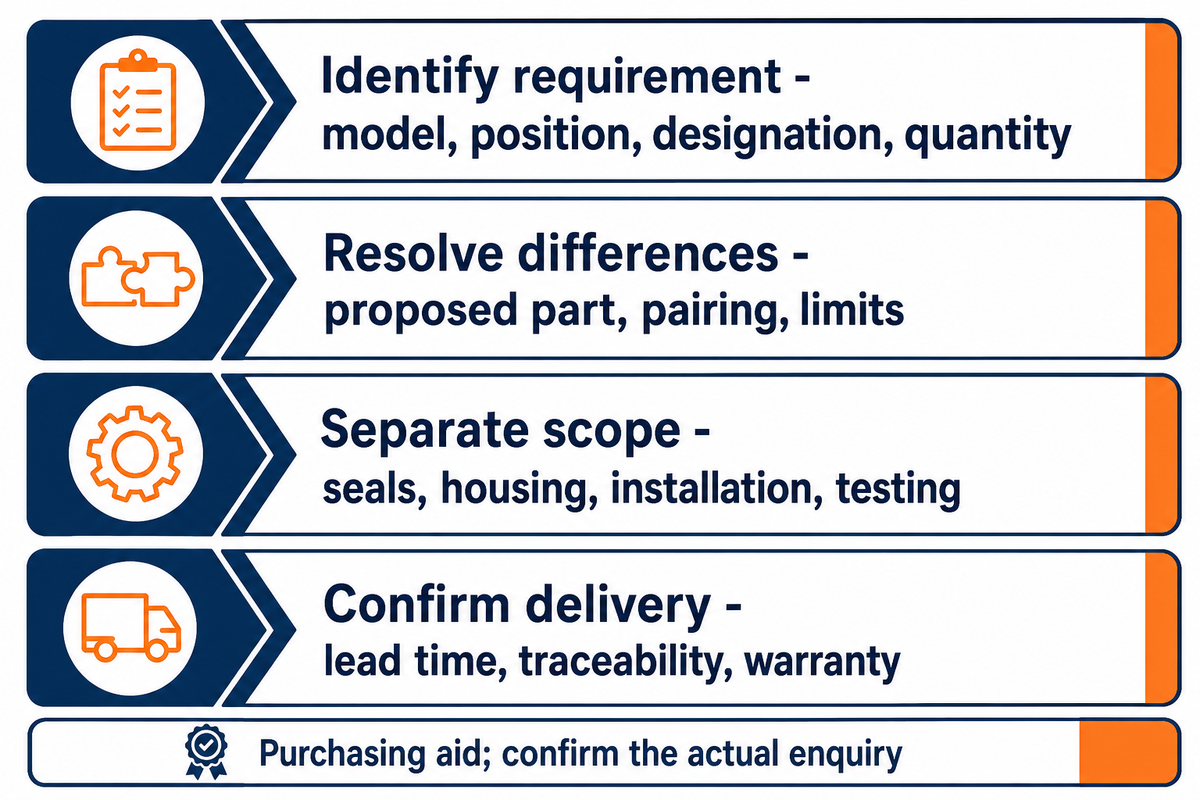
A good quote identifies the part and location, and states what the supplier will deliver. Identify a loose bearing, required matched set, and complete assembly. Ask for exclusions and unresolved technical differences in writing. A part description shouldn’t be vague and conceal work done to the housing and assumptions about lead time and installation.
Send the 9-Field Bearing Equivalence Record, including photos of markings and nameplates. Include the proposed repair scope. Don’t just send a request to “replace the bearing.” Provide the approved duty for high-speed or high-load service rather than asking the supplier to decipher from size.
- Identify the requirement — provide the pump model, drawing position, complete designation and quantity.
- Resolve differences — request confirmation of the proposed part, pairing and application limits.
- Separate the scope — list seals, housing repair, installation and testing as included or excluded.
- Confirm delivery terms — obtain lead time, traceability documents and the supplier’s stated warranty terms.
The Hydraulic Institute’s maintenance-cost discussion supports separating labour and consumables; the checklist above is a purchasing aid, not an industry-mandated quotation format. To discuss supply with BBP, prepare a complete pump enquiry with the identified bearing position and requested scope.
What should condition monitoring add to routine checks?
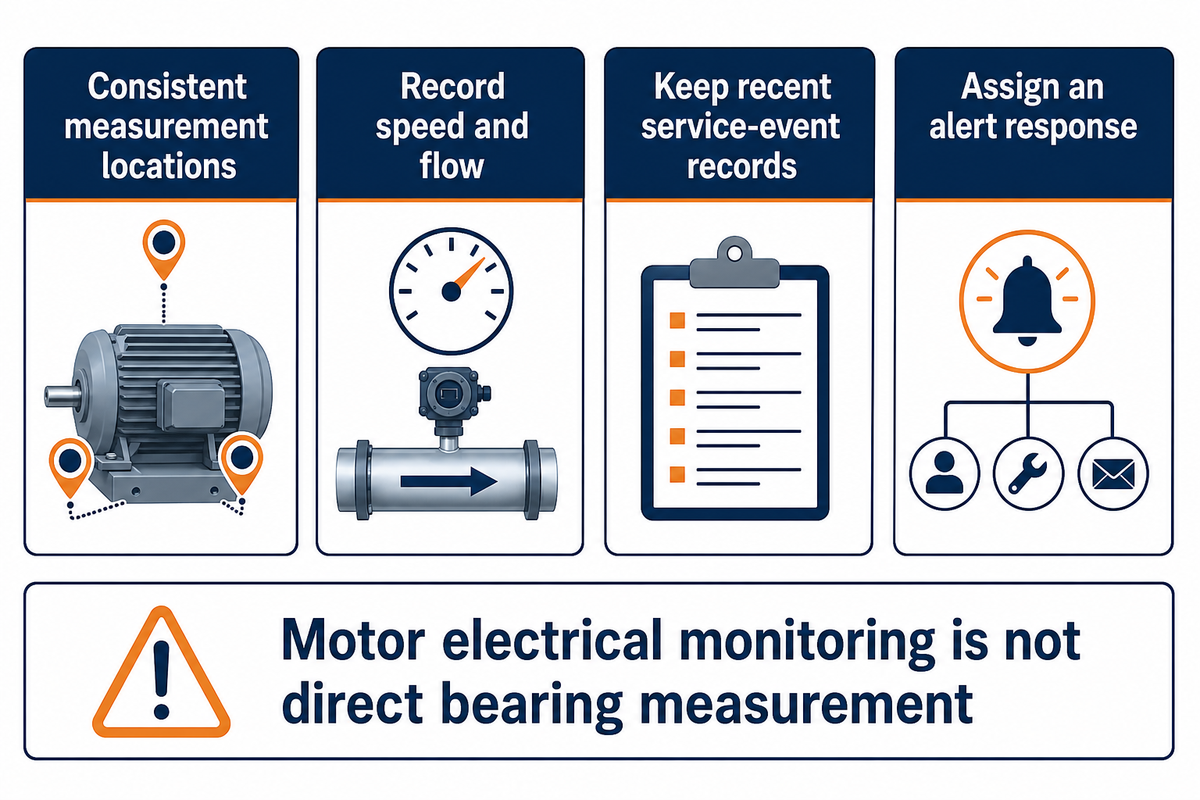
It’s condition monitoring that’s useful for identifying when and where to investigate a change in bearing health. For measurements to be useful, they must be at consistent locations. For a trend to be useful, record the condition at which the equipment was operated. Trends often help to identify a gradual shift in health. A dashboard without an assigned response does little for uptime. Having the measurement trend for equipment can be beneficial; however, monitoring can’t improve equipment health if the equipment has an incorrect bearing, is poorly aligned, or if the lubricant supply is interrupted.
According to the US Department of Energy’s pump Maintenance Sheet, trends in vibration data are more informative than a single data point in time. Record the locations of temperatures monitored: housing surface, bearing metal and sump oil values are separate measurements. Maintain the speed and flow readings and recent service-event records with the measurements.
As a dated technology example, Schaeffler’s February 2026 announcement details the FAG OPTIME E-CM, which analyzes currents and voltages in three phase motors driving rotary pumps. This is different from measuring a pump bearing. Prior to purchasing the monitoring hardware, confirm the measured asset, detectable faults and who will investigate an alert. No universal figure follows from the announcement for how much monitoring will extend life or save downtime.
Add those observations to a broader slurry pump maintenance record. Proper lubrication and documented operating duty remain necessary for smooth operation, whether sensors are fitted or not.
Pump bearing FAQs
What is a pump bearing?
A pump bearing supports the rotating shaft and controls movement within the specified arrangement.
Distinguish the bearing from its housing and from the complete assembly listed by a supplier. A housing supports and locates the bearing and may contain lubricant, covers and seals. The shaft, housing and bearings are not necessarily supplied together. Before buying a replacement, identify the drawing position and ask which components the offer includes; a familiar assembly name does not establish its contents.
How to tell if a water pump bearing is bad?
A bad water pump bearing may produce changed noise, vibration, heat or movement, but those symptoms require investigation.
Compare the observations with the established baseline and the machine limits. Check whether lubrication, installation work or operating duty changed before the symptoms appeared. Cavitation, alignment problems and damage elsewhere can produce similar observations. Follow the site response procedure and use qualified inspection to establish the cause. Listening alone cannot confirm which part needs replacement, and it does not establish that continued operation is acceptable.
How much does it cost to replace a water pump bearing?
The cost depends on the part, repair scope, access and outage consequences; obtain a quotation for the identified pump.
Automotive and industrial repair jobs are not comparable price categories. An integrated automotive unit may be replaced as a complete pump, while a repairable industrial frame may need separate bearings, seals or housing work. Ask what the quotation excludes and whether inspection could change it. The dollar arithmetic in this guide is hypothetical and should not be used as a market price or a supplier commitment.
Is a bushing the same as a sleeve bearing?
A bushing can be a sleeve-type plain bearing, but terminology depends on the component’s function.
Confirm what surface supports the shaft and how it receives lubricant. A wear sleeve or spacer elsewhere in the pump may have a different job.
What is a between-bearings pump?
A between-bearings pump has its impeller or impellers positioned between the supporting bearings.
The description concerns rotor support, not the number of rolling elements inside a bearing. A horizontal split-case pump layout provides a useful arrangement example.
What temperature is too hot for a pump bearing?
The applicable temperature limit comes from the machine, bearing and lubricant requirements, together with the site’s alarm and shutdown procedure.
A single value cannot cover every pump application. Sensor position, ambient conditions, lubricant and duty all affect the reading. A housing-surface reading and a bearing-metal measurement are not interchangeable. The 70 °C and 85 °C estimates in the published example are not permission to operate another pump at either temperature. Compare the correct measurement with its specified limit and established trend. Rapid change, noise, vibration, lubricant deterioration or a triggered alarm calls for the prescribed response. Do not wait for a fixed cooling period because a forum account reported one. If the approved limits are missing, obtain them from the responsible equipment supplier and site engineer before using temperature to justify continued operation.
How this bearing guide was prepared
BBP Manufacturing Co., Ltd. publishes this guide to help buyers define pump bearing replacement and assembly scope. The checks combine public technical material with a stated purchasing method; they aren’t BBP test results or a substitute for a machine drawing. The cost arithmetic is illustrative. Product suitability, included parts and delivery terms need confirmation against the particular enquiry.
Preparing a replacement enquiry?
Send BBP the pump identity, bearing position, complete markings and the repair scope you want quoted. Include any unresolved fit or housing findings so the proposal can address the actual job.
Related guides
- Pump wear rings: materials and replacement decisions
- Mechanical seal designs and their limits
- Pump and system curves for operating-point checks
- Industrial pump quotation specification checklist
- Slurry pump components from wet end to drive
References & Sources
- Pump-bearing lecture record Texas A&M Turbomachinery Laboratories, 1996, public abstract.
- Tribology Induced Water Pump Bearing Failure NASA technical record, 2022, public abstract.
- ISO 15243:2017 public scope and edition status.
- Reliability Basics: Understanding NPSH, POR, and AOR Hydraulic Institute, 2022.
- Lifecycle Cost Analysis Hydraulic Institute.
- Maintain Pumping Systems Effectively US Department of Energy, 2005.
- Proper Selection and Lubrication of Bearings David R. Mikalonis, SKF USA, Pumps & Systems, original 2008 issue.
- The Dangers of Overgreasing Noria Corporation, Machinery Lubrication.
- Bearing assembly retrofits Design World, 2021, Sulzer-attributed technical article.