Get in Touch with BBP

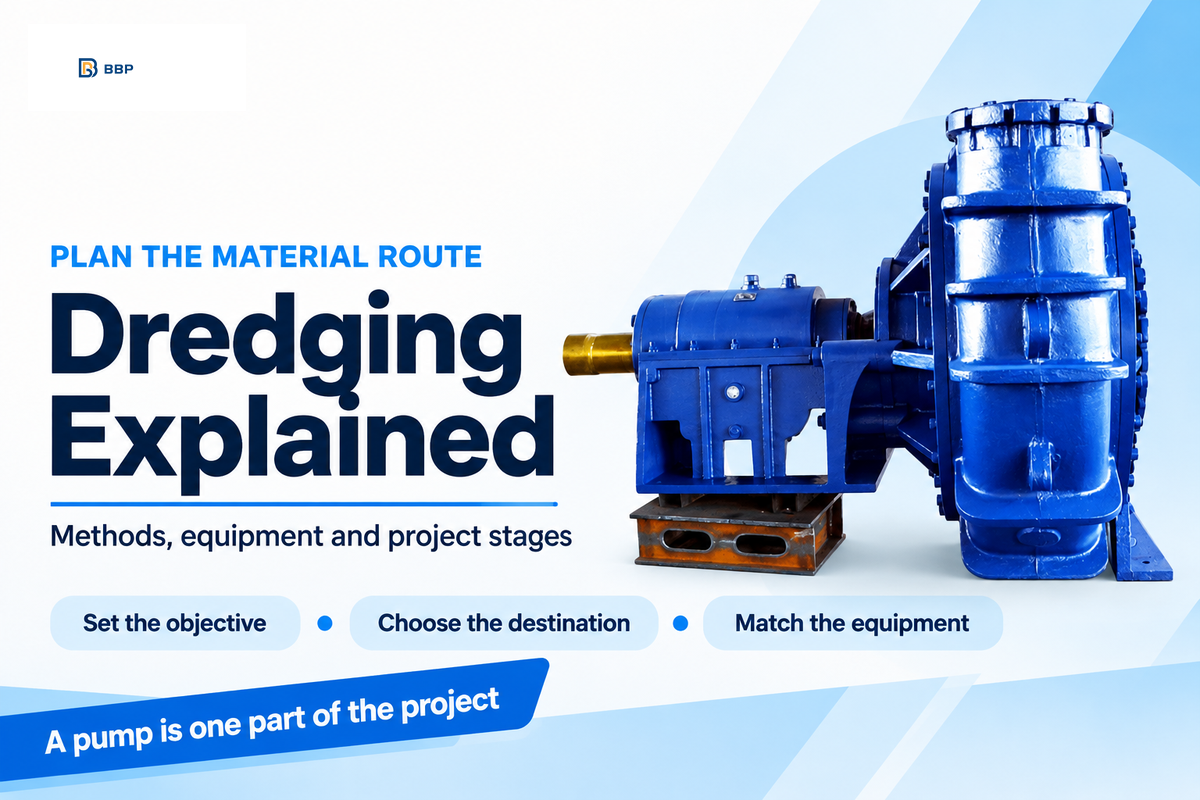
Dredging is the process of excavating or relocating material underwater. A dredge generally loosens, scoops or suctions sediment and debris from the bottom of a waterway. Projects using that work restore the depth of channels or construct marine infrastructure, or remove polluted deposits. The dredging process also describes how the material is transported and where it is deposited.
Sediment removal can be employed in different processes, depending on the project objective. For instance, a shallow harbor entrance and a contaminated industrial basin may both need sediment removal, but their finish lines are different. One needs sufficient depth for vessels; the other needs a defined cleanup result. The machine is selected after determining the objective and a workable route for the material.
Dredging excavates or relocates underwater material. Equipment choice follows the project objective, the material and its destination.
- Depth verification and contamination cleanup are different acceptance tests.
- Hydraulic removal creates slurry; receiving capacity can limit production.
- Compare quotations on the same quantity basis and complete scope.
Updated October 2026
What is dredging used for?
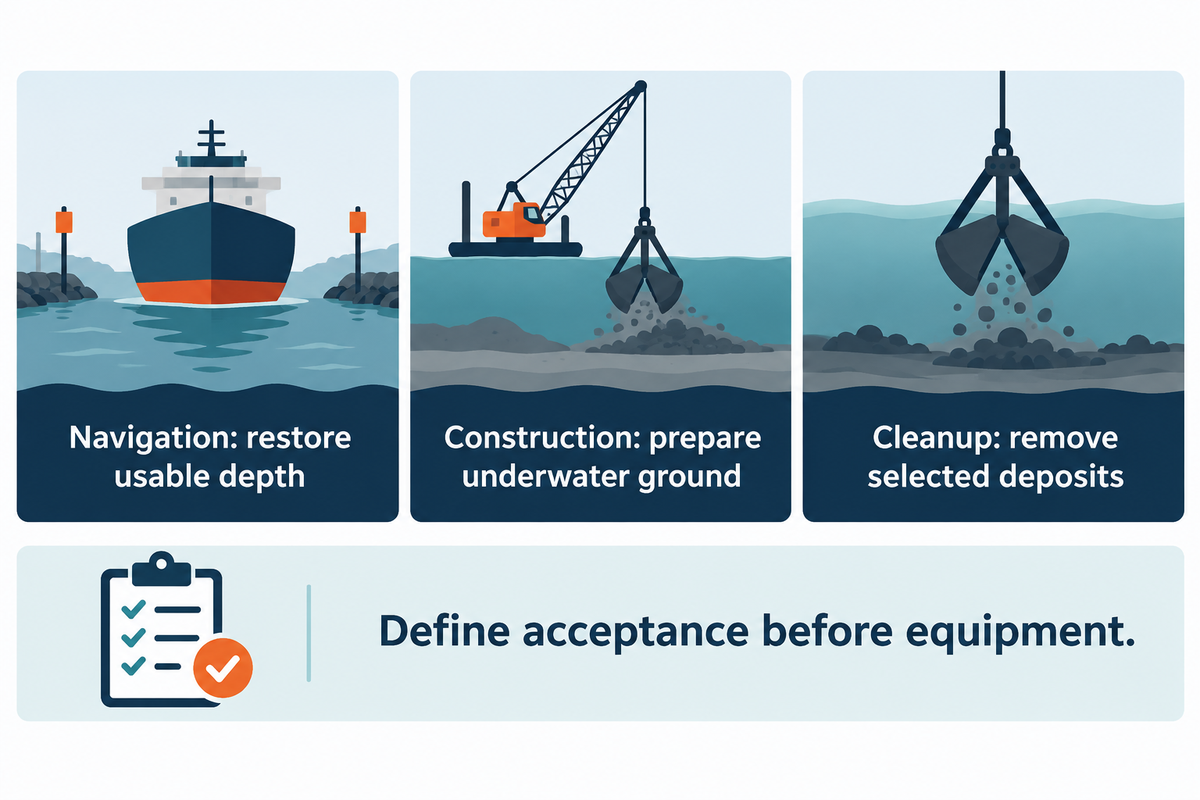
Dredging deepens or reinstates a channel’s usable depth, prepares underwater ground for construction, and removes deposits selected for environmental cleanup. Its purpose sets the work area and acceptance criteria. A navigation channel needs a specified bed profile; a remediation project also needs criteria for the contamination left behind and the material removed.
NOAA’s explanation of dredging distinguishes navigation work from environmental dredging. Sediment naturally settles in bodies of water, so keeping a channel navigable can require repeated maintenance. Capital work creates or enlarges a canal, berth or basin. Maintenance work restores an existing design after material accumulates.
What is the purpose of dredging?
The intent of dredging is to modify an underwater bed or to remove selected deposits to meet a specific need. These include providing vessel access, constructing foundations for structures, removing contaminated sediment, and obtaining suitable material for land reclamation or beach nourishment. Each of these needs its own survey, materials assessment, and completion criteria.
In the construction industry, excavation can prepare underwater areas for infrastructure projects. Dredging sand and gravel can also supply material for approved uses. Land reclamation creates new land through placement and engineering work beyond excavation. These uses should remain separate from a promise to always improve a waterway by removing more material.
For an owner planning a berth, the bed-level drawing shows required levels and footprint. This is useful for an equipment layout plan. For a cleanup manager, the remedial objective provides a foundation for the selection of equipment. Both managers should describe their objectives in a way that explains the equipment selection for their respective needs. Because objectives vary, equipment selection also varies.
Hydraulic vs mechanical dredging
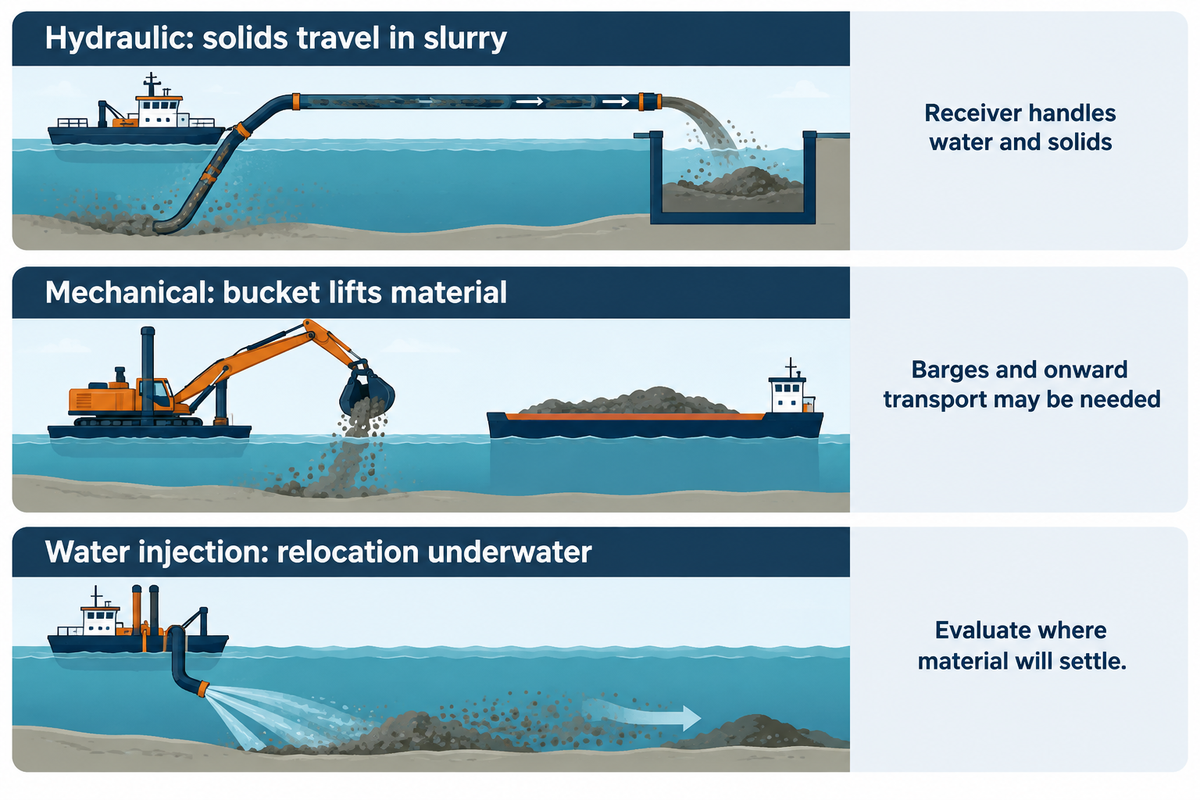
Hydraulic dredging removes loosened material as a water-and-solids mixture through suction equipment. Mechanical dredging lifts material with a bucket or excavator. The difference is excavation and handling. A suction dredger may load an onboard hopper while bucket-dredged material may enter a barge before another transport stage.
Hydraulic removal
Loosened solids travel in slurry. The receiving system must handle the water as well as the solids.
Mechanical removal
A bucket lifts material closer to its original water content. Barges, unloading and onward transport can still be needed.
The cutter suction dredge, often abbreviated CSD, makes use of a rotating cutterhead to break up the material near the suction inlet. A trailing suction hopper dredge draws material into its hold while moving. Both make use of suction; however, their arrangements differ. A slurry pump is part of the bigger system; the purchase of the pump doesn’t supply the vessel or receiving area.
IADC’s dredger selection guidance weighs soil, working depth, access, transport and economics together. Longer water routes can favor hoppers or barges. A suitable land route can favor a pipeline. Neither comparison gives a universal distance at which one method becomes economical.
Water injection is another pathway. Jets mobilize deposits so they can move within the waterbody rather than being lifted onto land. A 2025 U.S. Army report on the Tuttle Creek Reservoir pilot describes this approach and downstream monitoring. Its reservoir application was being tested.
“Water Injection Dredging is an established technology, but this is a new application.”
A relocation proposal must include a pathway where the material will eventually end up. This can’t be used as a shortcut around evaluating where material will be moved to.
Dredging equipment and what each machine does
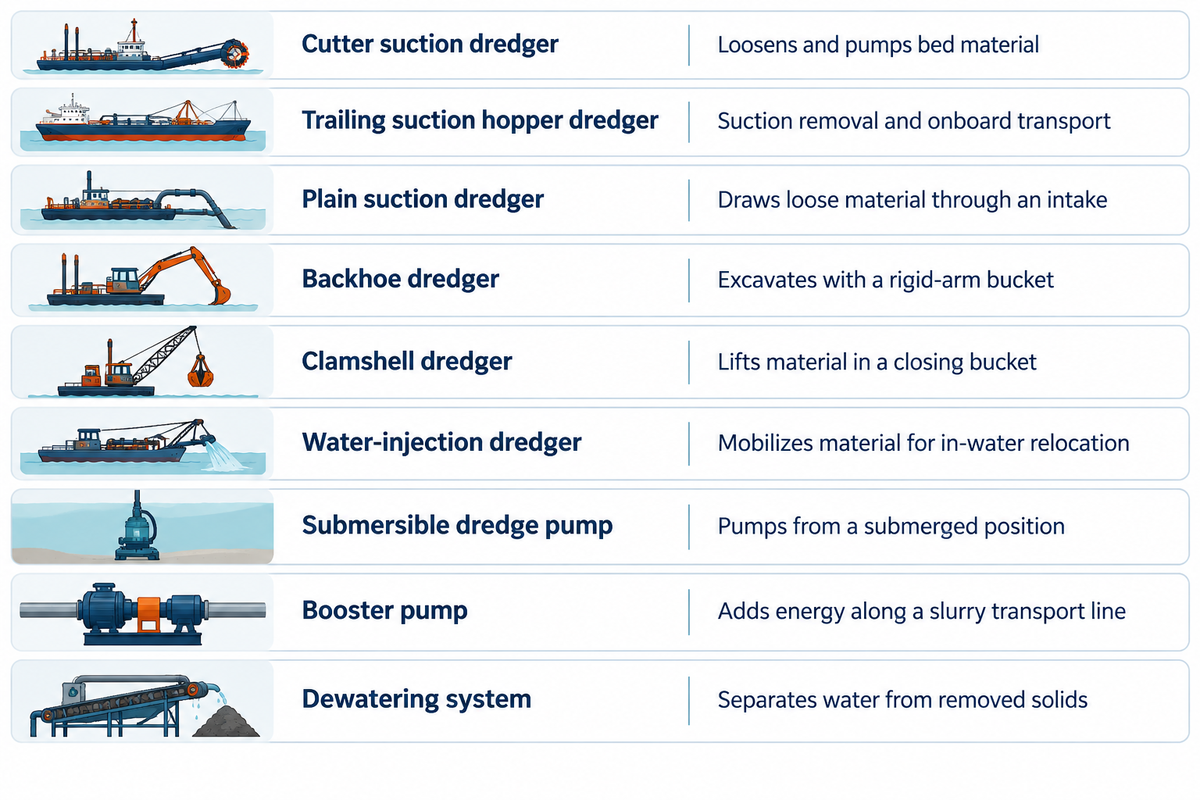
Dredge equipment includes the excavation machine and the systems that position it, transport material and manage the receiving area. Pumps, boosters and dewatering equipment play different roles. Comparing them in a single equipment list is useful only when their roles are evident. So, a support component isn’t mistaken for a complete dredger.
| Equipment | Main role | Selection question |
|---|---|---|
| Cutter suction dredger | Loosens and pumps bed material | Can the cutter handle the material and debris? |
| Trailing suction hopper dredger | Suction removal and onboard transport | Is there enough depth and maneuvering room? |
| Plain suction dredger | Draws loose material through an intake | Will the deposit feed the intake without a cutter? |
| Backhoe dredger | Excavates with a rigid-arm bucket | Can its working envelope reach the target bed? |
| Clamshell dredger | Lifts material in a closing bucket | How will bucket leakage and debris be managed? |
| Water-injection dredger | Mobilizes material for in-water relocation | Where will the material travel and settle? |
| Submersible dredge pump | Pumps from a submerged position | What solids and installation conditions apply? |
| Booster pump | Adds energy along a slurry transport line | What duty follows from the complete pipeline calculation? |
| Dewatering system | Separates water from removed solids | Can it keep pace with incoming material and water? |
Mechanical units can load scows, or other receiving craft. Anchors and a spud can position a working platform; support vessels move the equipment and attend the operation. Specialized dredging equipment must be suited to the dredging site before its production rate becomes useful. A large machine that can’t enter shallow water is of no practical use there.
Imagine a marina having a narrow entrance and a number of occupied berths. The owner compares alternative machines by advertised output. The contractor, on the other hand, reviews the layout and design to determine access, vessel movements and the route to the delivery site. A floating pipeline across the entrance would obstruct boat traffic; a bucket and barge arrangement would need space to load and exchange barges. Either of them would need a suitable operating footprint at the berths. In this example, access and the capacity to handle the material take priority over the equipment’s rated output. The brief should identify which berths can close and describe the area where equipment can be staged, to enable bidders to account for the same conditions when preparing their price proposal.
For the pumping portion, both the submersible dredge pump arrangements and the dredge pump impeller selection address installation and wear concerns that a machine-type list can’t answer.
The stages of a dredging project
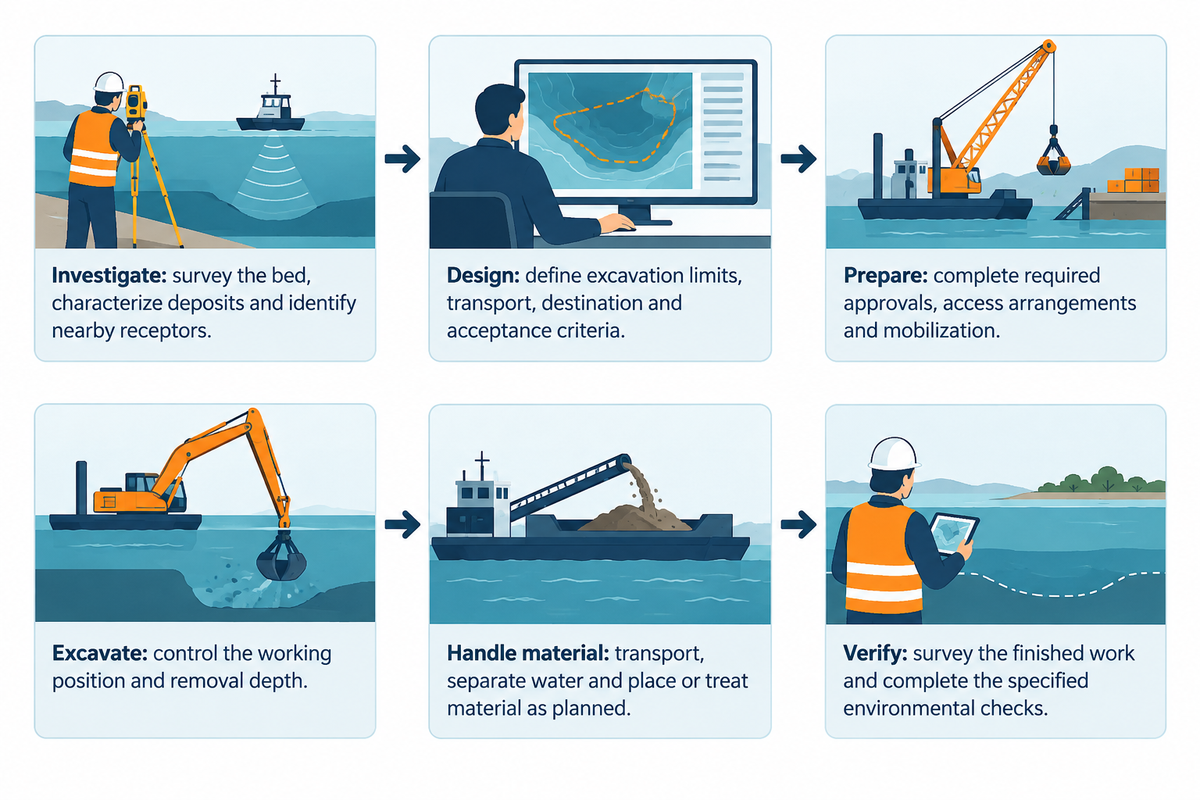
The dredging project typically transitions from investigation and design to mobilization, excavation, material handling, and verification. Decisions overlap: the destination must be feasible before the removal begins, and monitoring continues during the work. Final acceptance testing confirms achievement of the defined objective.
- Investigate: survey the bed, characterize deposits and identify nearby receptors.
- Design: define excavation limits, transport, destination and acceptance criteria.
- Prepare: complete required approvals, access arrangements and mobilization.
- Excavate: control the working position and removal depth.
- Handle material: transport, separate water and place or treat material as planned.
- Verify: survey the finished work and complete the specified environmental checks.
Survey quantities must have a common reference level, often called a datum. The bed elevation on a design drawing may not be the same as a depth below the water surface. Bid quantities and completion surveys should include the reference and the measurement method stated in the contract documents.
ITRC’s sediment removal guidance addresses residual material after excavation in environmental remediation. Multiple passes can still leave deposits requiring further management. Removing the specified volume and meeting cleanup criteria are different tests.
The owner may separate these responsibilities in the scope of work: a surveyor measures the completed profile, while the environmental team verifies attainment of the residual and water quality criteria. Maintaining both responsibilities in the acceptance plan prevents a depth survey from serving as a proxy for cleanup verification.
Where does dredged material go?
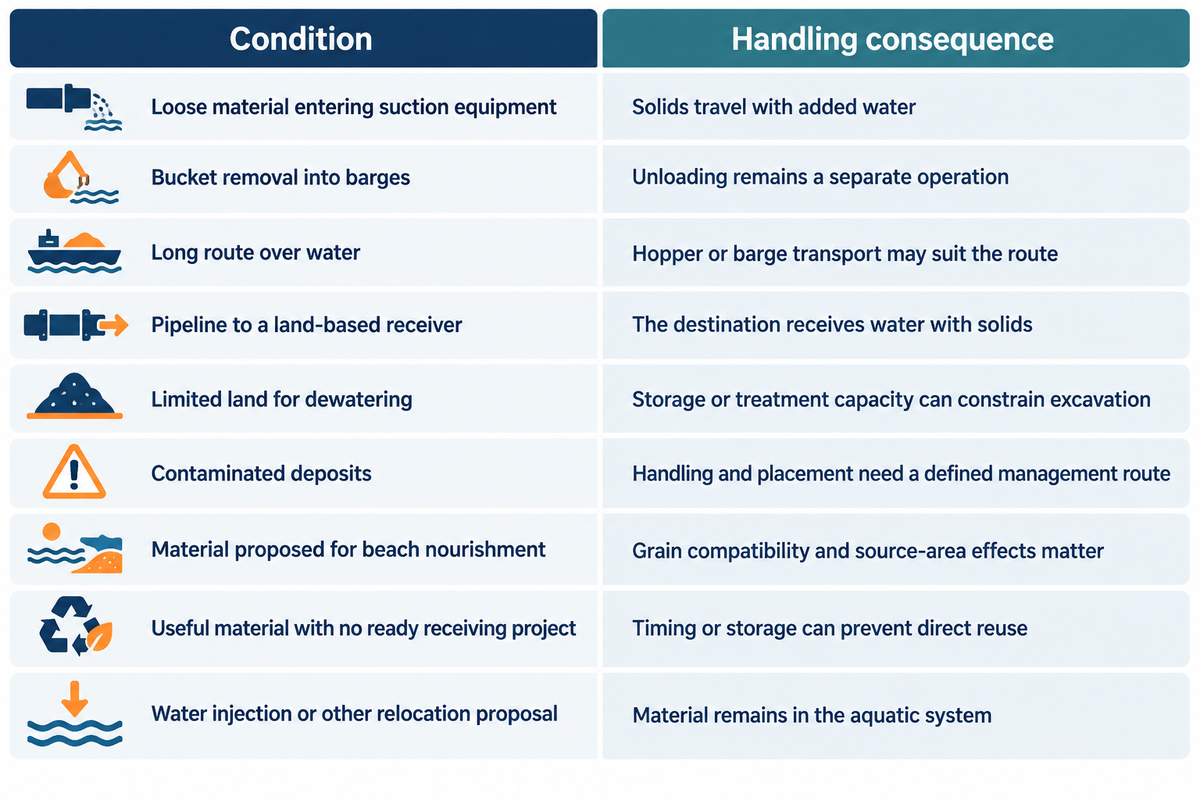
Dredged material may be relocated to an approved treatment or containment facility or a beneficial-use project. Other methods may relocate it within the waterbody. The choice depends on the material’s properties, the nature and extent of contamination, and the transport method. Pumped slurry also creates a water-handling requirement at the receiving end.
Sediment Route Map
The Sediment Route Map connects a material or site condition to the handling decision that must be resolved before excavation can be undertaken.
| Condition | Handling consequence | Action for the project brief |
|---|---|---|
| Loose material entering suction equipment | Solids travel with added water | State slurry and solids quantities separately |
| Bucket removal into barges | Unloading remains a separate operation | Include transfer facilities and onward haulage |
| Long route over water | Hopper or barge transport may suit the route | Compare loading, travel and discharge cycles |
| Pipeline to a land-based receiver | The destination receives water with solids | Size the receiving and water-management system together |
| Limited land for dewatering | Storage or treatment capacity can constrain excavation | Resolve space and processing capacity before mobilization |
| Contaminated deposits | Handling and placement need a defined management route | Match characterization results to acceptance requirements |
| Material proposed for beach nourishment | Grain compatibility and source-area effects matter | Assess both borrow site and receiving beach |
| Useful material with no ready receiving project | Timing or storage can prevent direct reuse | Include the receiver’s schedule and staging arrangements |
| Water injection or other relocation proposal | Material remains in the aquatic system | Evaluate its movement, settling and downstream effects |
This synthesis includes guidance from IADC on equipment selection, ITRC on removal and the Federal Remediation Technologies Roundtable’s environmental dredging profile. The route represents a decision, not a ranking of universally better methods.
Let’s imagine a pond owner has room for a compact dredge but very little land space next to the pond. A hydraulic proposal would remove material efficiently at the intake, but the proposed receiving area can’t store the incoming slurry. Increasing the size of the pump would further exacerbate the issue. In the hypothetical example, the team considers off-site transport, removal in stages and dewatering. The owners need an end point for the solids and a way for the water to leave the system. Only after the end point and water-handling arrangements have been established can the contractor set a removal rate. A small footprint at the water’s edge isn’t the footprint of the entire project.
A 2023 report of the Black River pilot describes using geofabric to separate water from material in a GeoPool. The pilot GeoPool spanned approximately half an acre and was designed to hold 5,000 cubic yards. Residual solids still required an evaluation for beneficial use and dewatering alone didn’t determine their final destination.
Environmental effects and project controls
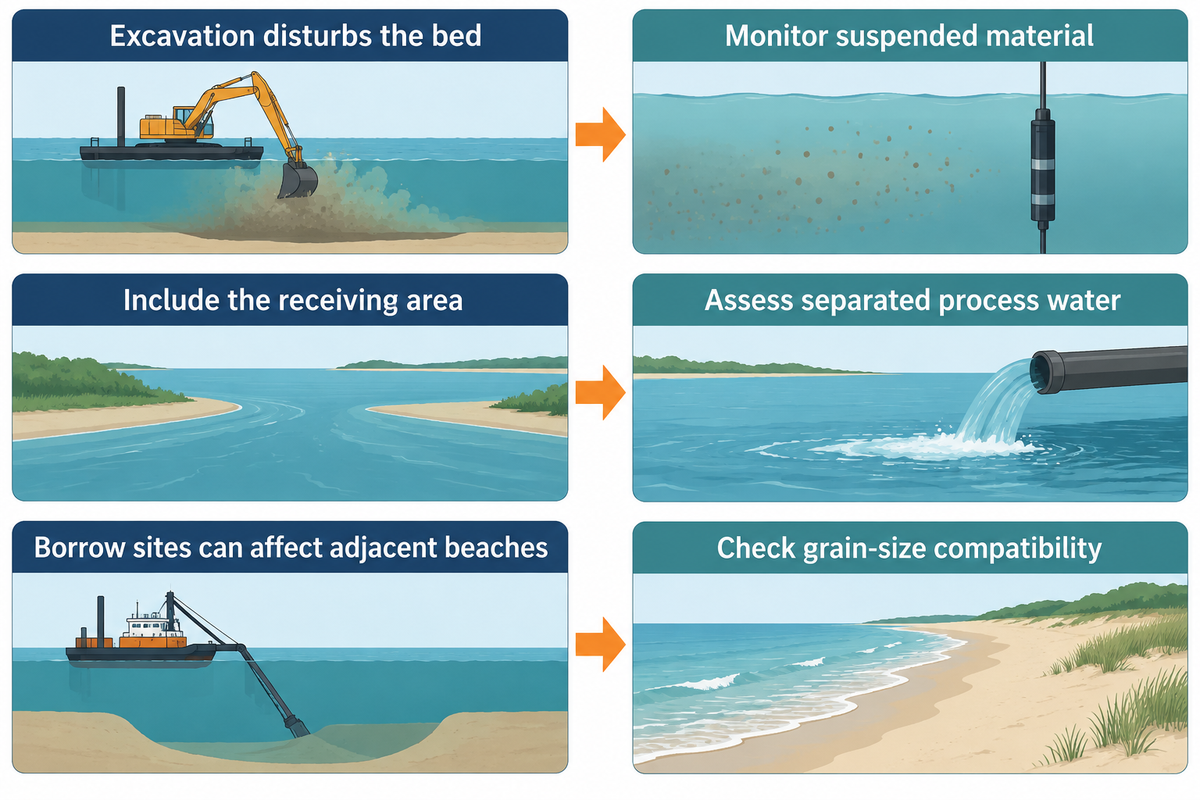
Dredging can restore access and remove pollutants; however, excavation disturbs the bed and can release suspended material. Environmental consequences depend on the material removed, the area affected, and where it’s sent. Controls must address both the work site and the receiving area, including the water returned after dewatering.
Is dredging good or bad for the environment?
Depending on the case, dredging can improve environmental conditions by eliminating targeted pollutants or restoring the environment with a suitable material. On the other hand, dredging can disturb habitat, change water quality and affect sediment movement. The balance comes from evaluating the project in relation to alternatives and assessing the impact at the excavation site, along the transport route and at the site of placement.
Guidance from the National Park Service states that borrow areas in the near shore zone can affect wave refraction and increase erosion along the adjacent beaches. Material placed along the shoreline also should be of similar grain size. The benefit to the receiving beach doesn’t eliminate the effect on the marine life and the ecosystem from where the material was dredged.
Managing dredging impacts starts with contaminated sediment, sensitive habitat and the timing of dredging activities. Monitoring can track the suspended material; remedial work can address the remaining contamination. Containment measures are site-specific and depend on the excavation method. ITRC describes situations where sediment curtains themselves cause problems, so a sediment curtain isn’t a complete control plan.
Stormwater runoff and separated process water must be assessed separately by a receiving site. A clear discharge doesn’t necessarily indicate no treatment or monitoring is required. Connecting the discharge pipeline directly to a lower area before resolving its water route simply transfers the problem onshore.
Local changes occur. The Seattle District’s dredged-material program register differentiates current from superseded directions. Therefore, its regional criteria shouldn’t be copied onto a project in a different jurisdiction.
What changes the cost of dredging?
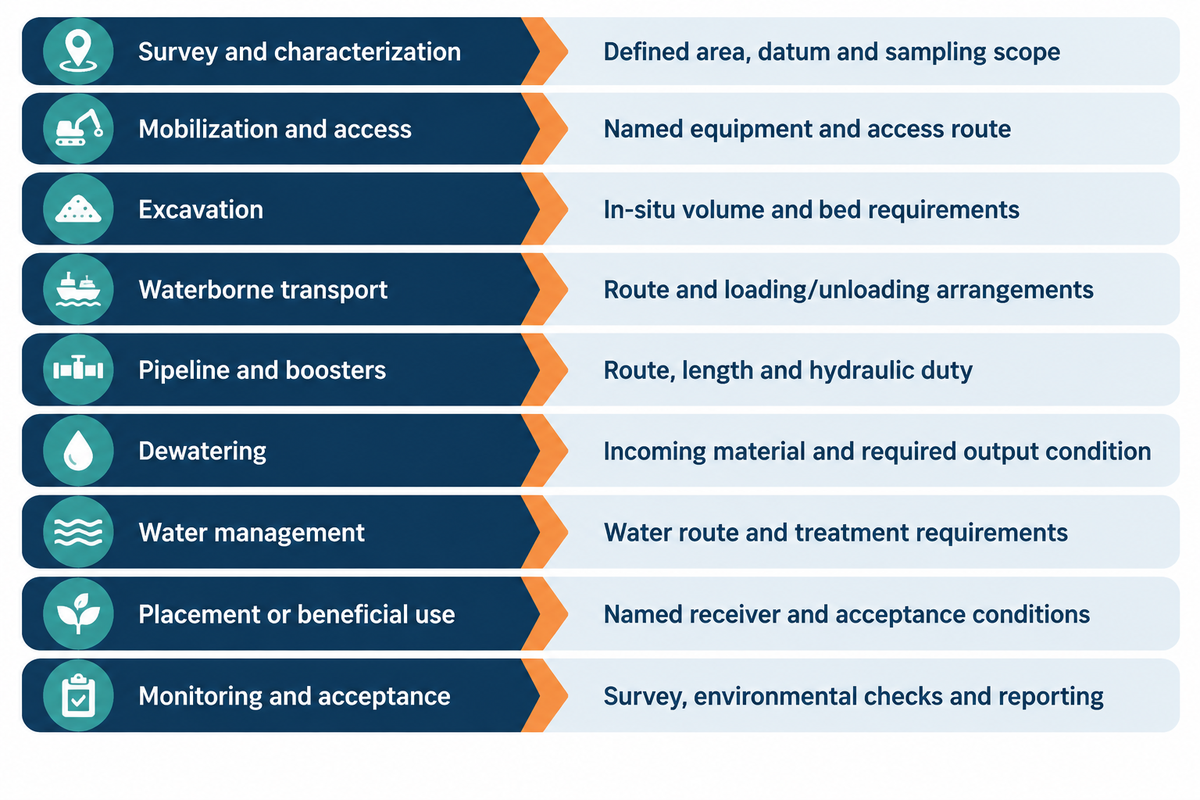
Dredging costs depend on access, material, quantity, transport, and the requirements of the receiving site. Dewatering and placement add work beyond excavation; bids need comparison against the same measured quantity and final destination. A lower unit price for excavation can be misleading.
In-situ volume measures material as it lies; slurry volume includes water to transport the material. Material dewatered to a different moisture condition isn’t equivalent to in-situ material. Those quantities can’t be interchanged without measurements and assumptions. A price per cubic meter isn’t complete without the basis of measurement and the work included.
| Cost line | Common basis to put in each bid | Missing scope that can change the price |
|---|---|---|
| Survey and characterization | Defined area, datum and sampling scope | Additional testing or revised quantities |
| Mobilization and access | Named equipment and access route | Assembly, temporary works and demobilization |
| Excavation | In-situ volume and bed requirements | Debris, difficult layers and additional passes |
| Waterborne transport | Route and loading/unloading arrangements | Barge waiting or receiver delays |
| Pipeline and boosters | Route, length and hydraulic duty | Relocation, extra pumping and wear parts |
| Dewatering | Incoming material and required output condition | Space, storage and solids handling |
| Water management | Water route and treatment requirements | Treatment, testing and discharge arrangements |
| Placement or beneficial use | Named receiver and acceptance conditions | Haulage, fees and rejected loads |
| Monitoring and acceptance | Survey, environmental checks and reporting | Further work needed to meet the agreed result |
Consider two hypothetical bids for the same surveyed quantity. Bid A offers a lower unit price for excavation but doesn’t include transport and placement. Bid B includes both. Procurement can’t rank them until the excluded work has been priced against the same destination and acceptance conditions. The owner also needs to compare how each bidder measures the quantity. Bid A may refer to material in the bed, while Bid B may refer to the pumped mixture. In this case, a standard scope sheet turns a misleading unit rate comparison into a useful purchasing decision. Mobilization, monitoring and work required for final acceptance need to be included in the comparison.
Environmental projects may spend more on material handling than an excavation-only comparison suggests. FRTR states that water treatment and dewatering can reverse an apparent on-water cost advantage. Therefore, efficient dredging requires the receiving system to keep pace with the removal; a dredger that’s idle still consumes project time.
Choosing a dredging contractor and briefing a pump supplier
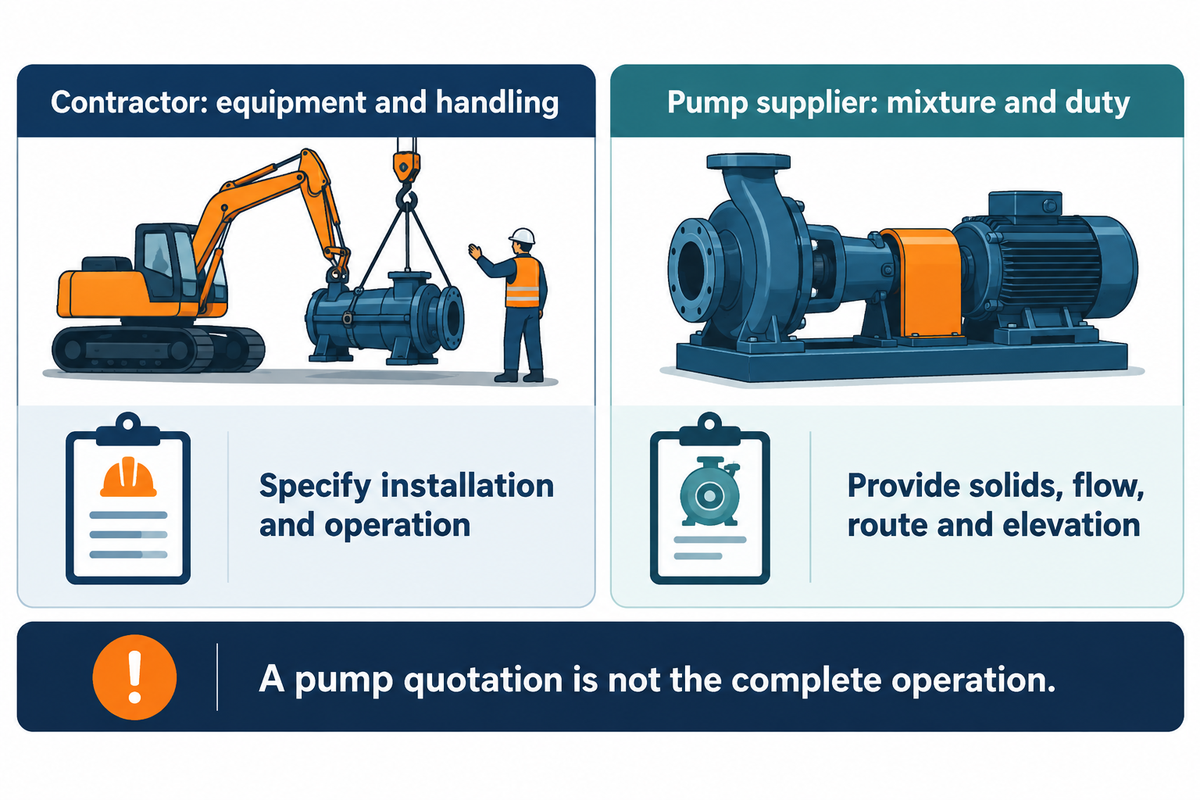
Choose a dredging contractor whose equipment and material-handling arrangements match the project. Brief the pump supplier on the duties for which the equipment is being contracted. The dredging contractor’s production commitment and the pump supplier’s equipment commitment answer different questions, so the quotation needs to include responsibilities for installation, operation and the receiving site.
The briefing should include survey, materials characterization, destination and working constraints. Who controls access to each area should be identified, along with who controls the environmental monitoring. Working constraints due to the presence of shipping, e.g. vessel movements and working windows, should be considered when developing the operating plan for dredging needs as much as the volume of material to be excavated.
For the pumping package, solids characteristics, required flow, route and elevation changes should be provided. A centrifugal pump must be selected for the mixture and duty, not simply the pipe connection size. Selecting a slurry pump covers some of the inputs; pump discharge pressure explains the pressure requirement within the system.
Responsibility lists should show who supplies and installs the dredging systems and who operates them. Surveys, excavations, transport and placements should be shown along with the supply of equipment. This allows a pump quotation to be compared without assuming it covers the entire dredging operation.
Why plan beneficial use before excavation?
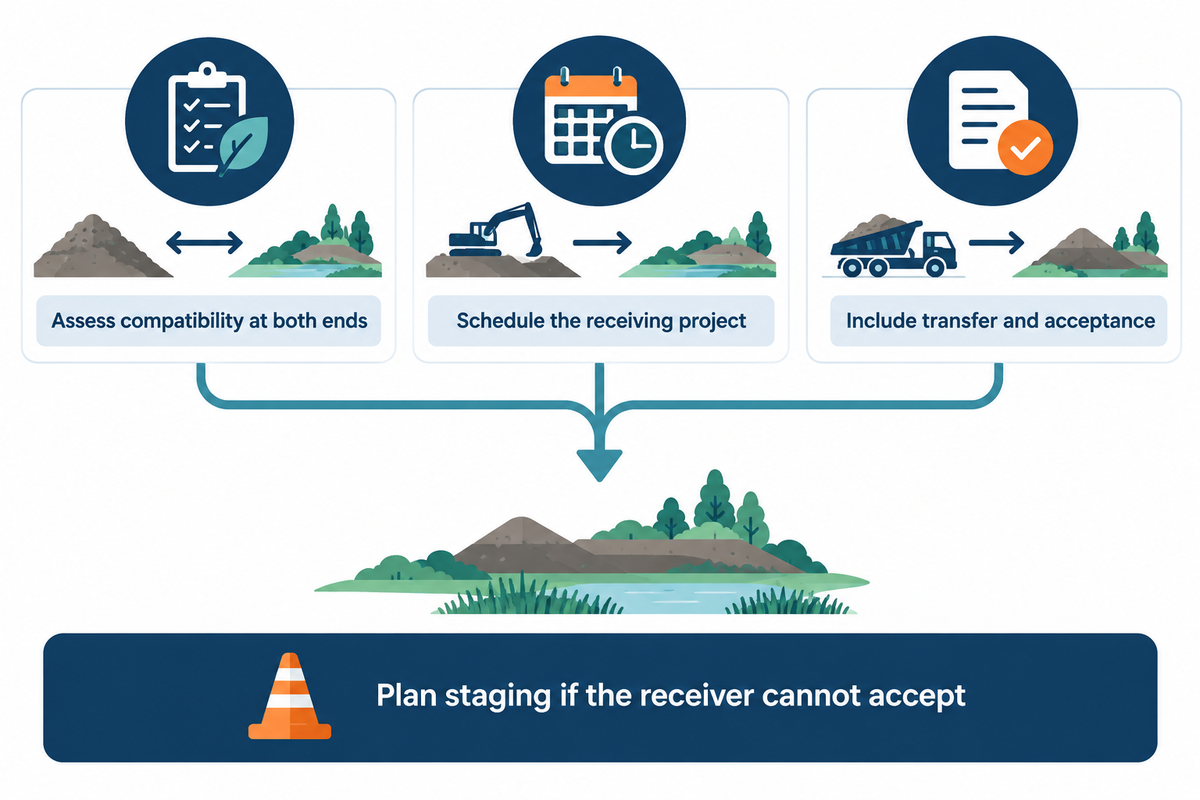
The intended destination influences the quality of materials required at the receiving site and the route and timing of transport. Suitable sediment can be used for restoration, construction and/or land reclamation and coastal protection works. An end use project that’s ready at the wrong time may force the dredging contractor to find alternative storage.
The United States Army Corps of Engineers beneficial-use program describes examples such as wetland habitat restoration and shoreline protection. Its January 2024 Maurice River example involved about 75,000 cubic yards placed at the Heislerville Wildlife Management Area to protect a dike. That’s a named public project, not a BBP installation.
Prior to choosing removal equipment, owners can put the receiving project into the schedule. The environmental team assesses material compatibility and effects at both ends. Procurement includes transfer and acceptance. There are plans for excavating the material and transporting it to the receiving site. If the receiving site can’t accept the material, a priced staging arrangement is required. Benefits of dredging are most useful when the schedule, material and intended use of the project fit together.
For the planned project, BBP’s slurry pump range provides a starting point for discussing the mixture and required pumping duty. Provide materials data and the pipeline route with the inquiry.
Frequently asked questions
Where is dredging used?
Harbors, channels, inland waters and construction sites.
Dredging is used in ports, river channels, marinas, reservoirs and other water bodies where a project needs to remove accumulated amounts of sediment or change the bed. Lake dredging can address selected deposits at the bottom of lakes, while marine work may involve a coastal inlet or offshore site. The objective and material destination determine the equipment and controls.
How long does dredging last?
There is no fixed duration; removal rate and repeat deposition set different timescales.
A dredging job lasts through preparation, removal, handling and acceptance, with its schedule set by the quantity and achievable production under site conditions. The resulting depth lasts until deposits accumulate again. A one-time construction excavation differs from channel maintenance, where continuing sediment movement can require repeat work. Weather, access restrictions and receiver capacity also affect the working schedule.
Does dredging rivers help with flooding?
Sometimes, but it can also transfer flood risk.
Dredging can help in selected flood-management schemes, but it isn’t a general flood-prevention measure. Hull City Council explains that local gradients, tidal deposits and downstream effects can limit its value. A channel may refill, and faster conveyance can move risk elsewhere. Flood assessment therefore needs the wider river system and alternatives, rather than depth alone.
What are dredging spoils?
Material excavated or removed during the work.
Dredging spoils are the material removed from the bed, including mixtures of sand, silt, clay and debris. The term doesn’t determine whether the material is clean, contaminated or suitable for reuse. Testing and the intended destination decide how it should be handled, transported and placed.
Is dredging illegal?
No. Dredging is lawful when applicable project requirements are met.
Dredging is lawful when it meets the requirements applicable to the location and work. Excavation, placement and water discharge can fall under different controls. In the United States, federal and state authorities may both be involved; local access and other requirements can also apply. The responsible project team should establish the applicable approvals before work starts.
What are dredging boats?
Vessels or floating platforms equipped for underwater excavation.
A dredging boat is commonly called a dredger or dredging vessel. It carries equipment that removes or relocates bed material. Some dredgers sail with material in a hopper, while others pump through a line or load separate craft. Support boats help position or move the equipment.
Can dredging cause coastal erosion?
Yes, changes to sediment movement and waves can cause erosion.
Dredging can contribute to coastal erosion when it removes material from the active sediment system or changes local wave and sediment behavior. NPS guidance identifies nearshore borrow sites as one possible cause of increased erosion at adjacent beaches. Placement for nourishment can help elsewhere, so assessment needs both the source area and the receiving coast.