Get in Touch with BBP

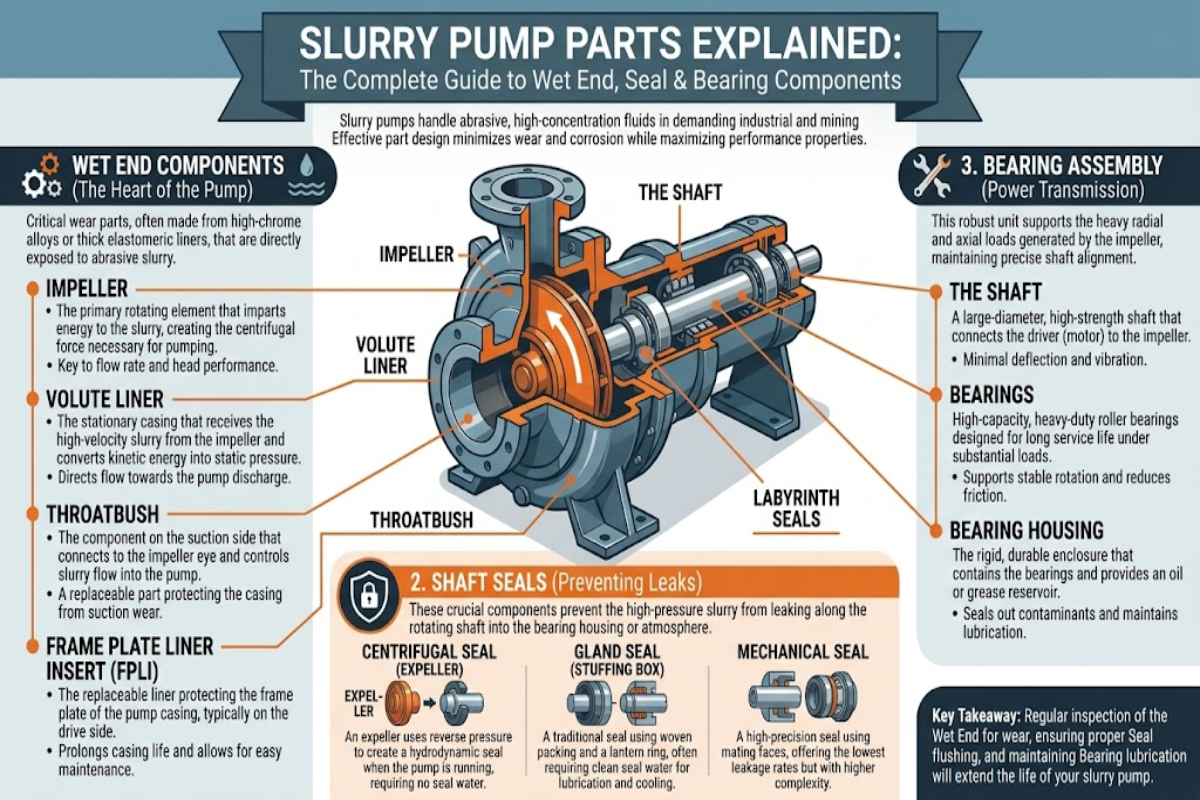
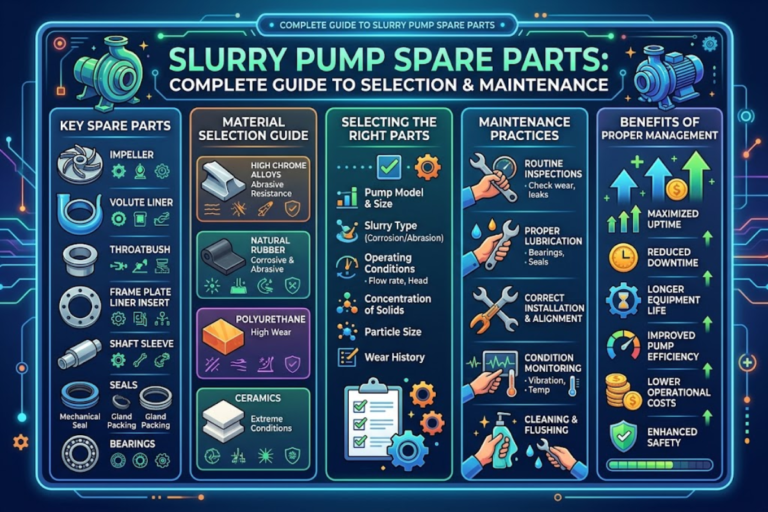
To a casual observer a slurry pump can seem straightforward – a motor, a shell, a suction and a delivery. Beneath the cover plate it is however a synchronized mountain of 15+ components, each of them designed to stand up to a combination of corrosion, abrasion and sustained mechanical loading. Read on to learn about each slurry pump component in three broad categories – the wet end, the seal line, and the bearing and drive assembly – identify each component’s evolution material and determine its failure point.
What Are the Components of a Slurry Pump?
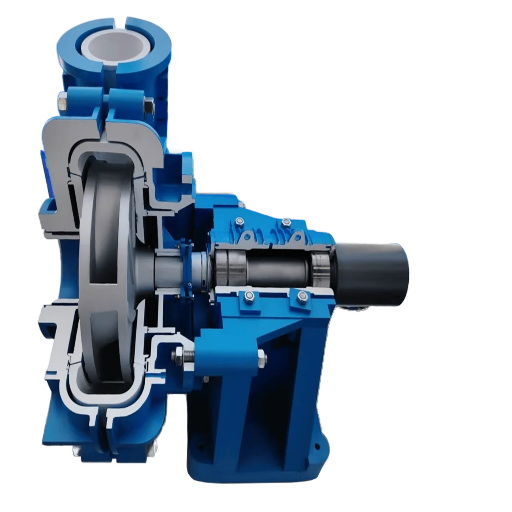
The component groupings of a slurry pump, as understood by all OEM suppliers to the industry, consist of the items contained in the wet end (those components e×posed to the slurry i.e. impeller, casing, throatbush, liners, frame plate), the seal (those components providing a barrier between the wet end and the driveshaft, i.e. gland packing, mechanical seal, or expeller seal), and the bearing assembly and drive (the driveshaft, bearings, lubrication system, and drive coupling). It is the centrifugal slurry pump that delivers the kinetic energy to the abrasive slurry through the rotating impeller and then converts that energy into flow to the process in the volute casing.
Since abrasive and corrosive slurries disintegrate components at different rates, each slurry pump component is a compromise between hardness, toughness, and cost. Wet components are frequently replaced; from 3 to 18 months on most applications. Seal components are replaced on a longer cycle.
If the bearing assembly is adequately lubricated it should last until the end of the pump life. This asymmetrical wear pattern is the inevitable reason that slurry pump spare part inventory is an ongoing line item rather than an occasional capital expenditure.
The Three Functional Groups at a Glance
- Wet end- impeller, volute casing, throatbush, frame plate liner, cover plate liner( wears the most and needs replaced more often than all other pis so)
- Tetting av forsegling – torn
gland packing/forsendlingsboks/linning/presseksel og mechanicale mindre slitasje, planlagt utskifting. - Bearing assembly and drive – shaft, shaft sleeve, bearings, bearing housing, oil seals, drive coupling (least wear when correctly lubrication)
The Wet End — Five Components That Touch the Slurry
All wet-end parts are in contact with the abrasive flow, which is the reason that wet-end parts constitute the majority of a slurry pump spares order. A diagram illustrating how the five main wet-ends operate and the reason for their different wear regimes:.
1. Impeller
Impeller – The rotating component of a pump that transforms torque from the motor into energy in the fluid. Slurry pump impellers are either semi-open or open in design – an open back shroud permits penetrative solids passage without build-up between vanes. Pumping is performed by three to five heavy section vanes – expeller vanes, also known as pump out vanes situated at the back, provide a reduction of the pressure behind the impeller, reducing the aggressive environment surrounding the seal.
Impellers tend to wear first at the leading edges of the vanes and at the front shroud.
2. Volute Casing
A volute is the spiral pressure containing shell that collects the slurry discharging from the impeller and converts velocity to head. In heavy-duty slurry pumps the pump casing is now normally lined- either with a replaceable high-chrome alloy casing liner or with a rubber or polyurethane elastomer lining. Lined casings mean that you can replace the wear surface without having to scrap the outer pressure shell.
3. Throatbush (Suction Liner)
A throatbush can be seen at the suction side of the impeller and forms the interior wall of the suction inlet. Usually the first wet end component to fail on high-solids service since the slurry hits this liner at full velocity before being accelerated by the impeller, wear through it is generally the first inkling of impending wet end failure. Excessive wear on the throatbush is often an early warning sign indicating the rest of the wet end is near the end of its service life.
4. Frame Plate Liner Insert
Frame plate liner inserts protect the back side of the pump casing, the face opposite the motor. Since the recirculating slurry behind the impeller erodes the frame plate as well as the casing, the liner helps reduce the wear. Available in high chrome or elastomer material families matching the casing liner, the frame plate insert is commonly replaced in pairs with the impeller.
5. Cover Plate Liner
On the inlet side of the pump, a cover plate liner (sometimes called the volute cover) acts as the interior face of the pump casing. Paired with the throatbush, the cover plate receives comparable slurry erosion and often signals how close the rest of the wet end is to failure. Because flow conditions and wear rates track each other closely on these two components, cover plate liner and throatbush are usually replaced in tandem.
| Wet Part | Primary Wear Mode | Typical First to Fail? |
|---|---|---|
| Impeller | Vane leading-edge erosion, front shroud wear | Yes on fine abrasive |
| Volute casing liner | Cutwater erosion, bottom-wall wear | Sometimes |
| Throatbush (suction liner) | Direct impingement on inlet flow | Yes on coarse/rock slurries |
| Frame plate liner insert | Recirculation behind impeller | Secondary |
| Cover plate liner | Inlet-side flow disruption | Paired with throatbush |
A complete listing of OEM-recommended replacement parts in each wet end category can be found here in our slurry pump wet-end spare parts catalog.
The Shaft, Sleeve, and Expeller — Where Wet Meets Dry

The interface of the wet end and the bearing assembly is the pump’s transition zone which is where the rotating pump shaft passes through the casing. This interface is where the earliest failures in most slurry pumps begin however, not because wet end parts wear through, but because a fine abrasive slurry begins to leak past the pump seal and eat away at the bearings.
📐 Engineering Note: Why the Shaft Sleeve Matters
A shaft sleeve is a cylindrical appendage on the pump shaft in the seal area. The sleeve should be a sacrificial element that resists the abrasion of the seal packing or of any slurry leaking past a failed seal, preventing it from damaging the main pump shaft. When the sleeve has been worn away to the pump shaft, its time to replace the seal cause the seal has actually failed much sooner than expected. For a drawing-controlled replacement component, precision turned parts from Zhenling provide a machining enquiry route; pump-specific material, fits and seal-surface requirements still need approval by the responsible equipment engineer.
An expeller is a secondary impeller mounted on the back of the main impeller, spinning at shaft speed and developing a low-pressure zone immediately behind the main impeller. This actively pushes slurry away from the pump seal area. Pumps with expeller seals do not require flushing water, gland packing, or a mechanical seal with the pump turned on however, in the event of a power failure the static expeller ring will seal to hold back residual pressure.
Sealing Arrangements — Gland Packing vs Mechanical Seal vs Expeller Seal
Sealing arrangements help form the divide between the wet end and the seal-less bearing assembly of the pump. There are three primary categories of sealing which each work in different applications with different limitations.
| Seal Type | Best For | Key Limit | Flush Water? |
|---|---|---|---|
| Gland packing (stuffing box) | General abrasive service, low-to-medium pressure | Needs constant slow drip of flush water | Yes |
| Mechanical seal | Clean or mildly abrasive slurry, higher pressure | Cannot tolerate coarse solids without flush plan | Often yes (API plans) |
| Expeller seal | Abrasive service where flush water is unwanted | Works only while pump runs; static seal at shutdown | No |
Most field operators tend to over tighten the gland packing when they discover a small leak. A slow, steady drip is the nature of proper packing operation, this slow leak will insure that the packing is kept cool and lubricated. Over-tightened packing: it runs dry, packs the sleeve, and shortens sealing life from years to mere months.
In addition to our slurry pump seal kits and spare assembly, our catalogue also features compatible parts for gland packing rings, mechanical seal cartridges, and expeller equipment.
Bearing Assembly and Drive Configuration
The bearing assemblies carry the impeller generated radial and axial loads, and maintain the shaft in alignment under the hydraulically swinging thrust loads that fluctuate with every change in flow and pressure. Most slurry pump bearing assemblies employ a pair of tapered roller bearings or some combination of deep-groove ball bearings and spherical roller bearings, according to the level of Axial Thrust and the shaft overhang.
Lubrication makes or breaks service life. Oil-bath lubrication (with a sight glass and vent) is standard for industrial continuous duty service, providing bearing life in the 50,000 hour range when the oil remains at the proper level and is changed on schedule. Grease lubrication is frequently found on smaller portable units where containment of oil is problematic. Synthetic oils substantially extend change intervals, but are an expense only justified in high temperature, high humidity, or high airborne abrasives environments.
Three basic drive configurations are employed: close-coupled to the motor, belt-driven through a pulley system, or flex-coupled to a separate mounted motor, usually on a baseplate. Service implications vary: converting flow by speed variation is less expensive with a close-coupled pump, versus changing pulleys on a belt-driven pump; exchanging a motor or reducer requires pulling the motor too, but the entire pump need not be disturbed with a flex-coupled unit; floor space is optimized with a close-coupled unit but the entire assembly must be pulled for motor service.
For complete bearing assemblies, oil seals and drive components that are interchangeable through out our slurry pump range, refer to our BBP bearing assembly spare parts catalog.
Materials That Matter — High-Chrome, Natural Rubber, Polyurethane, Ceramic
Ultimately there is no “best” material for a slurry pump. Material selection depends upon slurry chemistry and particle size and hardness; operational pressure and temperature. Here is a comparison of the four dominant material families in use – designed to achieve a specific mix of corrosion resistance, hardness and ductility or toughness.
| Material | Typical Hardness | Best Application | Weak Point |
|---|---|---|---|
| High-chrome white iron (ASTM A532) | 450–800 HB (Brinell) | Coarse, hard-rock abrasive service (mineral processing, sand and gravel, ore) | Brittle under heavy impact |
| Natural rubber | 55–70 Shore A | Fine abrasive, low-to-moderate tip speed, acidic slurries | Cut by sharp particles above ~40 mm |
| Polyurethane (synthetic rubber) | 85–95 Shore A | Fine-to-medium abrasive, higher tip speed than natural rubber | Hydrolyzes in hot water service |
| Ceramic (alumina, SiC composites) | 1500+ HV (Vickers) | Extreme fine abrasive, corrosive and abrasive combined | Cost and brittleness |
Hardness alone does not guarantee long wear life. Should a component be made from the hardest possible material, it will still shatter, every time, under impact if it is not sufficiently tough. Equilibrium is in the hardness and toughness balance and how this is derived from the Brinell or Vickers hardness scales is the reason why a good slurry pump supplier will ask about the particle size distribution in your slurry before quoting a material. High chrome iron heat treatment can vary the hardness by 100 HB within the ASTM A532 range without changing composition, for this reason we always verify hardness on every high chrome casting before shipment.
Our own foundry makes both high chrome and elastomer wear parts in-house, assuring full certification of the particular casting heat (or rubber batch) to the finished part, all traceable under one ISO 9001:2015 quality system. Use the BBP high-chrome and rubber slurry pump parts catalog for compatible spares throughout our major slurry pump frame sizes.
Why Slurry Pump Parts Wear Out — And How Long They Last
All slurry pump parts have finite service lives, and in abrasive service, wear is primarily determined by three “big” factors: slurry velocity (wear varies with the cube of velocity), particle size, and particle hardness. Secondarily, slurry temperature, pH, and intermittency or constant duty operation are “small” factors.
| Application | High-Chrome Wet End | Rubber-Lined Wet End |
|---|---|---|
| Fine mineral processing (≤5 mm particles) | 6–12 months | 12–18 months |
| Sand and gravel dredging | 6–10 months | 3–6 months (cut by coarse grit) |
| Pulp and paper stock transfer | 12–24 months | 18–30 months (corrosive-friendly) |
| Mill tailings (fine, corrosive slurries) | 4–8 months | 8–14 months |
Most typical failure modes can be related to a handful of root causes: pump is operated outside its design envelope (causing deterioration of the impeller due to cavitation), flush water system failure (resulting in gland packing heating up and scoring shaft sleeve), misaligned bearings after a rebuild (reducing bearing life by 40 to 60%), incorrect material of construction for the slurry (for instance rubber in a hot caustic environment) failing in a matter of weeks. Most of these failures are predictable with a simple program of monitoring and logging, as distinct from condition-based alarms.
So, the end-of-life decision is “rebuild the pump” or “just replace the wet-end parts”. If inspection reveals it has acceptable shaft and bearing housing, then it can be relatively simply rebuilt with wet-end parts, seal kit, and shaft sleeve and returned to near-original performance for a significantly lower cost than a complete new pump. On a well-stocked schedule spare parts inventory, the planned wet-end rebuild takes 4 to 8 hours downtime on the shop floor.
To determine a replacement cycle for a particular pump frame size and application or to obtain a replacement parts quote for a particular pump frame size and application, request a BBP wear parts replacement quote with your service conditions and current pump model.
Frequently Asked Questions
Q: What are the 7 major parts of a slurry pump?
View Answer
Industry lists usually settle on seven: impeller, volute casing, throatbush, frame plate liner, shaft with shaft sleeve, seal arrangement, and bearing assembly.
Q: How long do slurry pumps typically last before a rebuild?
View Answer
With good spare parts discipline, pump frame and bearing assembly (longest lived part) can last 8-15 years. Wet-end parts – impeller, liners, throatbush – are consumables: 3-18 months depending on slurry characteristics and material selected. Seal kits are replaced on a 6-12 month cycle.
So “how long does a slurry pump last” isn’t the right question, the right question is “how often am I replacing the wet end, and how can I slash that in half with a different material spec?”
Q: Are slurry pump parts interchangeable between brands?
View Answer
In general, a lot of the wet end components on a major horizontal slurry pump frame are interchangeable in size – impellers, throatbushes and casing liners will almost certainly be compatible down to the impeller hub bore size, vane shape and outer diameter even if OEM-wise there is no “fit” usually if the OEMs match then the equivalent aftermarket versions will. In addition be aware that different alloys in the wrong duty can reduce the working life by 50% of one made in the same alloy for the OEM application so know what you need, and ask for dimensions for your pump tag before buying.
Q: What is a throatbush and why does it wear first?
View Answer
A throatbush (also known as a suction liner) is the removable wear parts which constitute the inner lining of the suction inlet. The slurry at full the pump suction velocity impacts the throatbush before the slurry is passed through to the impeller, thus in high-solids application, the throatbush experiences the greatest impingement wear. As it is wears-through, the casing behind it will begin to wear and so, it is more economical to install a new throatbush well before failure than there will be to identify erosion of the casing.
Q: Which is better — high-chrome or rubber slurry pump parts?
View Answer
Neither is necessarily better. If coarse, hard-rock abrasive service and high tip speeds are involved, high-chrome white iron (ASTM A532) can outperform rubber. For moderate tip speeds handling fine abrasives, elastomers can outperform metal because the impact of particles on the internal surfaces is absorbed rather than fractured along grain boundaries. A mid-range crossover of approximately 5 mm and 28 m/s tip speed often exists – on both larger and smaller particle sizes and tip speeds, one material or the other will win. For mixed feeds, operators often run a metal front end (casing and throatbush) on the upper-wear surfaces and rubber liners on the low-wear surfaces.
Q: Can I replace individual wet-end parts or do I need a full rebuild?
View Answer
Individual parts are replaceable — that is the principle behind modular wet-end design. However, pairings of impeller and front liner, or throatbush and cover plate, wear in close tandem. Replacing one part when its partner still has 20 percent of life left often means another shaft pull within the quarter. A matched-set approach cuts total downtime even when it looks more expensive on the parts invoice, and most slurry pump suppliers — BBP included — offer high-quality matched kits to simplify the ordering.
Q: What does OEM mean for slurry pump spare parts?
View Answer
OEM indicates the part is manufactured according to the original equipment manufacturer (OEM) supplier ‘engineering drawing’ – same dimensions, material grade, hardening treatment and angular tolerances. Availability of Aftermarket parts and pricing does not necessarily mean the same specification was used. For slurry pumps, specify ASTM A532 class designation or Elastomer grade before ordering from an aftermarket vendor – you might save 2 on the purchase order, but a lower wear life costs in replacement downtime.
About This Guide
This guide was assembled by the BBP engineering team from our in-house foundry-and-test records of high-chrome and elastomer slurry pump parts. The hardness ranges described (450-800 HB for high chrome white iron, 55-95 Shore A for rubber and polyurethane) and wear-life bands provided (based on ASTM A532 grades and in-operation replacement experience) all reflect values stored in our OEM and aftermarket spare parts databases. Actual wear-life in your application may vary significantly depending on slurry particle size distribution, velocity and chemistry – your pump tag and operating duty are the logical starting point for a due diligence-based recommendation.
References & Standards
- ASME B73.1 – Specification for Horizontal End Suction Centrifugal Pumps – American Society of Mechanical Engineers
- ASTM A532 – Standard Specification for Abrasion-Resistant Cast Irons – ASTM International
- Pump Lifecycle Cost Analysis Framework – Hydraulic Institute
- Metallurgical Aspects of High-Chromium White Irons – Foundry-Planet technical paper (A reference for the hardening ranges and heat treatment ratios described above).
- Impact Wear Behavior of Large Rocks on Slurry Pump Materials – Western Dredging Association research, used for red and yellow bands above.
- ISO 9001:2015 – Quality Management Systems – International Organization for Standardization
Related Articles
- Self Priming Pump – No Foot Valve Necessary – Our equivalent of self-priming pumps, covering a different pump family from the BBP line.
- BBP Slurry Pump Spare Parts Catalog – Complete index of wet-end, seal, and bearing spare parts from the entire BBP slurry pump range.