Get in Touch with BBP

Water Pressure in House Is Low: Find the Cause Before Adding a Booster Pump

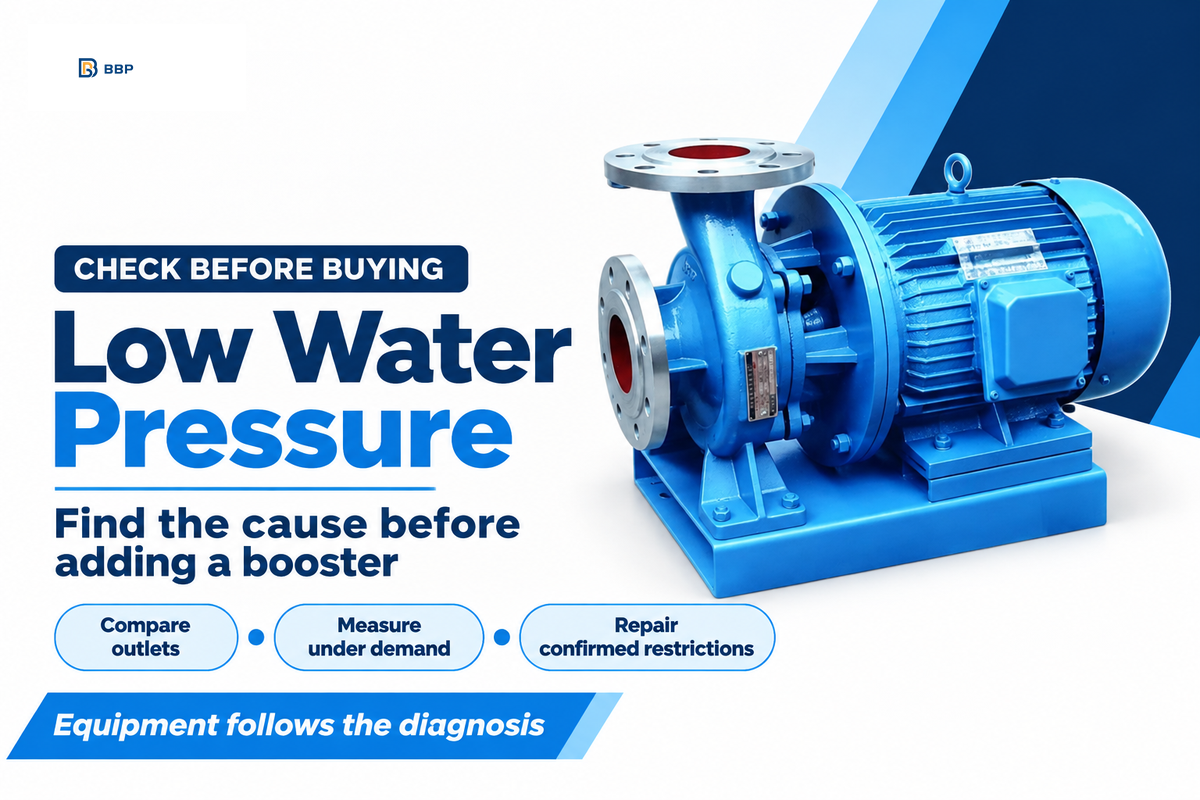
Low water pressure in a house prompts checking all affected faucets and measuring pressure at a known test point. Check the aerator, valves and filters. Supply problems, such as a break in a supply line or a closed valve, can also produce these symptoms. The remedy follows the pattern, not the strength of a shower.
Quick answer: Check one outlet versus the whole house, hot versus cold, and quiet periods versus simultaneous use. Record pressure before buying equipment. Fix restrictions or leaks first; consider a booster when the available supply cannot deliver the required pressure.
Dealing with low water pressure begins with separating the common causes of low water delivery. This helps homeowners identify water pressure problems and provides a record plumbers can use to start. It covers municipal supply and well water, and provides a decision point regarding the addition of equipment.
Start with the pattern: one faucet, hot water or the whole house
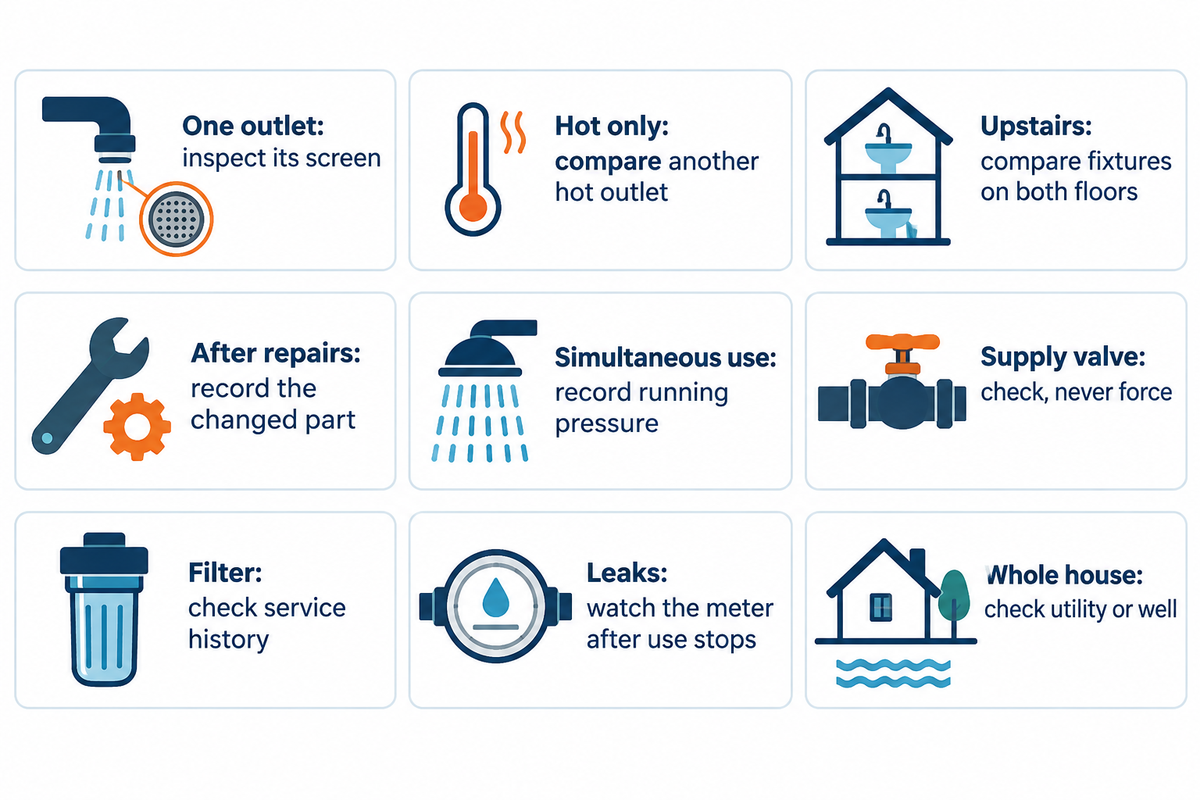
One weak faucet typically requires checking that fixture. Low water pressure in the entire house requires a different approach. Checks should be made on shared components and the water source. When a change affects hot and cold water, compare fixtures in your home before selecting a repair. A problem with just the hot water path suggests a different set of components than a general loss of pressure throughout your home.
Use this 9-Check Tap-to-Supply Triage to record what changes between tests. The last column is what’s important. Each observation is a step to the next check.
| Check | What you notice | Next useful action | What it does not prove |
|---|---|---|---|
| 1. One outlet | A kitchen faucet is weak; nearby taps work. | Inspect its aerator or spray-head screen using the model instructions. | That the main supply is low. |
| 2. Hot versus cold | Only hot water is affected. | Compare another hot outlet and note any heater work. | That a pressure booster will help. |
| 3. Different floors | An upstairs bathroom is weak. | Compare more than one fixture upstairs and downstairs. | That height is the only cause. |
| 4. Recent repairs | The problem began after service. | Record the part replaced and ask the installer to check restored flow. | That the replacement part is defective. |
| 5. Simultaneous use | A shower weakens when another tap opens. | Record pressure with that demand running. | Whether the restriction is inside or upstream. |
| 6. Supply valves | A known household valve was recently operated. | Check its documented open position without forcing it. | That every valve opens in the same direction. |
| 7. Treatment equipment | Flow declined around filter maintenance. | Check the cartridge, service record and valve arrangement. | That removing filtration is a suitable permanent fix. |
| 8. Leaks | There is unexplained use, dampness or running water. | Stop intended water use and check the accessible meter indicator. | Where a hidden leak is located. |
| 9. Water source | All outlets changed at once. | Check utility notices, neighbors or well-system behavior. | That the house needs a larger pump. |
An example would be noting “washing machine affects shower but not kitchen tap, but only during laundry” for the combination, and “Pressure drops during laundry” for the symptom. The Portland Water Bureau’s Troubleshooting Guide also starts by comparing fixtures and hot versus cold water.
Test your water pressure before choosing a fix
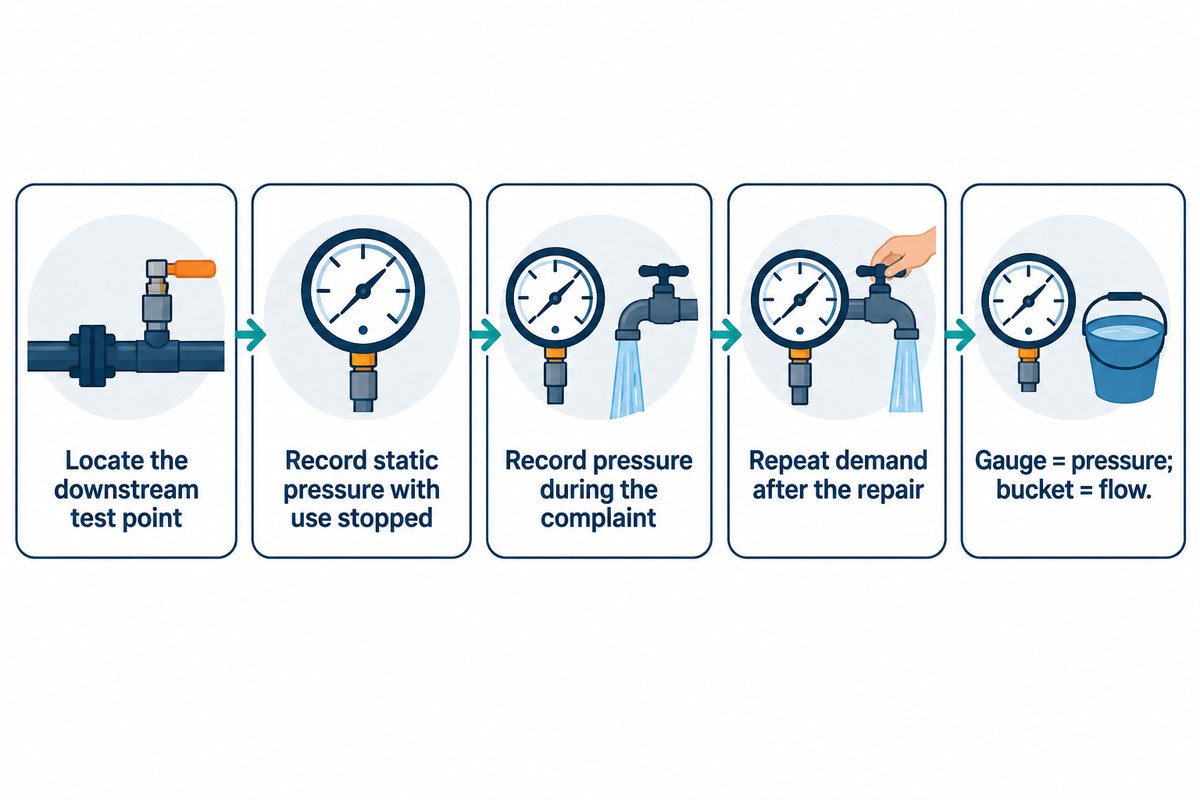
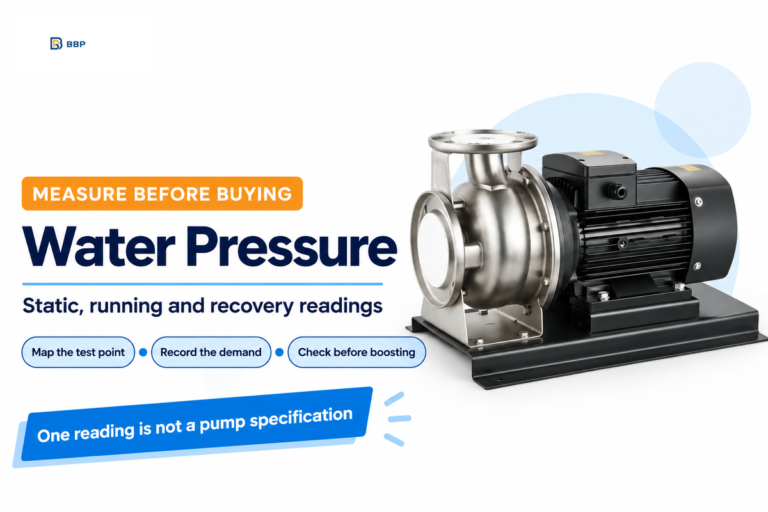
A pressure gauge measures pressure. A timed container measures flow. Use both to assess water pressure and flow at a weak shower or slow-filling sink. Even when pressure is normal, with every faucet closed, that reading doesn’t show how the supply behaves with several fixtures drawing water. Our water pressure measurement guide explains the reading conditions.
EPA WaterSense recommends an incoming service pressure of 45-60 psi for optimum home water use. Treat that as the agency’s guidance, rather than a universal minimum for every appliance or a reason to adjust a regulator without diagnosis. Check equipment instructions and the requirements for the real world situation.
“Your water-using fixtures will operate best if your home’s incoming water pressure is between 45 and 60 pounds per square inch (psi).”
- Identify the connection. Use an appropriate hose connection known to be downstream of the pressure regulator, if installed. An outdoor faucet may be connected before it. According to the City of Santa Barbara’s regulator guidance, a hose connection or washing machine connection can be used downstream.
- With other water usage stopped, connect the gauge securely and open the test tap for a static reading. Note the date, time, and the reading, location and condition of the connection, if it’s accessible. Avoid disturbing an inaccessible or damaged connection.
- Keep the same gauge location, open the outlet involved in the complaint and record the pressure reading. Note the fixtures in operation.
- Repeat household demand after the repair. If the position of a gauge is in doubt, have a plumber locate the gauge. Interpret the numbers accordingly.
Let’s say we perform a bucket test on a kitchen faucet. A container holding 1 US gallon fills in 30 seconds. Divide 60 seconds by 30, then multiply by 1 gallon: the measured flow is 2 gallons per minute. Indicate if the faucet was fully open, and if another outlet was running. You can test the faucet again after cleaning the aerator to see if there is an improvement in water delivery. It doesn’t show a pressure reading in psi. A fixture designed to limit flow can deliver less water than an unrestricted outlet; therefore, the result has to be compared to that fixture’s specification. Don’t turn this flow number into a pump-pressure setting.
Is 40 psi too low for house water pressure?
A 40 psi reading can be workable in some homes, but it requires context before it’s called normal water pressure for your installation. Note if the water was stopped or flowing, and the gauge position. It’s below EPA’s recommended service range. Compare fixture performance and equipment requirements, and then decide if you want to change your home’s water pressure.
Check valves, filters and plumbing restrictions
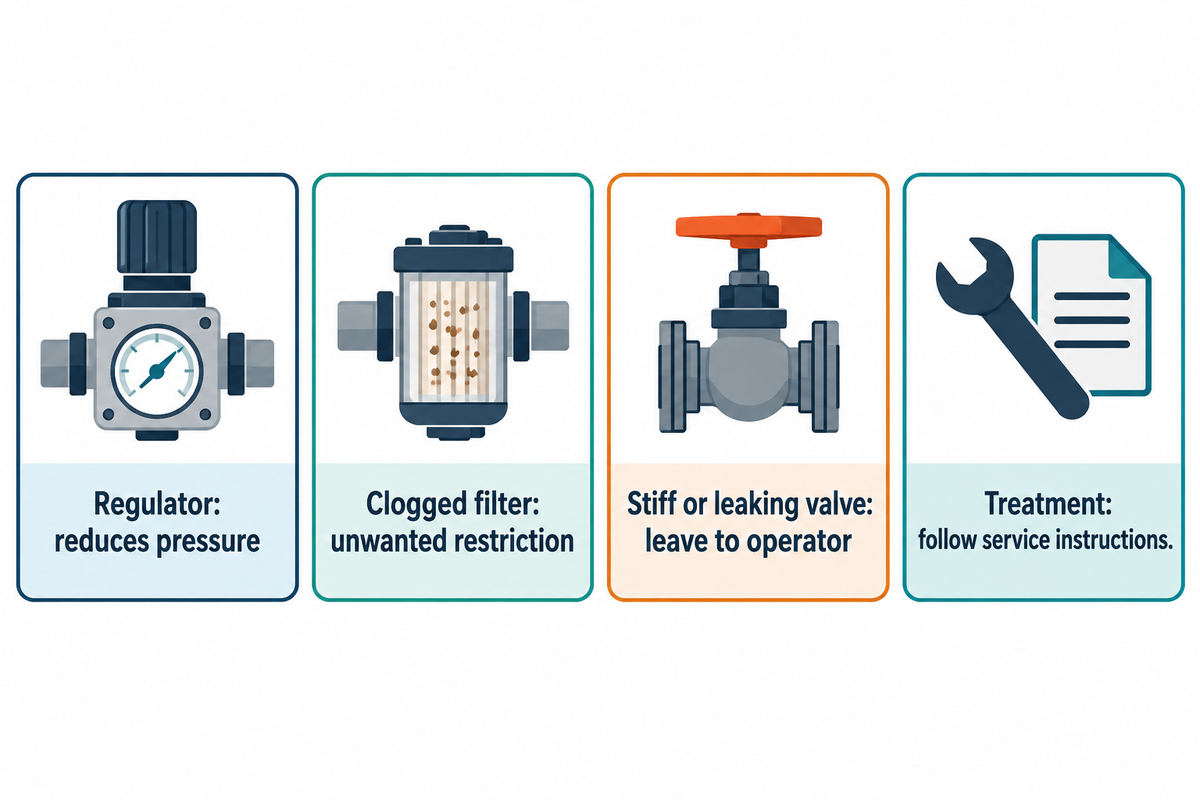
A partially closed household water valve, loaded filter or restricted pipe can cause low water pressure at outlets. This happens even with upstream pressure available. Start with the accessible observations and maintenance records. The main water valve, pressure regulator valve and water filter perform different functions. A regulator is designed to reduce pressure, while a clogged filter creates an unwanted restriction.
A known household shutoff should be checked against its operating instruction. Different valve types have different handle movements, and a damaged handle may not represent the internal position. Leave sealed utility equipment, shared-building valves and stiff or leaking valves to the responsible operator. Forcing them can turn a pressure problem into water damage.
Consider whole-house water filtration equipment’s service date. Follow instructions for cartridge changes and pressure relief. A bypass test should only use the intended arrangement and consider water quality requirements; it isn’t a reason to permanently remove treatment. Hard water mineral buildup and corrosion inside water lines can restrict water flow, but pipe age alone doesn’t locate the cause of low water pressure.
Why is my water pressure low after plumbing repairs?
Check whether supply valves were fully restored, whether a filter or fixture screen contains debris, and whether a regulator was changed or adjusted. A repair may have corrected previously high pressure. Report the date and time the change was noted, and which fixtures were affected, to the installer. The installer can then check the supply and cartridge. It may be necessary to correct a confirmed restriction before purchasing a whole-house booster. Be sure to list the component on the service call invoice.
Picture a homeowner who notices a slow kitchen faucet right after a shutoff-valve repair. The bathroom cold tap is normal. The outdoor supply is the same. The kitchen tap and its local supply are the first place to check. Cleaning the aerator, if it’s removable, per its instructions may restore flow; if not, the installer can check the supply and cartridge. A whole-house booster shouldn’t be purchased prior to checking the supply; doing so would leave a restriction in place.
Separate faucet and hot-water problems from supply pressure
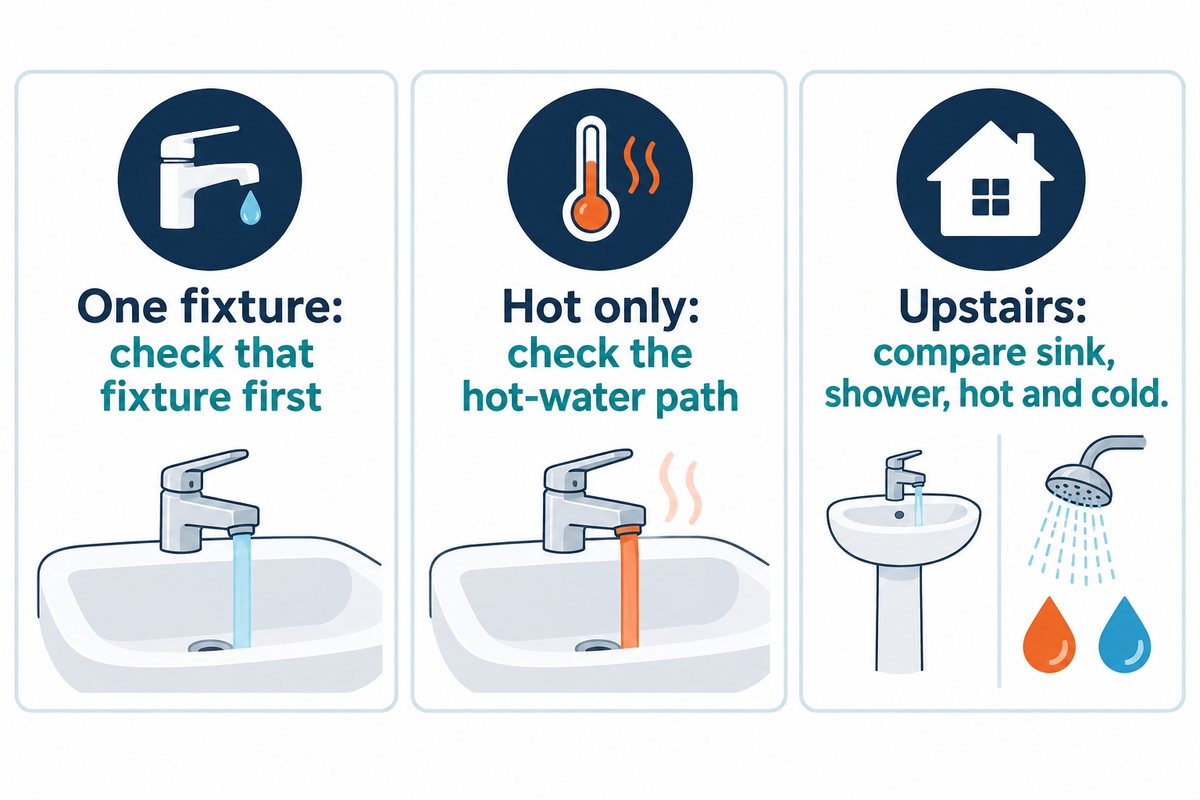
When only one fixture is weak, check that fixture before altering the house supply. If hot outlets are weak but cold water is normal, check the hot-water path. Comparing weak fixtures can identify the area to investigate; it doesn’t guarantee that the water heater, mixing valve or cartridge needs replacing.
Debris can collect on aerators and spray-head screens. Check the faucet (model) before removing parts and keep the seals and flow-control components. If cleaning the permitted removable screen isn’t helpful, the cartridge, supply line or valve may need professional assistance. Don’t remove flow restrictors to adjust for an unknown pressure issue.
A heater that has recently been serviced may not be the problem. If there are visible leaks, it could be the problem. If every hot outlet is affected, check the shared hot-water path for the problem. Heater work should be done by a professional. Hot-water recirculation systems can help cut down wait time for hot water. They shouldn’t be confused with a pressure booster for weak incoming supply.
Why is my upstairs bathroom low but not downstairs?
Many things can cause problems only in the upper-story fixtures including height, the route of the branch pipe, fixture restrictions and simultaneous use. Compare the sink and shower separately, then compare hot and cold. If only one shower fixture is weak, check that fixture. If all upper-story fixtures are weak, check for pressure and flow issues that take elevation and the shared branch into account.
To figure out what’s wrong with a floor, the important data points are the outlet, water temperature side, and what else is running during each check. Good pressure downstairs doesn’t show what reaches an upstairs shower through a different branch. Our total dynamic head explanation shows why elevation and pipe losses become important once the problem hits system sizing.
Trace whole-house pressure to the water source
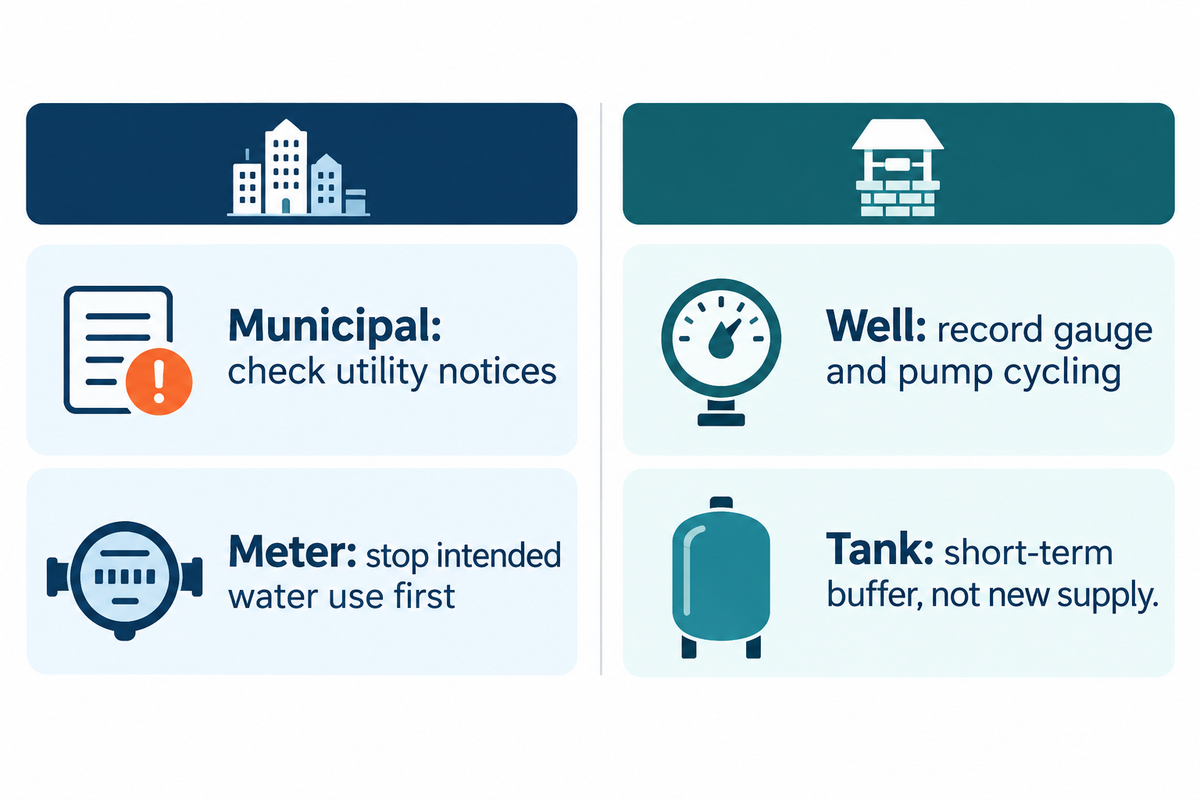
Low pressure throughout the house means to check the common supply before swapping out individual fixtures. A noticeable drop in water pressure at every outlet means checking what brings water into your home. Municipal water supply customers should read notices; private-well owners need to do a system evaluation that differentiates pump performance, stored water and well yield.
When surrounding properties are experiencing low water pressure at the same time, check for work in progress or an active advisory from the water company. The provider can look into pressure from the municipal water main, while a plumber checks the private service and building. Follow the provider’s instructions, including water quality advice, for the duration of the outage.
To check for a leak using an individual household water meter, stop all intended water use and watch for continuing water use. This means turning off fixtures and taking into account automatic appliances or irrigation; don’t close the main supply and assume a still meter rules out water leaks. Continuing water use justifies an investigation.
In a well system, record gauge behavior, pump cycling, recent treatment maintenance and changes in demand. The National Ground Water Association’s Wellowner guidance explains that a pressure tank cannot compensate for sustained demand above the pump’s capacity. Upgraded pressure tanks can help meet a particular short-term demand, but won’t create a new water supply.
A well that supplies sufficient water for the day can still not meet peak demands. When water levels drop toward the pump intake, adding pressure cannot restore the missing supply. Penn State Extension’s low-yield well guidance describes reducing peak demand or adding designed intermediate storage.
A well contractor should assess water level, recovery, pump capacity and controls before proposing well drilling, a pressure tank or switch change, or a larger pump. Well water systems are demand driven and dependent on available supply as well as functioning equipment. Increasing the setting on the pressure switch won’t make a well that takes a long time to recharge faster.
Compare plumbing repairs with a pressure booster
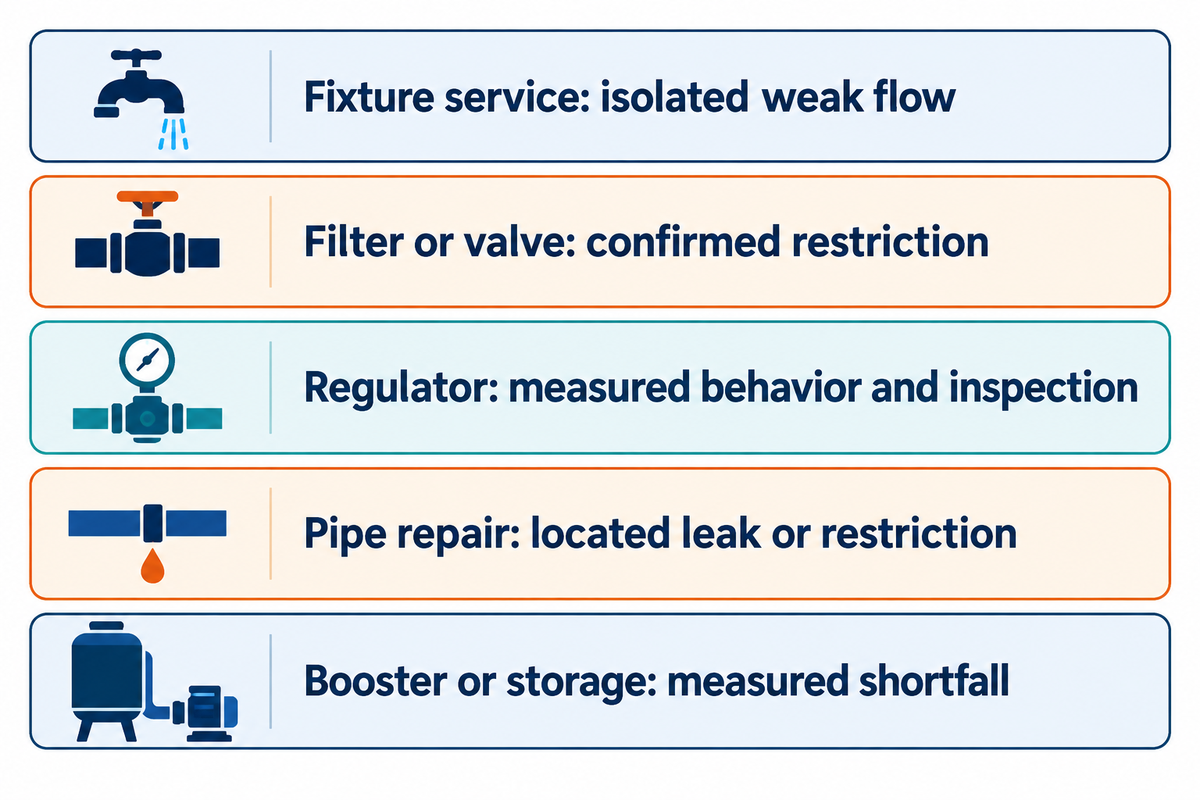
Repair a confirmed restriction or leak before sizing a booster. To diagnose and fix water pressure issues, determine where delivery becomes inadequate. A booster pump becomes a reasonable option when measured available supply pressure is insufficient for the required service and the source can support the demand; it can’t fix the problem of a blocked aerator or a depleted source.
| Remedy | Evidence supporting it | What to verify afterward |
|---|---|---|
| Fixture cleaning or service | Weak flow is isolated to the fixture or its local supply. | Flow at that outlet under the same conditions. |
| Filter or valve service | Inspection identifies a restriction in the common path. | Delivery through the serviced component and leak-free operation. |
| Regulator repair or replacement | Measured upstream/downstream behavior and inspection identify a regulator problem. | Static and running pressure, plus relevant expansion-control requirements. |
| Pipe or leak repair | Inspection locates leakage or a restricted branch. | Leak status and flow during the original demand complaint. |
| Booster or storage-system design | Supply and demand measurements establish a pressure or peak-delivery shortfall. | Required flow and pressure, inlet protection and control behavior. |
Consider a home where an upstairs shower becomes weak whenever another bathroom is used. The homeowner has already cleaned the shower screen, but that didn’t make the upstairs shower stronger. A measurements-based assessment of supply pressure and the branch structure is needed. If a pipe is restricted, a booster may not resolve the issue. A properly sized booster may be the best option if the supply is sound but pressure is inadequate for the required demand. The check is the original two-bathroom condition, not simply a higher reading on the pressure gauge with all the taps closed.
This is also the principle behind the demand audits described in Fred G. Drexler’s booster-system technical article. Its commercial-building savings aren’t household predictions. For equipment options after diagnosis, see our booster pipeline pump guide.
How much does it cost to fix low water pressure in a house?
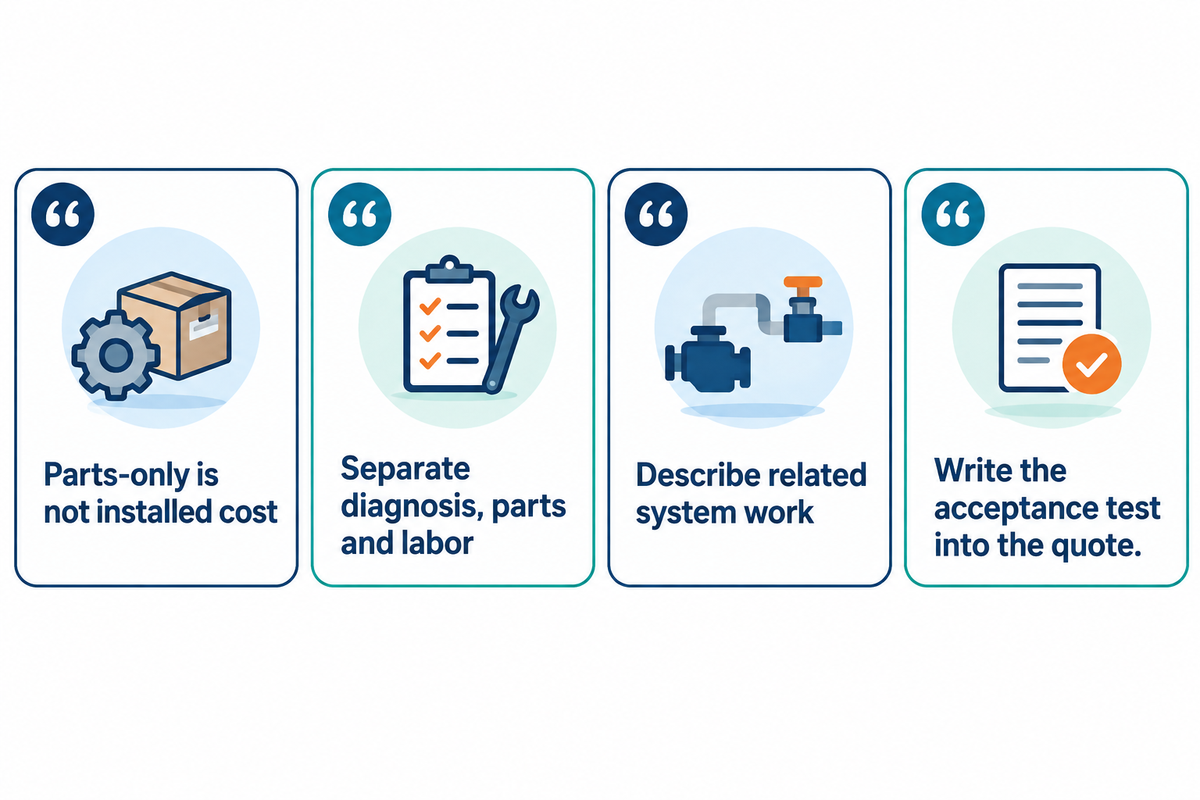
A screen clean may need no new part; two example regulator parts cost $89.99 and $111.99 before installation in the listings checked on October 23, 2026. Home Depot listed those prices for the 3/4-inch Watts LFN45BM1-U and 1-inch LFN45BU1-M1-1 respectively. Both are products from the same retailer, not an installed repair-price range.
The prices are for the parts only and don’t include the plumber diagnosis, labor, fittings or any related system work. Retail availability, location, tax and other promotions can affect the prices. Compare the actual pipe connection and the duty before using either part.
For similar quotes, insist the diagnostic visit, parts and labor be broken out, as well as the final test. A booster quote should also describe additional work related to electrical service, connection arrangements, backflow prevention, storage, thermal expansion and any related work. A lower price for equipment isn’t a saving if it requires a second trip to finish the system.
Keep the acceptance conditions on the quote: restore pressure and proper water flow under the recorded household demand, check for leaks, and document the final settings. This is especially important if the equipment and settings leave the complete system with inconsistent pressure. If inconsistent pressure remains, record when it occurs rather than accepting a single quiet-period reading.
Choose a booster only after the supply checks pass
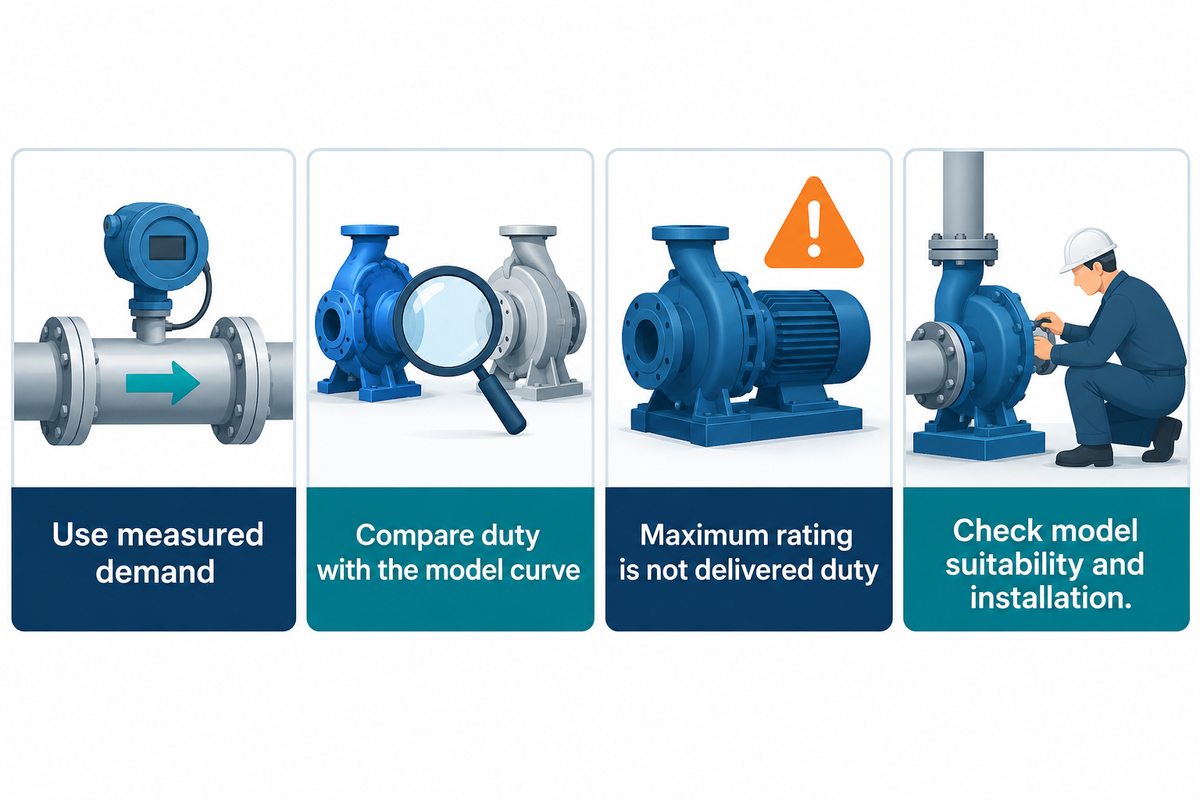
Select a booster from measured demand, not number of bathrooms alone. The required flow and pressure at the relevant outlets, elevation, pipe friction loss and the behavior of the supply are some of the factors the installer considers. A pump’s advertised maximum pressure is not the pressure it will necessarily deliver at the flow your home needs.
Prior to evaluating pumps, write a short handoff indicating your municipal or well supply, test point locations, static and running readings, affected outlets, the simultaneous use pattern, treatment equipment, electrical supply and space for service, so the supplier can assess the whole duty rather than selecting a pump based on an isolated pressure reading. Our pump discharge pressure guide explains the terms.
Keep other symptoms distinct: Water hammer, pressure spikes and reduced water delivery aren’t synonymous complaints. Note the time of occurrence of each. Those observations help the installer assess your home’s water system and prevent pressure problems caused by selecting equipment for the wrong symptom.
Do: Compare the required operating duty with the model’s performance curve. Consider the installation instructions and permitted connection arrangements.
Don’t: Select a pump from its maximum rating, bypass treatment permanently, or set controls to cover an unknown restriction.
Coding varies. For example, the 2024 Ohio Plumbing Code covers deficient supply, booster low-suction protection, and thermal expansion in specified situations. The conditions in the code are an example of a regional situation; the installer has to find the applicable codes and water authority rules where the job is situated.
If boosting is justified, examine the requirements with respect to BBP booster pipeline pumps. With those requirements, discuss the best configuration with an authorized supplier for the model that will best meet the needs, and determine the model’s suitability for potable water service and the requirements for its installation. It’s better to identify the required duty than to request the maximum pump.
Frequently Asked Questions
Can you still flush the toilet with low water pressure?
A gravity-tank toilet can generally flush once its tank has filled; low supply pressure mainly slows the refill.
Check that the tank reaches its marked fill level before judging the flush. If the tank fills normally but the bowl clears poorly, the cause may lie in the toilet or drainage rather than incoming supply. Pressure-assisted toilets and flush-valve systems have their own requirements. Compare the behavior with the manufacturer’s instructions instead of assuming every toilet responds to supply pressure in the same way.
Why is my well pump not building pressure above 30 psi?
A 30 psi ceiling doesn’t identify the failed component. The pump, supply, controls and gauge need to be assessed together.
Record whether the pump keeps running, cycles repeatedly, or stops at that reading, and note which outlets are open. Share recent filter changes and any change in well performance with a well contractor. Don’t keep raising the pressure switch to force a higher reading. The required setting must match the pump, tank and system, and a supply limitation needs a different remedy from a control fault.
What should I do if water pressure is low all of a sudden?
Check whether the change affects one fixture or the whole house, then look for visible leaks and utility notices.
If you find an active leak, use a known, safely accessible household shutoff if appropriate and arrange repair. For a supply-wide change, contact the water company or building manager and follow any advisory. Well owners should note pump behavior and seek service for unusual operation. Avoid adjusting several valves at once, because doing so removes the useful before-and-after pattern and can introduce another fault.
Can a bucket test tell me the water pressure?
No. A timed bucket test measures volume delivered per unit of time, usually gallons per minute. It doesn’t measure pressure in psi. Use a suitable pressure gauge and record the test location and water-use conditions.
Can low water pressure affect appliances?
Yes. Appliances that depend on an incoming water supply may fill slowly or fail to operate as intended when their supply requirements aren’t met.
Compare the appliance’s inlet requirements with measurements taken under its actual operating conditions. A washer that struggles only when another fixture is running presents a different pattern from one that always fills slowly. Its local supply valve, hose or screen may also need inspection, following the appliance instructions. The same reasoning applies to water treatment equipment: a pressure complaint may be a supply problem or a restriction in the equipment’s flow path.
Don’t use a generic house-pressure range as proof that every appliance is receiving sufficient flow. Nor should you increase whole-house pressure solely to overcome one slow appliance. Record the affected cycle, check the permitted maintenance steps, and have a technician distinguish local restrictions from a shared supply shortfall before changing equipment.
References & Sources
- Portland Water Bureau: troubleshooting water pressure and flow
- US EPA WaterSense: home maintenance and service pressure
- City of Santa Barbara: pressure regulators and gauge location
- Penn State Extension: using low-yielding wells
- Wellowner.org: water pressure and pump capacity
- 2024 Ohio Plumbing Code: water supply and distribution
- Fred G. Drexler, Pumps & Systems: upgrading domestic water booster stations
WHY BUYERS WORK WITH BBP
About BBP Manufacturing
BBP Manufacturing Co., Ltd. is a Beijing-based industrial pump manufacturer with in-house foundry, heat treatment, machining, assembly, coating and inspection capabilities. We support industrial projects across slurry handling, sewage treatment, clean water transfer, chemical service, fire protection, irrigation and OEM pump supply.
Our Engineering Support
We help engineering buyers select and source the right pump configuration, not just compare prices. Send us your flow rate, head, medium, solids content, temperature, pH value, material requirement and installation conditions. BBP engineers will recommend a pump series, material option, duty curve basis, lead time and spare-parts plan for your RFQ.
Company Profile // DATA_SHEET
Name
BBP Manufacturing Co., Ltd.
Brand Name
BBP
Country
China
Headquarters
Beijing, P.R. China
Business Type
Industrial Pump Manufacturer
Model
B2B / OEM / ODM / Project Supply
Main Products
Slurry Pumps, Sewage Pumps, Centrifugal Pumps, Split Case Pumps, Multistage Pumps, Chemical Pumps, Fire Pumps, Irrigation Pumps
Manufacturing Capability
Foundry, Heat Treatment, Machining, Assembly, Coating, Inspection
Certifications
ISO 9001 / CE / SGS / BV / TÜV
Export Reach
90+ Countries & Regions
Standard Lead Time
About 25 Days for Standard Configurations
Contact Person
Wesley · International Sales
Phone / WhatsApp
+86 182 1085 0516
Email
contact@bbpmfg.com
Website
https://bbpmfg.com/
Address
Room 2803, Building 11, Phase II, Nuode Center, Fengtai District, Beijing, P.R. China
Trending now