Get in Touch with BBP

Updated November 2026 · Published by BBP Manufacturing Co., Ltd.
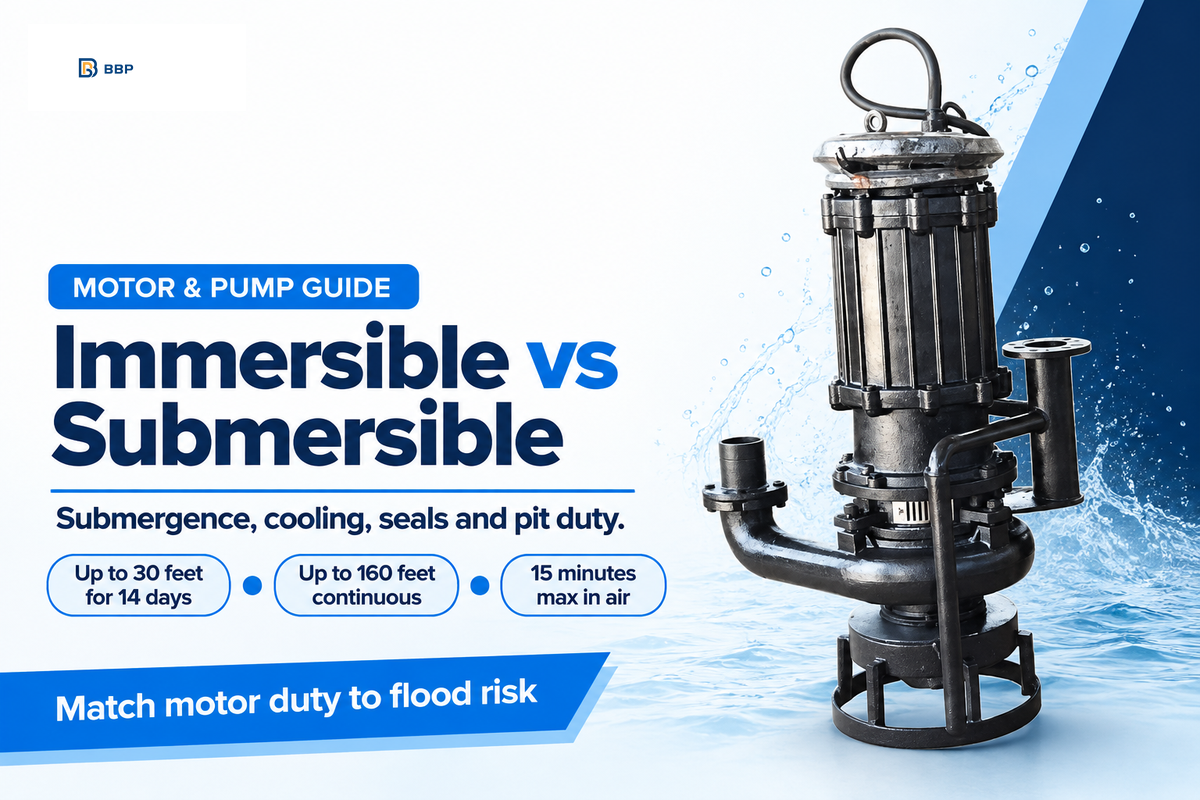
An immersible motor can continuously run in dry air and survives accidental flooding up to 30 feet deep for 14 days. That benchmark is from the ABB NEMA Motors Division guidance in Pumps & Systems. On the other hand, a true submersible motor operates totally submerged down to 160 feet for years. Standard wet-pit submersibles run uncooled in air for only 15 minutes before stator heat trips thermal protection.
Procurement specifications also vary by region when an immersible pump is concerned. In North America, municipal engineers combine a dry-pit centrifugal pump with a flood-rated motor to substitute a 20-foot vertical jack shaft. European chemical plants mount the electric motor permanently above the tank plate and submerge only a sealless column.
Quick Specs
| Normal Operating Medium | Immersible: Continuous S1 duty in dry air · Submersible: Continuous S1 duty in liquid |
| Rated Submergence Envelope | Immersible: Up to 30 feet (9.1 m / 13.0 psi) for 14 days (ABB / Baldor) · Submersible: Up to 160 feet continuous (ABB) |
| Dry-Air Run Limit | Immersible: Unlimited (TENV or 1/2 HP TEBC blower) · Standard Wet-Pit Submersible: 15 minutes max |
| Shaft Sealing Architecture | Immersible: Grease-packed dual lip seals (no oil chamber) · Submersible: Oil-filled chamber + Type 21 or Double SiC mechanical seals |
| Hazardous Location Listing | Immersible: Non-hazardous pits · Submersible: Available with UL Division 1, Class I, Groups C & D |
| Post-Flood Action | Immersible: Mandatory disassembly, seal/bearing service, IP 55 blower replacement (for TEBC units only), 500 V DC Megger check · Dry-Pit Submersible: None |
Immersible Definition: Dictionary Word Meaning vs Industrial Term Usage
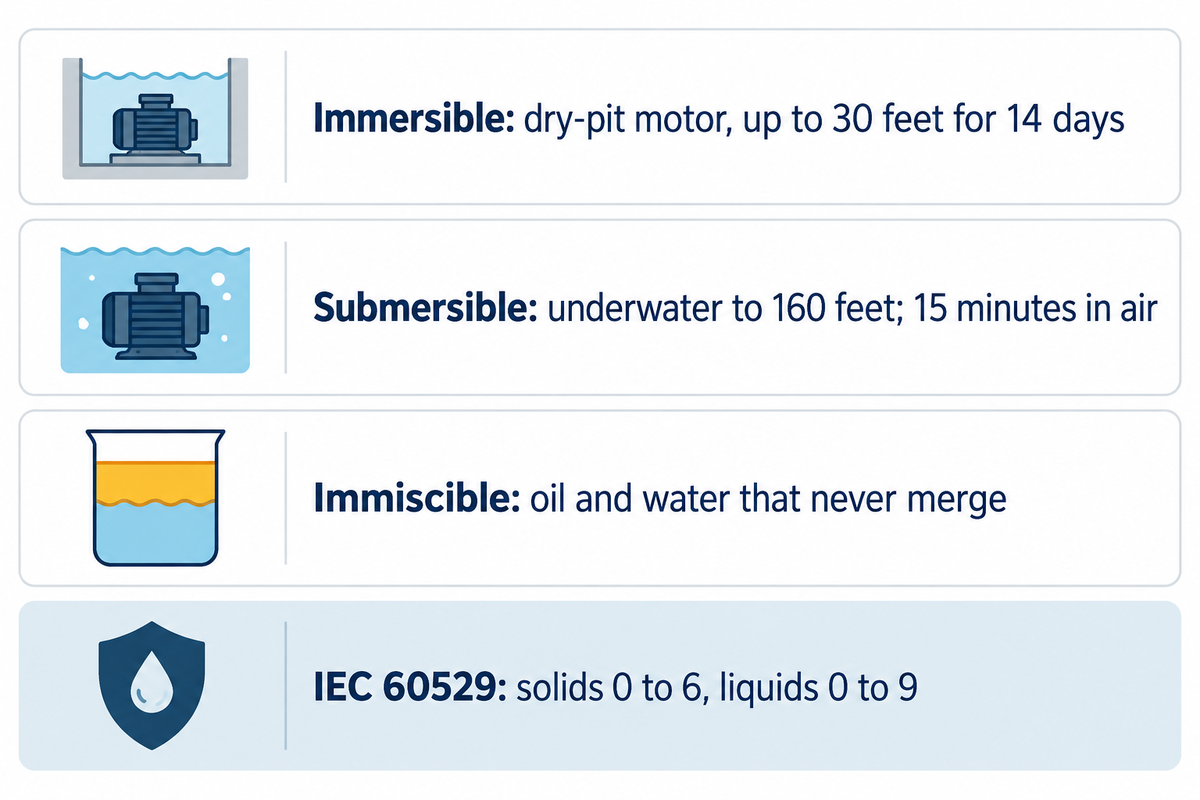
In an English dictionary, the immersible definition simply means capable of being put under water without damage. In industrial rotating equipment, the meaning of immersible is much stricter. A flood-rated motor runs in dry air year-round and survives temporary pit submergence up to 9.1 meters, per ABB and Baldor data.
Consumer product labels can obscure related words and phrases. For example, a kitchen heating element can use the word immersible for a quick wash in a shallow sink. Plant engineers can’t apply that casual usage to a 100 kW pump drive. A motor rated for washdown use will cause stator windings to short in a below-grade sewage vault when the first storm surge occurs.
To standardize enclosure claims, the International Electrotechnical Commission (IEC 60529) grades solid particle protection from 0 to 6. The ensuing numeral classifies liquid ingress from 0 to 9. Spell-checkers also swap immersible with immiscible, a chemistry term for a pair of liquids like oil and water that never merge.
| Term | General Dictionary Sense | Industrial Pump & Motor Boundary | Typical Operating Limit |
|---|---|---|---|
| Immersible | Capable of being placed under liquid without immediate harm | Dry-pit air-cooled motor rated for rare pit flooding, or vertical tank column pump with overhead motor | Up to 30 feet flood head for 14 days max (dry-pit motor, ABB / Baldor) |
| Submersible | Built to function while completely underwater | Hermetically sealed motor-pump unit cooled by surrounding pumped fluid | Up to 160 feet continuous underwater duty; 15 minutes max in dry air (ABB) |
| Immiscible | Incapable of mixing to form a homogeneous liquid phase | Fluid property (such as lubricating oil and water in a seal chamber), never an enclosure grade | Not applicable to motor enclosures; milky oil emulsion signals seal leakage |
What’s the difference between submersible and immersible?
Submersible motors are designed to run continuously while submerged down to 160 feet in wet wells, whereas immersible motors run continuously in dry air and survive only short-term emergency pit flooding. This defines the core operating duty boundary of the differences between submersible and immersible equipment.
That split is driven by cooling and shaft lubrication. Standard wet-pit submersibles transfer stator heat into surrounding water and require pumped liquid to wet their tandem mechanical seals. Immersible motors reject heat into pit air via ribbed frames or external blowers. Their grease-packed lip seals run dry without burning.
Immersible Motor vs Submersible Motor: 10-Point Engineering Comparison
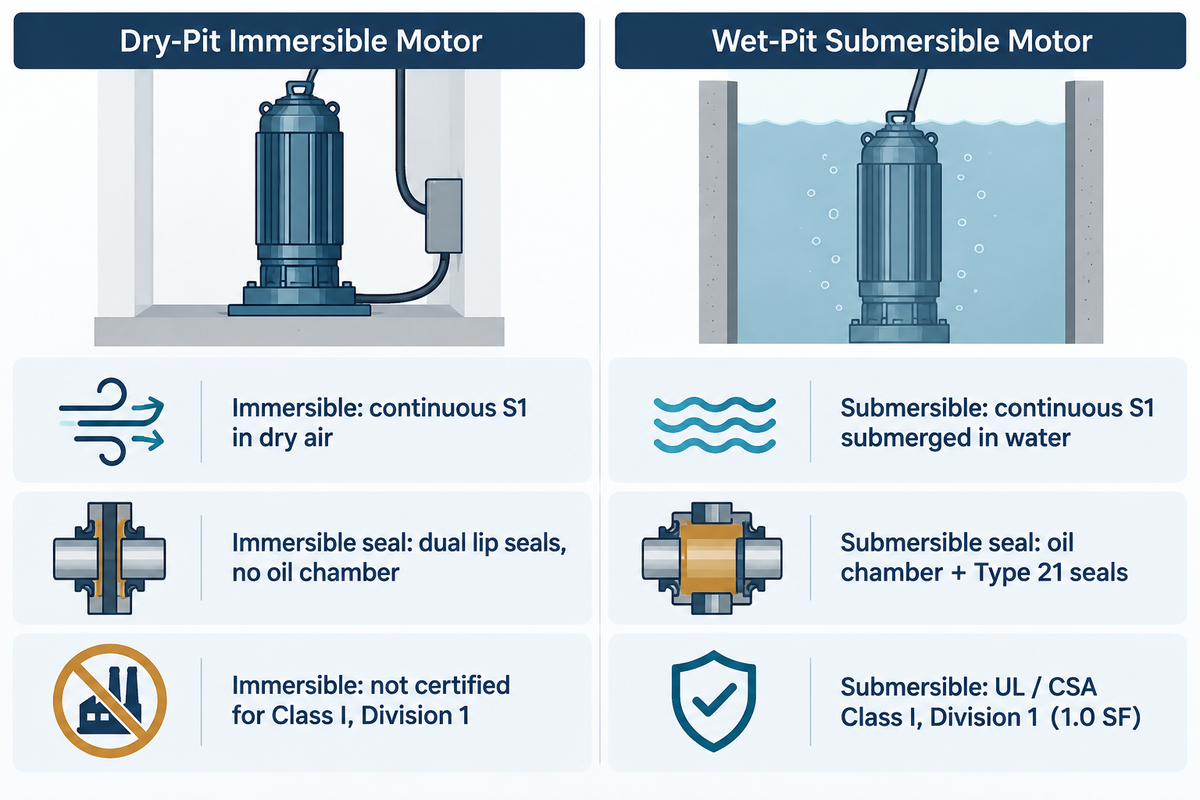
To avoid premature bearing and winding failure, motor construction should match the pit flooding frequency. An immersible motor should be specified when the dry pump room remains dry for regular operations while flooding only during infrequent storms. Switch to a continuous-in-air submersible when flooding is frequent or methane classification applies.
As Baldor specialist Bobby Bowen notes in Pumps & Systems, wet-pit submersibles feature an oil-filled chamber with dual moisture probes and tandem Type 21 mechanical seals. Explosion-proof submersibles carry UL and CSA listings for Class I, Division 1, Groups C and D with a 1.0 Service Factor. For wet-well hydraulics, review submersible sewage pump selection and installation before sizing discharge piping.
Dry-Pit Immersible Motor
- Runs continuously in open pit air with dry-running grease-packed dual lip seals
- Withstands accidental pit flooding up to 9.1 m (13.0 psi) for up to two weeks
- Uses standard C-face or P-base pump flanges for accessible dry-room alignment
- Requires full teardown after every flood plus IP 55 blower replacement on TEBC units
Wet-Pit Submersible Motor
- Runs continuously underwater down to 160 feet in municipal and slurry wet wells
- Limits uncooled dry-air run time to 15 minutes unless oversized or jacketed
- Couples directly to the pump volute so pumped liquid cools the outer seal
- Resumes normal operation after flood recession without extra disassembly
The civil layout as well as maintenance cost estimates are impacted by the 10 engineering parameters shown below. Standard submersible motor seal systems are limited to water or similar liquids at ambient fluid temperatures up to 194 °F (90 °C), per ABB NEMA Motors Division data.
| Engineering Parameter | Immersible Motor (Dry-Pit Flood-Rated) | Submersible Motor (Wet-Pit / Dry-Pit) |
|---|---|---|
| 1. Primary Duty Cycle | Continuous S1 in dry air; emergency submerged duty only | Continuous S1 submerged in water; 15 min max in air (wet-pit design) |
| 2. Maximum Submergence Depth | 30 feet (9.1 m / 13.0 psi freshwater head) | 160 feet (48.8 m / 69.3 psi freshwater head) |
| 3. Submerged Duration Ceiling | Up to 14 days (2 weeks) per flood event | Continuous year-round underwater operation |
| 4. Normal Heat Rejection | TENV frame fins or TEBC 1/2 HP constant-velocity external blower | Convection to surrounding pumped liquid, cooling jacket, or oversized air frame |
| 5. Shaft Seal Chamber | No oil chamber; dual lip seals packed with moisture-resistant grease | Oil-filled chamber with tandem Type 21 mechanical seals in carbon-ceramic, tungsten-carbide, or silicon-carbide (SiC) |
| 6. Dry-Running Seal Capability | Seals run dry indefinitely without pumped-fluid lubrication | Outer tandem seal requires wet lubrication from pumped fluid |
| 7. Moisture & Thermal Sensors | Two normally closed winding thermostats plus anti-condensation space heaters | Dual oil-chamber moisture probes plus winding thermostats |
| 8. Hazardous Area Certification | Not certified for Class I, Division 1 explosive gas zones | UL Listed / CSA Certified Class I, Division 1, Groups C & D (1.0 Service Factor) |
| 9. Mounting Orientation | Coaxial TEBC limited to vertical shaft-down; TENV allows vertical or horizontal | Vertical shaft-down standard; horizontal allowed per moisture-probe orientation |
| 10. Post-Flood Maintenance | Mandatory teardown: service bearings, O-rings, seals, and replace IP 55 blower (TEBC units) | No teardown needed after floodwater recedes on continuous-in-air units |
Submergence Depth and Time Limits: The 2-Week Flood-Head Survival Envelope
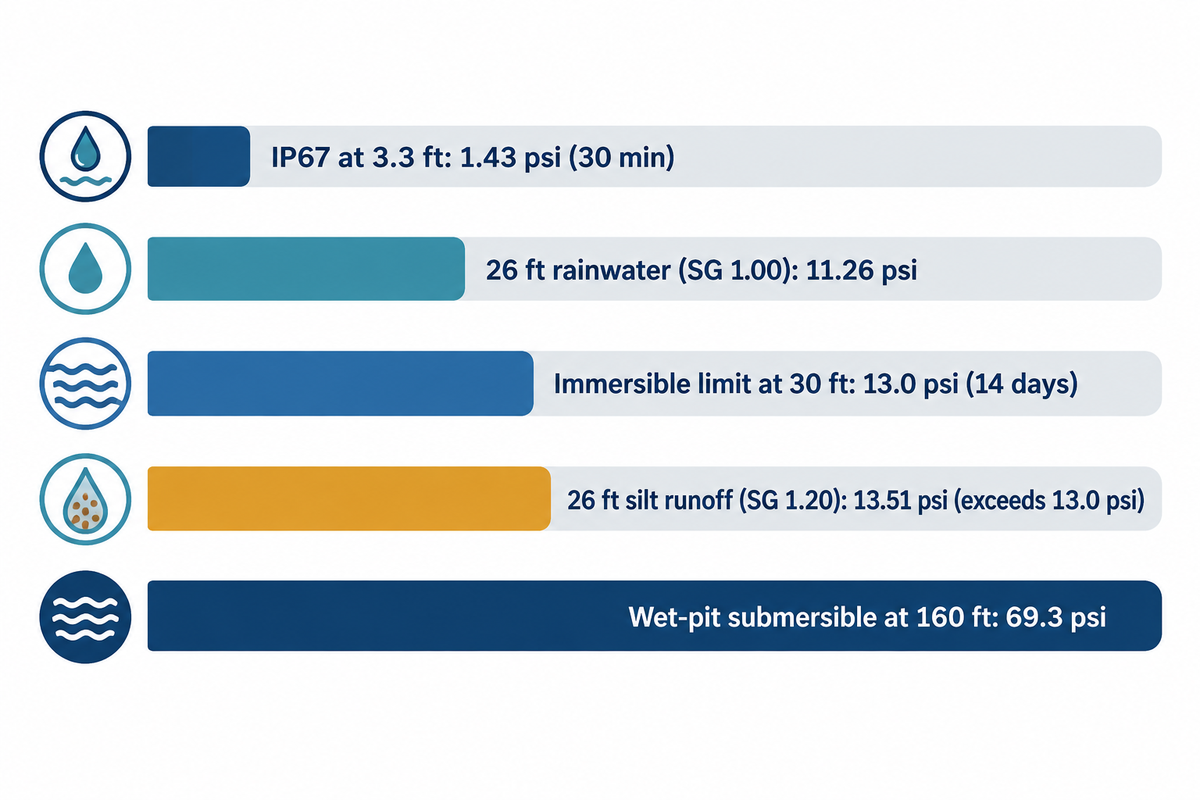
Thirty feet of water depth for two weeks marks the outer flood limit published for North American dry-pit immersible motors. Every foot of freshwater adds 0.433 psi of static seal pressure: IP67 testing at 3.3 ft equals 1.43 psi, while a 15 ft pit flood reaches 6.50 psi. At full 30 ft immersible limit depth, water exerts 13.0 psi (89.6 kPa) pressure loads against shaft lip seals, versus 69.3 psi at 160 ft head for wet-pit submersibles.
That flood ceiling is an OEM engineering limit set by companies like ABB Baldor-Reliance. Neither IEC 60529 nor ANSI/NEMA MG 00001-2024 sets a universal flood-duration clause. Exceeding either depth or duration forces water past grease-packed lip seals, as they lack a pressurized oil counter-balance.
Consider a below-grade storm vault that floods 26 feet above the motor shaft centerline, using a freshwater head factor of 0.433 psi per foot. Case A holds clean rainwater (specific gravity 1.00), while Case B holds silt runoff (specific gravity 1.20). Under clean rainwater, static seal pressure equals 26 × 0.433 = 11.26 psi, staying 1.74 psi inside the 13.0 psi freshwater envelope. Under 1.20 specific-gravity silt runoff, pressure reaches 26 × 0.433 × 1.20 = 13.51 psi. Silt runoff exceeds the rated freshwater pressure ceiling even with 4 feet less depth. Rotating slurry grit also abrades elastomer lip seals faster than clean rainwater.
| Submergence Tier | Water Depth | Freshwater Static Pressure | Rated Duration | Qualified Motor Architecture |
|---|---|---|---|---|
| 1. Hose Washdown Only | 0 ft (surface spray) | 0 psi hydrostatic head | 0 minutes submerged | Standard TEFC / IP 55 washdown motor (mount >20 ft above flood floor) |
| 2. Shallow Enclosure Test (IP67) | 3.3 feet (1.0 m) | 1.43 psi (9.8 kPa) | 30 minutes static | IP67 instrument/junction enclosure; unsuitable for flooded pump operation |
| 3. Moderate Dry-Pit Storm Surge | 15 feet (4.6 m) | 6.50 psi (44.8 kPa) | Up to 14 days | TENV or TEBC immersible motor (with post-flood teardown afterward) |
| 4. Immersible Ceiling Limit | 30 feet (9.1 m) | 13.0 psi (89.6 kPa) | 14 days (336 hours) max | Upper limit for dry-pit immersible motors (ABB / Baldor benchmark) |
| 5. Deep Wet-Well Service | Up to 160 feet (48.8 m) | 69.3 psi (478 kPa) | Continuous (8,760 hr/yr) | True oil-filled submersible motor (or oversized dry-pit submersible) |
What does it mean if something is submersible?
Calling a wet-pit motor or pump submersible means the entire assembly can remain totally submerged in water continuously, down to 160 feet on standard municipal units (per ABB), without leakage. Pressurized dielectric oil in the seal housing balances water head while the liquid cools the stator iron.
Since water transmits heat about 20 times faster than still air, standard wet-pit submersibles contain high horsepower in a small package. The stator will overheat if a non-jacketed wet-pit motor is exposed to open air for more than 15 minutes. Continuous dry-air service requires an external cooling jacket or an oversized derated frame.
Motor Cooling Systems: TENV, Blower-Cooled (TEBC), and Cooling Jackets
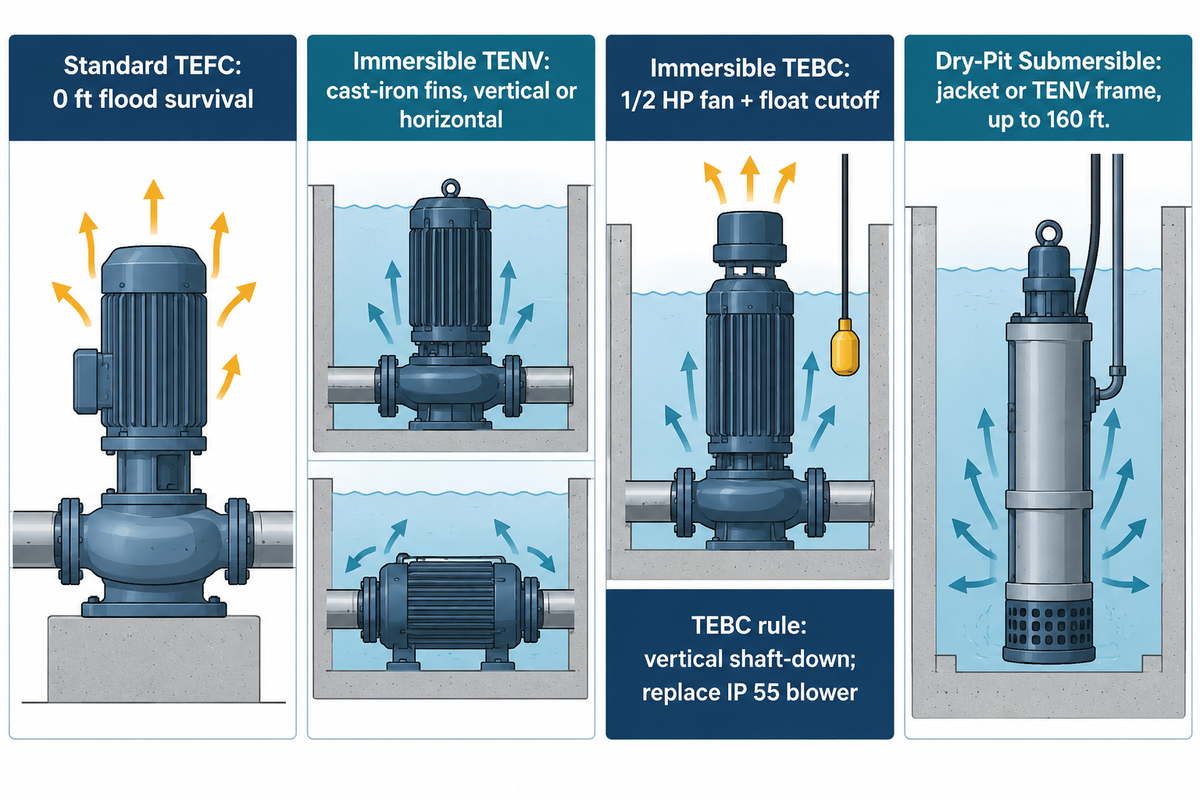
Smaller immersible motors reject heat through totally enclosed, non-ventilated (TENV) cast-iron fins. Larger horsepower frames add a separate 1/2 horsepower external blower (TEBC) that shuts off via a float switch when floodwater reaches the motor. Surrounding floodwater then cools the submerged main stator shell directly.
Coaxial TEBC immersible motors carry a strict mechanical layout constraint: they must mount vertically shaft-down so the top blower clears rising water last. Horizontal dry-pit pump skids must upsize to an oversized frame TENV immersible motor. ABB supplies a washdown-duty IP 55 blower motor as standard on TEBC packages, which requires replacement if submerged.
Variable speed drives (VSDs) impose a second thermal limitation. Because TENV enclosures have no shaft-mounted fan, low-speed turndown relies on frame radiation. TEBC blowers provide constant airflow at low Hertz. Compare drive losses in our VFD pump speed control guide and fractional-kilowatt electronically commutated motor (ECM) breakdown.
⚠️ Common Mistake: Submerged IP 55 Blower Motors
A user supplied float switch cuts power to the 1/2 HP cooling blower before water hits the fan blades, preventing blade snap. Because standard TEBC immersible motors carry an IP 55 washdown blower motor on top, submerging that blower ruins its bearings and insulation. Maintenance crews replace the blower motor before service can be restored to the dry-pit (ABB NEMA Motors Division).
| Selection Criterion | Standard TEFC Motor | Immersible TENV | Immersible TEBC (Blower) | Dry-Pit Submersible (Jacket / Derated) |
|---|---|---|---|---|
| 1. Dry-Air Heat Transfer | Shaft-mounted external fan | Natural convection off cast-iron fins | Separate 1/2 HP constant-velocity fan | Pumped-liquid jacket or oversized TENV frame |
| 2. Flood Survival Rating | 0 ft (fails immediately on submergence) | Up to 30 ft for 14 days | Up to 30 ft for 14 days (blower off) | Up to 160 ft continuous submergence |
| 3. Float-Switch Interlock | Not applicable | Not required (no external fan) | Mandatory to trip blower before submergence | Not required |
| 4. Mounting Position | Vertical or horizontal (>20 ft elevated shaft) | Vertical or horizontal dry-pit | Vertical shaft-down only (coaxial blower) | Vertical or manufacturer-approved horizontal |
| 5. Rag & Grit Fouling Risk | Zero pumped-fluid contact | Zero cooling-passage clogging | Zero internal liquid cooling passages | Open-loop jackets foul on wipes/sludge; oversized TENV avoids jackets |
| 6. VFD Low-Speed Cooling | Airflow drops with shaft RPM | Independent of shaft fan; limited by fin radiation | Full constant airflow across entire VFD speed range | Governed by jacket flow velocity or oversized frame |
| 7. MCC Control Complexity | Single starter or VFD feed | Main feed + space heater + thermostats | Main feed + auxiliary 1/2 HP blower starter + float relay | Main feed + moisture-probe relay + thermal sensor |
| 8. UL Div 1 Methane Rating | Available in explosion-proof frames | Not certified for UL Class I, Division 1 | Not certified (blower & conduit limits) | Available with UL Class I, Division 1, Groups C & D |
| 9. Post-Flood Recovery Work | Rewind or scrap motor | Disassemble motor and renew seals/grease | Disassemble motor plus replace IP 55 blower | Zero extra post-flood teardown |
Sealing, Conduit Boxes, and Cable Entry Against Hydrostatic Ingress
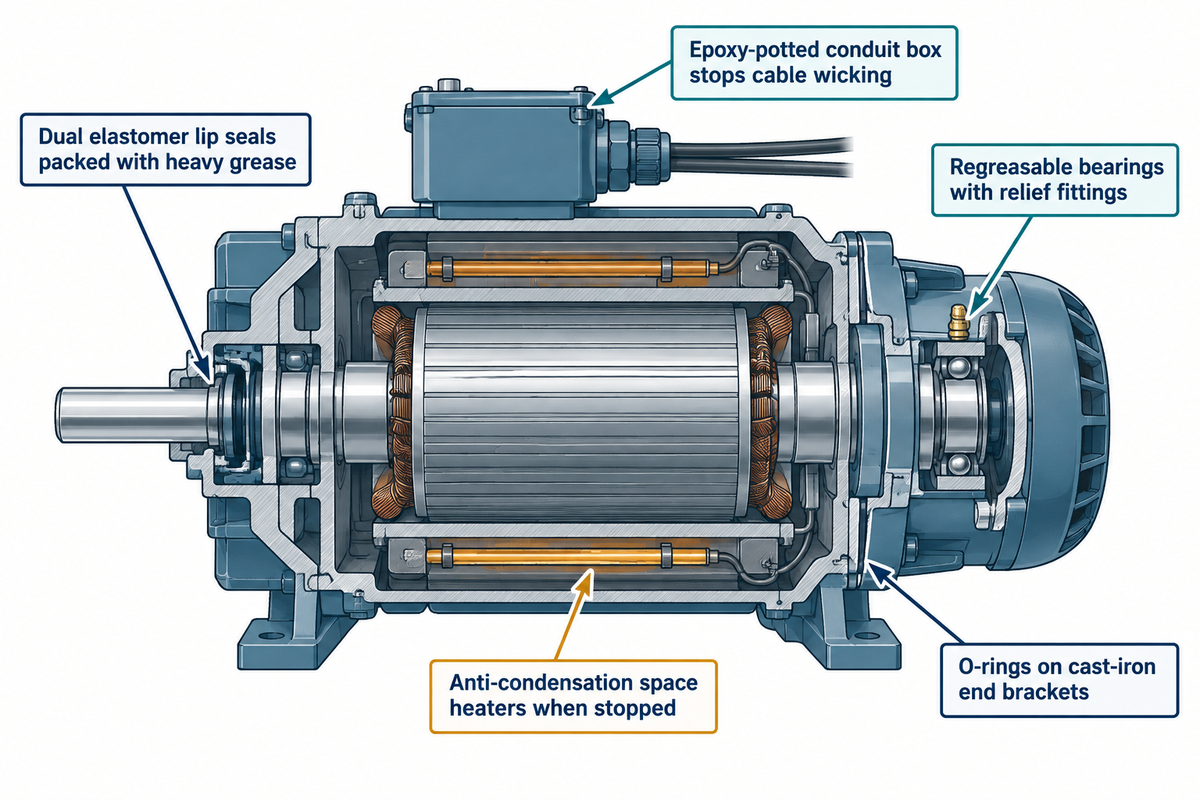
Immersible motors block static floodwater without an oil chamber through grease-packed dual shaft lip seals, O-ring bracket rabbets, and an epoxy-potted conduit box. Power leads potted in resin stop capillary water wicking. Outer cable jackets can nick during pit installation.
An unpotted stranded copper cable underwater acts like a lamp wick drawing kerosene. Under submerged pit head, water travels between copper strands straight into the stator splice cavity. Baldor engineering specifications state that a space heater coupled with an explosion proof style epoxy potted conduit box is used to keep the windings of the motor dry.
Wet-pit submersibles counter 69.3 psi pressures with different hardware. Standard submersible units use 316 stainless steel fasteners, a 416 stainless steel shaft, and 25 to 30 feet of sealed cable. Inside the oil chamber, a Type 21 carbon-ceramic mechanical seal handles clean effluent, while tungsten carbide or silicon carbide resists grit. On dry-pit pumps coupled to immersible motors, a cartridge mechanical seal simplifies shaft maintenance.
-
✔
Drive-end shaft seals: Dual elastomer lip seals packed with heavy grease run dry in air and block silt during floods. -
✔
Potted conduit box: Epoxy compound encapsulates lead-to-stator splices so flooded junction boxes can’t wick water into windings. -
✔
Machined housing rabbets: Elastomer O-rings on cast-iron end brackets seal static frame joints under full rated flood head. -
✔
Anti-condensation space heaters: Energized whenever the motor stops, holding stator surfaces above internal dew point. -
✔
Regreasable bearings: Relief fittings let technicians purge contaminated grease during mandatory post-flood shop service.
Two Industrial Meanings of “Immersible Pump”: Dry-Pit Flood Sets vs Vertical Sump Pumps
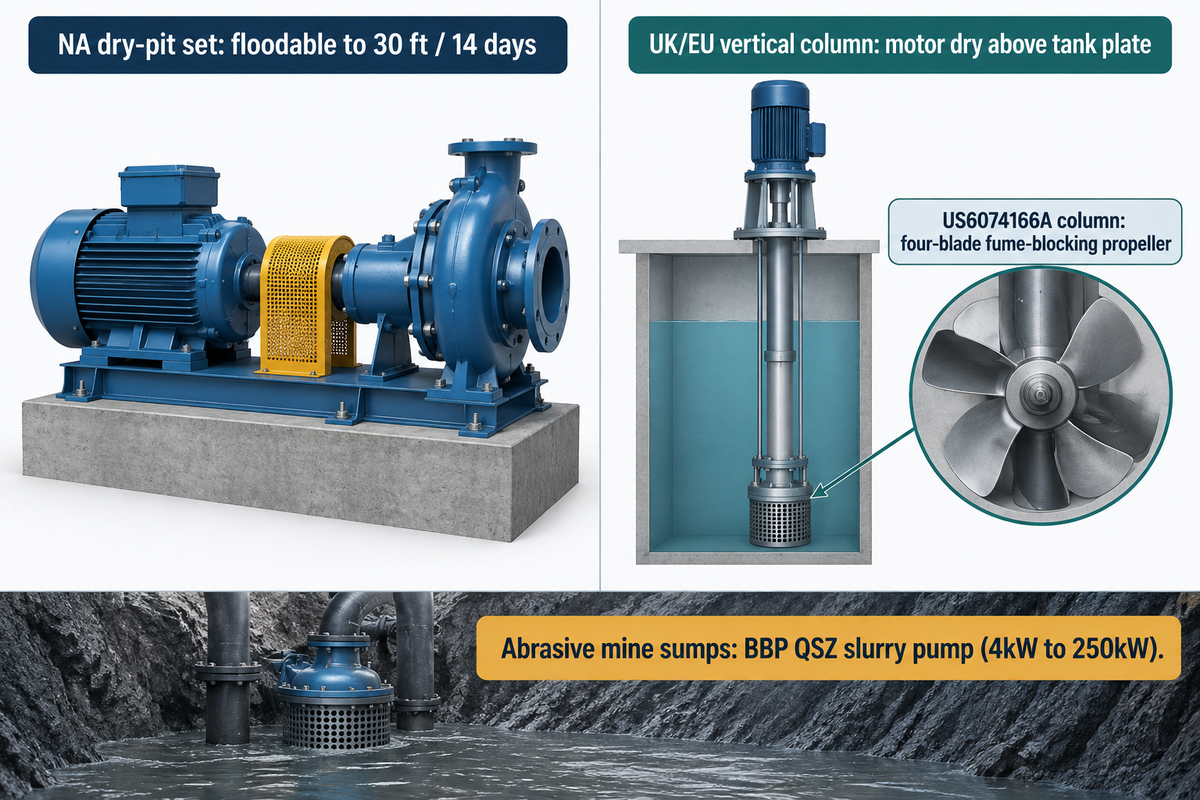
Two types of machines sold as immersible pumps exist in the international marketplace. Dry-pit centrifugal pumps, driven by a flood-rated immersible motor, are commonly found in North American municipal catalogs. Vertical sealless tank column pumps, whose motor is dry above the mounting plate, are found in UK and European chemical catalogs.
Stating the architecture your plant requires on the quote sheet prevents international bid mismatches. Rapid corrosion of gray cast-iron immersible motor frames is seen in low pH chemicals, so motor frames are isolated above the tank deck. Per USPTO Patent US6074166A, sealless plastic acid column pumps mold a 4.80-inch rear-repeller impeller and a 5.160-inch three-vane baffle from CPVC, polypropylene or PVDF. Inside the column, a four-blade propeller blocks acid fumes across 24 discharge positions spaced 15 degrees apart.
Where abrasive mine sumps outgrow plastic columns, BBP supplies heavy-duty submersible slurry pumps covering 19 to 2,400 m³/h flow, up to 80 m head, and 4 to 400 kW (5 to 536 HP) power for particles up to 56 mm. Standard QSZ series models span 4kW to 250kW, pairing a Cr27 impeller with Double SiC mechanical seals. For dry-pad acid transfer, BBP builds horizontal corrosion-resistant acid pumps delivering 6.3 to 1,060 m³/h across pH 0–14. Review our submersible slurry pump engineering guide for high-solids sizing.
| Configuration Type | Motor Location | Wetted Metallurgy | Typical Duty Envelope | Primary Supplier Tier |
|---|---|---|---|---|
| 1. NA Dry-Pit Immersible TENV Set | Dry pit (floodable to 30 ft / 14 days) | Cast iron or 316SS wet end; cast-iron motor | Smaller/medium HP municipal storm & sewage | NEMA motor OEMs + centrifugal pump OEMs |
| 2. NA Dry-Pit Immersible TEBC Set | Vertical dry pit (1/2 HP blower + float cutoff) | Cast iron or high-chrome wet end | High-HP municipal lift stations, 4 in to 30 in discharge | Specialty NEMA motor OEMs + dry-pit pump packagers |
| 3. UK/EU Vertical Cantilever Immersible | Above tank plate (dry air / ATEX optional) | PP, PVC, PVDF, or 316 stainless steel | Corrosive sumps, run-dry safe, short columns (<750 mm) | European thermoplastic vertical pump OEMs |
| 4. Extended-Column Vertical Sump Pump | Above sump deck (line-shaft supported) | PP, PVDF, 316SS, or nickel alloys | Deep chemical tanks up to 6 m immersion depth | Industrial vertical chemical sump pump makers |
| 5. Wet-Pit Submersible Slurry Pump | Submerged IP68 motor with built-in agitator | Cr27 high-chrome impeller (2–3x cast-iron wear life) | 19–2,400 m³/h, up to 80 m head, 4–400 kW (5–536 HP) | BBP QSZ Series & heavy slurry pump OEMs |
| 6. Wet-Pit Submersible Sewage Grinder | Submerged IP68 oil-filled motor | Cast iron with hardened cutter ring | Compact municipal/commercial sewage wet wells | BBP Sewage Grinder Series & wastewater OEMs |
| 7. Dry-Pit Continuous-in-Air Submersible | Dry pit (submersible to 160 ft indefinitely) | Cast iron / 316SS hardware / tandem seals | Frequently flooded or UL Div 1 dry pits | Municipal submersible pump/motor manufacturers |
| 8. Dry-Pit Horizontal Chemical Acid Pump | Dry chemical bund / non-flooded pad | SS316L, Alloy 20, or PTFE-lined (80–150 °C acids) | 6.3–1,060 m³/h, pH 0–14, horizontal dry-pad footprint | BBP QJ Series chemical centrifugal pumps |
| 9. Elevated Motor + 20 ft Jack Shaft | Upper deck >20 ft above dry-pit pump | Cast iron wet end + steel line shafting | Legacy flood stations (high alignment maintenance) | Legacy civil retrofit contractors |
What is the difference between submersible and immersible pumps?
Submersible pumps submerge both the sealed motor and the wet end underwater, while immersibles keep the motor in dry air. Dry-pit immersible sets sit inside flood-rated vaults, while vertical tank immersible pumps mount the motor above the column.
In submersible pumps, the sealed motor and wet end hoist out together on guide rails, while vertical immersible pumps support the wet end on a cantilevered vertical shaft. Vertical chemical immersible pumps are better suited for handling corrosive chemicals because they keep motor windings above acid fumes and tolerate dry running on cantilever shafts.
Dry-Pit vs Wet-Pit Pump Station Application Selection
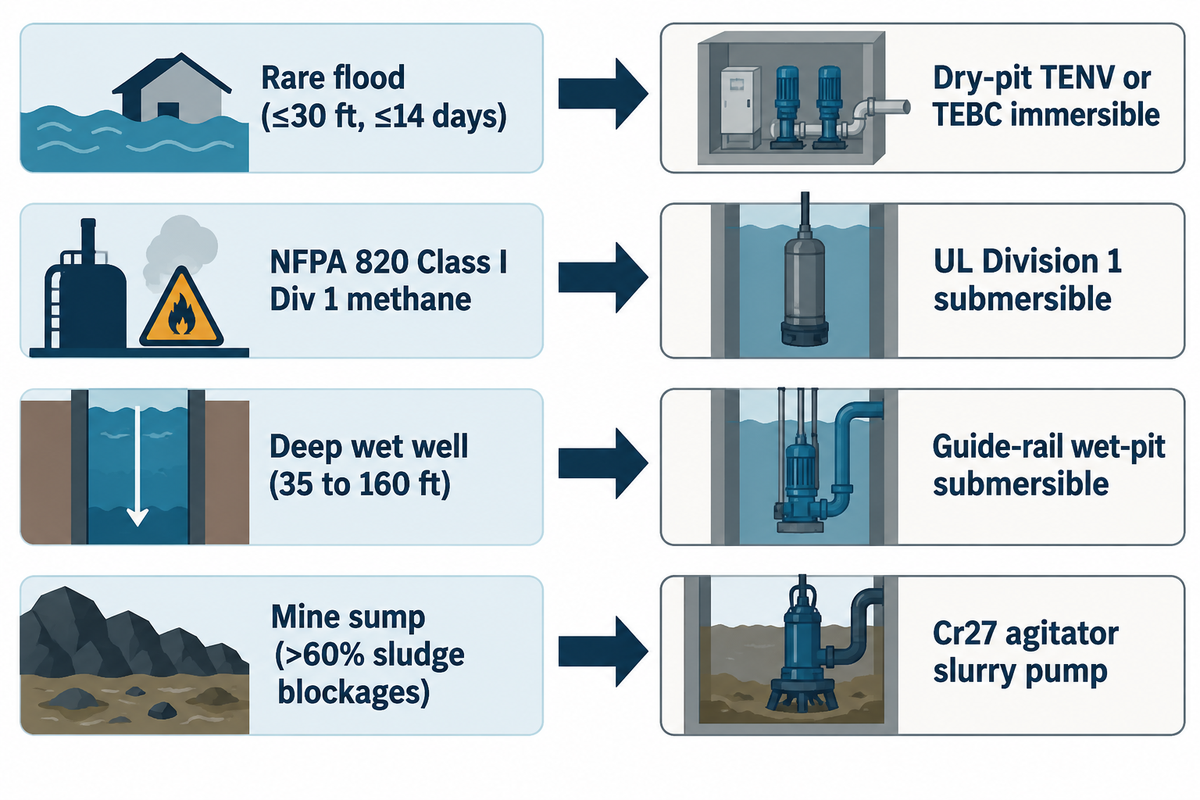
Dry-pit immersible pump packages fit non-hazardous stations operating dry year-round where shallow storm floods clear within two weeks, whereas wet-pit submersibles take over above 30 feet of head or in methane-classified pits.
Municipal station designs in US EPA Publication 832-F-00-069 detail wet-well and dry-well layouts. In contrast, US Department of Energy Pump Systems resources indicate lifetime energy and maintenance costs outweigh the initial purchase cost of a system. On mine slurry sump installations, more than 60% of pump emergencies stem from sludge blockages, so agitator-equipped wet-pit slurry units are preferred.
Consider a municipal engineer designing a duplex sewage lift station inside a 22-foot below-grade dry vault. NFPA 820 classifies that vault as Class I, Division 1, Group D for methane, and storm flood drawdown takes 5 days. Both pit depth (22 feet) and 5-day drawdown sit inside the standard immersible flood window. Even so, immersible motors are excluded because ABB Baldor-Reliance immersible motor catalogs don’t offer UL Class I, Division 1 explosion-proof listings. Selecting a UL Division 1 continuous-in-air submersible motor satisfies both dry-room access and methane containment.
In non-hazardous dry vaults, BBP QI(H) ISO 2858 end-suction centrifugal pumps span 3.6 to 1,500 m³/h flow, 5 to 147 m head, and 0.37 to 315 kW power with ISO 9906:2012 Grade 1U/2B hydraulic acceptance testing and an approximate 25-day standard factory lead time. Pairing those dry-pit wet ends with lead-lag pump control balances seal wear, while compact wet wells use IP68 sewage grinder pumps.
| Plant / Station Scenario | Recommended Architecture | Governing Engineering Threshold |
|---|---|---|
| 1. Dry vault, rare storm flood (≤30 ft, ≤14 days), vertical pump | Dry-pit TENV or TEBC immersible motor + centrifugal pump | Clean dry-floor valve/pump access without 20 ft jack shafts |
| 2. Horizontal end-suction skid in flood-prone non-hazardous basement | Oversized-frame TENV immersible motor (not coaxial TEBC) | Coaxial TEBC blowers require vertical shaft-down mounting |
| 3. Dry pit with monthly/frequent flooding or >14-day drawdown | Continuous-in-air dry-pit submersible motor | Eliminates mandatory post-flood motor teardown after each storm |
| 4. NFPA 820 Class I Division 1 methane-classified dry well | UL Division 1 continuous-in-air submersible motor | Immersible motors lack UL Class I, Division 1, Groups C & D listing |
| 5. Compact deep municipal lift station (35 to 160 ft wet well) | Guide-rail wet-pit submersible sewage pump | Exceeds 30 ft immersible seal limit; saves dry-vault excavation |
| 6. Unscreened rag-heavy sewage in dry pit | TEBC immersible (non-hazardous) or oversized air-frame submersible | Avoids narrow open-loop cooling jackets that clog with wipes |
| 7. High-solids mine/dredge sump with settled tailing sludge | BBP submersible slurry pump (4–400 kW; QSZ models 4–250 kW, Cr27 agitator) | Built-in agitator prevents settled sludge blockages in deep sumps |
| 8. Open pickling or scrubber acid sump (<750 mm to 6 m tank) | Vertical sealless PP/PVDF chemical immersible column pump | Keeps motor above acid liquid and tolerates dry running |
| 9. High-flow hot acid transfer (80–150 °C, >5,000 hr/yr, dry pad) | BBP QJ PTFE-lined or Alloy 20 horizontal acid pump (6.3–1,060 m³/h) | Fluoropolymer/nickel alloy resists hot reducing acids above 80 °C |
How do end users choose, and what are each type’s ideal applications?
Choose dry-pit immersible motors for clean-access municipal stormwater stations where flooding is a rare emergency within the rated flood-head ceiling. Select vertical plastic immersible column pumps for acid tanks and pick wet-pit submersibles for deep sewage lift wells and mine sumps.
Check three site boundaries before locking the bid sheet: NFPA 820 gas classification, expected flood frequency per decade and fluid temperature. Hot acid transfer lines between 80 °C and 150 °C belong on dry-pad fluoropolymer centrifugal pumps rather than cast-iron motor housings.
Ingress and Safety Standards: IEC 60034-5 (IP67/IP68), NEMA MG 1, and Hazardous Areas
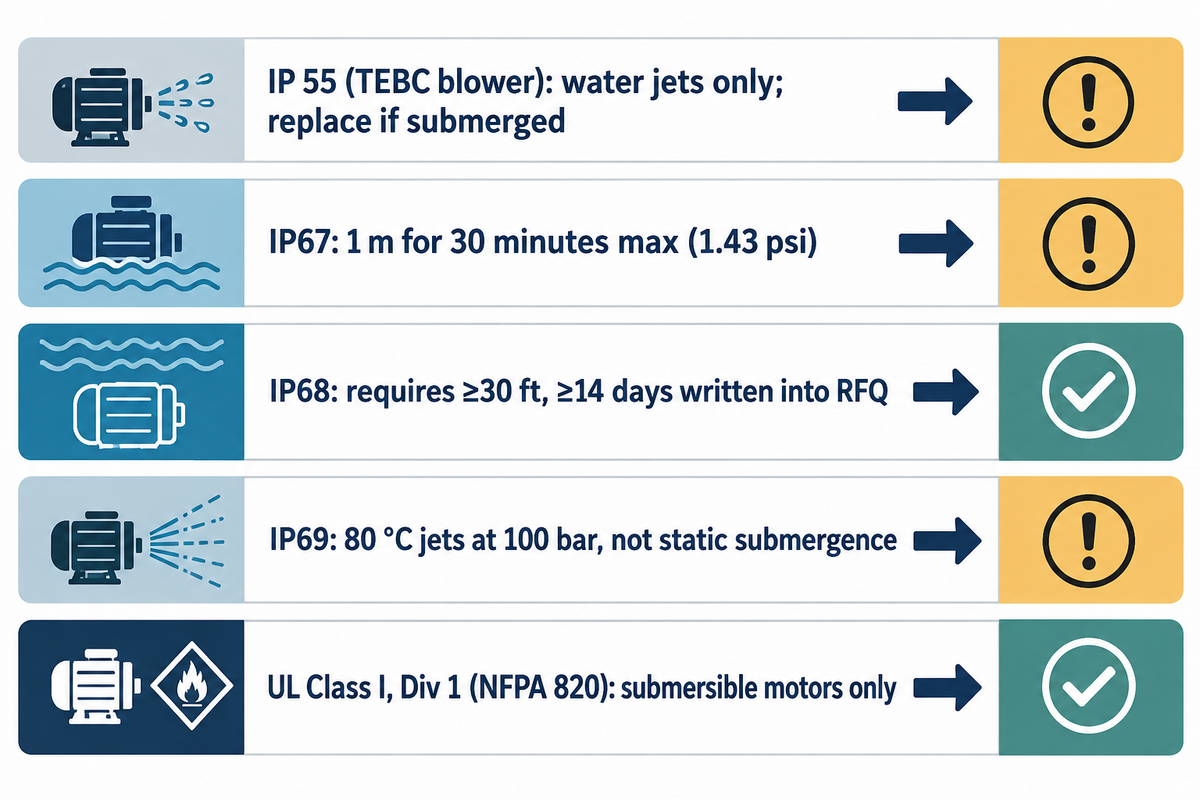
Stamping bare IP68 on a motor purchase order leaves flood depth and duration undefined unless buyer and manufacturer write test numbers into the contract. Under IEC 60529 and IEC 60034-5, only IP67 sets a fixed immersion test of 1 meter for 30 minutes.
Per the IEC technical explainer on IP water testing, an IP rating reflects fresh-water resistance at the time of testing. Elastomer seals can still be broken down by salty, hot, or chemically reactive fluids. Higher second digits do not nest lower tests either: IP69 tests 80 °C water jets at 100 bar pressure, not deep static submergence.
North American specifications also updated their core numbering. In 2024, NEMA renumbered NEMA MG 1 into ANSI/NEMA MG 00001-2024 for rotating electric motor systems. Engineers often compare IP68 with NEMA 6P, yet NEMA standards add corrosion, gasket aging, and icing checks absent from IEC 60529. Hazardous sewage pits still require UL Class I, Division 1, Groups C and D motors under NFPA 70 and NFPA 820.
| Standard / Rating | Defined Liquid / Hazard Scope | Covers 30 ft / 14-Day Flood Motor Duty? |
|---|---|---|
| IEC 60529 / IEC 60034-5 IP 55 | Dust-protected + low-pressure water jets (standard TEBC blower rating) | No; fails if submerged and requires post-flood replacement |
| IEC 60529 / IEC 60034-5 IP67 | Dust-tight (6) + static immersion up to 1 m for 30 minutes max | No; 1.43 psi / 30-min ceiling is far below 13.0 psi pit floods |
| IEC 60529 / IEC 60034-5 IP68 | Dust-tight (6) + continuous immersion beyond 1 m at manufacturer-defined limits | Only when RFQ explicitly specifies ≥30 ft depth, ≥14 days, and rotating shaft test |
| IEC 60529 / DIN 40050-9 IP69 / IP69K | 80 °C high-pressure water jets at 100 bar from multiple angles | No; jet-wash rating does not certify prolonged static submergence |
| NEMA 6P (ANSI/NEMA 250) | Prolonged submersion at limited depth plus corrosion/icing checks (electrical enclosures) | Applies to static junction/control enclosures, not rotating shaft seals |
| UL Class I, Div 1, Groups C & D (NFPA 820) | Explosive methane/sewage gas containment (1.0 Service Factor, T2A code) | Available on submersible motors; not certified on standard immersible motors |
Post-Flood Maintenance and Recommissioning Protocol
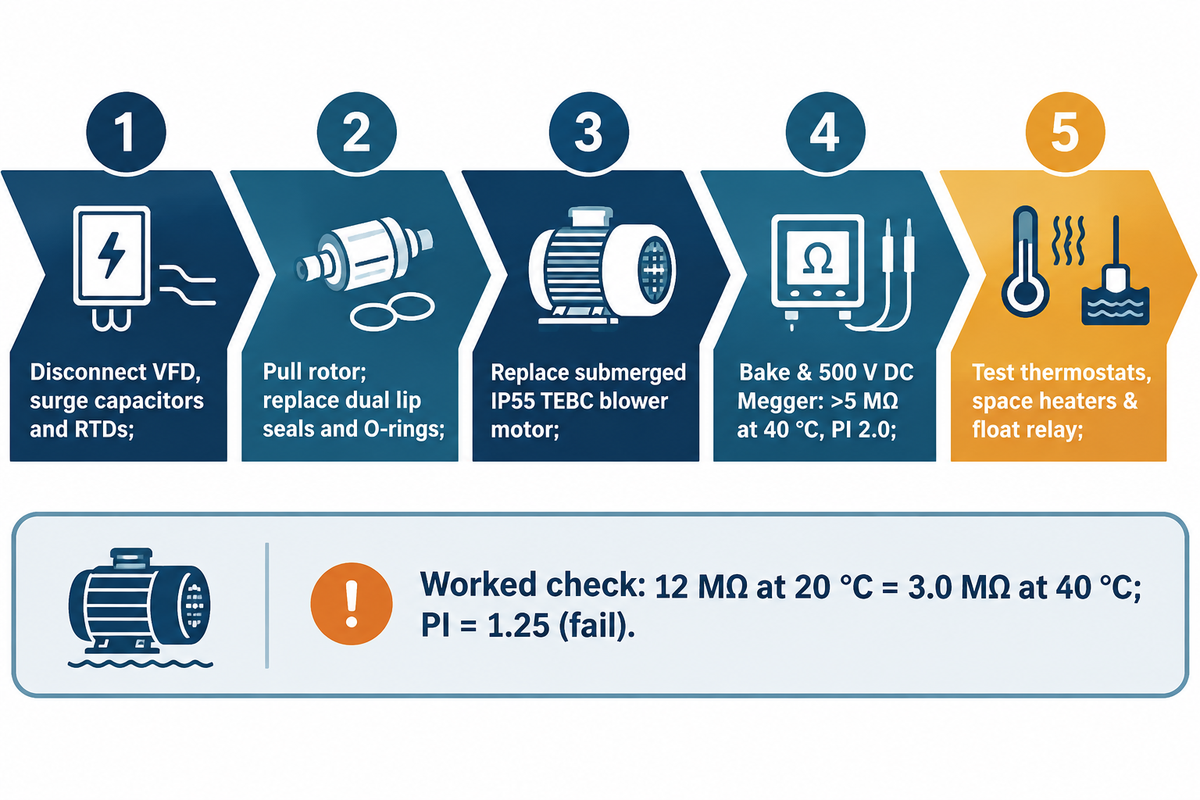
Every flooded immersible motor must undergo complete shop disassembly, seal and bearing service, and 500 V DC winding insulation resistance verification before returning to dry-pit duty. A quick Megger check at the MCC doesn’t waive this service.
“Every time the motor (TEBC or TENV) is operated in a flooded environment, it must be disassembled and maintenance performed per the manufacturer’s recommendations.”
Bob Perdue, Product Manager, Specialty Products, ABB NEMA Motors Division (Pumps & Systems, 2022)
Electrical verification follows IEEE Std 43 guidance alongside ANSI/EASA AR100-2025 Section 4. IEEE inactivated the 2013 edition of IEEE 43 in 2024 pending revision, so test specs should cite the 2013 values explicitly. Apply 500 V DC on windings below 1,000 V and verify at least 5 MΩ corrected to 40 °C. Confirm a Polarization Index (10-minute divided by 1-minute reading) of at least 2.0 for Class B, F, or H insulation.
Suppose technicians isolate a flooded 460 V random-wound immersible stator from its VFD at 20 °C winding temperature. Testing at 500 V DC yields 12 MΩ at 1 minute and 15 MΩ at 10 minutes, corrected using two 10 °C halving steps to 40 °C. Temperature correction drops the 1-minute value to 12 × 0.5 × 0.5 = 3.0 MΩ, falling below the 5 MΩ minimum. Polarization Index equals 15 ÷ 12 = 1.25, also failing the 2.0 minimum. Technicians must bake out the stator, overhaul seals and bearings, and retest before energizing.
5-Step Post-Flood Recommissioning Sequence
- Lock out and isolate electronics: Disconnect VFD, surge capacitors and RTDs so 500 V DC Megger voltage doesn’t damage drive semiconductors.
- Disassemble mechanical barriers: Pull the rotor, replace sacrificial dual shaft lip seals and bracket O-rings, and check bearings for silt emulsion.
- Replace the TEBC blower: Swap out any submerged standard IP55 washdown blower motor for a new unit before recommissioning.
- Clean, bake, and Megger windings: Dry the stator per ANSI/EASA AR100-2025 until 40 °C resistance exceeds 5 MΩ and PI reaches 2.0, then ground leads.
- Test auxiliary protection: Check dual winding thermostats, anti-condensation space heaters, and the pit float-switch blower cutoff relay before restart.
Cost Drivers, Lead Times, and Immersible Motor & Pump RFQ Checklist
Immersible motors are custom, non-stock, engineered to order machines. The factory quotes prices rather than using fixed catalog multipliers over standard TEFC frames. Project schedules must take into account custom motor engineering and factory build lead times, rather than assuming one week off the shelf from a distributor for a pump station retrofit.
One defining feature of custom immersible builds is their five-part sealing and cooling package. Potted conduit boxes and dry-running dual lip seals add machining hours, as do O-ring frame rabbets and 1/2 HP TEBC blowers. Space heaters also eat up machining time. Replacing a failed heavy pump seal assembly, if spares are on hand, takes 4 to 8 hours of technician time. For continuous acid duty above 5,000 hours per year, PTFE-lined or Alloy 20 casings beat 316L stainless steel (suited under 2,000 hours).
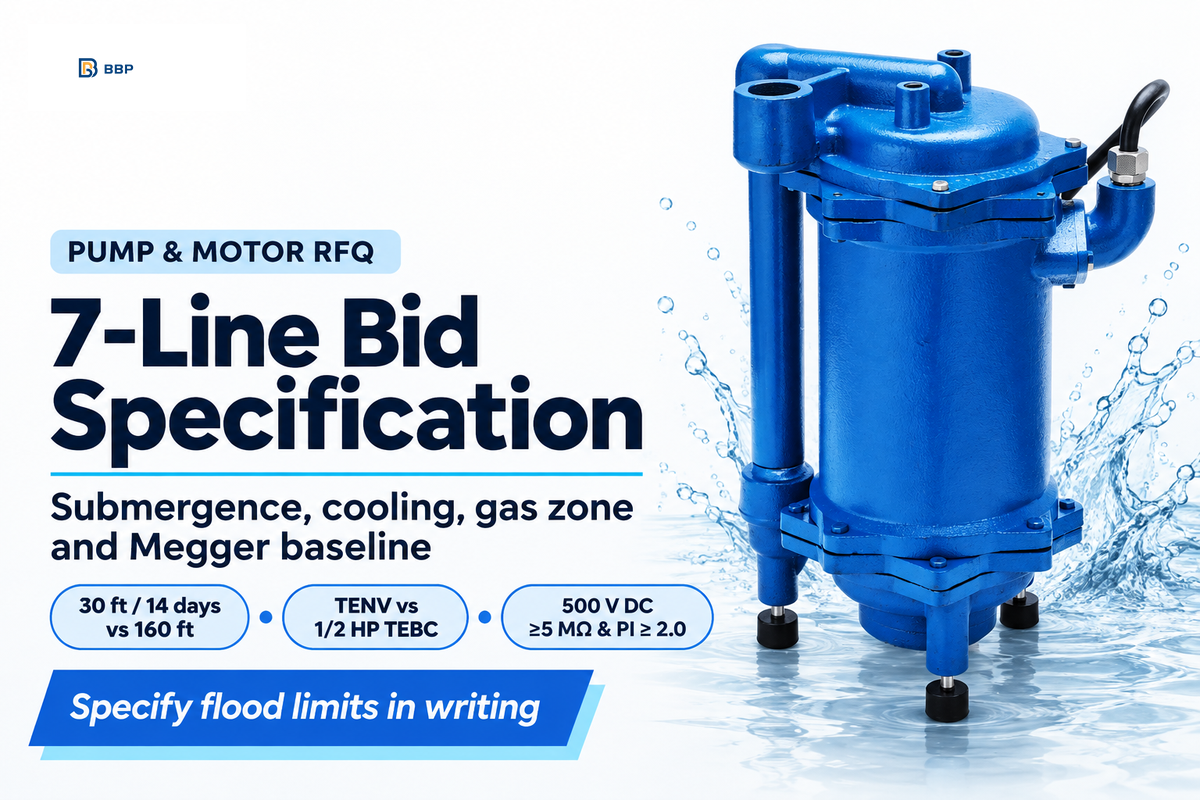
Copy the 7-row specification table below and include it in your bid package for motor and pump suppliers to quote to the same submergence, cooling, and testing requirements.
RFQ checklist — copy these into your quote request:
| Parameter | Recommended range | Why it matters | How to verify |
|---|---|---|---|
| Architecture definition | Dry-pit flood-rated motor set OR vertical above-plate column pump | Eliminates NA vs UK/EU immersible pump quote mismatches | Cross-sectional general arrangement drawing |
| Submergence head & duration | Up to 30 ft (13.0 psi) for 14 days (immersible) or 160 ft continuous (submersible) | Bare IP68 leaves depth and time undefined under IEC 60529 | Written OEM submergence test certificate |
| Cooling & mounting orientation | TENV (vertical/horizontal) or coaxial TEBC (vertical shaft-down + 1/2 HP blower) | Coaxial TEBC blowers cannot operate horizontally or submerged | Motor outline drawing & float-switch wiring schematic |
| Hazardous gas classification | Non-hazardous OR UL Class I, Division 1, Groups C & D (1.0 SF) | Standard immersible motors are excluded from NFPA 820 Div 1 pits | UL / CSA nameplate listing file number |
| Fluid chemistry & solids | Cr27 + Double SiC for slurry; PP/PVDF (<80 °C) or PTFE/Alloy 20 (80–150 °C) for acid | Cast-iron housings corrode in acid; carbon-ceramic seals wear in grit | Wetted-parts material test report (MTR) |
| Cable & stator protection | Epoxy-potted conduit box, space heaters, dual NC thermostats | Stops capillary water wicking down power leads at 13.0 psi | Potting detail & auxiliary terminal diagram |
| Baseline winding test | ≥5 MΩ corrected to 40 °C at 500 V DC (<1 kV) and PI ≥ 2.0 | Sets factory reference trend for post-flood IEEE 43 checks | Signed factory routine & insulation test report |
Need help matching a wet-pit slurry unit, sewage grinder, chemical acid pump, or ISO 2858 dry-pit centrifugal wet end to your station conditions? You can request a pump and motor package quote from BBP with your duty point, sump depth, and fluid chemistry.
Frequently Asked Questions
Q: What is an immersible motor?
An immersible motor is a specialty dry-pit electric motor engineered for continuous dry-air operation while surviving emergency pit flooding up to 30 feet deep for 14 days.
Manufacturers build the enclosure without an oil chamber, using grease-packed dual shaft lip seals, O-ring bracket joints, anti-condensation space heaters, dual winding thermostats, and an epoxy-potted non-wicking conduit box.
Q: How does an immersible pump work?
An immersible pump operates either as a flood-tolerant dry-pit centrifugal unit or as a vertical sealless tank column pump with an overhead dry motor.
On North American TEBC dry-pit sets, a pit float switch disconnects the 1/2 HP top cooling blower during floods, so that surrounding water cools the main stator shell directly.
Q: What does “immiscible” mean compared with immersible?
Immiscible describes two liquids like mineral seal oil and water that never dissolve into one phase, whereas immersible describes machinery built to survive temporary liquid submergence.
Pump mechanics encounter immiscible liquids while draining a submersible motor oil chamber, where leaked water shears into a milky oil emulsion, which indicates outer mechanical seal wear.
Q: Should “immersible” be capitalized in technical specifications?
No. Write immersible in lowercase for running text because it is a generic technical adjective.
Capitalize the word only in section headings, specification table titles, or official manufacturer product line names on procurement schedules.
Q: Can an immersible TENV motor run on a variable frequency drive (VFD)?
Yes, inverter-duty TENV and TEBC immersible motors run on variable frequency drives when sized for low-speed stator heat dissipation and shaft bearing current protection.
Because TENV frames cool by natural fin convection without a shaft fan, continuous constant-torque VFD operation at reduced speed is limited by frame surface heat dissipation. Larger TEBC units hold full cooling airflow at low Hertz via their separate 1/2 HP constant-velocity blower until a flood float switch trips it offline.
Q: Does an IEEE 841 severe-duty motor count as immersible?
IEEE 841 motors are severe-duty TEFC machines built for surface washdown, not static flood submergence.
Submerging an IEEE 841 motor forces water past its labyrinth shaft seals and unpotted terminal box, requiring immediate stator rewind.
Q: Can a wet-pit submersible motor run dry in open air without a cooling jacket?
Standard wet-pit submersible motors can run in open air for up to 15 minutes during sump pump-down, while continuous dry-air operation requires a cooling jacket or oversized derated frame.
Even on continuous-in-air dry-pit submersibles, pumped liquid must still fill the pump volute to wet the seals. Running the pump casing completely dry overheats the seals within minutes and compromises the primary fluid barrier.
References & Sources
- Pump Motors for Industrial & Municipal Water & Wastewater Operations (Bob Perdue, 2022) ABB NEMA Motors Division / Pumps & Systems
- The Differences Between Submersible & Immersible Motors (Bobby Bowen) Baldor Electric Company / Pumps & Systems
- Ingress Protection (IP) Ratings Overview (IEC 60529) International Electrotechnical Commission (IEC)
- IP Ratings Explained: Testing Boundaries Under IEC 60529 (2026) International Electrotechnical Commission (IEC Today)
- Wastewater Technology Fact Sheet: In-Plant Pump Stations (EPA 832-F-00-069) U.S. Environmental Protection Agency (EPA)
- Industrial Pump Systems & Life Cycle Cost Assessment Resources U.S. Department of Energy (DOE)
- Electric Motor Systems Efficiency & Management U.S. Department of Energy (DOE)
- ANSI/NEMA MG 00001-2024 Motors and Generators Standards Designation National Electrical Manufacturers Association (NEMA)
- IEEE Std 43 Recommended Practice for Testing Insulation Resistance of Electric Machinery IEEE Standards Association
- IEEE 43 Insulation Resistance Testing & ANSI/EASA AR100-2025 Electrical Apparatus Service Association (EASA)
- USPTO Patent US6074166A: Vertical Acid Column Pump With Anti-Vortex Baffle & Fume Propeller U.S. Patent and Trademark Office (via Google Patents)
About This Engineering Comparison
This technical guide separates North American dry-pit immersible motor flood ratings from European vertical chemical column pumps and wet-pit submersibles. Benchmarks to standards are taken from IEC 60529, ANSI/NEMA MG 00001-2024 and IEEE Std 43 in conjunction with factory hydraulic specs for QSZ slurry, QJ acid and QI(H) centrifugal pumps. Published by BBP Manufacturing Co., Ltd.