Get in Touch with BBP

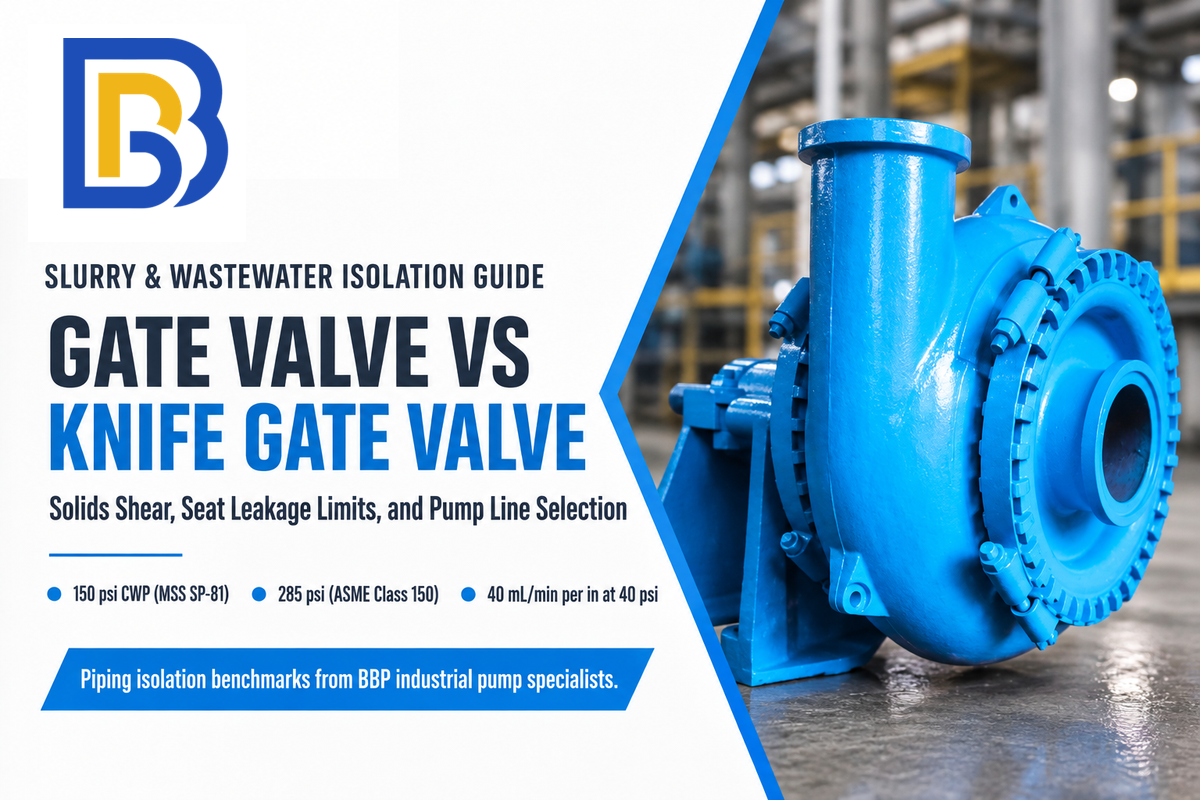
Comparing a gate valve vs knife gate valve comes down to solid particle clearance, seat leakage limits, and line pressure. An ASME Class 150 WCB cast-steel gate valve holds 285 psi at 100°F under ASME B16.34 for clean fluids. A standard bonnetless MSS SP-81-2021 stainless knife gate valve is rated to 150 psi CWP (10.3 bar) on 2–24 in sizes (100 psi on 30–36 in) without shock loadings. Its thin beveled blade slices through slurry, pulp stock, and fibrous sewage.
Plant teams often replace a conventional flanged gate valve with a knife gate valve, thinking it is a more economic alternative. However, this becomes a seat blow-by issue and leads to failures of the gland. In the factory water tests, metal-seated MSS SP-81 knife gates allow 40 mL/min per inch of diameter at a test pressure of 40 psi. Metal-seated API 598 gate valves face a strict drops-per-minute ceiling at 1.1× the rated pressure. Picking the right isolation valve starts with matching body geometry and seal design to the fluid entering your pump train.
Gate Valve vs Knife Gate Valve: Core Design Differences and Side-by-Side Specs
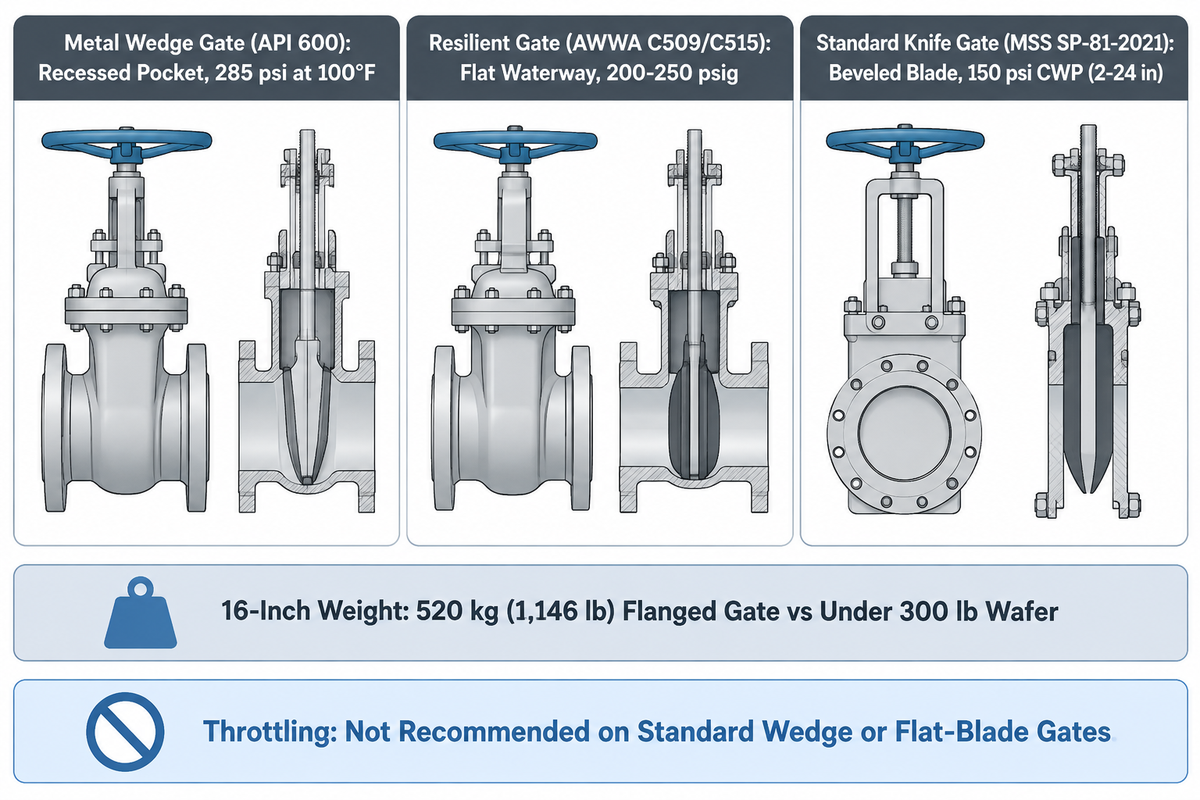
A conventional gate valve uses a thick cast wedge inside a bolted bonnet for clean fluids up to 285 psi in ASME Class 150 steel. A knife gate valve drives a thin, flat blade through a compact wafer or lug body to shear dense slurry, sludge and fibrous wastewater without clogging.
Traditionally, all conventional gate valves and knife gate valves are lumped into a single valve type group, hiding a key municipal distinction. API 600 metal-seated wedge gate valves have a recessed bottom seat, which creates a pocket that traps grit and rags. In contrast, AWWA C509 and AWWA C515 resilient-seated gate valves use a rubber-encapsulated wedge on a flat, pocket-free waterway. Engineers reviewing sludge pump selection and solids handling must distinguish between metal wedge gates, flat-bottom resilient gates and the four different architectures of knife gates, before selecting a line valve.
What’s the difference between a knife valve and a gate valve?
The core difference between a gate valve and a knife gate valve is closing geometry and containment. A wedge gate valve lowers a thick metal or rubber covered disc into a body seat in a pressurized bonnet. A knife valve drives a thin, beveled stainless steel blade across the bore to shear thick solids and push grit past the seat.
There’s variation in naming conventions in different sectors. Waterworks engineers commonly call a flanged gate valve a sluice valve. Pulp mills and mines often refer to a knife gate valve as a guillotine valve. Whatever the label, the mechanical difference between knife gate and wedge gate hardware decides where each unit survives. Conventional gate valves are primarily built for clean water, steam, and hydrocarbons where tight shutoff and high pressure matter most. Knife gates cut through heavy media where standard wedges jam.
What are the three main types of gate valves?
Solid wedge designs use one cast piece for stable temperatures. Flexible wedges are perimeter cut so thermal expansion will not bind the disc in hot lines. Parallel-slide and double disc designs for steam and refinery service use spring-loaded flat faces.
A second structural split is made by the stem. A gate valve is often ordered with a rising outside screw and yoke (OS&Y) stem so operators can spot valve position from across the floor. Buried water mains use non-rising stem (NRS) valves to save space. Side-by-side specifications show how gate valve and knife gate vary in these aspects.
| Design Parameter | Metal-Seated Wedge Gate (API 600 / ASME B16.34) | Resilient-Seated Gate (AWWA C509 / C515) | Standard Knife Gate (MSS SP-81-2021) |
|---|---|---|---|
| Closing Element | Thick cast solid, flexible, or split metal wedge | Elastomer-encapsulated iron wedge | Thin flat stainless blade with beveled bottom edge |
| Bottom Seat Geometry | Recessed V-shaped pocket; traps settling solids | Flat, unobstructed pocket-free waterway | Open or flush-port seat; no wedge pocket |
| Ambient Pressure Rating | 285 psi at 100°F (ASME Class 150 WCB) | 200–250 psig (AWWA C515 common ratings) | 150 psi CWP (10.3 bar) on 2–24 in; 100 psi (6.9 bar) on 30–36 in, non-shock |
| Governing Standards | API 600, API 598, ASME B16.34-2025 | AWWA C509-23 (to 72 in), AWWA C515 | MSS SP-81-2021 (high-pressure models: MSS SP-135; testing: MSS SP-151) |
| Face-to-Face (4 in / 16 in) | 229 mm (9.0 in) / 406 mm (16.0 in) | Full flanged waterworks length | Narrow MSS SP-81 wafer/lug length (about 2 in on small sizes) |
| 16-Inch Typical Weight | 520 kg (1,146 lb) to 1,200+ lb | Heavy ductile or cast iron body | Under 300 lb (manual wafer body) |
| Factory Water Seat Leakage | Tiered drops/min limit by valve size at 1.1× rating (API 598) | 0 drops/min (zero visible leakage) | 40 mL/min per in at 40 psi (MSS SP-81 metal seat); 0 drops on resilient models (MSS SP-151 / AWWA C520) |
| Throttling Suitability | Not Recommended (wire-drawing erosion) | Not Recommended (elastomer tear) | Not Recommended (except V-port or pentagon-port trims) |
| Primary Media Envelope | Clean water, steam, thermal oil, hydrocarbons | Potable water, fire mains, screened sewage | Pulp stock, mining slurry, raw sewage, thick sludge, dry solids |
| Sealing Flow Direction | Bi-directional | Bi-directional | Unidirectional (standard SP-81); bi-directional on perimeter or sleeve models |
Inside the Valve Body: Wedge Cavity, Sharp Blade, Flange Styles, and Bonnetless vs Bonneted Designs
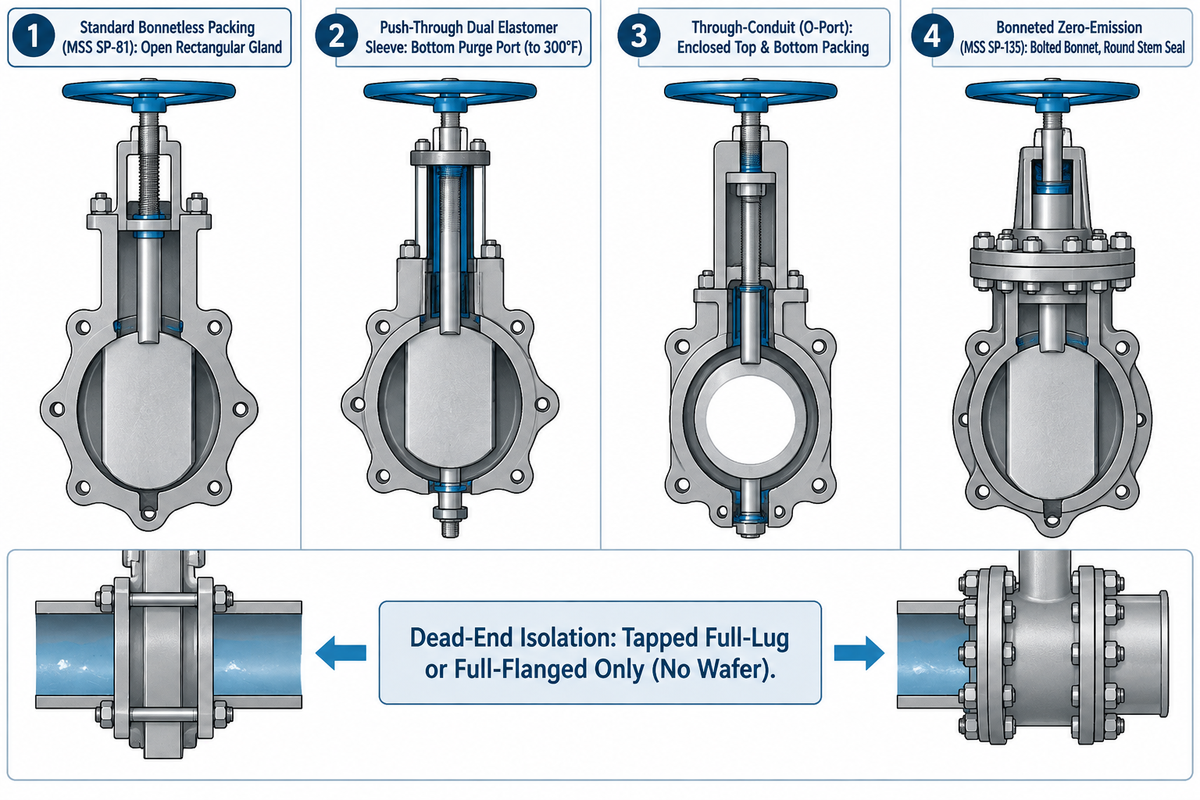
Valve geometry influences whether a valve jams after ten cycles or sequesters slurry for years. A standard wedge valve built to ASME B16.34-2025 houses its disc inside a bolted bonnet above a bottom seat groove. A knife gate valve removes that bottom pocket and uses a thin blade to cut straight through compacted fibers.
Treating every knife gate as one commodity wafer build invites dead-end flange risks and fugitive packing leaks that can violate emission rules on hazardous service. To match hardware to slurry density and containment rules, this guide sorts industrial knife gate valve designs into four body architectures, outlined in The 4-Architecture Knife Gate Classification below.
| Knife Gate Architecture | Sealing & Containment Mechanism | Solids & Slurry Clearance | External Leakage Risk | Best Duty Scope |
|---|---|---|---|---|
| 1. Standard Bonnetless Packing (MSS SP-81) | Blade exits open body chest through rectangular braided gland packing | Good for pulp and fibrous wastewater; coarse grit can pack bottom seat | Moderate (gland needs periodic bolt tightening) | Pulp mills, light-to-medium wastewater, non-hazardous lines |
| 2. Push-Through Dual Elastomer Sleeve | Two opposed heavy rubber sleeves compress together; packingless top chest | Excellent; blade pushes coarse abrasive solids out bottom purge port | Bottom purge splash on stroke unless fitted with splash guard or flush pan | Mining tailings, cyclone feed, coarse slurry (DeZURIK KSL to 300°F) |
| 3. Through-Conduit (O-Port) | Full circular hole machined into elongated blade; top and bottom packing chambers | Superior for high-consistency pulp, thick sludge, and silo columns | Low (enclosed bottom chest with optional flush ports) | Heavy sludge headers, high-consistency stock, bi-directional isolation |
| 4. Bonneted Zero-Emission (MSS SP-135) | Pressurized bolted bonnet encloses entire retracted blade; round stem packing only | High; heavy cast bodies handle thick slurries under high head | Very Low (eliminates rectangular gland weepage) | Hazardous chemicals, toxic slurries, vacuum suction, high-pressure lines |
).
Packing geometry shows why bonnetless builds require added attention. A standard bonnetless valve has a packing gland shaped like a wide rectangle that seals around the gate as it exits the valve body into open air. Manufacturers sharpen the bottom edge so the gate is designed to cut fibers cleanly. However, compressing rectangular packing evenly is far harder than a round stem seal. When airborne grit or dried slurry coats the blade, the next closing stroke drags that grit into the braided rings.
The other design concern is the style of the flange connection which creates a second safety hazard. Standard MSS SP-81 bodies come in wafer, semi-lug, full-lug, and full-flanged styles drilled to ASME B16.5 Class 150 bolt patterns. Wafer bodies rely on long through-bolts spanning both mating pipe flanges. Never mount a wafer knife gate on dead-end pump isolation where downstream pipe must be unbolted for overhaul. Removing the downstream flange relaxes bolt tension and allows line pressure to dislodge the wafer body. Dead-end isolation requires tapped full-lug or full-flanged bodies whose tapped lugs align with the drilled bolt circle on the mating flange body.
Stem style and body containment are directly related to plant maintenance rules. Choose a rising OS&Y stem when maintenance crews need visual stem confirmation from floor level. A bolted bonnet body is used with hazardous media to contain possible fugitive seepage. A tapped, full-lug or full-flanged type of valve body is specified whenever downstream piping must be unbolted while the upstream line is under head.
Bi-Directional Sealing, Allowable Leakage, and Pressure Limits (MSS SP-81 vs API 598 and AWWA C520)
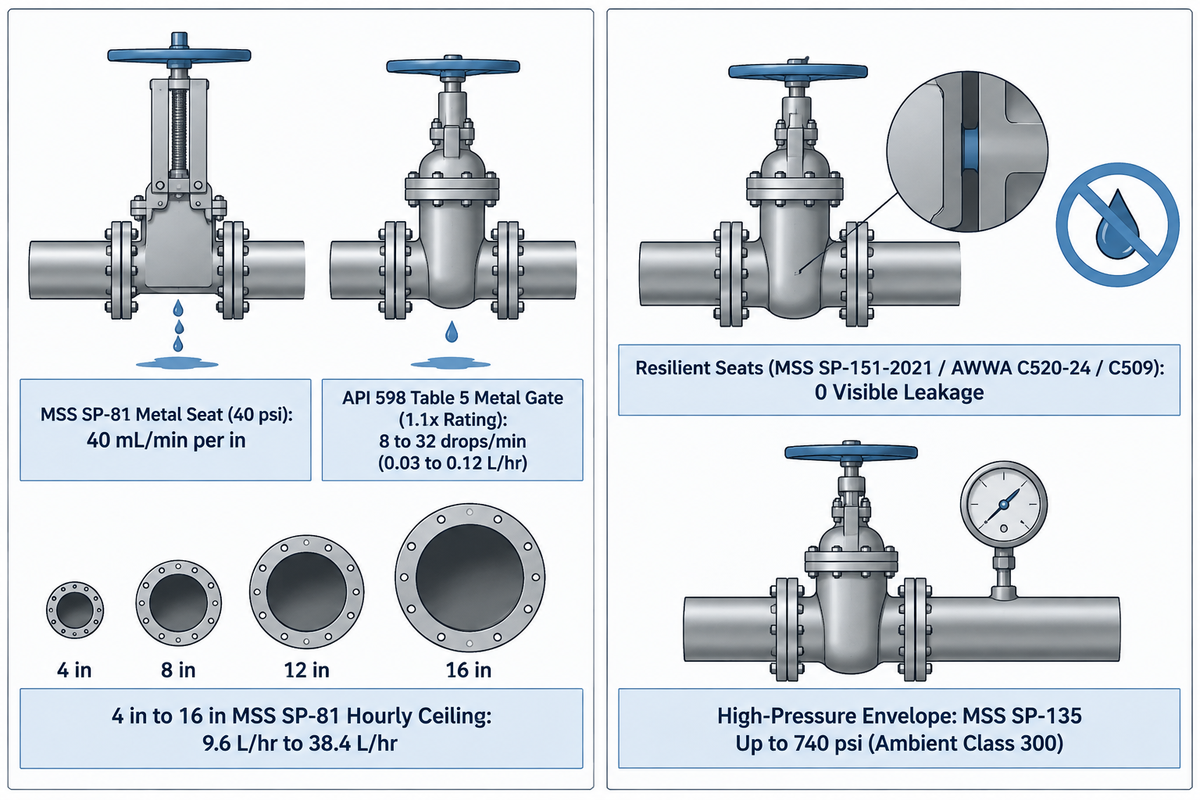
Yes, during factory water tests, metal-seated knife gate valves built to MSS SP-81-2021 permit far higher seat leakage (up to 40 mL/min per inch of pipe diameter at 40 psi) than metal-seated API 598 gate valves, which are tested to drops-per-minute limits at 1.1× rated pressure. Resilient-seated gates under API 598, AWWA C509, MSS SP-151, or AWWA C520 require zero visible drops.
Many piping engineers read “ASME B16.5 Class 150 flange drilling” on a knife gate datasheet and assume the valve holds 285 psi with bi-directional tight shutoff like an ANSI gate valve. That reading confuses bolt-hole geometry with body strength. MSS SP-81 stainless bodies cap cold working pressure at 150 psi (10.3 bar) on 2–24 in valves and 100 psi (6.9 bar) on 30–36 in valves. Thin flat blades deflect under higher pressure. Above that ceiling, engineers specify heavy-cast ANSI/MSS SP-135 models or bolted-bonnet API 600 wedge gates. For example, DeZURIK KSV Class 150 and Class 300 severe-service knife gates reach 740 psi at ambient Class 300 limits and handle temperatures up to 450°F (232°C) with standard pressure-temperature de-rating.
Do knife gate valves leak?
Yes, MSS SP-81 allows metal-seated knife gate valves to weep water during factory tests, up to 40 mL/min per inch of pipe diameter at 40 psi. Resilient elastomer-seated knife gates tested under MSS SP-151-2021 or AWWA C520-24 achieve zero visible leakage on clean water when closed fully in their rated flow direction.
A documented Eng-Tips field failure illustrates the limitation of MSS SP-81 testing. A 4-inch 150# MSS SP-81 metal-seated knife gate passed an external bench test at 3.75 bar shell and 2.75 bar seat pressure, yet leaked immediately when placed on low-pressure steam service. Because MSS SP-81 covers cold hydrostatic water testing on one side only, a metal-seated knife gate can’t serve as a tight shut-off valve on steam or gas headers. Even a hairline leak of steam will erode a thin seating ring of stainless steel.
| Standard & Edition | Valve Category Covered | Pressure Envelope | Maximum Allowable Water Seat Leakage |
|---|---|---|---|
| MSS SP-81-2021 | Stainless bonnetless flanged metal-seated knife gate (NPS 2–36) | 150 psi CWP (2–24 in); 100 psi (30–36 in), non-shock | Metal seat: 40 mL/min per inch at 40 psi (1.5× shell test) |
| MSS SP-151-2021 | Pressure testing for resilient, non-metallic, and metal knife gates | Per valve body rating (1.5× shell test) | Resilient seats: 0 visible leakage; tiered criteria for metal seats |
| ANSI/MSS SP-135-2021 | High-pressure ASME Class-rated knife gates | ASME Class 150–300+ (DeZURIK KSV up to 740 psi at ambient Class 300) | Per purchase order (0 visible on resilient; tight alloy seats) |
| AWWA C520-24 | Municipal water and wastewater knife gates (2–96 in) | Municipal low-to-medium head waterworks | Resilient seat: 0 visible leakage during test hold |
| AWWA C509-23 / C515 | Full-wall (C509) and reduced-wall ductile iron (C515) resilient gates | C515 common ratings: 200–250 psig cold water | 0 drops/min (bubble-tight hydrostatic closure) |
| API 600 / API 598 Table 5 | Steel bolted-bonnet wedge gate valves (ASME B16.34) | ASME Class 150 (285 psi at 100°F) through Class 2500 | Metal seat: tiered drops/min by NPS at 1.1× rating; Resilient: 0 drops |
Setting per-inch test limits in terms of water volume supports sizing sumps and lockouts. The table below makes use of two published baselines. First, per MSS SP-81, metal-seat testing allows 40 mL/min per nominal inch at 40 psi (1 cc = 1 mL; multiply mL/min by 0.06 to get L/hr). Second, API 598 Table 5 sets size-tiered liquid closure limits for metal-seated gate valves tested at 1.1× rated pressure, using Note a (1 mL = 16 drops). Note that both of these standards refer to testing new valves on clean water at some fixed factory pressures. Field seepage increases after the seat is scored by abrasive slurry.
| Nominal Pipe Size (NPS) | MSS SP-81 Metal Seat (mL/min at 40 psi) | MSS SP-81 Hourly Ceiling (L/hr) | API 598 Table 5 Metal Gate (drops/min & mL/min) | API 598 Hourly Ceiling (L/hr) |
|---|---|---|---|---|
| 4 in (DN 100) | 160 mL/min | 9.6 L/hr | 8 drops/min (0.50 mL/min) | 0.03 L/hr |
| 6 in (DN 150) | 240 mL/min | 14.4 L/hr | 12 drops/min (0.75 mL/min) | 0.045 L/hr |
| 8 in (DN 200) | 320 mL/min | 19.2 L/hr | 16 drops/min (1.00 mL/min) | 0.06 L/hr |
| 10 in (DN 250) | 400 mL/min | 24.0 L/hr | 20 drops/min (1.25 mL/min) | 0.075 L/hr |
| 12 in (DN 300) | 480 mL/min | 28.8 L/hr | 24 drops/min (1.50 mL/min) | 0.09 L/hr |
| 16 in (DN 400) | 640 mL/min | 38.4 L/hr | 32 drops/min (2.00 mL/min) | 0.12 L/hr |
A 16-inch metal-seated knife gate that passes 38.4 L/hr of water would pass inspection per MSS SP-81. On dense paper stock, wood fibers bridge that thin gap and plug the weep. On clean flush water or chemical lines, 38.4 L/hr accumulates roughly 300 to 460 liters during an 8- to 12-hour maintenance shift. Direction of flow adds to the problem. Standard unidirectional knife gates need upstream pressure to press the blade against the seat ring. Reverse pressure pushes the blade away from the seat and opens a leak path. Specify a bi-directional perimeter-seal or dual-sleeve valve for backflow headers, and a bonneted zero-emission or vacuum-rated O-port valve with tight packing around the gate for negative suction service.
Slurry, Sludge, and Wastewater Lines: When Conventional Gate Valves Fail and Knife Gates Win
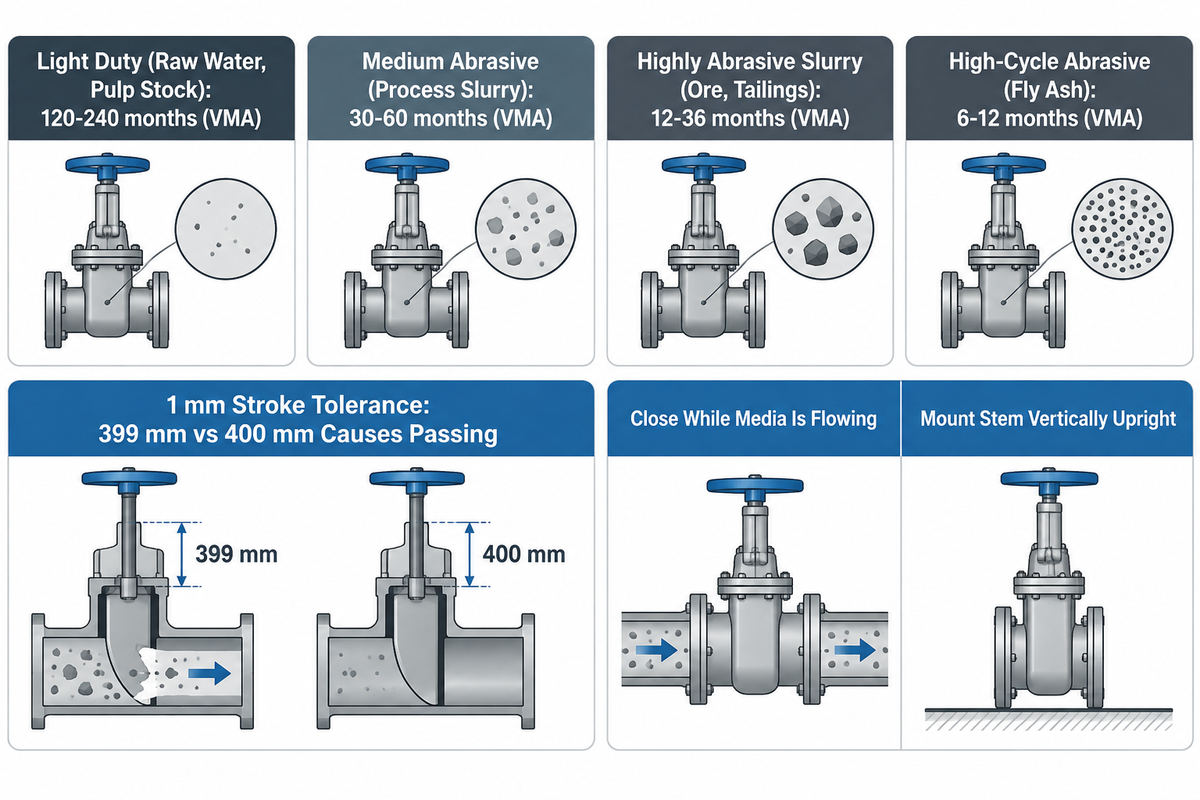
Conventional wedge gate valves jam in unscreened sewage, mining tailings, and heavy paper stock because suspended solids pack the bottom seat groove. Knife gate valves shear those fibers cleanly and clear their own seat path. A Valve Magazine article published by the Valve Manufacturers Association (VMA) puts expected knife gate life at 120–240 months in general-purpose light-duty service and 6–12 months on high-cycle abrasive fly ash.
Field maintenance records show how stroke precision controls slurry valve survival. In a Valve Manufacturers Association technical article published in “Valve Magazine,” retired knife gate product manager Dr. S. Vijayakrishnan explained why closure tolerance is unforgiving:
“For example, a knife gate valve with a rated stroke of 400 mm that travels only 399 mm, could cause excessive passing. In contrast, a ball valve with a rated travel of 90 degrees may still be shut at 89 or even 88 degrees.”
That 1 mm tolerance is why incomplete stroke closure can quickly erode sealing surfaces in abrasive industrial applications. Full sealing happens only at the exact end of blade travel with zero over-travel margin. If a pneumatic cylinder’s thrust is reduced by an air leak, or if a pebble causes a false torque trip on an electric actuator, that 1 mm slit turns abrasive tailings into a cutting jet. Teams operating industrial slurry pumps or managing sewer lift station piping design extend valve life by planning for 12–36 months on highly abrasive ore and tailings and verifying full stroke seating.
Can a knife gate valve be used for throttling?
No. Standard flat-blade knife gate valves should never be used for continuous flow throttling. Using a partially closed gate in slurry or wastewater creates a high-velocity jet, vibro-erosion of the blade, and seat erosion. Only special V-port or pentagon-port trims, which are designed for a modulating function, can act as a control valve.
The same prohibition also applies to conventional gate valves in both pulp and paper industry and the municipal wastewater treatment plants. Cracking a discharge valve reduces the pump flow. In the process, the unsupported edge of the blade becomes deformed, gland bolts loosen up, and the stainless seats are scoured. Use a pump variable-frequency drive, or use a dedicated pinch or eccentric plug control valve to modulate the flow instead. The table below shows estimates of the service lives of valves from VMA Valve Magazine, along with the major preventive measures in the field.
| Duty Severity / Failure Mode | Typical Media / Root Mechanism | Expected Life / Field Consequence | Field Prevention Rule |
|---|---|---|---|
| Light Duty Benchmark | Raw water, light sludges, pulp stock | 120–240 months (VMA guideline) | Cycle infrequently operated valves partially every few months |
| Medium Abrasive Benchmark | Process slurry, abrasive chemicals | 30–60 months (VMA guideline) | Inspect blade surface for scale; flush chest ports routinely |
| Highly Abrasive Slurry Benchmark | Mining ore, tailings, tar sands pipelines | 12–36 months (VMA guideline) | Specify dual push-through elastomer sleeves or hardened alloys |
| High-Cycle Abrasive Benchmark | Pneumatic conveying, fly ash | 6–12 months (VMA guideline) | Avoid closing against stagnant powder columns; use O-port or ceramic trim |
| Closing After Pump Shutdown | Settled slurry packs into bottom seat cavity | Incomplete stroke (1 mm short) and severe seat jetting | Close knife gate while media is still flowing for self-cleaning sweep |
| Sideways / Inverted Stem Mounting | Gravity drops grit into lateral seat groove or gland chest | Blade dragging, bent stems, and accelerated gland leakage | Mount stem vertically upright on horizontal pipes; direct vertical flow upward |
Two installation habits prevent most early failures. First, close the knife gate valve while slurry is still moving, rather than closing it after pump shutdown. A fluid in motion is less likely to stall the blade and seat as it’s still moving. Second, for a horizontal valve, position the stem in the vertical position and add chest flush ports. For a rising pipe valve in a tailings or heavy sludge line, flow should be directed upward to prevent heavy solids from depositing on the seat.
Pump Suction vs Discharge Isolation: Matching Valves to Slurry and Sewage Pump Systems
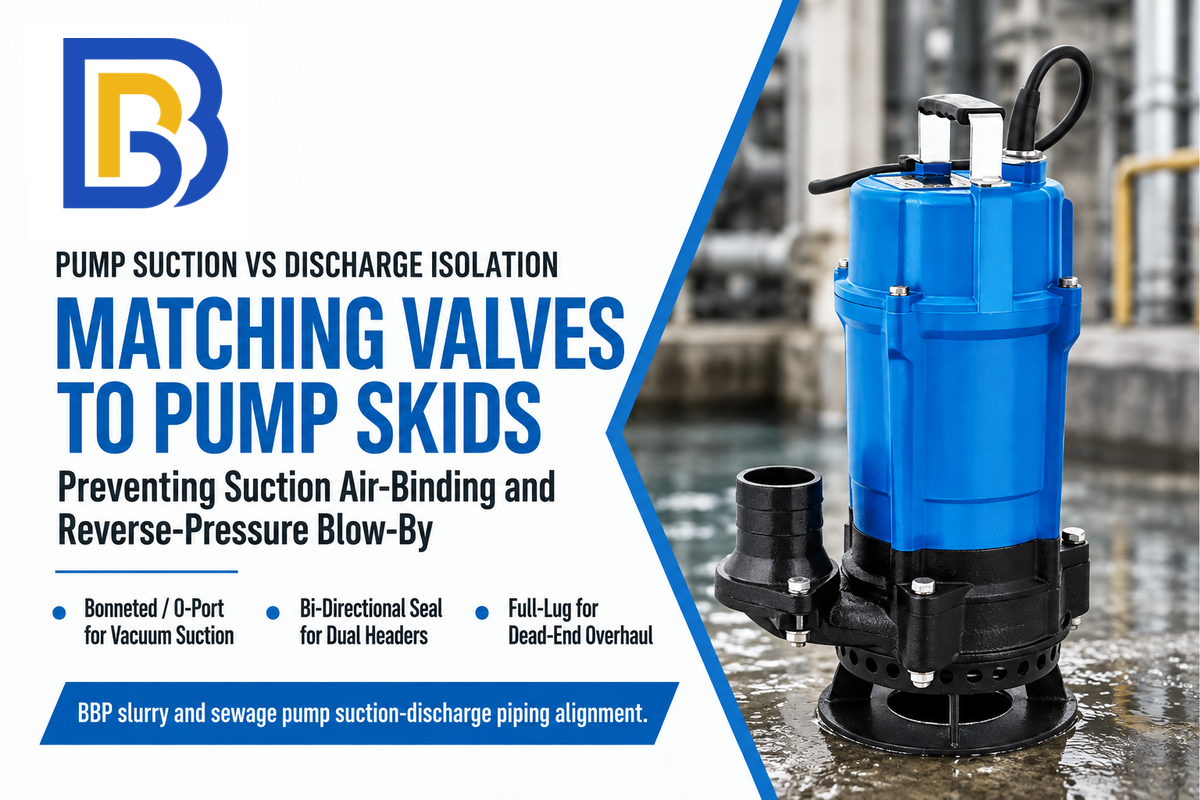
Due to the opposite directional loads on pump suction and discharge lines, air binding occurs when the same valve is used across both lines. For a discharge line, the valve should be designed for reverse pressure to minimize seat blow by.
Most comparisons overlook this distinction. In a suction-lift pump, the pressure within the pump falls below atmospheric pressure at the pump inlet. Because a commodity bonnetless knife gate relies on wide rectangular braided packing, vacuum pulls ambient air inward into the impeller eye. This, in turn, can lead to air binding and can cause total loss of prime. Engineering teams checking valve flow coefficient (Cv) in pump systems prefer full-bore isolation to protect suction margin and avoid collapse and cavitation covered in Pump cavitation and suction diagnostics.
When to use a knife gate valve?
A knife gate valve is your best bet against solids (rags, wood pulp, thick sludge, abrasive ore) packing a wedge pocket. Keep the operating pressure within standard MSS SP-81 cold working pressure (CWP) limits or heavy-cast MSS SP-135 ratings. Knife gate valves are primarily designed for on-off solids isolation rather than throttling or unsealed vacuum suction.
AWWA C509 and C515 resilient types are separately classified from AWWA C520 knife gates by municipal waterworks engineers. Resilient-seated gate valves are used across clean-water boosters and screened submersible sewage pump installations because AWWA C515 ductile-iron bodies commonly handle 200–250 psig with O-ring stem seals and zero exposed rectangular packing. Knife gate valves are designed to step in once unscreened rags, thick biosolids, or abrasive ore enter the pipe. Apply The Suction-Vacuum vs Discharge-Solids Split Matrix below to select the correct valve at every pump-skid position.
| Pump Station Position & Fluid Duty | Dominant Risk | Recommended Valve Choice | Avoid / Engineering Caution |
|---|---|---|---|
| 1. Clean Water Suction Lift (Negative Head) | Air ingress through packing causing air-binding and loss of prime | AWWA C509/C515 resilient gate or bolted-bonnet API 600 gate | Avoid standard bonnetless knife gates (rectangular gland draws air) |
| 2. Flooded Slurry Pump Suction (Positive Tank Head) | Settled ore blocking closure; full-bore Cv needed | Push-through dual elastomer sleeve slurry knife gate (full port) | Avoid wedge gates; add auxiliary isolation ahead of tall slurry tanks |
| 3. Vacuum Slurry / Chemical Suction | Combined air ingestion and corrosive solids | Bonneted zero-emission knife gate or vacuum-rated O-port valve | Avoid unsealed open-chest wafer knife gates |
| 4. Screened Municipal Sewage Discharge | Standby pump backflow and odor or weeping control | AWWA C509 (full-wall) or AWWA C515 (200–250 psig) resilient gate | Avoid recessed-pocket metal wedge gates; match valve rating to head |
| 5. Raw Unscreened Sewage & Fibrous Sludge Discharge | Wipes, rags, and dense biosolids wrapping wedge | Bi-directional resilient-seated AWWA C520 knife gate or O-port | Avoid unidirectional metal-seat SP-81 on shared manifold headers |
| 6. Abrasive Mining / Gravel Pump Discharge (≤150 psi) | Coarse grit scouring metal seats and packing | Bi-directional push-through dual elastomer sleeve knife gate | Avoid standard cast-iron gate valves and thin unidirectional blades |
| 7. High-Head Tailings Transfer (>150 psi) | Blade deflection and body failure under high head | Heavy-cast ANSI/MSS SP-135 slurry knife gate (e.g., DeZURIK KSV Class 300) | Never apply MSS SP-81 valves above their rated CWP limit |
| 8. High-Head Clean Water / Multistage Booster (>285 psi) | High differential pressure above Class 150 ambient ceiling | API 600 / ASME B16.34 Class 300–600 bolted-bonnet gate valve (Class 150 up to 285 psi) | Avoid knife gates and Class 150 bodies above 285 psi |
| 9. Dead-End Pump Skid Overhaul Isolation | Downstream pipe removal while upstream line stays full | Full-lug tapped or full-flanged bi-directional isolation valve | Never use wafer bodies retained only by through-bolts |
A conventional gate valve uses clean-fluid seating and bolted-bonnet pressure containment earns its place on water, steam, and high-head lines. On parallel dual-pump headers, check reverse-pressure exposure when one pump runs while the standby pump is isolated for repair. Reverse manifold head pushes a unidirectional MSS SP-81 blade away from its seat ring and results in heavy bypass leakage, even with the stem locked closed. Specify bi-directional sealing rated for full pump shutoff head.
Materials, Elastomer Sleeves, and Pneumatic vs Electric Actuation for Abrasive Duty
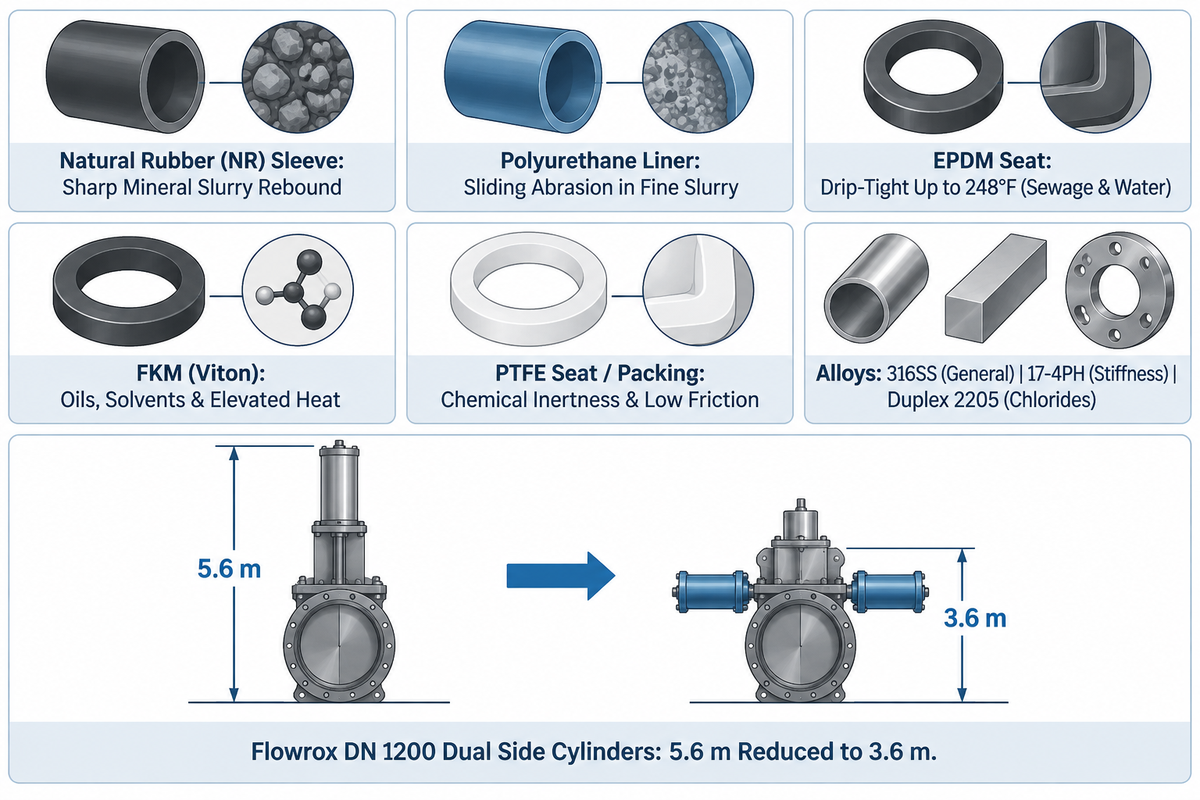
Slurry isolation valves are expected to last between 12-36 months in highly abrasive service due to wear. Wetted trim and actuator sizing determine if the valves can meet the expected service life. Generic 316 stainless steel and EPDM rubber degrade quickly in sharp ore or hot oils, while unthrottled pneumatic cylinders can slam shut and trigger destructive hydraulic shock.
Slurry valve metallurgy strikes a balance between abrasion and corrosion. For municipal wastewater and pulp stock, standard 304 and 316 stainless steel bodies work well. For brines and slurries containing chlorides, Duplex 2205 is used to increase resistance to pitting corrosion, and for higher yield and tensile strengths, 17-4PH is used. Natural rubber and polyurethane liners absorb particle impact better than steel on coarse-solids gravel pump lines. This has been demonstrated by several recent patents. The USPTO patent US11499644B2 (granted November 15, 2022 to Emerson Automation Solutions Final Control US LP) describes a symmetrical resilient transverse seal that engages the blade tip and lateral edges as well as the faces of the gate.
| Material / Component | Primary Strength | Limitation / Avoid When | Typical Duty Match |
|---|---|---|---|
| Natural Rubber (NR) Sleeve | High rebound resilience against sharp abrasive mineral particles | Degrades rapidly in petroleum oils, hydrocarbons, and high heat | Mining tailings, sand/gravel slurry, mineral processing |
| Polyurethane (Urethane) Liner | High sliding abrasion and tear resistance in fine slurries | Hydrolyzes in hot water and strong acids or alkalis | Cyclone feed, ash slurry, gritty municipal grit pumps |
| EPDM Elastomer Seat | Drip-tight shutoff up to 248°F on water, sewage, and mild slurry | Swells in mineral oils, fats, and hydrocarbon fuels | AWWA C509/C520 wastewater treatment, pulp stock |
| FKM (Viton) Elastomer | Chemical resistance to oils, solvents, and elevated process heat | Lower abrasive tear life than natural rubber; higher replacement cost | Oily wastewater, chemical plant sumps, refinery sludges |
| PTFE Polymer Seat / Packing | Broad chemical inertness and low sliding friction on gate faces | Cold-flows under sustained load; poor resilience against coarse grit | Corrosive chemical isolation and low-friction braided packing rings |
| 316SS / 17-4PH / Duplex 2205 Gate | General corrosion (316SS); blade stiffness (17-4PH); chloride pitting & strength (2205) | Uncoated 316SS erodes fast in quartz slurry; 17-4PH is not a chloride upgrade | Pulp/sewage (316SS); high-thrust blades (17-4PH); chloride slurry (2205) |
Actuator selection governs both plant footprint and surge safety. Manual handwheels and bevel gears keep closing speeds naturally slow for infrequent isolation. Pneumatic cylinders predominate in automated slurry lines for cost reasons and the breakaway thrust they generate. However, slamming a pneumatic valve shut in two seconds on a long pumped discharge header generates a severe pressure surge that can damage pump casings and pipe supports. Reliable water hammer and surge control starts with adjustable exhaust flow-control valves that stretch pneumatic stroke time cleanly.
Electric actuators fit remote lift stations lacking plant air, provided torque-limit switches are tuned so a pebble doesn’t stop closure 1 mm short. Hydraulic cylinders handle massive, high-pressure mining valves. Overhead clearance also impacts actuator design. As reported in World Pumps, Flowrox redesigned its DN 900 to DN 1500 slurry knife gate valves to have dual side-mounted cylinders instead of a top tower. This change reduced the fully opened DN 1200 height from 5.6 m to 3.6 m (a 2 m reduction) and kept all maintenance points under 2 m from the floor.
Knife Gate Valve vs Pinch, Plug, Slide Gate, Butterfly, and Ball Valves
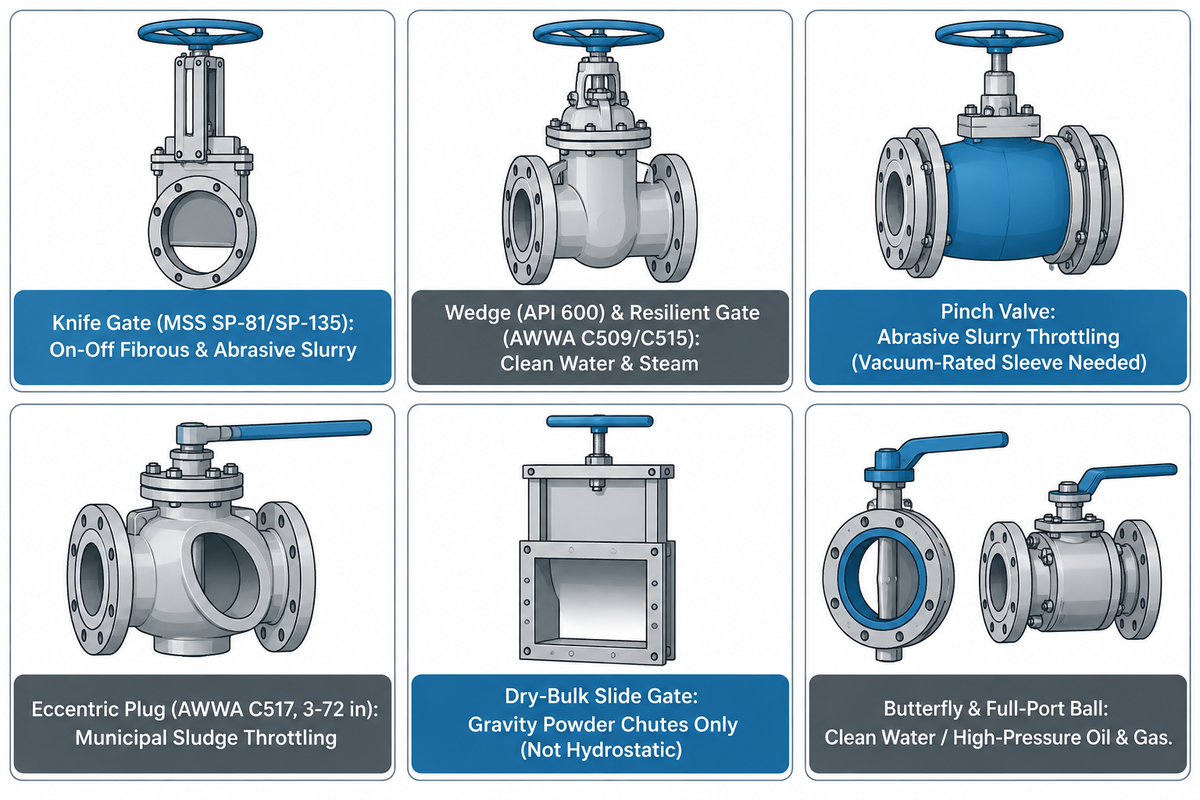
Neither a wedge gate nor a knife gate suits every solid-bearing or pumped line. Slurry throttling, dry-bulk hopper cutoff, tight quarter-turn clean-water shutoff, and automatic pump minimum-flow bypass each belong to a different valve family.
During front-end piping design, engineering buyers compare a knife gate valve vs adjacent designs such as slide gate, pinch, plug, butterfly, and ball valves. Confusing slide gates with liquid knife gates is a common sourcing error. Comparing a slide gate valve with a knife gate valve shows a sharp divide. Slide gates are used in dry bulk applications like gravity hoppers and low-pressure powder chutes with dust seals. Liquid knife gates hold hydrostatic flange pressure. In municipal sewage, AWWA C517 eccentric plug valves (3 to 72 inches) handle sludge throttling better than either gate type. On clean water, butterfly valves cut large-bore weight, while full-port ball valves deliver fast quarter-turn shutoff in oil and gas manifolds.
| Valve Family | Solids / Slurry Handling | Throttling Control | Pressure Range | Primary Limitation |
|---|---|---|---|---|
| Knife Gate Valve (MSS SP-81 / SP-135) | Recommended (shears fibers and dense slurry) | Not Recommended (standard flat blade) | 150 psi CWP standard (2–24 in); higher on SP-135 models | Rectangular gland maintenance; metal-seat weeping |
| Metal Wedge Gate (API 600) | Not Recommended (bottom pocket jams) | Not Recommended | ASME Class 150 (285 psi) to Class 2500 | Long face-to-face, heavy casting, slow multi-turn |
| Resilient-Seated Gate (AWWA C509/C515) | Suitable (screened sewage; flat waterway) | Not Recommended | AWWA C515 common: 200–250 psig | Coarse abrasive ore and unscreened rags cut rubber wedge |
| Pinch Valve | Recommended (full rubber tube isolates body) | Suitable (abrasive slurry control) | Low-to-medium (sleeve pressure limit) | Standard sleeves collapse under vacuum; suction requires vacuum-rated sleeves |
| Eccentric Plug Valve (AWWA C517) | Recommended (raw sewage and sludge, 3–72 in) | Suitable (good municipal sludge control) | Municipal wastewater pressure classes | Reduced port creates higher head loss than full-bore gates |
| Dry-Bulk Slide Gate | Recommended (dry cement, grain, ash, pellets) | Suitable (gravity discharge metering) | Gravity or low-pressure pneumatic bulk | Not rated for hydrostatic liquid pipe containment |
| Butterfly Valve | Not Recommended (center disc catches rags) | Suitable (clean water and air) | Low-to-medium industrial pressure classes | Permanent disc in flow stream catches fibrous debris |
| Full-Port Ball Valve | Clean liquids, gases, or light solids only | V-ball designs only | High pressure (oil and gas manifolds) | Solids pack behind ball cavity; steep cost in large bores |
| Automatic Recirculation Valve | Clean boiler feed and high-head process pumps | Self-actuated minimum-flow bypass | High-pressure multistage pump discharge | Not a manual shutoff isolation valve |
Two pairings show up often in pump rooms. Comparing a pinch valve vs knife gate valve, pinch valves excel on abrasive throttling because only the rubber tube contacts fluid. Standard loose sleeves collapse under suction vacuum and, therefore, require a vacuum-rated or mechanically retained sleeve for suction-side installations. Comparing a plug valve vs knife gate valve, AWWA C517 eccentric plugs handle sludge balancing cleanly, while full-port knife gates preserve lower head loss on large headers. Never use isolation valves for minimum-flow pump protection—high-head centrifugal trains still need dedicated automatic recirculation valves for minimum-flow pump protection.
4-Inch to 16-Inch Budget Cost, Lifecycle Maintenance, and Installation Economics

From 4 to 16 inches, manual MSS SP-81 wafer knife gates weigh far less than ASME Class 150 cast-steel flanged gate valves, under 300 lb versus 1,146 to 1,200+ lb at 16 inches. Distributor comparisons note that purchase price scales roughly with casting weight, while exact engineered pricing requires a vendor quotation matched to alloy, liner, and actuator specs.
Casting mass and face-to-face space drive upfront cost, pipe-rack support steel, and rigging labor. A 16-inch wafer knife gate installs with two fitters and a chain block, whereas a 1,200+ lb flanged ANSI gate valve demands a crane pick and reinforced pipe supports. Published L&T Valves API 600 ASME Class 150 flanged WCB gate valve schedules show how steeply mass rises from 4 to 16 inches (using 1 kg = 2.20462 lb).
| Nominal Size (NPS / DN) | API 600 Class 150 Gate Face-to-Face | API 600 Class 150 Flanged Gate Weight | Wafer Knife Gate Comparison & Pricing Basis |
|---|---|---|---|
| 4 in (DN 100) | 229 mm (9.0 in) | 53 kg (117 lb) | Compact wafer installs by hand; quote required |
| 6 in (DN 150) | 267 mm (10.5 in) | 87 kg (192 lb) | Narrow MSS SP-81 gap cuts rack width; quote required |
| 8 in (DN 200) | 292 mm (11.5 in) | 139 kg (306 lb) | Lighter pipe hangers than flanged gate; quote required |
| 10 in (DN 250) | 330 mm (13.0 in) | 210 kg (463 lb) | Casting mass gap widens sharply; quote required |
| 12 in (DN 300) | 356 mm (14.0 in) | 302 kg (666 lb) | Heavy hoist needed for ANSI gate; quote required |
| 14 in (DN 350) | 381 mm (15.0 in) | 410 kg (904 lb) | Major steel support savings on wafer builds; quote required |
| 16 in (DN 400) | 406 mm (16.0 in) | 520 kg (1,146 lb) to 1,200+ lb | Manual wafer knife gate runs under 300 lb; quote required |
Price is just part of the cost of ownership story. Gate valves are available in widely stocked carbon-steel and ductile-iron sizes. A bolted-bonnet API 600 gate valve features circular stem packing, while AWWA C509 and C515 resilient-seated gate valves typically use O-ring stem seals that avoid gland tightening on clean lines. A poor economy decision would be to purchase a cheap, unidirectional wafer knife gate for coarse abrasive ore. This creates a false economy and leads to repeat outages. Packing leaks and abrasive ore cutting the blade are just a couple of the problems that result in unplanned outages and increase the cost to operate the plant. On heavy slurry lines, dual-sleeve push-through knife gates or replaceable seat cartridges cut five-year labor because crews swap wear liners without scrapping the body.
Who Makes Heavy-Duty Industrial Slurry and Wastewater Knife Gate Valves? Vendor Tiers and Specification Checklist
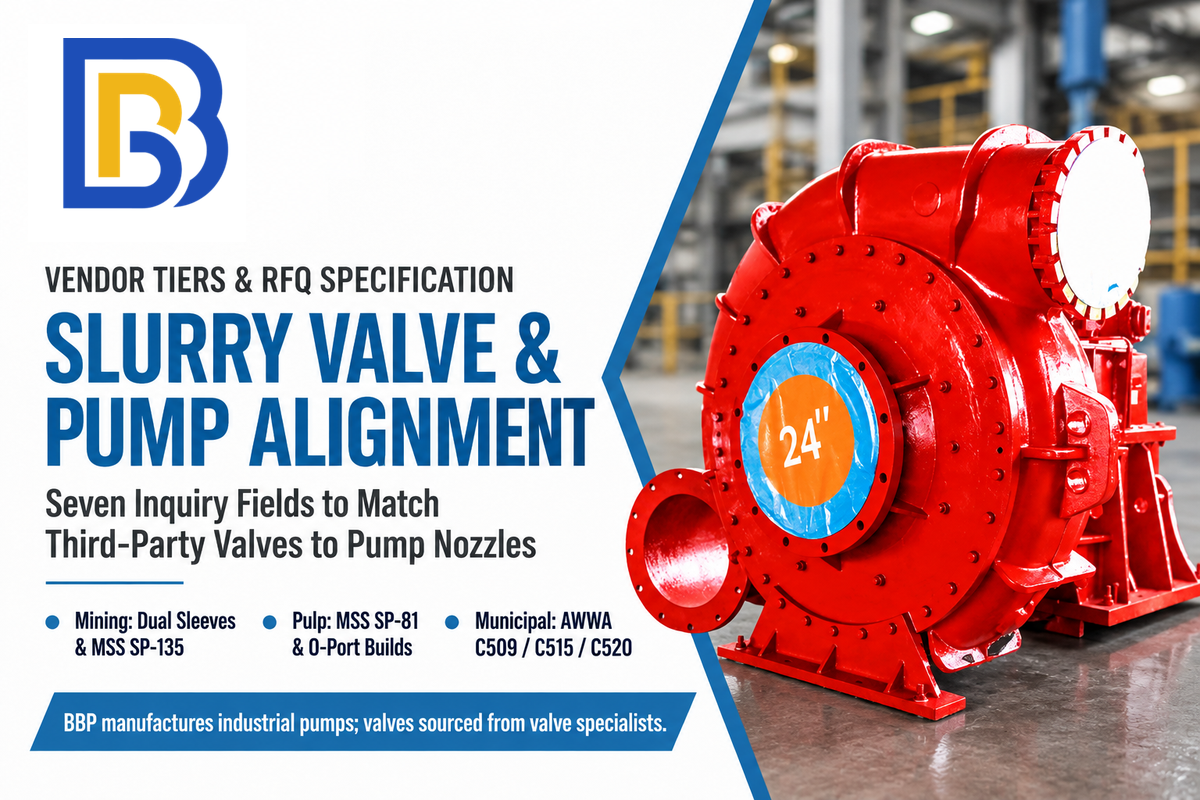
Heavy-duty mining slurry knife gate valves come from Emerson (Clarkson), Weir Minerals (Isogate and Delta Industrial), DeZURIK, Red Valve, Valmet (Flowrox), and Metso (KGH). Pulp and process lines rely widely on ORBINOX, Stafsjö, and ITT Fabri-Valve. Municipal waterworks and sewage treatment plants use AVK and DeZURIK.
Heavy-duty knife gate valves come from industrial valve manufacturers, so shortlist one by matching its documented sealing architecture to your pump duty rather than buying on brand recognition. Mining specialists lead in packingless push-through dual sleeves and heavy-cast MSS SP-135 bodies for tailings and cyclone feed. Pulp and process builders supply broad MSS SP-81 stainless, through-conduit O-port, and bonneted zero-emission designs. Municipal specialists such as AVK (AVK International) cover both AWWA C509/C515 resilient gate valves and AWWA C520 wastewater knife gates. Always plan open-bottom push-through slurry valves for purge containment. Without a bolted flush pan or splash guard, each closing stroke releases a slug of slurry on the walkway.
| Application Tier | Representative Specialists | Documented Core Architectures | Key Verification Point |
|---|---|---|---|
| Heavy Mining & High-Pressure Slurry | Emerson (Clarkson), DeZURIK (KSV/KSL), Weir Minerals (Isogate/Delta), Red Valve, Valmet (Flowrox), Metso (KGH) | Packingless dual push-through elastomer sleeves, MSS SP-135 Class 150–300 bodies | Confirm splash guard or flush pan containment and sleeve temperature limit |
| Pulp, Paper & Process Industrial | ORBINOX, Stafsjö, ITT Fabri-Valve | MSS SP-81 bonnetless stainless, through-conduit O-port, bonneted zero-emission | Confirm uni- vs bi-directional rating and gland repacking access |
| Municipal Waterworks & Sewage | AVK (AVK International), DeZURIK | AWWA C509/C515 resilient-seated gate valves and AWWA C520 wastewater knife gates | Confirm zero-drop hydrostatic closure test and coating standard |
Before issuing an inquiry for gate and knife gate valves, run every line tag through The 5-Gate Valve Specification Filter. Check solids and phase to distinguish clean fluids from fibrous and/or abrasive slurry. Next, verify suction vacuum and maximum pressure against standard CWP or ASME Class limits. Third, determine flow direction and external packing containment. Fourth, select wafer versus dead-end full-lug or flanged bolting. Last, balance actuator thrust and stroke time to surge limits. Capture all seven RFQ fields in the table below when ordering knife gate valves and gate valves so suppliers can’t substitute light-duty builds.
| RFQ Parameter | Exact Data Required on Inquiry | Risk Prevented |
|---|---|---|
| Media & Solids Profile | Fluid chemistry, pH, % solids by weight, max particle size, fiber presence | Prevents wedge pocket jamming and elastomer chemical swell |
| Pressure, Vacuum & Temp | Min suction pressure (vacuum/psig), max shutoff differential pressure, operating °F/°C | Prevents Class 150 drilling vs CWP mistakes and suction air ingress |
| Flow Direction & Architecture | Unidirectional or bi-directional; bonnetless, push-through sleeve, O-port, or bonneted | Stops standby pump backflow blow-by and fugitive gland seepage |
| Standard & Leakage Acceptance | MSS SP-81-2021, MSS SP-135-2021, MSS SP-151-2021, AWWA C520/C509, or API 598 | Eliminates surprise 40 mL/min per inch metal-seat seepage |
| Body & Flange Drilling | Wafer, full-lug (dead-end rated), or flanged; ASME B16.5 Class 150/300 or EN PN10/16 | Prevents unsafe wafer removal during pump maintenance |
| Wetted Metallurgy & Trim | Body alloy, blade grade (316SS / 17-4PH / 2205), elastomer sleeve, flush-port size | Stops premature abrasion and chest solidification |
| Actuator, Stroke Time & LOTO | Manual gear, pneumatic with exhaust throttles, or electric; lock-out pin & proximity switches | Prevents water hammer surge and 1 mm incomplete closure trips |
Engineers combining third-party valves with mining slurry pump packages can provide line conditions to the BBP technical team. Doing so keeps pump nozzle flange drilling, suction pipe sizing, and shutdown sequencing aligned cleanly from commissioning day one.
Industry Shifts in Slurry and Wastewater Isolation: Zero-Fugitive Packing, High-Pressure Standards, and Automated Feedback
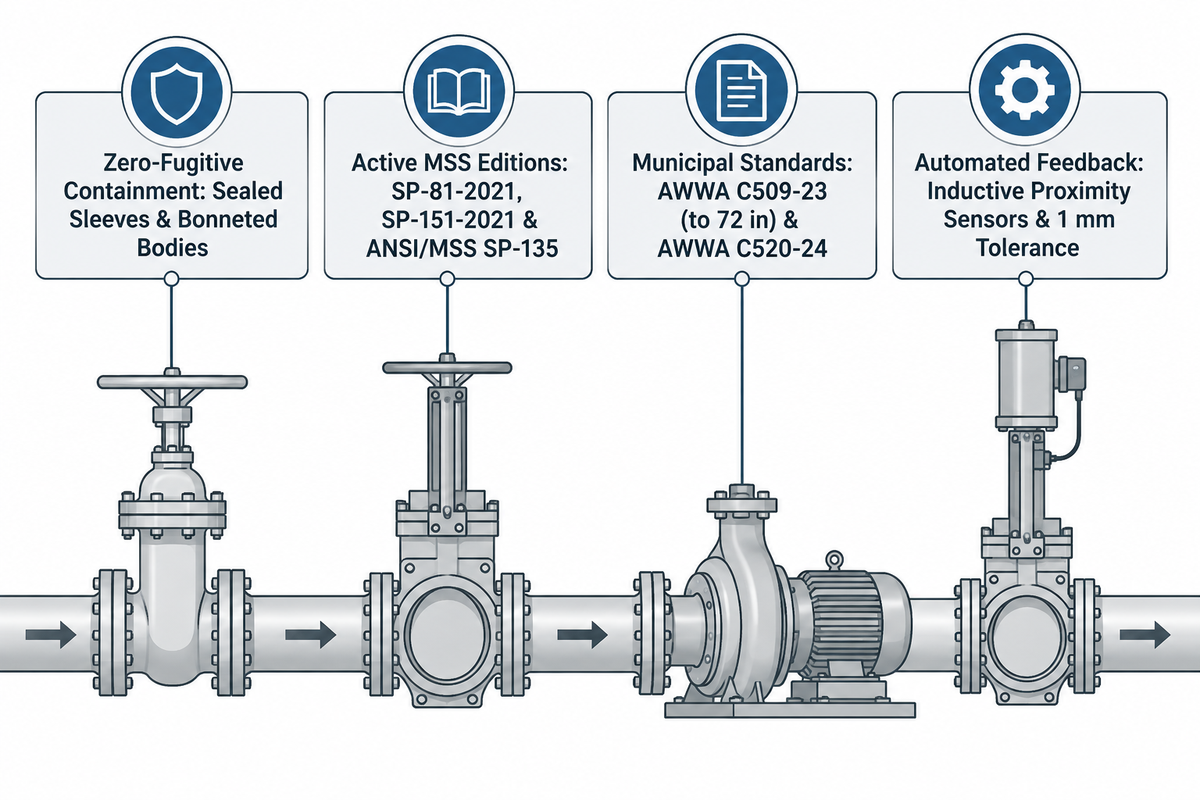
More stringent plant housekeeping regulations and mandated emission reduction targets, along with higher-head tailings transport, are shifting specifications away from open-bottom commodity bonnetless valves. More and more industrial projects are requiring sealed push-through sleeves, bonneted, zero-emission bodies, and ANSI/MSS SP-135-2021 high-pressure designs to eliminate continuous gland weeping and floor spills.
Active standards mirror this engineering transition. Current editions include MSS SP-81-2021 for bonnetless stainless knife gates, ANSI/MSS SP-135 for ASME Class high-pressure knife gates, and MSS SP-151-2021 for seat pressure testing across resilient and metal seats. On the municipal side, AWWA C509-23 expanded resilient-seated gate coverage up to 72 inches, while AWWA C520-24 updated wastewater knife gate rules. Equipment suppliers are expanding heavy slurry lines in parallel: in October 2025, Metso updated its KGH high-pressure slurry knife gate portfolio for demanding mineral processing duty.
Feedback from automation is also closing the 1 mm stroke-tolerance gap that historically accelerated slurry seat wear. More recently, actuated knife gates are shipped with inductive end-of-stroke proximity sensors and a dual side-cylinder drive. Those sensors verify closure to the control room where maintenance lockout permits are signed before any work is done.
Scope & Technical Review Note: BBP Manufacturing Co., Ltd. manufactures industrial slurry, sewage, centrifugal, chemical, multistage, and deep-well pumps rather than valves, and this guide was reviewed by the BBP technical team using published MSS, API, ASME, AWWA, USPTO, and Valve Manufacturers Association references. Final hydrostatic test certificates and chemical compatibility should be provided by the chosen valve manufacturer.
Frequently Asked Questions About Gate Valves vs Knife Gate Valves
What is the difference between a knife gate valve and a slide gate valve?
A knife gate valve is pressure-rated for liquid slurries, sludge, and fibrous wastewater in flanged pipelines. Standard MSS SP-81-2021 builds seal up to 150 psi CWP on 2-24 in sizes, while heavy MSS SP-135 designs handle much greater heads. A slide gate valve serves gravity-fed or low-pressure pneumatic dry bulk solids such as grain and cement. Slide gates are used to control the outflow of dry bulk material and contain dust, and aren’t used to control hydrostatic seal.
Is a ball valve or gate valve better for pipeline isolation?
Ball valves are preferred for bubble-tight shutoff of gases and clean liquids in smaller line sizes and when a fast quarter-turn valve is necessary. Gate valves are better in large line sizes, high pressure headers, and pump stations. In these applications, a slow multi-turn closing of a gate valve minimizes hydraulic shock and a full-port passage of the gate valve reduces the head loss. Neither a standard ball valve nor a recessed-pocket wedge gate valve can handle heavy fibrous slurry as reliably as a purpose-built knife gate valve.
Are standard gate valves obsolete in wastewater treatment plants?
Standard gate valves are not obsolete in wastewater plants; however, conventional metal-seated wedge designs with recessed bottom pockets have largely disappeared for use in raw sewage. In modern municipal pump stations, AWWA C509 and AWWA C515 resilient seated gate valves are still heavily relied on for clean water and screened effluent. Knife gate valves take over where unscreened rags, thick biosolids sludge, or coarse abrasive grit overwhelm resilient-seated gate valves.
Are knife gate valves unidirectional or bidirectional?
Standard MSS SP-81 metal-seated knife gates are unidirectional and rely on upstream pressure pushing the blade onto the seat. Bi-directional builds add perimeter elastomer seats or dual push-through sleeves to hold reverse pressure equally.
Can a knife gate valve handle high pressure above 150 psi?
Yes, heavy-cast ANSI/MSS SP-135 knife gates such as DeZURIK KSV reach ASME Class 300 ambient ratings up to 740 psi for tailings lines. Standard bonnetless MSS SP-81 valves cap at 150 psi CWP (2–24 in) and 100 psi (30–36 in).
Is a knife gate valve suitable for clean water lines?
Yes, for low-pressure isolation: a resilient-seated knife gate valve can isolate clean water in tight plant galleries where narrow wafer length saves space. For potable water mains or high-pressure headers, however, an AWWA C509 resilient-seated gate valve avoids rectangular gland maintenance with O-ring stem seals, while an ASME Class 150 wedge gate provides higher pressure capacity.
What are iron gate valves and where do AWWA C509 and C515 apply?
Iron gate valves incorporate cast iron or ductile iron bodies engineered for municipal waterworks, fire-protection headers and screened wastewater pumping stations. AWWA C509 governs full-wall-thickness resilient-seated iron gate valves, with the 2023 edition expanded up to 72 inches. AWWA C515 covers reduced-wall ductile iron resilient-seated gate valves that trim body weight while commonly holding 200 to 250 psig cold water ratings. As per both standards, the bottom of the valve body must have a full waterway to allow unobstructed flow, and there should be zero visible leakage during factory hydrostatic closure tests. Resilient-seated iron gate valves therefore remain the municipal benchmark for potable water and screened wastewater, where unscreened rags and abrasive mining grit are absent.
What should a pump-station RFQ specify when ordering isolation valves?
Every RFQ for a pump-station isolation valve should lock down seven requirements. Start with fluid chemistry, solids percentage, and max particle size, and include presence of fiber. Next, include min. Next, list minimum suction pressure (including vacuum), maximum shutoff differential pressure, and operating temperature. Specify body architecture (bonnetless, push-thru sleeve, O-port, bonneted), and flow direction (uni or bi-directional). Also include the acceptance standard (MSS SP-81, MSS SP-135, MSS SP-151, AWWA C520/C509, API 598). Then include end connections (wafer, dead-end full lug, flanged), actuator stroke speed to prevent water hammer, and wetted alloys and elastomer grades.
References & Sources
- Manufacturers Standardization Society (MSS) MSS SP-81-2021: Stainless-Steel or Stainless-Steel-Lined, Bonnetless, Knife Gate Valves with Flanged Ends
- Manufacturers Standardization Society (MSS) MSS SP-151-2021: Pressure Testing of Knife Gate Valves
- ASME ASME B16.34-2025: Valves, Flanged, Threaded, and Welding End
- ANSI/MSS Webstore ANSI/MSS SP-135: High Pressure Knife Gate Valves Standard Preview
- Valve Manufacturers Association (VMA) / S. Vijayakrishnan Proper Care of Knife Gate and Slurry Valves (Valve Magazine, November 1, 2021)
- United States Patent and Trademark Office (USPTO) – Patent US11499644B2: Knife Gate Valve Sealing Assembly (Emerson Automation Solutions Final Control US LP, Granted Nov 15, 2022)
- World Pumps Flowrox Redesigns Slurry Knife Gate Valves for DN 900, DN 1500
- Valve Standard Technical Reference – API 598 Valve Inspection and Pressure Testing Table 5: Allowable Closure Leakage
- L&T Valves. “API 600 Cast Steel Gate, Globe, and Check Valves Dimensional & Weight Catalog.”
- DeZURIK. “KSV Severe Service (MSS SP-135) and KSL Slurry Knife Gate Valve Technical Specifications.”
- Valve Atlas. “Water Treatment Plant Valves: AWWA C509, C515, C517, and C520 Selection Guide.”