Get in Touch with BBP

★★★★★
Engineered for HVAC · Water Supply · Booster Service
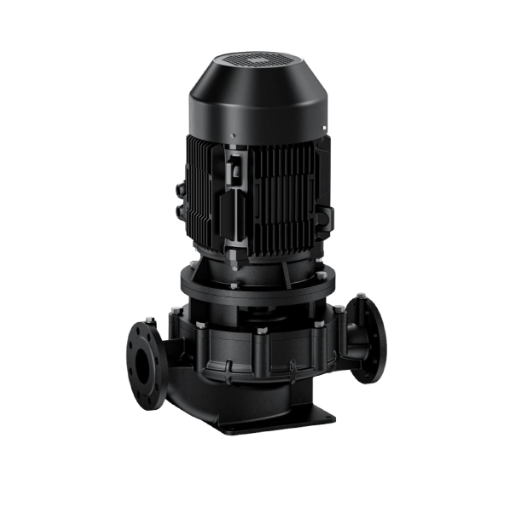
Vertical Inline Pumps — Space-Saving HVAC & Water Circulation
BBP vertical inline centrifugal pumps install directly in the piping line- no baseplate, no foundation pit, no separate alignment routine. Flow from 10 to 12,000 GPM, heads up to 560 ft, 175 PSIG standard, ISO 9001 listed. Designed for commercial, district cooling, municipala80 booster stations, and industrial circulation loops
Request a QuoteStandard & Compliance
ISO 9001
API 610
ISO 21940
ISO 9906
Configuration
API 610 OH3 / OH4 / OH5
Flow Range
10 – 12,000 GPM
Head Range
Up to 560 ft
Working Pressure
175 PSIG (300 opt.)
Balance Grade
ISO 21940 G6.3
Performance Test
ISO 9906 Grade 2B
All Personas
Space-Constrained Pumping in HVAC and Water Systems — How Vertical Inline Pumps Solve It
Mechanical rooms shrink on every retrofit cycle. Chiller plants get pushed into former storage closets. High-rise booster rooms end up sharing space with fire risers and electrical gear. In that environment, a vertical inline pump earns its place by removing three line items from the install sheet — the baseplate, the grouted foundation, and the field-alignment routine. Suction and discharge nozzles sit on the same centerline, so the pump drops into the existing pipe run the way a valve would. The motor mounts above the volute, either close-coupled (API 610 OH5) or rigidly coupled through a C-face adapter (OH4), depending on the head and shear load.
This matters to the three people who sign off on the project.

HVAC Engineer
For the HVAC engineer, the close-coupled or split-coupled configuration means shaft alignment is factory-set — field crews no longer inherit the tolerance-stacking problem that plagues horizontal baseplate installations.

Procurement Lead
For the procurement lead, deleting the baseplate and grouted foundation cuts scope from the civil contractor and shortens the critical path.

Facilities or Project Manager
For the facilities or project manager, the back-pullout design lets a maintenance team access the mechanical seal, impeller, and wear rings without breaking any piping — so a seal change does not drain a building loop.
These benefits apply within a clearly delineated duty band — chilled and condenser water circulation, closed hydronic heating loops, commercial water supply boosters, cooling tower return, light chemical transfer, and UL 448 listed fire protection service. Outside that band (NPSHa-limited suction, heavy abrasive slurry, or flow above 12,000 GPM) we recommend a different pump family and will say so directly when we review your duty point.
Not sure if vertical inline is the right fit for your application?
Send your flow, head, and fluid dataBBP Vertical Inline Pump Series — Models and Selection
Engineer · Procurement
Four series cover the hydraulic envelope. Each one is built on the same in-house casting, heat-treating, machining, assembly, and hydrostatic-test line described in the manufacturing chain section below, so dimensional tolerances, balance quality, and mechanical seal fits stay consistent across the catalog.
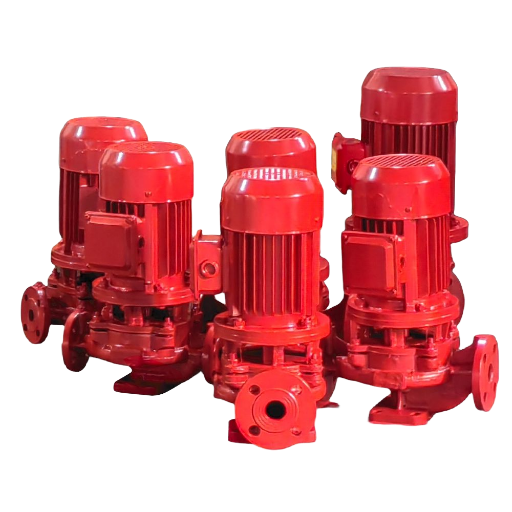
BBP-ISG
Single-stage vertical inline — our HVAC workhorse. Close-coupled (OH5) and split-coupled (OH3) variants. Cast iron standard; stainless and bronze trim on request.
- Flow: 10 – 2,500 GPM
- Head: 10 – 175 ft
- HP: 0.75 – 60
- In-out: 1.5″ – 10″

BBP-ISGD
Split-coupled heavy-duty inline for large flow loops — cooling towers, district cooling mains, municipal water supply. Bearing-bracket (OH3) construction for higher shaft loads.
- Flow: 100 – 12,000 GPM
- Head: 20 – 560 ft
- HP: 10 – 400
- In-out: 4″ – 13″

BBP-ISWB
Vertical inline multistage — for high-rise booster loops, reverse-osmosis skids, and pressure-critical circulation. Stainless steel 304 or 316 hydraulics standard.
- Flow: 50 – 800 GPM
- Head: 100 – 900 ft
- HP: 10 – 250
- In-out: 2″ – 6″
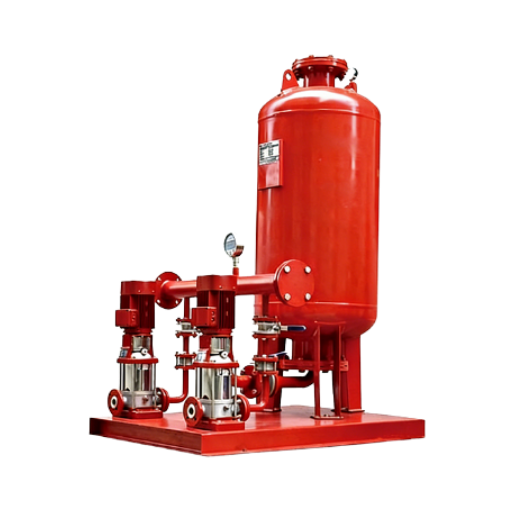
BBP-ISGF
Vertical inline fire pump — engineered to UL 448 with NFPA 20 compliant performance. For space-constrained fire riser rooms in high-rise and commercial projects. Available on request with FM approval.
- Flow: 50 – 1,500 GPM
- Head: 100 – 400 ft
- Listing: UL 448 / NFPA 20
- Material: Cast iron, bronze
Decision Matrix — Application to Recommended Series
Drop this matrix into your preliminary equipment schedule, then send us the specific duty point (flow, head, fluid, temperature, NPSHa) for a firm selection.
| Application | Flow Range | Head Range | Recommended Series | Standard Material | Typical NPSHr | Typical HP |
|---|---|---|---|---|---|---|
| HVAC chilled water | 50 – 2,500 GPM | 30 – 175 ft | BBP-ISG | Cast Iron | 6 – 10 ft | 2 – 60 |
| Building water supply | 10 – 500 GPM | 100 – 400 ft | BBP-ISG / ISWB | CI or SS 304 | 6 – 12 ft | 3 – 50 |
| Cooling tower loop | 200 – 5,000 GPM | 40 – 120 ft | BBP-ISG / ISGD | Cast Iron | 8 – 14 ft | 10 – 150 |
| Municipal booster station | 500 – 8,000 GPM | 80 – 350 ft | BBP-ISGD | CI or Duplex | 10 – 16 ft | 25 – 400 |
| High-rise booster | 50 – 500 GPM | 300 – 900 ft | BBP-ISWB | SS 304/316 | 8 – 14 ft | 10 – 250 |
| Light chemical transfer | 50 – 1,000 GPM | 30 – 200 ft | BBP-ISG (SS) | SS 316 / Bronze | 6 – 12 ft | 5 – 75 |
| Fire protection (NFPA 20) | 50 – 1,500 GPM | 100 – 400 ft | BBP-ISGF | Cast Iron, bronze trim | per UL 448 curve | UL-rated |
Vertical Inline vs. End Suction vs. Horizontal Split Case — Performance Comparison
Pump selection rarely comes down to a single best arrangement. Each centrifugal family owns a region of the flow-head chart and its own set of install constraints. Below, the comparison lays out the numbers so your team can route the right body style to each loop in the project.
[Image of a horizontal split case centrifugal pump]| Criterion | Vertical Inline | End Suction | Horizontal Split Case |
|---|---|---|---|
| Floor footprint | Up to 60% smaller vs. end-suction baseline | Baseline (with baseplate & grouted foundation) | 2 – 3× larger than end-suction baseline |
| Install scope | Drops into pipe run; no baseplate, no foundation | Baseplate + grouted foundation + field alignment | Baseplate + foundation + double alignment (pump & motor) |
| Typical NPSHr | 6 – 12 ft | 4 – 10 ft | 4 – 8 ft (double suction) |
| Shaft coupling | Close-coupled (OH5) or rigidly coupled C-face (OH4) or bearing-bracket flex-coupled (OH3) | Bearing frame + flexible coupling | Bearing frame + flexible coupling |
| Service access | Back-pullout; seal service with piping intact | Remove from piping to access impeller | Lift upper split casing; rotor stays supported |
| Practical GPM ceiling | ~12,000 GPM (ISGD series) | ~8,000 GPM | 20,000+ GPM (our horizontal split case series covers this range) |
| API 610 classification | OH3 / OH4 / OH5 | OH1 / OH2 | BB1 / BB2 |
Straight Talk on NPSHr
Vertical inline pumps typically run 2 – 4 ft higher NPSHr than an equivalent end-suction design at the same duty point. On a suction-limited application — say, a cooling tower sump with marginal elevation, or a hot-water loop above 190°F — that difference matters. Our standing recommendation: confirm your NPSHa ≥ 1.5 × published NPSHr, and if the margin is tight, move to the BBP-ISWB multistage series to split the head across stages and drop the per-stage NPSHr. We will flag it during selection review rather than have you discover it at commissioning.
A senior pump engineer put it cleanly in a recent discussion thread: vertical inline pumps “aren’t inherently less durable if selected and installed correctly.” That is the whole job — selected correctly against the duty point, installed with NPSHa headroom, and commissioned with a proper strainer and isolation arrangement. Get those three right and vertical inline earns its space savings without paying for them in reliability.
5-Year TCO Framework · Silver Tier
Where Vertical Inline Saves Money Over a Building Lifecycle
Space cost
mechanical-room square footage runs $200 – $600 per sqft in commercial retrofits; reclaiming 40 – 60% of the pump footprint recovers usable building area.
Install labor
deleting the baseplate, foundation, and double-alignment routine removes a full civil-trade scope and roughly half a day of millwright labor per pump; measured by schedule rather than dollars, the effect shows up in crane days avoided.
Energy
VFD-driven vertical inline pumps appear as standard components in deep-energy retrofits, documented in the IEA EBC Annex 61 case studies as part of heat-pump and chilled-water loop upgrades that land in the 15 – 35% building-energy-reduction band.
Maintenance
back-pullout service means mechanical seal replacement is a bench job, not a piping job, so downtime drops to hours rather than a full shift.
Parts availability
BBP keeps mechanical seals, bearings, impellers, and shafts on the shelf for active series, with most items dispatched within 7 days.
This framework is directional. For a numbered TCO against your specific building load profile, send your current equipment schedule and utility rates and we will build a case-specific analysis.
Customer Results — Real-World Deployment

Office Tower HVAC Primary Loop — Mid-Rise Retrofit
8 × BBP-ISG 6″ | 1,200 GPM
A mechanical-room retrofit replacing eight aged end-suction pumps. The replacement deleted the baseplate scope, recovered half the floor, and consolidated alignment check. Loop pressure stability within ISO 9906 Grade 2B was reported by the commissioning team.

Municipal Booster Station — Mid-Size Utility Service
4 × BBP-ISGD 10″ | 4,500 GPM
Booster station using bearing-bracket (OH3) construction for higher shaft-load margin. Split-coupled design let the team pull the seal without disassembling the manifold. Eighteen months in continuous service with no alignment issues.

Deep Energy Retrofit — Industry Benchmark Study
IEA EBC Annex 61 | VFD Context
Documented as standard components in heating/cooling side upgrades. Reported primary energy reductions into the 40 – 60% band for full-scope retrofits. Selected for space efficiency and serviceability.
Procurement · Engineer
Certifications, Materials, and Manufacturing Standards
Certification and material traceability are where “China-made” procurement decisions are won or lost. We publish the standards we hold against, the testing tolerances we accept the pump against, and the process sequence inside our own factory. No sub-contracted castings, no brokered machining.
ISO 9001:2015
Quality management system · Pump design, manufacturing, service
ISO 9906 Grade 2B
Hydraulic performance acceptance · ±8% flow, ±5% head, +8% power
ISO 21940 G6.3
Rotor balance quality · Industrial pump impeller standard
CE Directive 2014/68/EU
Pressure Equipment Directive (PED) · EU market access
UL 448
Fire pump listing · Available on BBP-ISGF series on request
NFPA 20 compliant
Fire protection system design · ISGF series performance curves
API 610 Reference
OH3, OH4, OH5 configurations per 11th Ed. classification
ASME B73.2 Reference
Vertical in-line chemical process pump dimensional reference
Material Schedule
| Component | Standard Material | Upgrade Options |
|---|---|---|
| Casing | Cast Iron GG25 (EN-GJL-250) | Ductile Iron GGG40, SS 304/316, Duplex 2205 |
| Impeller | Cast Iron, dynamically balanced G6.3 | SS 304/316, Bronze ASTM B62, Duplex |
| Shaft | AISI 1045 carbon steel | SS 420, SS 316, Duplex |
| Mechanical seal | Carbon vs. silicon carbide, EPDM | SiC/SiC, tungsten carbide, PTFE bellows, API 682 cartridge |
| Trim (wear rings, sleeves) | Bronze ASTM B62 | SS 316, Stellite-faced, ceramic-coated |
End-to-End Manufacturing Chain
All primary operations run inside one Beijing facility: ferrous and non-ferrous casting with in-house heat treatment, CNC machining of volutes and impellers, rotor dynamic balancing to ISO 21940 G6.3, assembly and coating, and 100% hydrostatic testing at 1.5 × rated working pressure. Performance testing runs per ISO 9906 Grade 2B on a calibrated closed-loop test rig; customer-witnessed performance testing is available on request for tender-grade projects. Every pump ships with a traceable material certificate, hydrostatic test record, and performance curve.
Procurement · Manager
Procurement Guide — Lead Time, MOQ, and After-Sales Support
As a vertical in-line pump manufacturer with an in-house casting-to-test production chain, BBP answers procurement questions the way your sourcing team wants to see them — with firm numbers on lead time, a transparent MOQ policy, and a clear picture of what happens when something needs service. Here is how a typical BBP vertical inline order moves from quote to delivery.
Lead Time
Stocked BBP-ISG configurations in common sizes dispatch within 7 – 10 days. Standard catalog orders — any ISG or ISGD variant in a cataloged hydraulic end and a standard material — ship in 20 – 35 days from production slot booking. Custom configurations (non-standard material trim, special mechanical seal arrangements, UL-listed ISGF fire pumps, OEM private-label) run 45 – 60 days, driven by casting lead time and third-party witness scheduling where applicable. All lead times are quoted firm at order confirmation; we track each job against the quoted date and publish weekly progress reports on tender-grade projects.
Minimum Order Quantity
MOQ is 1 unit on standard catalog series, so spare-parts purchases and single-unit replacements are welcomed. OEM private-label orders carry a 10-unit minimum per series because of badging and documentation set-up.
Pricing Factors (Framework, Not Quote)
A BBP vertical inline quote is driven by five factors, and we will walk through each one with your procurement team on the first call: (1) hydraulic duty point (flow, head, and efficiency target at BEP); (2) material schedule (cast iron vs. stainless vs. duplex vs. bronze trim); (3) mechanical seal specification (standard cartridge vs. API 682 plan 53A, for example); (4) listing and certification requirements (UL 448, witness performance test, customer-specific QA plan); (5) OEM or private-label markup.
Ask for a quote once you have a firm duty point —
Request a quoteTechnical Support — Pre-Sale to Lifecycle
Our pre-sales engineering group reviews your duty point, suggests the right series, and flags NPSHa margin issues before the order is placed. Post-delivery, the after-sales team runs 24/7 remote diagnostics and will dispatch field commissioning support on international projects where the contract calls for it. Maintenance training for plant teams is available on request, either at the customer site or at our Beijing facility. Mechanical seals, bearings, and wear parts for active-catalog series ship in 7 days from the spare-parts warehouse.