Get in Touch with BBP


Engineering guide for water-moving projects
Split Case Pumps are often discussed as if they were the default solution for every high-flow water system. This isn’t the case. Instead, ask whether the hydraulic arrangement, physical accessibility, suction conditions, and operating schedule suit your system.
This article provide a practical guide for determining if your system and the product are a good match before engaging in a product conversation.
Before designers adopt the casing form as their automatic choice, they must evaluate the piping diagram, source elevation, liquid temperature, operating schedule, driver control strategy, accessibility for lifting the upper section, isolation route, anticipated maintenance practices, and acceptance records, because relying solely on a sound pump curve won’t prevent poor outcomes if the installation or operating conditions are overlooked.
Scope Note: this article addresses the standard axially split double-suction centrifugal pump. In the wider context of the Hydraulic Institute’s between-bearing classifications, radially split and multistage pump types are considered distinct categories and aren’t addressed in this article as equivalent selection problems.
Split casing: what is a split case pump?
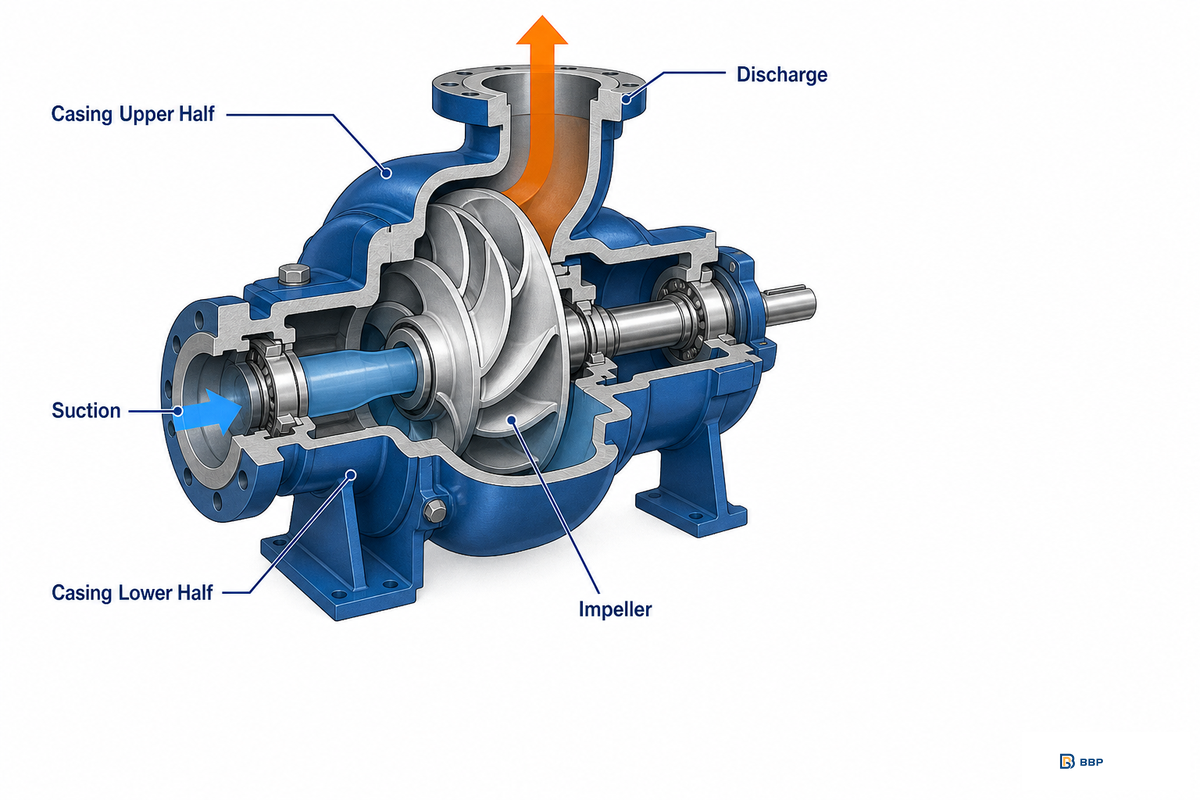
A split case pump is a centrifugal pump whose split case design divides the casing horizontally—split into two complementary sections—to give easy access to internal components; in a common single-stage double-suction layout, the bearings support the shaft while impeller design, centrifugal force, and hydraulic forces determine whether the opposing inlets can reduce axial load at the assigned duty.
Although the mechanical configuration is important, it doesn’t determine the pump selection. Factors such as flow range, required head, liquid temperature, suction conditions, room dimensions, operating hours, and service accessibility still dictate whether the configuration is a reasonable option. DOE treats pump selection, system evaluation, maintenance, and efficiency testing as integrated aspects of a project, rather than separate equipment decisions.
This document uses DOE information for system-level operating guidelines and not as a statement that an axially split, double-suction pump meets product compliance standards. DOE also has test procedures for designated commercial and industrial pump classes; the agency’s final rule for 2023 didn’t include between-bearing pumps in the scope of those test procedures, though they were considered.
Verify the specific standards and approvals applicable to the project, location, liquid, and intended service.
The split line can make internal inspection easier.
It shouldn’t be presented as a promise of reduced downtime. Service time is influenced by the accessibility of lifting equipment, isolation arrangements, operational procedures of personnel, spare parts availability, and the actual condition of the pump.
Why the double-suction arrangement changes the conversation
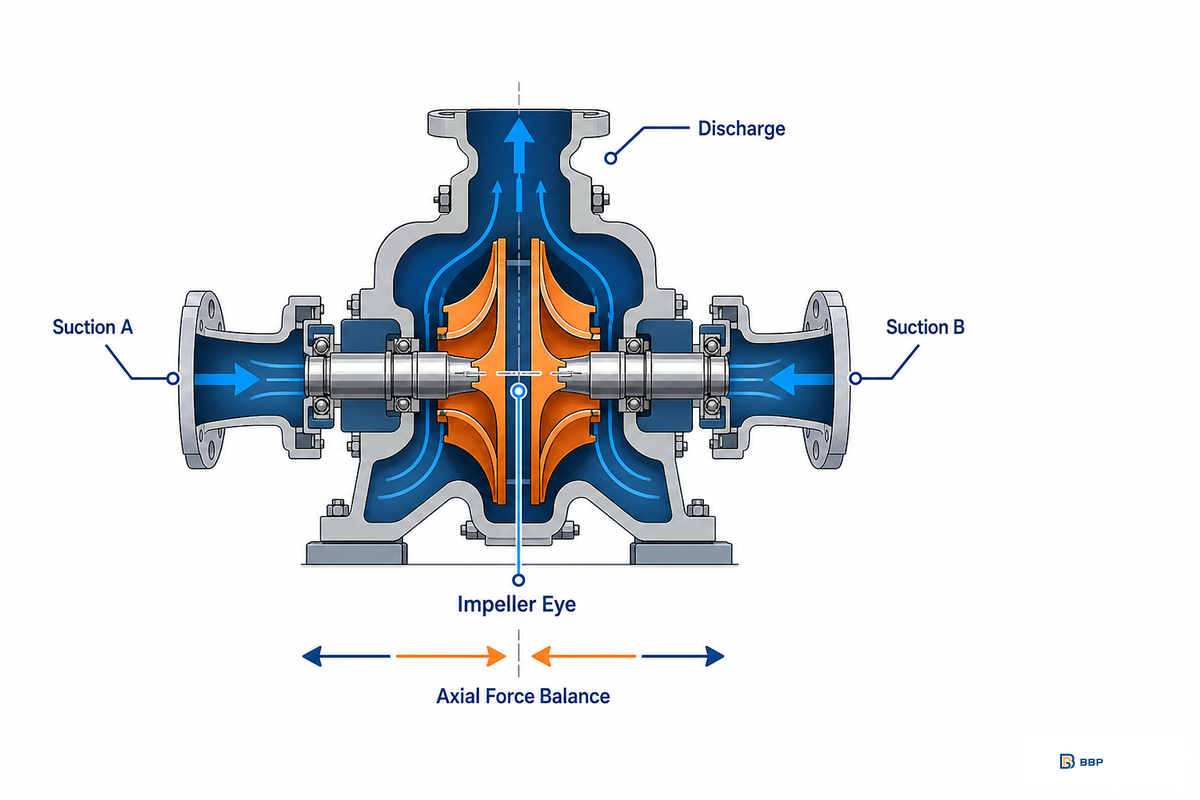
With a double-suction impeller, the incoming flow is distributed into two impeller inlets. This design is often considered for water supply duties where a well-supported rotor arrangement is needed. While the split inlet is a construction feature, it’s not a guarantee of specific suction performance in other systems.
Consult the actual performance curve and operating conditions, rather than assuming a performance benefit based solely on the product family.
Instead of assuming suction performance from a family designation, ask for the pump curve at the assigned duty. A simple, concrete required-NPSH example: in operating ranges where NPSH margins are tight, simple speed scaling based on an arbitrary assumption is less reliable than curve or test data.
Selection principle: a split casing changes service access; the system curve, suction margin, installation conditions, and acceptance evidence still control the decision.
Current HI guidelines recommend considering NPSH margin as application-specific-review the lowest available NPSH, and how both available and required NPSH curves are behaving as you cross the operating range. This is more informative than presenting double suction as a generic suction benefit.
Horizontal split case pumps and vertical layouts: start with layout, not labels
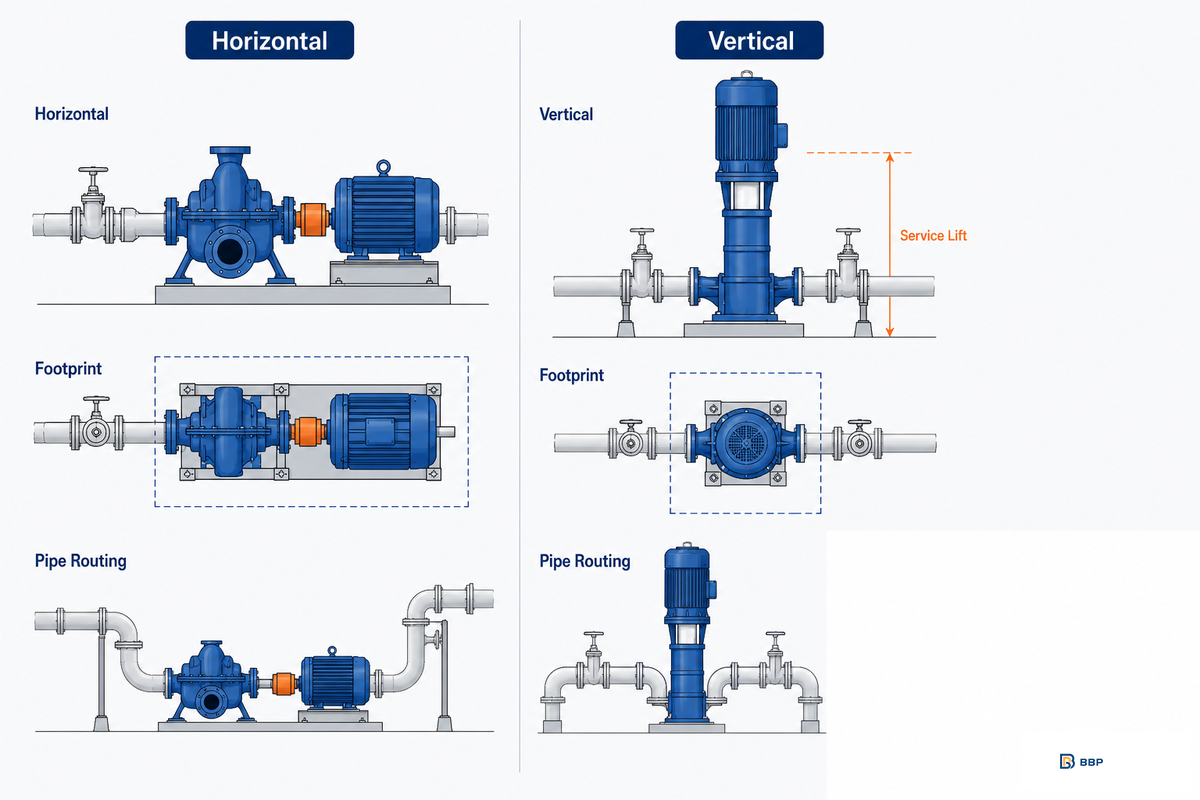
Orientation should follow a pump selection tool that records whether the unit must be handled horizontally or vertically, its installation space and space for installation above the casing, the lifting route, piping loads, driver access, and whether an in-line arrangement would prevent planned service access.
BBP’s own product data sheets treat the selection between horizontal split case pumps and vertical arrangements as being layout driven rather than an inherent advantage. This approach to describing orientation for an informational guide is correct; DOE pump-system guidance similarly keeps selection at a system level, so evaluate the constraints in light of the layout drawings and the selected pump installation document.
The 4-Route Flow-System Fit Map
| Project signal | Question to resolve | Direction to investigate |
|---|---|---|
| Wide flow variation | Where do normal and low-load points fall on the curve? | System curve, control method, and parallel operation |
| Tight suction margin | What does the certified required-NPSH curve show at every point? | Suction piping, source elevation, temperature, and margin review |
| Limited floor area | Which orientation leaves safe service and lifting access? | Room model and maintenance route review |
| High service criticality | What evidence must be retained for future operation? | Acceptance data, baseline readings, spares, and procedures |
Split case vs. end-suction pumps: a conditional decision, not a ranking
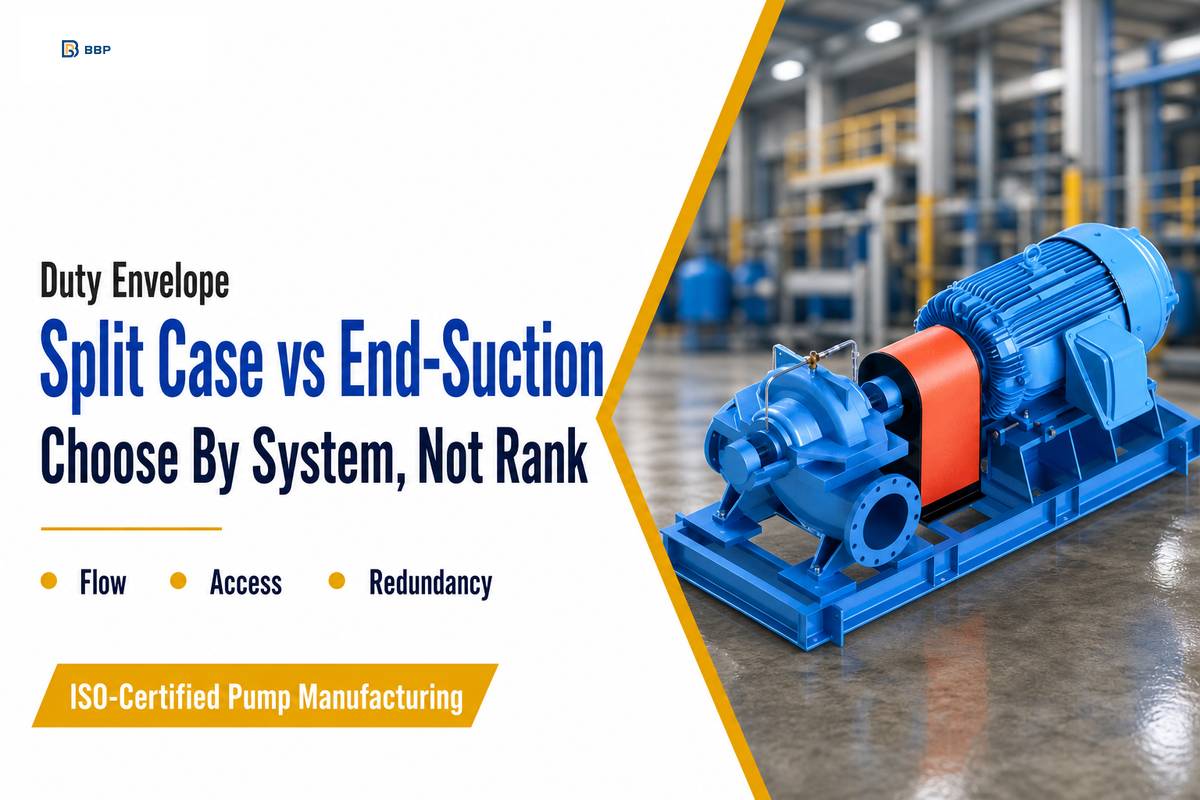
End-suction and split case pump are centrifugal-pump families. An end-suction pump is an effective solution where budget, duty point, and service configuration are aligned. A split-case arrangement deserves review where flow conditions, rotor support, access, and project importance are considered together.
Just as an under-specifying can create problems, over-specifying with a large, expensive construction can be equally counterproductive. BBP’s technical document offers a similar piece of advice: some duties don’t warrant the additional footprint and capital expenditure required for a split case pump.
Start the selection process by looking at the operating range and the system curve. DOE recommends examining the expected operating range and efficiency profile in the pump’s curve, and not merely a single operating point. Make sure this is recorded.
Common applications: where split case pumps may fit
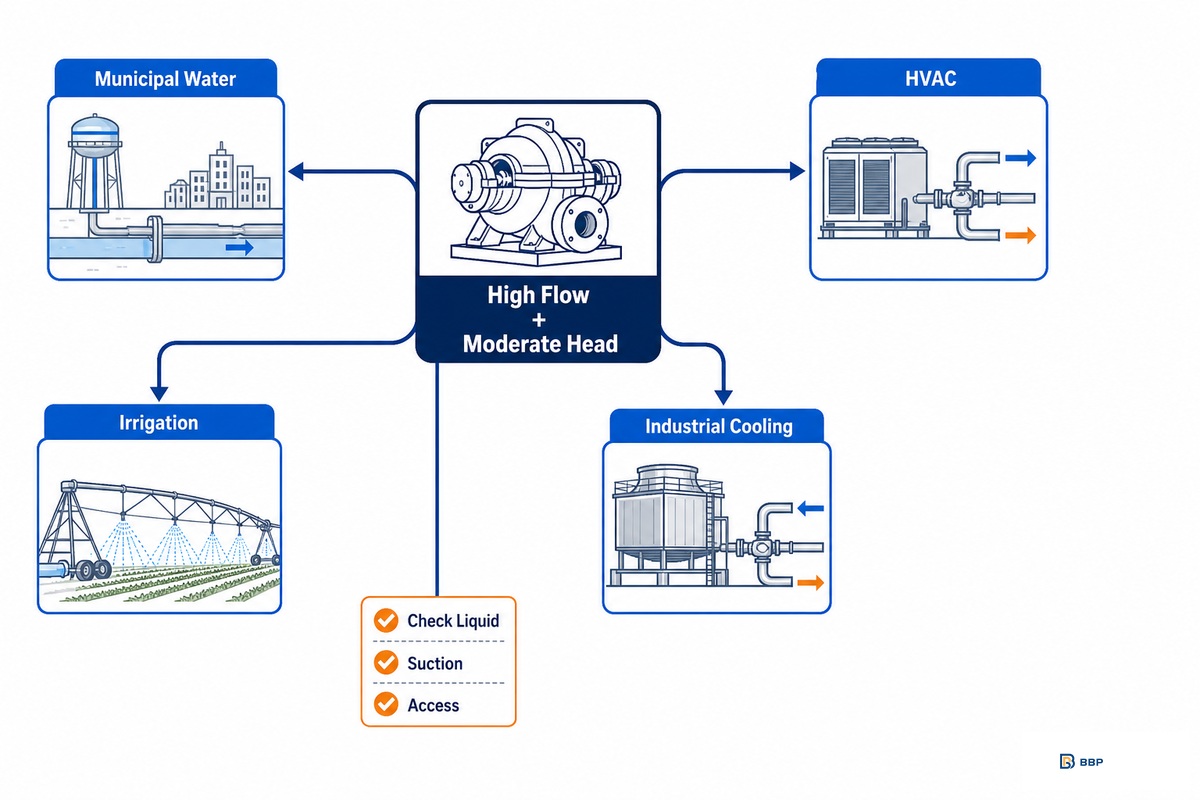
Common applications include clear-water water supply systems, municipal water supply systems and municipal water systems, HVAC systems for water circulation or cooling water, and selected industrial processes; where pumps are designed for large volumes, higher flow rates, high-velocity piping, continuous operation, or high-pressure service, fire protection systems, power plants, boiler feed, and agricultural irrigation systems each need an applicable standard and a duty-specific review.
geometry in a generic sense can be overcome with the appropriate project specific standard or requirement. For example there’s a specific latest edition of NFPA 20, for the latest edition for stationary fire pumps and AWWA E103 for the minimum design standards for horizontal centrifugal pumps and vertical line-shaft pumps in water-service applications. Use this document as a selection aid, then consult your project specific standard or specification.
EPA recommends that a water-utility energy effort should start with an energy baseline and a grasp of the impacts of energy-intensive processes, such as pumping. That would set the stage for a system discussion, not a guarantee that changing the construction of a pump will result in a certain savings.
A hold before treat a standard water-service split case pump for liquids with a relevant solids, abrasion, high/low viscosity or corrosive chemistry. The compatibility of liquids and construction should be checked at the duty itself.
Use an alignment-to-availability risk chain at commissioning
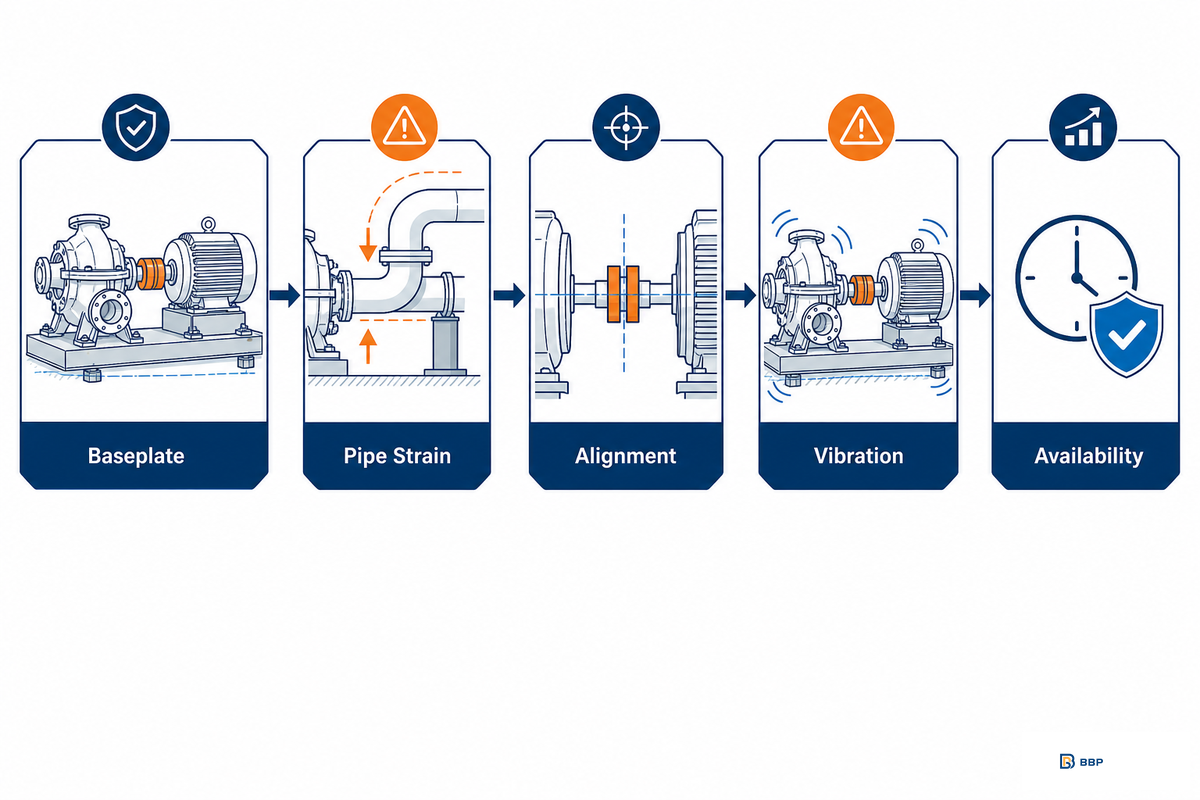
Alignment isn’t a one-time checkbox. Service wise, a machine can be aligned when off the system, then start to drift as pipe forces, base distortion, temperature change, or operating loads come into play. Commissioning should provide documentation that the installation, piping and observed operation match the application requirements.
Practical maintenance tips should treat installation and maintenance as a continuous evidence trail: a heavy-duty unit in large-scale systems does not automatically deliver long service life, reliable operation, or a highly efficient result, because lubricant setting, condition monitoring, work practices, and energy consumption all affect reliability and efficiency as well as ease of maintenance.
There are mechanical checks of pipe support and potential nozzle loads. The alignment can be influenced by the combination of pipe strain, hydraulic pressure reactions, thermal growth, base condition and hold-down arrangement. A coupling reading isn’t the installation verification.
What does this mean for practitioners? It provides a practical warning: repeated seal failure or poor reliability may have multiple contributing factors. Use vibration, temperature, pressure, leakage, lubrication quality, and piping information together; do not use the casing design to solve every symptom.
Split case pump maintenance tips: when access supports a real maintenance plan
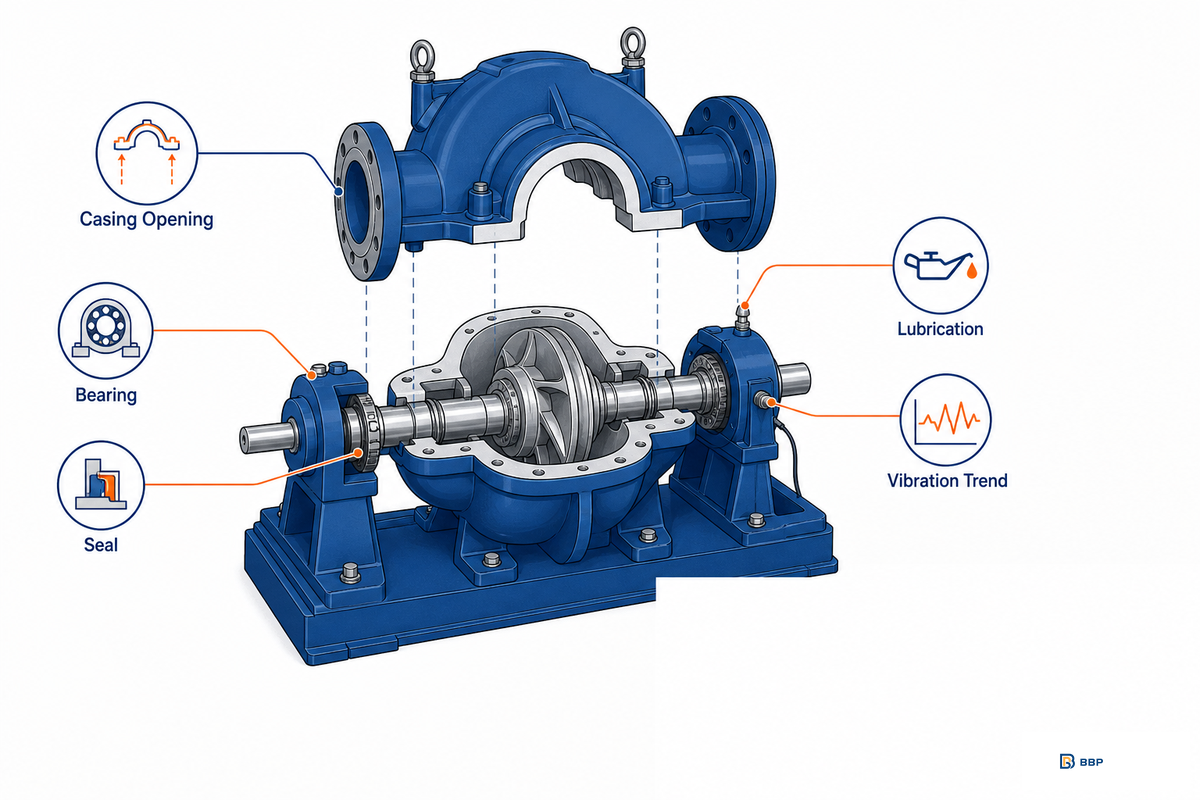
A split casing may support easy maintenance by easing access to internal work, avoiding a requirement for all service work to become a pipe-removal task. That split casing access can help when the pump room has isolation points, lifting space, a safe work route, documented clearances, and staff able to use the available evidence. Each split casing service plan should state which inspections require opening the casing and which can be completed with it shut. A split casing is an access feature, not a substitute for that plan.
When designing, access and safety can’t be separated. OSHA requires protection against rotating components, including pump shafts. Follow all site procedures before performing service.
Create a plan based on observations, not a one-size-fits-all template. Trend readings and assess the conditions that matter to the selected pump. Use the original equipment manufacturer’s lubricant type, interval, acceptable readings, and disassembly order. Service life depends on operating conditions and care; high efficiency at the intended operating point is one item in the evidence set. One manufacturer manual notes that excess grease can raise bearing temperature, so more maintenance is not automatically better maintenance.
The 10-Point Split-Case RFQ Evidence Sheet

Use this work sheet to identify project specific data prior to purchasing the equipment and at technical review.
| Evidence type | Why it matters | Project prompt |
|---|---|---|
| 1. Duty-point statement | Anchors all later checks | State flow in m³/h or gpm and head in m or ft |
| 2. Operating envelope | Avoids selection at one isolated point | Show normal, minimum, and maximum cases |
| 3. Liquid data | Sets compatibility and suction assumptions | Give °C or °F, solids, chemistry, density, and viscosity |
| 4. System curve | Shows where the pump will run | Separate static head from friction head |
| 5. NPSH evidence | Checks suction margin at duty | Compare available and required values in m or ft |
| 6. Arrangement drawing | Tests access before installation | Show nozzles, driver, lift path, and service clearances |
| 7. Driver review | Matches drive to actual operating range | State voltage, frequency in Hz, speed in rpm, and control approach |
| 8. Material statement | Connects construction to liquid conditions | List wetted parts and project assumptions |
| 9. Acceptance basis | Makes performance verification auditable | State requested test method, tolerance, and report format |
| 10. Handover baseline | Supports future diagnosis | Retain approved curve, readings, alignment record, and O&M plan |
ISO 9906 provides a basis to determine acceptable hydraulic performance characteristics. When developing a project specification, define the applicable basis of test and who is responsible for providing required documentation. Also, include if acceptance testing covers the pump or an entire assembly.
Remember two distinctly separate data sets; a controlled factory test or laboratory acceptance test on a particular pump assembly versus evidence of the actual installation’s conditions after installation and startup. Although both are valuable, a site pressure reading isn’t a factory test, nor does a factory curve verify the operational condition of the piping system.
What should matter most to a buyer?
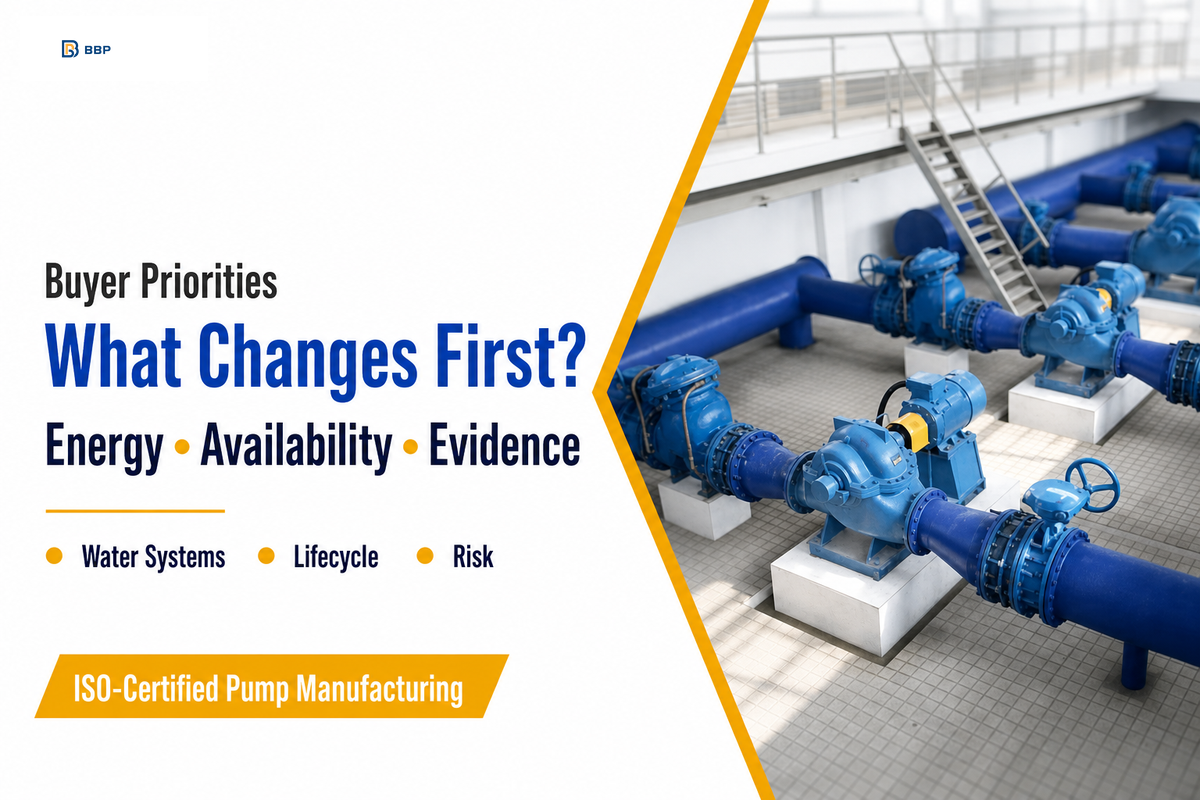
Evidence quality must come first. Use the system curve, operating envelope, suction operating conditions, available space, work routing, and a test basis at the actual operating duty to reach a defensible decision instead of relying on a summary list.
When the duty envelope points to an axially split, double-suction configuration, the next step is a project-specific technical discussion rather than a generic promise. Readers who need to compare project-specific configurations can continue to BBP Manufacturing’s Split Case Pumps solution page. That page is intentionally the commercial destination; this article remains the decision guide.
Beijing Beibangpu Co., Ltd. provides pumps, OEMs, spare parts and lifecycle services. Its first-party context isn’t intended as a replacement for an individual project’s operating and point-of-use evaluation.
Frequently asked questions
For the suction-margin context behind the answers below, review the Hydraulic Institute’s NPSH guidance alongside the selected pump documentation.
What is a split case pump used for?
Use an axially split, double-suction pump where the actual water duty, suction conditions, layout, maintenance route, and acceptance plan justify that configuration. It is common in large clean-water duties, yet it is not a default choice for every flow rate or building room. Compare the system curve and the project constraints before selecting a pump family.
What is the difference between a split case pump and an end-suction pump?
An axially split, double-suction pump has a divided casing and commonly supports the impeller between bearings. An end-suction pump usually has single-side inlet flow and an overhung impeller. Split case construction can change access, rotor support, and suction considerations, while an end-suction unit can be sensible for many duties. Compare the exact system curve, operating range, physical layout, maintenance route, driver arrangement, available lifting access, and evidence needed at handover rather than ranking the categories in isolation.
Are horizontal and vertical split case pumps the same?
Both orientations raise the same duty-point and evidence questions, but they create different demands on floor area, height, piping routes, lifting access, and service procedure. A vertical arrangement may suit a constrained footprint, while a horizontal arrangement may suit the available maintenance route. Resolve the room model and project duty first, then confirm the final arrangement, nozzle loads, and service clearances in the approved drawing.
Do split case pumps need alignment checks?
Yes. Alignment should be verified according to the selected pump and driver instructions, then considered again after piping connection and under the project’s operating conditions. Unsupported piping, a shifting base, thermal movement, or an adjustment made during commissioning can affect the final result. Record the approved method and the relevant baseline readings so later work can be compared with the handover condition. If vibration, bearing temperature, seal condition, suction pressure, discharge pressure, or operating point moves away from that baseline, investigate the system before assigning blame to the pump construction alone, because a casing split does not explain every field symptom.
What should I request before selecting a split case pump?
Start with duty-point and liquid data. Ask for the curve and NPSH evidence, review the arrangement drawing and maintenance route, agree the acceptance basis, and retain commissioning readings and the O&M plan.
Sources used in this guide
- U.S. Department of Energy — Pump Systems
- Hydraulic Institute — A Guide to Pump System Assessment
- U.S. EPA — Energy Efficiency for Water Utilities
- ISO 9906:2012 — Rotodynamic pumps hydraulic performance acceptance tests
- OSHA — The adequate guarding of a process pump
- AWWA — Water-service pump standards overview
- Hydraulic Institute — Between-bearing pump types
- Hydraulic Institute — 2024 NPSH margin updates

![Cavitation in Slurry Pumps NPSH Solids Onset [Field Guide]](https://bbpmfg.com/wp-content/uploads/2026/07/cavitation-in-slurry-pumps-featured-1-150x150.png)