Get in Touch with BBP

BTU/hr to kW Converter: Formula, Chart, and Examples


Updated August 2026
BTU/hr to kW is a power-unit conversion that expresses the same heat-transfer rate in two measurement systems.
To convert btu/hr to kw, multiply the BTU per hour value by 0.0002930710701722222. For example, 12,000 BTU/h equals 3.5168528421 kW, usually displayed as 3.5169 kW. This is a conversion of power or heat-transfer rate. It doesn’t automatically tell you an air conditioner’s electrical input, a boiler’s useful output, or a motor’s required size. Below, the calculator uses the International Table Btu, written Btu-IT, as its declared convention and works in both directions.
1 BTU/hequals 0.0002930711 kW
1 kWequals 3,412.1416 BTU/h
12,000 BTU/hequals 3.5169 kW capacity
BTU per hour to kilowatt converter
Convert between BTU per hour and kilowatt. The unit changes; the measured quantity does not.
Result
kW
1 BTU/h = 0.000293 kW
Enter 0 or more — a negative value is not a valid reading for this quantity.
This entry is ambiguous. Use a comma only as the decimal mark, for example 1,5, and do not type thousands separators.
BTU/hr to kW Formula
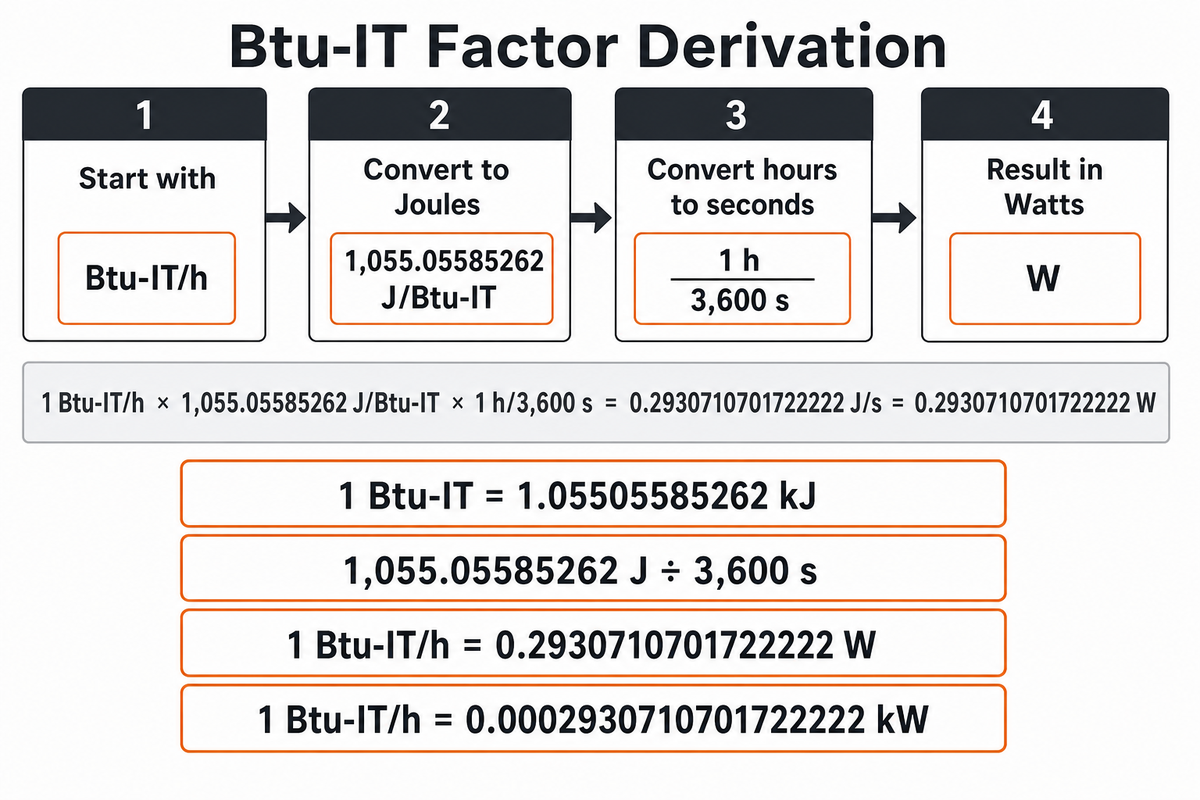
The forward formula is:
Power in kW = power in BTU/h × 0.0002930710701722222
You can also divide by the reciprocal:
Power in kW = power in BTU/h ÷ 3412.1416331279
This factor comes from an energy definition and a time interval. According to the National Institute of Standards and Technology, one International Table Btu equals exactly 1.05505585262 kilojoules. Dividing 1,055.05585262 joules by 3,600 seconds gives 0.2930710701722222 watt per Btu-IT/h. Dividing by 1,000 then expresses that power in kilowatts.
The NIST Appendix B.9 heat-flow-rate table independently lists 1 Btu-IT/h as 0.2930711 W. The table rounds the displayed factor to seven significant digits, while the derivation above retains the exact Btu-IT definition for calculation.
Under the framework maintained by the International Bureau of Weights and Measures, the watt is the International System of Units derived unit of power. That’s why BTU/h and kW can be converted directly: both describe a rate of energy transfer, even though they come from different unit systems.
One common failure occurs when an engineer copies a factor for a different Btu convention or treats the “per hour” value as a standalone energy amount. For example, when checking a 12,000 BTU/h HVAC schedule entry for an engineering drawing or procurement comparison, first confirm that the source is a power rate in Btu-IT/h; then the unit cancellation and the reverse calculation provide two independent checks.
“The exact conversion factor for the International Table Btu is 1.055 055 852 62 kJ.”
Written out, BTU means British thermal unit. Its “British thermal” wording describes the historical energy unit, while “per hour” changes the quantity into a rate. In calculations, write the destination unit after the factor: BTU/h × kW per BTU/h = kW. Cancelling the repeated unit is a simple dimensional check and makes it harder to confuse a power conversion with an energy calculation.
Which BTU definition does the calculator use?
The BTU/hr to kW calculator uses Btu-IT, the International Table Btu commonly used for HVAC capacity conversions. That choice needs to be explicit. NIST also lists the thermochemical Btu and several temperature-specific historical Btu definitions, each with a slightly different joule value. If a legacy specification names another convention, use the factor attached to that convention instead of silently applying the Btu-IT factor.
Although the arithmetic factor can be exact, the source value may be rounded. Nameplate markings such as 12,000 BTU/h don’t justify reporting an operating result to ten decimal places. Keep full precision in the calculation, then round the displayed value to the precision appropriate for the input and the decision.
Common HVAC Capacity Worked Examples
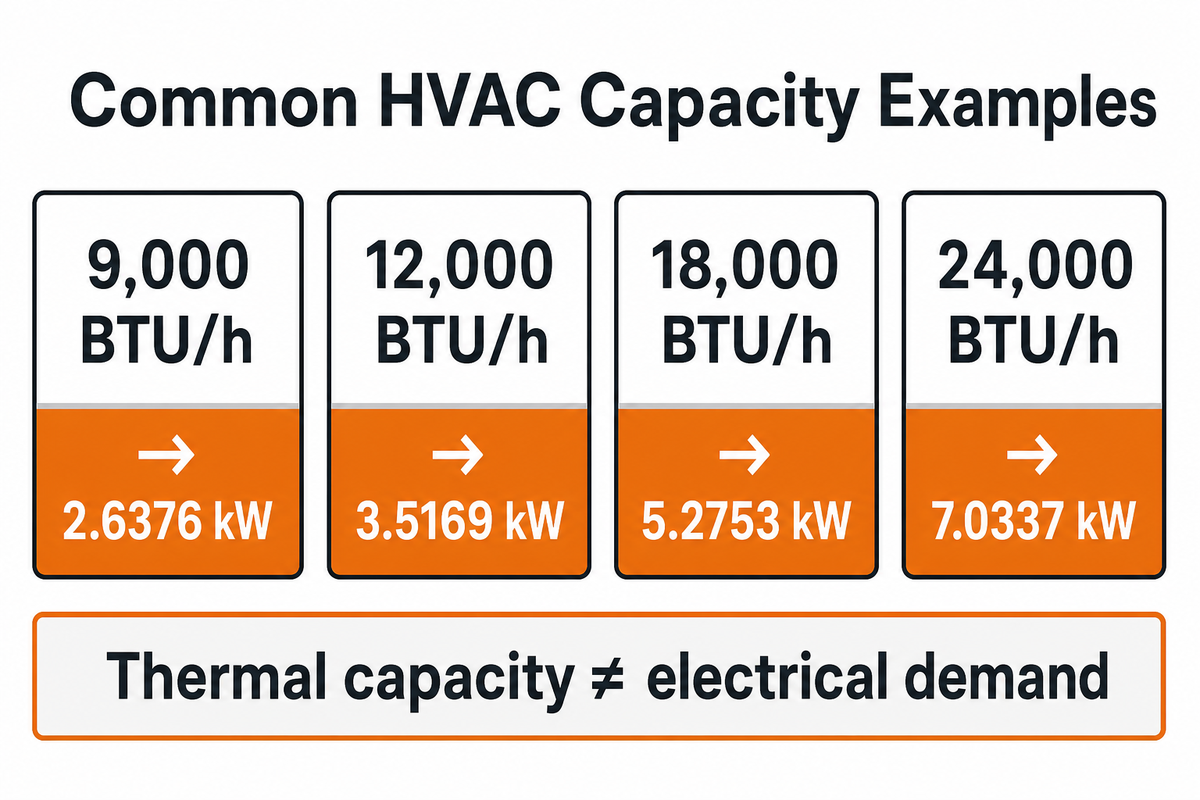
HVAC nameplates frequently use round BTU/h capacity classes. Each example below applies the same Btu-IT formula. The result describes the same thermal rate in kilowatts; it is not yet an estimate of electrical demand.
When comparing two catalogs, use the NIST Btu-IT definition for both values and keep the original rating condition beside each result. One common mistake is to compare a converted nominal capacity with an operating measurement taken at a different ambient temperature, which can make correct arithmetic support the wrong equipment decision.
How much is 9,000 BTU/h in kW?
9,000 × 0.0002930710701722222 = 2.6376396316 kW. For a practical display, use 2.6376 kW. Reverse-check it by multiplying 2.6376396316 by 3412.1416331279, which returns approximately 9,000 BTU/h. This remains thermal capacity in that document unless the source label identifies another physical meaning.
How much is 12,000 BTU/h in kW?
12,000 × 0.0002930710701722222 = 3.5168528421 kW. Displayed to four decimal places, that’s 3.5169 kW of thermal capacity. It doesn’t mean the equipment draws 3.5169 kW of electricity. Use efficiency data for the equipment to estimate electrical input separately.
How much is 18,000 BTU/h in kW?
18,000 × 0.0002930710701722222 = 5.2752792631 kW, or 5.2753 kW to four decimal places. Those extra digits are useful for a reverse check, but the rounded nameplate input remains the limiting precision. Record the rated condition beside this converted capacity.
How much is 24,000 BTU/h in kW?
24,000 × 0.0002930710701722222 = 7.0337056841 kW, normally shown as 7.0337 kW. If two catalogs use different units, this conversion puts their capacity ratings on a common scale. It still doesn’t prove the machines perform identically under identical ambient conditions or load.
- Confirm the source label — verify that the number is a rate in BTU/h, not an energy amount in BTU.
- Confirm the convention — use Btu-IT unless the source document identifies a different Btu definition.
- Multiply once — apply 0.0002930710701722222 to obtain kW.
- Label the physical meaning — record whether the value is cooling capacity, heating output, or fuel input.
- Reverse-check the result — multiply the kW value by 3412.1416331279 and compare it with the starting value.
Large and small values obey the same linear relationship. Doubling a 12,000 BTU/h rate to 24,000 BTU/h doubles the converted capacity from about 3.5169 kW to 7.0337 kW. Halving it produces about 1.7584 kW. This proportionality is useful for checking arithmetic, but it isn’t a promise that real equipment efficiency or output scales linearly with size.
BTU/hr to kW Conversion Chart
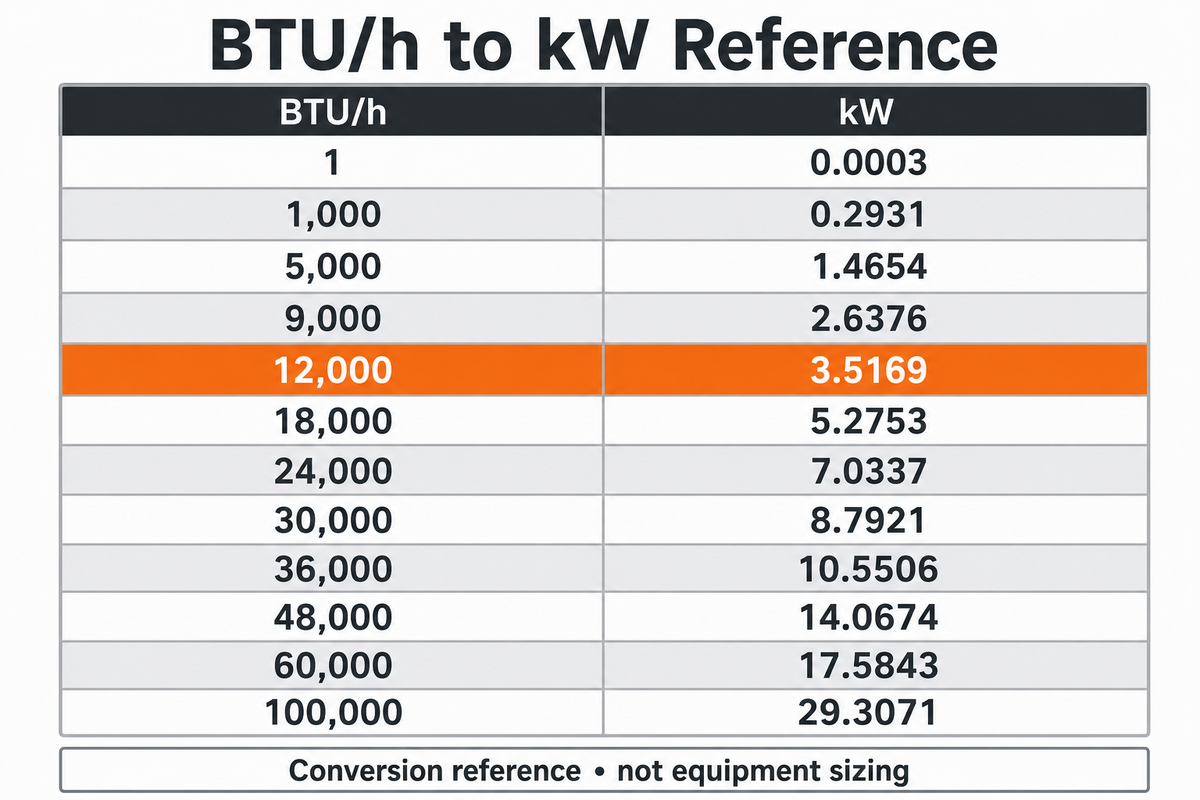
This chart uses the Btu-IT factor and four decimal places for the kW display. Values near zero may need more digits; specifications may need fewer digits if the source rating is coarse. Treat the table as a conversion reference, not an equipment-sizing chart.
For example, an engineer checking a 12,000 BTU/h catalog line should obtain 3.5169 kW with the NIST-based factor. Results near 0.0035 kW usually mean the value was divided by 1,000 twice; results near 40.95 million kW usually mean the reciprocal was applied in the wrong direction.
| BTU/h | kW | Typical interpretation |
|---|---|---|
| 1 | 0.0003 | Small heat-transfer rate |
| 1,000 | 0.2931 | Converted power rate |
| 5,000 | 1.4654 | Small HVAC capacity class |
| 9,000 | 2.6376 | Common HVAC capacity class |
| 12,000 | 3.5169 | One refrigeration-ton capacity reference |
| 18,000 | 5.2753 | Common HVAC capacity class |
| 24,000 | 7.0337 | Common HVAC capacity class |
| 30,000 | 8.7921 | Converted capacity rate |
| 36,000 | 10.5506 | Converted capacity rate |
| 48,000 | 14.0674 | Converted capacity rate |
| 60,000 | 17.5843 | Converted capacity rate |
| 100,000 | 29.3071 | Industrial heat-transfer rate |
If your value isn’t listed, use the calculator or multiply it by the factor. Enter plain digits and a decimal point. Because commas can mean a thousands separator in one locale and a decimal separator in another, removing ambiguous punctuation reduces silent input errors.
kW to BTU/hr Reverse Conversion
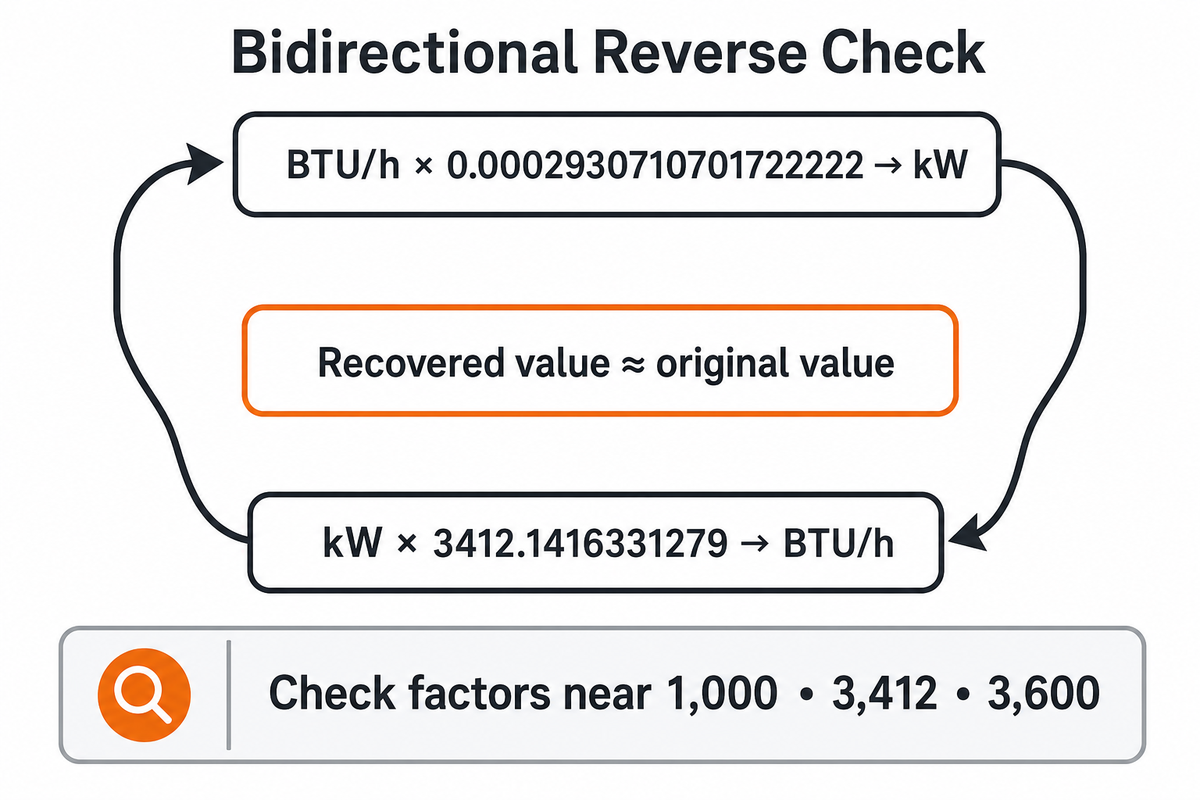
To convert kilowatts back to Btu-IT per hour, use:
Power in BTU/h = power in kW × 3412.1416331279
This reciprocal follows from the same NIST Btu-IT definition used for the forward conversion, so changing direction does not change the Btu convention.
For example, 1 kW × 3412.1416331279 = 3412.1416331279 BTU/h. The calculator displays this as 3412.141633 BTU/h. At 5 kW, the thermal rate becomes 17,060.7082 BTU/h; at 10 kW, it becomes 34,121.4163 BTU/h.
How do you reverse-check the conversion?
Use a three-part reverse check: start with the original value and unit, perform the forward conversion, then perform the inverse conversion on the result. After the inverse step, the number should return to the original value within the declared rounding tolerance. If it differs by a factor near 1,000, 3,412, or 3,600, check whether the wrong direction, unit scale, or time basis was used.
Don’t reuse the forward multiplication when converting back. Multiplying a kW value by 0.0002930710701722222 again drives the number in the wrong direction and creates a very large scale error. Write the units beside every intermediate value; the labels make a directional error easier to see.
Reverse conversion is also useful when a specification limit is written in kW but a supplier catalog is written in BTU/h. Convert the limit into the catalog unit, compare like with like, and retain the original unrounded value in the calculation record. A rounded display may suit a table, while procurement acceptance should follow the precision and tolerance stated in the governing specification.
BTU/hr, BTU, kW, and kWh Are Not the Same
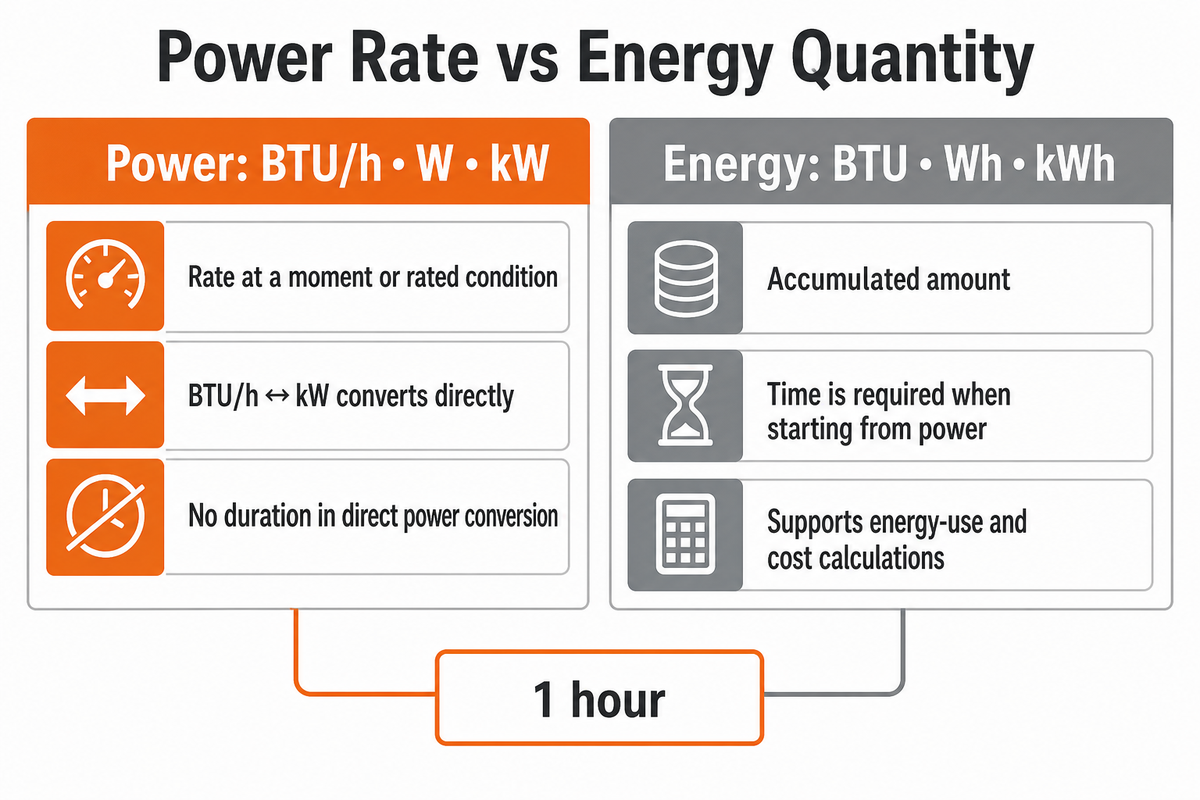
Here the slash in BTU/h matters: BTU/h and kW are power units, while BTU and kWh are energy units. Power answers “how fast?” Energy answers “how much over a period?” Direct power-to-power conversion doesn’t need an operating duration, but a power-to-energy calculation does. The distinction is consistent with the energy-to-power derivation from the NIST Btu-IT factor.
Why do catalogs use different conversion phrases?
BTU is an abbreviation for British thermal unit. Search and catalog labels such as “BTU to kW,” “convert BTU to kW,” “BTU and kW,” “BTU to kW conversion,” and “conversion table” often omit the time basis. A professional using a power conversion calculator must confirm that the source is BTU/h before treating the result as actual kW of power.
An insulation or climate calculation may estimate an amount of heat or a heat-loss requirement before anyone selects a central plant or boiler model. Boiler outputs may then be listed in BTU/h, while a boiler stove label or a document from Europe may use kW. Those planning inputs are different from the direct conversion itself.
Kilowatt-hours measure energy, not power. If a document says “using BTU” without “per hour,” first determine whether it describes an energy total or a rate; otherwise the units cannot be converted responsibly.
Power rate
- Uses BTU/h, W, or kW
- Describes a rate at a moment or rated condition
- Converts directly between BTU/h and kW
- Does not include operating duration
Energy quantity
- Uses BTU, Wh, or kWh
- Describes an accumulated amount
- Requires a time interval when starting from power
- Supports energy-use and cost calculations
How does a one-hour duration check work?
A one-hour duration check connects power to energy without pretending they’re the same quantity. Maintained for one hour, a constant thermal rate of 12,000 BTU/h transfers 12,000 BTU of energy. Its converted rate is 3.5168528421 kW; sustained for one hour, that corresponds to 3.5168528421 kWh of thermal energy. Change the duration and the energy changes, even though the power rate can remain the same.
That doesn’t mean the equipment used 3.5169 kWh of electricity. Thermal output and electrical input are separate sides of an efficiency relationship. This bridge is valid only after the physical meaning of the power value is identified.
Cooling Capacity kW Is Not Automatically Electrical Input kW
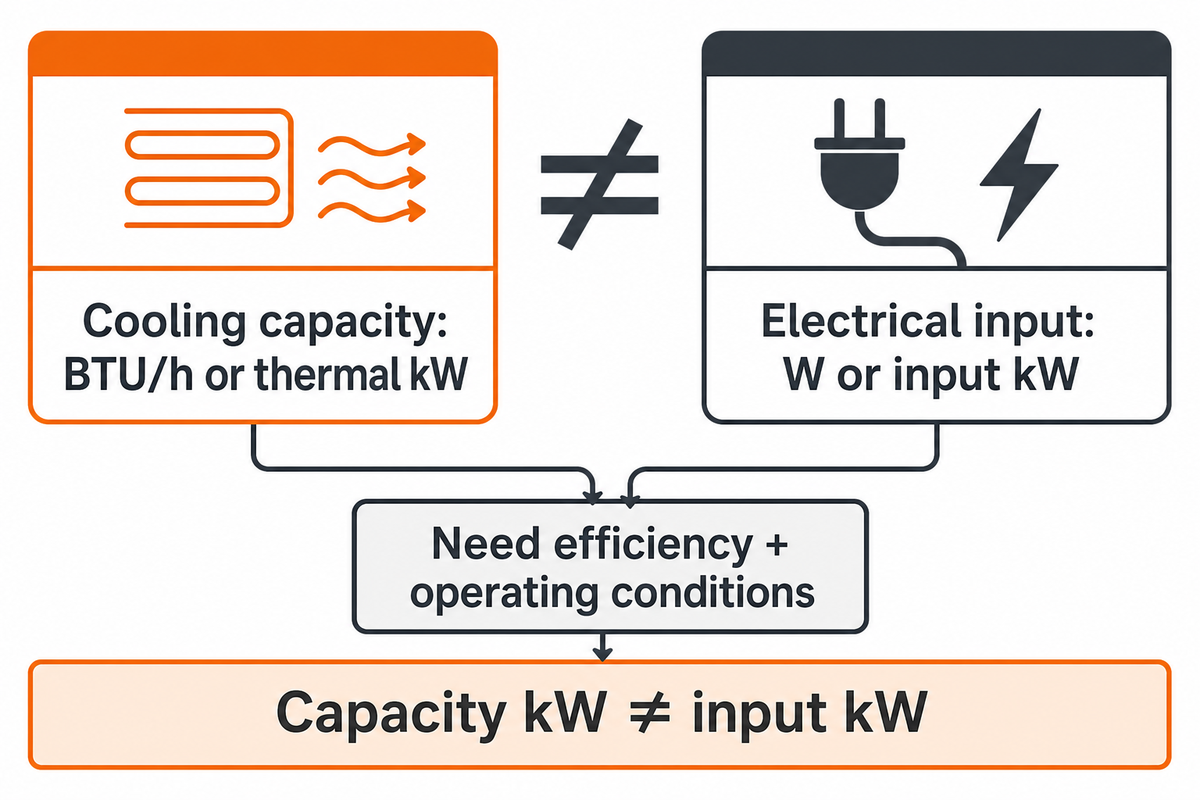
Converting a cooling rating to kW and calling the result “power consumption” is a frequent mistake. For a 12,000 BTU/h air conditioner, about 3.5169 kW is the rated cooling capacity under the stated rating conditions. Its electrical input must be measured or estimated from separate efficiency and operating data.
In the U.S. Department of Energy chiller calculator, energy efficiency ratio is net cooling capacity in BTU/h divided by total electrical input power in watts. Here, numerator and denominator are separate measurements. If capacity and input were automatically equal after unit conversion, that ratio would have no engineering purpose.
The Department of Energy’s light-commercial heating and cooling procurement guidance uses the same distinction: energy efficiency ratio compares cooling capacity with power input. A converted capacity therefore needs an efficiency rating or measured input before it can support an electrical-load estimate.
How do you separate capacity from electrical input?
A capacity-versus-input review classifies the physical flow, its input-or-output role, and its rated or operating condition. Only after those items are recorded for downstream use should the converted value enter an efficiency, cost, or electrical-load calculation for another engineering decision.
Rated and operating values can differ. Ambient temperature, entering-fluid temperature, load fraction, control mode, fouling, and the applicable test procedure can affect both delivered capacity and electrical input. The converter faithfully restates the number you enter; it does not simulate changing conditions.
Suppose a schedule lists 36,000 BTU/h of cooling. Direct conversion gives 10.5506 kW of rated cooling capacity. Estimating electrical input still requires the equipment’s efficiency data and the relevant rating point. Using 10.5506 kW as the input without that second step would be a category error, even though the unit conversion itself is mathematically correct.
BTU/h is not limited to cooling. A boiler document may state fuel-input rate or useful heat output. A furnace may list both. A process heater may state thermal duty. Each rate can be converted to kW, but the resulting kW inherits the original meaning. A fuel-input kW value does not become useful-output kW, and neither becomes electrical input unless the equipment and measurement actually use electricity that way.
Using Converted Values in Pump and HVAC Documentation
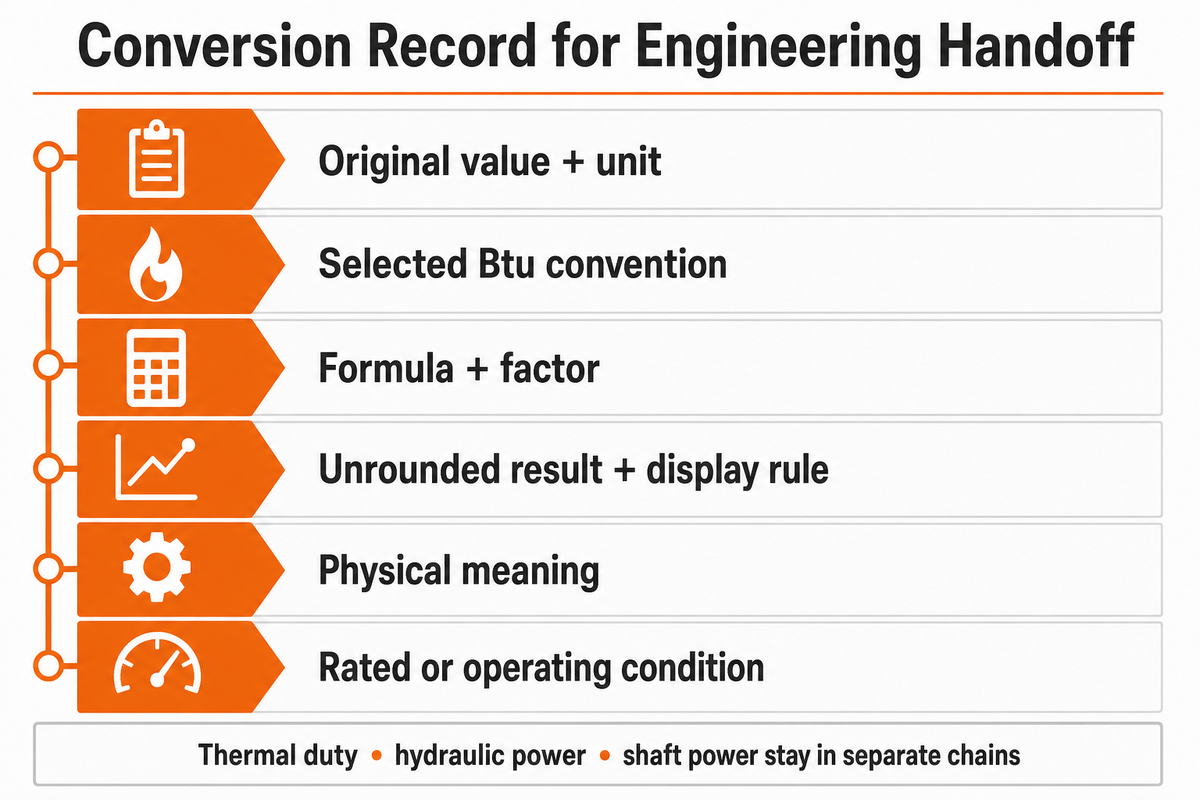
Unit conversion is useful when two documents describe the same physical quantity in different units. You can convert a heat-exchanger duty, chiller capacity, boiler input, or useful heat output into kW to make a comparison easier. Preserve the original label, rated condition, Btu convention, source revision, and display precision beside the converted value, along with the applicable NIST conversion basis.
For pump systems, thermal duty and mechanical power are different calculations. If you need hydraulic, shaft, or motor power, calculate it from flow, head, fluid properties, and efficiency; a BTU/h-to-kW conversion doesn’t supply those inputs. The same boundary applies when reviewing BBP centrifugal pump configurations or double-suction split-case configurations.
When the source document already states mechanical power in kilowatts or horsepower, use the separate mechanical-power conversion between kilowatts and horsepower rather than treating thermal capacity as shaft power.
Variable-speed comparisons add another layer. The pump affinity laws describe relationships among speed, flow, head, and power for similar operating conditions. They don’t turn thermal capacity into shaft power. Keep each physical quantity in its own calculation chain, then compare results only where the system boundary supports the comparison.
What should a converted specification record?
- Original value and unit exactly as supplied.
- Selected Btu convention, with Btu-IT stated when used.
- Formula and factor applied.
- Unrounded result and the display-rounding rule.
- Physical meaning: fuel input, heat output, cooling capacity, or another power rate.
- Rated or operating condition attached to the source value.
This record is short enough for a calculation note and detailed enough for another engineer to reproduce the conversion without guessing what “kW” meant.
When multiple documents are involved, attach the conversion note to the source revision rather than copying the result into a disconnected spreadsheet cell. That preserves traceability if a capacity changes, a supplier corrects a nameplate, or the project team later discovers that the original document used a different Btu convention. Recalculation then becomes a controlled update instead of a search for unexplained numbers.
Common Conversion Mistakes and Limits
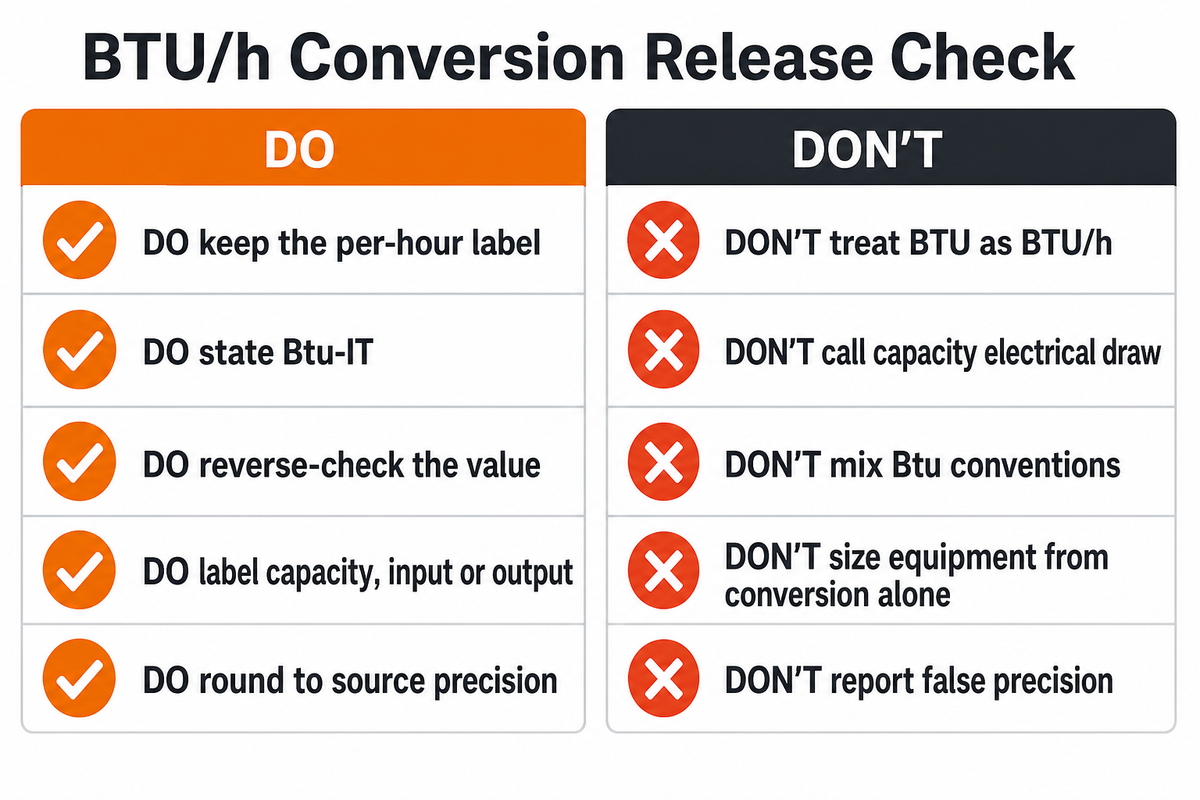
Most incorrect results look plausible because the arithmetic is simple. Check three levels: the written unit, the physical quantity, and the intended downstream use. Correct multiplication can’t rescue an incorrectly identified input, even when the numerical factor matches the NIST definition.
Do
- Keep the “per hour” label through the calculation
- State Btu-IT as the selected convention
- Reverse-check the converted value
- Label capacity, input, or output explicitly
- Round for the source value’s precision
Don’t
- Convert plain BTU as if it were BTU/h
- Treat capacity kW as automatic electrical draw
- Mix Btu-IT and thermochemical Btu silently
- Use the result to size equipment by itself
- Report false precision from a rounded nameplate
Missing “/h”: BTU is energy; BTU/h is power. If the source is an energy total, a duration is required before a power rate can be calculated.
Wrong direction: Multiply BTU/h by 0.0002930710701722222 to get kW. Multiply kW by 3412.1416331279 to get BTU/h. The reverse-check exposes a swapped operation.
Wrong physical meaning: Thermal capacity, fuel input, useful output, shaft power, and electrical input may all be written as kW. The unit alone does not make them interchangeable.
False precision: The factor can be exact under the Btu-IT definition while the measured or rated input remains uncertain or rounded. Store enough digits for calculation, then display only what the source and application justify.
Overreaching into equipment selection: Voltage and current aren’t needed for a direct BTU/h-to-kW unit conversion. They may be needed to derive electrical input. Efficiency, operating conditions, flow, head, and safety factors may be needed for equipment or system decisions. This calculator deliberately doesn’t invent those values.
As a final reasonableness check, use order of magnitude as well as the reverse formula. Because 1 kW is roughly 3,412 BTU/h, a 12,000 BTU/h value should land a little above 3 kW, not 0.003 kW or 3,500 kW. This mental estimate catches misplaced decimal points before a precise-looking number reaches a schedule or purchase comparison.
Frequently Asked Questions
How many BTU/h is 1 kW?
Answer
One kilowatt equals 3412.1416331279 Btu-IT per hour. Multiply a kW value by that factor for the reverse conversion. In the calculator, 1 kW displays as 3412.141633 BTU/h. This is a power-rate conversion. It doesn’t say how many BTU of energy accumulate unless a time interval is also specified. Keep Btu-IT in the calculation note when the source convention matters.
How much kW is 12,000 BTU/h?
Answer
Using the International Table Btu convention, 12,000 BTU/h equals 3.5168528421 kW, usually shown as 3.5169 kW. For an air conditioner, that number normally describes thermal cooling capacity at a rated condition. It isn’t automatically the unit’s electrical draw; efficiency and operating data are required for that estimate. Ambient conditions and load can also move real capacity and input away from rated values. Preserve the original 12,000 BTU/h label, the selected convention, and the relevant rating condition whenever the converted number enters a specification or comparison. If the source is a boiler or process heater instead, identify whether 12,000 BTU/h means fuel input or useful output. The mathematical conversion stays the same, but the engineering interpretation and any efficiency calculation change.
How do you convert BTU/h to kW?
Answer
Multiply the BTU/h value by 0.0002930710701722222, or divide it by 3412.1416331279. Keep the “per hour” label, declare Btu-IT when that’s the convention, and reverse-check the result. Multiplying the resulting kW by 3412.1416331279 should reproduce the original BTU/h value within the rounding tolerance. Label the result as capacity, input, or output so its physical meaning isn’t lost.
What is 18,000 BTU/h in kW?
Answer
18,000 BTU/h converts to 5.2752792631 kW under the Btu-IT convention. Rounded to four decimal places, it’s 5.2753 kW. Keep the unrounded value for a reverse check, but don’t present every calculated digit as measured precision when the original 18,000 BTU/h rating is itself a rounded capacity class.
Are BTU/h and BTU the same?
Answer
No. BTU/h is a rate of energy transfer, so it’s a unit of power. BTU is an amount of energy. Converting BTU/h to kW is a direct power conversion. Converting a BTU energy total to kWh is an energy conversion. Moving between power and energy requires a duration, such as one hour.
Does cooling-capacity kW equal input kW?
Answer
No. Cooling-capacity kW describes the thermal rate delivered under a stated condition, while input kW describes electrical power supplied to the equipment. Under the Department of Energy’s efficiency-ratio definition, cooling capacity in BTU/h and electrical input in watts remain separate values. Efficiency, load, and operating conditions connect them; unit conversion alone doesn’t.
Do I need voltage or current for the conversion?
Answer
No voltage or current is needed when the source value is already in BTU/h and the goal is only to express the same power rate in kW. Voltage, current, phase, and power factor may be required when deriving electrical input from measurements. They’re inputs to a different calculation, not to the unit conversion itself.
Use the calculator for the unit change, then preserve the physical meaning of the result. If your next decision involves pump duty, motor input, equipment selection, or a project-specific operating point, send BBP your duty point and the relevant source conditions rather than treating a converted capacity as a complete design.
References & Sources
- NIST Guide to the SI, Footnotes on Btu definitions National Institute of Standards and Technology
- NIST Guide to the SI, Appendix B.9 Heat Flow Rate National Institute of Standards and Technology
- Measurement Units and the SI International Bureau of Weights and Measures
- Energy Savings Calculator: Air-Cooled Electric Chillers U.S. Department of Energy
- Purchasing Energy-Efficient Light Commercial Heating and Cooling Equipment U.S. Department of Energy
WHY BUYERS WORK WITH BBP
About BBP Manufacturing
BBP Manufacturing Co., Ltd. is a Beijing-based industrial pump manufacturer with in-house foundry, heat treatment, machining, assembly, coating and inspection capabilities. We support industrial projects across slurry handling, sewage treatment, clean water transfer, chemical service, fire protection, irrigation and OEM pump supply.
Our Engineering Support
We help engineering buyers select and source the right pump configuration, not just compare prices. Send us your flow rate, head, medium, solids content, temperature, pH value, material requirement and installation conditions. BBP engineers will recommend a pump series, material option, duty curve basis, lead time and spare-parts plan for your RFQ.
Company Profile // DATA_SHEET
Name
BBP Manufacturing Co., Ltd.
Brand Name
BBP
Country
China
Headquarters
Beijing, P.R. China
Business Type
Industrial Pump Manufacturer
Model
B2B / OEM / ODM / Project Supply
Main Products
Slurry Pumps, Sewage Pumps, Centrifugal Pumps, Split Case Pumps, Multistage Pumps, Chemical Pumps, Fire Pumps, Irrigation Pumps
Manufacturing Capability
Foundry, Heat Treatment, Machining, Assembly, Coating, Inspection
Certifications
ISO 9001 / CE / SGS / BV / TÜV
Export Reach
90+ Countries & Regions
Standard Lead Time
About 25 Days for Standard Configurations
Contact Person
Wesley · International Sales
Phone / WhatsApp
+86 182 1085 0516
Email
contact@bbpmfg.com
Website
https://bbpmfg.com/
Address
Room 2803, Building 11, Phase II, Nuode Center, Fengtai District, Beijing, P.R. China