Get in Touch with BBP

Industrial Pump Maintenance Checklist: Daily, Monthly, Quarterly, and Annual Tasks

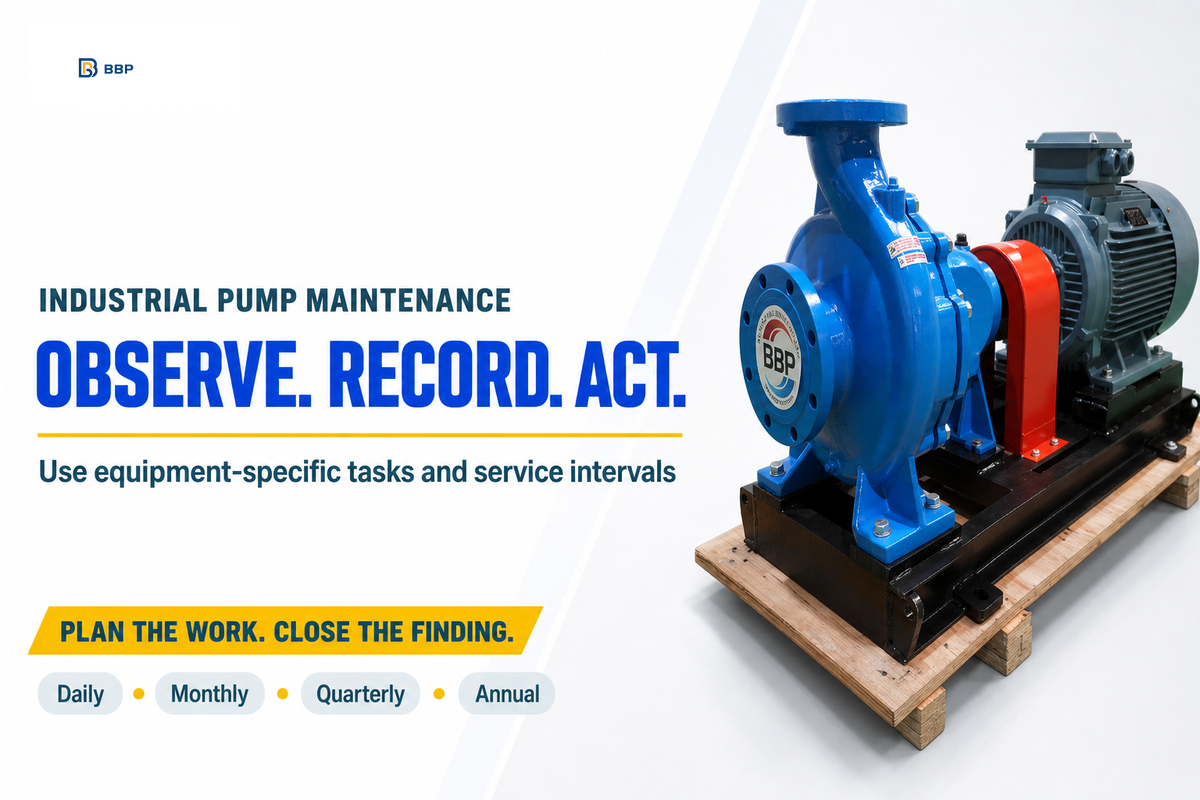
A pump maintenance checklist specifies what operators should observe, what maintenance technicians should service, and what planning evidence closes each job. It’s usually derived from daily, monthly, quarterly, and annual reviews. Set actual inspection and servicing intervals based on equipment manuals, operating hours, service conditions, and site constraints.
The schedule below covers industrial centrifugal pump systems, including process-water and HVAC duties. It shows where other checks are needed for slurry, chemical, and submersible pumps. It doesn’t include residential sump pumps or dedicated fire-pump compliance schedules.
Pump Maintenance Schedule at a Glance
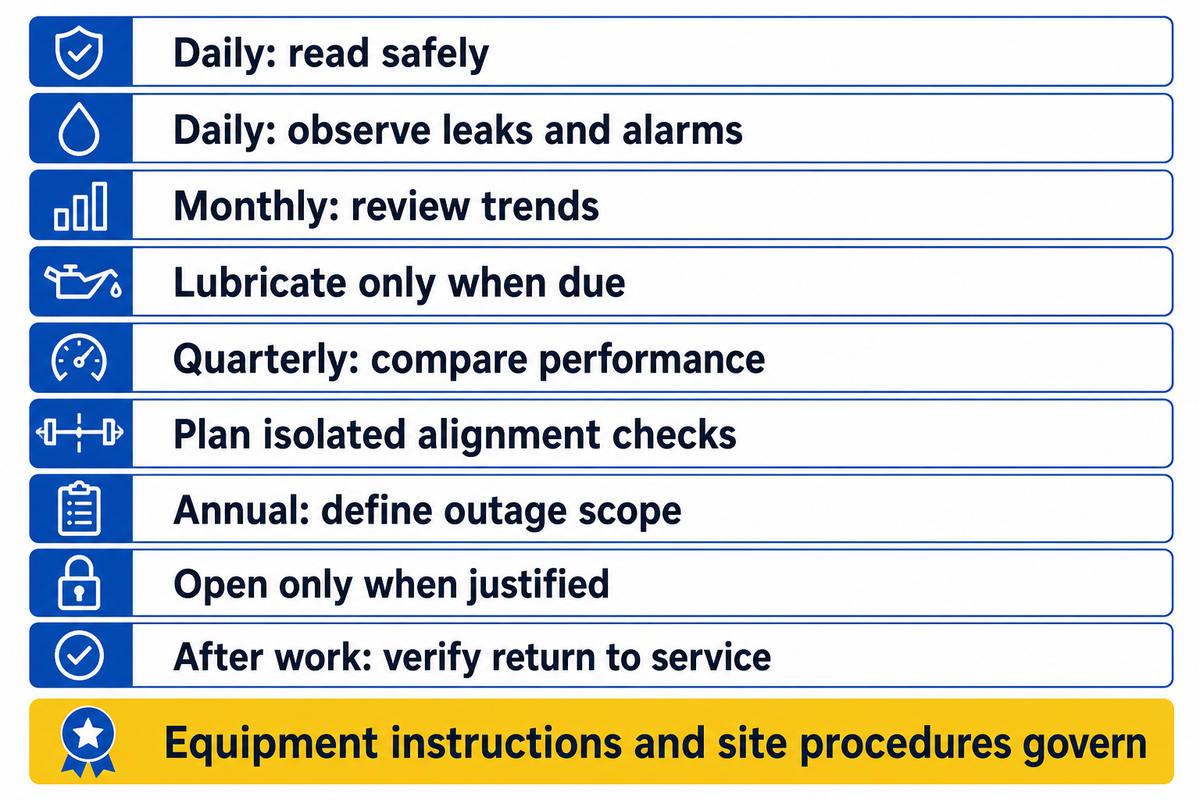
Daily rounds verify operating conditions. Monthly rounds check for developing trends. Quarterly maintenance compares performance and mechanical conditions. Annual maintenance defines the outage and spare-parts plan. Treat these as planning buckets. Required weekly inspection, operating-hour service, or event-triggered checks remain in the asset’s maintenance schedule.
The maintenance guidance from the Hydraulic Institute starts with equipment documentation and adjusts monitoring to the criticality level. Before using this template, enter pump model, serial number, manual revision, duty, lubrication arrangement and approved limits. Other inspections, testing, and records may also be required for regulated chemical services and other specialized services; incorporate approved programs.
4-Interval Pump Action Ledger
Copy this log into the work order. The operator owns the observation. The maintenance team owns the investigation and repair. The planner owns scheduling and closure. The parts information is needed by procurement prior to the outage.
| Review bucket | Task and permitted condition | Record | Owner and closure evidence |
|---|---|---|---|
| Daily | Read safely accessible operating instruments with guards intact | Time, speed, flow, inlet and outlet pressures, relevant temperature | Operator; reading and deviation reference |
| Daily | Observe leakage, noise, visible supports, and installed auxiliaries from a safe position | Location, change, fluid involved, alarm status | Operator; escalation or normal observation logged |
| Monthly | Review readings and open defects | Comparable trend, recurring alarms, unresolved work | Maintenance lead; assigned investigation and due date |
| Monthly | Check lubrication instructions against runtime and condition; perform only due, authorized service | Lubricant specification, quantity, method, hours | Technician; service record and follow-up reading |
| Quarterly | Assess hydraulic performance and vibration using the approved measurement route | Speed, duty, instrument, measurement points, baseline comparison | Reliability technician; finding and action |
| Quarterly | Review alignment and mounting; perform physical checks under the required isolation | As-found condition, procedure, correction where needed | Technician; alignment report and reinstatement record |
| Annual | Review history and define planned outage scope | Hours, defects, inspections due, parts, labor, standby capacity | Planner; approved work package |
| Annual | Inspect internal pump components when the manual or evidence calls for opening | As-found dimensions and signs of wear against specified limits | Maintenance lead; inspection report and disposition |
| After repair or relevant system change | Verify reinstatement and establish an appropriate operating baseline | Configuration, test conditions, readings, accepted work | Responsible engineer; return-to-service record |
Before You Start: Running Checks and Isolated Work
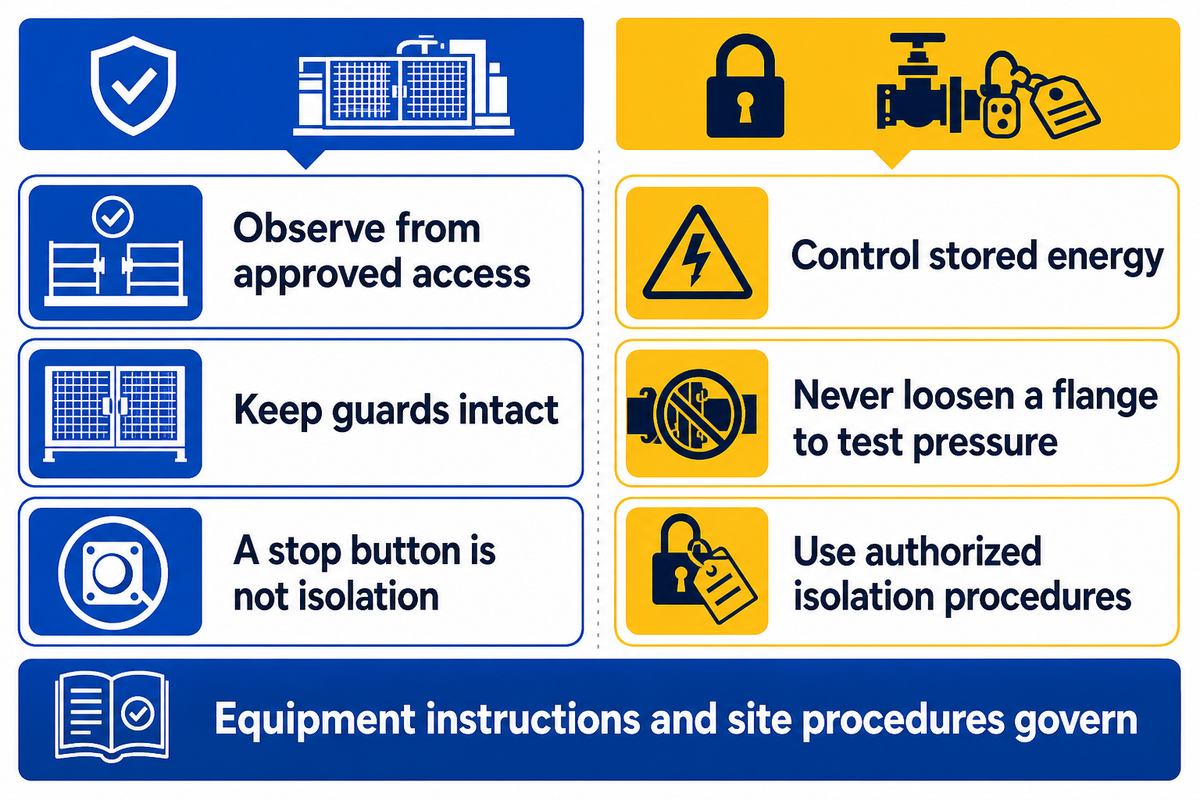
Approved observation points are defined in a location accessible to the observer without putting themself at risk. Opening up a casing, removing a coupling guard, reaching into a danger zone, or servicing exposed equipment requires the applicable shutdown and isolation procedure. Writing both types of work on an inspection checklist must not give the impression that they can be performed in the same operating condition.
For covered work in the United States, 29 CFR 1910.147 addresses unexpected energization, startup, and stored energy, among other things. A stop button, by itself, doesn’t provide physical energy isolation. Electrical energy, automatic restart commands, hydraulic pressure, trapped liquid, thermal energy, and other energy sources must be addressed by the equipment-specific procedure by authorized personnel. Do not loosen a flange to find out whether pressure remains.
Don’t touch a bearing housing to judge bearing temperature or remove a guard to check for vibration. Use the approved instruments and access arrangements. Identify each relevant power source in the isolation procedure. Inspection tools and maintenance tools must match the task, fluid hazards and access condition; performing maintenance tasks safely starts before the toolbox reaches the pump.
Do
- Identify the asset and approved procedure.
- Read instruments from designated safe locations.
- Record the operating state beside each finding.
Don’t
- Use a stop command as proof of isolation.
- Reach past guards for a closer inspection.
- Open a pressure boundary during a running round.
Daily Pump Maintenance: Record the Operating Condition
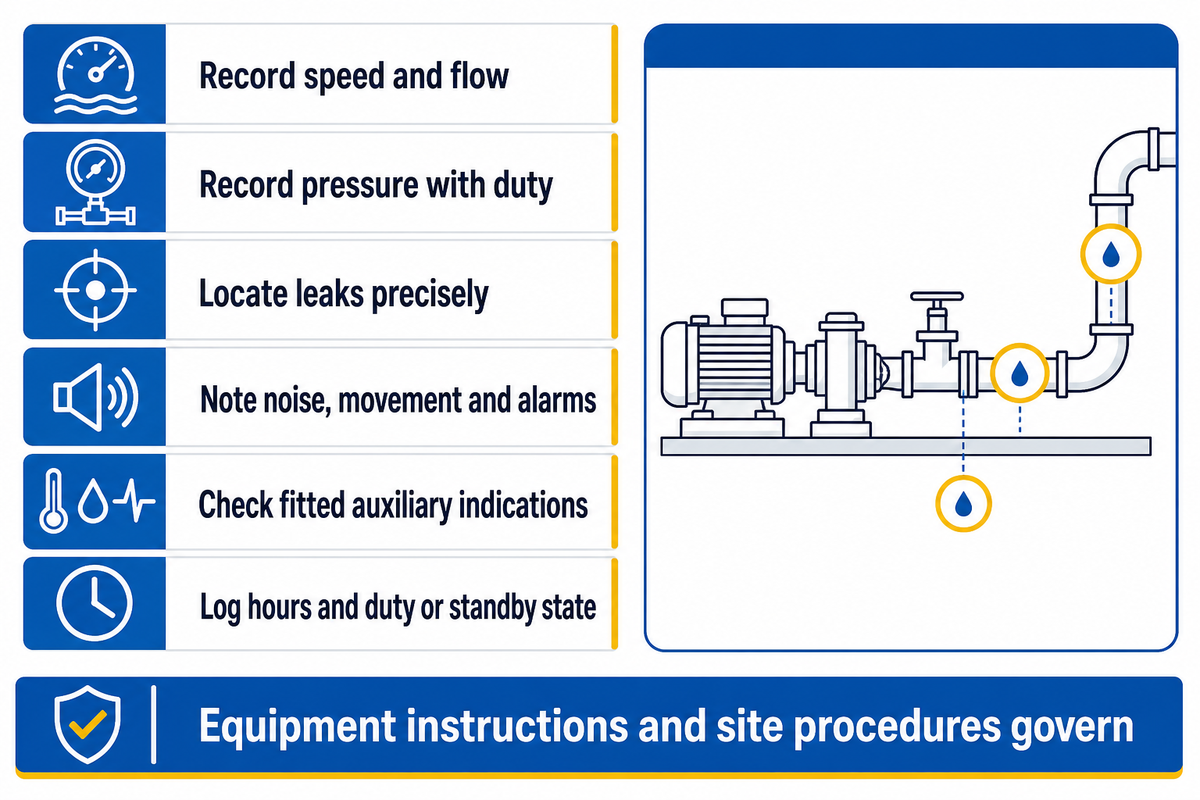
Daily pump inspection establishes whether the unit’s operating normally for its present duty. Record readings and changes rather than checking a box marked “good.” A stable discharge pressure means little without the flow, speed, suction condition, and previous baseline needed to interpret it. The same measurement route must be used each time.
- Check for leaks around the seal, packing, casing joints, flanges, and connected services.
- Note unusual noise, visible movement, alarms, and changes in accessible instrument readings.
- Read lubricant level through the designated indicator where the supplied design permits it.
- Review installed seal-flush, cooling, barrier-fluid, or other auxiliary-system indications against their own instructions.
- Record running hours, starts where available, and whether the duty or standby pump is operating.
Packings and mechanical seals require different leakage criteria. The U.S. Department of Energy’s pumping-system maintenance tip sheet states that for packing, controlled leakage is required for both lubrication and cooling. Mechanical-seal leakage, on the other hand, is assessed against the manufacturer’s criteria. Don’t tighten packing until all dripping stops or use a single drip rate to evaluate all designs.
What should be included in the inspection checklist?
Each asset should be identified, and the date, the operating state, duty, readings and their relevant conditions, applicable limits, and an action field should be recorded. Provide the inspector’s name, and work order reference number for abnormalities. Each check should specify its measurement point or the location where the condition was observed, so that the next person who performs the check can identify and distinguish a new condition from a previously known condition.
For example, “seal area wet” is incomplete. You must provide the following information: The joint or area of seal and the liquid involved. Is leakage changing? Who received the report? Take a picture from a safe position if possible. This will assist maintenance in identifying the problem. A closed work order should link back to this observation and document what changed.
Monthly Pump Maintenance: Review Trends and Lubrication
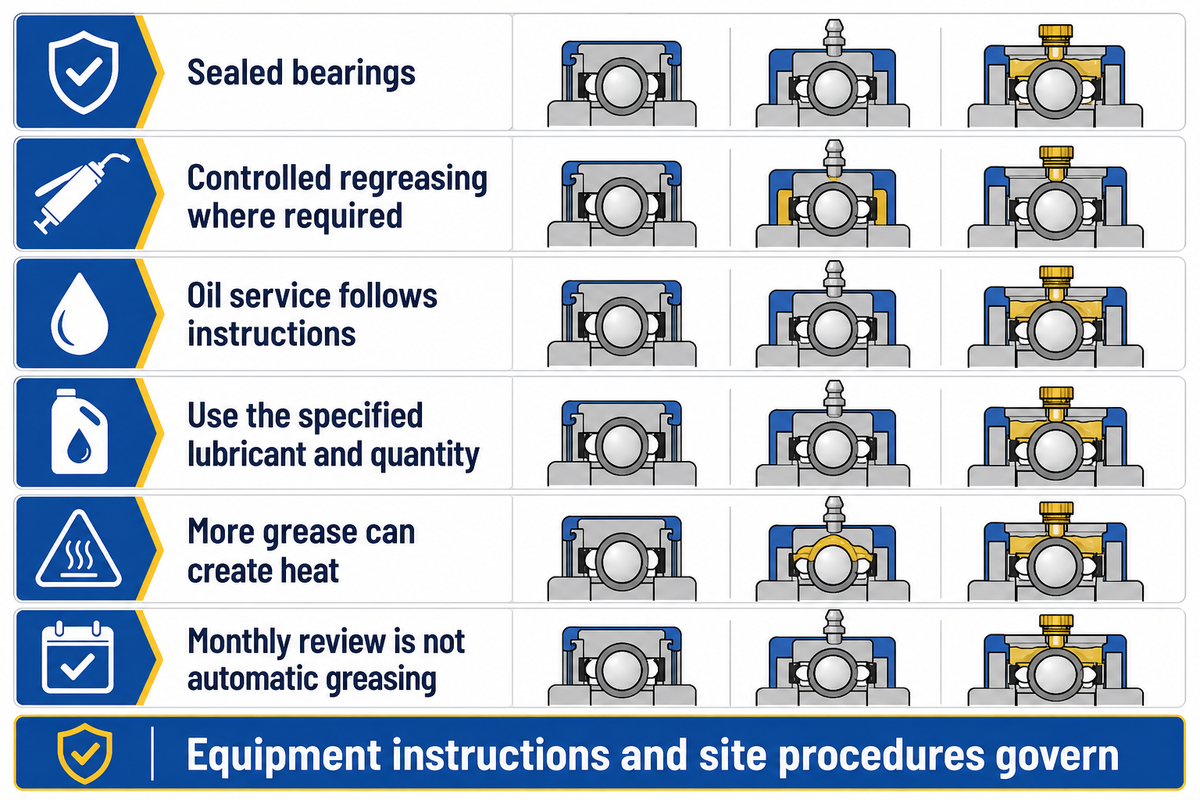
Monthly maintenance should transform individual observations into a maintenance plan. This includes lubrication condition, leakage changes and trends, and repeat alarms. Lubricate or change the oil when the installed bearing arrangement and manufacturer’s instructions require it. A monthly reminder to grease a bearing doesn’t mean every pump bearing requires more grease.
Bearings can be sealed. Controlled regreasing or service is required for some bearing arrangements. Excessive grease can generate heat and cause churning. Incompatible lubricant or contaminated lubricant can compromise the protection required. Identify the correct lubricant, quantity, method, and service interval. For bearing arrangements and inspection context, see our pump bearing guide.
“Be sure to use this approach consistently when taking measurements.”
Hydraulic Institute, What a Basic Pumping System Maintenance Plan Looks Like, 2022
Let’s say you have a plant with two similar pumps. One is on standby, and the other is running. The planner gives both the same monthly grease task because they share the same model number. The technician checks both units’ manuals, runtime logs, and storage/standby logs first. One unit might have reached a service point, and the other might need a different check. The point is to correct the task basis, not to complete two grease tickets. Recording the lubricant and actual quantity gives the next tech evidence if temperature changes after service. Regular preventive maintenance is meant to open the correct job, not authorize the same intervention on every asset.
Quarterly Pump Maintenance: Compare Performance and Alignment
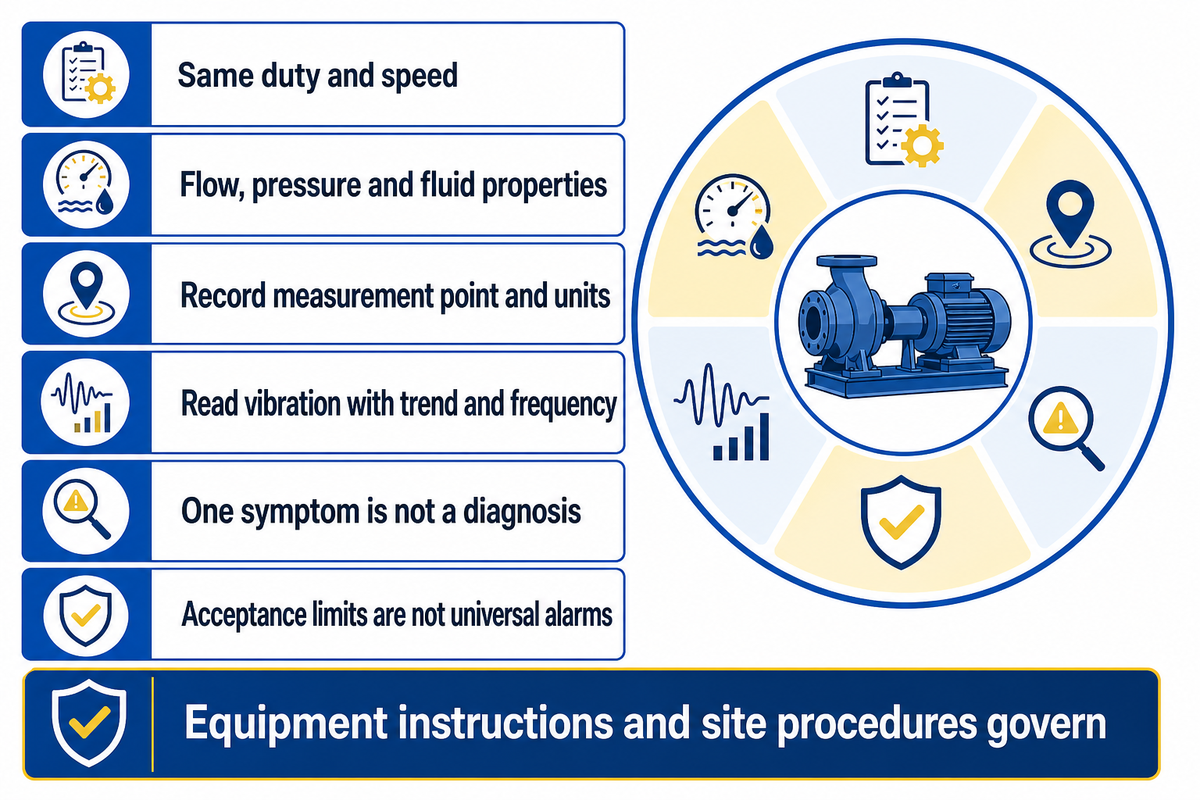
Quarterly maintenance reviews whether hydraulic performance and mechanical condition have drifted under comparable operating conditions. Review measurements of flow, pressure, speed, fluid properties, and electrical input where measured. Consider alignment and vibration measurements together with mounting, pipe supports, and recent maintenance history. A changed reading starts an investigation; it does not identify the failed part by itself.
The Hydraulic Institute’s Condition Monitoring guidance states that one should compare measured pump performance to the original pump curve at consistent flow and speed. Pressure difference alone shouldn’t be taken as total pump head; use the actual measurement arrangement and fluid in the calculation and comparison. Keep the original readings and approved calculation method.
What vibration levels indicate a pump bearing problem?
There’s no single vibration value that will define a pump bearing issue across the fleet. Interpretation requires an understanding of the measurement location, units, frequency content, speed, support configuration, instrument settings, and operating condition. Compare the results with approved asset criteria, consider previous trends and have a qualified analyst assess possible causes prior to determining if a replacement is required.
Increased vibration can be attributed to misalignment, looseness, imbalance or bearing issues. The public ANSI/HI 9.6.4-2022 scope overview describes measurement and allowable values for rotodynamic pump acceptance testing. An acceptance value for a given new installation is not necessarily an alarm value for all in-service pumps. Maintain a distinction in the records.
Given the risk of misalignment issues, consider having the unit aligned per procedure, especially after work that disturbs the motor, coupling, base, or piping. Visual inspection through a guard isn’t a reliable or precise alignment measurement. Schedule access, isolation, and thermal-growth allowances before the job. Review pump efficiency and energy consumption together with delivered duty. An altered process can change electrical input without proving wear.
Annual Pump Maintenance: Plan the Outage Around Evidence
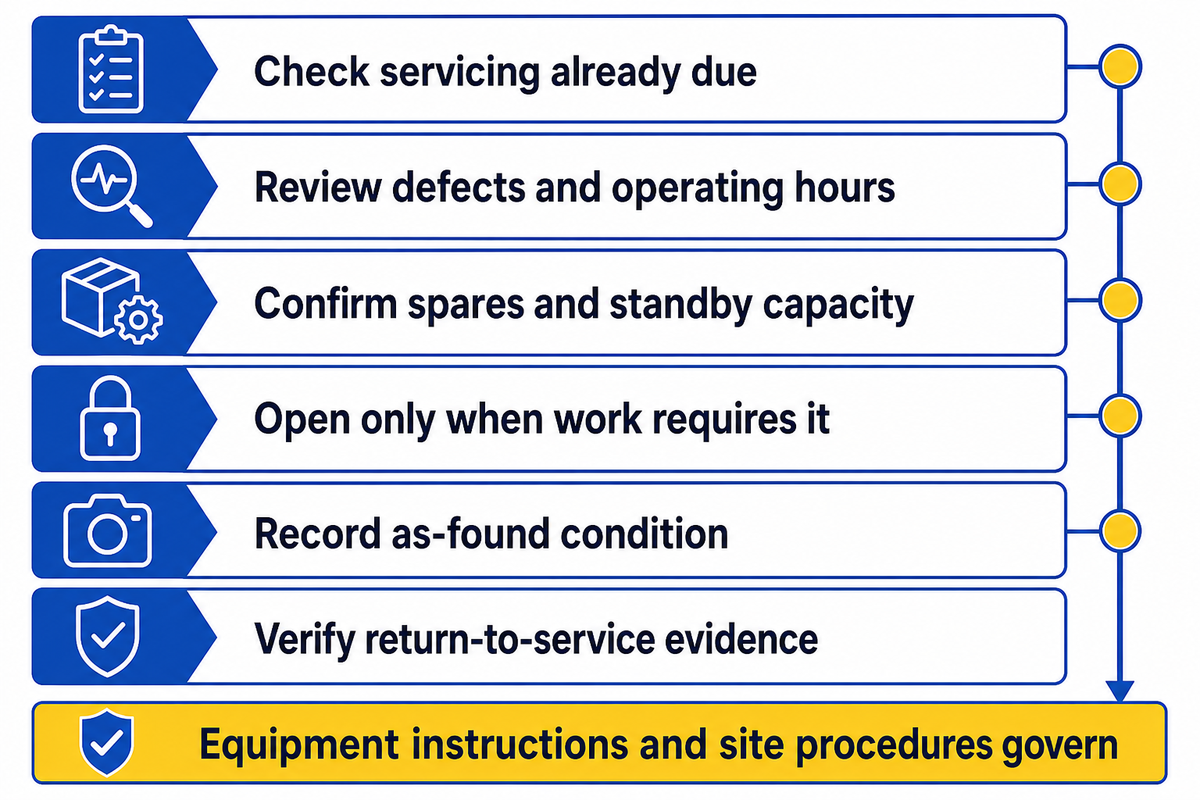
During an annual review of an asset, the actual inspection and repair work of the asset should be determined. Review required servicing, operating hours, defects, reliability, spare availability, and standby capacity. The pump should be opened only if required to perform preventive maintenance, or to assess condition and/or function of the asset. The calendar doesn’t necessarily warrant replacing seal and bearing components. See the Hydraulic Institute’s condition-monitoring guidance for maintenance strategy selection.
If the work package mandates opening, inspect the impeller and other designated internal parts for signs of wear or damage, corrosion, deposits, and specified clearances. Check against the exact model’s service limits. Record existing conditions (as found) before any changes (machining, removal of parts, etc.) to the equipment; otherwise, the next assessment wouldn’t show how the equipment looked previously.
Picture a process-water pump approaching a planned annual shutdown. Recent readings remain stable, but the motor was removed due to an electrical fault and the alignment report is missing. The planner should resolve evidence gaps and check all servicing due under the manual. Another abrasive-duty pump on the same site has a declining performance trend and known wear part consumption. Its work package may require internal inspection along with spares. Giving both units the same automatic overhaul order disguises the reason for each decision. It’s a justified scope for a given work crew, the correct parts, and an agreed return-to-service check; it isn’t a promise that every pump should get the same work.
How often should a pump be serviced?
Pumps should be serviced as per the intervals defined for the configuration installed, its operating hours, and the duty. Additional work should be done based on approved condition criteria or the maintenance program. Regular maintenance may include a combination of calendar dates, operating hours and/or events. Daily observation does not imply daily intervention, and a quarterly review does not postpone a service task already due.
Update the maintenance record every time a fault, repair, or process change modifies the basis of the schedule. A heavily used unit and its standby may develop different service needs despite having identical nameplates. Keep the basis of the schedule visible to the planner to avoid replacing a shorter required interval with an annual outage.
Adjust the Checklist for Pump Type and Service Severity
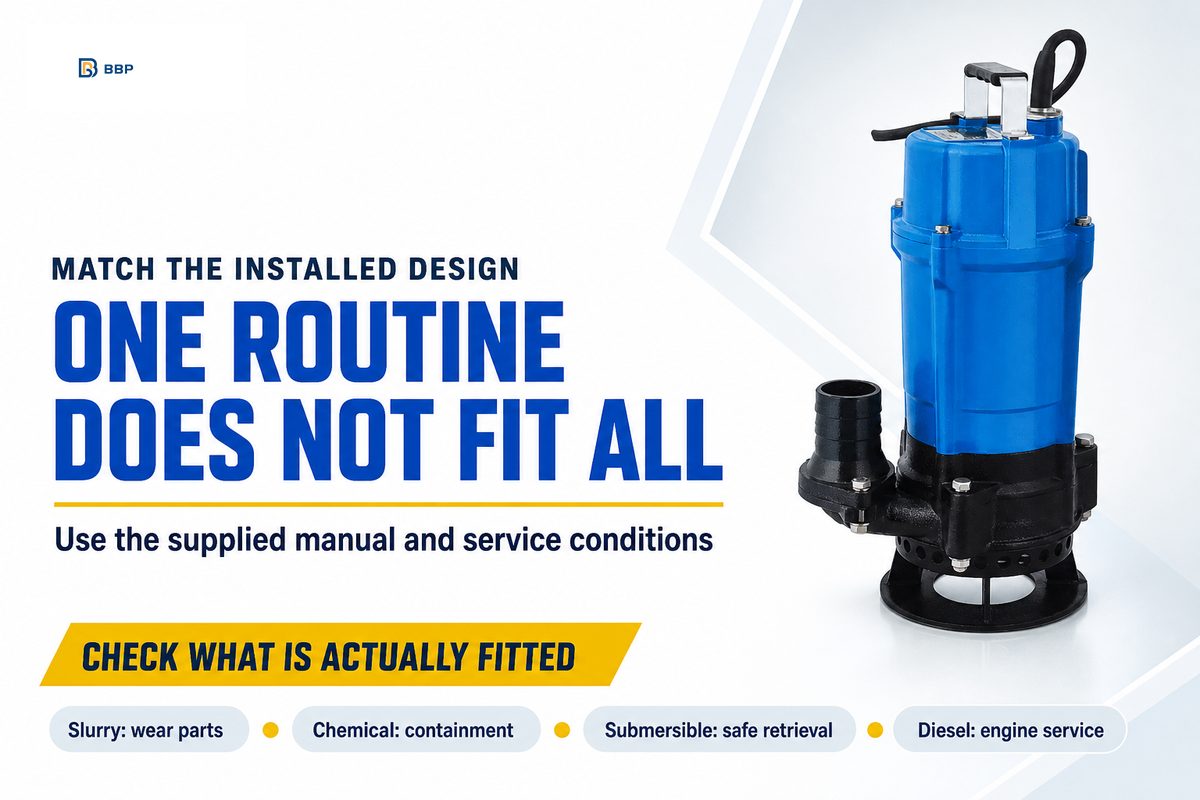
A centrifugal pump maintenance checklist must match the supplied design and its actual service. Abrasive slurries and corrosive chemicals create different inspection objects. So do submerged, or diesel-driven, installations. For service-related checks, focus on the pump, seal, motor or engine, and auxiliary system. Add service checks to the common record rather than repeat identical tasks across the fleet.
The Hydraulic Institute’s maintenance answers include auxiliary systems and say unusual heat, moisture and dust may require more maintenance. Use the following prompts to review your equipment documents:
| Installed service | Review with the equipment instructions | Planning consequence |
|---|---|---|
| Slurry duty | Wear-part condition, materials, specified clearances, solids and duty changes | Prepare the correct wear parts and record the reason for inspection |
| Chemical duty | Material compatibility, containment, seal support and fluid hazards | Include the approved handling and maintenance program |
| Submersible installation | Access and lifting arrangement, cable and entry condition, fitted monitoring | Plan safe retrieval and the model-specific electrical and seal checks |
| Diesel-driven unit | Separate engine servicing and pump maintenance activities | Track engine requirements alongside the pump record |
Don’t write a task for equipment that isn’t fitted. For example, a sealless design can’t be inspected as though it had the same external shaft-seal arrangement as a packed pump. For installation context, see the submersible sewage pump selection and maintenance guide. A change of liquid or duty warrants an engineering review before reusing the existing routine maintenance plan. For abrasive-service inspection context, see our slurry pump wear-monitoring guide; use the installed equipment instructions for limits and servicing intervals.
When to Escalate an Abnormal Pump Inspection
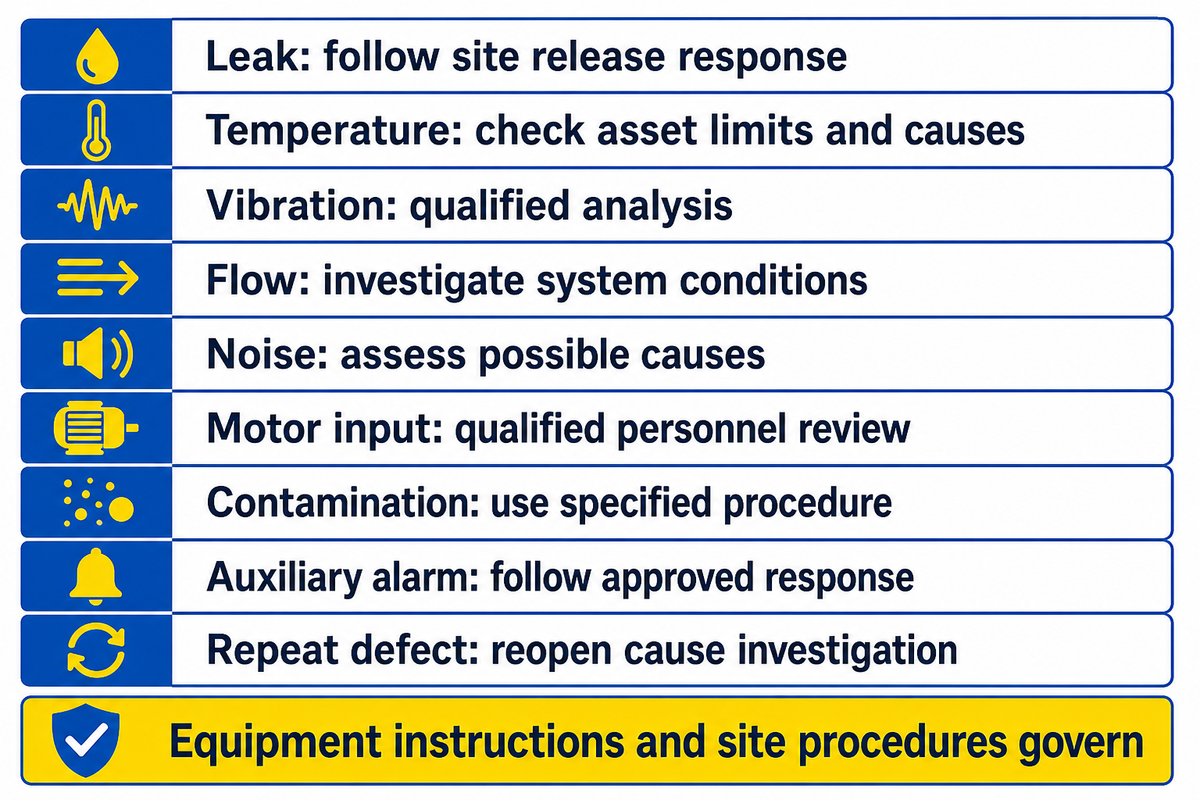
An abnormal finding should be reported based on hazard, approved operating limits, rate of change, and consequence of pump failure. An operator notes the finding and follows site response procedures; a technician investigates possible causes. The Hydraulic Institute’s maintenance guidance calls for inspection records and prompt reporting of problems. Don’t combine the symptom with the diagnosis as this may lead to an incorrect conclusion, e.g. procuring a replacement component.
| Observation | What the record should distinguish | Responsible next step |
|---|---|---|
| New or increasing leak | Fluid, source, containment, trend, approved seal or packing criteria | Operator follows release response; maintenance investigates |
| Rising bearing temperature | Measurement method, load, ambient condition, lubricant and trend | Maintenance checks causes against asset limits |
| Changed vibration | Point, units, frequency information, speed and duty | Qualified analyst reviews the evidence |
| Lower delivered flow | Speed, valve configuration, suction condition and process change | Operations and maintenance check the pump system |
| Unusual noise | Location, onset, operating point and accompanying readings | Investigate possible hydraulic or mechanical causes |
| Changed motor input | Load, duty, control state and instrument validity | Qualified personnel assess electrical and process causes |
| Lubricant contamination | Appearance, sampling result where applicable, ingress path | Use the specified contamination and service procedure |
| Auxiliary alarm | Which system, indicated variable, setpoint and alarm history | Follow that system’s approved response |
| Defect recurring after repair | Prior work, parts, configuration and operating-condition changes | Reopen the cause investigation before repeating the repair |
Cavitation is one possible explanation of noise and unstable hydraulic behavior; however, noise alone can’t confirm it. Likewise, replacing a seal won’t correct every process-induced seal issue. If a site stop criterion is met, follow the approved response immediately; a monthly review date isn’t a permit to continue operations.
Turn Inspection Findings into a Repair and Spares Request
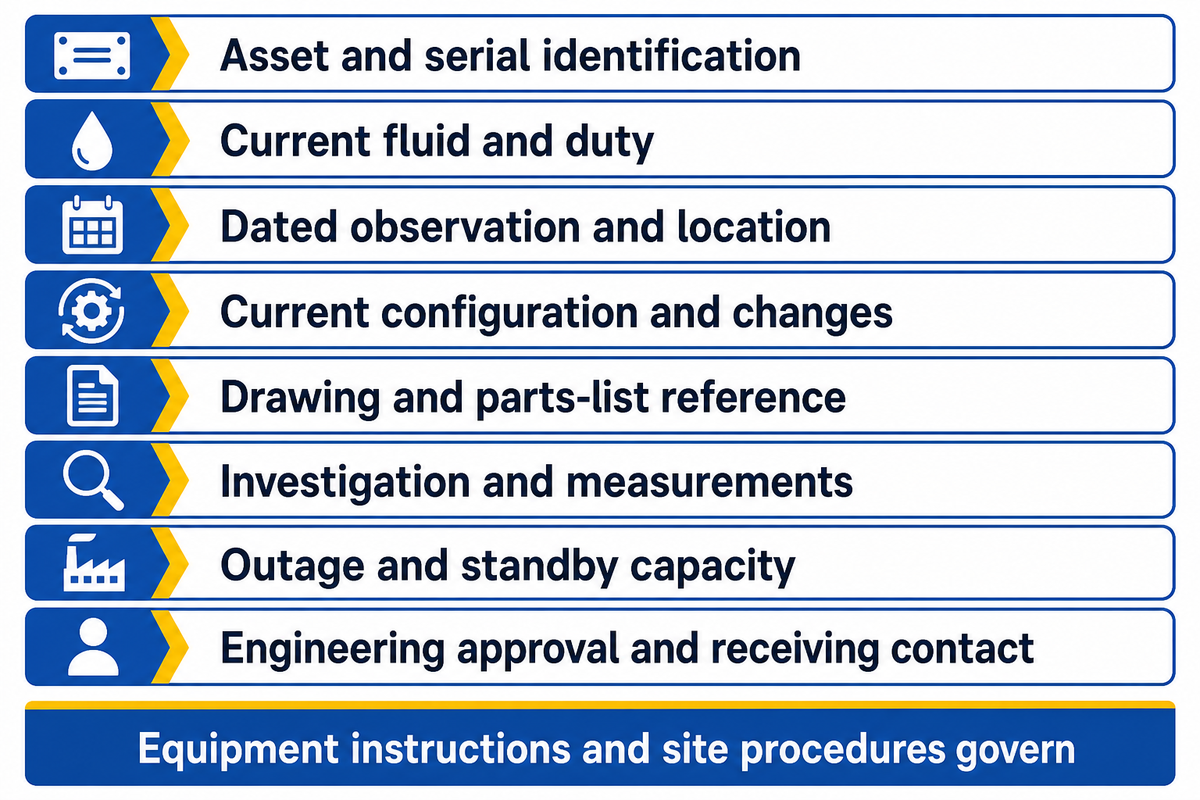
An effective repair request provides details on the unit in question, explains the problem, and supplies a configuration to validate replacement parts. Connect the inspection record to the quotation request. Model identification may miss a different seal, material, or impeller trim, or later modification, and, therefore, the current drawing and parts-list references should be included, if available.
The Hydraulic Institute’s pump-system competency outline includes identifying parts and component numbers in a parts manual. A drawing item number is a locating aid; confirm the part with the concerned supplier/engineer. Our industrial pump quotation-request guide provides a template for organizing the duty and supply information. Filling in this information prior to the start of downtime gives procurement a clearer request to send.
| Information | Illustrative entry | Why it matters |
|---|---|---|
| Installed asset | P-101; attach nameplate photograph and serial number | Locates the supplied unit |
| Service | Process-water transfer; attach current fluid and duty details | Frames material and operating requirements |
| Observation | Leak observed at the identified seal location; attach dated log | Separates the symptom from an assumed diagnosis |
| Configuration | Attach current seal, impeller and material records; note modifications | Prevents reliance on an obsolete bill of materials |
| Parts reference | Mark the component on the applicable drawing and parts list | Supports identification without assuming compatibility |
| Investigation | Attach findings, measurements and photographs from authorized work | Shows why a repair or part is being requested |
| Outage and standby | State the planned window and available backup capacity | Lets the planner compare repair timing with supply |
| Release and receipt | Name the engineering approver and receiving contact | Keeps configuration changes and delivery acceptance assigned |
Beijing Beibangpu Co., Ltd produces centrifugal pumps and pump spare parts through its manufacturing resources. Its slurry pump spare parts include wear components. Send the installed configuration and inspection findings to request support, and confirm material, dimensional fit, and documentation and delivery requirements. Engineering approval is required to change the configuration.
Industry Outlook: From Calendar Tasks to Condition-Based Maintenance
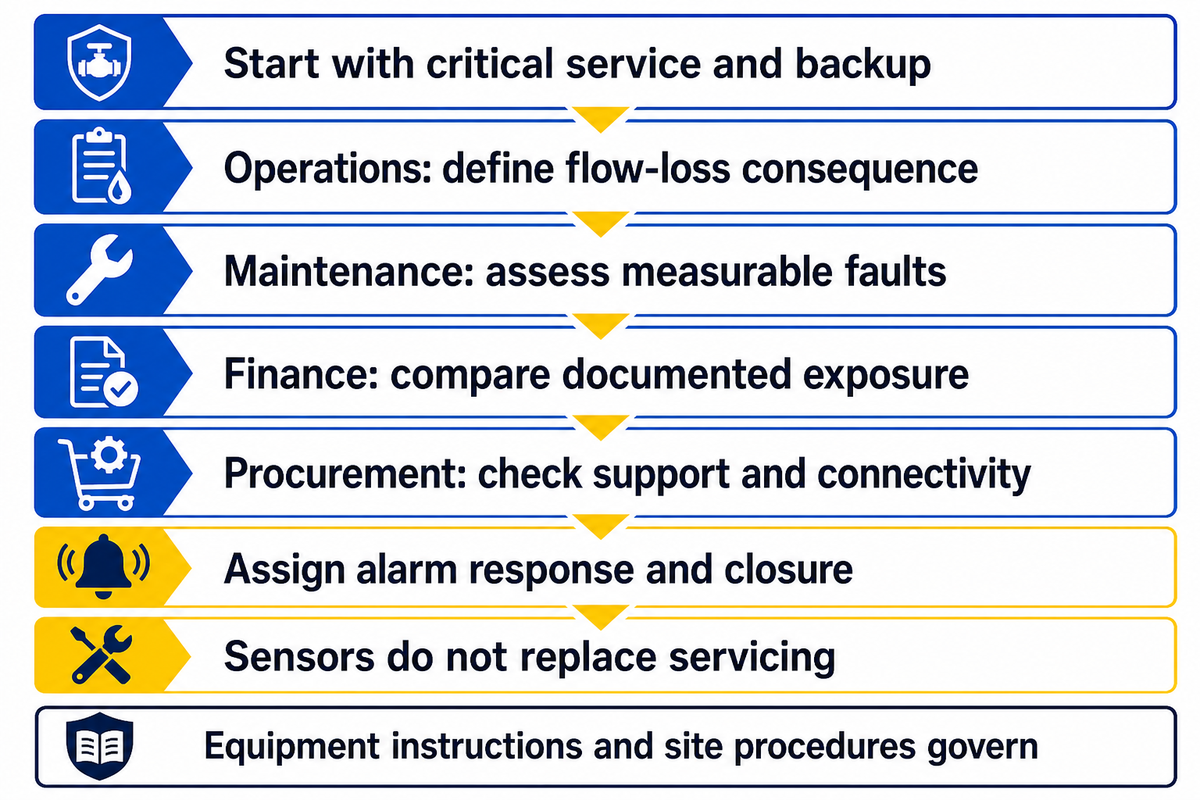
Condition-based monitoring is useful when the reading is in the hands of someone who can act on it. Prior to purchasing additional sensors or maintenance software, define baseline and alarm criteria, the response owner, and the available maintenance capacity. A plant can collect more data without improving decisions if nobody investigates alarms or closes the resulting work.
The tech exists already. Hydraulic Institute’s 2021 monitoring guidance gives examples of both periodic measurements and continuous measurements. Other suppliers combine multiple measurements and perform remote analysis. The decision is on which failure consequence justifies that level of coverage, how the data is integrated with existing work orders, and who can interpret the data. Do not assume that a sensor replaces the operator’s safely performed rounds or the equipment manufacturer’s servicing requirements.
Demand influences the background information rather than a formal maintenance policy. Oxford Economics’ June 2026 outlook, in partnership with Europump and the Hydraulic Institute, forecasts global pump demand growth of 2.6% in 2026. This overall market outlook doesn’t establish changes in required service intervals, explain searches for maintenance tips, or quantify savings from a particular monitoring purchase.
For a maintenance manager planning a monitoring purchase, the discussion should begin with the most critical service duty and its backup. Operations explains the consequence of losing flow. Maintenance identifies what measurements it can make, and which faults are still difficult to determine. Finance compares monitoring and analysis cost with the site’s documented disruption exposure; procurement checks installation, connectivity, support, and ongoing service in the offer. If an alarm would still wait unattended for the next shutdown, spending first on response capacity may be the more useful choice. These checks help predict future maintenance needs without pretending that forecasts or software dashboards guarantee longer pump life.
Key takeaway
A pump maintenance schedule works when every task has an equipment-specific basis, a safe work condition, a useful record, and an owner who closes the finding.
Frequently Asked Questions
What Is Pump Preventive Maintenance?
Planned inspections and servicing address known maintenance needs before failure.
Preventive maintenance for pumps includes the routine checks, lubrication, adjustments, cleaning, and scheduled parts work specified for the asset. Condition monitoring complements these activities by identifying changes that need investigation. Proper maintenance supports pump life and efficiency, but neither a calendar nor a completed ticket proves the machine is in acceptable working condition; retain readings and evidence.
What are the 7 elements of preventive maintenance?
Use seven practical headings to organize a site program.
One workable organization is asset identification, task scope, scheduling basis, safe access, condition records, corrective action, and closure. These seven headings are an editorial way to structure preventive pump maintenance, not a universal standard. Put each pump manufacturer’s requirements inside the structure, assign responsibilities, and review whether the records lead to timely action rather than merely documenting visits.
What is the ISO standard for pumps?
ISO 9906:2012 is one relevant standard for hydraulic acceptance testing.
The ISO 9906:2012 public abstract addresses hydraulic acceptance tests for rotodynamic pumps at test facilities. It is not a daily-to-annual maintenance calendar. Other requirements concern different design, testing, or monitoring subjects. Identify the applicable scope and edition with the responsible engineer; keep the installed equipment instructions and approved maintenance program as the basis for servicing.
Can this template replace the pump manufacturer’s maintenance instructions?
No. Use it to organize the equipment-specific instructions.
Add required tasks and intervals from the supplied manuals and approved programs. Keep special-service inspections, operating-hour tasks, and mandatory checks even when they don’t fit the four calendar buckets.
Can a CMMS track pump maintenance across multiple facilities?
Yes, when the underlying asset records and workflows are maintained.
A computerized maintenance management system can connect facility maintenance records, recurring tasks, work orders, parts usage, and inspection results. Give each installed unit a unique asset record and keep its own manual, configuration, limits, and maintenance history attached. Matching model names across sites doesn’t mean that duty, fluid, controls, or required checks are identical.
For mobile inspection, make the essential fields easy to enter: operating state, measurement point, reading, unit, observation, and follow-up reference. Assign someone to review anomalies rather than accepting every submitted form as a pass. Track whether the investigation was completed, what changed, and which return-to-service evidence was accepted. Maintenance software can preserve the trail, but people still determine whether a reading is valid and whether the equipment is ready for operation.
Preparing a repair or replacement inquiry?
Send your pump identification, operating duty, inspection findings, and current parts references to Beijing Beibangpu Co., Ltd.
References & Sources
- What a Basic Pumping System Maintenance Plan Looks Like Hydraulic Institute, 2022.
- 29 CFR 1910.147: The Control of Hazardous Energy Occupational Safety and Health Administration.
- Maintain Pumping Systems Effectively U.S. Department of Energy, Pumping Systems Tip Sheet 5, 2005.
- Condition Monitoring on a Budget Hydraulic Institute, 2021.
- ANSI/HI 9.6.4-2022: Rotodynamic Pump Vibration Measurements American National Standards Institute.
- Pump FAQs Hydraulic Institute.
- Pump System Certification Hydraulic Institute.
- ISO 9906:2012: Rotodynamic Pumps, Hydraulic Performance Acceptance Tests International Organization for Standardization, public abstract.
WHY BUYERS WORK WITH BBP
About BBP Manufacturing
BBP Manufacturing Co., Ltd. is a Beijing-based industrial pump manufacturer with in-house foundry, heat treatment, machining, assembly, coating and inspection capabilities. We support industrial projects across slurry handling, sewage treatment, clean water transfer, chemical service, fire protection, irrigation and OEM pump supply.
Our Engineering Support
We help engineering buyers select and source the right pump configuration, not just compare prices. Send us your flow rate, head, medium, solids content, temperature, pH value, material requirement and installation conditions. BBP engineers will recommend a pump series, material option, duty curve basis, lead time and spare-parts plan for your RFQ.
Company Profile // DATA_SHEET
Name
BBP Manufacturing Co., Ltd.
Brand Name
BBP
Country
China
Headquarters
Beijing, P.R. China
Business Type
Industrial Pump Manufacturer
Model
B2B / OEM / ODM / Project Supply
Main Products
Slurry Pumps, Sewage Pumps, Centrifugal Pumps, Split Case Pumps, Multistage Pumps, Chemical Pumps, Fire Pumps, Irrigation Pumps
Manufacturing Capability
Foundry, Heat Treatment, Machining, Assembly, Coating, Inspection
Certifications
ISO 9001 / CE / SGS / BV / TÜV
Export Reach
90+ Countries & Regions
Standard Lead Time
About 25 Days for Standard Configurations
Contact Person
Wesley · International Sales
Phone / WhatsApp
+86 182 1085 0516
Email
contact@bbpmfg.com
Website
https://bbpmfg.com/
Address
Room 2803, Building 11, Phase II, Nuode Center, Fengtai District, Beijing, P.R. China