Get in Touch with BBP

Water Pressure: How to Measure Static and Running Readings

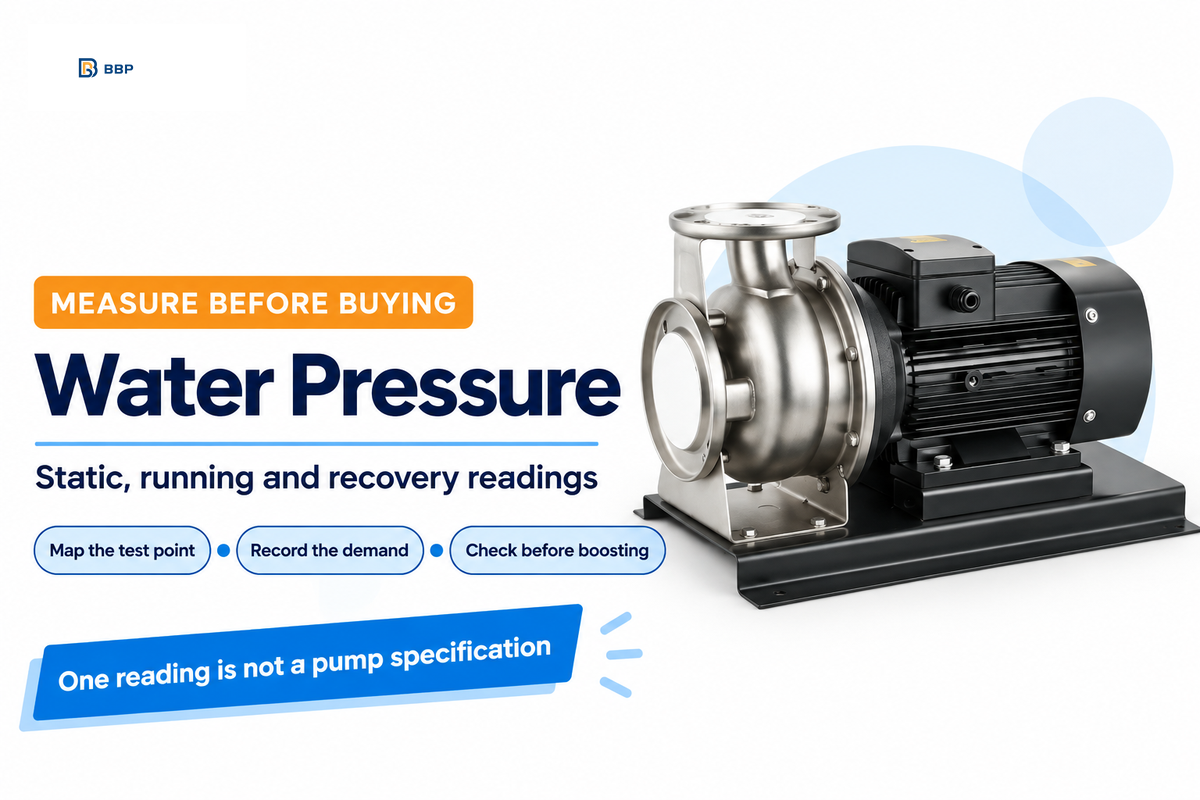
To check water pressure, connect a suitable gauge to a known cold-water test point and take a reading with all water use stopped. Then, take a reading as a named fixture runs water. Compare the conditions, not just the readings: weak shower pressure can mean restricted flow even with normal static pressure.
This guide outlines household screening steps and the measurements a building owner can take to a plumber or pump supplier. It doesn’t include pipe strength testing or acceptance tests for fire-systems. A water system may use various water sources, including a municipal main or a well. If service suddenly disappears, check your water supplier’s incident notices and follow any water quality advisories before troubleshooting equipment.
Water pressure, static pressure and running pressure
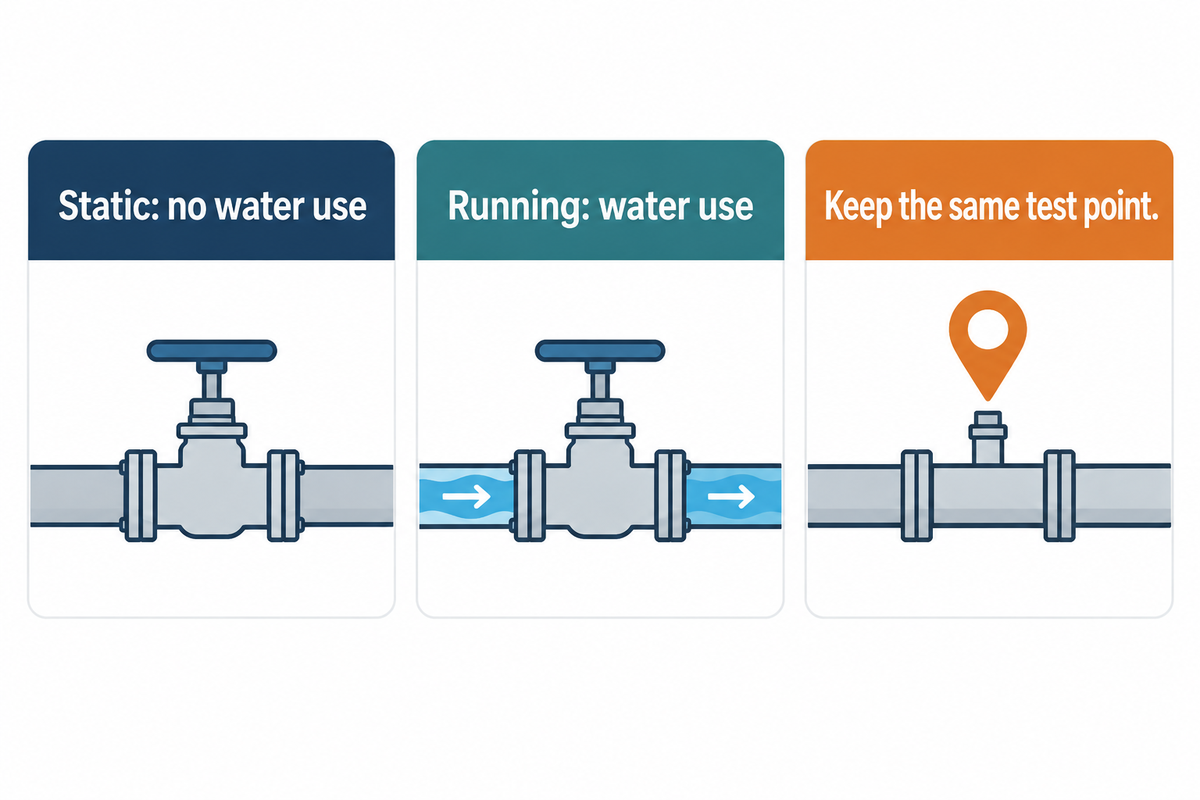
Water pressure expresses force per unit area and water flow expresses volume over time. A reading is classified as static if there’s no water use. A reading is classified as running if there’s water use. Keeping the gauge at one fixed point can help illustrate how water pressure affects delivery, because a different elevation or branch introduces a new variable.
Household gauges often display pounds per square inch or psi. The WIKA unit reference gives 1 bar as approximately 14.5 psi, so 4 bar is approximately 58 psi. Static pressure shows the condition of the system at that point with the system at rest. Open a faucet elsewhere and the gauge shows the pressure at that point with a demand. Plumbing guides sometimes call this dynamic pressure; here, “running pressure” describes the pressure during flow, not velocity pressure in a fluid-mechanics equation.
“Sometimes people experience what seems like low pressure, but the problem is actually low flow.”
A water pressure gauge measures pressure at the connection point. It can’t tell you the amount of water reaching every fixture. A clog in a faucet aerator may limit water flow locally while pressure remains satisfactory elsewhere. Make sure to record these two observations separately.
Normal water pressure depends on the test point
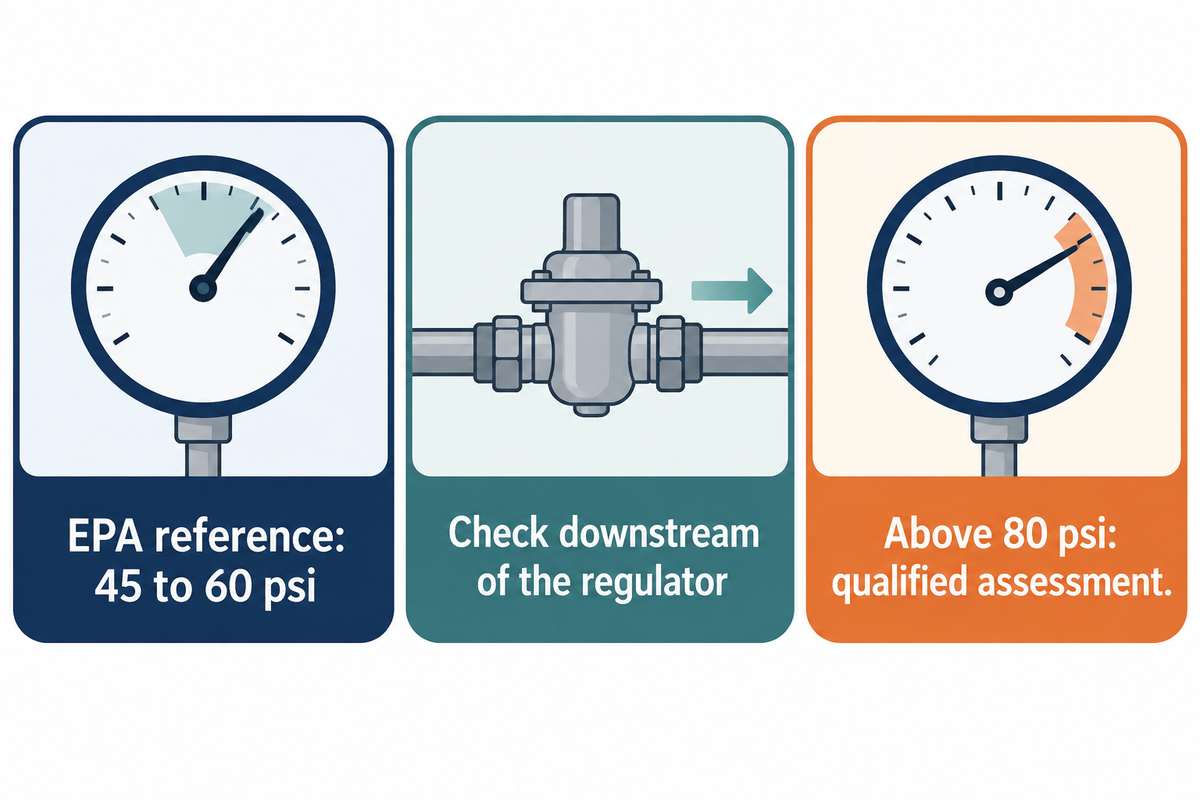
Measuring water pressure in your home requires a defined test location and operating condition. EPA’s home maintenance guidance suggests an incoming pressure of 45 to 60 psi. Supply pressure measurements here are made using a water pressure gauge. While this EPA recommendation is a good starting reference for a resting supply measurement, it isn’t a universal operating requirement for every appliance, well system or building.
What is normal water pressure?
EPA’s home maintenance guidance suggests 45 to 60 psi and states testing is done when water isn’t being used. Oklahoma State University notes location differences and says the ideal residential range is 40 to 60 psi; a shower may not have the same reading as the service entrance during peak demand.
First determine if a gauge is placed before or after a pressure-reducing valve. An outside faucet may be connected directly to the water main while the pipes and fixtures in your home plumbing receive lower pressure. Santa Barbara’s measurement instructions state a hose connection should be made downstream of the regulator. A reading from the wrong side can’t check its outlet setting.
If your water pressure is too high, establish your test location first. If downstream static pressure is higher than 80 psi, ask a plumber whether to install a pressure regulator and check local requirements. The EPA’s service pressure technical sheet mentions most U.S. plumbing codes require pressure regulation above that level. The local code and equipment ratings will determine installation. Don’t adjust a pressure valve until its identity and function are known.
Choose a water pressure gauge for the job
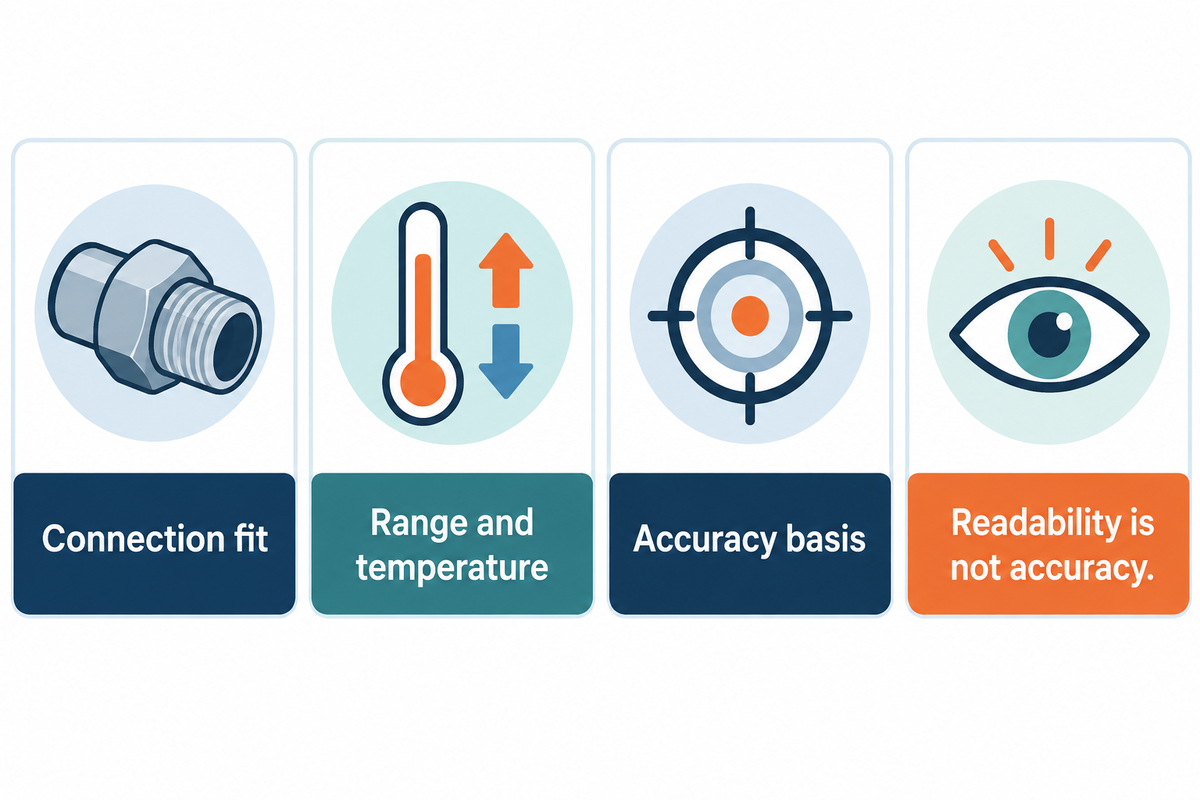
Choose a water pressure gauge by connection, water pressure range, temperature rating, and stated accuracy. For changes in water pressure to be readable, the gauge must cover the expected pressure range and not be operated beyond its rating. A readable dial doesn’t guarantee more accurate measurement.
For a concrete example, Reotemp’s home water pressure test gauge lists a ¾-inch hose connection, a 0–200 psi range and markings every 10 psi. Those are this particular gauge’s specs. Check your own fitting and gauge and don’t force a connector that looks similar. Hose and pipe threads aren’t interchangeable just because they’re the same nominal size.
The ASHRAE measurement handbook distinguishes resolution from accuracy. Check to see if the manufacturer states accuracy in terms of percentage of full scale or of the reading. As a calculation example, a hypothetical 0–160 psi instrument specified at ±2% of full scale has an accuracy band of ±3.2 psi. This isn’t a specification for the Reotemp model.
Use a suitable cold-water connection, inspect the sealing washer and follow the instrument instructions. A gauge with a maximum pointer can represent a peak reading, but how quickly it registers a change is important as well. If readings are near a decision threshold, the gauge should be checked.
How to test water pressure in 5 steps
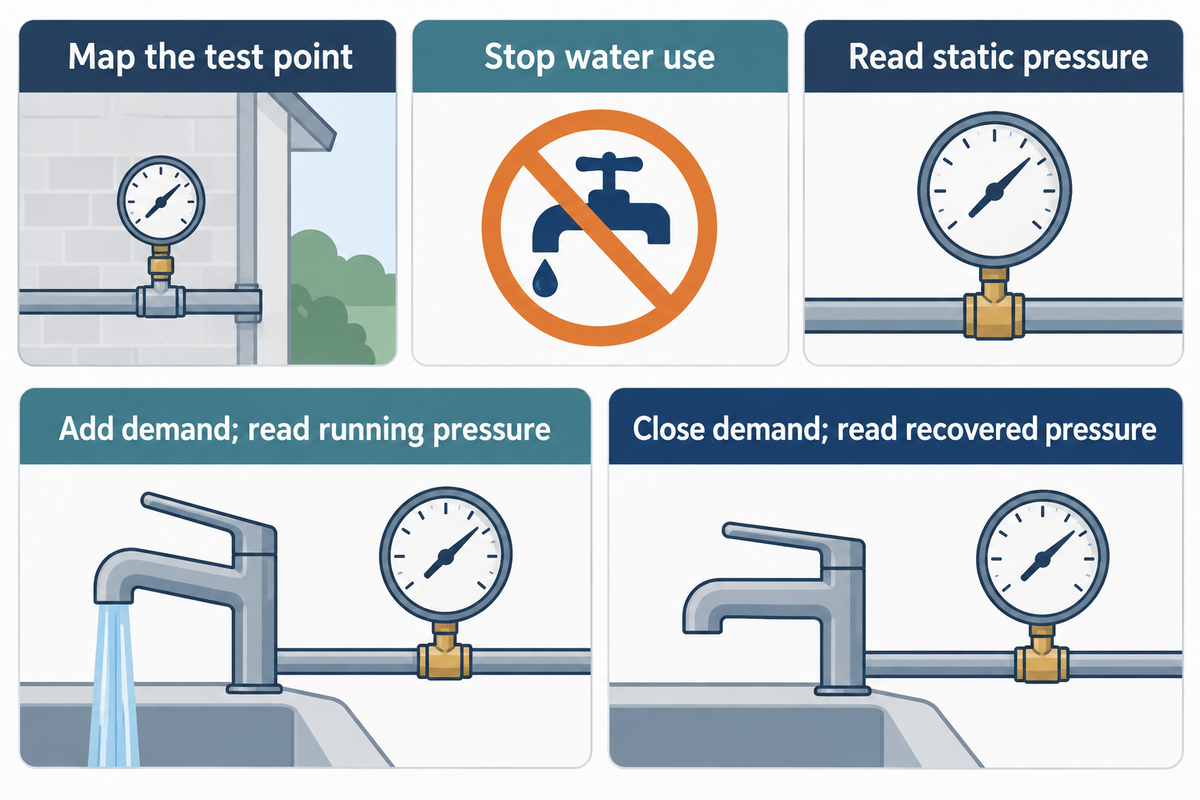
Test water pressure through a repeatable series of actions: identify the connection, stop demand, measure static pressure, add a documented demand, and record pressure recovery. Keep the same gauge in the same location; don’t treat one reading as a map of water pressure throughout your home, because the result provides a useful screening record for a plumber but doesn’t prove that plumbing system faults have been ruled out.
- Map the test point: Note the floor, cold-water branch and position relative to the regulator, water meter and filter. Use an accessible connection intended for the gauge. Do not disconnect a hot-water appliance or open a utility-owned valve to create one.
- Stop water use: Close household faucets and wait for toilets and appliances to finish filling. Check that irrigation and the washing machine are not drawing water. For a well system, record the pump state as well.
- Read static pressure: Attach the gauge with the test tap closed, following its instructions, then open the tap slowly. Once the reading settles, note the pressure, units and time. An unexpected or over-range indication calls for professional assessment.
- Add a known demand: Leave the gauge connection open and run a separate cold-water fixture. Record which fixture is open, its operating position and the stable running reading. Keep water safely directed to a drain; have another person read the gauge if needed.
- Read recovery and finish: Close the demand fixture and record the recovered pressure after it settles. Close the test tap and depressurize the gauge according to its instructions before removal. Check the connection for leakage afterward.
Example: a morning shower complaint. Suppose a downstream gauge reads 60 psi before demand, 45 psi with one cold-water tap running, then 60 psi after it closes. Those three values describe that test, not the shower’s pressure. Record whether the shower was affected during the test and if the problem occurs elsewhere. Repeat the test when the symptom occurs rather than comparing a morning test with an unrelated evening complaint. If the original test used a tap upstream of the regulator, its result would answer a different question. Give the plumber the connection location and demand details, along with the numbers.
The EPA describes a no-demand service-pressure measurement. The running and recovery comparison gives documentation of operating conditions. Three manual readings may miss intermittent pressure issues between observations. Repeated water hammer, transient surges or unexplained appliance problems may call for a service technician to use a recording instrument. A test gauge shouldn’t be left in place for a longer period of time than the manufacturer allows.
Water flow: what a bucket test can tell you
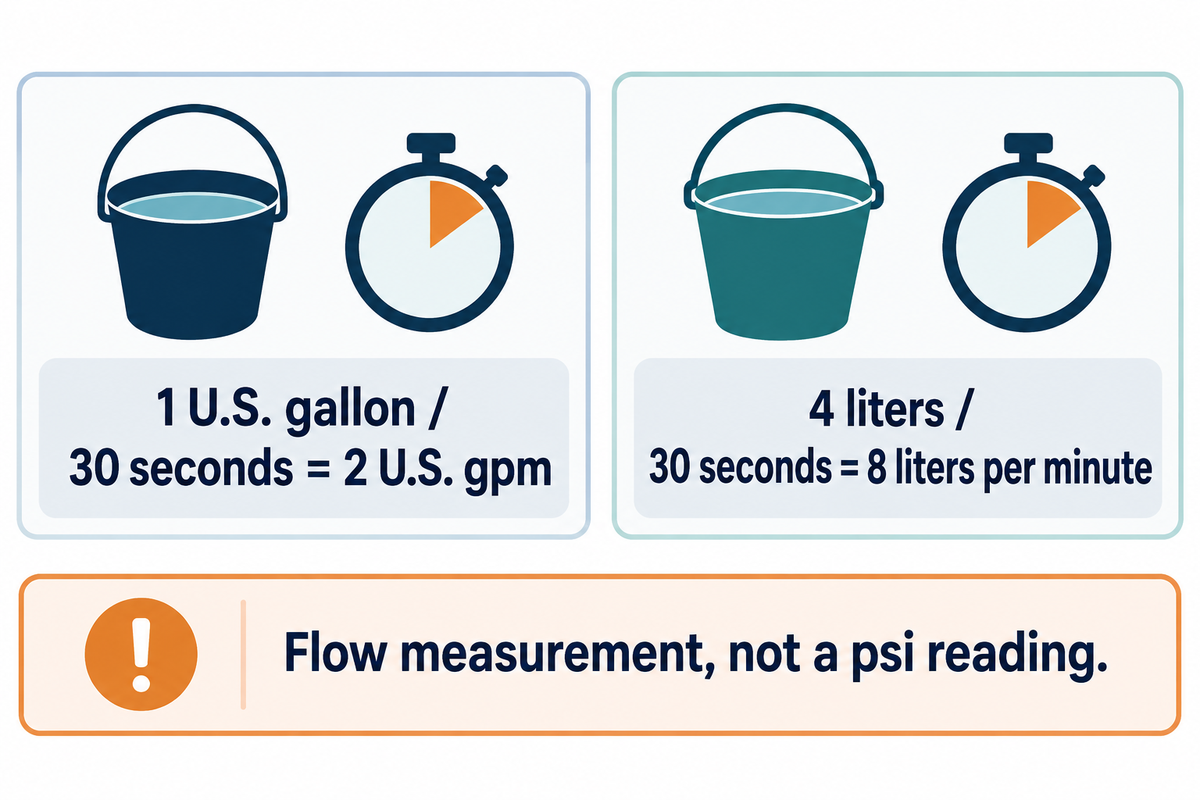
A timed bucket test measures water flow through one outlet. Collect a measured volume, document the collection time and compute volume per minute. Results help interpret similar tests performed at a particular fixture. A bucket test, however, can’t determine water pressure in psi, nor can it distinguish various reasons for a low flow complaint.
How do I check water pressure without a gauge?
A gauge isn’t needed to determine that delivery is weak, but it isn’t possible to accurately assess a water pressure reading based on how long it takes to fill a bucket. For example, collecting 1 U.S. gallon in 30 seconds gives 2 U.S. gallons per minute. Separately, collecting 4 liters in 30 seconds gives 8 liters per minute. These are simple flow calculations and don’t measure or assess pressure.
The Portland Water Bureau distinguishes flow from pressure. A safe and stable container should be used to avoid hot water scalding and/or overflow. Compare the same outlet under the same conditions. A flow-limited showerhead is designed to restrict water flow. Removing a required restrictor isn’t a valid pressure test. Compare the outlet’s delivery with its specified flow at the rated conditions before treating it as faulty.
If only one faucet is weak, consider inspecting the aerator, if accessible, according to the instructions. If poor flow is experienced with both hot and cold water throughout your home, expand the investigation. One bucket test can’t determine if the main water line, regulator or the supply is the cause of the weakness.
Low and high water pressure: when to call a plumber
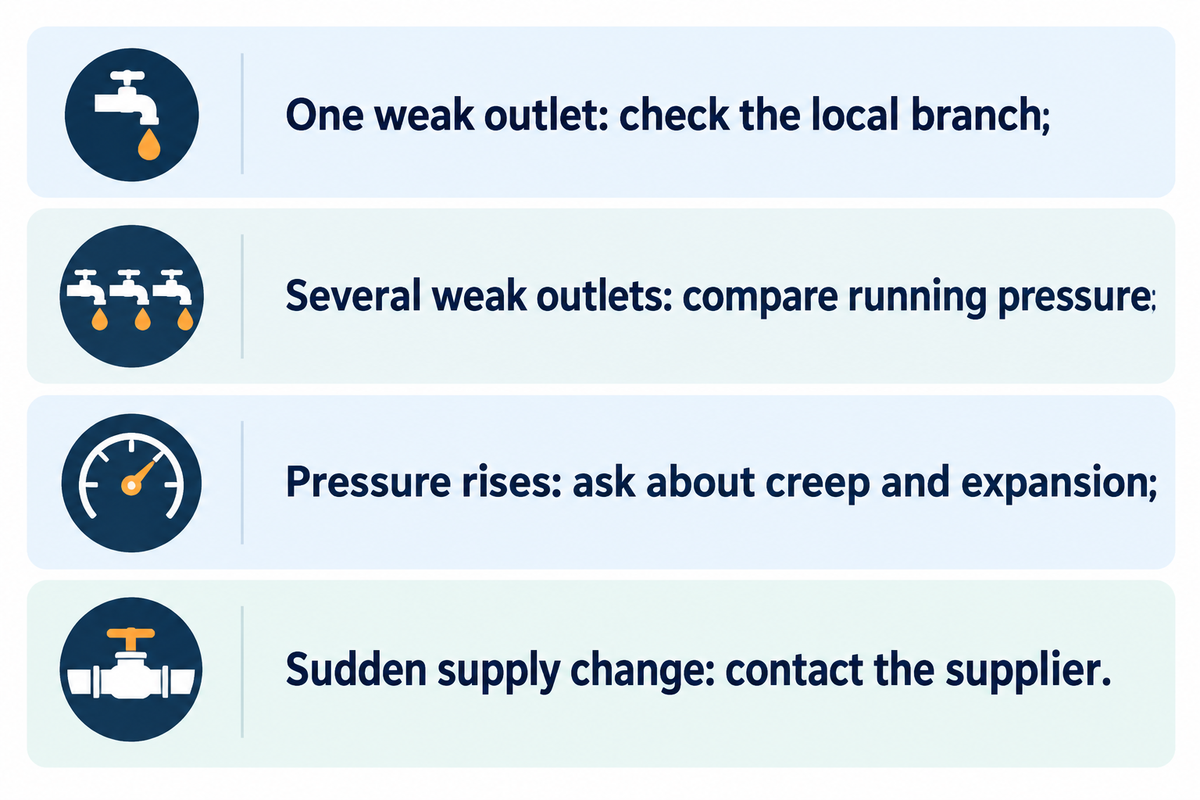
Investigating low water pressure issues begins with a pattern check before deciding whether replacement is needed. Compare affected fixtures, hot and cold delivery, and readings under demand. High pressure downstream also requires a separate examination. The table below routes observations to the next check, and doesn’t indicate a failed component from a symptom.
| Observation | Next check | Decision boundary |
|---|---|---|
| One faucet is weak; others work normally | Accessible aerator, fixture valve and local branch | Do not specify a whole-building booster from one outlet |
| Hot water is weak; cold water is satisfactory | Ask a plumber to examine the hot-water path | Do not raise the cold-water supply setting to compensate |
| Several outlets are weak but static pressure looks normal | Compare running pressure and inspect service restrictions | A resting reading cannot exclude a flow restriction |
| Static and running readings are low at a mapped point | Check supplier notices, location and upstream components | Confirm the cause before requesting a pump quotation |
| Downstream static reading is above 80 psi | Qualified gauge, regulator and local-code assessment | Confirm the point is downstream before judging regulation |
| Pressure rises after demand stops | Record timing; ask about regulator creep and thermal expansion | The pattern alone cannot distinguish those causes |
| Well pressure repeatedly cycles | Record cycle behavior for a well-system professional | Tank, pump and controls need system-specific assessment |
| Banging or brief surges occur between readings | Describe the event and ask about suitable logging | Three normal snapshots do not clear intermittent events |
| Service suddenly stops or changes after a main break | Contact the supplier and follow current incident advice | Resume home diagnosis after supply conditions are clarified |
What is a water pressure regulator?
A water pressure regulator is used to lower pressure to its controlled downstream level. It isn’t used to strengthen a weak supply. It’s also known as a pressure reduction valve or pressure-reducing valve, and performs a different function from a pressure relief valve, which opens to relieve excessive pressure under specific conditions.
According to Watts’ LF25AUB instructions, possible reasons for elevated downstream pressure may include thermal expansion, pressure creep and/or debris at the seating surface. Have a qualified plumber distinguish them. A closed plumbing system may need thermal expansion control; lowering the regulator setting doesn’t establish the cause.
Example: replacing the wrong part. An owner sees a satisfactory resting gauge reading but loses shower delivery whenever another fixture opens. Buying a larger booster before checking the existing shut-off valve, filter and regulator risks leaving the restriction in place. Start with the mapped pressure test and record which fixtures share the symptom. A plumber can then compare relevant upstream and downstream conditions. If an accessible filter is overdue for maintenance, follow its service instructions; don’t bypass required treatment or backflow protection. The spending decision follows the diagnosis, rather than the strength of the shower spray alone.
Look for a leak when high water bills accompany changing delivery, and then tell a plumber about hard water deposits or a recent repair. These help identify where to look, but aren’t proof that scale or leakage is responsible for a water pressure problem.
When a booster pump is the next step
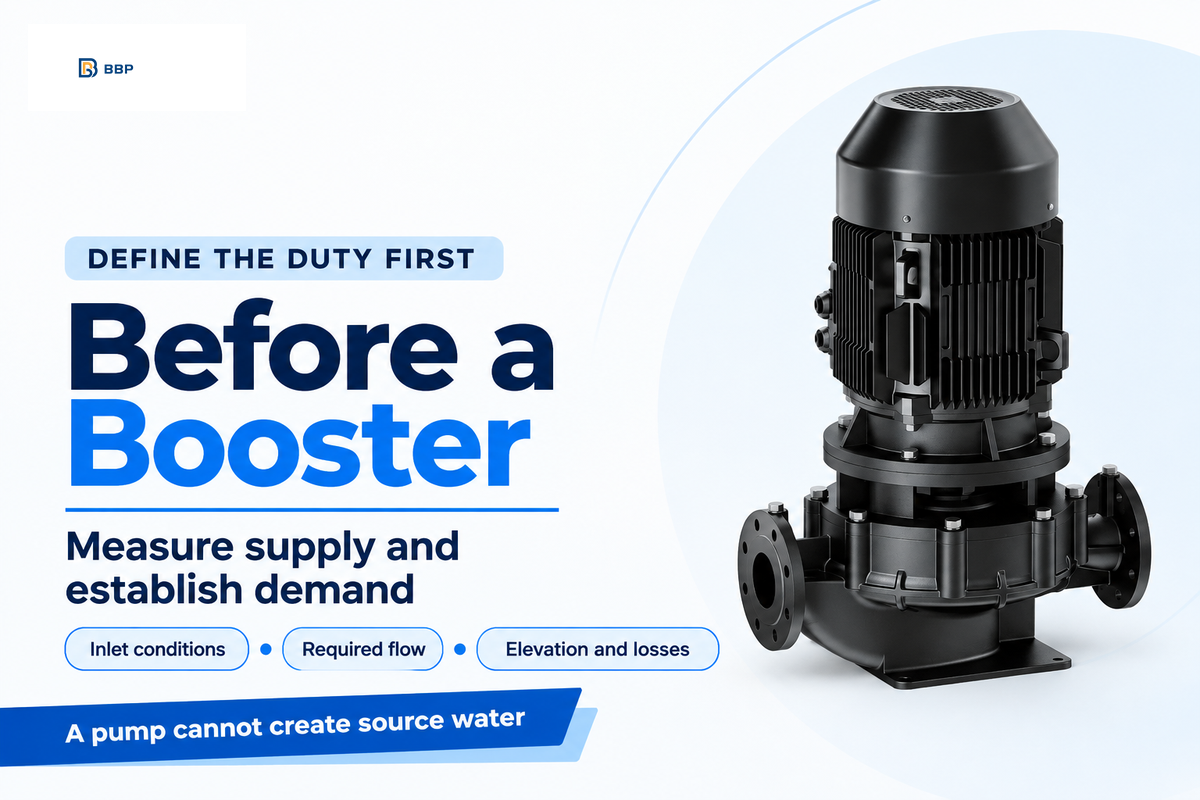
A booster pump is a choice when repeated measurements show the available supply can’t meet the required service conditions, and restrictions have been ruled out. The supply conditions and service demand are relevant to pump selection. A single measured value of a static gauge doesn’t determine the duty of the pump.
For building equipment, BBP offers its booster and pipeline pump options. Evaluate required pressure at the most demanding fixture and account for elevation and distribution losses. BBP’s total dynamic head calculation provides the relationship, and the effect of signed inlet pressure on pump discharge covers the pressure side of the duty. Keep those calculations apart from a household screening test.
Portland identifies location-dependent low pressure as a possible reason for boosting. Confirm the water supplier’s connection rules before opting for direct boosting. Available inlet water, permitted suction conditions, backflow protection and any storage requirement constrain the arrangement. A pump can’t create source water. Protection for the local supply is required and must be designed for the applicable supply conditions and utility requirements.
Example: a building purchase decision. A facilities manager has reported poor delivery on a top floor, and wishes to purchase a larger unit. Procurement has only a ground floor static reading. Before comparing prices, maintenance records the inlet condition during peak demand and the design team (in this case the designer) establishes the required flow, elevation and losses. If the inlet supply is inadequate, a larger pump may not address the issue. If a restriction is found, repair may change the duty requirement. The useful quotation therefore follows a defined operating point, potable-water requirements and electrical constraints, rather than a guess based on floor count.
Review BBP’s Booster pipeline pump selection guide for the equipment discussion. A well pump and pressure tank require their own control assessment; municipal city water pressure advice isn’t a substitute.
Take this pressure record to your supplier
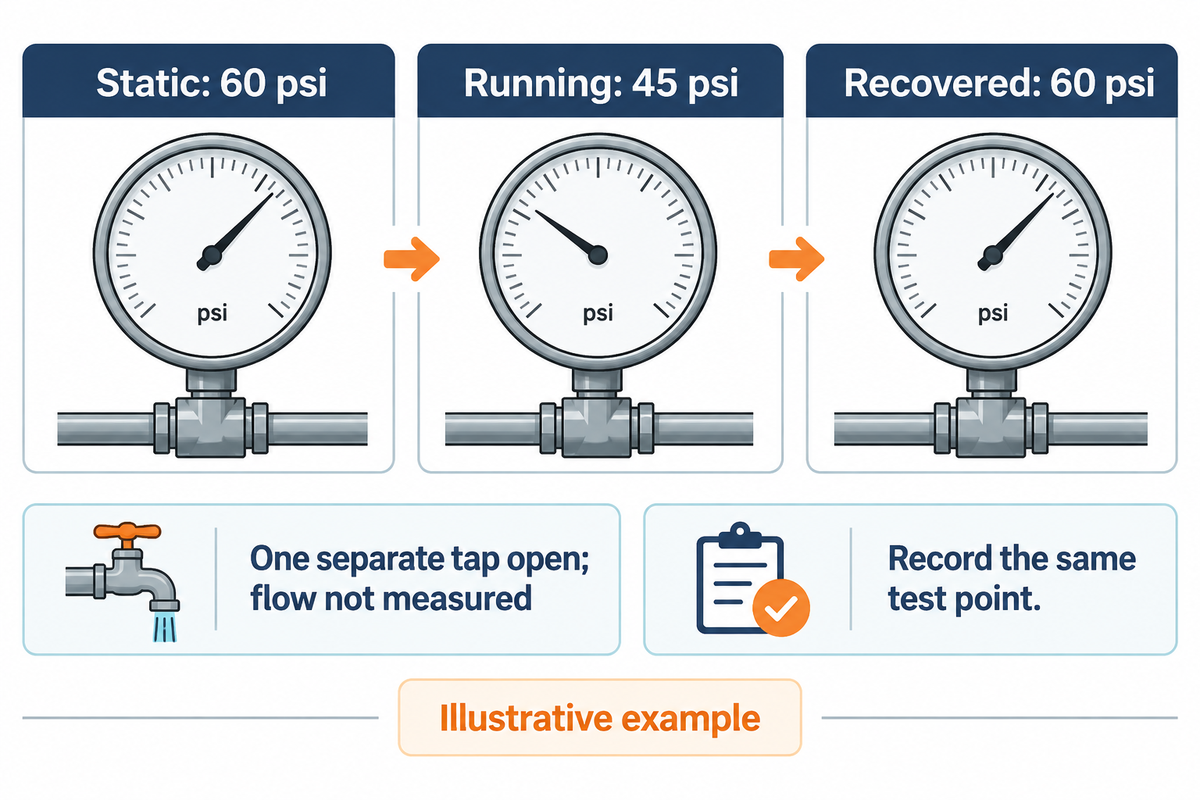
The Three-Reading Supply Record gives an owner, maintenance technician and equipment buyer the same account of the test. Record the test point, demand and instrument along with the three readings. It expands the City of Santa Barbara test-point guidance. Its value is traceability: another person can identify what was measured and define what’s missing before suggesting repairs or determining what the problem is.
| Field | Example entry | Why retain it |
|---|---|---|
| Time and symptom | 07:30; weak shower during simultaneous use | Owner can repeat the relevant condition |
| Test location | Ground-floor cold-water service tap | Maintenance can locate the same point |
| Device position | Confirmed downstream of regulator and filter | Identifies which supply section was measured |
| Instrument | Gauge model and full-scale accuracy recorded | Use the actual instrument specification when interpreting readings |
| Static reading | 60 psi; no water demand observed | Resting condition, not a flow-capacity test |
| Demand condition | One separate cold-water tap open; flow not measured | Prevents an unmeasured flow from becoming a design input |
| Running reading | 45 psi at that gauge | Pressure remaining during this named demand |
| Recovered reading | 60 psi after the demand stops and reading settles | Shows recovery for this observation only |
| Next information needed | Fixture comparison and actual required design flow | Buyer has insufficient data to select a booster yet |
Key takeaway
Record the conditions before buying equipment. A useful pressure record identifies where, when and under what demand the readings were taken. Normal static pressure does not prove adequate flow, and three normal readings do not rule out short-lived pressure events.
For a building pump inquiry, send BBP measured inlet conditions, required flow, target service pressure, elevation and available power. The booster pipeline pumps range is a starting point for that discussion. For household diagnosis or an unexplained supply change, start with your plumber or water company.
Frequently asked questions
How long do water pressure regulators last?
Water pressure regulators have no universal replacement age.
Water quality, debris, operating conditions and the model affect service life. Check the manufacturer’s maintenance guidance and investigate changed downstream readings or symptoms. A qualified inspection is more useful than replacing a working regulator solely because it reaches a generic anniversary. Keep previous readings and maintenance records so a change is easier to recognize.
Why is water pressure low?
Low water pressure can originate in the supply or within the property; a restricted fixture can feel similar.
Compare several outlets, hot and cold delivery, and static versus running readings at a known point. Check supplier incident notices first if the change is sudden; persistent problems need inspection before choosing a regulator or booster. Describe which fixtures are affected and whether simultaneous use changes the symptom. Mention any recent plumbing repair.
Why did my water pressure increase?
An increase can reflect a supply change, regulator problems or thermal expansion in a closed system.
Confirm the gauge location and repeat the measurement under recorded conditions. If downstream static pressure exceeds 80 psi, arrange qualified assessment against local requirements. Don’t assume that tightening a regulator adjustment will address every cause of rising pressure. Note whether the increase follows water heater operation, happens overnight or appears immediately after a repair.
How do I check water pressure without a gauge?
A bucket test measures flow, not pressure; a gauge is needed for a dependable pressure reading.
Compare delivery at several outlets to describe the symptom. Record which fixtures are running and whether hot and cold water behave differently. These observations help a plumber plan the pressure test, but they can’t supply a psi value.
What is a water pressure regulator?
A water pressure regulator reduces incoming pressure to a controlled downstream level.
The regulator doesn’t add pressure to a weak supply. Check whether the gauge connection is upstream or downstream before interpreting its reading as regulator performance.
References & Sources
Additional guidance: EPA WaterSense service water pressure technical sheet; Portland Water Bureau water pressure and flow guidance.
WHY BUYERS WORK WITH BBP
About BBP Manufacturing
BBP Manufacturing Co., Ltd. is a Beijing-based industrial pump manufacturer with in-house foundry, heat treatment, machining, assembly, coating and inspection capabilities. We support industrial projects across slurry handling, sewage treatment, clean water transfer, chemical service, fire protection, irrigation and OEM pump supply.
Our Engineering Support
We help engineering buyers select and source the right pump configuration, not just compare prices. Send us your flow rate, head, medium, solids content, temperature, pH value, material requirement and installation conditions. BBP engineers will recommend a pump series, material option, duty curve basis, lead time and spare-parts plan for your RFQ.
Company Profile // DATA_SHEET
Name
BBP Manufacturing Co., Ltd.
Brand Name
BBP
Country
China
Headquarters
Beijing, P.R. China
Business Type
Industrial Pump Manufacturer
Model
B2B / OEM / ODM / Project Supply
Main Products
Slurry Pumps, Sewage Pumps, Centrifugal Pumps, Split Case Pumps, Multistage Pumps, Chemical Pumps, Fire Pumps, Irrigation Pumps
Manufacturing Capability
Foundry, Heat Treatment, Machining, Assembly, Coating, Inspection
Certifications
ISO 9001 / CE / SGS / BV / TÜV
Export Reach
90+ Countries & Regions
Standard Lead Time
About 25 Days for Standard Configurations
Contact Person
Wesley · International Sales
Phone / WhatsApp
+86 182 1085 0516
Email
contact@bbpmfg.com
Website
https://bbpmfg.com/
Address
Room 2803, Building 11, Phase II, Nuode Center, Fengtai District, Beijing, P.R. China
Related Posts
Trending now