Get in Touch with BBP

Vertical Inline vs. Vertical Multistage Pumps: Structure, Sizing, and Selection

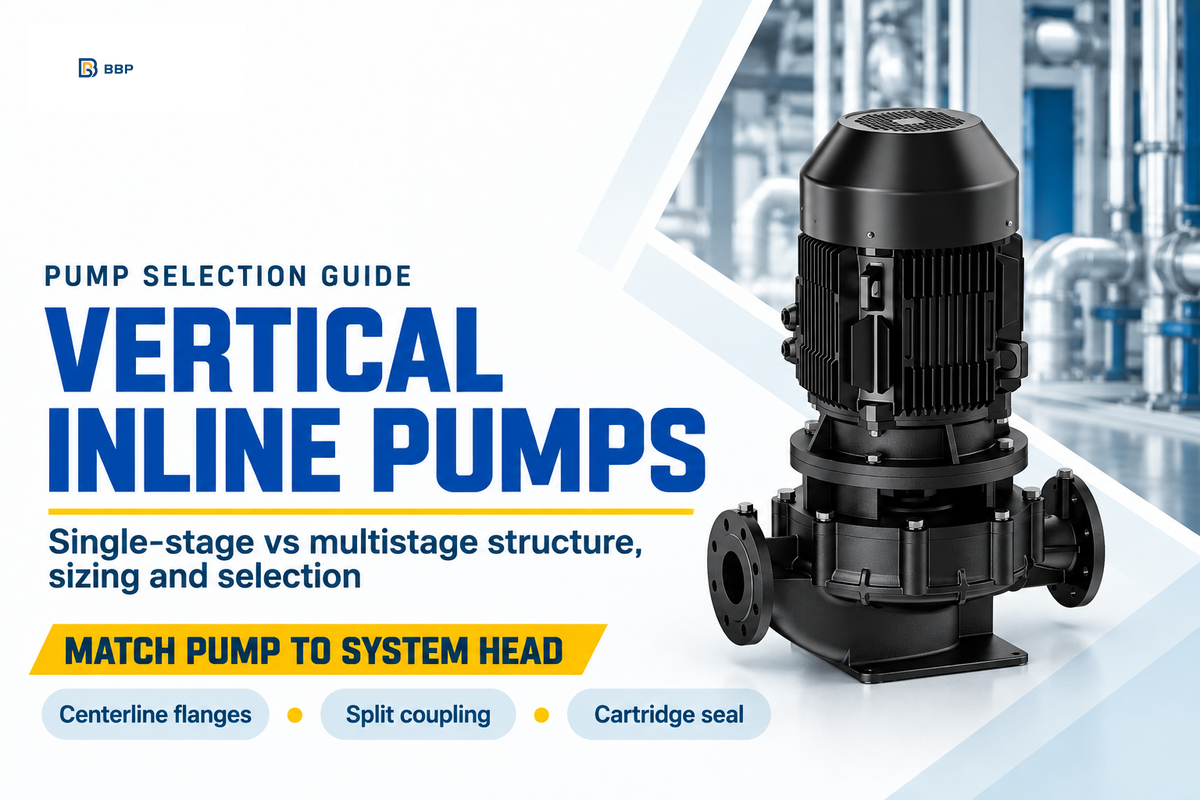
A vertical inline centrifugal pump places its suction and discharge flanges on a single 180-degree horizontal centerline. The pump body bolts directly into a straight pipe run like a valve without a separate base frame or concrete floor mounting pad. For instance, Armstrong Series 4300 single-stage vertical inline pumps reach flows to 28,000 USgpm (1,800 L/s) or heads to 500 ft (150 m).
That single-stage offering ranged from 1 to 1,250 HP (0.75 to 900 kW) for HVAC circulation. Meanwhile, EBARA EVMSU stacked-impeller vertical multistage pumps could produce 3 to 607 GPM with heads from 24 to 930 ft. Those multistage models maintain a working pressure up to 435 PSI (30 Bar) across 1/2 to 60 HP.
Use single stage vertical inline Circulators for closed HVAC Loops where resistance to flow is mostly pipe friction. Select vertical multistage boosters for open loops that must overcome high static lift and fixture pressure. Closed hydronic loops balance static pipe elevation between supply risers and return downcomers, so a single radial impeller only overcomes pipe and coil friction.
Open-loop high-rise water supply and boiler feed circuits fight unrecovered static lift and fixture pressure, and when that lift is greater than a single impeller can produce efficiently, they use multistage pumps with impellers and diffusers one above the other on a vertical shaft.
80 to 110% BEP
recommended HVAC operating point window on the pump curve per Rotech Pumps
500 ft vs 930 ft
Armstrong 4300 single-stage head ceiling vs EBARA EVMSU multistage head
1 to 200 HP
US DOE regulated In-Line (OH3, OH4, OH5) and RSV (VS8) clean-water power scope
What Is a Vertical Inline Pump and How Does Centerline Piping Geometry Work?
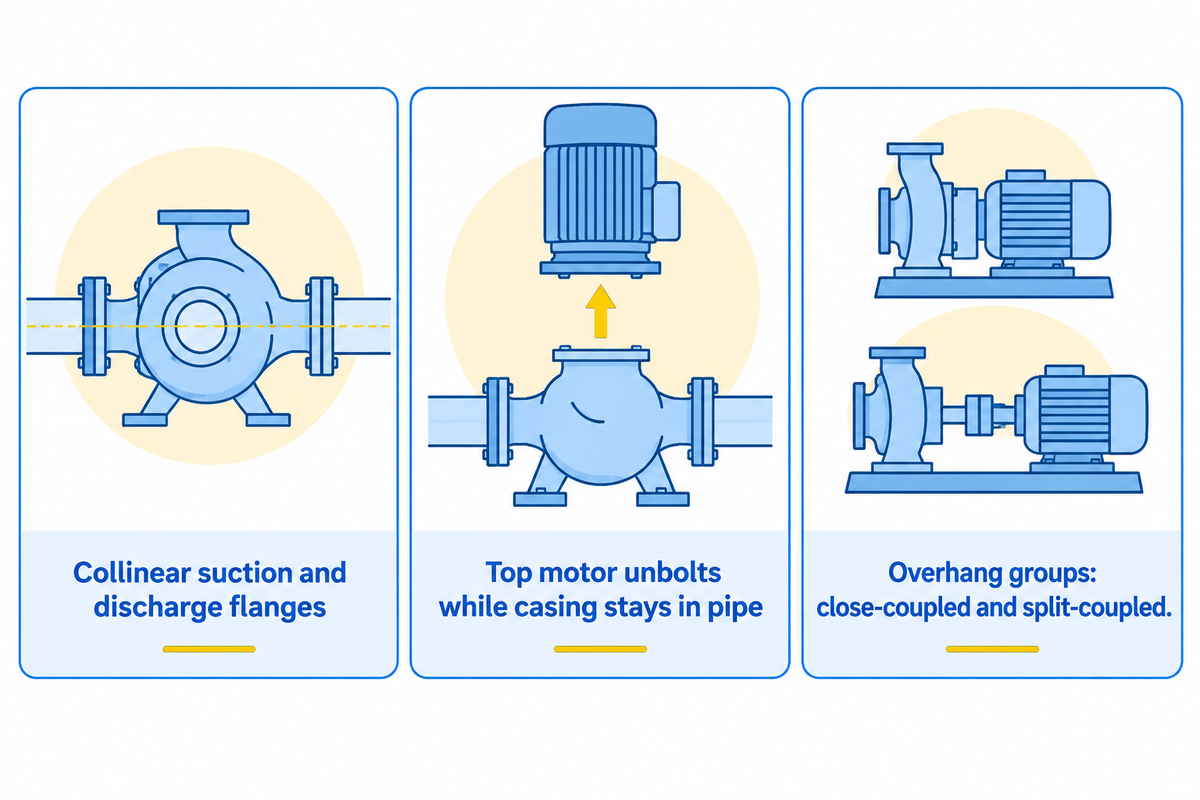
A vertical inline pump is a single-stage, single-axis flow centrifugal pump. Its collinear suction and discharge flanges sit on a 180-degree centerline while the motor stands vertically above the volute casing in a compact inline design. Under Hydraulic Institute and US Department of Energy definitions, the DOE regulates commercial clean-water in-line pumps rated from 1 to 200 HP at Best Efficiency Point (BEP).
Think of an inline pump like an isolation valve bolted straight into a pressurized water main. Water passes in to the suction flange, follows the pipe axis into the centrifugal force and immediately begins to accelerate radially through the impeller. It flows out the reverse discharge nozzle in the same pipe centerline from which it entered without having to bend the pipe 90 degrees to meet an axial inlet.
The impeller trim has been matched to your design flow and head for maximum hydraulic energy efficiency through your seasonal cooling loads. During overhaul, the technicians remove the top motor and shaft assembly while the cast pump casing remains bolted directly in the pipeline.
“In-line pump means a pump that is either a) a twin-head pump, or b) a single-stage, single-axis flow, dry rotor, rotodynamic pump that has a shaft input power greater than or equal to 1 hp and less than or equal to 200 hp at BEP and full impeller diameter, in which liquid is discharged through a volute in a plane perpendicular to the shaft… Examples include, but are not limited to, pumps complying with ANSI/HI nomenclature OH3, OH4, or OH5, as described in ANSI/HI 1.1-1.2–2014.” Examples include, but are not limited to, pumps complying with ANSI/HI nomenclature OH3, OH4, or OH5, as described in ANSI/HI 1.1-1.2–2014.”, Hydraulic Institute (HI), DOE Pumps: Diagrams and Definitions (ANSI/HI 1.1-1.2)
Single-stage vertical in-line pumps are classified into three overhang mechanical groups by engineers that follow an ANSI/HI 1.1-1.2 rotodynamic nomenclature. The impeller is secured directly to a long motor shaft with type OH5 close-coupled units. Type OH4 rigid split-coupled units connect a pump shaft to a common vertical motor with a removable spacer coupling.
The OH3 bearing-frame units use an independent bearing bracket between the pump casing and the motor to receive large hydraulic radial loads.
Q. Buyers often confuse single stage in-line pumps with submerged sump pumps or multi-stage booster pumps. In the US Department of Energy rulemaking there is a distinctly separate category of radially split multi-stage vertical in-line diffuser casing pumps.
That designation is defined as VS8 by ANSI/HI terminology and RSV by DOE terminology. In addition, mechanically or close-coupled pumps rated 5 HP or less at BEP with a horizontal motor are excluded from the DOE In-Line (IL) category.
Vertical Inline vs. Horizontal End-Suction Pumps: Footprint, Baseplates, and Piping Layout
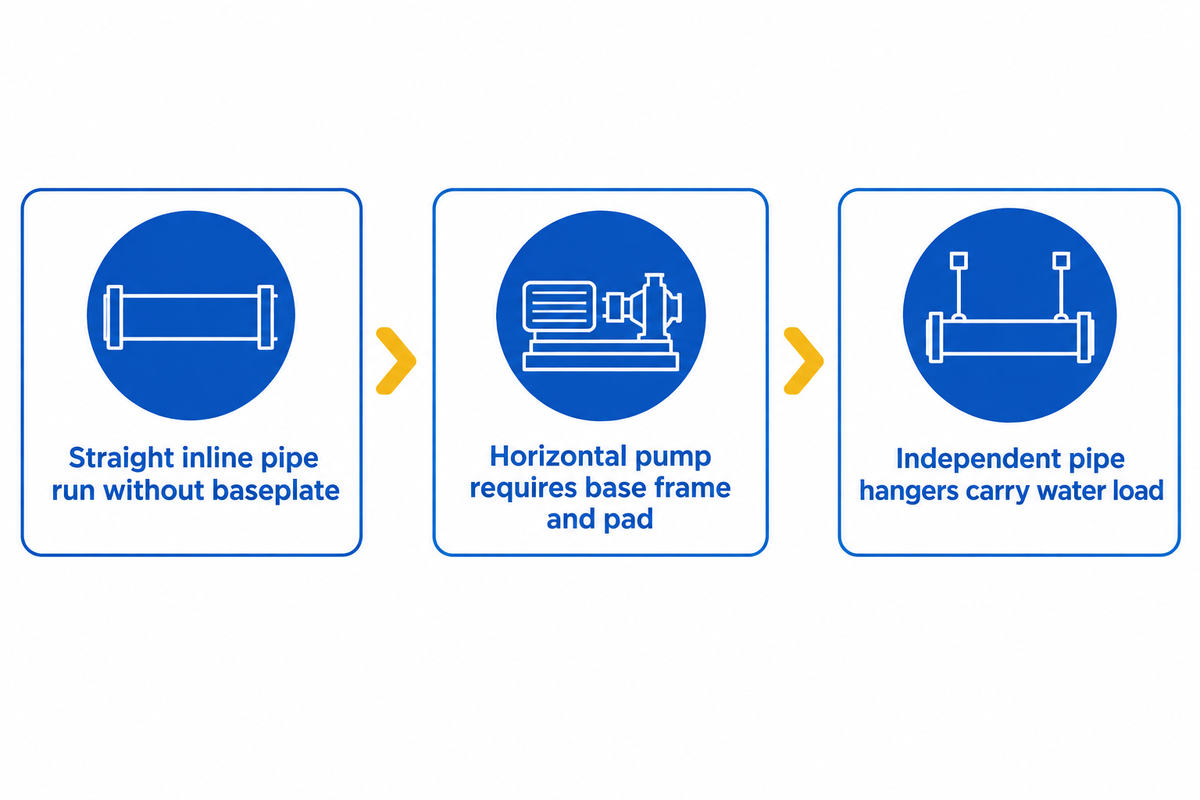
A pipe-mounted vertical inline pump sits in the pipe run and needs no baseplate or housekeeping pad of its own. According to Rotech Pumps HVAC selection guidelines, vertical inline pumps are preferred for secondary loops under 1,500 to 2,000 GPM where floor space is limited.
Comparing a vertical inline pump vs horizontal end-suction unit shows how layout geometry dictates total installed cost when floor space is limited. As shown in our horizontal end-suction centrifugal pump field guide, a typical horizontal pump (ANSI/HI OH0, OH1, or OH7) receives fluid in an axial direction at one end of the volute. And then it discharges it in a radial direction out the top. 90-bends force pipefitters to incorporate a suction elbow, a structural steel base frame, foundation anchor bolts, and grouting.
Pipe-mounted inline pump solutions simplify installation compared to base-mounted horizontal designs because they require no concrete inertia base or flex connectors. Nixing the baseplate, concrete pad, and field alignment minimizes installation costs across the piping system and gives easy installation under installation constraints.
Vertical In-Line Centrifugal Pump (OH3 / OH4 / OH5)
- Suction and discharge ports align on a 180° straight pipe centerline.
- Mounts directly in the pipeline without a separate floor base frame or mounting pad.
- Removes the need for structural steel base frames, grouting, and concrete inertia bases.
- Unit is preferred for secondary HVAC loops and zone circuits less than 1,500-2,000 GPM.
- Motor unbolts from the top of the casing without disturbing pipeline connections.
Horizontal End-Suction Pump (OH0 / OH1 / OH7)
- Axial end suction and radial top discharge 90° pipe turn.
- Requires floor area for base frame as well as maintenance walk around area.
- Demands anchor bolts, concrete mounting pad, and coupling alignment at commissioning.
- Handles all primary chiller headers and general plant distribution up to 5,000 GPM per Rotech Pumps.
- Enables at waist-height, horizontal access to the casing and bearing frame.
What Is the Difference Between a Horizontal and Vertical Centrifugal Pump in Piping Load and Foundation Design?
A horizontal centrifugal pump moves the pump and motor weight into a base frame on the floor fitted to a concrete pad. A vertical inline pump is installed directly in the pipeline on the pipe to support smaller models. Larger models have additional floor stands or pipe hangers to support the motor weight without the need for a concrete inertia base.
A costly procurement objection occurs when contractors assume any vertical inline pump can hang unsupported from overhead copper or thin-wall steel pipe. According to Rotech Pumps’ HVAC installation guidance, the pump is designed to carry its own weight and the weight of the motor, not the surrounding piping. Excessive pipe loads on the pump flanges cause internal misalignment and accelerate mechanical seal and bearing wear. Pipe hangers and floor supports on both sides of the pump must carry the water-filled piping weight independently of the pump flanges.
Vertical Inline Single-Stage vs. Vertical Multistage Pumps: Structural and Hydraulic Crossover
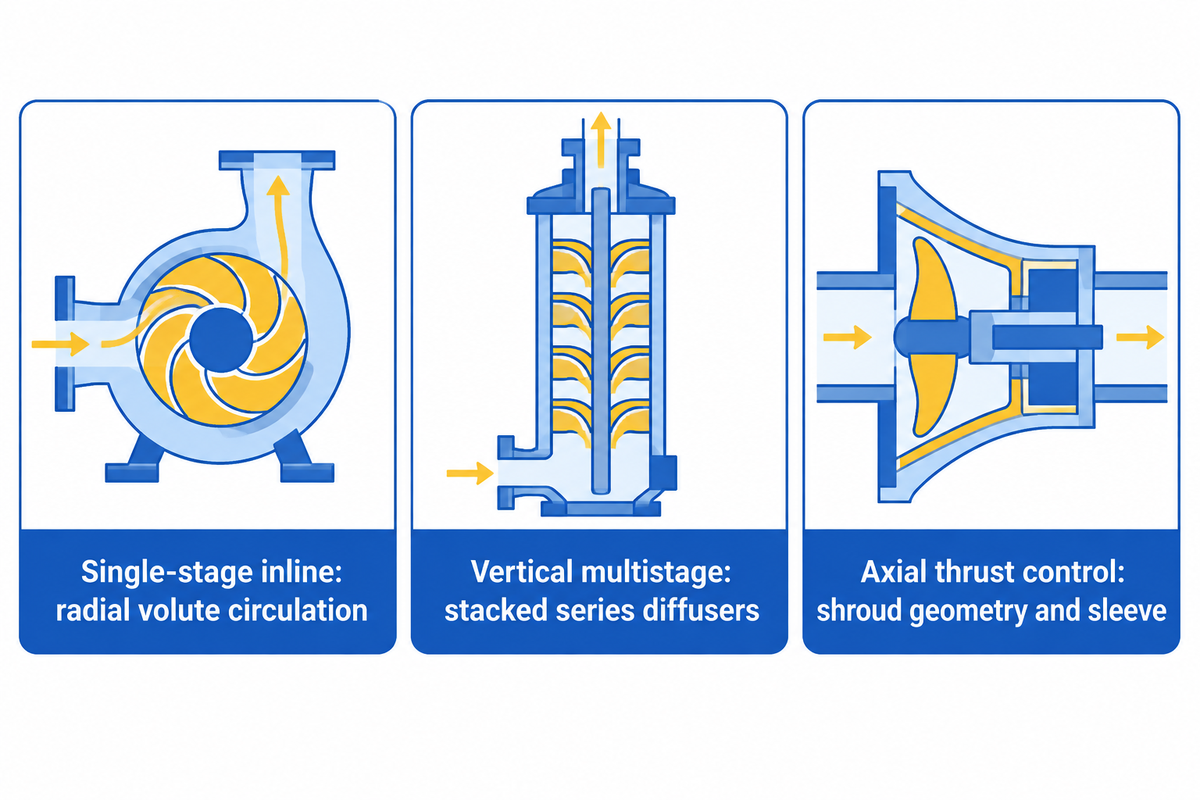
Choose one stage vertical inline pump for high-flow, moderate-head applications in closed, HVAC loops. Armstrong Series 4300 single-stage systems can provide flow up to 28,000 USgpm (1,800 L/s) or head up to 500 ft (150 m). Specify a vertical multistage centrifugal pump when system needs require high pressure, such as EBARA EVMSU units rated up to 435 PSI (30 Bar) and 24 to 930 ft head across 3 to 607 GPM.
However, while pump configurations both put their suction and discharge ports inline very low in the unit, their internal hydraulic engines are radically different. A single-stage vertical inline pump uses one enclosed radial impeller spinning inside a heavy cast volute casing for high-volume fluid transfer. Fluid enters the impeller eye, gains velocity from centrifugal force, and converts kinetic energy into pressure inside the single volute channel.
Because one impeller must generate the entire differential head, increasing pressure beyond 150 m (500 ft) requires an oversized impeller diameter. That oversize rotor causes high disk frictional losses and low-specific speed efficiency.
A vertical multistage inline pump solves high-head boosting by stacking multiple moderate-diameter stainless steel impellers and vaned diffusers in series on a single vertical shaft. Flow rate remains identical through every stage, while each stage adds a stepped pressure increment that provides precise flow and pressure control. As documented in the EBARA EVMSU Series Vertical Multistage engineering datasheet, a 1/2 to 60 HP multistage stack with 1-1/4 inch to 4 inch ANSI flanges reaches 24 to 930 ft of head. It also sustains 435 PSI (30 Bar) maximum working pressure across liquid temperatures from -22°F to +248°F (-30°C to 120°C).
3-Architecture Inline & End-Suction Crossover Matrix
The 3-Architecture Inline & End-Suction Crossover Matrix below gives plant engineers a quantitative selection boundary. It shows the comparison between single-stage vertical inline volute pumps, stacked-diffuser vertical multistage inline boosters and horizontal end-suction.
| Engineering Parameter | Single-Stage Vertical Inline (IL) | Vertical Multistage Inline (RSV) | Horizontal End-Suction (ESFM / ESCC) | Selection Boundary & Reference |
|---|---|---|---|---|
| 1. ANSI/HI & DOE Code | OH3, OH4, OH5 (DOE In-Line IL) | VS8 (DOE Radially Split RSV) | OH0, OH1 (DOE ESFM) & OH7 (DOE ESCC) | ANSI/HI 1.1-1.2 & 2.1-2.2; DOE scope 1–200 HP |
| 2. Hydraulic Stage Count | 1 radial impeller in cast volute | Multiple series impellers & diffusers | 1 radial impeller in end-suction volute | Multistage multiplies head at same flow |
| 3. Flow Rate Envelope | Up to 28,000 USgpm (1,800 L/s) on Armstrong 4300 | 3 to 607 GPM on EBARA EVMSU | Up to 5,000 GPM in HVAC service per Rotech | Armstrong 4300, EBARA EVMSU & Rotech benchmarks |
| 4. Differential Head Ceiling | Up to 500 ft (150 m) on Armstrong 4300 | 24 to 930 ft on EBARA EVMSU | Single-stage volute friction head range | EVMSU overlaps below 500 ft and extends to 930 ft at 3–607 GPM |
| 5. Maximum Working Pressure | Up to 200 to 300 PSI in standard HVAC per Rotech | 435 PSI (30 Bar) max on EBARA EVMSU | Up to 200 to 300 PSI in standard HVAC | Rotech HVAC rating vs EBARA EVMSU sleeve rating |
| 6. Piping Nozzle Geometry | 180° collinear inline flanges | 180° collinear bottom inline flanges | 90° axial suction to radial discharge | Inline mounts directly in straight pipe |
| 7. Floor Space & Foundation | In-pipe mounting; no concrete inertia pad | Compact vertical base flange footprint | Requires separate base frame & floor pad | Inline eliminates baseplate & field alignment |
| 8. Seal & Bearing Design | Top motor removal or OH4 split spacer coupling | SiC/Carbon/Viton cartridge seal & WC lower bush | Back-pull-out frame; requires field alignment | Cartridge seal services without motor bracket removal |
| 9. Primary Facility Duty | Secondary chilled/hot water & zone loops | High-rise booster, boiler feed, RO & filtration | Primary chiller headers & general distribution | Match architecture to flow, static lift & mechanical room space |
Stacking multiple impellers creates cumulative downward hydraulic thrust toward the suction base. To protect pump and motor bearings, high-pressure vertical multistage centrifugal pumps incorporate low-axial-thrust impeller shroud geometry. Per EBARA EVMSU specifications, they also use tungsten carbide lower pump bearings and sleeves along with square-edge four-spline shafts. In USPTO Patent US7775763B1, engineers document an angled front shroud labyrinth seal. That labyrinth seal self-regulates front cavity fluid pressure whenever axial impeller displacement occurs. You can compare single-stage versus stacked impeller thrust mechanics in our guide to axial thrust and radial thrust in centrifugal pumps. For high-capacity central plant headers where horizontal floor space is available, compare double-suction rotor layouts in our horizontal double-suction split-case pump selection guide.
Close-Coupled (OH5) vs. Split-Coupled (OH4) Vertical Inline Pumps: At What Horsepower Should You Switch?
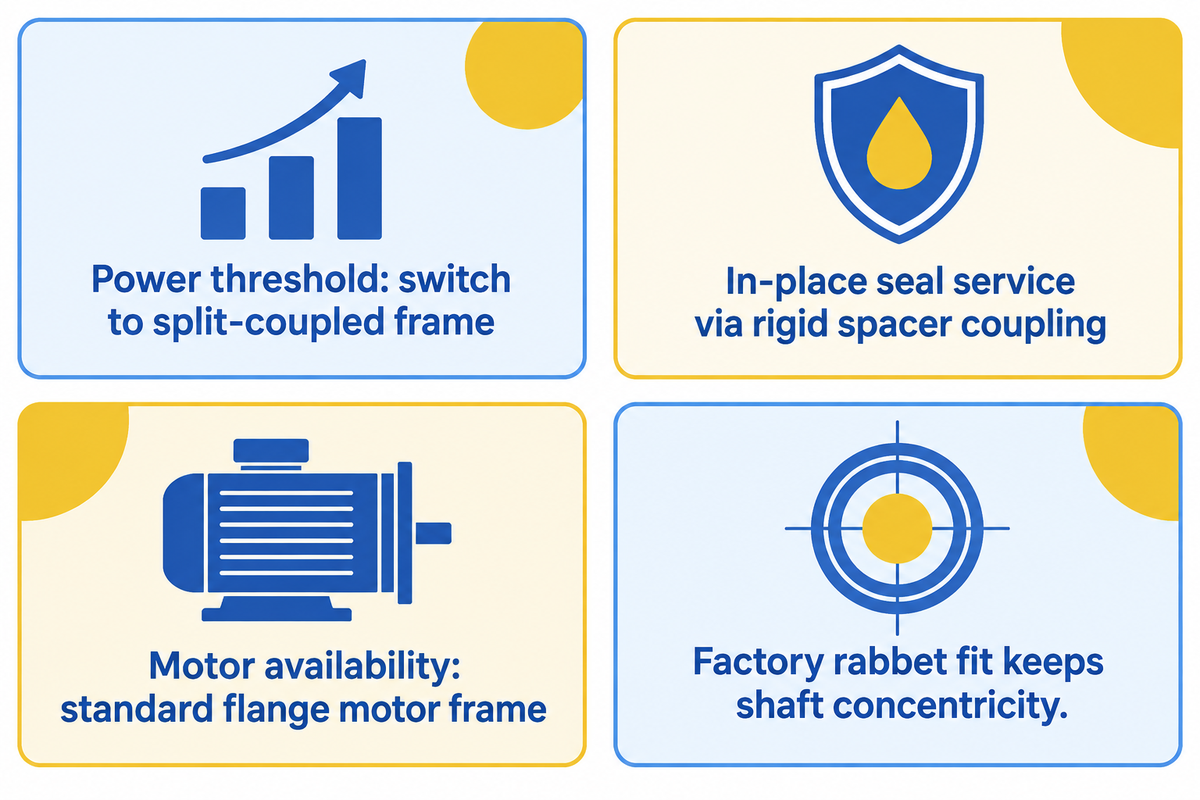
Armstrong offers close-coupled (OH5) vertical inline units up to 15 HP (11 kW), while split-coupled (OH4) designs span 1 to 1,250 HP (0.75 to 900 kW). Split-coupled units enable maintenance technicians to remove the cartridge mechanical seal without having to disconnect the pump casing or use a hoist on the motor.
A close-coupled (OH5) pump has the impeller mounted directly on the extended motor shaft. The shared extended shaft of the pump and motor provides no coupling and the entire assembly maintains a low profile. However, the motor bearings carry all hydraulic axial and radial thrust.
When the mechanical seal weeps, the motor must be unbolted from the pump casing and lifted out. A split-coupled (OH4) pump has a typical vertical flange motor on a support bracket. It drives a pump stub shaft via a rigid spacer coupling.
4-Threshold Close-Coupled vs. Split-Coupled Serviceability Protocol
Commercial pump submittal approval: Apply the 4-Threshold Close-Coupled vs. Split-Coupled Serviceability Protocol to avoid maintenance bottleneck prior to pump approval:
- For motor power ratings, Armstrong Series 4300, 4360, and 4380 technical literature specifies close-coupled inline units (Series 4360 and 4380) up to 15 HP (11 kW). Split-coupled Series 4300 units span 1 to 1,250 HP (0.75 to 900 kW). Specify split-coupled OH4 units for all motors above 15 HP so technicians don’t have to rig and hoist a heavy motor during seal replacement.
- In-place seal access on a split-coupled vertical inline pump or an EBARA EVMSU multistage unit can be accomplished by unbolting the rigid spacer coupling to uncover the shaft end. The service technician easily slides the cartridge mechanical seal replacement assembly off the pump shaft without disconnecting the motor bracket or disturbing any of the piping.
- Emergency Motor Frame Availability: Close-coupled OH5 pumps typically use NEMA JM or JP close-coupled pump motors, which local motor shops stock less widely than standard TC-frame motors. Split-coupled OH4 complete pump assemblies accept standard NEMA or IEC motors to provide efficient solutions under variable system conditions.
- When mounting a pump in a vertical pipe run with its motor shaft horizontal, Armstrong instructions restrict horizontal-shaft mounting to close-coupled units up to 15 HP (11 kW). Split-coupled OH4 pumps above 15 HP must always operate with the shaft vertical.
Do Vertical Inline Pumps Need Field Shaft Alignment After Mechanical Seal Replacement?
Neither close-coupled (OH5) nor rigid split-coupled (OH4) vertical inline pumps require dial-indicator or laser shaft alignment in the field. Close-coupled pumps have one motor shaft. Split-coupled inline pumps use a rigid coupling with the rabbet fit alignment in the factory to keep the shaft concentricity by itself.
Only frame-mounted inline pumps (ANSI/HI OH3) equipped with a flexible coupling between the motor and an independent bearing frame require coupling condition and alignment checks. According to Rotech Pumps’ commissioning guidance, field alignment work is unnecessary for factory-set rigid couplings of split-coupled vertical inline units. This self-centering fit shortens the time of commissioning and will avoid bearing and seal failure early from misalignment.
How to Size and Select a Vertical Inline Pump: Flow, Head, RPM, and Parallel Staging
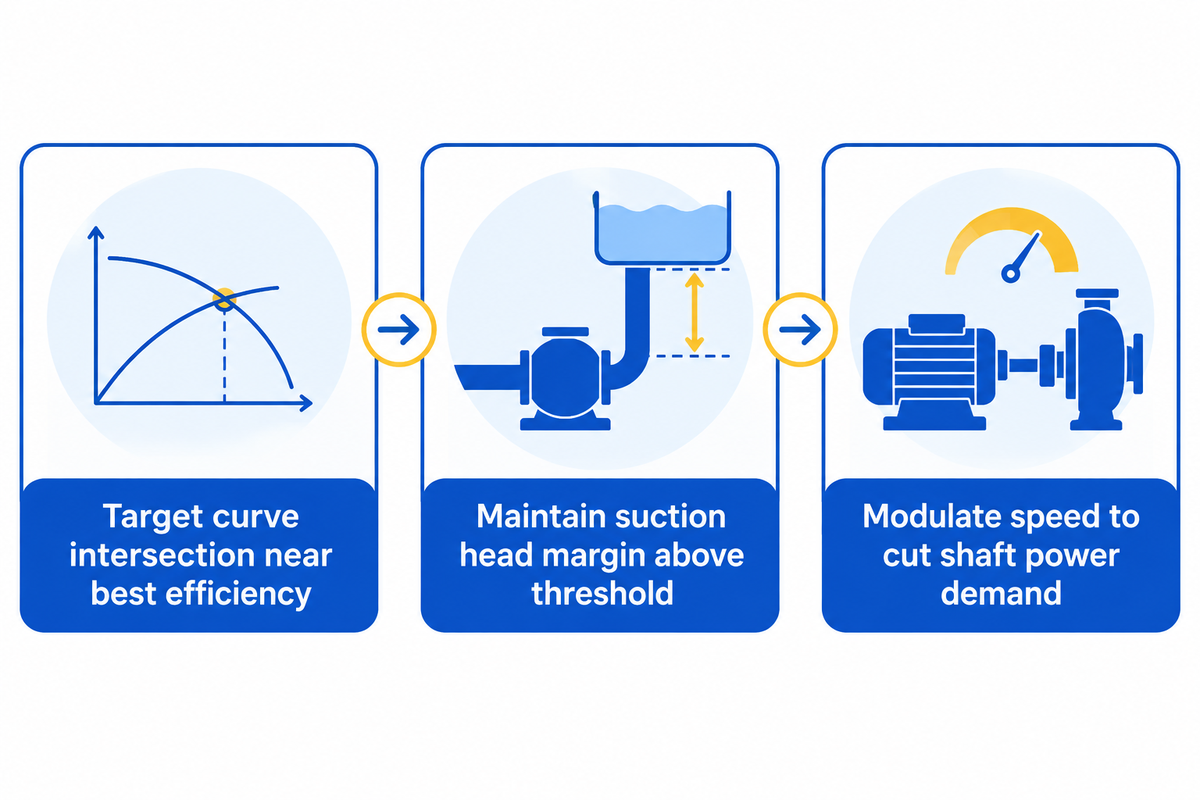
Select a vertical inline pump so your system curve intersects the pump performance curve at 80 to 110% of the pump’s Best Efficiency Point (BEP) per Rotech Pumps HVAC sizing guidelines. Maintain a Net Positive Suction Head (NPSHa over NPSHr) safety margin of at least 2 to 3 feet.
Operating a centrifugal pump far to the left or right of its BEP on the pump curve generates excessive radial thrust on the impeller and shaft. From Rotech Pumps failure analysis report, off-BEP radial loading is the most common root failure cause for bearing and mechanical seal failure in vertical inline pumps. When sizing multiple pumps in a duty/standby or two-pump parallel header, keep single-pump operation within 80 to 110% of BEP flow.
Also maintain at least 2 to 3 feet of NPSHa margin over NPSHr. Use the curve-intersection technique in our guide on pumps in parallel combined curves and flow sharing.
Worked Chilled-Water Flow & Variable-Speed Affinity Sizing Example: Suppose a facility engineer is sizing a secondary chilled-water vertical inline pump for a 100-ton commercial cooling load with a 10°F chilled-water temperature differential (ΔT). Under the standard HVAC heat-transfer equation documented by Rotech Pumps, design flow rate equals GPM = (Tons of cooling × 24) ÷ ΔT (°F). Assumed inputs and step-by-step results are shown in Table 2 below. Based on these assumed inputs, the 100-ton loop requires 240 GPM of base flow. Adding a 10 to 15% safety margin yields 264 to 276 GPM. When building cooling load drops during shoulder seasons and a variable-speed drive reduces pump speed by 20%, flow drops by 20% (from the 240 GPM base flow to 192 GPM). At that reduced speed, pump power consumption drops by nearly 49% under the cubic affinity law.
| Sizing Step / Parameter | Full-Load Peak Design Condition | Part-Load VSD Condition (20% Speed Reduction) |
|---|---|---|
| Assumed Cooling Load & ΔT | 100-ton chiller load at 10°F ΔT | Part-load cooling demand at 10°F ΔT |
| Base Chilled-Water Flow Rate | (100 × 24) ÷ 10 = 240 GPM | 20% speed reduction → 192 GPM (20% flow reduction) |
| Design Flow with 10 to 15% Safety Margin | 240 × 1.10 to 1.15 = 264 to 276 GPM | Operates inside 80 to 110% BEP curve window |
| Required NPSHa Margin Over NPSHr | At least 2 to 3 feet above pump NPSHr | NPSHr drops at reduced speed; margin increases |
| Relative Shaft Power Consumption | Rated full-speed shaft power | Cuts power consumption by nearly 49% per affinity law |
Commercial HVAC and Industrial Applications: Chilled Water, Hydronic Heating, and Booster Loops
In commercial HVAC systems, single-stage vertical inline pumps serve secondary chilled-water loops, low-temperature hot water (LTHW) heating at 140°F to 180°F, and cooling tower condenser loops at 85°F to 95°F. Condenser loops typically require roughly 3 GPM per ton of refrigeration up to 1,500 to 2,000 GPM.
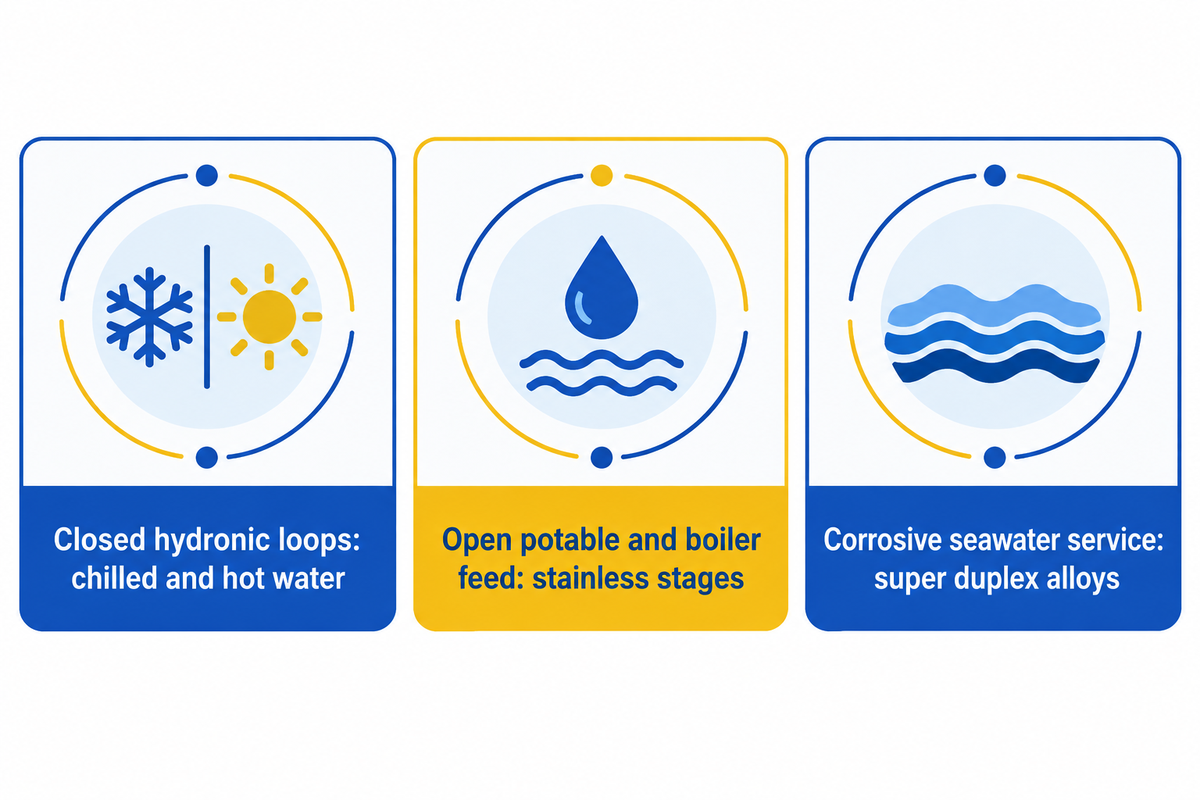
Use single-stage vertical inline circulators for closed HVAC loops. Specify 304 or 316 stainless steel vertical multistage pumps for open potable and boiler feed loops to prevent corrosion. Explore our booster and pipeline pump selection guide for piping layout schematics across these five common applications:
- In secondary chilled-water distribution, single-stage vertical inline pumps with variable-speed drives move chilled water from the common header. They provide flow to air-handling coils and fan coil zone risers up to 1,500 to 2,000 GPM.
- In low-temperature hot water (LTHW) and glycol heating loops, pumps circulate water at 140°F to 180°F through riser shafts and ceiling voids. Adding propylene or ethylene glycol for freeze protection raises fluid viscosity and reduces flow rate and head compared to water.
- In domestic hot water and potable high-rise pressure boosting, open potable water systems contain dissolved oxygen that corrodes plain cast iron. High-rise booster packages use corrosion-resistant 304 or 316 stainless steel multistage units (or all-bronze inline circulators).
- For boiler feedwater, filtration, and reverse osmosis (RO), EBARA EVMSU vertical inline multistage pumps operate from -22°F to +248°F (-30°C to 120°C). They sustain up to 435 PSI (30 Bar) to feed high-pressure steam boilers and membrane filtration skids.
- In industrial chlorination and seawater booster circuits, Water Tech Online industrial chlorination specifications note that seawater booster pumps increase pressure to approximately 5 to 6 barg. They’re made of super duplex stainless steel casings, impellers, shafts, and wear rings.
Wetted Materials, Flange Pressure Ratings, and Cartridge Mechanical Seal Specification
Standard HVAC cast-iron vertical inline casings handle temperatures from 14°F to 250°F and working pressures up to 200 to 300 PSI per Rotech Pumps. Stainless-steel EBARA EVMSU multistage units reach 435 PSI (30 Bar) from -22°F to +248°F (-30°C to 120°C) and pair with Silicon Carbide/Carbon/Viton cartridge mechanical seals.
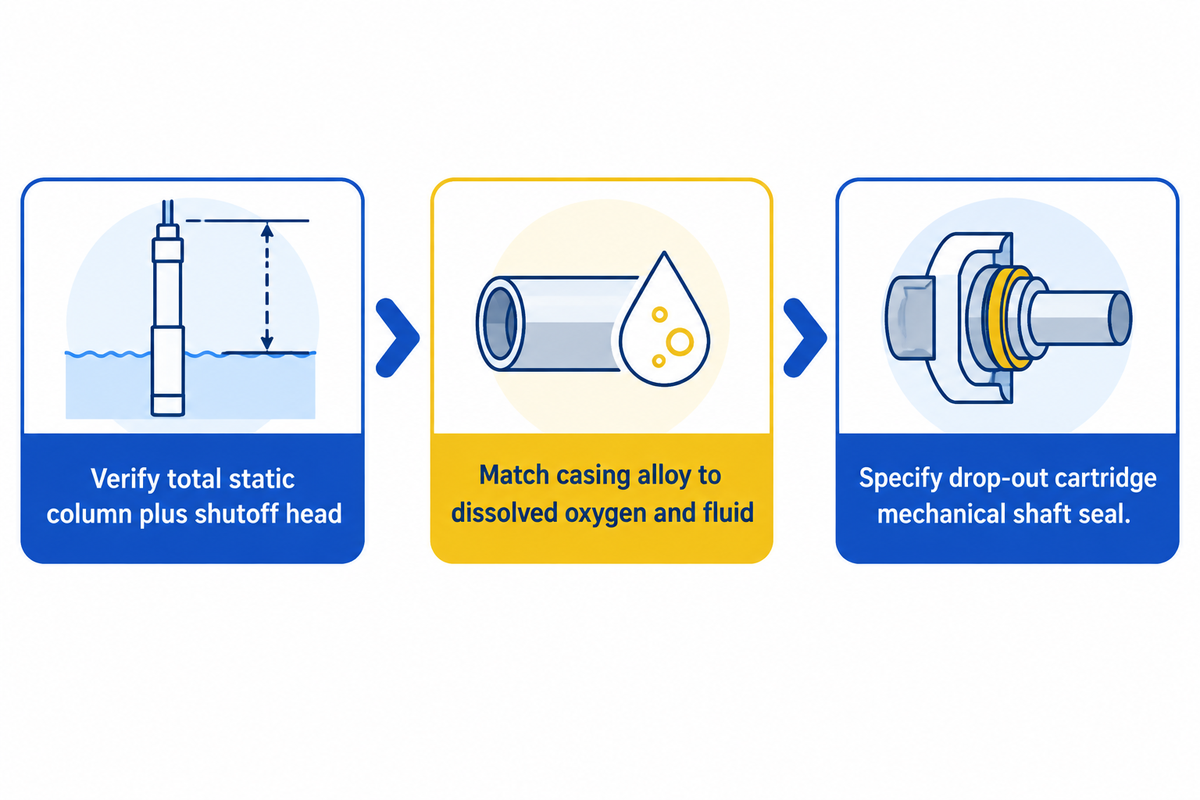
An often-occurring design deficiency in high-rises is installation of a pump casing based on a differential pump head pressure alone, leaving out static water column elevation. Casing pressure ratings are based on adding static building water column pressure and expansion-tank charge to the pump shutoff head against the certified factory hydrostatic test rating. The OH4 pump has a split coupling and a Silicon Carbide/Carbon/Viton cartridge mechanical shaft seal for servicing so the mechanic slides the cartridge seal out the coupling spacer gap without removing the motor bracket.
Wetted Metallurgy, Flange Class & Cartridge Seal Compatibility Grid
The Wetted Metallurgy, Flange Class & Cartridge Seal Compatibility Grid in Table 3 matches casing alloys, flange ratings, fluid and temperature envelopes, and commercial price and lead-time bands.
| Component / Alloy Tier | Connection & Rated Working Pressure | Verified Fluid & Temperature Envelope | Procurement & Specification Basis | Recommended Facility Application |
|---|---|---|---|---|
| 1. Cast Iron Casing with Bronze/SS Impeller | Standard HVAC flanged casing (up to 200 to 300 PSI model dependent) | Treated chilled/hot water, 14°F to 250°F; LTHW at 140°F to 180°F | Baseline commercial HVAC metallurgy; request quote by motor HP | Closed secondary chilled water & LTHW heating loops per Rotech |
| 2. Condenser Loop Cast Iron / Bronze Trim | ANSI flanged inline volute (up to 200 to 300 PSI model dependent) | Cooling tower condenser water at 85°F to 95°F (3 GPM/ton) | Sized for continuous near-BEP (80 to 110% BEP) operation | Chiller condenser to cooling tower circulation circuits |
| 3. All-Bronze or Stainless Steel Inline Casing | In-pipe flanged or threaded domestic recirculation body | Aerated potable domestic hot water recirculation | Prevents dissolved-oxygen rust tuberculation in open potable lines | Domestic hot-water loops in hotels, hospitals & apartments |
| 4. 304 / 316 Stainless Steel Multistage (EVMSU) | 1-1/4″ to 4″ fixed/loose ANSI, oval, Victaulic, or clamp; 435 PSI (30 Bar) max | Clean water, hot water, glycol, -22°F to +248°F (-30°C to 120°C) | 1/2 to 60 HP range; price & lead time quoted by stage count | High-rise potable boosters, boiler feed & membrane filtration |
| 5. Super Duplex Stainless Steel Booster | Industrial centrifugal booster (approximately 5 to 6 barg discharge) | Seawater filtration and sodium hypochlorite generator feed | Super duplex casing, impeller, shaft & wear rings; custom quote | Industrial seawater chlorination packages per Water Tech Online |
| 6. Floating Outer Casing & Liner Ring | Self-aligning floating liner ring & flexible outer casing | Hot water thermal expansion and pressure fluctuation service | Standard EBARA EVMSU construction prevents high-temp swelling | High-temperature hydronic heating and boiler feedwater loops |
| 7. Cartridge Mechanical Seal (SiC / Carbon / Viton) | Rated to pump working pressure (EVMSU pumps up to 435 PSI / 30 Bar) | Water and glycol from -22°F to +248°F (-30°C to 120°C) | Drop-out replacement without disassembling motor bracket | Standard shaft seal on EBARA EVMSU & split-coupled OH4 |
| 8. Tungsten Carbide Lower Sleeve Bearing | Tungsten carbide lower bearings/sleeves & 4-spline vertical shaft | Continuous multistage hydraulic thrust and high-pressure duties | Standard construction on EBARA EVMSU for maximum operating life | Eliminates impeller spline wear and supports lower rotor shaft |
| 9. Angled Shroud Labyrinth Thrust-Balance Seal | Variable-gap front/rear shroud cavity pressure regulator | Centrifugal pumps experiencing axial rotor displacement | Documented in USPTO Patent US7775763B1 (teeth & angled lands) | Self-compensates axial hydraulic thrust to protect bearings |
What Are the Standard Specifications of a Vertical Inline Centrifugal Pump for Commercial Hydronic Service?
Standard commercial HVAC vertical inline pump specifications cover a 1 to 200 HP DOE regulated power scope (extending up to 1,250 HP on large split-coupled Armstrong 4300 models). They handle working pressures up to 200 to 300 PSI across 14°F to 250°F and use NEMA Premium Efficiency or IEC IE3 inverter-rated motors.
Pipe-mounted vertical inline units reduce mechanical room installation labor compared to base-mounted pumps because they require no concrete inertia base, grouting, or flex connectors. Major OEMs providing commercial vertical inline and multistage pumps include Armstrong Fluid Technology (Series 4300, 4360, 4380), Bell & Gossett (Series e-80, Ecocirc-XL), EBARA (EVMSU Series), Rotech Pumps (RVI80 Series), and BBP Manufacturing Co., Ltd. Equipment prices and factory lead times will be influenced by casing metallurgy, stage number, and motor enclosure.
Formal factory quotes can be sent to your team matched to your duty point; compare supplier submittals within the same horsepower class.
Vertical Inline Pump Installation, Piping Support, and Seal Chamber Air Venting
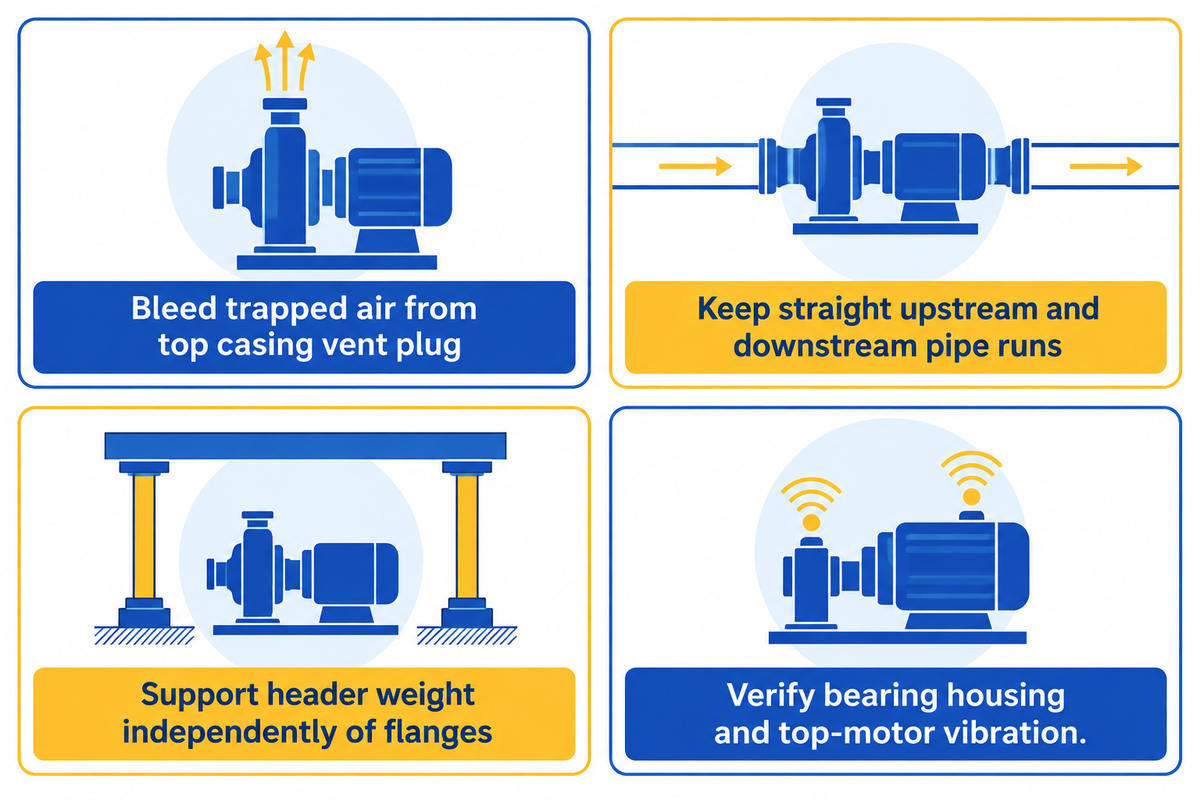
Install at least 5 pipe diameters of straight pipe before the suction flange and 3 pipe diameters after the discharge flange per Rotech Pumps installation guidelines. Always vent trapped air from the top casing cover plug before startup, and bearing housing vibration across speeds above and below 600 RPM falls under ANSI/HI 9.6.4-2022.
Installation shortcuts such as excessive pipe loads on the flanges and skipped casing venting accelerate seal and bearing wear. Operating a pump well outside of its 80 to 110% BEP window creates radial shaft loads that lead to premature mechanical failure. Watch these four installation requirements during Mechanical Room commissioning:
- Before startup, bleed air from top of pump casing. In a vertical inline pump, the stuffing box is located at the top of the wet end directly below the motor bracket. Air tends to collect around mechanical seal faces as the system fills.
Per the EBARA EVMSU engineering specification and Rotech Pumps startup guidelines, open the air vent plug in the casing cover during initial fill until solid water exits. Running a vertical mechanical seal dry in a trapped pocket of air will cause rapid thermal shock cracking of silicon-carbide and carbon faces.
- Maintain the 5-diameter upstream inlet run and 3-diameter downstream outlet run so the water enters the impeller eye without turbulence. Also install gate or butterfly isolation valves on both sides and a Y-strainer or basket strainer on the suction side.
Clean the strainer after a few weeks while the loop flushes construction debris.
- Support suction and discharge headers independently of the pump flanges. Pipe hangers and floor stanchions shall support the weight of the piping filled with water such that the pump casing carries no load from the flanges.
- Under ANSI/HI 9.6.4-2022 rotodynamic pump vibration measurement standards, evaluate bearing housing vibration for speeds above and below 600 RPM. Also check top-of-motor vibration criteria on vertical pumps during acceptance testing. During monthly and annual maintenance checks per Rotech Pumps guidelines, verify that motor bearing temperature stays no more than 40°F above ambient. Confirm that pump efficiency has not dropped more than 5% from the original curve.
2025-2026 Efficiency Trends, Installed Cost TCO, and Buyer RFQ Specification Checklist
According to the U.S. Department of Energy (cited in Rotech Pumps HVAC energy guidance), variable-speed pumping systems can cut pump energy use by 30 to 50% compared to fixed-speed operation in variable-flow applications, and US DOE 10 CFR Part 431 covers commercial clean-water inline pumps from 1 to 200 HP.
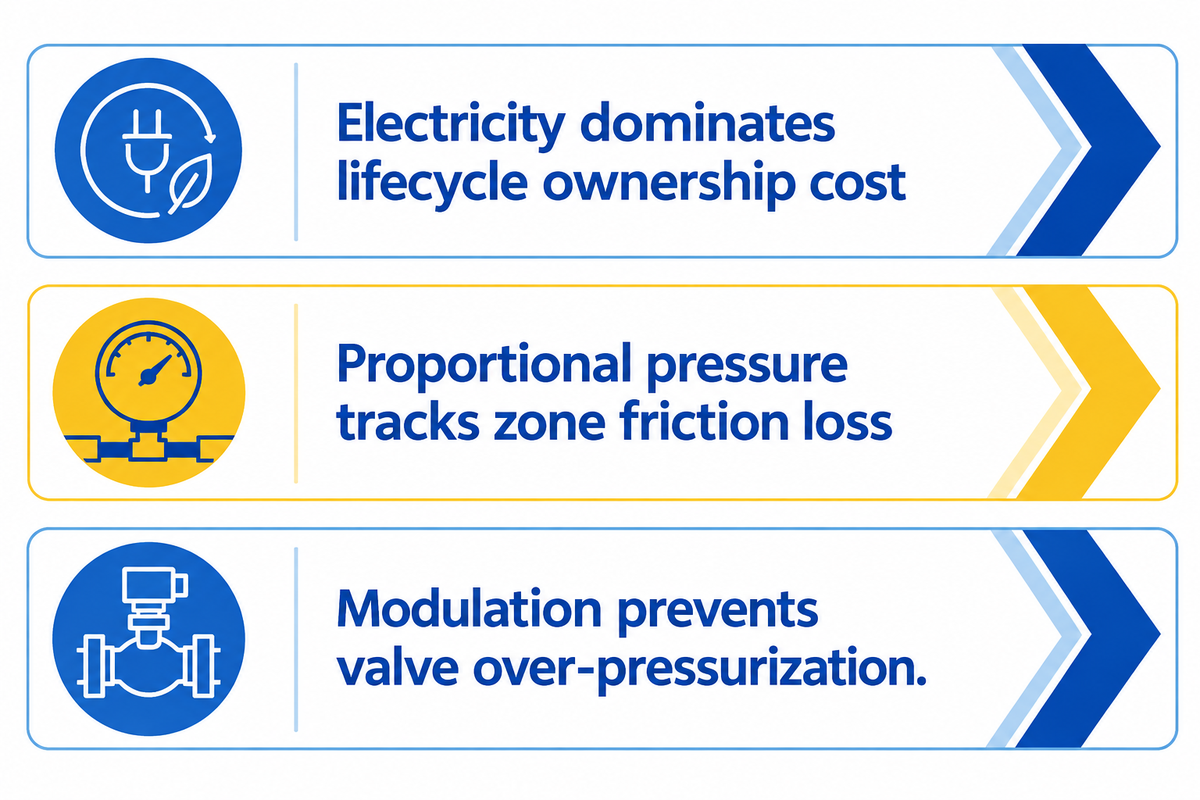
Because a commercial HVAC pump runs thousands of hours per year, electricity dominates total cost of ownership across the 15 to 20 years of typical motor service life. Under centrifugal affinity laws documented in Rotech Pumps HVAC guidelines, reducing pump speed by 20% reduces flow by 20% and cuts power consumption by nearly 49%. Yet many specifications still program variable frequency drives (VFDs) to hold a flat constant differential pressure across the header. As explained by the Hydraulic Institute in Pumps & Systems (June 2025) and R L Deppmann’s ECM Smart Pump bulletin, pipe friction head drops sharply when two-way valves throttle from 4 open zones down to 3, 2, or 1 open zone. Proportional-pressure control (ΔPv) lowers pump speed and head along a linear or quadratic curve as zone demand falls. This modulation prevents valve over-pressurization and sustains reliable performance across partial-load seasons. Review our engineering guides on variable frequency drive VFD pump control and electronically commutated ECM motor pump drives to configure sensorless control curves.
| RFQ Specification Item | Required Engineering Data to Provide | Verification Standard / Failure Prevented |
|---|---|---|
| 1. Duty Point & Operating Envelope | Design flow rate (GPM) + total dynamic head (ft) with 10 to 15% flow safety margin | Curve intersection at 80 to 110% BEP per Rotech; prevents off-BEP radial shaft thrust |
| 2. Static Suction & System Working Pressure | Maximum static column pressure + shutoff head + NPSHa margin (≥2 to 3 ft over NPSHr) | Matches casing rating (standard HVAC up to 200–300 PSI; EVMSU multistage up to 435 PSI / 30 Bar) |
| 3. Pump Architecture & Stage Count | Single-stage radial volute (IL) vs. stacked-diffuser vertical multistage (RSV / VS8) | Matches pressure ceiling (Armstrong 4300 up to 500 ft vs EBARA EVMSU up to 930 ft) |
| 4. Coupling & Overhang Group | Close-coupled (OH5, ≤15 HP) vs. rigid split spacer coupling (OH4, >15 HP) | Enables in-place cartridge seal replacement without lifting the motor |
| 5. Liquid Properties & Glycol Viscosity | Fluid type, temperature (-22°F to +248°F on EVMSU; 14°F to 250°F standard HVAC), glycol % | Applies glycol viscosity curve correction & selects cast iron vs 304/316/super duplex |
| 6. Mechanical Seal & Air Vent Arrangement | SiC/Carbon/Viton cartridge mechanical seal + top casing cover air vent plug | Prevents top-of-casing air entrapment and dry-run seal thermal cracking |
| 7. Motor Efficiency & VSD Control Mode | NEMA Premium / IEC IE3 inverter-rated motor + proportional-pressure (ΔPv) VSD control | US DOE 1–200 HP compliance & ASHRAE 90.1 VSD mandate above 5 HP |
| 8. Factory Acceptance Testing & Vibration | Certified performance curve, hydrostatic pressure log, and bearing housing vibration test | ANSI/HI 9.6.4-2022 vibration acceptance (speeds above/below 600 RPM & top of motor) |
Frequently Asked Questions About Vertical Inline and Multistage Pumps
Can a vertical inline centrifugal pump be mounted horizontally in a vertical pipe run?
Close-coupled vertical inline pumps up to 15 HP (11 kW), for example, Armstrong Series 4360, 4380, that are supported in vertical piping with the motor shaft horizontal, can be installed. Larger split-coupled (OH4) vertical inline pumps over 15 HP must be mounted absolutely vertically with motor on top. No inline motor may ever be hung upside-down underneath the pump casing.
What are the four main types of vertical pumps used in commercial and industrial facilities?
There are four vertical pump types used in commercial and industrial facilities. One: single-stage vertical inline volute pumps (ANSI/HI OH3, OH4 and OH5 pipe-mounted circulators for HVAC loops). Two: vertical multistage inline centrifugal pumps (VS8 / RSV stacked-diffuser high-pressure water boosters).
Three: vertical turbine deep-well and wet-pit bowl pumps. Four: vertical submersible sump pumps (for industrial pits).
How long do vertical inline and vertical multistage centrifugal pumps typically last?
According to Rotech Pumps HVAC service benchmarks, with proper installation and regular maintenance, the pump casing and impeller of a vertical inline pump can last 20 years or more in clean-water HVAC service. With installation and maintenance protecting the wear surfaces of consumable components, this life expectancy can be extended. Rotech Pumps notes that mechanical seals typically last 3 to 5 years as the most frequent maintenance item, while motors have a typical service life of 15 to 20 years.
Do vertical inline pumps require a suction diffuser or straight pipe run?
Yes. A vertical inline pump needs an unobstructed 5-pipe-diameter upstream inlet run and a 3-pipe-diameter downstream outlet run so water enters the impeller eye without turbulence. When confined mechanical room walls require an elbow immediately ahead of the suction nozzle, install a flow-straightening suction diffuser, also with commissioning strainer screen.
Why do vertical inline pump mechanical seals fail prematurely after system startup, and how do you prevent it?
About 250 hours into the first commissioning of a vertical inline pump, mechanical seal failure occurs because rising air collects directly around the mechanical seal faces under the casing cover during system filling. In this case, accumulated air pockets, along with construction scrap, crumble the silicon-carbide and carbon faces. Because the pump shaft is vertical, rising air now flows directly around the mechanical seal faces just under the casing cover during system filling.
Starting the motor without bleeding the casing cover air vent plug thrusts the silicon-carbide and carbon faces dry against each other and cracks them from thermal shock. In addition, weld slag and pipe scale shave off as the closed loop initially runs. Both failures can be avoided by bleeding the casing vent port until solid water is pumped out and cleaning the suction strainer after several weeks of operation.
Need Industrial Vertical Inline or Multistage Booster Pumps for Your Project?
BBP Manufacturing Co., Ltd. (BBP) develops and manufactures single stage vertical inline pipeline circulators and high pressure vertical multistage centrifugal pumps. We build pumps in cast iron, ductile iron, 304/316 stainless steel, and duplex alloys. Send your flow rate, head and fluid parameters to our engineering team for a matched pump curve and factory price.
Explore Vertical Inline Pumps
View High-Pressure Multistage Pumps
Author & Technical Review: Written by CYH. Reviewed by the BBP Manufacturing Co., Ltd. technical team.
Hydraulic definitions, pressure classifications, vibration criteria and comparison & standards in this guide are derived from publicly available standards and manufacturers’ technical manuals. Sources include the Hydraulic Institute (ANSI/HI 1.1-1.2, ANSI/HI 2.1-2.2, ANSI/HI 9.6.4-2022), the U.S. Further comparison & standards references are Armstrong Fluid Technology, EBARA Pumps Americas Corp, Rotech Pumps and R L Deppmann.
Always match exact flange pressure classes, available NPSH margins (at least 2 to 3 ft over NPSHr), and motor non-overloading service factors against the manufacturer’s certified performance test curve before issuing a purchase order.
References & Sources
- DOE Pumps: Diagrams and Definitions (In-Line IL OH3/OH4/OH5 & Multi-Stage Vertical In-Line RSV VS8) Hydraulic Institute (HI)
- Series 4300 Split-Coupled Vertical In-Line Centrifugal Pumps Technical Specifications Armstrong Fluid Technology
- EVMSU Series Vertical Inline Multistage Centrifugal Pumps Engineering Specifications EBARA Pumps Americas Corporation
- Vertical Inline Pumps for HVAC: Industry Standard Sizing, Installation & Maintenance Guide Rotech Pumps
- ANSI/HI 9.6.4-2022: Rotodynamic Pump Vibration Measurements and Allowable Values American National Standards Institute (ANSI) / Hydraulic Institute
- What Is Pump Proportional Pressure Control? (Hydraulic Institute Pump FAQs) Pumps & Systems (June 2025)
- Using ECM Smart Pumps in Secondary Hydronic Systems R L Deppmann Technical Engineering Bulletin
- Considerations for Chlorination Packages and Booster Pumps in Industrial Facilities Water Tech Online (Amin Almasi)
- US Patent US7775763B1: Centrifugal Pump with Rotor Thrust Balancing Seal United States Patent and Trademark Office (USPTO)
WHY BUYERS WORK WITH BBP
About BBP Manufacturing
BBP Manufacturing Co., Ltd. is a Beijing-based industrial pump manufacturer with in-house foundry, heat treatment, machining, assembly, coating and inspection capabilities. We support industrial projects across slurry handling, sewage treatment, clean water transfer, chemical service, fire protection, irrigation and OEM pump supply.
Our Engineering Support
We help engineering buyers select and source the right pump configuration, not just compare prices. Send us your flow rate, head, medium, solids content, temperature, pH value, material requirement and installation conditions. BBP engineers will recommend a pump series, material option, duty curve basis, lead time and spare-parts plan for your RFQ.
Company Profile // DATA_SHEET
Name
BBP Manufacturing Co., Ltd.
Brand Name
BBP
Country
China
Headquarters
Beijing, P.R. China
Business Type
Industrial Pump Manufacturer
Model
B2B / OEM / ODM / Project Supply
Main Products
Slurry Pumps, Sewage Pumps, Centrifugal Pumps, Split Case Pumps, Multistage Pumps, Chemical Pumps, Fire Pumps, Irrigation Pumps
Manufacturing Capability
Foundry, Heat Treatment, Machining, Assembly, Coating, Inspection
Certifications
ISO 9001 / CE / SGS / BV / TÜV
Export Reach
90+ Countries & Regions
Standard Lead Time
About 25 Days for Standard Configurations
Contact Person
Wesley · International Sales
Phone / WhatsApp
+86 182 1085 0516
Email
contact@bbpmfg.com
Website
https://bbpmfg.com/
Address
Room 2803, Building 11, Phase II, Nuode Center, Fengtai District, Beijing, P.R. China
Related Posts
Trending now