Get in Touch with BBP

BBP Manufacturing • ISO 9001 OEM Manufacturer
Split Case Pumps — 22–1250 kW Double-Suction Centrifugal Pump Manufacturer
Engineered double-suction centrifugal pumps for water supply, fire protection, HVAC, and heavy industry. In-house casting through final hydrostatic test. Six material grades. Compliant designs available with FM/UL listing path on quoted fire pump projects.
ISO 9001:2015
ISO 9906 Grade 2B
NFPA 20 Compliant Designs
CE PED + Machinery
API 610-Compatible Variants
Request a Quote
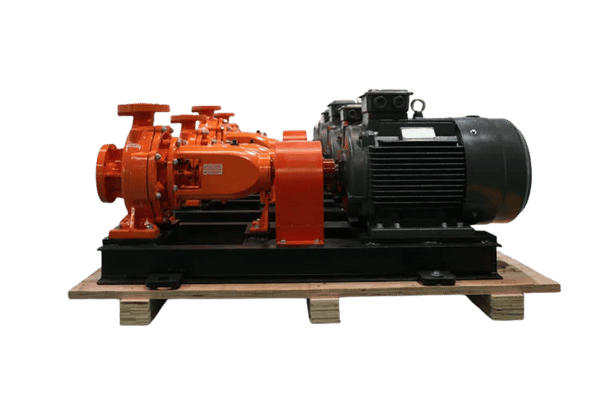
When Single-Suction Pumps Hit Their Wall: Why Engineers Switch to Split Case
Single-suction centrifugal pumps run into three predictable walls above 2,500 gpm: unbalanced axial thrust shortens bearing life, NPSH-required climbs as flow rises, and a single-end pull for any seal or impeller work means the entire pump leaves the baseplate. A split case pump (also called a split casing pump or double-suction centrifugal pump) splits the volute axially along the shaft centerline, so the top half lifts straight up for service while the rotating element stays aligned in the bottom case.

Why double-suction beats single-suction at high flow
- Axial thrust balanced near zero – twin impeller eyes face opposite directions, cancelling hydraulic load on the bearings.
- Lower NPSHr – flow enters the impeller from both sides, halving the velocity per eye.
- Top-half lift access – mechanical seal, wear rings, and bearings are exposed in 60-90 minutes without breaking suction or discharge piping.
- 3-5% efficiency advantage at the BEP over an equivalent single-suction unit.
A classic split case pump uses an axially split (horizontal) volute casing with the impeller mounted between bearings. Some manufacturers also build radially split designs for very high pressure, but the between-bearings double-suction layout is what defines a modern HSC pump for water supply, HVAC, and fire protection duty.
Engineering Note – Pain Nugget from r/firePE
“Split case horizontal is what I usually specify because of reliability, performance, and maintenance.” – specifying engineer, r/firePE thread on fire pump selection. The trade-off he names is real: a horizontal split case pump occupies roughly 30% more floor area than a vertical inline unit. Section H2 2 below addresses that footprint constraint with our vertical split case option.
BBP Split Case Pump Range
Three series built off the same axially-split platform. Consistent double-suction efficiency, engineered for distinct deployment footprints and applications.

Horizontal Split Case Pump
Horizontal split case (HSC pump) is the planet’s favorite workhorse of municipal water systems, district HVAC chilled water distribution and industrial cooling. HSC casing splits athwart-shaft in the same plane as the horizontal shaft and motor, and motor and pump are mounted side-by-side on the same bedplate. Performance range goes from medium-flow HVAC or process service at low head to approximately 30,000 gpm at high head. When possible choose the horizontal orientation since top-half removal take twice as long otherwise.
Application
Municipal drinking waters, HVAC, industrial chilling, boiler feed, irrigation.
Flow Envelope
up to ~30,000 gpm.
Head Envelope
up to ~600 ft single-stage.
Drive
Electric motor (IE3 / NEMA Premium) direct/belt.

Vertical Split Case Pump
BBP’s vertical split case pump rotates the same hydraulic core ninety degrees so the motor mounts above the pump. This compact footprint answers the most common Reddit objection against split case (“requires 30% more space than inline”) – it preserves the double-suction efficiency and bearing balance while shrinking the floor plate. Use this configuration in city water booster stations, district cooling pump halls, and any retrofit where the existing footprint is fixed.
Best For
Urban district cooling, booster stations, constrained retrofits.
Flow Envelope
up to ~12,000 gpm.
Head Envelope
up to ~400 ft single-stage.
Power
22-600 kW vertical motor mount.

Split Case Fire Pump (H/V)
Designed to NFPA 20 (2022) “Standard for the Installation of Stationary Pumps for Fire Protection”, our split case fire pump is available in horizontal or vertical configurations with electric or diesel drive. BBP ships listed compliant designs with an FM/UL listing path on quoted work. Units are not pre-listed in order to not mis-claim approval, the listing pathway is filed against your AHJ specification at the time the order is placed.
Best For
Fire suppression per NFPA 20 (commercial, high-rise, data center).
Flow Envelope
250-5,000 gpm rated points.
Head Envelope
50-500 ft.
Drive
Electric/diesel, UL/FM rated via quoted listing path.
| Series | Flow (typical) | Head (typical) | Power | Primary Application | Footprint vs Inline | Key Standard |
|---|---|---|---|---|---|---|
| Horizontal | up to 30,000 gpm | up to 600 ft | 22-1250 kW | Municipal / HVAC / Industrial | +30% floor area | ISO 9906 |
| Vertical | up to 12,000 gpm | up to 400 ft | 22-600 kW | Urban district / Limited footprint | parity with inline | ISO 9906 |
| Fire (H/V) | 250-5,000 gpm | 50-500 ft | UL/FM rated | Fire protection per NFPA 20 | varies | NFPA 20 + FM/UL path |
Performance Specifications: 22-1250 kW Power, 6-48 inch Outlet, Materials Matrix
Every published performance figure on this page corresponds to ISO 9906 Grade 2B hydraulic acceptance test on shop production runs. Custom performance curves and certified test reports are issued per project against your duty point. A summary of the standard envelope follows below.
NPSH and Suction Performance
A double-suction impeller halves the velocity at each impeller eye relative to an equivalent single-suction unit. This typically lowers NPSH-required by a meaningful margin at the same operating point, which is why engineers reach for split case designs whenever suction lift, hot water, or flashing-fluid risk is in play. Exact NPSH curves are duty-point specific – request the certified test report for your selection.
Two stage variants are used in high-head water transfer applications with a single impeller unable to achieve the rated head economically. All standard products ship with bronze wear rings by default as the renewable wear pair against the cast iron or stainless impeller; SS316 and Duplex options are supplied with matching material wear rings.
Parameter
Range / Specification
Capacity (Flow)
up to ~38,000 gpm at full 1250 kW
Head
up to ~765 ft single-stage; ~1300 ft two-stage variants
Power
22-1250 kW
Outlet (Discharge)
DN150-DN1200 (6-48 inch)
RPM (synchronous)
980 / 1480 / 1780 (per motor pole / Hz)
Materials
Cast Iron HT250, SS304, SS316, SS316L, Duplex 2205, SS904L
Mechanical Seal
Single mechanical or double cartridge with API Plan 53/54 flushing
Drive Options
Electric motor (IE3 / NEMA Premium) or Diesel motor
Coupling
Flexible direct or Belt drive
Standards
Designed and tested per ISO 9906 Grade 2B
Split Case vs End Suction vs Vertical Inline: 10-Year TCO Comparison
According to the Hydraulic Institute Lifecycle Cost Analysis, the initial purchase price of a typical medium-size industrial pumping system is only about 10 percent of total cost over a 15-to-20-year lifespan. Energy accounts for roughly 40 percent and maintenance for another 25 percent, with operations, installation, environmental, and downtime making up the remainder.
This cost profile shows why “lowest sticker price” is rarely the most economical whole of life choice. Split case architecture asks for higher Capex in the form of balanced bearing design, lower NPSHr, and a higher efficiency double-suction impeller, precisely the area where the Hydraulic Institute acknowledges there is the biggest few cent savings for whole of life.
10%
Capex
40%
Energy
25%
Maintenance
Pump system 15-to-20-year Total Cost of Ownership breakdown
Source: Hydraulic Institute “Pump Pros Know – Lifecycle Cost Analysis” citing U.S. DOE EERE Motor Market Assessment (estimating mid-range energy savings of 20% across industrial fleets).
Source: Hydraulic Institute “Pump Pros Know – Lifecycle Cost Analysis” citing U.S. DOE EERE Motor Market Assessment (estimating mid-range energy savings of 20% across industrial fleets).
| Dimension | Split Case | End Suction | Vertical Inline |
|---|---|---|---|
| Flow capacity (typical max) | ~38,000 gpm | ~5,000 gpm | ~6,000 gpm |
| Pump efficiency at BEP | ~85% | ~78% | ~80% |
| Bearing axial thrust | balanced (near zero) | high (single suction) | medium |
| NPSH required (typical) | low | medium-high | medium |
| Top-half lift MTTR | 60-90 min | 4-6 h (full pull) | 6-8 h |
| Footprint per kW | medium | smallest | smallest |
| Initial Capex (relative) | 1.0x | 0.7x | 0.85x |
| 10-Year TCO (energy + maintenance) | 0.75x | 1.0x | 0.95x |
How to read this table
- Choose split case if flow rates exceed ~2,500 gpm, the duty is continuous, NPSH headroom is tight, or the desired lifecycle exceeds 15 years.
- Choose end suction when flow rates are lower, installed cost is the priority, and the overall footprint can be tolerated.
- Optimum vertical inline choice if footprint is restricted, piping runs are inline, and duty cycles are not continuous.
Want this table tailored to your fluid, flow, and energy cost? We feed your duty data into the Hydraulic Institute LCC framework and return a side-by-side spreadsheet within 48 hours.
Request a custom 10-year TCO comparison
Industries and Applications: Where Split Case Performance Pays Off
Choosing the right material grade comes from analyzing seven core industry groups, with one hydraulic platform for each industry by altering materials, drive and certification arrangements.

01
Municipal Water Supply
City water distribution, raw water intake, transmission booster stations. Cast iron HT250 with bronze wear rings is the standard combination; SS316 is specified for chlorinated potable water with aggressive disinfection.
02
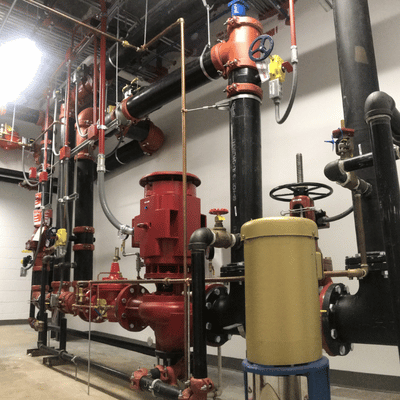
Fire Protection (NFPA 20)
Horizontal and vertical split case fire pumps for commercial, industrial, high-rise and data centre facilities. Suited to compliant designs with FM/UL listing process on nominated projects; diesel or electric drives may be specified.

03
HVAC – Chilled Water & Condenser
District cooling plants, central chiller halls, and large condenser water loops where continuous duty and NPSH headroom matter more than absolute footprint. Vertical split case is preferred where the pump room footprint is fixed.

04
Industrial Cooling
Steel mill scale wash water, petrochemical process water, and auxiliary cooling circuits within power stations. Materials are derived primarily from the chloride, temperature, and deposit loading characteristics of the service waters.

05
Power Generation
Boiler feed (lower stages), condenser cooling water, and circulation duty in coal, gas, and combined-cycle plants. Two-stage split case variants achieve the higher head requirements of feed-pump booster service.

06
Mining & Slurry-Adjacent
Process water for mineral processing, tailings supernatant return, and dewatering loops where solids carry-over is below the true slurry pump threshold. Material grade is application-specific.
Engineering and Materials: BBP’s Vertical Integration Advantage
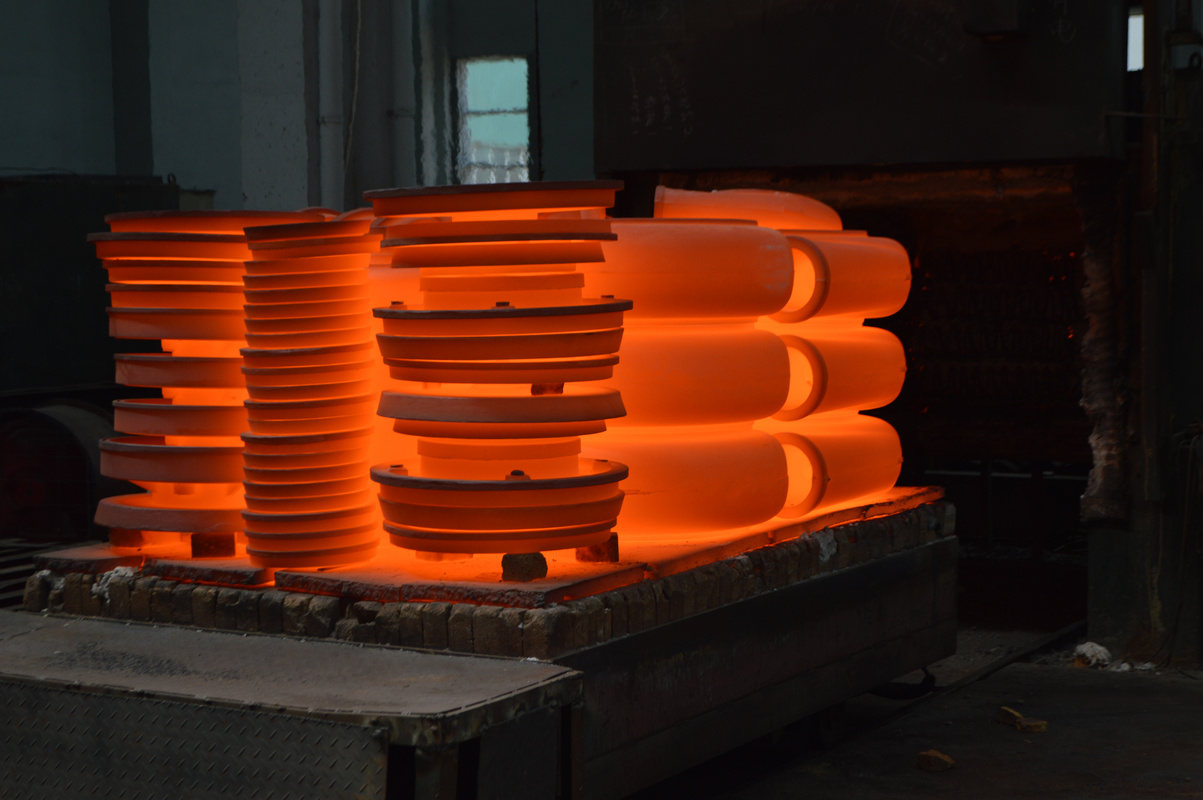
BBP controls every step of split case pump production inside one factory complex in Beijing. From raw casting to performance test, the chain below shows the operations that stay in-house – and therefore stay on schedule and on spec.
Casting
Heat Treatment
Machining
Assembly
Coating
Performance Test
Vertical integration matters for two procurement-relevant reasons. First, lead time stays at 17 days for 1-10 sets because no foundry sub-contractor inserts a queue between order and machining. Second, material certification is traceable from heat number through to the final pump nameplate, so audit trails for ISO 9001 and AHJ filings stay short.
Material Selection Matrix
| Material | Recommended Service |
|---|---|
| Cast Iron HT250 | Clean potable water, ambient industrial cooling, irrigation |
| SS304 | Mild corrosive duty, food-grade water, fertiliser-injected irrigation |
| SS316 | Chlorinated potable water, wastewater, limited seawater duty |
| SS316L | Marine, low-temperature wastewater, pharmaceutical and chemical process |
| Duplex 2205 | Aggressive seawater, chloride-rich brine, brackish industrial water |
| SS904L | Sulfuric acid process, hot chloride process, severe corrosion duty |
ENG-LOG // 2024
We tested SS316L versus Duplex 2205 across fourteen pump rebuilds in chloride-rich cooling water before settling on Duplex as our default for that service – it was the only grade that delivered five-year wear ring life without surface pitting in our shop accelerated wear rig.
Pre-Installation Clearance & Maintenance Access
Top-half lift in 60-90 minutes is the split case pump’s headline easy-maintenance advantage – but it only materialises if the piping and overhead crane access are designed for it. Our installation drawings call out recommended overhead clearance and pipe-spool removal envelope so the field crew is not surprised at the first scheduled maintenance.
- Overhead clearance: at least 150% of the upper case lift plus crane hook reach.
- Side clearance: at least one pipe diameter over the suction and discharge for spool access.
- Front clearance: enough to remove the impeller and shaft at the coupling end.
Why alignment is the silent failure mode
Industry root-cause data places pump-to-motor misalignment as the leading cause of coupling failure and abnormal split case vibration. Our commissioning protocol uses a laser alignment fixture and sets cold-alignment offsets that anticipate hot running thermal growth, which extends bearing service life on continuous duty installations.
Certifications and International Compliance
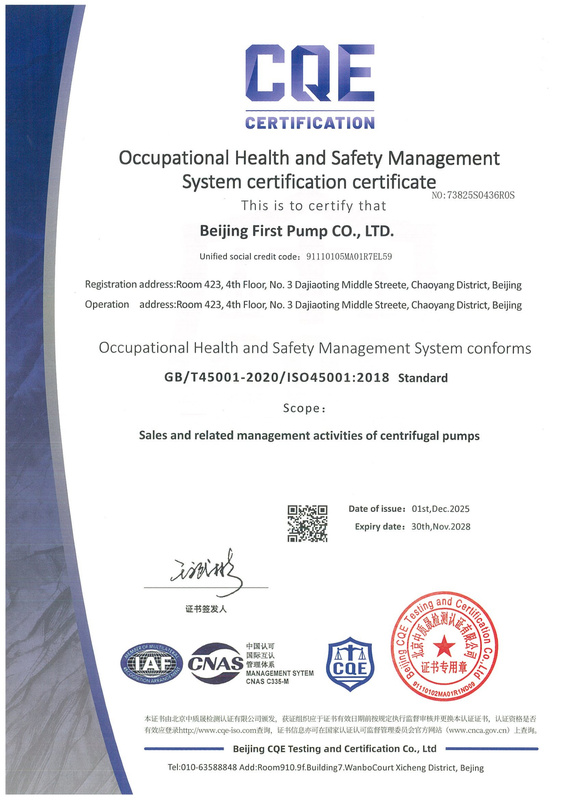
BBP split case pumps comply to and are tested to the following international standards. Certificates and test reports are issued one for each project against the scope relevant to the project.
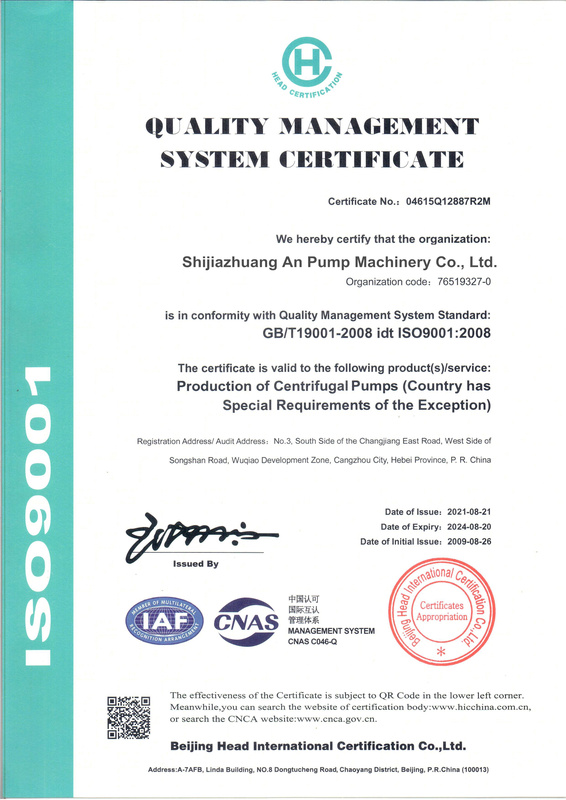
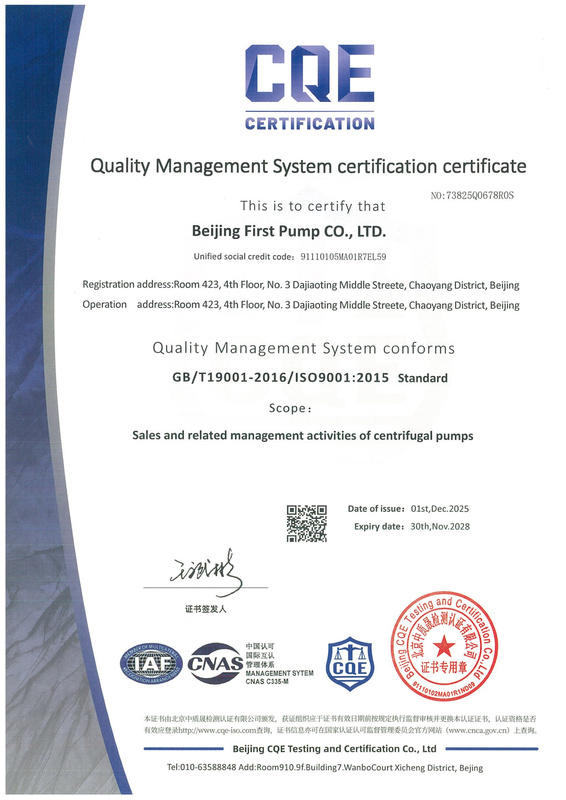
ISO 9001:2015
Quality Management System, factory-wide certification covering casting, machining, assembly, and test.
ISO 9906 Grade 2B
Hydraulic performance acceptance test on every shop production run; test reports issued with each pump.
NFPA 20 (2022)
Compliant designs with FM and UL listing path filed on quoted fire pump projects against your AHJ specification.
CE Marking
Pressure Equipment Directive (PED) and Machinery Directive for European Union export shipments.
API 610 Reference
Reference-design oil and gas variants on the same hydraulic platform; full API certification per project on request.
Need the full compliance binder for an EPC bid? ISO test reports, material heat numbers, and AHJ-ready NFPA 20 listing path documentation are available.
Request Certification PackageCompany Qualifications & Certificates



×
![Certificate Preview]()
Procurement Guide: Lead Time, MOQ, Payment, OEM, After-Sales
This section answers the questions that come up after the engineer has signed off on the duty point. Single-set orders are accepted, and standard production lead time is currently 17 days for 1-10 sets.
Standard Lead Time
17 days for 1-10 sets
Lead Time, larger orders
Quoted per project, typically 25-45 days for 11+ sets
MOQ
1 piece – single-set orders accepted
OEM / ODM
Hydraulic, casing, shaft, seal, and material grade all customisable
Payment Terms
25% T/T deposit + 75% before shipment; L/C at sight available
Spare Parts Inventory
6-year inventory commitment for all major model wear parts
Technical Support
Pre-sales selection assistance + 24/7 post-sales remote diagnostics
On-Site Service
Optional installation training, laser-alignment commissioning, and start-up supervision
Pro Tip
What to send with your RFQ to get an accurate quote in 24 hours
- Duty point – flow (gpm or m3/h), head (ft or m), fluid temperature, fluid type
- NPSH-available at the suction flange, suction line layout
- Drive preference – electric (voltage and frequency) or diesel
- Material grade for casing and impeller, or describe the fluid for our recommendation
- Flange standard – ANSI, EN, JIS – and any project-specific certification scope
Procurement teams comparing BBP against Pentair Aurora, Grundfos, Xylem, or KSB are usually working a significant capex delta. Section H2 4 shows how that delta plays out across a 10-year TCO frame with the Hydraulic Institute lifecycle cost methodology – the short answer is the energy and maintenance components dominate, and the double-suction efficiency advantage self-multiplies over the asset life.
Ready to compare a real quotation?
Send your duty data and our application engineering team will return a sized selection, certified test report scope, and 24-hour quote turnaround.
Manufacturing Power & Global Reach
01
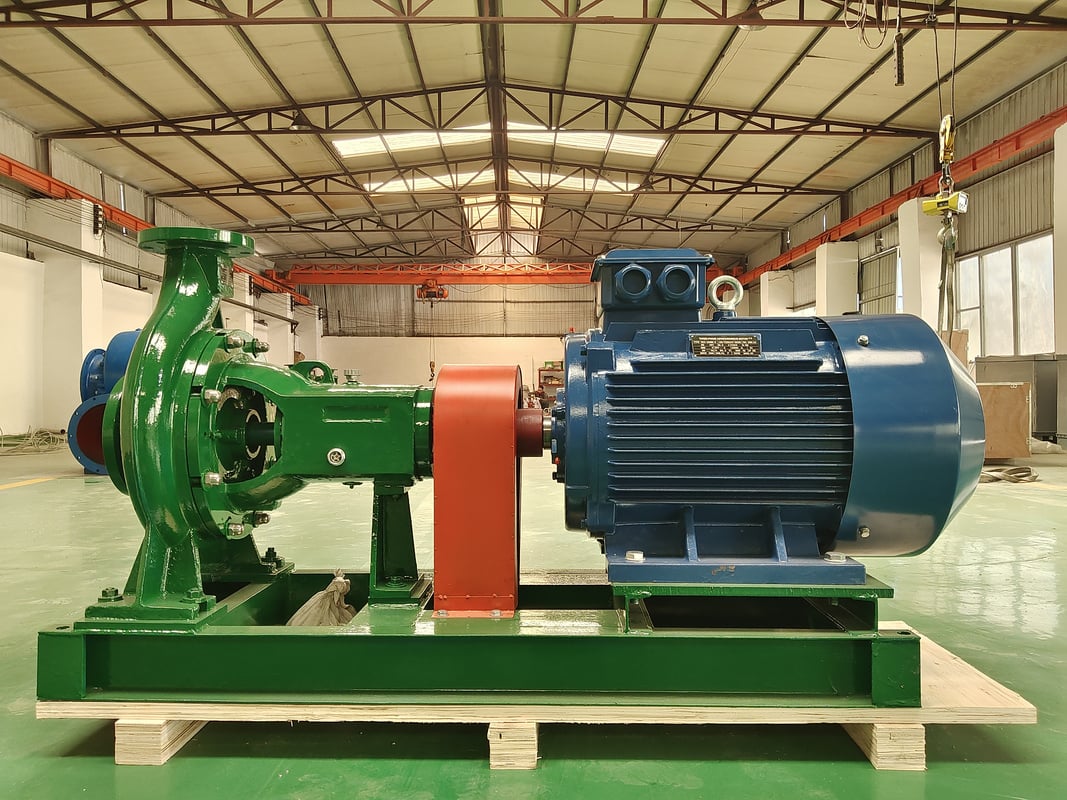
Factory Infrastructure





02
International Exhibitions


Engineering Toolkit: Interactive Calculators & Selection Helpers
Streamline your procurement process. Use our proprietary digital tools to calculate lifecycle costs, determine optimal pump configurations, and specify precise metallurgies for your fluid handling duty points.
Split Case vs End Suction — 10-Year TCO Calculator
Input your power, operating hours, and local energy rates. Instantly generate a 10-year Lifecycle Cost (LCC) comparison to justify capex decisions using Hydraulic Institute methodology.
Launch Calculator →
Split Case Pump Series Selection Helper
Filter by your exact flow (gpm/m³/h), head, and footprint constraints to automatically identify the most efficient horizontal or vertical split case series for your installation.
Open Selection Tool →
Split Case Pump Material Selection Helper
Ensure chemical compatibility. Match your specific fluid type, temperature range, and chloride concentration to our recommended casing, impeller, and wear ring metallurgies.
Access Material Guide →
Project Initiation
Ready to size a split case pump for your project?
Provide us with your duty point, and we will back to you with a certified select, ISO 9906 test scope, and quotation in 24 hours.
Frequently Asked Questions
End suction pumps take in fluid on one side of a single-suction impeller and bolt the impeller cantilevered on the shaft – which loads the bearings axially, hence a full-pump pull for any seal or impeller work.
Split case pumps use a double-suction impeller mounted between bearings, balance the axial thrust and enable their rotor to be pulled in 60-90 minutes by lifting only the top half casing. See the H2 4 comparison table above for the bottom line TCO version of the story.
Vertical inline pumps mount the motor directly above a vertical shaft and bolt into the pipeline like a valve, which minimises floor area but uses a single-suction impeller and offers limited maintenance access.
Horizontal split case pumps require roughly 30 percent more floor area but deliver a balanced double-suction impeller, lower NPSHr, higher BEP efficiency, and top-half lift maintenance access. The choice usually comes down to whether floor space or lifecycle cost is the binding constraint.
An axial split enables the upper casing half to be hoisted vertically away from the rotor without disrupting the inlet or outlet pipework. Coupled to the double-suction impeller bearing balance, this concept pushes bearing life and shortens mean-time-to-repair for the seal, wear rings, and bearings.
Yes. A split case pump is a type of centrifugal pump with the axial split in the casing, and the typical double-suction impeller mounted between bearings. It operates according to the same centrifugal principles as end suction and vertical inline pumps – the difference is the casing shape and impeller design.
A single-suction impeller draws fluid in from one side, which generates an unbalanced axial thrust that must be carried by the bearings or balanced by hydraulic devices. A double-suction impeller draws fluid in from both sides simultaneously, cancels the axial thrust, halves the velocity at each impeller eye, and typically delivers a 3-5 percent efficiency advantage at the BEP.
BBP ships NFPA 20 compliant split case fire pump designs with an FM and UL listing path filed against your project specification at the quotation stage. We do not pre-list units, because pre-listing without an AHJ-specific scope risks mis-claiming approval – instead, the listing pathway is documented project-by-project against the AHJ jurisdiction, with full ISO 9906 test reports and material certificates included in the submittal package. Visit the NFPA 20 split case fire pump catalog for project examples.
Yes – the in-house casting, machining, and assembly chain lets us modify hydraulic geometry, casing dimensions, shaft diameter, mechanical seal configuration, and material grade to project specification. Most customisation requests are quoted within 24 hours and shipped on the standard 17-day production cycle for 1-10 set orders. Send your specification through the RFQ form or contact our application engineering team directly.