Get in Touch with BBP

kW to HP Calculator: Convert Kilowatts to Horsepower

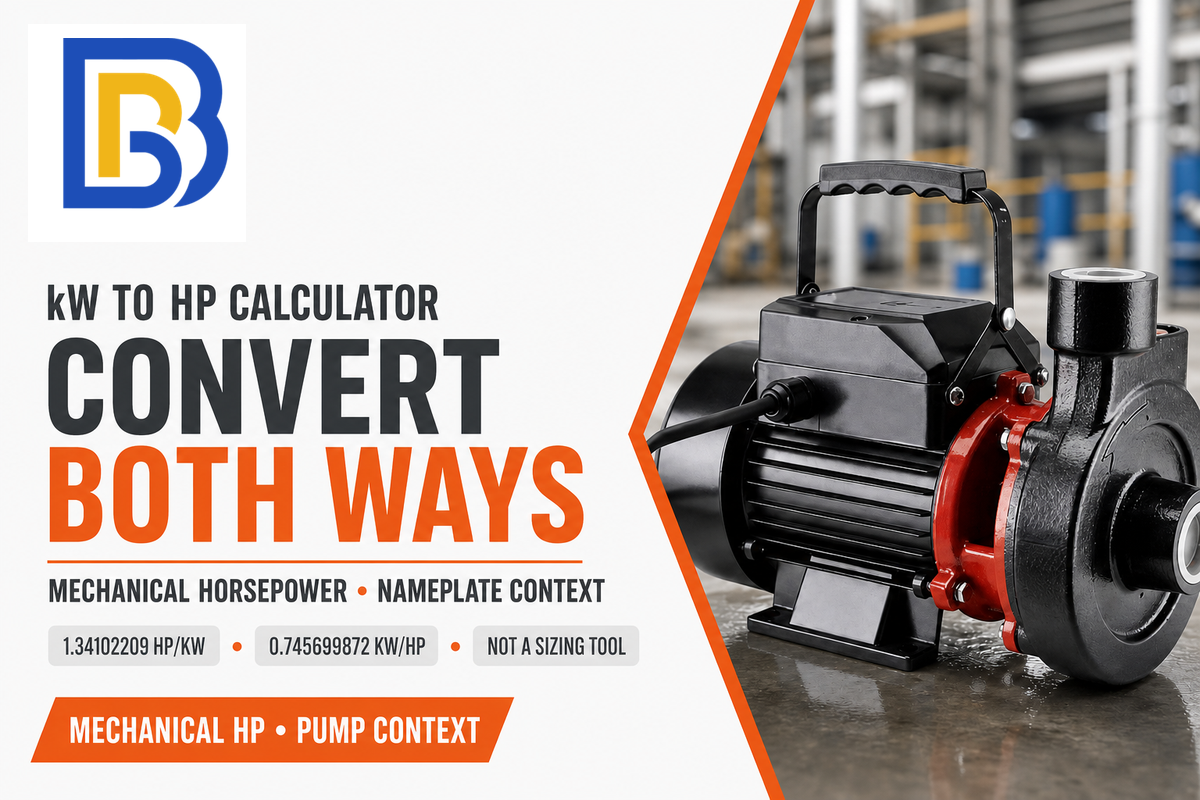
To convert kW to hp, multiply kilowatts by 1.34102209 for mechanical horsepower. For example, a 7.5 kW rating is 10.0577 mechanical hp. The arithmetic is exact enough for documentation, but it does not by itself select a motor or prove that two nameplates are interchangeable.
A kW to hp calculator is a bidirectional unit converter that expresses the same power value in kilowatts or a specified horsepower convention.
Kilowatt to mechanical horsepower converter
Convert between kilowatt and mechanical horsepower. The unit changes; the measured quantity does not.
Result
hp
1 kW = 1.341 hp
The same motor rated 10 hp and 10 PS differs by about 1.4%. Align the convention before comparing nameplates across markets.
Enter 0 or more — a negative value is not a valid reading for this quantity.
This entry is ambiguous. Use a comma only as the decimal mark, for example 1,5, and do not type thousands separators.
Quick Specs
| Primary convention | Mechanical horsepower, based on 550 ft·lbf/s |
| kW to mechanical hp | hp = kW × 1.34102209 |
| Mechanical hp to kW | kW = hp × 0.745699872 |
| Metric horsepower | 1 PS = 0.7354988 kW |
| Selection warning | Converted rating is not a pump motor selection |
How Does the kW to HP Calculator Work?
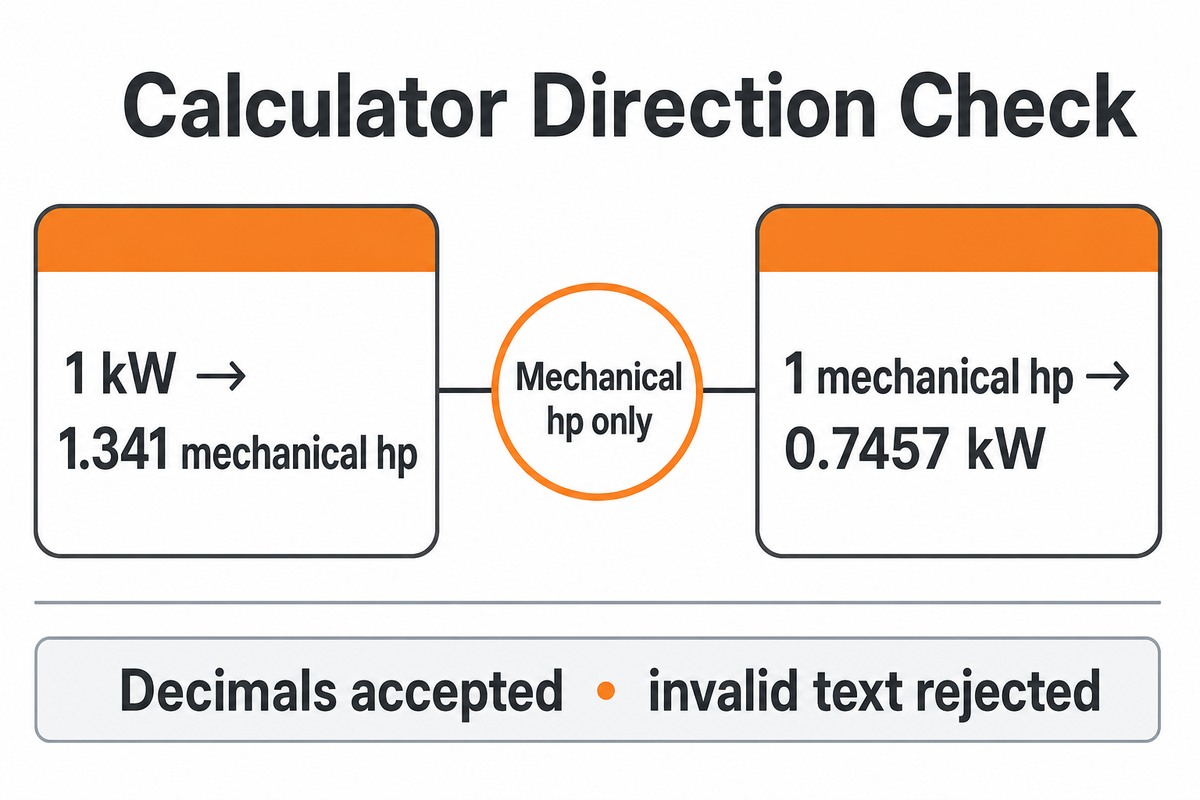
The kW to HP calculator converts between kilowatts and mechanical horsepower in either direction. It uses the registry-backed mechanical definition, not metric PS, electric hp, boiler hp, or water hp. Enter a number, choose the input and output units, and use the displayed result for comparison or documentation.
The output stays on the mechanical definition because every result derives from the NIST watt relationship shown below. That boundary prevents a correct calculation from being attached to the wrong horsepower label.
A simple default test vector makes the behavior visible: 1 kW returns 1.341 mechanical hp, while 1 mechanical hp returns 0.7457 kW at the component’s display precision. The calculator accepts decimals, rejects invalid text, and preserves the same factor in both directions. You can still reproduce every result manually with the formulas below.
Use more displayed digits when reconciling specifications; use a sensible rounded value when talking about a standard motor rating. A calculated 10.0577 hp equivalent does not create a new 10.0577 hp motor class. It tells you what 7.5 kW means in the selected horsepower convention.
What Formula Converts kW to Mechanical Horsepower?
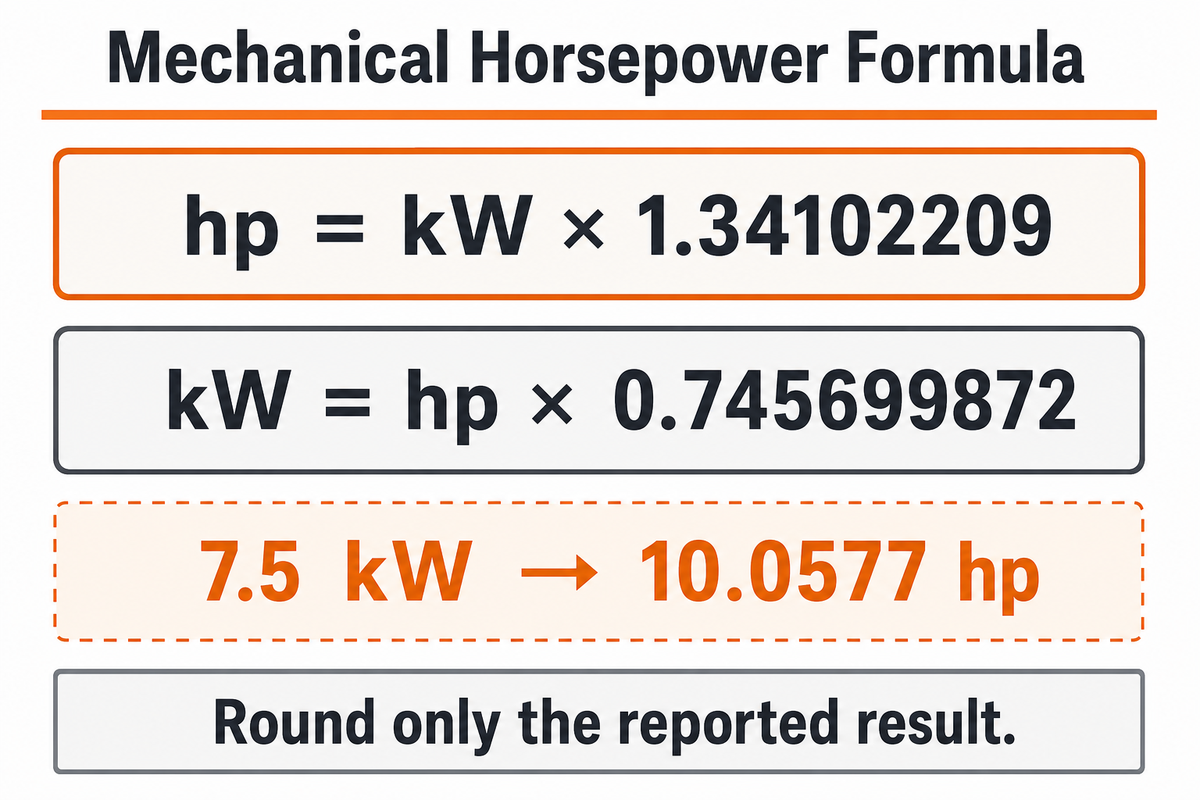
Multiply kilowatts by 1.34102209 to obtain mechanical horsepower. For the reverse direction, multiply mechanical horsepower by 0.745699872 to obtain kilowatts. Those operations describe exactly the same power in two units; they do not apply motor efficiency or estimate electrical input.
1.34102209mechanical hp per kW
745.6999 Wper mechanical hp
1.387%metric result above mechanical
Start with the watt definitions to reproduce the factor. One kilowatt is 1,000 watts. The NIST power conversion table gives mechanical horsepower as 745.6999 watts at its published precision. Dividing 1,000 by the fuller definition value produces 1.34102209.
Example: 7.5 kW × 1.34102209 = 10.0576657 hp, which displays as 10.0577 hp to four decimal places. To reverse it, 10.0576657 hp × 0.745699872 = approximately 7.5 kW. Small differences in the last digit usually come from the chosen display precision, not a different physical result.
Engineering note
Keep the unrounded value during intermediate calculations. Round only the reported result, and always label the horsepower convention beside it.
kW to HP Conversion Chart for Common Motor Ratings
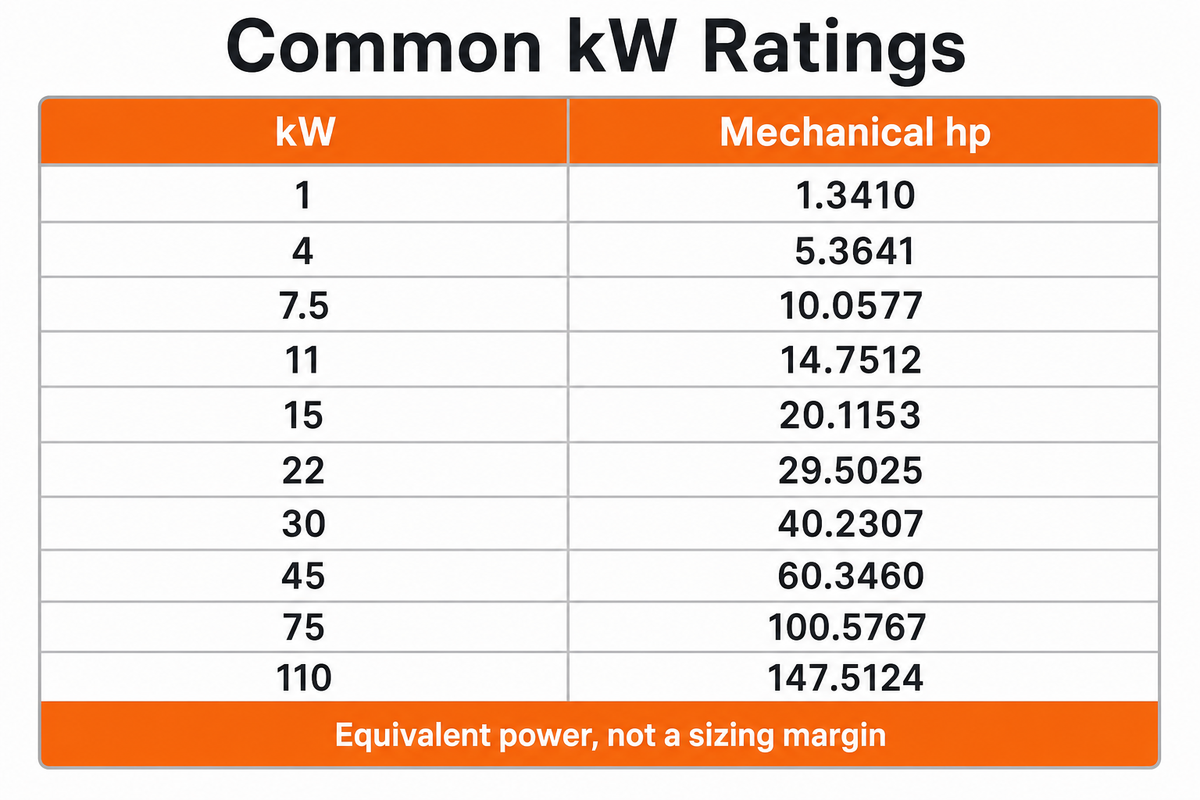
This chart applies the mechanical-horsepower factor to ten common kW values. It is a reference table, not a catalog of standard hp motor sizes. When a converted number falls between available ratings, the next decision must come from the load, motor standard, manufacturer data, and operating conditions.
The chart uses the same NIST basis because each row is a direct multiplication, not a rounded catalog substitution. Keep the source kW value visible when the result moves into a specification or quote.
| Kilowatts | Mechanical hp | Practical reading |
|---|---|---|
| 1 kW | 1.3410 hp | Exact unit equivalent |
| 4 kW | 5.3641 hp | Compare with available rating |
| 7.5 kW | 10.0577 hp | Often discussed as a 10 hp class |
| 11 kW | 14.7512 hp | Do not round before selection |
| 15 kW | 20.1153 hp | Equivalent, not a sizing margin |
| 22 kW | 29.5025 hp | Verify catalog convention |
| 30 kW | 40.2307 hp | Preserve rated output basis |
| 45 kW | 60.3460 hp | Check speed and duty |
| 75 kW | 100.5767 hp | Definition trap becomes visible |
| 110 kW | 147.5124 hp | Confirm full application data |
For a pump project, carry the exact converted value into the next calculation only if it represents the same location in the power chain. The pump power formula guide separates hydraulic output from shaft demand, while the total dynamic head calculator helps establish the system condition that the motor must serve.
The 1.4% Horsepower Definition Trap: Mechanical, Metric, and Electric HP
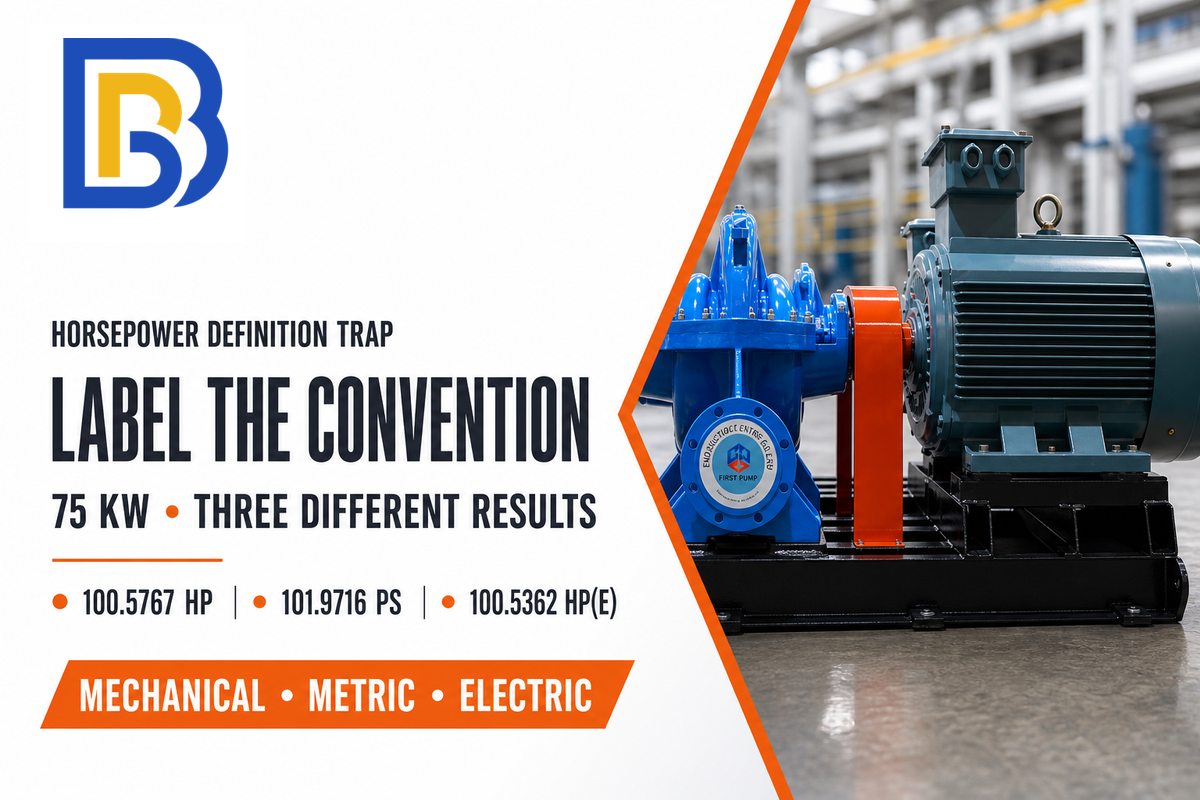
Mechanical hp, metric PS, and electric hp are different definitions. Printing only “HP” hides a decision that can change the result. Mechanical hp is the primary convention in this article; metric horsepower is labeled PS, and electric horsepower is labeled hp(E).
The risk is a plausible-looking number with the wrong label. Because the definitions use different watt values, confusion can create a mismatch even when the arithmetic itself is correct.
NIST publishes each definition separately. Its mechanical entry is based on 550 foot-pounds force per second, metric horsepower is 735.4988 watts at the table’s precision, and electric horsepower is 746 watts. The BIPM SI Brochure provides the SI system context for watts and prefixes, but horsepower itself is not an SI unit.
“The nameplate power is the rated output power.”
At 75 kW, the result is 100.576657 mechanical hp but 101.971621 metric PS. The metric result is 1.387% higher relative to the mechanical result. That gap is small enough to overlook in conversation and large enough to create a mismatch in a catalog comparison, replacement record, or quote.
| Convention | Watts per unit | 75 kW result | Use |
|---|---|---|---|
| Mechanical hp | 745.6999 W | 100.5767 hp | Primary calculator output |
| Metric PS | 735.4988 W | 101.9716 PS | Some continental specifications |
| Electric hp(E) | 746 W | 100.5362 hp(E) | Explicit electric-hp convention only |
Do not “correct” a vendor’s number until you know which convention was used. Ask for the definition, original unit, and rated measurement location. Numbers copied from a translated catalog may retain their digits while losing the label that made those digits meaningful.
An engine datasheet may also report mechanical horsepower, but the label still needs checking because vehicle, marine, and regional documents can use different conventions and test conditions. This article keeps the calculator on one defined unit so an industrial motor comparison does not inherit an assumption from an unrelated engine context.
What Does a Motor Nameplate kW or HP Rating Mean?
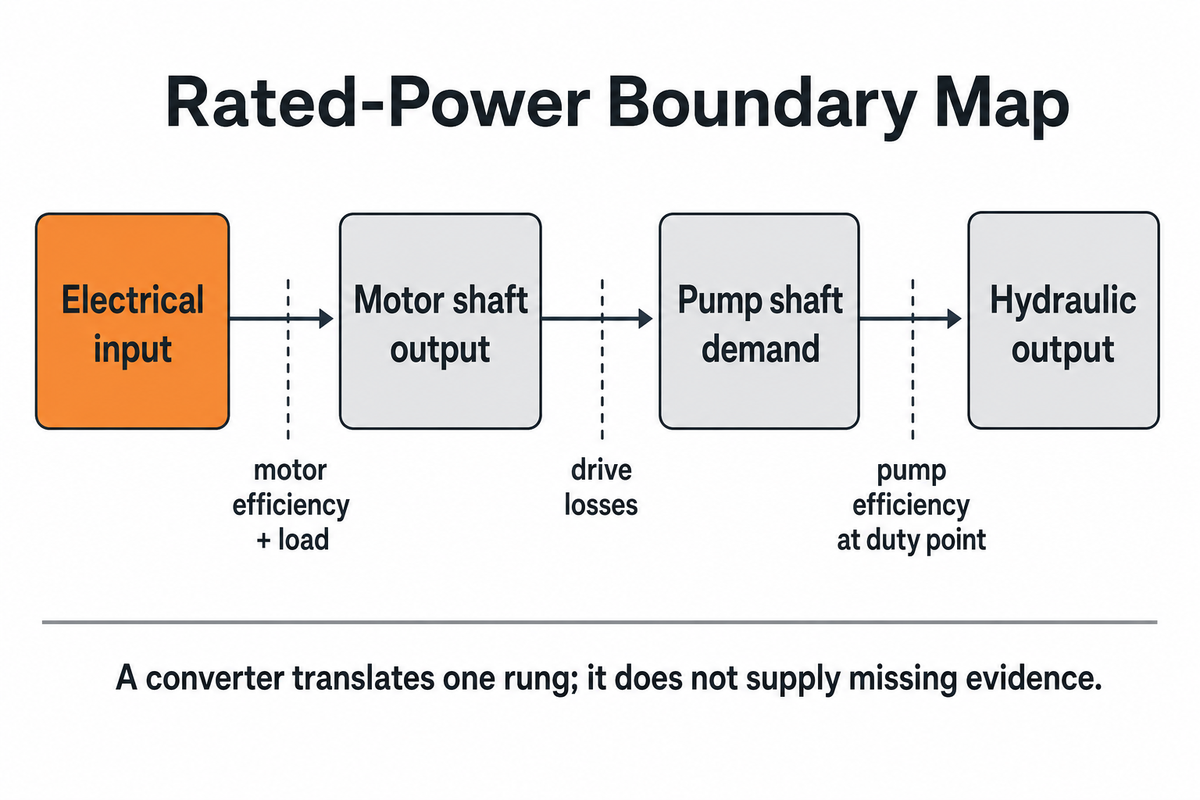
On the reviewed standard industrial motor nameplates, hp or kW typically identifies rated mechanical output at the shaft. It is not the same as electrical input drawn from the supply. Always verify the actual nameplate and manufacturer documentation, especially for specialty or nonstandard equipment.
ABB’s motor-manufacturer nameplate guide defines rated horsepower as mechanical output capability at rated speed. It also defines efficiency as output power divided by input power. The two statements create a clean boundary: the nameplate output can be converted directly between kW and mechanical hp, while measured electrical input needs efficiency and operating-condition context.
The 4-Checkpoint Rated-Power Boundary Map
| Rung | Power location | Missing input before the next rung | Typical evidence |
|---|---|---|---|
| 1 | Electrical input | Motor efficiency and operating load | Metered kW, voltage, current, power factor |
| 2 | Motor shaft output | Coupling or drive losses | Motor nameplate and performance data |
| 3 | Pump shaft demand | Pump efficiency at the duty point | Certified or manufacturer pump curve |
| 4 | Hydraulic output | System flow, head, and fluid properties | Duty-point and system data |
At the system level, the U.S. Department of Energy motor-systems hub organizes selection, field efficiency, sourcebooks, and case studies as connected work. That structure is a useful reminder: a unit converter can translate a value on one rung, but it cannot supply the missing evidence between rungs.
Viewed this way, two documents can show different kW values without either being arithmetically wrong. A motor datasheet may list rated shaft output, a drive may report electrical input, and a pump curve may show power absorbed at the pump shaft. The word “power” is not enough; the measurement boundary is part of the specification.
For a replacement, capture the original plate before calculating. Record whether the machine runs directly online or through a drive, note the actual frequency and rated speed, and compare the driven load rather than the motor in isolation. These checks are not extra conversion steps. They are the evidence that tells the applications engineer whether the converted value belongs on the same rung as the proposed replacement.
Does Three-Phase Power Change the kW-to-HP Conversion?
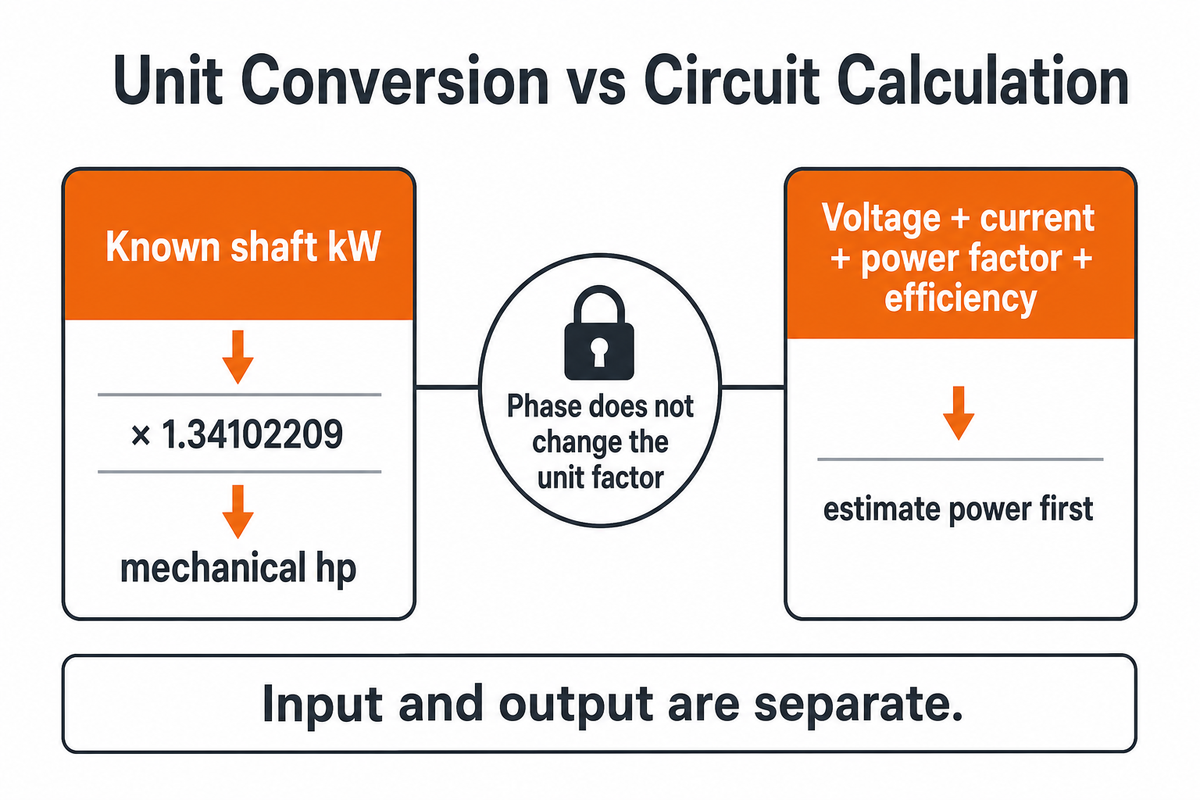
No. Three-phase power does not change the conversion between kW and mechanical hp. If the starting quantity is already mechanical output in kW, multiply by 1.34102209 regardless of phase. Phase matters only when voltage and current are used to estimate electrical input power.
Searches for “kW to hp conversion for three phase” often combine two different tasks. A unit conversion starts with known power. An electrical calculation starts with circuit measurements and may require line voltage, current, power factor, phase configuration, and motor efficiency before anyone can estimate shaft output; the U.S. Department of Energy motor-systems resources treat those as system variables rather than a different unit identity.
Do
- Confirm whether the starting kW is input or output.
- Convert known shaft kW directly to mechanical hp.
- Keep power factor and efficiency as separate inputs.
- Verify the actual nameplate and operating load.
Don’t
- Change the unit factor because the supply is three-phase.
- Treat current alone as a shaft-power reading.
- Assume power factor equals motor efficiency.
- Use rated output as measured electrical consumption.
Suppose a motor nameplate shows 15 kW rated output. That rating converts to 20.1153 mechanical hp whether the motor is single-phase or three-phase. If instead a technician has only voltage and current readings, the technician is not yet at the unit-conversion step. The electrical input must be established first, followed by a supported efficiency basis if shaft output is needed.
When Not to Use Converted Horsepower to Size a Pump Motor

Do not size a pump motor from converted horsepower alone. The converted number may describe a nameplate output, but the motor decision must cover pump shaft demand across the required operating range, the duty point, speed, fluid, starting method, service conditions, and manufacturer limits.
The sizing risk remains because a unit conversion contains no evidence about the pump curve, operating margin, or installation. A precise equivalent can still support the wrong motor decision.
Hydraulic Institute pump-curve guidance places head, flow, efficiency, input power, and net positive suction head required on the same performance map. It also defines the best-efficiency point and operating regions. None of those conditions appears in the equation “kW × 1.34102209.”
Converting a 75 kW nameplate produces 100.5767 mechanical hp with excellent arithmetic. The selection can still be wrong if 75 kW is electrical input rather than rated output, if the pump requires more shaft power away from the quoted duty point, if speed or frequency changes, or if the replacement frame and enclosure cannot fit the installation.
Use the conversion as a normalization step inside a larger sequence:
- Identify the original value. Record the label, unit, convention, and whether it is input, motor output, or pump demand.
- Establish the pump duty. Confirm flow, total dynamic head, fluid, operating range, and speed. For system-side work, start with the TDH calculator.
- Read the pump curve. Use power and efficiency at the intended operating point, not a generic factor.
- Apply motor-selection constraints. Preserve supply, frequency, speed, frame, enclosure, mounting, duty, starting method, and manufacturer margin rules.
- Compare standard ratings. Only now map the verified requirement to an available motor rating.
For deeper pump-type context, the centrifugal pump hub routes different hydraulic configurations, while the end-suction pump field guide shows why layout and long-term operating conditions matter beyond nameplate power.
The Nameplate-to-RFQ Power Handshake
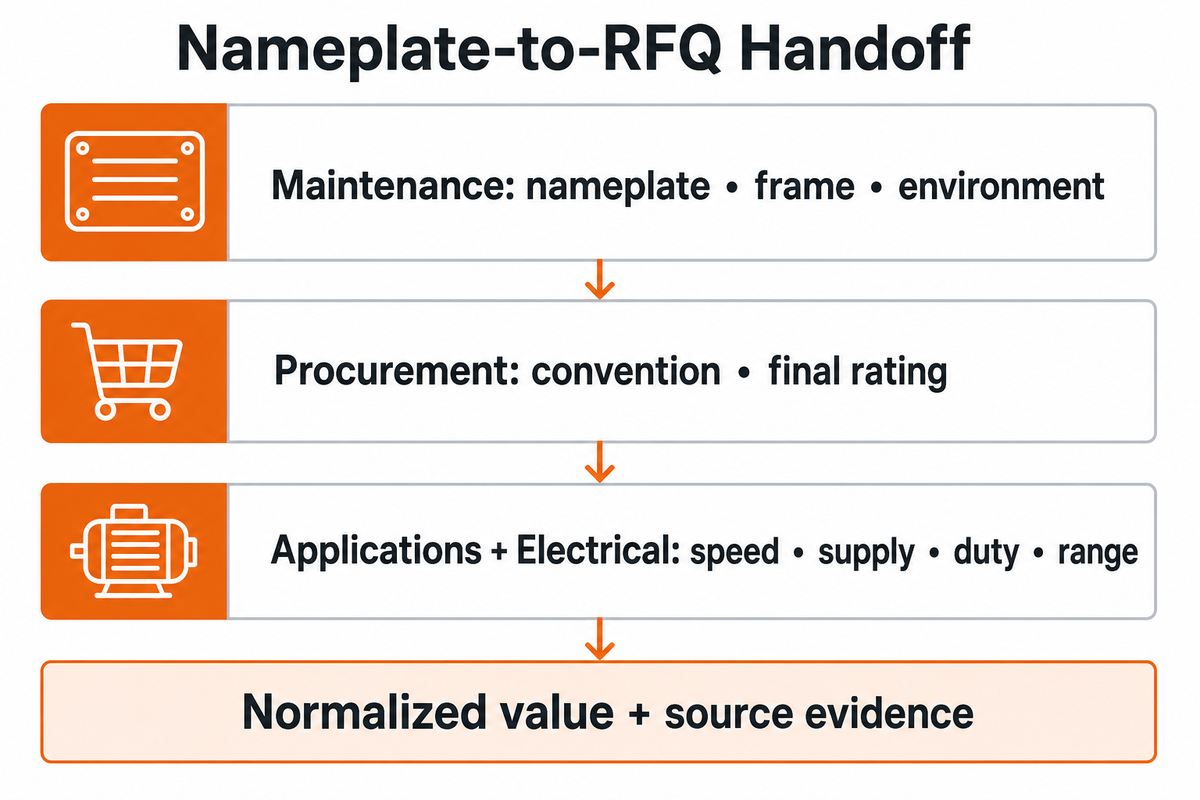
In this practical BBP-recommended RFQ framework, assign label consistency to procurement, the duty and power chain to applications engineering, and the installed-equipment record to maintenance. Useful RFQs state both the normalized power value and the evidence behind it, preventing a correct conversion from becoming an incorrect replacement.
| Check category | Owner | Required evidence | Release question |
|---|---|---|---|
| Original power label | Maintenance | Clear nameplate image | Is this input or rated output? |
| Horsepower convention | Procurement | Catalog definition | Mechanical hp, PS, or hp(E)? |
| Rated speed | Applications | rpm and frequency | Will speed remain equivalent? |
| Supply | Electrical | Voltage, phase, frequency | Is the replacement compatible? |
| Pump duty point | Applications | Flow, head, fluid, curve | What shaft demand must be covered? |
| Operating range | Applications | Minimum and maximum conditions | Where is maximum power? |
| Frame and mounting | Maintenance | Dimensions and shaft details | Will it physically interchange? |
| Enclosure and environment | Maintenance | Ambient and ingress requirements | Does protection match the site? |
| Final standard rating | Procurement | Approved datasheet | Has engineering released the rating? |
For a broader quote-request structure, use the industrial pump RFQ guide. Add the original nameplate photo and the converted value as two separate fields. That keeps the source evidence visible instead of replacing it with a rounded number.
Key takeaway
Convert the unit only after naming the horsepower convention and power location; select the motor only after verifying the driven-equipment duty.
Frequently Asked Questions
How do you convert kW to hp?
Multiply kW by 1.34102209 for mechanical horsepower. For example, 5 kW × 1.34102209 = 6.7051 hp. Label the result “mechanical hp” so it is not confused with metric PS. Keep the full factor through the calculation and round only the displayed result. If a source uses PS or electric horsepower, change the definition before using the number in specifications or comparison tables.
Is 1 kW equal to 1 hp?
No. One kilowatt equals approximately 1.3410 mechanical hp. In the other direction, one mechanical hp equals approximately 0.7457 kW. The units express the same dimension at different scales. State which hp definition you mean because metric PS and electric horsepower use slightly different watt values. A one-for-one substitution introduces avoidable error.
How many hp is a 7.5 kW motor?
For a 7.5 kW rated mechanical output, the equivalent is 10.0577 mechanical hp. Catalog grouping may place it near a 10 hp class, but replacement selection still requires rated speed, voltage, phase, frequency, frame, enclosure, mounting, starting method, driven-equipment duty, operating range, and manufacturer approval. Keep the nameplate image with the converted value so applications engineering can confirm that both numbers describe the same power location.
How much hp is 75 kW?
Seventy-five kilowatts equals 100.5767 mechanical hp or 101.9716 metric PS. The answer changes because the two horsepower conventions have different watt definitions.
Does three-phase use a different kW-to-hp formula?
No. Known kW converts to mechanical hp with the same factor. Three-phase formulas are relevant only when voltage, current, and power factor are being used to estimate electrical input power.
Can I choose a pump motor from the converted hp?
Not from conversion alone. Confirm pump shaft demand at the duty point and across the required operating range, then apply motor and installation constraints. Use the converted result only to normalize units.
Use the Conversion Without Losing the Engineering Context
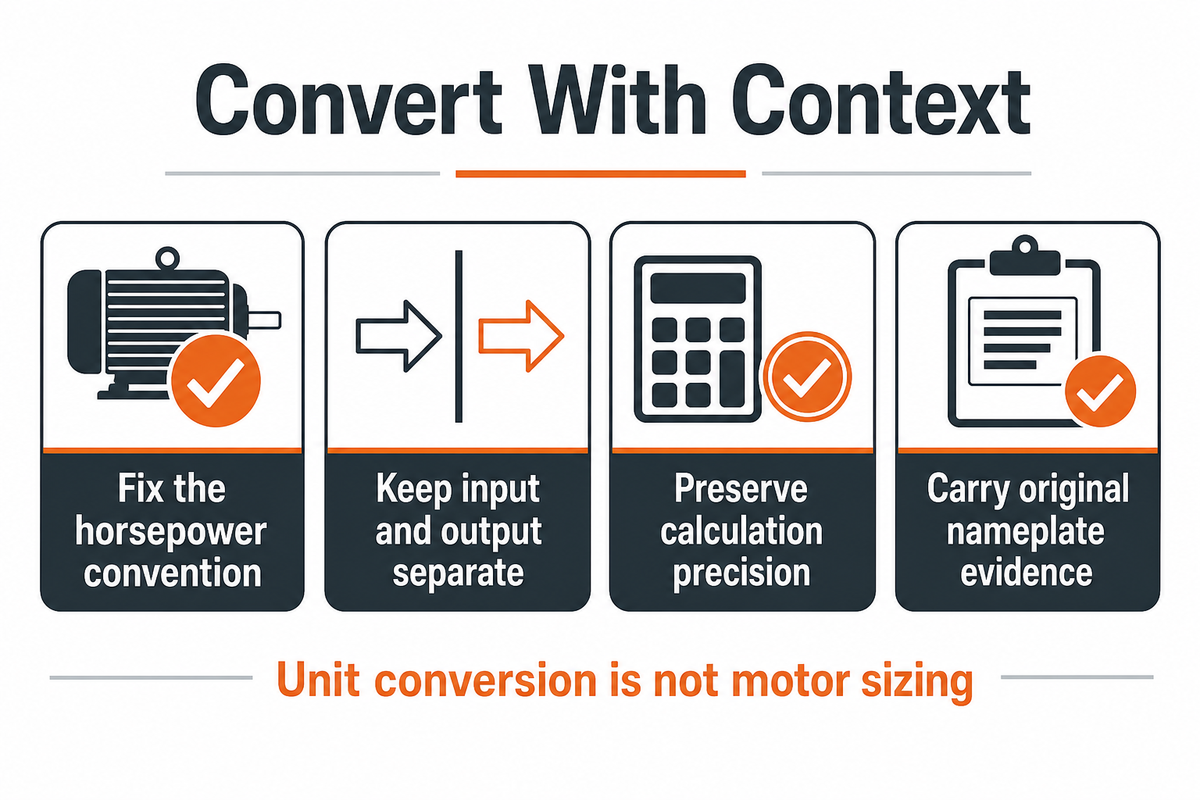
The kW-to-hp identity is simple; the specification around it is not. Fix the horsepower convention, keep input and output power separate, preserve precision through the calculation, and carry the original nameplate evidence into the RFQ. Those steps prevent most errors without turning a unit converter into an unsupported sizing tool.
For an application-specific pump review, prepare the duty point, fluid data, operating range, motor nameplate, and installation constraints before requesting a selection. Keeping these inputs together lets the pump and motor be assessed as a system instead of approving a replacement from one converted number.
About This Conversion Guide
BBP Manufacturing Co., Ltd. publishes this guide to keep power-unit arithmetic separate from centrifugal pump and motor selection. The conversion table is generated from the NIST-backed mechanical-horsepower definition, while the selection boundaries are tied to motor nameplate and pump-curve evidence.
Related Articles
References & Sources
- NIST Guide to the SI, Appendix B.9 — Power Conversion Factors — National Institute of Standards and Technology
- The International System of Units, SI Brochure — Bureau International des Poids et Mesures
- Motor Systems Technical Publications and Case Studies — U.S. Department of Energy
- Pump Curves: Head, Power, Efficiency, and NPSHR — Hydraulic Institute
- How to Read a NEMA Motor Nameplate — ABB motor-manufacturer technical guide
- Why Users Should Pay Attention to the Motor Nameplate Rating — Pumps & Systems; authored by a Flowserve motor specialist
WHY BUYERS WORK WITH BBP
About BBP Manufacturing
BBP Manufacturing Co., Ltd. is a Beijing-based industrial pump manufacturer with in-house foundry, heat treatment, machining, assembly, coating and inspection capabilities. We support industrial projects across slurry handling, sewage treatment, clean water transfer, chemical service, fire protection, irrigation and OEM pump supply.
Our Engineering Support
We help engineering buyers select and source the right pump configuration, not just compare prices. Send us your flow rate, head, medium, solids content, temperature, pH value, material requirement and installation conditions. BBP engineers will recommend a pump series, material option, duty curve basis, lead time and spare-parts plan for your RFQ.
Company Profile // DATA_SHEET
Name
BBP Manufacturing Co., Ltd.
Brand Name
BBP
Country
China
Headquarters
Beijing, P.R. China
Business Type
Industrial Pump Manufacturer
Model
B2B / OEM / ODM / Project Supply
Main Products
Slurry Pumps, Sewage Pumps, Centrifugal Pumps, Split Case Pumps, Multistage Pumps, Chemical Pumps, Fire Pumps, Irrigation Pumps
Manufacturing Capability
Foundry, Heat Treatment, Machining, Assembly, Coating, Inspection
Certifications
ISO 9001 / CE / SGS / BV / TÜV
Export Reach
90+ Countries & Regions
Standard Lead Time
About 25 Days for Standard Configurations
Contact Person
Wesley · International Sales
Phone / WhatsApp
+86 182 1085 0516
Email
contact@bbpmfg.com
Website
https://bbpmfg.com/
Address
Room 2803, Building 11, Phase II, Nuode Center, Fengtai District, Beijing, P.R. China