Get in Touch with BBP

![Sewer Lift Station: How It Works, Types & Costs [2026]](https://bbpmfg.com/wp-content/uploads/2026/07/sewer-lift-station-featured.png)
Reviewed by: BBP Manufacturing Co., Ltd. technical team. Update: July 2026.
A sewer lift station is the apparatus that moves wastewater from a low-lying collection area to higher elevation where gravity flow to the wastewater treatment plant (WWTP) is possible. Since an entire system rests upon a few pumps, a wet well, and a control panel working together, small design decisions separate the decades of quiet operation from a quick death of short-cycling. Let’s explore how a sewer lift station works, its parts, common types, sizing considerations, costs, typical failures, and related regulations.
A sewer lift station is a wastewater pumping station that transports sewage from a low collection point to a higher elevation, typically a gravity sewer line that leads to a wastewater treatment plant. It contains a wet well that accumulates incoming flow, submersible pumps that start when water reaches a specific level, and a discharge pipe (a force main) to push the sewage to its destination.
Key Takeaways
- Bigger is not always better. A municipality has a code that limits wet-well detention time to a maximum of four hours, to prevent sewage from becoming septic and causing concrete corrosion.
- The size of a wet well is based on the minimum amount of time a pump needs to run between cycles, not on the amount of storage a person thinks is safe.
- Clogging of a sewer line is the primary cause of sewer overflows. According to the EPA, roughly 48% of identified overflows are due to a blockage. The largest contributor to these blockages isn’t wipes, but grease, at about 47%.
- Failure rate versus volume of overflow. Roughly 26% of sewer overflows are caused by wet-weather infiltration; however, these events account for approximately 74% of the volume that’s spilled.
- The lift station must be designed to accommodate the peak flow rate while its largest pump isn’t operating (known as the firm capacity requirement).
- Lift station cost spans a wide range: roughly $2,000–$50,000 installed for small residential and commercial stations, rising to $1.5 million or more for large municipal packages.
Quick Specs
| Function | Lift wastewater from low to high elevation past a gravity break |
| Core components | Wet well, submersible pumps (lead/lag), float switches, control panel, check valves, force main |
| Solids passage (raw sewage) | Pumps pass ≥3 in (80 mm) spheres; openings ≥4 in (100 mm) |
| Typical pump size | 20–150 HP (small residential kits use fractional-HP grinder pumps) |
| Cycle limit | ≤15 starts per hour; ≥15 min between starts for constant-speed motors |
| Governing standards | Ten States Standards (firm capacity, alternation); OSHA 1910.146 (confined space) |
What Is a Sewer Lift Station?
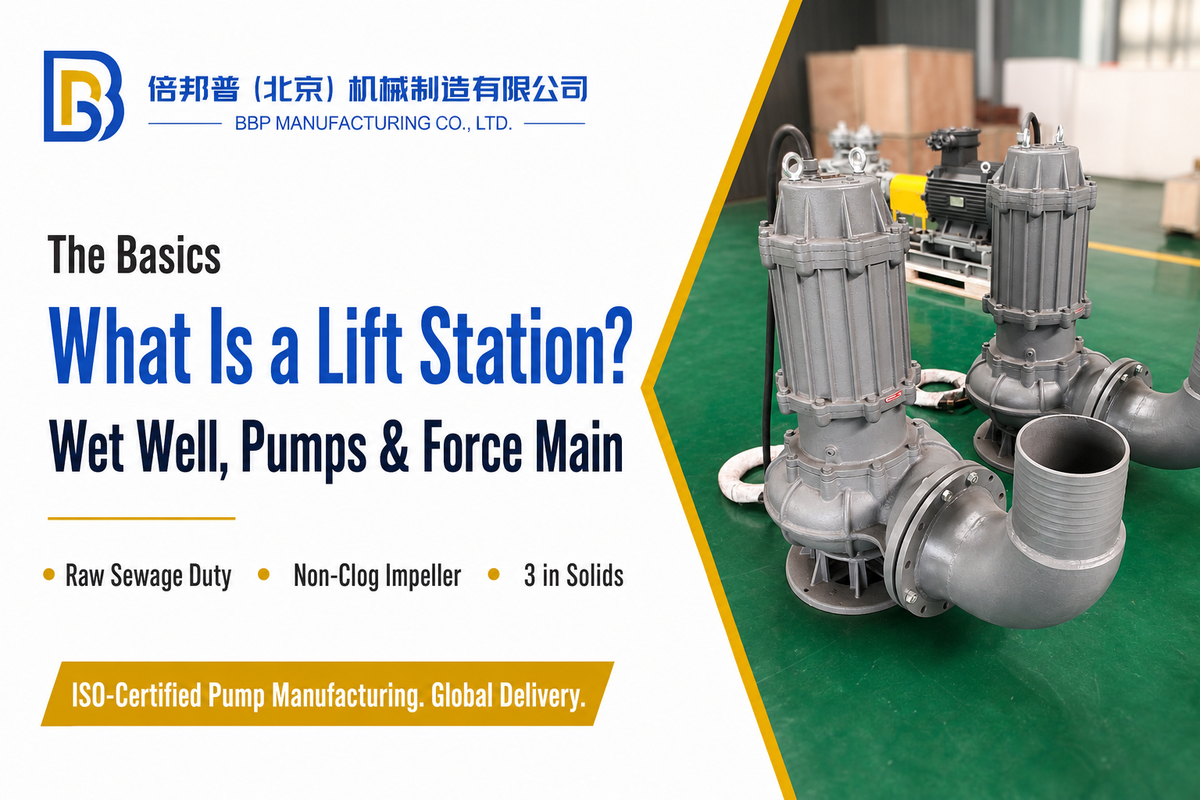
A sewer lift station — also called a sewage lift station — is a wastewater pumping facility that lifts sewage from a lower elevation to a higher one so gravity can carry it onward to the treatment plant. It collects incoming flow in a wet well, stores it briefly, then pumps the wastewater uphill through a force main. Where topography leaves no downhill path, the lift station is what moves the sewage up.
A wastewater lift station is one part of a larger wastewater system: these systems collect wastewater from residential and commercial sources and move wastewater from lower to higher ground so it can reach the main sewer line and, eventually, the plant. Lift stations are essential wherever gravity alone cannot keep wastewater moving, and they are designed to transport wastewater reliably across both municipal and industrial sites. When a lift station fails, sewage can back up into streets and basements within hours, because the collection system upstream has no other way to climb the grade.
The U.S. EPA sets cost and operating benchmarks for these facilities – its Lift Station Index is based on a 1.0 MGD (million gallons per day) raw-wastewater station – that offer a clue to how common and important they’re to public sanitation. A municipality may have dozens; a single commercial building below street sewer may require one.
The authoritative regulatory context, the EPA’s sanitary sewer overflow guidelines treats both lift station capacity and maintenance as frontline defenses against raw sewage spills.
How Does a Sewer Lift Station Work? The 5-Stage Pumping Cycle
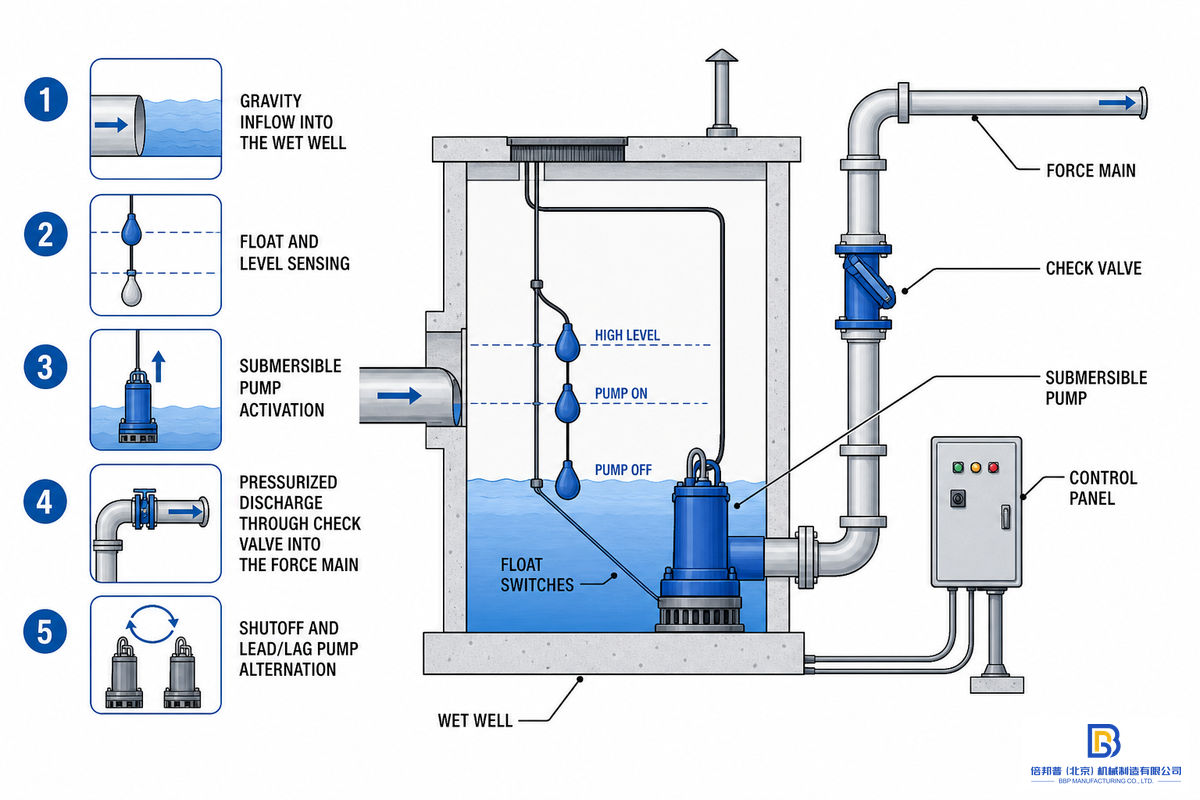
A sewer lift station stores incoming gravity flow in a wet well and then pumps it upward in short spurts when the water reaches a certain level.
The entire operation occurs as a five-step loop that engineers tune to protect the pumps.
The 5-Stage Lift Station Pumping Cycle
A named sequence of the repeated loop every wet-well station performs: inflow, sensing, lift, discharge, and reset.
- Gravity inflow. Wastewater comes down from the collection sewer and fills the wet well-the underground storage chamber that’s sized for the incoming flow.
- Level sensing. Float switches or a submersible pressure transducer detect water level and signal the control panel to start when the “lead” start point is reached.
- Pump activation. The lead submersible pump kicks on and draws the sewage into its housing and pushes solids through a nonclog impeller.
- Pressurized discharge. The pump forces flow up through a check valve and out a force main to a higher gravity sewer or the treatment plant.
- Shutoff and alternation. At the low level float the pump stops; the control panel switches lead and lag pumps to share the work — a practice required in automated mode by the Ten States Standards and embodied in modern level-control and alternation patents.
More complex stations have a lag pump that comes on during high flow, plus a high-level alarm to alert operators when overflow is imminent. The number of starts can also be an issue: submersible pumps are usually rated for a maximum of 15 starts and stops per hour, which amounts to a four-minute cycle minimum. Get the start and stop levels wrong and the pump short-cycles; because each restart stresses the motor, a unit that should last 15 years can wear out in 2 to 3.
The control system is the brain of the station: a controller and monitoring system watch the water level and switch the two pumps in sequence, and many modern stations add remote monitoring so operators can monitor the water level from off-site. Capacity is rated in gallons per minute, and the size of the wet well must match it — a station that pumps the wastewater from a lower elevation at a few hundred gallons per minute may move thousands of gallons a day, so site conditions and access for maintenance both shape the final design.
Key Components of a Lift Station
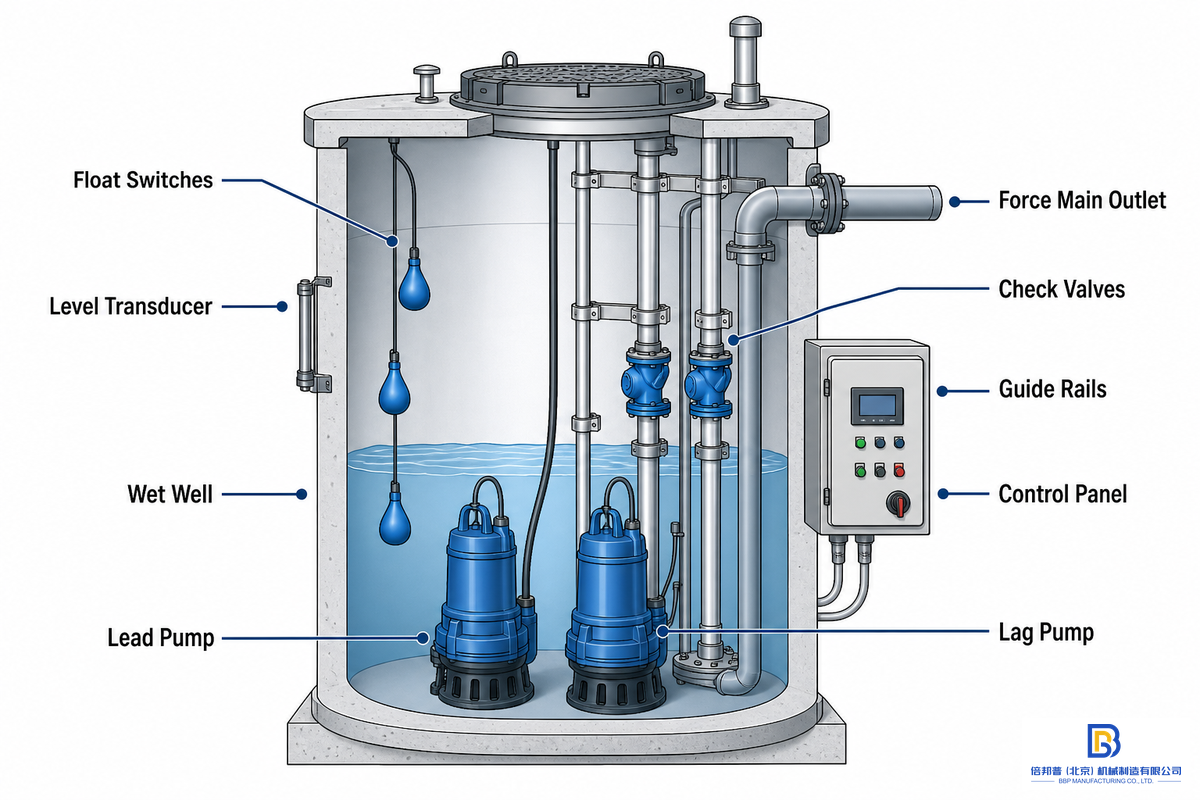
Every wet-well station, whether serving one building or an entire town, contains the same basic components. The following table lists each part and the key feature that most affects reliability.
| Component | Function | Design detail that matters |
|---|---|---|
| Wet well | Holds incoming flow between pump cycles | Volume set by cycle time, not by “extra safety” storage |
| Submersible pumps (lead/lag) | Lift the sewage up the force main | Pass ≥3 in (80 mm) solids; 4 in (100 mm) minimum openings |
| Float switches / level sensor | Trigger pump start/stop and alarms | Tethered floats snag on grease; transducers need routine cleaning |
| Control panel | Sequences pumps, alternation, alarms | Duplex logic must alternate lead/lag automatically |
| Check valves | Stop backflow when the pump shuts off | Swing checks foul on rags; ball checks tolerate solids better |
| Isolation (gate) valves | Let crews service one pump while the other runs | Required for maintenance without draining the well |
| Force main | Pressurized pipe carrying flow uphill | Velocity must scour solids yet limit surge and odor |
| Guide rails & lifting chain | Let a pump be pulled without well entry | Avoids confined-space entry for routine pump removal |
| Backup power & high-level alarm | Prevent overflow during outages | Generator or storage; alarm dials out before overflow |
| Vent / odor control | Releases and treats hydrogen sulfide gas | Controls the H₂S that corrodes concrete and metal |
Minimum dimensions for solids and openings per the Ten States Standards for wastewater pumping stations.
Types of Lift Stations
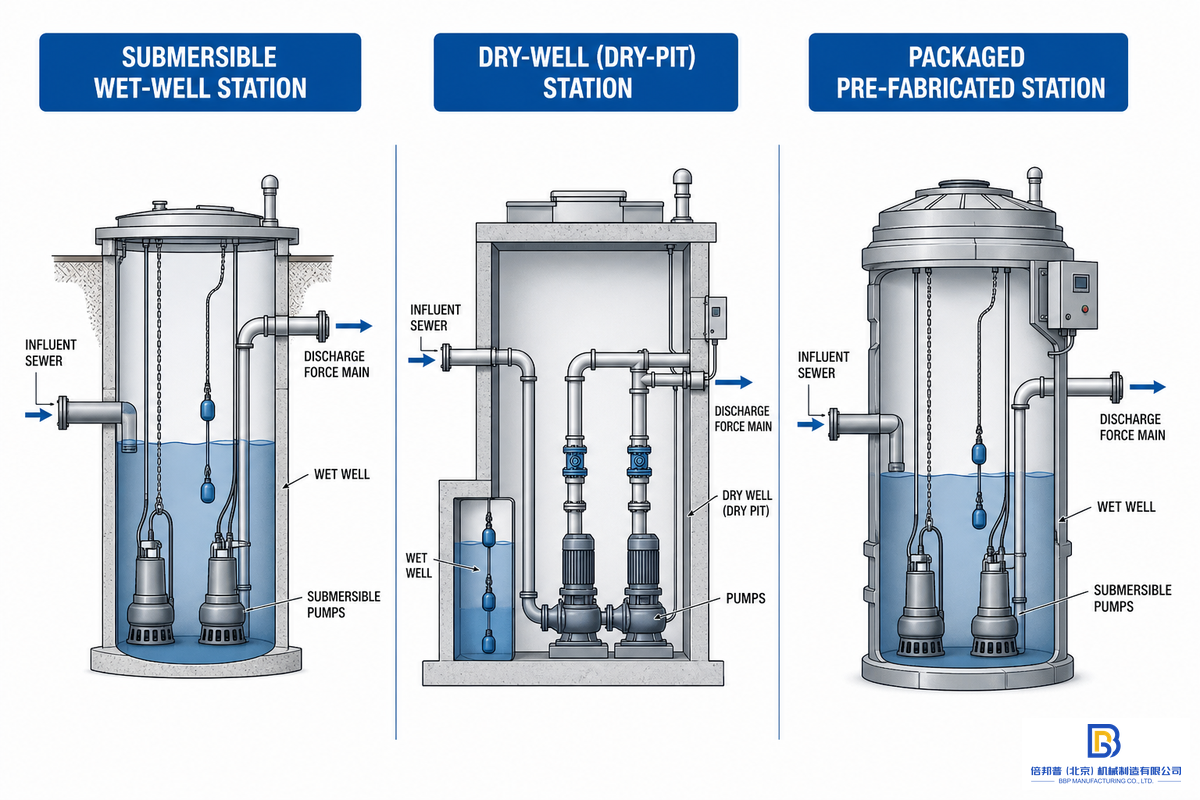
Pump arrangement and the number of pumps working simultaneously distinguish different types of lift stations.
The ladder below will help you select the correct station configuration for your site, moving from residential scale up to the redundancies that a municipality expects.
The Lift Station Configuration Ladder
A flowchart guiding you from site depth and flow to the appropriate station configuration.
② By pump location
- Wet-well (submersible): Pumps submerge in the sewage; the most common setup with the smallest footprint.
- Dry-well (dry-pit): Pumps sit in a dry compartment adjacent to the wet well; easier maintenance, higher initial cost.
③ By redundancy
- Simplex: one pump; residential only.
- Duplex: Lead and lag pumps; standard for a municipality’s capacity and redundancy requirements.
- Triplex: three pumps for high or variable flow.
Third up is solids handling: a sewage grinder pump shreds solids for small-diameter pressure sewers and wipe-heavy flows, while a non-clog pump passes whole solids for larger municipal duty. Packaged stations arrive as a pre-plumbed fiberglass or polymer basin with pumps, rails, and controls installed-the format most small commercial sites choose. For the engineering rationale behind each configuration, the EPA’s design references for pumping stations are a neutral starting point. EPA collection-system guidance ties configuration choices back to overflow prevention. In practice, choosing simplex versus duplex comes down to risk: a single-pump station has no backup, and because one clog then backs up the whole site, codes require duplex above a threshold flow.
Lift station systems come in several forms, and choosing a lift station means matching the configuration to flow, depth, and budget. Lift station solutions range from a pair of sump pumps in a basement to a submersible lift serving a whole subdivision; a well-maintained lift station of either kind is a cost-effective solution that lift stations help utilities rely on for decades, which is why lift stations are designed for reliable operation from day one.
Lift Station vs Pump Station vs Septic Tank vs Sewage Ejector
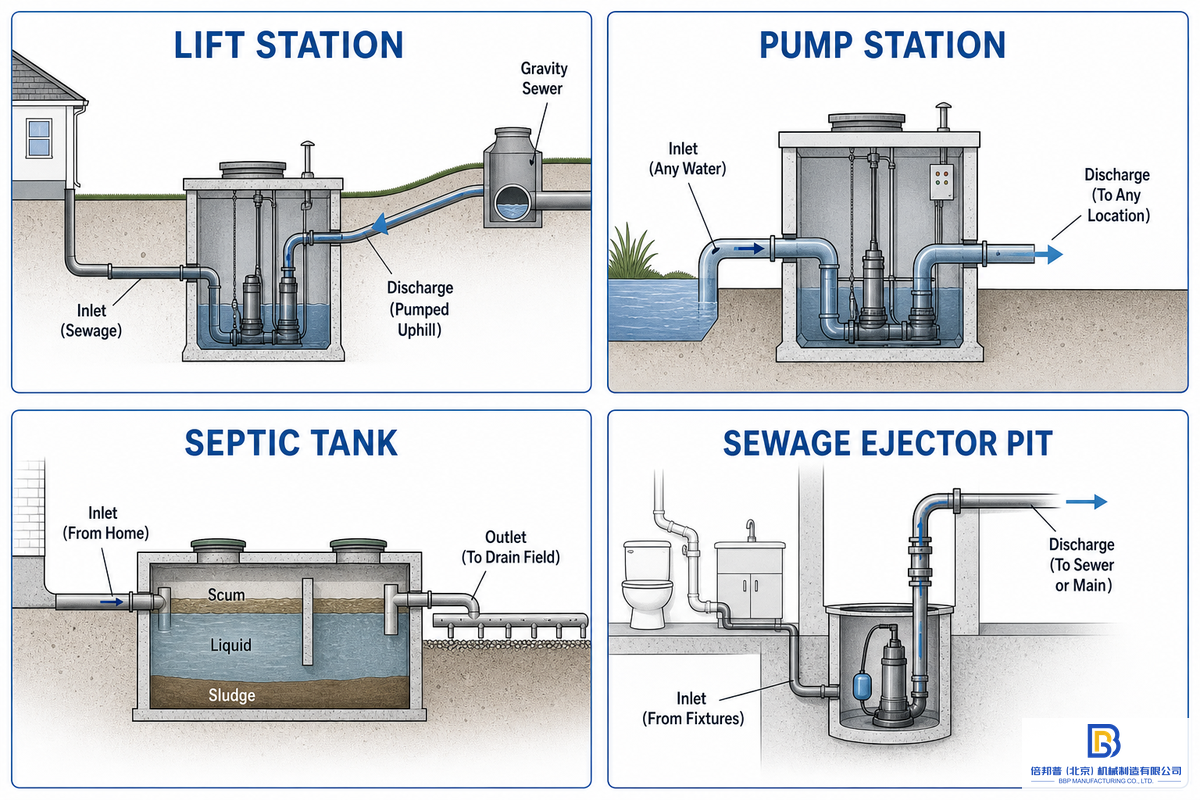
These four terms get used interchangeably, but they describe different machines. A lift station moves sewage that contains solids; a pump station is the broader category that can move any water; a septic tank stores and treats on site without pumping uphill; a sewage ejector handles a single building. The table untangles them.
| System | What it moves | Scale | Pumps uphill? |
|---|---|---|---|
| Sewer lift station | Raw sewage with solids | Building to municipal basin | Yes — that is its whole job |
| Pump station | Any water (storm, potable, sewage) | Broadest category | Yes; a lift station is one kind of pump station |
| Septic tank | On-site wastewater (settles & treats) | Single property | No — gravity to a drain field |
| Sewage ejector pump | Sewage from a basement fixture | One building/basin | Yes — a mini lift station |
In short: a sewage ejector is a small residential lift station; a pump station is the parent category; a septic tank isn’t a pumping system at all. For definitions grounded in federal terminology, the EPA collection-system materials keep the wastewater vocabulary consistent.
How to Size a Sewer Lift Station
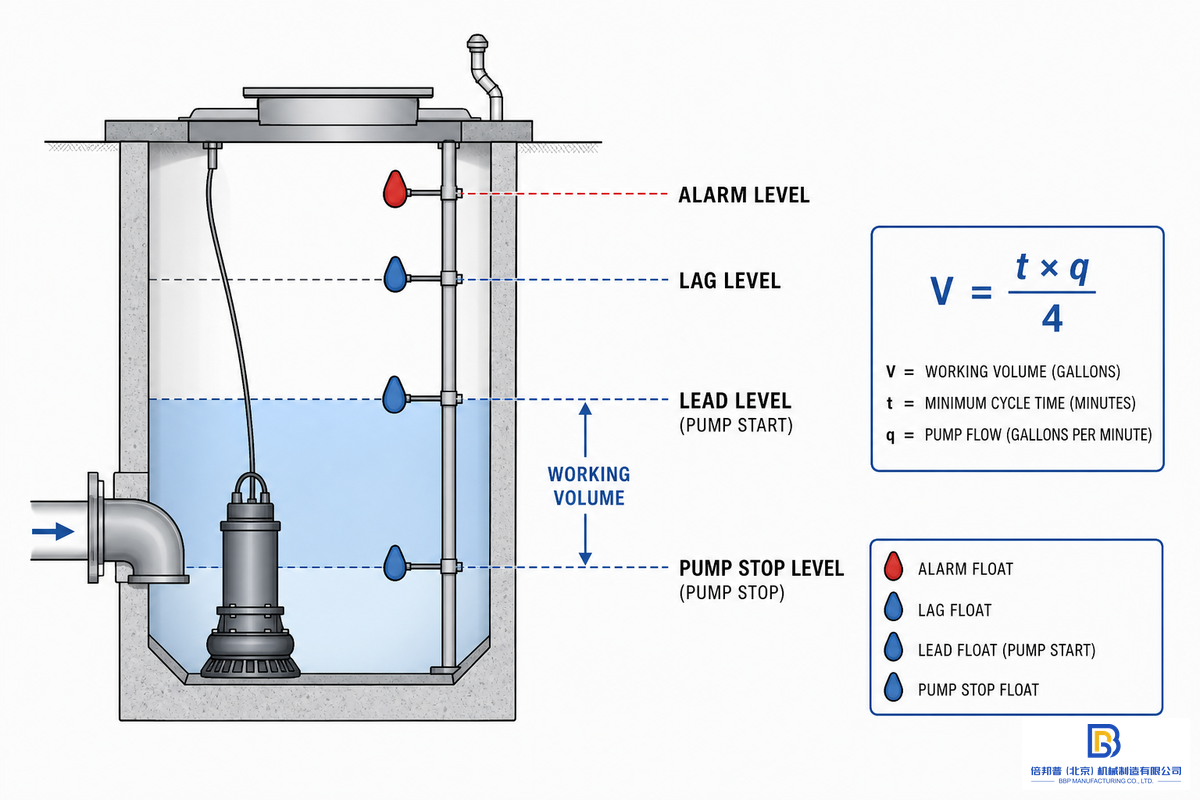
Sizing a lift station isn’t about picking a tank big enough to feel safe. Two numbers govern the design: the firm capacity (peak flow the pumps must handle with the largest unit out of service) and the minimum pump cycle time (which sets the usable wet-well volume). Get the cycle time wrong and the motors pay for it.
The Ten States Standards require that a station handle its design peak instantaneous flow with one pumping unit out of service-the firm-capacity rule that forces at least a duplex arrangement. On the storage side, the wet-well working volume between the pump start and stop levels is derived from the cycle-time limit, not chosen freely:
📐 Engineering Note — Worked wet-well volume
The usable volume between start and stop for a single constant-speed pump is V = (t × q) / 4, where t is the minimum minutes between starts and q is the pump capacity. Take a pump rated 200 GPM with a 15-minute minimum cycle: V = (15 × 200) / 4 = 750 gallons of active storage. Size the well to that number. Doubling the storage to “be safe” does the opposite, it lengthens detention and turns the sewage septic.
That last point is where intuition fails. San Diego’s sewer design guide caps wet-well detention time at four hours precisely because excessive detention “can create odor problems, accelerated corrosion and hazardous gases.” The City of San Diego sewer design standards make the ceiling explicit. A peer-reviewed review of sewage pumping station operation reaches the same conclusion from the control side: added complexity “may not always lead to better results.”
“In my experience, a station should cycle 4 or 5 times per hour, pumps shouldn’t run non-stop. For constant-speed pumps, the time between starts of the motor should not be less than 15 minutes.”
Senior wastewater engineer, Eng-Tips design forum
Operation, Maintenance & the 6-Mode Failure Taxonomy
Many of these lift-station call-outs stem from just a few recurring failure modes. Awareness of cause and the early symptom is the key difference between routine pumping-out and an overflow that has you tiptoeing across raw sewage at 2 in the morning. This taxonomy shows you each failure mode’s underlying cause and the remedy that sticks.
The 6-Mode Lift Station Failure Taxonomy
One called classification on the six modes of lift station failure with its root cause and a preventive measure.
| Failure mode | Root cause | Early symptom | Prevention |
|---|---|---|---|
| 1. Rag / wipe clogging | Non-flushable wipes, FOG braiding through the impeller | Rising run times, tripping overloads | Grinder pumps; scheduled declogging |
| 2. Short-cycling | Undersized wet well; pump too large for inflow | Pump starts many times per minute | Size volume to ≥15 min between starts |
| 3. H₂S crown corrosion | Septic sewage off-gasses hydrogen sulfide | Pitting on concrete crown, rotten-egg odor | Limit detention; vent and treat odor |
| 4. Float / control failure | Greased-over floats, panel faults | Pumps not alternating; false alarms | Clean floats; test alternation quarterly |
| 5. FOG accumulation | Fats, oils, grease coating the well | Grease mat, sensor fouling | Grease-trap enforcement; wet-well cleaning |
| 6. Power loss / no backup | Outage without generator or storage | High-level alarm, imminent overflow | Standby generator; alarm auto-dialer |
The largest single category is clogging. According to the EPA’s 2004 Report to Congress on sewer overflows, the still most frequently referenced national cause breakdown for known cause events, approximately 48% are due to blockages, and of these blockages grease is the number one cause, representing approximately 47% compared to grit and debris (27%) and roots (22%). Non-flushable wipes, and fats oils and grease are the operating factor driving the industry trend toward the use of grinder pumps and smart anti-clog controls.
The corrosion mode is chemical. When sewage stands, sulfate reducing bacteria create hydrogen sulfide gas. These bacteria “convert the H2S into sulfuric acid (H2SO4) which then begins to react with the infrastructure in a destructive way,” reports a corrosion study published in pumps & systems magazine.
Ironically, CMOM guidance from the EPA says that those systems that succeed in limiting infiltration have higher corrosion potential due to off-gassing of hydrogen sulfide as reduced flows allow more gas to escape onto the concrete crown. The undersized pump feeds mode 2 directly, with a user posting to Eng-Tips.com having a 300-gallon wet well at a 400-gpm inflow causing a continuously operating pump. Modern duplex pump controls are now being patented for a more efficient level-based pump control and for alternation back-up.
⚠️ Failure count is not overflow volume
Mechanical modes, such as clogging and short-cycling, cause the number of overflows, but I/I causes the volume. And in that EPA study, even though I/I only causes about a quarter of the overflow events, it was responsible for three-quarters of the overflow volume. A plant can have no clogging events but still spill the most, simply because the force main, back up power and bypass are not designed for wet weather – so don’t ignore air release valves, surge control and standby power for the force main.
💡 Pro Tip
Log your pump run-times every month. A steady climb in run-time at a given inflow rate is the first, cheapest clue that a clog is developing, often many minutes before the alarm fires. A Minnesota operator’s video demonstration of how to clear out an accumulating clog on a routine basis quickly shows how output suffers when an impeller is caked.
How Much Does a Sewer Lift Station Cost?
A sewer lift station costs roughly $2,000 to $50,000 installed for most small residential and commercial stations, and far more at municipal scale. Price is driven mostly by depth, pump horsepower, redundancy, and controls, so treat any single figure as directional rather than a firm quote.
The label “lift station” describes the whole gamut, from a small home basement kit to a million-gallon municipal package, so the range is wide. Published industry estimates put the vast majority of small, commercial, and residential stations between about $2,000 and $50,000 installed, though the total range reaches $400,000 for very large stations. For municipal package plants, cost rises with flow rate; one cost reference ranges from about $150,000 (at 20 GPM) to $1.5 million (at 100,000 GPM). At the high, municipal end of the scale — a different category from the smaller stations just referenced, not a per-unit cost comparison — agencies themselves publish data: the City of Phoenix’s 2024 unit-cost study puts a 1-MGD lift station at approximately $1.79 million in construction cost, and a 3-MGD unit at $3.55 million (assuming submersible pumps and 50 ft total head). For the smaller-station numbers, treat the price range as indicative only; actual installed cost depends heavily on factors such as depth, horsepower, and controls.
Four factors move the number most:
- Depth and excavation: deeper wet wells drive civil cost faster than the pumps themselves.
- Pump horsepower: a typical commercial or residential lift station uses 20- to 150-HP pumps (home kits are smaller, using fractional-HP grinders).
- Redundancy: a duplex or triplex station ensures capacity is met even when the largest pump is out of service.
- Controls and standby power: SCADA and variable frequency drives can add upfront capital but provide lifetime savings and reliability.
Energy cost is often overlooked until it hits the balance sheet; a station pumping 500 GPM, 40 ft head, at 65% wire-to-water efficiency will consume roughly $2,550 per year per pump if electricity costs $0.10/kWh. Our website provides build options on the commercial sewer lift station page and a reference guide to the EPA’s Lift Station Index, should you need engineered pricing for a specific configuration.
Regulations & Safety: Firm Capacity and Confined Space
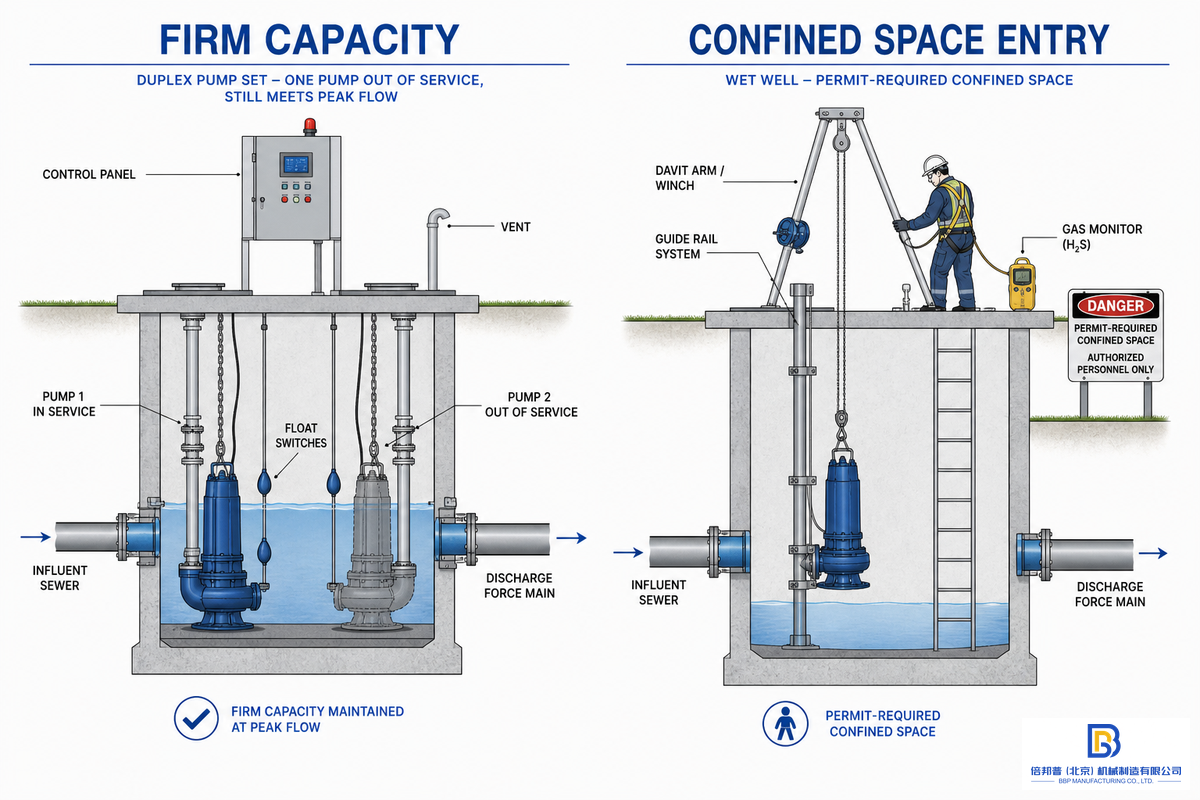
Two core principles guide municipal lift station design and operation: first is capacity standards, as outlined in the Ten States Standards, and second is worker safety regulations from OSHA. Neither principle is optional, and both will come up during inspection.
Regarding capacity, Ten States requires pumps that can discharge 3-in. (80 mm) solids through a 4-in. (100 mm) opening, an automatic pump alternating function, and sufficient backup to maintain capacity if the largest pump is offline. Regarding worker safety, standards state, “Equipment for confined space entry, in accordance with OSHA … , shall be provided for all wastewater pumping stations,” because the wet well is classified as a permit-required confined space under OSHA 29 CFR 1910.146. An additional requirement-lockout/tagout under OSHA 1910.147-is added when working on a pump, requiring disabling electrical and storing any potential energy source. Hydrogen sulfide, low oxygen, and the risk of falls into the well make entry dangerous; hence guide rails that permit removing the pump from outside the well provide enhanced safety.
Maintenance requirements are modest but non-negotiable: lift stations often fail from neglect, and skipped upkeep can lead to sewage overflows, structural damage to the wet well, and costly effluent releases. Compliance with regulations helps prevent environmental harm, and proper, efficient wastewater management keeps effluent out of waterways while helping utilities deliver reliable wastewater service and reduce costs over a station’s life.
⚠️ Important
Never enter a wet well without permit-required confined-space procedures: atmospheric testing, ventilation, fall protection, and a trained attendant. The EPA also ties station capacity and maintenance directly to overflow liability — inadequate O&M is a leading, citable cause of sanitary sewer overflows.
Industry Outlook: What’s Changing for Lift Stations
Regulatory and operational factors, not market froth, will reshape lift stations in 2025-26. Grease remains the No. 1 clogger responsible for most overflow events. However, a rise in non-flushable wipes adds to the operational strain and has driven the push for grinder pumps and smart anti-clog controls. The former and the latter represent a shift in the items engineers must specify, rather than optional upgrades. In practice, utilities that defer VFD and grinder retrofits risk rising energy bills and premature motor failure from hard starts — the trade-off is driven by hard-start wear, not by the purchase price, which is why efficiency mandates keep tightening.
The regulatory environment is intensifying – although erratically. Although many stations still lack them, VFDs, used to minimize starting stress, are moving from option to standard in some areas. Ontario guidance mandates VFD-equipped sewage works starting in 2024, and U.S. EPA Green Project Reserve financing for State Revolving Funds favors stations that achieve 20% efficiency gains through retrofits. State standards are catching up too: Iowa’s wastewater facilities design standards became effective June 18, 2025, though the interstate Ten States Standards remain stuck in its 2014 edition.
Funding is a tailwind: the federal Infrastructure Investment and Jobs Act authorizes roughly $69 billion for water infrastructure, a large share of it routed through the Clean Water and Drinking Water State Revolving Funds, and, according to U.S. Census Bureau construction-spending data, U.S. sewage and waste-disposal construction rose about 8.9% year over year in April (from $45.2 billion in April 2024 to $49.3 billion in April 2025). By comparison, industry estimates put the global lift-stations market at $2.7 billion in 2026 and rising to $3.4 billion in 2031 – this represents background context, not a trigger for immediate action. Plan for VFD-ready controls and a grinder option on 2026 projects, since they’re increasingly becoming the default specifications, not add-ons. For additional background on selecting the right pump for lift stations, refer to our guide to submersible pump selection for solids-handling duty.
Frequently Asked Questions
How does a sewer lift station work?
View Answer
At a sewer lift station, wastewater collecting via gravity flows to a wet well where it is pumped upward once a float switch indicates that the level has reached a set point. At that point, the control panel signals a submersible pump, which forces the sewage through a check valve into a force main and shuts off at a low level. In duplex stations, lead and lag pumps alternate service, and one remains on standby.
What is the difference between a lift station and a pump station?
View Answer
A lift station is a specialized type of pump station used to transport sewage, including solids, from a low elevation to a high one. Pump stations in general refer to equipment used to move any type of fluid, including storm water, potable water, and sewage. All lift stations are pump stations, but not all pump stations transfer sewage, so they should not be used interchangeably when developing project specifications.
Is a lift station the same as a septic tank?
View Answer
No. A septic tank stores and treats sewage on-site, discharging it by gravity to a drain field. A sewer lift station does not treat the sewage-it only lifts it over an elevation change and conveys it to a public sewer or treatment plant. A property that can be serviced by gravity to a public sewer will have neither.
How often should a lift station be cleaned?
View Answer
Most wet wells are pumped out and inspected on a quarterly basis, with high grease or high solids facilities requiring monthly cleaning. An increasing number of pump operating cycles with stable flow can indicate build-up of grease or rag in the well.
How do you size a sewer lift station wet well?
View Answer
The active working volume of a wet well should be determined by the minimum acceptable pump cycle time, not the total storage volume. For a constant speed single pump wet well, the active volume between starts and stops is given by V=(t*q)/4, where V=active volume in gallons, t=minimum time in minutes between starts and q=pump capacity in gpm. Thus, a 200 GPM pump requiring a 15-minute cycle would need an active volume of at least 750 gallons. A larger active volume is counter-productive as it increases detention and creates a septic condition within the wet well. This is why code generally restricts detention in wet wells to approximately 4 hours.
Why do sewer lift stations fail?
View Answer
By far the most common failure of sewer systems is clog: The EPA identifies 48% of known cause sewer overflows to clogs, of which grease is the largest single cause. Frequent starts due to insufficient wet well capacity leads to motor failure. H2S attacks concrete and metals in the well, and faulty floats or controls result in one or both pumps being inoperative. In the event of power failure, the system without standby power will overflow quickly.
Can toilet paper or wipes go into a sewage ejector?
View Answer
Toilet paper is fine for the system. “Flushable” wipes are not. They do not break down, and they can weave through the pump impeller and cause the primary cause of clogs in ejector pumps and lift stations. Use a grinder pump if use of “flushable” wipes cannot be avoided.
Looking to specify a sewer lift station for a commercial or municipal project?
About This Guide
This article was prepared by the engineers at BBP Manufacturing Co., Ltd., a manufacturer of submersible sewage pumps and packaged lift stations. Design principles, failure analysis and code considerations are based on material found in the Ten States Standards, EPA guidance documents, OSHA confined space safety regulations and municipal sewer design standards, not on sales material. Technical review was provided by BBP Manufacturing Co., Ltd.
References & Sources
- Sanitary Sewer Overflows (SSOs) — CMOM ResourcesU.S. Environmental Protection Agency
- Report to Congress: Impacts and Control of CSOs and SSOs (2004) — overflow cause and volume dataU.S. Environmental Protection Agency
- Recommended Standards for Wastewater Facilities (Ten States Standards, 2014)Great Lakes, Upper Mississippi River Board / Minnesota Dept. of Health
- Sewer Design Guide (wet-well detention limits)City of San Diego
- 29 CFR 1910.146, Permit-Required Confined SpacesU.S. Occupational Safety and Health Administration
- 29 CFR 1910.147, The Control of Hazardous Energy (Lockout/Tagout)U.S. Occupational Safety and Health Administration
- Iowa Wastewater Facilities Design Standards (effective June 18, 2025)Iowa Department of Natural Resources
- Odor and Corrosion Control in Wastewater Collection SystemsPumps & Systems
- Water and Wastewater Unit Cost Study (2024) — lift station capital costs by capacityCity of Phoenix
- US 11,486,401 B2, Fluid-level pump control with backup alternationUSPTO / Google Patents