Get in Touch with BBP

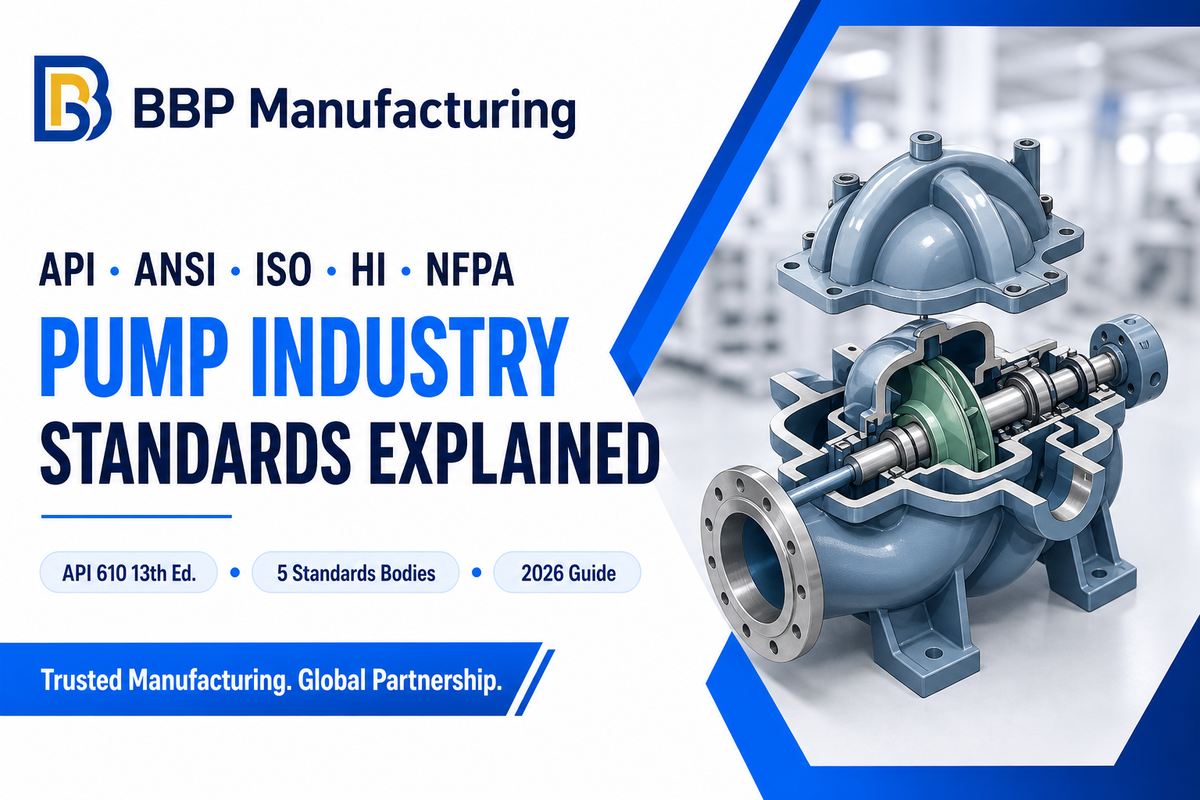
What Is an API Pump and Why Should I Care? There’s a set of standards, or an industry consensus-API 610, ANSI/ASME B73.1, ISO 2858/5199, Hydraulic Institute standards, and NFPA 20-that govern how centrifugal pumps should be designed, tested, and installed for process, water, and fire protection use. June 2026 marks a shift, as API just released the 13th Edition of Standard 610, replacing the 12th Edition that’s dictated the specifications of centrifugal pumps purchased since 2021. In this article, we’ll dive into what each standard applies to, what each really specifies, and where buyers get the selection process most wrong.
The 5-Standard Compliance Cross-Reference
There are five standards bodies for building centrifugal pumps. Here’s the quickest reference guide on how to select which one applies to you.
| Body | Core Standard | Focus Area | Typical Industry |
|---|---|---|---|
| API | API 610, 13th ed. (Jun 2026) | Heavy-duty centrifugal pumps | Petroleum, petrochemical, gas |
| ASME/ANSI | B73.1 / B73.2 (2026 ed.) | Dimensional interchangeability | Chemical process, general industrial |
| ISO | ISO 2858 / ISO 5199 | International dimensional + performance | Europe, Asia, multinational projects |
| Hydraulic Institute | ANSI/HI 14.6, 9.8, 9.6.x | Performance testing, intake design | North America, cross-industry |
| NFPA | NFPA 20 (2025 ed.) | Fire pump installation | Fire protection, high-rise, industrial |
Key takeaways
- A standard like API 610 has many editions – most recently the 13th Edition (June 2026) – and the previous version was the 12th Edition (2021). A vendor mentioning “API 610 compliant” should also reference the edition number.
- Plants adhering to API 610 specifications are not strictly banned from using an ANSI B73.1 pump. It’s simply up to the purchaser; many refineries still run ANSI B73.1 on noncritical utility service.
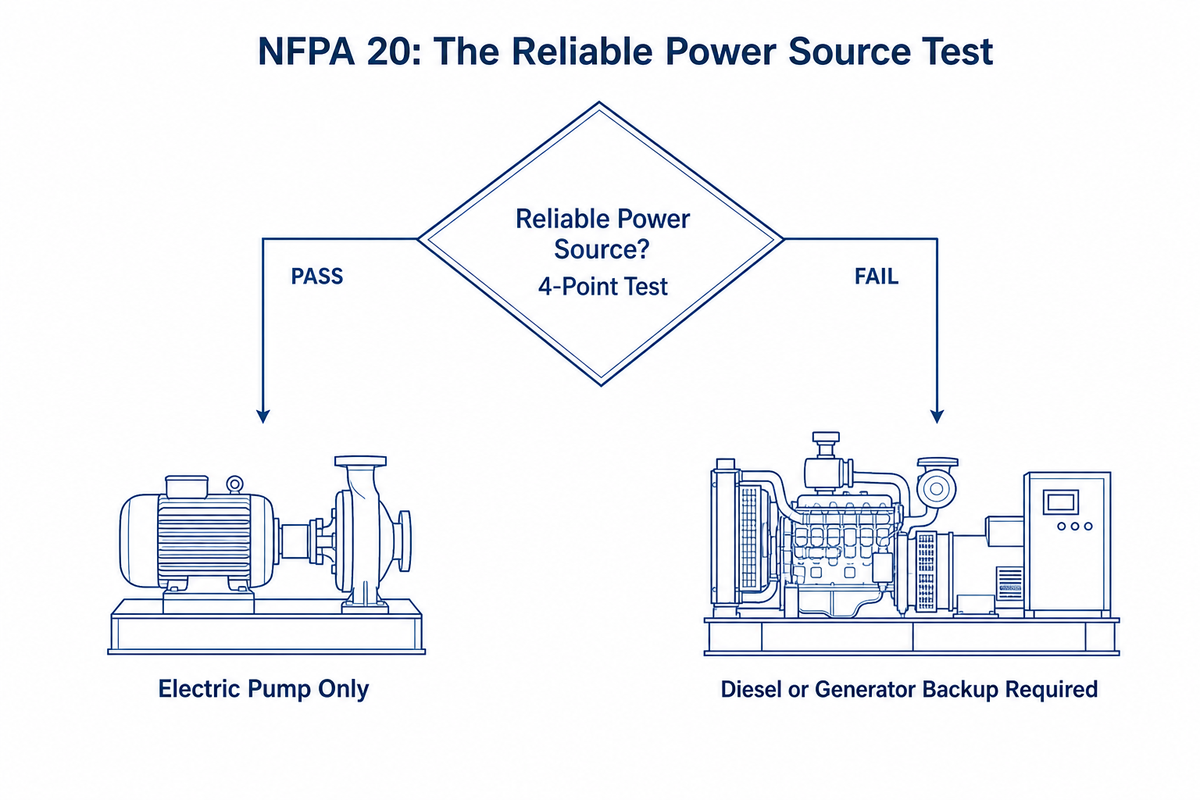
- NFPA 20 doesn’t mandate the use of diesel on every fire pump – it only applies if a 4-condition test of a “reliable power source” fails.
- A common guideline (developed at the Monsanto plant in Texas City, Texas and well-documented by reliability engineer Heinz Bloch) uses thresholds for factors such as a named system size and elevation that increase the pump design from an ANSI/ISO standard to API 610. That call shouldn’t ride on the purchaser’s “feel” or gut instinct.
Why Pump Standards Matter When You’re Comparing Manufacturers
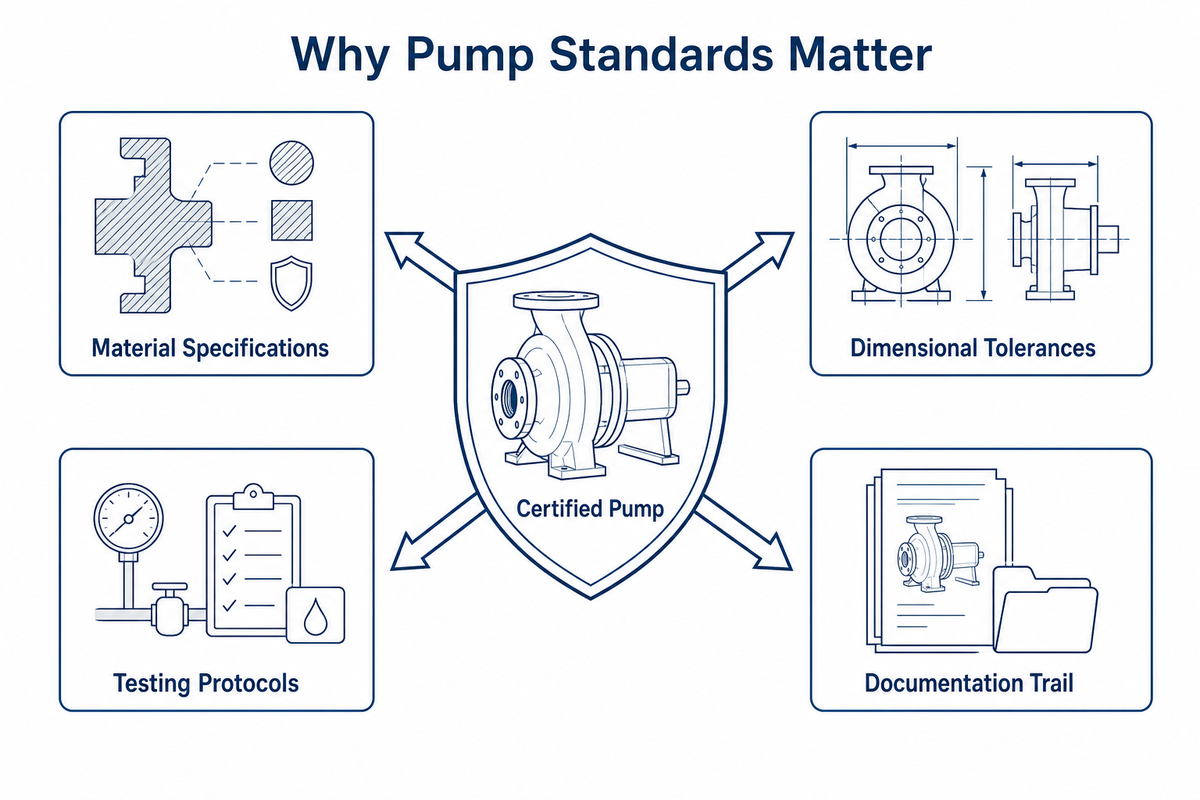
Selecting industrial pumps by standard offers guaranteed levels of quality regarding material specifications, design features, dimensions, testing protocols, and documentation. When a manufacturer declares that a pump meets “API 610 compliance,” that should clearly convey a minimum design service life of 20 years, uninterrupted operation of at least 3 years before an overhaul is scheduled, and bearing systems with a minimum bearing life of 25,000 hours under typical operating load. This is a standard check for buyers when evaluating various vendors – it helps sort vendors before they even discuss pricing.
These are voluntary standards based on the consensus of an industry organization. The API, ASME, ISO, and the Hydraulic Institute are not regulatory bodies, and the selection of any specific edition is a contractual or purchaser-specified requirement, not a legally mandated obligation. In the U.S., pumps designated for clean water applications must also adhere to federal regulations; 10 CFR Part 431 Subpart Y establishes energy conservation requirements (efficiency index, nameplate, and testing standards) for defined categories of pumps. The EU has similar regulations in place (Commission Regulation 547/2012) for minimum efficiency index for clean water rotodynamic pumps. These regulatory frameworks differ from the requirements of an API 610 standard.
BBP Manufacturing has earned ISO 9001, ISO 14001, and ISO 45001 certifications, and has been awarded the CE mark. BBP Manufacturing’s centrifugal, slurry, and split-case product lines are manufactured to conform to the specific requirements of the standards listed below, on an application-by-application basis.
API Standards for Centrifugal & Process Pumps
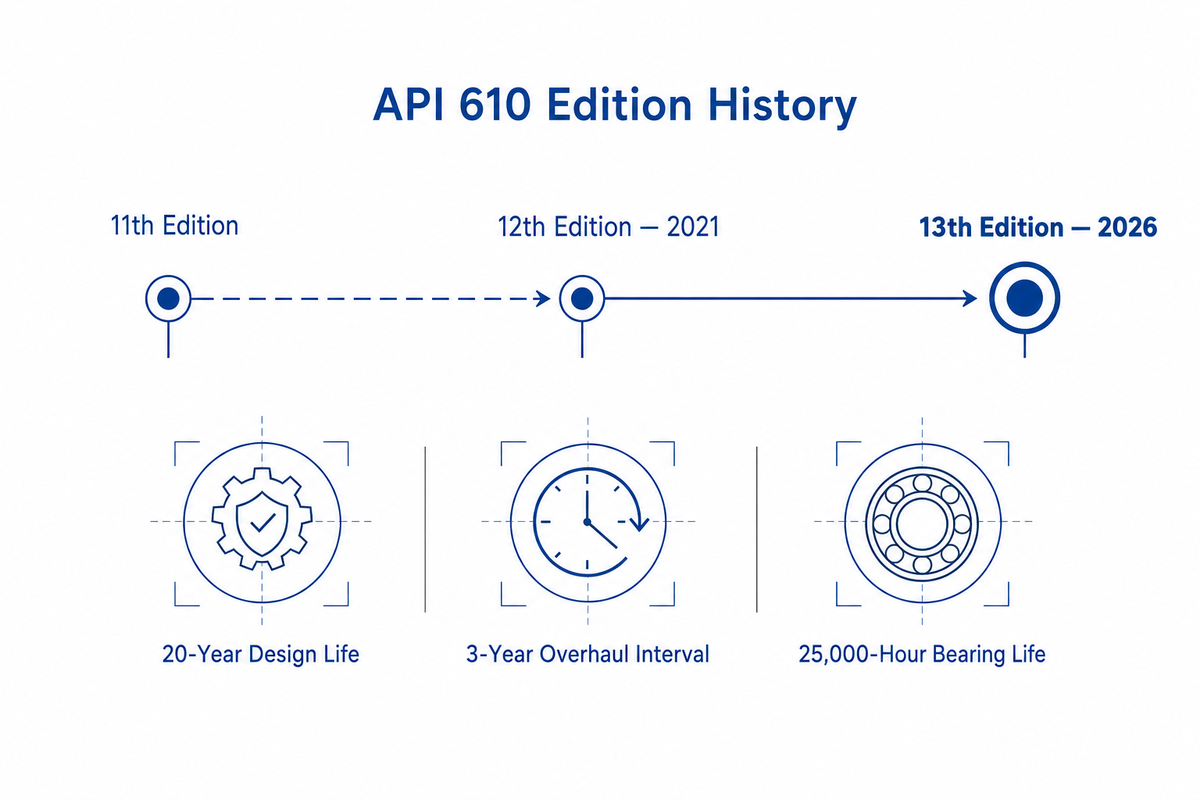
API 610 is the American Petroleum Institute standard for centrifugal pumps used in petroleum, petrochemical, and natural gas (oil and gas) services, and has just been updated to its 13th edition, released on June 1, 2026 – replacing the 12th edition that has been in use since January 2021. That’s a relatively brief interval, on the order of the 5 years API usually spends on its review (the time between the 11th and 12th editions was much longer at 11 years), and worth asking a vendor about directly if their proposal or data sheet only references the 12th edition.
API 610 defines a minimum 20-year design service life, with a minimum of 3 years of continuous, uninterrupted service prior to a planned maintenance cycle, and bearing systems that can withstand a minimum of 25,000 hours of continuous operation at rated loads (16,000 hours at max load), while the IOGP JIP33 specification (which stands for International Association of Oil & Gas Producers’ Joint Industry Project 33 and is supported by the World Economic Forum) states that equipment must have a “field proven” history with 24,000 hours of operation on at least three identical applications, equating to approximately three years of operation. A number of design features and system components carry their own construction features and validation requirements beyond these headline figures – inlet geometry, casing thickness, and auxiliary piping among them.
📐 Engineering Note
Closed impellers with wear rings and centerline mounting (to accommodate thermal expansion) are mandatory for API 610 designs operating at elevated temperatures. ANSI B73.1 pumps, meanwhile, use open or semi-open impellers with no wear rings and a foot-mount (acceptable in steady state and moderate service but will experience thermal stress and potential misalignment during thermal cycles). This difference in designs explains most of the reliability differences between the two standards.
API 610 Pump Type Classification, OH, BB, and VS Explained
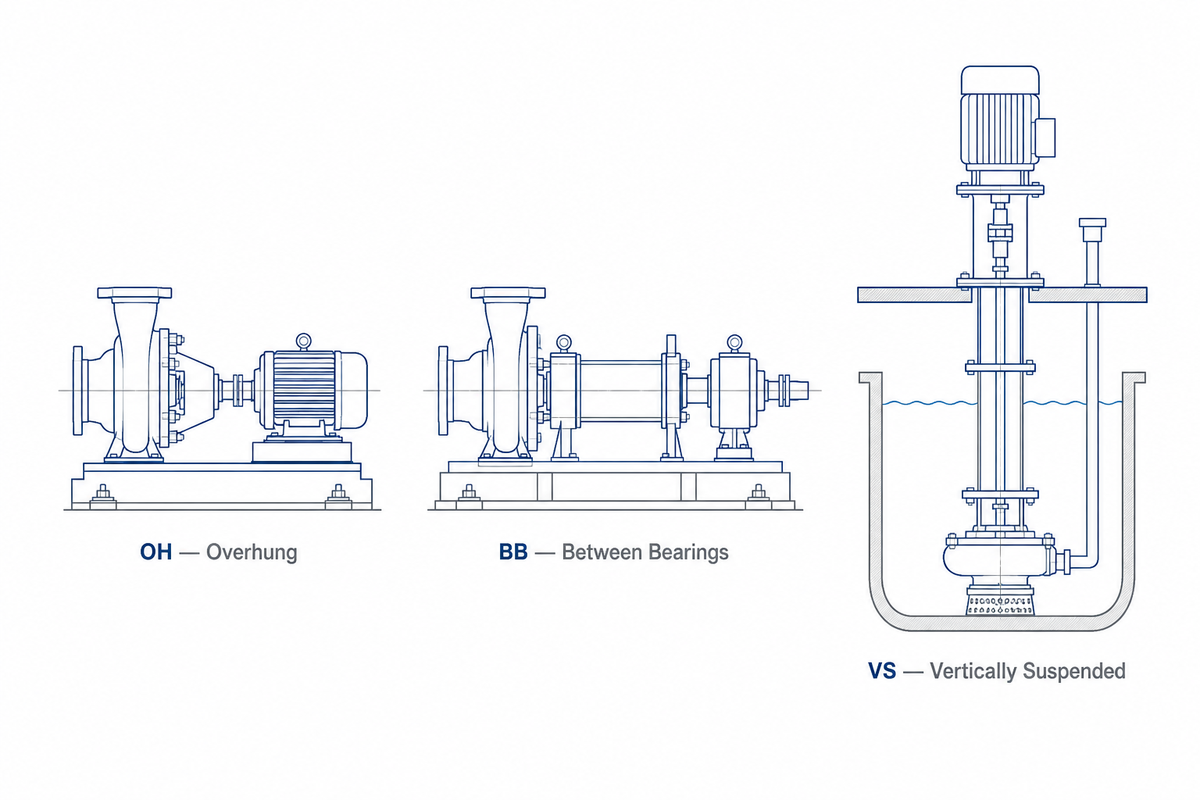
The standard organizes this variety of pump designs into one of three families: Overhung (OH), Between-Bearings (BB), and Vertically Suspended (VS), each having numbered subtypes. You know if a pump will work for your needs before opening the vendor datasheet when you’ve already identified the correct subtype because you already understand the pressure and flow limits, maintenance accessibility, and required space footprint of the unit.
The 8-Code API 610 Type Map
All possible centrifugal pump configurations recognized by API 610 are contained in just eight design types: OH1, OH2, OH3, OH6, BB1, BB2, BB3, BB5, and VS1 through VS7, encompassing everything from a foot-mounted, overhung, general-service unit to a high-pressure, double-casing sump pump.
| Type Code | Configuration | Typical Duty | Limitations / Not Suitable For |
|---|---|---|---|
| OH1 | Overhung, centerline-mounted foot support | General process service, moderate duty | Not for services exceeding OH1’s thermal-growth tolerance |
| OH2 | Overhung, single-stage, foot-mounted | Refinery general service (most common single-stage API type in field examples) | Suction-specific speed capped ≤11,000 gpm·rpm·ft under most supplementary specs |
| OH3 | Overhung, two-stage | Higher-head single-casing duty | Less common than OH2; check vendor stocking before specifying |
| OH6 | Vertical in-line, overhung | Space-constrained piping runs | Exempt from the 11,000 suction-specific-speed cap other OH types carry |
| BB1 / BB2 | Between-bearings, single/two-stage, axially split | Higher pressure/flow than OH types allow | Larger footprint and maintenance access than overhung types |
| BB3 | Between-bearings, multistage, axially split | High-head multistage process duty | Excluded from some supplementary specs above 150 HP single-volute limits |
| BB5 | Between-bearings, multistage, radially split | Very high pressure service (boiler feed and similar) | Frequently excluded from standard supplementary specs — confirm scope with vendor |
| VS1–VS7 | Vertically suspended (VS6/VS7 = double-casing diffuser/volute) | Sump, wet-pit, and below-grade suction duty | Not for services requiring horizontal maintenance pull; longer shaft spans raise vibration sensitivity |
Amarinth delivered OH2 horizontal centrifugal pumps (API 610, 12th edition, Plan 53B, ATEX Zone 2) for an expansion project on a North Sea oil field, while Trillium Flow Technologies is providing BB2 multistage trains for the International Thermonuclear Experimental Reactor (ITER) project (governed by API, IEC, and French nuclear-code requirements), illustrating that there is indeed a need for different classes of service for OH and BB types and that they’re not just different sizes.
Beyond API 610, The Specialty API Standards (674/675/676/685)
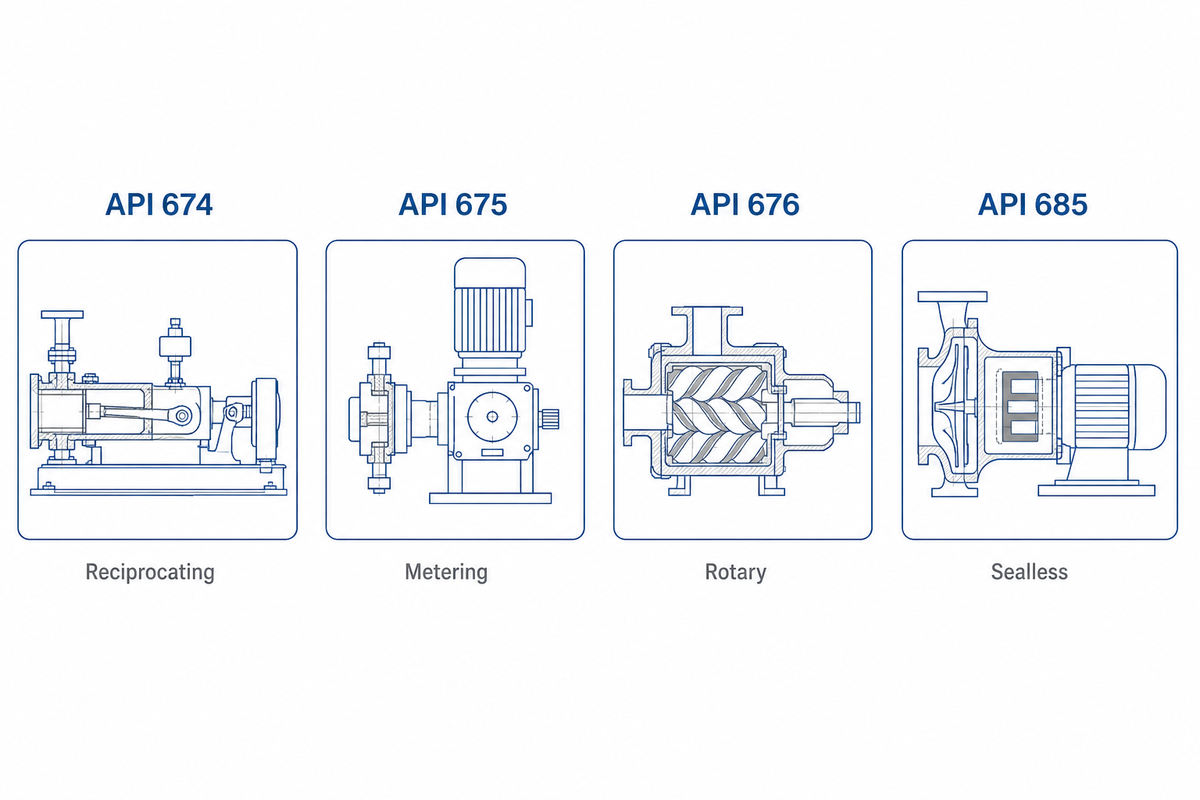
Note that API 610 applies only to centrifugal pumps-reciprocating, metering, rotary, and sealless pumps all have their own standards and the most common purchasing mistake is assuming they can all use API 610 standards.
| Standard | Pump Type | Scope |
|---|---|---|
| API 674 | Reciprocating (positive displacement) | Metering and process reciprocating pumps |
| API 675 | Metering (controlled-volume) | Precision chemical injection/dosing |
| API 676 | Rotary (screw, gear) | Viscous fluid transfer |
| API 685 | Sealless (magnetic-drive, canned-motor) | Zero-leakage hazardous/toxic fluid handling |
Tucked between all of that is API 682 – the mechanical seal standard – it’s explicitly called out as applicable to “pumps other than API 610 pumps (e.g. ASME B73.1)” so the seal questions inevitably arise regardless of the base pump standard you’re referencing. Seals are hardly a footnote: mechanical seals were involved in 60.4% of a documented set of 3,500 pump failures at 18 different end-users, with the failure roots about evenly divided among Operations (49%), Maintenance (28%) and Engineering (23%) – suggesting most seal-related failures trace back to how the compliant pump was operated and maintained, rather than a deficiency in the seal standard.
ANSI/ASME B73.1 and B73.2, The “ANSI Pump” Standard Explained
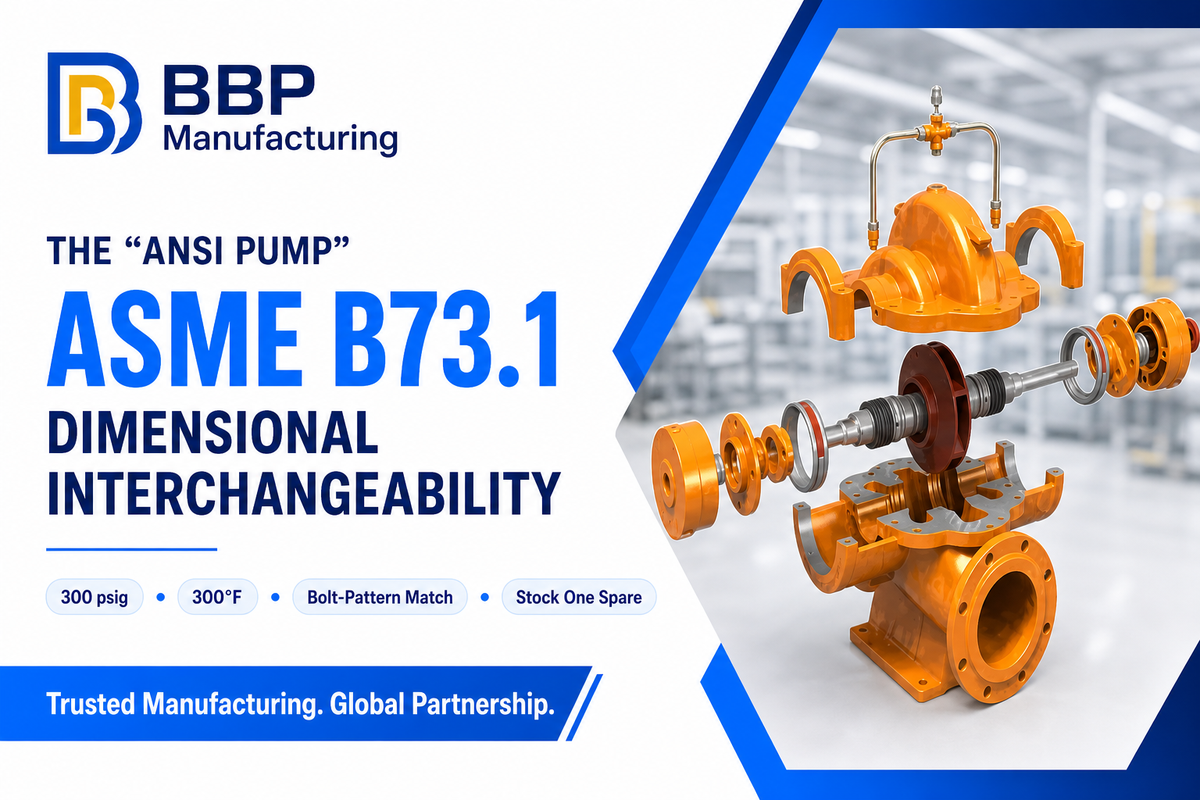
The shop floor equivalent of an “ANSI pump” (ANSI being short for the American National Standards Institute) is usually one built to ASME B73.1, the horizontal end-suction centrifugal pump standard based on dimensional interchangeability. (It incorporates the former ASME B73.5 sealless-pump standard as of its 2012 update, while ASME B73.2 handles the vertical in-line version, including motor pumps built to the same designation). The basic idea behind ASME B73.1 is that any qualifying manufacturer’s pump should bolt in on top of any other qualifying manufacturer’s pump with an identical general layout. That layout covers footprint, mounting bolt circles, nozzle locations, overall height and length, length of the bare pump, and shaft heights among the number of key dimensions and mounting details the standard fixes – allowing plants to stock one spare for a multitude of locations.
✔ ANSI B73.1 fits well when
- Pressure stays under roughly 300 psig at 300°F
- Service is general industrial, water, or light chemical
- Spares interchangeability across vendors matters
⚠ ANSI B73.1 falls short when
- Pressure/temperature exceeds roughly 600 psig / 600°F (API 610 territory)
- Speed exceeds 3,600 rpm or driver exceeds 100 hp
- Fluid is flammable, toxic, or highly corrosive at elevated temperature
Myth: “ANSI Pumps Are Illegal in API-610 Plants”
This isn’t exactly true. Whether a plant will accept an ANSI B73.1 pump in place of API 610 is purely a purchasing decision, not something dictated by the code. As one process engineer told the online community forum Eng-Tips when asked whether an ANSI B73.1 pump would be appropriate in lieu of API 610 for a crude-oil-transfer pump:
“If it is your refinery, you can decide whether or not you accept ANSI B73.1 standard instead of API 610. If you are a supplier, ask your customer.”
As a matter of fact, most refineries would use ANSI B73.1 pumps for any number of non-critical utility applications – water service, wastewater treatment, chemical injection – even on an API 610-standardized facility, while saving API 610 for the specific, critical process/hydrocarbon services for which it was intended. Reliability engineer Heinz P. Bloch – an Exxon Chemical regional machinery specialist and ASME Life Fellow who authored some 770 papers, articles, and books – documented a specific escalation rule for moving up from ANSI/ISO-class pumps to API 610, developed at Monsanto’s Texas City plant in the 1970s:
Bloch’s Escalation Rule: Move to API 610 When Any One of These Holds
A documented best-practice decision rule for escalating up from ANSI/ISO-Class pumps to API 610 class pumps – not an official API 610 standard element – from Heinz P. Bloch.
- kW × rpm exceeds 675,000
- Head exceeds 350 ft
- “Temperature exceeds 300F on 6” nominal pipeline or 350F on 8” nominal pipeline.”
- Driver exceeds 100 hp (≥75 kW)
- Suction pressure exceeds 75 psig
- Duty point falls outside the pump’s best-efficiency window
- Speed exceeds 3,600 rpm
“Exceptions to any of the above are made if the fluid is nonflammable, non-explosive, non-toxic and the supplier can provide a record of having previously provided and maintained such a pump operating under similar or more demanding conditions.”
The same argument applies in reverse: independent benchmarks of failure rates back the gap in reliability the rule is designed to protect against. A commonly cited industry benchmark, compiled by reliability engineer Allan Budris for WaterWorld, puts ANSI B73.1 process pump mean time between failures at roughly 2.5 years average industry-wide, with 3.75 years considered a good target, 4.5 years rated excellent, and 1.5-2.0 years considered poor. Over-specifying API 610 on a duty that ANSI B73.1 would suffice, and doing so by much, just pays for an extra bit of buffer no one actually needed, while under-specifying ANSI B73.1 on a duty that would cross the Bloch line would just mean accepting a documented jump in failure rates to keep costs down.
Hydraulic Institute (HI) Standards, the US Testing & Design Framework
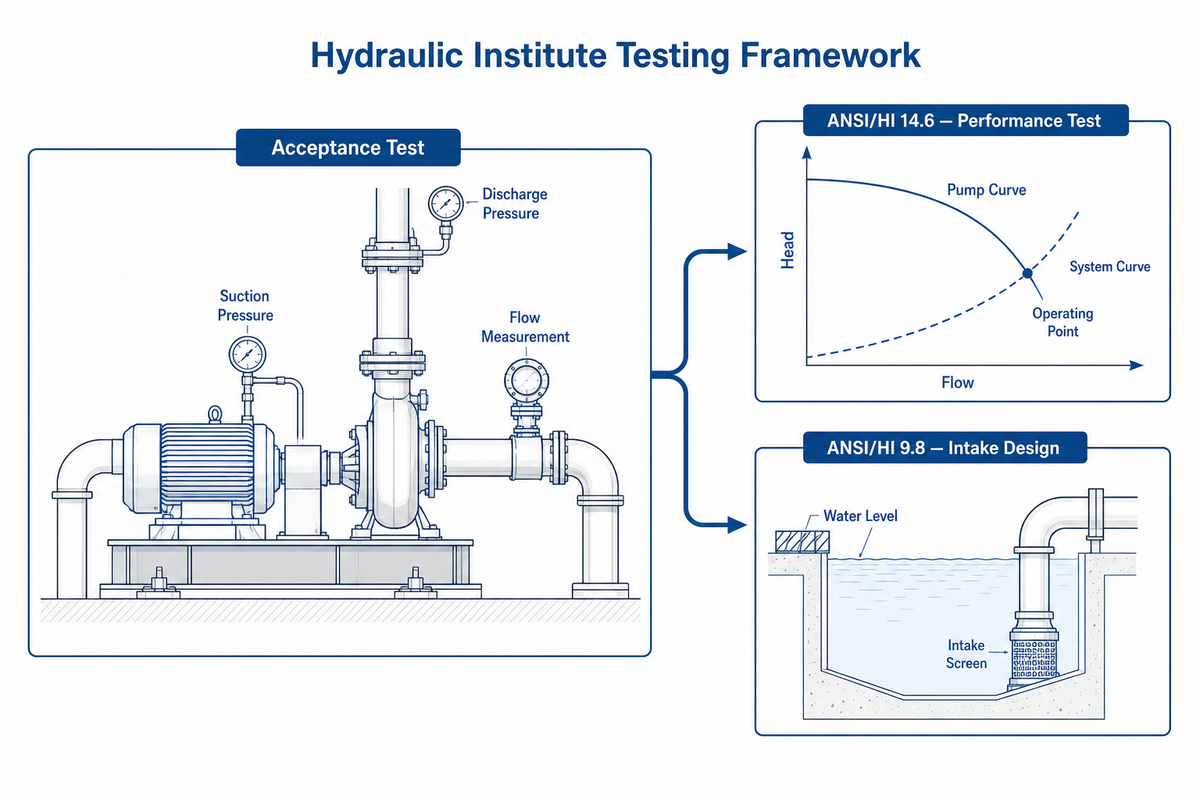
The Hydraulic Institute is North America’s authority on how pumps are tested and certified for pump users – regardless of the pump standard(s) that its design may have complied with. Its own site, pumps.org, hosts the HI Data Tool referenced below. ANSI/HI 14.6 specifies test methodology for rotodynamic pump performance characteristics, and ANSI/HI 9.8 provides guidelines on intake and sump design, often a key area of failure in systems when even a compliant pump is put on an ill-conceived foundation. Variable frequency drives factor into several HI guidelines too, since they change the hydraulic power and vibration profile a pump sees across its speed range.
| Standard | Governs |
|---|---|
| ANSI/HI 14.6 | Rotodynamic pump hydraulic performance acceptance tests |
| ANSI/HI 9.8 | Pump intake design (sump geometry, approach velocity) |
| ANSI/HI 9.6.x series | Rotodynamic pump guidelines (NPSH margin, vibration, allowable operating range) |
| HI 30.1 | General-purpose OH1 rotodynamic pump specification |
| HI 40.9 | Pump Industry Fundamentals body of knowledge |
These two testing frameworks are hardly in entirely separate worlds; API 610 actually specifies that the required NPSH test must be performed “in accordance with HI 14.6 or ISO 9906” – meaning, by and large, treating the Hydraulic Institute’s or ISO’s tests as equally valid and reliable acceptance tests.
If the numbers from the Hydraulic Institute alone aren’t enough of a reason to take test procedures seriously (pump systems are estimated to account for nearly 20% of world energy consumption, or over half in pumping-intensive plants), know that maintenance is the second-highest factor in lifecycle cost, at nearly 25% (after energy).
ISO 2858 and ISO 5199, the International Standard
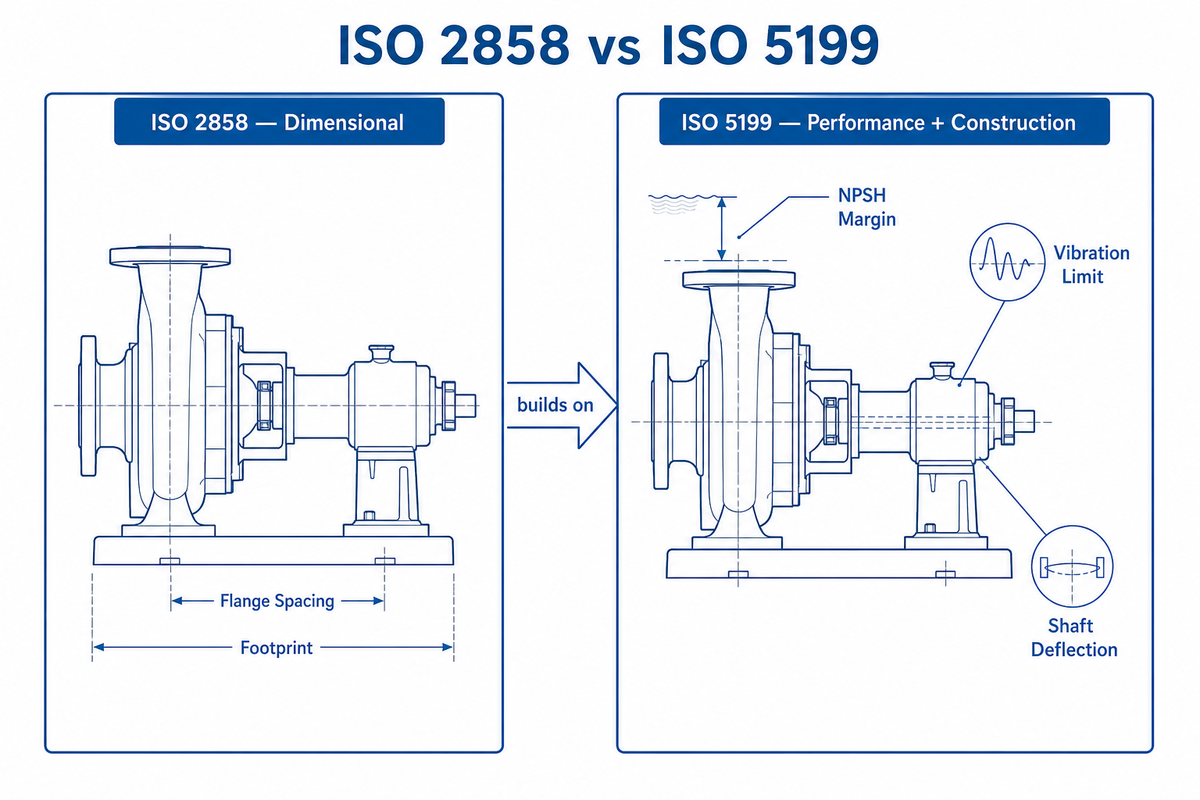
ISO 2858 is the international counterpart to ANSI B73.1 – a dimensional standard for an end-suction centrifugal ISO pump with flanges up to 200 mm and pressures to 16 bar. ISO 5199 goes further, building on that dimensional base with this variety of performance requirements and construction criteria closer in spirit to API 610 – so international buyers sometimes spec it as a non-API, ISO-region alternative. Seal configurations, net positive suction head margin, and maximum permissible vibration levels are among the specifics ISO 5199 adds on top of ISO 2858’s dimensions.
A side-by-side comparison shows they aren’t simply alternate-language versions of each other:
| Parameter | ASME B73.1 | ISO 5199 |
|---|---|---|
| NPSH margin (minimum) | > 0.9 m (stricter) | 0.5 m |
| Critical speed margin (minimum) | 20% (stricter) | 10% |
| Shaft deflection (maximum) | 0.13 mm | 0.05 mm (stricter) |
| Vibration limit | 4.8 mm/s (<200kW) | 3.0 mm/s (≤225mm centerline, stricter) |
Several ISO 5199 tolerances are tighter than their ASME B73.1 counterparts, and others are looser – the table above is the specific breakdown. On the vibration row specifically, ISO 5199 is more stringent than B73.1 at smaller centerline heights, which is exactly the kind of detail this guidebook exists to surface instead of a generic “check the standard” wave-off.
ISO 2858’s base text has been maintained without substantial revision since its initial 1975 issue, periodically re-affirmed (most recently 2017) and under a systematic review with no new edition as of mid-2026 – a considerably more static situation than the two revision-intensive standards below. A 2010 European regional harmonization (EN ISO 2858:2010, CEN/BSI’s reprint) should not be mistaken for an actual new ISO international edition – they are not the same document.
NFPA 20, The Fire Pump Standard Almost No Guide Covers
But you know what’s not there in any of the general pump standards guides we encountered while researching this post (including Google’s own AI overview)?
NFPA 20 – the Standard for the Installation of Stationary Pumps for Fire Protection, the absolute #1 highest searched volume standard in this whole grouping, which dictates jockey pump sizing, controller listing and driver redundancy for fire pump systems to guard buildings and industrial plants.
The most recent edition of NFPA 20 is the 2025 edition, issued in October 2024. As has been the pattern for a while, NFPA 20 has a three-year review cycle, having also had a 2016, 2019, and 2022 edition. In this new edition, the term “jockey pump” was normalized across the document, configurations of the fire pump controller and automatic transfer switch have been simplified and detailed, testing on electrically-driven pumps has become more extensive (specifically automated testing) and (finally) diesel-driven pumps now have their own automatic/remote automatic testing requirements.
Myth: “Every Fire Pump Needs a Diesel Engine”
It doesn’t. NFPA 20 only mandates a “reliable power source” and electric only works great, as long as the utility source passes the specific test of reliable – the diesel backup is activated if not, the generator backup if that’s activated and that source also fails the test. This reliability test involves 4 points, any of which failing automatically forces backup power:
- ✔No power outages exceeding roughly 4-10 continuous hours in the prior year
- ✔No grid-failure outages unrelated to a natural disaster
- ✔Normal power isn’t routed via overhead conductors outside the protected facility
- ✔Only NFPA-permitted disconnects/overcurrent devices sit in the normal power path
Here’s an item many don’t bother to ask about: There’s no guarantee the AHJ and your property insurer use the same yardstick for this limit. For instance, the NFPA has one test based on a four to 10-hour single event, but a large commercial property insurer, FM Global, declares the grid unreliable if power’s out for longer than eight hours three times or more in a year. The building might clear inspection but fail the insurer’s higher bar (or clear the insurer and not the AHJ).
📐 Engineering Note
NFPA 20 Style – The traditional horizontal split-case (HSC) fire pump. Its dual suction port design, centrally accessible to mechanical work, perfectly suits the high flows and constant demands of fire protection systems. Learn the mechanics of these pump designs in our horizontal split case pump guide.
Final compliance-planning note to carry around with you: the ‘current edition’ and the ‘edition that your jurisdiction actually enforces’ aren’t necessarily synonymous. U.S. federal regulation 10 CFR Part 431 Subpart Y still uses NFPA 20-2016 to define a fire pump for its specific purposes in the regulation – so it bears noting that date-published versus date-adopted can be different, and it’s best to ascertain the exact edition that’s required or adopted by your AHJ, insurer or contract before stating it will always be the “2025 edition”.
If your organization is undertaking a new fire pump installation, our NFPA 20 compliance checklist for split-case fire pumps can assist you in navigating through the listed submittal requirements outlined in this section.
How to Read a Pump’s Compliance Documentation
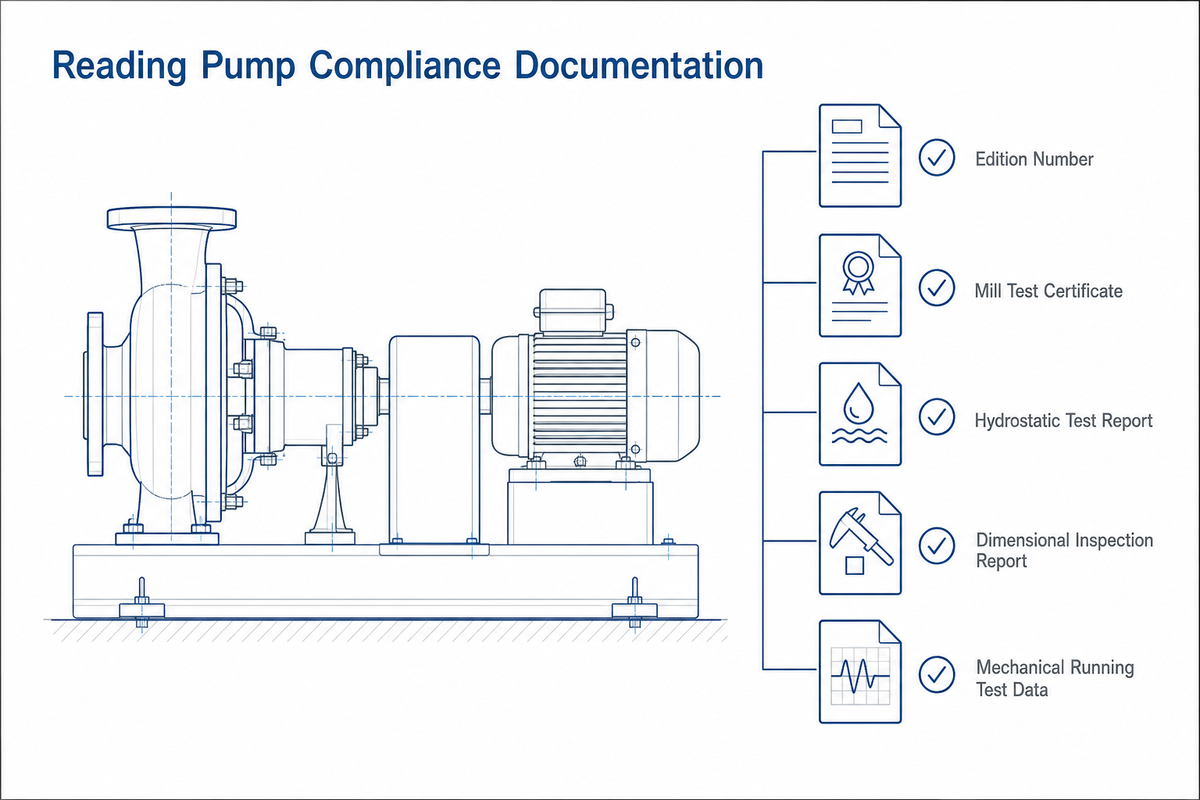
The standard number on a spec sheet is only as good as the paperwork behind it – and the paperwork is where “API 610-ish” claims get caught. One practitioner’s blunt warning on this point, from an Eng-Tips discussion of centrifugal pump codes:
“There are manufacturers out there that make ‘API 610-ish’ pumps that are fit for service but are built to manufacturer’s standard construction, and frequently were compliant once upon a time to an older version of API 610 – and the manufacturer just didn’t see a need to update.”
With the 13th edition now live, that verification question just got sharper – a “compliant” claim without an edition number could mean the 13th, the 12th, or something older still being sold under the same label.
- Edition number: confirm which edition (e.g., API 610 13th, not just “API 610”) the design was actually qualified against.
- Mill Test Certificate: verify material grade and heat number trace to the actual casting, not a generic material spec sheet.
- Hydrostatic test report: confirm test pressure as a percentage of maximum allowable working pressure, not just a pass/fail stamp.
- Dimensional inspection report: cross-check against the interchangeability tolerances the standard actually specifies.
- Mechanical running test data: vibration and bearing-temperature readings, not just a summary “passed” line.
Even fully compliant documentation doesn’t guarantee reliability by itself.
Reliability data on U.S. oil refineries shows that roughly 7% of the installed pump population fails three to four times more often than that refinery’s average pump – and the root cause is generally drive-end cost-cutting within a nominally compliant spec (incorrectly designed oil rings, inferior bearing housing protector seals, unspecified lubricators), not standard non-compliance itself. Compliance documentation tells you the pump was built to spec; it doesn’t tell you whether the spec’s cheapest legal options were quietly selected throughout.
Frequently Asked Questions
Q: What is the ASME Code for pumps?
ASME B73.1 is the code most engineers mean by “the ASME pump code” — it specifies dimensional interchangeability for horizontal end-suction centrifugal pumps.
ASME B73.1 defines mounting dimensions, nozzle placement, shaft height, and baseplate configuration so pumps from different manufacturers can be installed in the same footprint without piping changes. ASME B73.2 covers the vertical in-line equivalent, and the former B73.5 sealless-pump standard was folded into B73.1 as of the 2012 edition. None of these are government codes – they’re voluntary consensus standards a purchaser chooses to specify.
Q: What is the ISO standard for pumps?
Two ISO standards cover pumps: ISO 2858 (dimensional, the international counterpart to ANSI B73.1) and ISO 5199 (performance and construction requirements, closer to API 610 in spirit).
ISO 2858 covers end-suction centrifugal pumps rated to 16 bar across flange sizes from 50mm to 200mm, and has been in its current text since 1975 with periodic five-year reconfirmations rather than substantive rewrites. ISO 5199 layers on tighter performance, vibration, and construction requirements.
A separate document, EN ISO 2858:2010, is a European regional harmonized re-issue – not a new ISO international edition, a distinction worth knowing before assuming the base standard was rewritten in 2010.
Q: What is the ANSI standard for pumps?
“ANSI pump” almost always refers to ASME B73.1 — the dimensional-interchangeability standard for horizontal end-suction centrifugal pumps used across general industrial and chemical process service.
ASME administers B73.1 under ANSI accreditation, which is why folks call the pumps “ANSI Pumps” even though ASME writes the actual document. Common service limits go up to about 300 psig and 300F, typical mean time between failure industry-wide is around 2.5 years, 3.75 years for “good” or 4.5 years for “excellent” pumps. When you get higher pressure, temp and speed, most users go with the API 610.
Q: What is the difference between ASME B73.1 and ISO 5199?
They cover similar ground but aren’t interchangeable — ISO 5199 has a looser NPSH margin and critical-speed requirement than B73.1, but a tighter shaft-deflection and vibration limit.
More specifically: The B73.1 standards mandate a minimum NPSH margin of 0.9m and a minimum 20% critical-speed margin-stricter than the ISO 5199 standard’s 0.5m and 10% respectively-but the ISO 5199 standard specifies tighter allowable shaft deflection (0.05mm vs B73.1’s 0.13mm) and vibration (3.0mm/s vs 4.8mm/s). There are differences in bearing-isolation hardware as well. ISO 5199 allows a circlip thrust bearing locking and lip-seal bearing isolators in configurations that the ASME B73.1 standard simply doesn’t address, which can cause significant headaches when maintenance teams look to replace bearings and make the false assumption that parts lists are interchangeable between the two standards.
Simply assuming ASME B73.1 and ISO 5199 represent an imperial and metric version of each other-that it’s the same pump measured in different units-can lead to a costly mistake, particularly for a buyer sourcing equipment from both US and European suppliers.
Q: What is API 610 standard?
API 610 is the American Petroleum Institute’s standard for centrifugal pumps in petroleum, petrochemical, and natural gas service, now in its 13th edition as of June 2026.
Minimum of a 20-year design service life is required. A minimum of 3 years continuous operation is required between overhauls. All bearings must be sized for 25,000 hours of service at rated load.
API 610 assigns pumps into type families of OH (overhung), BB (between-bearings), and VS (vertically suspended). Within these families, numbered subtypes provide detailed shaft and bearing arrangement specifications.
Q: What is the HI 14.6 standard?
ANSI/HI 14.6 is the Hydraulic Institute’s rotodynamic pump hydraulic performance acceptance test standard.
It lays down how flow, head and efficiency should be calculated and checked against a manufacturers guarantee curve. For API 610 supplementary requirements, API 610 states that the test may use HI 14.6 or ISO 9906 as alternatives and will be acceptable against either method regardless of what standard the base pump is based on.
Why We Write This
Centrifugal, slurry and split case pumps designed by BBP Manufacturing to meet ISO 9001, ISO 14001, and ISO 45001 certification and marked with a CE, Our engineering staff handles standard selection inquires weekly from clients serving the water treatment, mining, and industrial process industry. This walkthrough covers the standards documentation we use with our clients – not an executive overview. Verified by BBP Manufacturing Co., Ltd.
Technical Team.
References & Sources
- API Std 610, 13th Edition – Accuris/Techstreet (authorized API standards distributor)
- API Standards Program – American Petroleum Institute
- JIP33 Supplementary Specification to API 610 – International Association of Oil & Gas Producers (IOGP)
- ASME B73.1 – American Society of Mechanical Engineers
- ISO 2858:1975 – International Organization for Standardization
- HI Data Tool, Standards References – Hydraulic Institute
- NFPA 20 Standard Development – National Fire Protection Association
- NFPA 20, 2025 Edition – Accuris/Techstreet
- 10 CFR Part 431 Subpart Y – U.S. Electronic Code of Federal Regulations
- Selecting the Right Pump for Oil & Gas Applications – Pumps & Systems (Heinz P. Bloch)
Related Articles
- Horizontal split case pump guide – the classic NFPA 20 fire pump architecture
- Is a slurry pump just a centrifugal pump? – 7 engineering differences
- Slurry pump selection: the 7-step duty-point method
- Slurry pump total cost of ownership: the 13% rule
- High chrome slurry pump: metallurgy & wear guide
- NFPA 20 compliance checklist for split case fire pumps – itemized AHJ submittal tool
- ISO 2858 replacement finder – find a BBP drop-in equivalent