Get in Touch with BBP

Tons of Refrigeration to kW Converter: Formula, Chart, and Examples

Updated August 2026
Tons of refrigeration to kW refers to converting a heat-removal rate from refrigeration tons into kilowatts.
One ton of refrigeration equals 3.516853 kW of cooling capacity. To convert tons of refrigeration to kW, multiply the TR value by 3.516853. To convert kW back to refrigeration tons, divide by 3.516853.
For example, 10 TR equals 35.16853 kW, while 100 TR equals 351.6853 kW. These numbers describe a heat-removal rate. They are not automatically the electrical power drawn by a chiller, compressor, pump, or complete cooling system.
1 TR3.516853 kW cooling capacity
1 TR12,000 Btu-IT/h
100 TR351.6853 kW cooling capacity
Ton of refrigeration to kilowatt converter
Convert between ton of refrigeration and kilowatt. The unit changes; the measured quantity does not.
Result
kW
1 RT = 3.5169 kW
Enter 0 or more — a negative value is not a valid reading for this quantity.
This entry is ambiguous. Use a comma only as the decimal mark, for example 1,5, and do not type thousands separators.
Refrigeration Ton to kW Formula
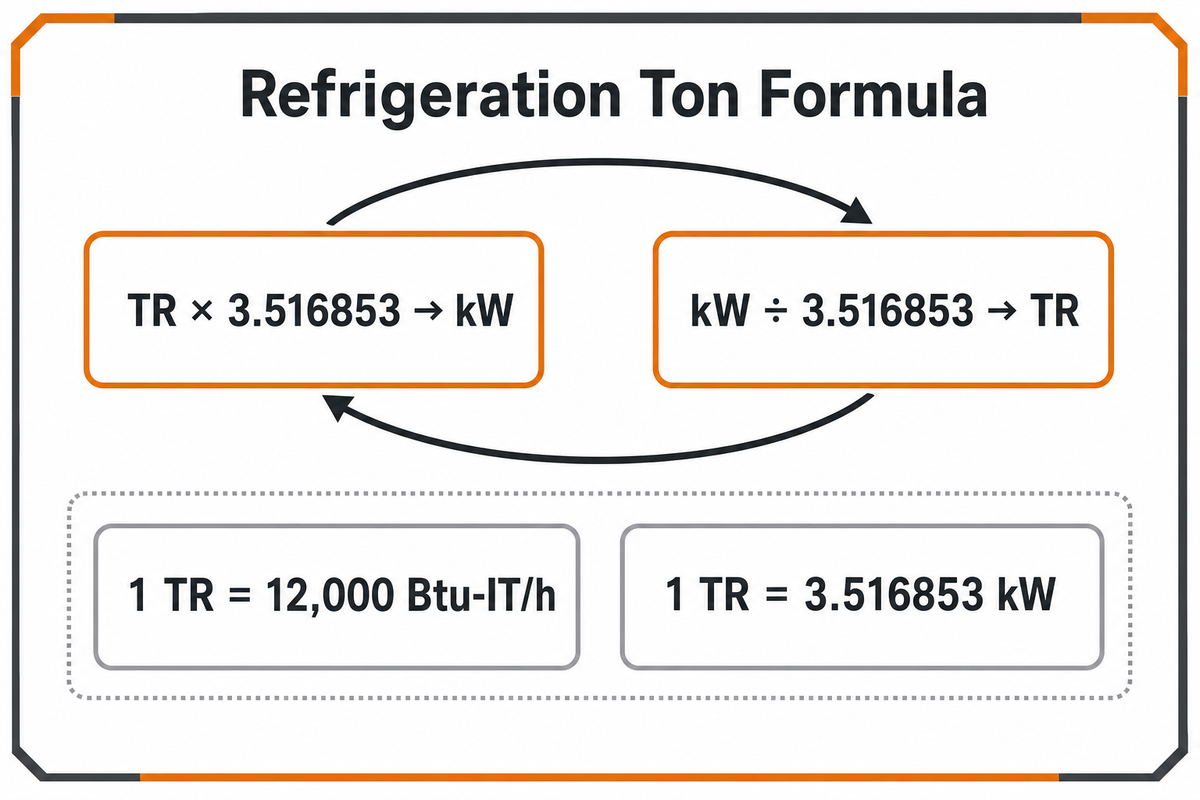
Building on the heat-removal rate above, the forward formula is:
Cooling capacity in kW = refrigeration tons × 3.516853
The reverse formula is:
Refrigeration tons = cooling capacity in kW ÷ 3.516853
The factor comes from an official heat-flow conversion. The National Institute of Standards and Technology Appendix B.8 lists a ton of refrigeration, defined as 12,000 Btu-IT per hour, as 3.516853 × 10³ watts. Dividing by 1,000 expresses the same rate as 3.516853 kilowatts.
NIST Appendix B.9 places the same entry under “Heat Flow Rate.” That classification matters: the kW result is a cooling-capacity rate, not a claim about electrical consumption. The International Bureau of Weights and Measures SI Brochure supplies the SI framework in which the watt is a unit of power.
Engineering note based on NIST Appendices B.8 and B.9: one refrigeration ton is listed as 12,000 Btu-IT/h and converts to 3.516853 × 10³ W.
Keep the full NIST-listed factor inside the calculation. You can round to 3.517 to get a convenient mental check, but calculate with 3.516853 before rounding the displayed result according to the source value and the decision. Catalog labels such as 100 TR usually are not measurements accurate to six decimal places, even though the published conversion factor carries more precision. Using the wrong quantity or implying unsupported precision creates a traceability risk in a procurement schedule.
Common Tonnage Worked Examples
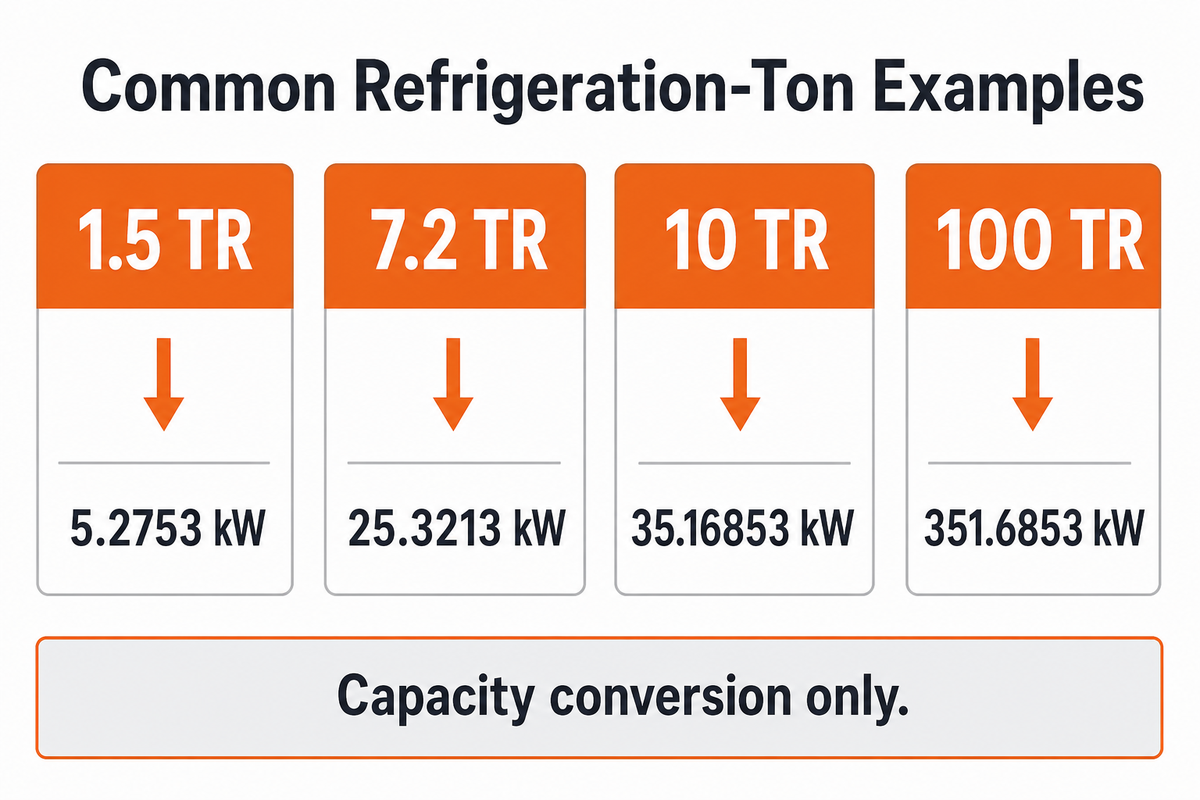
Every example below uses the same linear relationship from NIST Appendix B.8. Doubling the refrigeration ton value doubles the converted cooling capacity. The arithmetic does not adjust for ambient conditions, load fraction, fouling, control settings, or the rating procedure used by the equipment manufacturer.
How much is 1.5 tons of refrigeration in kW?
1.5 × 3.516853 = 5.2752795 kW. For practical display, use 5.2753 kW of cooling capacity. If 1.5 TR is only a nominal class, retain “nominal” in the record rather than presenting the result as measured operating output. Keep the unrounded result for reverse checking.
How much is 7.2 TR in kW?
7.2 × 3.516853 = 25.3213416 kW. Displayed to four decimal places, the result is 25.3213 kW. Reverse-checking 25.3213416 ÷ 3.516853 returns 7.2 TR. The check confirms both the direction and the decimal scale before the value enters a schedule.
How much is 10 TR in kW?
10 × 3.516853 = 35.16853 kW. This is a useful mental checkpoint: ten refrigeration tons should land a little above 35 kW of cooling capacity. Results near 3.5 kW or 351 kW indicate a misplaced decimal or the wrong starting value.
How much is 100 TR in kW?
100 × 3.516853 = 351.6853 kW. The result converts the capacity unit only. To estimate chiller input, the applications engineer still needs a relevant efficiency metric and rating condition from the equipment data. Keep those fields separate in the comparison.
Because the NIST-listed factor is linear, these cases also provide an evidence-backed scale check. A result that breaks the proportional pattern is a calculation problem, while excessive displayed precision can misrepresent a nominal equipment value in a supplier comparison.
- Identify the source field — confirm that the value is refrigeration tons, not mass tons or material throughput.
- Apply the factor — multiply TR by 3.516853.
- Label the result — write “kW cooling capacity” or “kW heat-flow rate.”
- Retain the rating condition — keep nominal, full-load, test-condition, or measured context with the number.
- Reverse-check — divide the unrounded kW result by 3.516853.
Refrigeration Ton to kW Conversion Chart
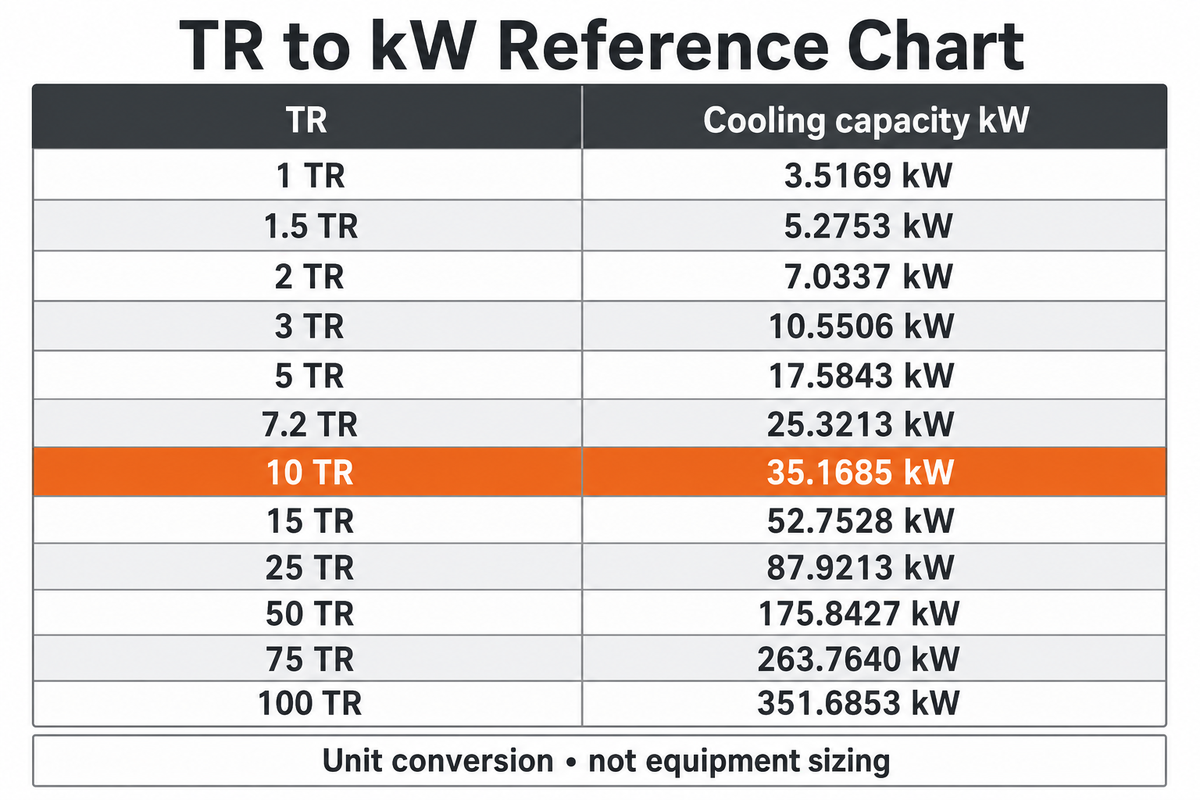
For values beyond the worked examples, the chart applies the factor in NIST Appendix B.8 and displays kW to four decimal places. It is suitable for document normalization and a quick arithmetic check. It is not a chiller selection table or an electrical-load schedule.
| Refrigeration tons (TR) | Cooling capacity (kW) | Calculation |
|---|---|---|
| 1 | 3.5169 | 1 × 3.516853 |
| 1.5 | 5.2753 | 1.5 × 3.516853 |
| 2 | 7.0337 | 2 × 3.516853 |
| 3 | 10.5506 | 3 × 3.516853 |
| 5 | 17.5843 | 5 × 3.516853 |
| 7.2 | 25.3213 | 7.2 × 3.516853 |
| 10 | 35.1685 | 10 × 3.516853 |
| 15 | 52.7528 | 15 × 3.516853 |
| 25 | 87.9213 | 25 × 3.516853 |
| 50 | 175.8427 | 50 × 3.516853 |
| 75 | 263.7640 | 75 × 3.516853 |
| 100 | 351.6853 | 100 × 3.516853 |
If a schedule uses a value not shown here, enter it in the calculator rather than interpolating between rows. Retain the original value beside the converted value. This prevents a rounding mistake or an incorrect interpolation from hiding in a vendor comparison, and it preserves the precision needed for later review if the supplier updates the nominal capacity or rating condition.
kW to Refrigeration Tons Reverse Conversion
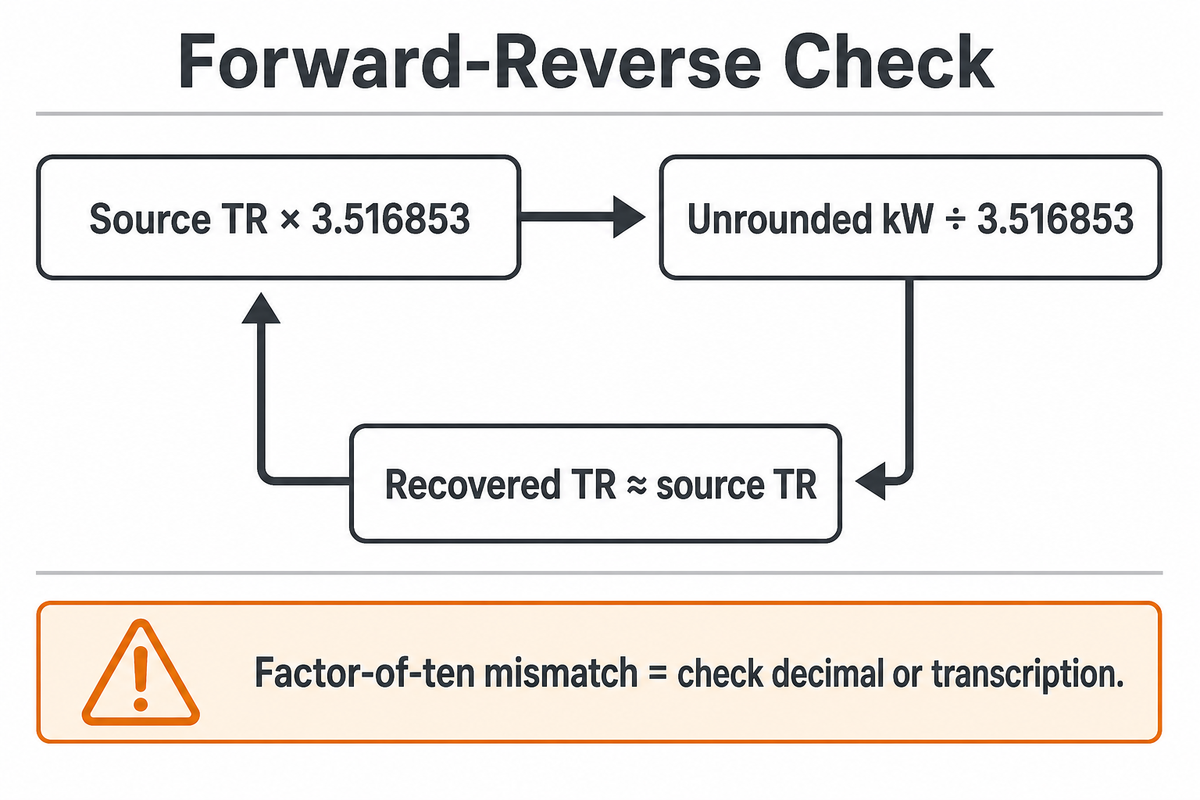
To reverse the chart for a cooling-capacity value already expressed in kilowatts, divide by the NIST-listed 3.516853 factor:
TR = kW ÷ 3.516853
For example, 35.16853 ÷ 3.516853 = 10 TR. A 100 kW cooling-capacity entry converts to approximately 28.4345 TR. Use the unrounded kW value when the reverse result will be compared with a specification limit.
The Forward-Reverse Check catches directional and scale errors. Start with the source TR value, multiply by 3.516853, and divide the unrounded result by the same factor. The final number should reproduce the source within the rounding tolerance. A factor-of-ten mismatch usually indicates a decimal or transcription error, not a small difference in convention.
Do not multiply a kW value by 3.516853 to obtain TR. That operation moves the number in the wrong direction. Writing the units beside the expression makes the error visible: kW ÷ (kW/TR) = TR.
What a Ton of Refrigeration Actually Measures
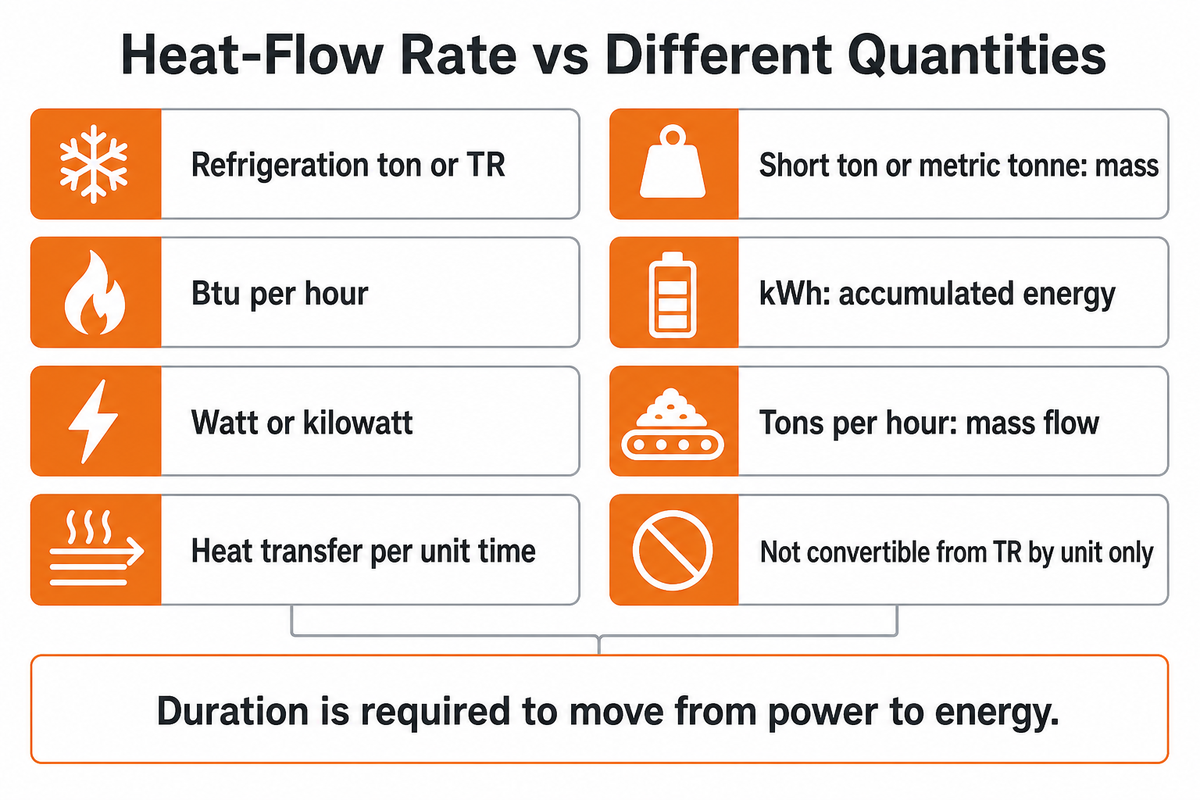
A refrigeration ton is a rate of heat removal, not a mass measurement. The reverse-direction check preserves this underlying quantity. NIST Appendix B.9 lists one refrigeration ton as 12,000 Btu-IT per hour and classifies the entry under heat flow rate.
This is why “ton,” “tonne,” and “ton of refrigeration” cannot be swapped. Short tons and metric tonnes are mass units. A refrigeration ton is a power rate. “Tons per hour” in a material-handling document is mass flow. The word may look familiar, but the quantity and dimensions are different.
Cooling-rate units
- Refrigeration ton or TR
- Btu per hour
- Watt or kilowatt
- Describe heat transfer per unit time
Different quantities
- Short ton or metric tonne: mass
- kWh: accumulated energy
- Tons per hour: mass flow
- Cannot be obtained from TR by a unit-only conversion
TR and kW can be converted directly because both can express power or heat-flow rate. kWh cannot be substituted for kW. If a system delivers 35.16853 kW of cooling capacity for one hour, that operating period corresponds to 35.16853 kWh of thermal energy removed, but the duration is an additional input.
Historical language does not change the modern conversion factor
Historical explanations sometimes connect the name to ice-based cooling, but that origin story is not a calculator input and is not the evidence used here. The current conversion relies on the NIST-listed heat-flow relationship. “Ton of cooling” may be informal shorthand; confirm the document legend before treating it as TR.
Historical narratives do not alter the published NIST conversion factor. This calculator therefore uses the current unit relationship rather than an anecdote as the numerical basis for converting refrigeration tons to kilowatts.
Search-term boundary: historical queries may contain phrases such as “1 ton of ice,” “ice per day,” “amount of heat required to melt one ton of ice,” “freeze,” “melt,” or “required to melt.” Other historical queries mention the “transition from stored natural ice,” “natural ice to mechanical refrigeration,” or “stored natural ice to mechanical refrigeration.” They may also pair the topic with “1 ton of cooling” or “1 ton of refrigeration.” These are query labels, not extra variables and not evidence that a particular historical account is correct.
Other query suggestions include “1880s,” “Thomas Shipley,” “industry standard in 1903,” “1904,” “formation of an industry association,” “founding of the American Society,” and “American Society of Refrigerating Engineers.” This article does not present those names or dates as facts because they require separate archival verification. Likewise, a search result showing 3.5168525 does not replace the NIST-listed 3.516853 factor used by the calculator.
For modern refrigeration and air conditioning work, the calculation is dimensional: 1 TR becomes 3.516853 kW, often rounded to 3.517 kW. Since 1 kW equals 1000 watts, the same rate is 3516.853 W. A cooling unit, air conditioner, or heat pump may list capacity in TR or kW, but its electricity use remains a separate field tied to energy efficiency and equipment specifications.
Cooling-Capacity kW Is Not Electrical-Input kW
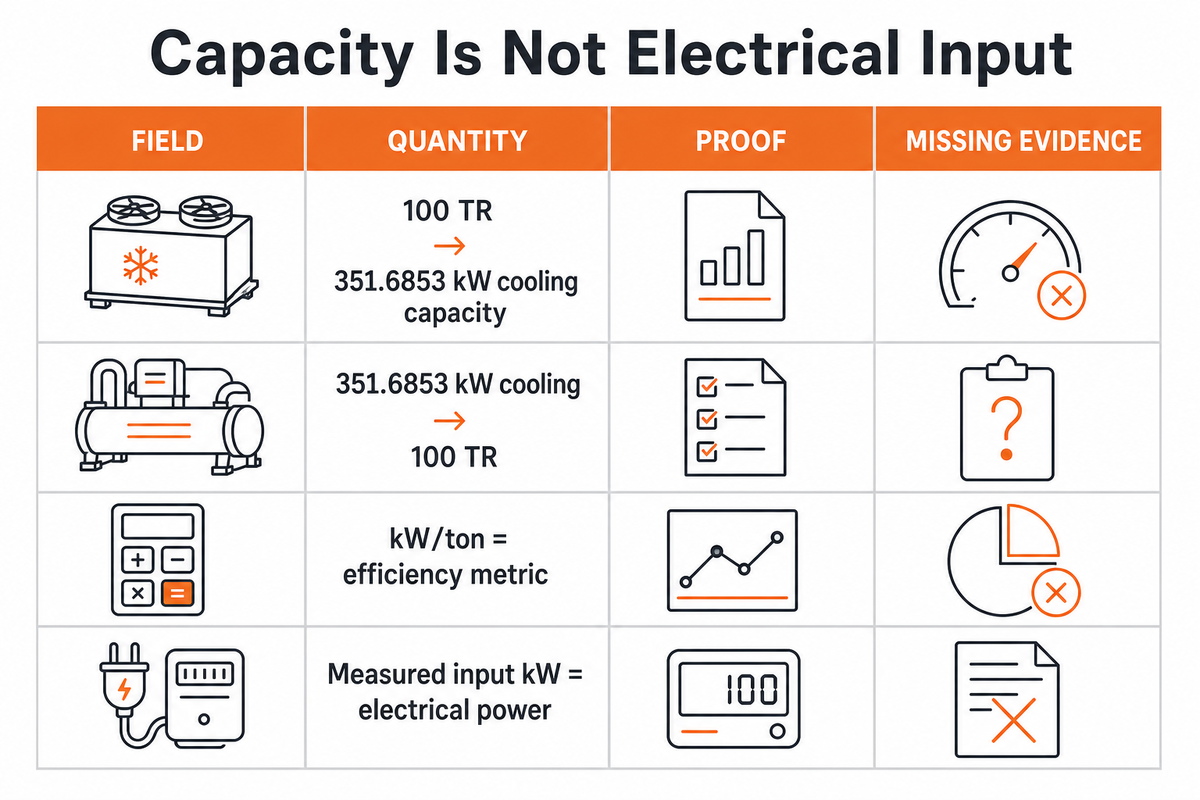
The most consequential mistake is to call 3.516853 kW per TR an electrical-demand factor. It is not. It converts cooling capacity. Electrical input depends on the actual equipment, its efficiency metric, the rating point, load, controls, and operating condition.
The U.S. Department of Energy electric-chiller purchasing guidance makes the separation visible. Its tables list capacity in tons and efficiency separately, using measures such as EER or kW/ton for defined equipment classes. Capacity and efficiency are different specification fields; equipment-specific input cannot be recovered from capacity alone.
| Document field | Physical quantity | What it proves | What is still missing |
|---|---|---|---|
| Capacity: 100 TR | Cooling rate | 351.6853 kW cooling capacity | Electrical input and efficiency |
| Capacity: 351.6853 kW | Cooling rate | 100 TR after reverse conversion | Electrical input and operating cost |
| Efficiency: kW/ton | Input per cooling capacity | Connects defined input and capacity at a rating point | Applicability to the actual unit and condition |
| Measured input: kW | Electrical power | Actual input at the recorded condition | Delivered capacity if performance is being assessed |
Ratios written as kW/ton are therefore not the inverse of the NIST capacity conversion. They are equipment-efficiency metrics. The same two unit labels appear, but the relationship answers a different engineering question.
Do not invent a universal efficiency value to bridge the gap. Obtain COP, EER, IPLV, kW/ton, or another applicable measure from the selected equipment data and confirm the test or operating condition. The converter deliberately stops before that equipment-specific calculation.
This distinction also clarifies common query wording. “Convert tons to kW,” “TR to kW,” and “refrigeration to kilowatts” request a capacity-unit conversion. “kW to TR” asks for the reverse. By contrast, “electrical kW for a 10-ton chiller” asks for equipment performance and cannot be answered by multiplying or dividing by the bare capacity factor alone.
Using the Result in Equipment Documents and RFQs
Converted values are most useful when they remain traceable. A bare spreadsheet cell labeled “351.6853 kW” does not reveal whether the number is cooling capacity, motor input, shaft power, or an energy total entered in the wrong column.
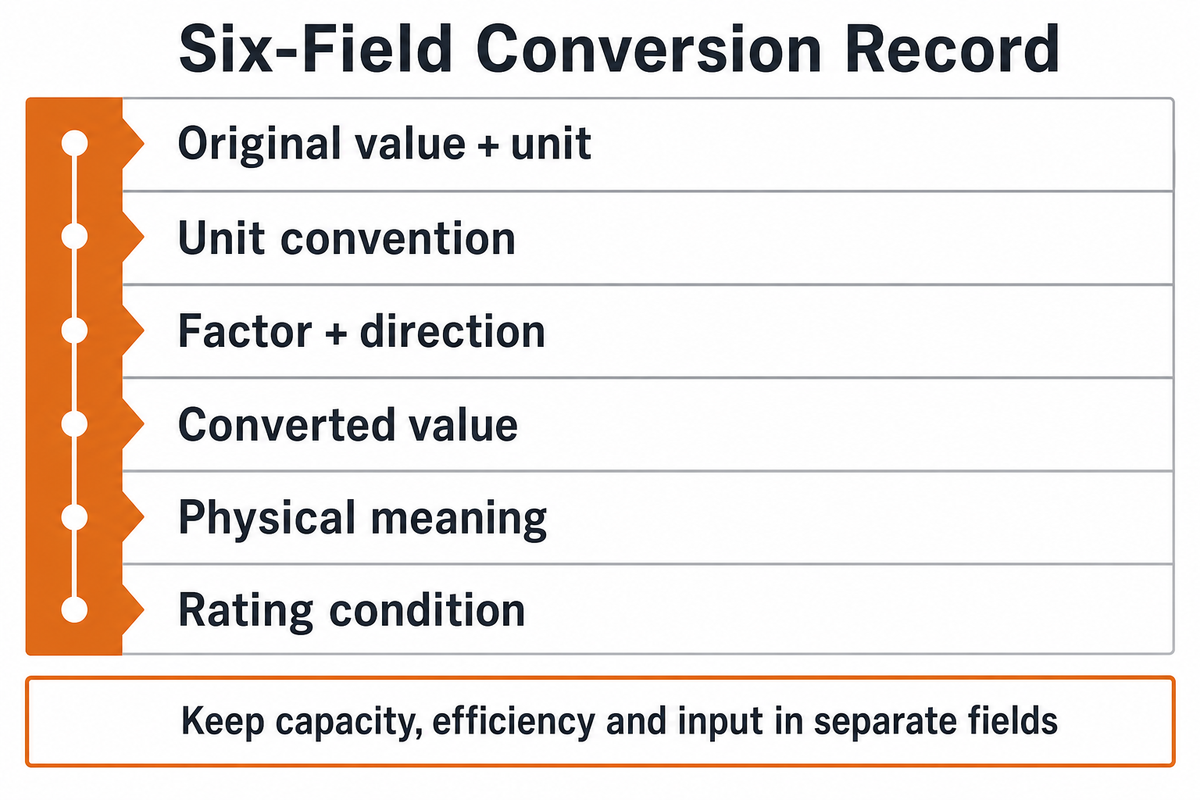
Use this six-field record:
- Original value and unit: for example, 100 TR.
- Unit convention: ton of refrigeration defined as 12,000 Btu-IT/h.
- Factor and direction: multiply by 3.516853 kW/TR.
- Converted value: 351.6853 kW before display rounding.
- Physical meaning: cooling capacity or heat-removal rate.
- Rating condition: nominal, catalog, full-load, part-load, or measured condition.
Keep the record with the source revision. If a supplier corrects the capacity, another reviewer can update the conversion without guessing which factor or meaning was used.
Before comparing supplier offers, ask each vendor whether the stated value is nominal capacity, certified capacity at a published rating point, or measured capacity at an operating point. Also request the fluid temperatures, ambient or condenser condition, load percentage, test procedure, and the separate electrical-input or efficiency field that applies. These details do not change the TR-to-kW factor; they determine whether two converted values describe comparable duties.
Unit labels deserve the same control. TR is the common abbreviation, while some catalogs may write RT. Treat either abbreviation as provisional until the document legend confirms “ton of refrigeration.” In North America, the word “ton” may also refer to a short ton of mass, so spelling out the quantity on first use reduces ambiguity. International standardization of the watt does not make every ton label a refrigeration capacity.
When a procurement table combines multiple vendors, add separate columns for original capacity, converted capacity, efficiency metric, electrical input, and rating condition. Do not overwrite the source column with the converted number. Keeping both values makes arithmetic review, bid clarification, and later revision control faster.
When the next question concerns hydraulic, shaft, or motor power, move to the pump power formula guide. It requires flow, head, fluid properties, and efficiency. For a direct motor-unit comparison, use the kW-to-horsepower converter. For an HVAC schedule written in Btu per hour, use the BTU/h-to-kW converter. These are separate calculation chains, not interchangeable shortcuts.
For pump-system context, the centrifugal pump guide and split-case pump range provide equipment-level routes after the system duty has been defined.
Conversion Mistakes and Precision Limits
Once the schedule and RFQ record are complete, check these failure modes against the quantity classification in NIST Appendix B.9.
Using a mass ton: a refrigeration ton is a cooling rate, not 2,000 lb or 1,000 kg. Stop if the source field does not explicitly concern refrigeration capacity.
Applying the factor backward: multiply TR by 3.516853 to get kW; divide kW by 3.516853 to get TR. The forward-reverse check exposes a swapped operation.
Dropping “per hour” from the Btu definition: 12,000 Btu-IT/h is a rate. Plain Btu is energy. A duration is required when moving between a rate and an energy total.
Calling capacity electrical input: converted capacity does not contain an equipment-efficiency value. Use applicable performance data before estimating input.
Ignoring the rating condition: nominal catalog capacity and measured operating capacity can differ. Unit conversion preserves the entered number; it does not normalize environmental or operating conditions.
Reporting false precision: maintain full factor precision during calculation, but do not imply that a rounded catalog capacity was measured to six decimal places. State the rounding rule and retain the source value.
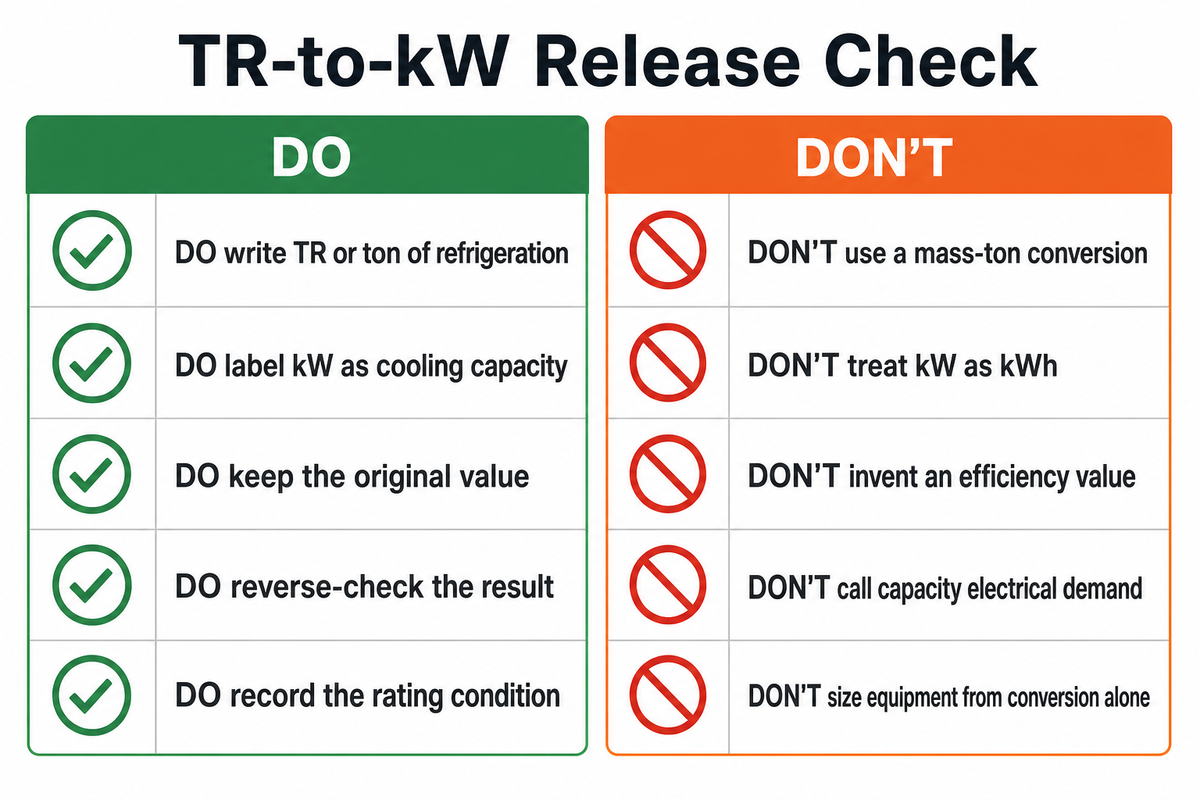
Do
- Write TR or “ton of refrigeration”
- Label kW as cooling capacity
- Keep the original value
- Reverse-check the result
- Record the rating condition
Don’t
- Use a mass-ton conversion
- Treat kW as kWh
- Invent an efficiency value
- Call capacity electrical demand
- Use the result alone to size equipment
Frequently Asked Questions
How many kW is one ton of refrigeration?
Answer
One ton of refrigeration equals 3.516853 kW of cooling capacity. NIST lists the refrigeration ton as 12,000 Btu-IT per hour and gives the equivalent as 3.516853 × 10³ W. The result is a heat-removal rate, not an automatic electrical-input value. Equipment efficiency and the applicable rating condition are separate inputs when estimating power consumption. In an RFQ or schedule, retain the original 1 TR value, state that the conversion uses Btu-IT, label the result as cooling-capacity kW, and preserve the nominal or test condition. That short record prevents another reviewer from treating a correct conversion as an unsupported estimate of electricity demand.
How many refrigeration tons is 100 kW?
Answer
Divide 100 kW by 3.516853 to obtain approximately 28.4345 TR. This reverse conversion is valid when the 100 kW value represents cooling capacity or another equivalent heat-flow rate. If 100 kW is electrical input, it cannot be converted directly into refrigeration tons without applicable equipment-efficiency and operating-condition performance data.
Is a refrigeration ton the same as a metric ton?
Answer
No. A refrigeration ton is a rate of heat removal equal to 12,000 Btu-IT/h, or 3.516853 kW of cooling capacity. A metric ton, also called a tonne, is 1,000 kg of mass. The shared word “ton” is historical and does not make the quantities convertible. Always write TR or “ton of refrigeration” in technical documents.
How do I convert cooling tonnage to kW?
Answer
Confirm that the source is refrigeration tonnage, then multiply the TR value by 3.516853. Label the result as cooling-capacity kW, preserve the original value and rating condition, and divide the unrounded result by 3.516853 as a reverse check. Do not use the converted capacity as electrical demand without separate equipment-efficiency data.
Does 3.516853 kW of cooling mean 3.516853 kW of electrical input?
Answer
No. The 3.516853 kW value is the heat-removal rate represented by one refrigeration ton. Electrical input is a different measurement. DOE chiller guidance lists capacity and efficiency as separate fields, including equipment-specific measures such as EER or kW/ton. Obtain the relevant efficiency and rating condition before estimating electrical power.
Why is a refrigeration ton equal to 12,000 Btu/h?
Answer
The name has historical associations with ice-based cooling, but that history is not the calculator’s evidence. In current technical use, NIST lists a ton of refrigeration as 12,000 International Table Btu per hour and places its SI equivalent under heat flow rate. Use that published relationship rather than attempting to reconstruct a modern equipment rating from ice mass or operating hours.
What does TR mean on an equipment schedule?
Answer
TR normally means ton of refrigeration, a cooling-capacity rate. Check the schedule legend; a mass or throughput ton needs a different calculation.
Use the calculator to normalize units, then carry the quantity label and source condition into the engineering decision. For a project-specific enquiry, send BBP the original schedule and operating requirements rather than relying on a converted capacity alone.
References & Sources
- NIST Guide to the SI, Appendix B.8 — alphabetical conversion table
- NIST Guide to the SI, Appendix B.9 — heat-flow-rate conversion table
- SI Brochure — International Bureau of Weights and Measures
- Purchasing Energy-Efficient Electric Chillers — U.S. Department of Energy
- ASHRAE Terminology: ton of refrigeration — industry terminology reference
WHY BUYERS WORK WITH BBP
About BBP Manufacturing
BBP Manufacturing Co., Ltd. is a Beijing-based industrial pump manufacturer with in-house foundry, heat treatment, machining, assembly, coating and inspection capabilities. We support industrial projects across slurry handling, sewage treatment, clean water transfer, chemical service, fire protection, irrigation and OEM pump supply.
Our Engineering Support
We help engineering buyers select and source the right pump configuration, not just compare prices. Send us your flow rate, head, medium, solids content, temperature, pH value, material requirement and installation conditions. BBP engineers will recommend a pump series, material option, duty curve basis, lead time and spare-parts plan for your RFQ.
Company Profile // DATA_SHEET
Name
BBP Manufacturing Co., Ltd.
Brand Name
BBP
Country
China
Headquarters
Beijing, P.R. China
Business Type
Industrial Pump Manufacturer
Model
B2B / OEM / ODM / Project Supply
Main Products
Slurry Pumps, Sewage Pumps, Centrifugal Pumps, Split Case Pumps, Multistage Pumps, Chemical Pumps, Fire Pumps, Irrigation Pumps
Manufacturing Capability
Foundry, Heat Treatment, Machining, Assembly, Coating, Inspection
Certifications
ISO 9001 / CE / SGS / BV / TÜV
Export Reach
90+ Countries & Regions
Standard Lead Time
About 25 Days for Standard Configurations
Contact Person
Wesley · International Sales
Phone / WhatsApp
+86 182 1085 0516
Email
contact@bbpmfg.com
Website
https://bbpmfg.com/
Address
Room 2803, Building 11, Phase II, Nuode Center, Fengtai District, Beijing, P.R. China