Get in Touch with BBP


(Updated August 2026)
Quick Specs, BBP T-Series Centrifugal Trash Pumps
| Frame / discharge size | 2 in – 8 in |
| Flow range | 200 – 2,800 GPM |
| Total dynamic head | 40 – 145 ft |
| Max solids passing size | 1.25 in – 3 in |
| Motor / engine power | 3 – 125 HP |
| Drive options | Electric, gasoline, diesel, submersible electric |
Centrifugal trash pump construction dewatering refers to using a self-priming, solids-handling pump for water that is not clean — open-excavation drainage and jobsite sump pits where mud, gravel, and debris would jam a standard clear-water pump. The buyer question is whether “centrifugal trash pump” and “standard trash pump” are actually two different products or two labels for the same underlying design.
Short answer: they’re the same solids-handling, self-priming pump type. “Standard” isn’t an actual engineering designation of the Hydraulic Institute but some vendors’ terminology to distinguish their lowest offering from their company’s “heavy-duty” ones; duty tier will impact your purchase.
Key Takeaways
- “Standard trash pump” does not appear as a category in the cited Hydraulic Institute taxonomy; those resources use solids-handling pump terminology.
- In BBP’s published T-series lineup, duty tier is the classification that matters: semi-trash models are listed for roughly 1–1.75 in solids and full-trash/heavy-duty models for 2–3 in solids. These are supplier-published model ranges, not universal category limits.
- Full-trash-duty models usually carry an upfront price premium; compare quotes only when frame, drive type, and material grade match.
- Frame size (2 in–8 in) sets your GPM ceiling; max solids size is a separate spec set by impeller and casing clearance.
- Drive-type choice increasingly turns on jobsite noise ordinances, not just fuel cost per hour.
At a Glance, Centrifugal Trash Pump vs “Standard” Trash Pump
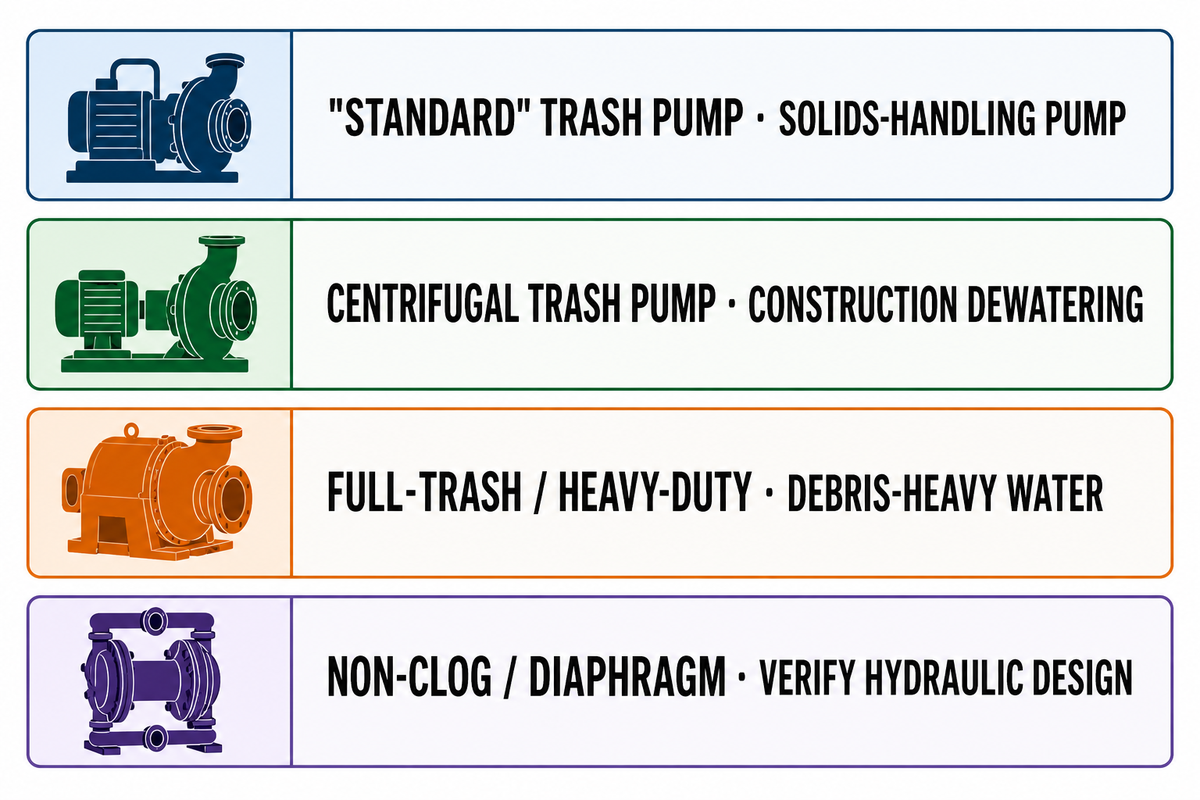
Centrifugal trash pump and “standard trash pump” name the same self-priming, solids-handling pump design — some catalogs simply sell that design under the “standard” label — so the two terms describe one underlying product family, not two competing technologies. The confusion comes from marketing language, not engineering: several sellers use “standard” to mean their entry-level tier within a trash-pump line, which reads to a buyer like a separate category when it is really a duty-level label.
| Term used | Is it centrifugal? | Typical use | Official HI classification |
|---|---|---|---|
| “Standard” trash pump | Yes | Seller’s base/entry-tier trash pump | Solids-handling pump |
| Centrifugal trash pump | Yes | Construction dewatering, all duty tiers | Solids-handling pump |
| Full-trash / heavy-duty pump | Yes | Muddy, gravelly, debris-heavy dewatering | Solids-handling pump (larger clearance) |
| Non-clog / diaphragm pump | Design-dependent: diaphragm pumps are positive displacement; “non-clog” pumps may be centrifugal | Sludge, thick slurry, entrained solids | Verify the specific hydraulic design |
What actually differentiates a trash pump from a plain water pump is not a separate pump-type code — it is the impeller and casing. Trade-press coverage of large-diameter-impeller designs describes the differentiator directly: wider impeller clearance and a more rugged, abrasion-resistant casing are what let a pump pass solids instead of jamming, while a standard clear-water pump uses tight tolerances built for efficiency on clean liquid, not durability against grit. Dewatering pumps are designed for relatively clean water and sit a notch below trash pumps on this same spectrum, with trash pumps carrying more rugged construction specifically to survive dirtier water and higher solids content.
At its most basic, pumping water is the same principle across every category here — impeller motion moves liquid — but a standard centrifugal pump, a submersible pump, and a positive-displacement unit (diaphragm pumps, rotary lobe pumps) are built for different jobs. Pump housing material follows the same logic: casings on the heavy-duty tier are typically cast iron or ductile iron construction for abrasion resistance against muddy water and grit, not the lighter alloys used on a clear-water pump.
What’s the Difference Between a Trash Pump and a Regular Water Pump?
Impeller and casing design — not pumping principle — differentiate a trash pump from a regular water pump: both are centrifugal, but a trash pump uses a wider impeller eye and more clearance to pass solids without clogging. By contrast, a regular clear-water pump is machined to tight tolerances for maximum efficiency, which is exactly what makes it prone to jamming or wearing out fast on debris-laden water.
In practice this means a regular water pump is the wrong tool the moment your jobsite water carries mud, gravel, leaves, or construction debris — even light sediment can lodge in a clear-water impeller’s tighter clearances and cause cavitation or seal damage within hours. The trade-off runs the other way too: trash pumps generally deliver a bit less head and efficiency per horsepower than an equivalent clear-water pump, because that extra clearance built in for solids passage is not free.
Naming & Terminology: Why “Standard” Isn’t a Real Pump Category
In the cited Hydraulic Institute rotodynamic pump-type taxonomy, the listed codes (OH0–OH13, VS0–VS8, CP1–CP3, RT1–RT2) do not include a category named “standard trash pump.” The cited Hydraulic Institute Pump FAQ page also uses solids-handling pump terminology in the material reviewed. This source-level observation does not prove that the phrase never appears anywhere in Hydraulic Institute materials; it shows why a seller’s “standard” label should not substitute for explicit duty-tier and solids-clearance specifications.
Terminology note: the reviewed Hydraulic Institute reference pages use “solids-handling pump” for pumps intended to move liquids carrying suspended or entrained solids. This is an editorial paraphrase of the cited pages, not a direct quotation or a claim that no other Hydraulic Institute document uses informal market terminology.
A U.S. Department of Homeland Security SAVER TechNote provides a different classification lens rather than proof about the Hydraulic Institute taxonomy. It groups flood-response pumps by delivery format — portable dewatering, portable trash, mobile trash, PTO-driven, and submersible — and does not use a “standard vs. trash” split. That omission shows only how this emergency-management document organizes pumps; by itself, it does not establish a universal engineering rule about every seller’s terminology.
⚠️ Common Mistake
Treating “standard” as a technical specification instead of a sales label is a common buying mistake. Selection should be based on duty tier, solids clearance, flow at the required head, and the actual dewatering method, not the word printed on the pump’s nameplate.
How a Centrifugal Trash Pump Handles Solids
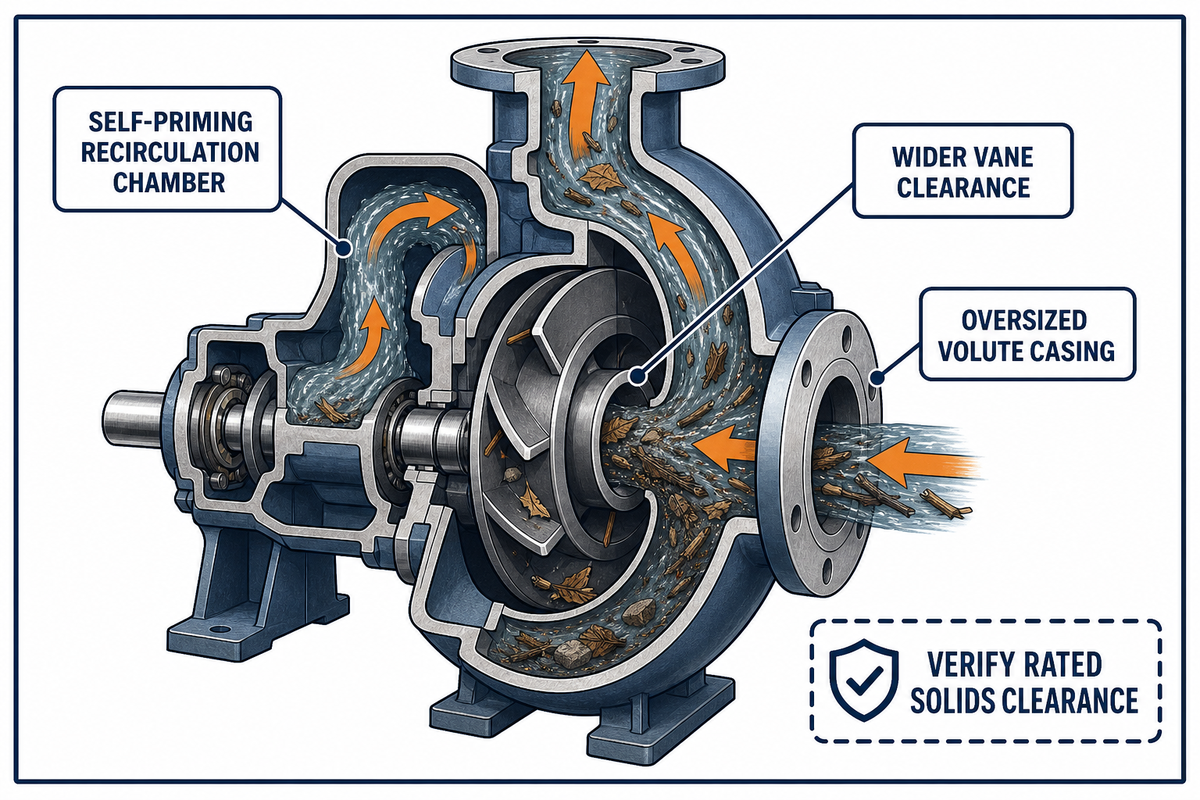
A centrifugal trash pump handles solids by spinning an impeller with wider vane clearance inside an oversized volute casing, so debris moving through the pump has room to pass rather than lodge against tight tolerances. Self-priming versions add a recirculation chamber that keeps the pump primed after the initial startup cycle, which matters on a jobsite where the suction hose may run dry between cycles as the water table drops.
The third-party patent family that includes WO2008036098A2 describes a self-priming centrifugal pump for solids-laden mixtures. Its corresponding U.S. record identifies The Gorman-Rupp Company as assignee; this is not a BBP patent and is included only as external design literature, not as evidence for BBP model specifications or ownership.
“Mixtures of solids and liquids, solids-laden mixtures, and slurries.”
Even a well-designed trash pump has real limits, though. One engineering-forum discussion of high-flow, low-head pump selection describes a trash pump passing a 2-inch rock while warning that doing so can bend or break impeller vanes; treat that anecdote as a caution, not as rating evidence. A suction screen on the suction line helps keep oversized debris out, but its opening and placement must follow the selected pump’s manual and rated solids clearance, especially on a high head run. “Handles solids” does not mean “handles anything,” and skipping the specified inlet protection on a debris-heavy site can turn a routine pumping job into an impeller repair.
For the full mechanical breakdown — impeller styles, self-priming chamber design, and wear-plate replacement intervals — see our full mechanics breakdown.
Semi-Trash vs Full-Trash, The 3-Path Dewatering Selection Ladder
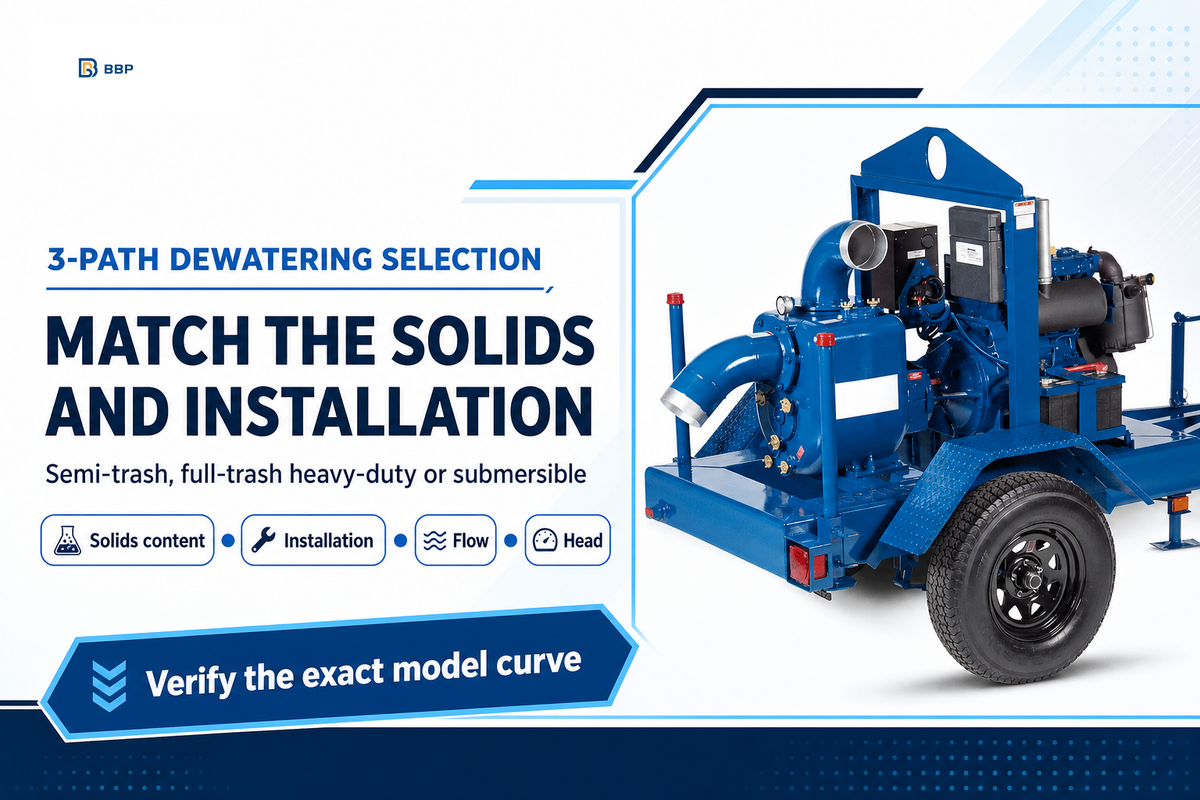
For construction sites where inflow carries mud, gravel, or debris, solids-handling duty — not frame size alone — is an early sizing decision. BBP’s published lineup presents three practical selection paths: semi-trash, full-trash/heavy-duty, and submersible configurations. Call this the 3-Path Dewatering Selection Ladder: a way to match actual solids content and installation needs, not just flow volume, to a suitable pump path before comparing GPM numbers.
BBP’s eight-model lineup shows a product-line-specific progression: its 2-inch frame lists 1.25-inch solids, its 3-inch frame lists 1.75-inch solids, and its 4-inch through 8-inch frames list up to 2.5–3-inch solids depending on model. These figures describe the BBP models in the table below, not a standardized cross-manufacturer rule. Two forum discussions mention broadly similar discharge-to-solids patterns, but forum examples do not establish an industry-wide rating; every purchase still requires the selected model’s published curve and max-solids specification.
| Model | Duty tier | Frame | Flow (GPM) | Head (ft) | Max solids | Typical dewatering scenario | Limitations / not suitable for |
|---|---|---|---|---|---|---|---|
| T-2ST | Semi-trash | 2 in | 200–400 | 40–90 | 1.25 in | Light sump pits, small trench dewatering | Not for open excavation with gravel — screen above 1 in solids |
| T-3ST | Semi-trash | 3 in | 250–650 | 45–110 | 1.75 in | Medium sump/trench, moderate debris | Not for continuous mining-grade abrasive slurry duty |
| T-4HD | Full-trash heavy-duty | 4 in | 500–1,200 | 80–135 | 2.5 in | Open excavation, muddy/gravelly inflow | Oversized and inefficient for light sump work |
| T-4HD-SC | Full-trash heavy-duty | 4 in | 500–1,000 | 70–120 | 3 in | High-debris industrial/quarry dewatering | Lower max head than T-4HD — not for long discharge runs |
| T-6HD | Full-trash heavy-duty | 6 in | 900–1,800 | 90–145 | 3 in | Large open-cut excavation, high-volume drainage | Too large/costly for residential or small commercial jobs |
| T-8HD | Full-trash heavy-duty | 8 in | 1,600–2,800 | 90–145 | 3 in (Ni-hard available for silica duty) | Major civil/mining dewatering, high flow | Needs crane/rigging and heavy power supply — not hand-portable |
| T-3SUB | Submersible | 3 in | 300–700 | 40–85 | 2 in | Drop-in wet sump, limited surface access | Electric only — no option without on-site power |
| T-4SUB | Submersible | 4 in | 500–1,100 | 45–100 | 2.5 in | Larger wet-sump / lift-station-style dewatering | Same power-availability constraint as T-3SUB |
Specification ownership note: model, frame, flow, head, max-solids, and the listed Ni-hard option for the eight T-series rows are supplier-published BBP specifications captured from BBP’s trash-pump product page. Scenario and limitation columns are editorial selection guidance, not certified performance statements.
That extra solids clearance usually carries an upfront price premium, but no reliable source establishes a universal 40–60% markup across frames, drive types, and material grades. Compare available frame and duty options using like-for-like quotes instead of applying one market-wide markup.
One warning worth taking seriously before you jump straight to the biggest pump on the ladder: a major dewatering-equipment manufacturer’s own buying guide states that bigger is not always better on efficiency grounds. An oversized pump can operate away from its efficient range and waste fuel or power per gallon moved. Match duty tier to your actual worst-case solids content first, then size flow within that tier, rather than defaulting to the largest frame “to be safe.”
See BBP’s T-series trash pump lineup for full datasheets on each model in the ladder above.
Sizing by Frame, 2″ to 8″ for Your Dewatering Job
Frame diameter, from 2 inches to 8 inches across BBP’s T-series line, sets the outer boundary on how much water a trash pump can move per minute — but frame size and max-solids size are two independent specs, not one number that scales together automatically. A 4-inch pump moves more GPM than a 2-inch pump, but its solids clearance depends on the specific impeller and casing design inside that frame, which is why the duty-tier table above and the frame table below need to be checked together, not separately.
| Frame | Flow (GPM) | Head (ft) | Max solids | HP range | Best-fit job |
|---|---|---|---|---|---|
| 2 in | 200–400 | 40–90 | 1.25 in | 3–10 | Light sump / wellpoint header |
| 3 in | 250–700 | 40–110 | 1.75–2 in | 5–20 | Medium trench, moderate submersible |
| 4 in | 500–1,200 | 45–135 | 2–3 in | 10–50 | Open excavation / industrial |
| 6 in | 900–1,800 | 90–145 | 3 in | 30–75 | Large open-cut site |
| 8 in | 1,600–2,800 | 90–145 | 3 in | 60–125 | Major civil / mining dewatering |
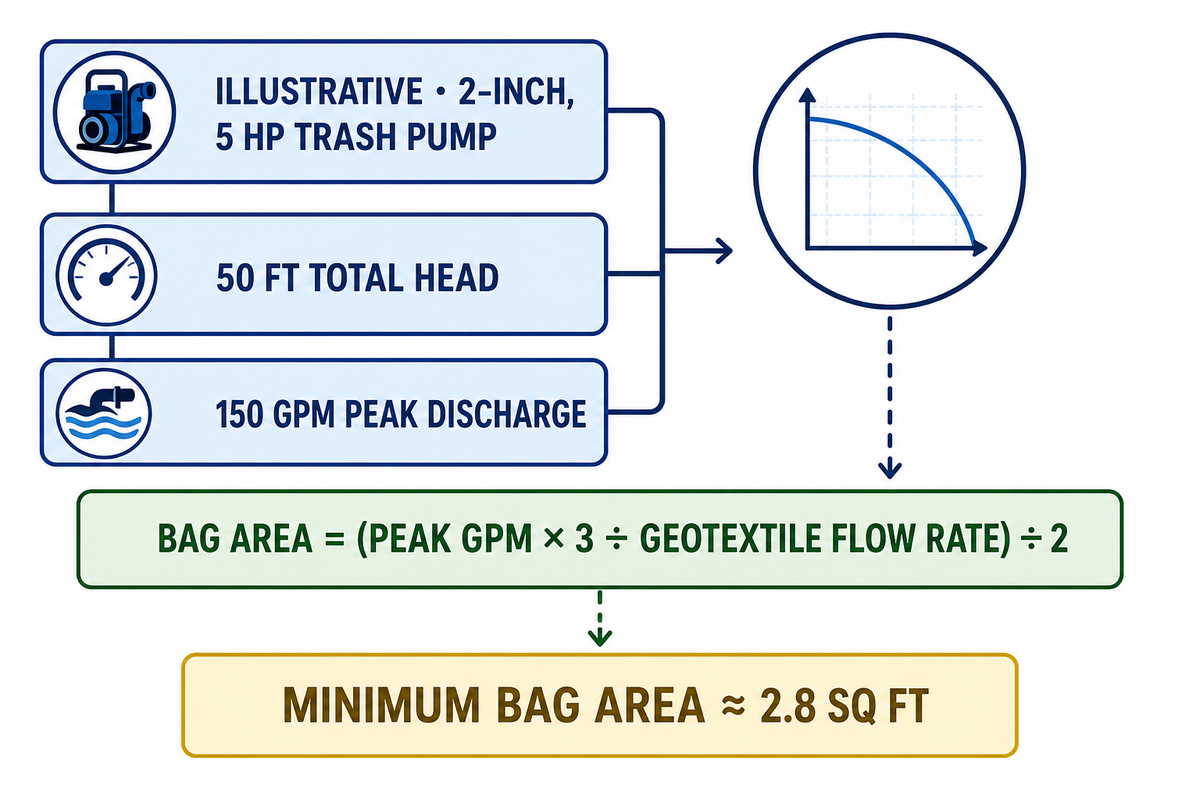
Virginia Department of Transportation’s one-page dewatering-bag guidance includes an illustrative worked example rather than a universal pump specification. It assumes a 2-inch, 5 hp trash pump represented by curve B and 50 ft of total head, estimates 150 GPM from that example curve, and then applies the guidance formula to obtain a minimum bag area of about 2.8 sq ft.
Bag area (sq ft) = (Peak discharge GPM × 3 ÷ geotextile flow rate) ÷ 2
Example: 2 in pump @ 50 ft head → 150 GPM peak discharge → ≈ 2.8 sq ft bag footprint
One takeaway for sizing your own job: pull peak discharge off the actual pump curve at your expected head, not off the pump’s nameplate max-flow rating, since nameplate GPM is measured at minimal head and will overstate what you get once lift and friction are subtracted.
What Size Trash Pump Do I Need for My Dewatering Job?
The trash pump size you need is set by your peak inflow rate at your actual total dynamic head, cross-checked against your worst-case solids size, not by pit size or a single “bigger is safer” guess. Start with the frame-sizing table above: match your calculated peak GPM (inflow rate, not pit volume) to a frame’s flow range at your expected head, since GPM drops as head rises on every centrifugal curve.
Then check that frame’s max-solids rating against the largest debris you realistically expect, gravel, root balls, or construction trash, because frame size and solids clearance are set by separate parts of the pump and do not scale together automatically. If your GPM need falls between two frames, size up rather than down: running a pump below its efficient flow range wastes power, but running one below its needed GPM means the water table never actually drops. Dewatering pump sizing follows this same two-step logic regardless of scale: whether a supplier proposes a 2 HP portable unit or one of BBP’s published T-series models, start with peak GPM and head, then check solids clearance. BBP’s published T-series starts at 3 HP for construction-duty use.
Drive Type Comparison for Jobsite Dewatering
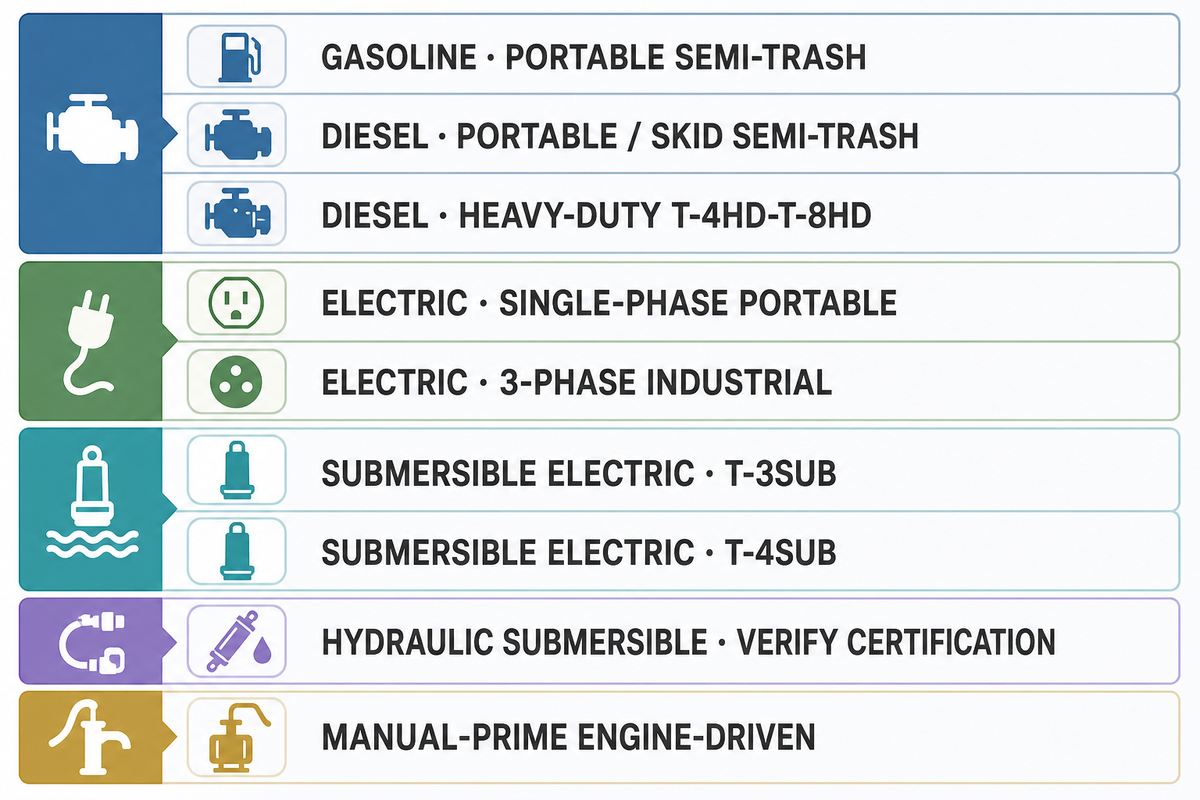
Among electric drive options, an electric dewatering setup built around an electric submersible pump removes the surface combustion engine and generally reduces jobsite noise at the pump. Diesel power avoids grid dependence, but compliance still depends on the exact model’s sound data, distance, operating hours, permits, and the current local rule, so fuel type alone cannot establish whether a setup is compliant. Under OSHA’s construction noise standard, 29 CFR 1926.52, the Table D-2 permissible exposure is 90 dBA for an 8-hour day, and a continuing, effective hearing conservation program is required when exposure exceeds the table values. Some product lines also offer vacuum pump-assisted priming as an alternative to a self-priming recirculation chamber; confirm availability on the exact model under review.
| Drive type | Power source | Noise verification | Best-fit scenario | Maintenance note | Limitations / not suitable for |
|---|---|---|---|---|---|
| Gasoline (portable, semi-trash) | Gasoline engine | Model/system-specific; include the surface engine | Remote jobs, no power hookup | Frequent refueling; oil/plug per engine-hour interval | May conflict with local quiet-hour limits; verify model sound data and current rules |
| Diesel (portable/skid, semi-trash) | Diesel engine | Model/system-specific; include the surface engine | Remote or overnight unattended pumping | Fuel/particulate filter service intervals | Noise-ordinance exposure depends on sound data, distance, and restricted hours |
| Diesel (heavy-duty, T-4HD–T-8HD) | Diesel engine | Model/system-specific; include the surface engine | Large open-cut sites away from receptors | Scheduled engine service per hour intervals | Verify model data, distance, and local rules near sensitive receptors |
| Electric (single-phase, portable) | Grid or generator | Model/system-specific; include any generator | Urban/suburban jobs with power access | Bearing/seal inspection, no combustion service at the pump | Needs reliable single-phase power on site |
| Electric (3-phase industrial) | Grid 3-phase | Model/system-specific; verify the complete setup | Industrial sites with 3-phase already run | Motor/seal service; VFD upkeep if variable-speed | 3-phase supply not available on many small sites |
| Submersible electric (T-3SUB) | Electric only | Model/system-specific; verify the complete setup | Drop-in wet sump, tight surface footprint | Seal/cable inspection before each deployment | No option without on-site power |
| Submersible electric (T-4SUB) | Electric only | Model/system-specific; verify the complete setup | Larger wet-sump/lift-station-style dewatering | Same seal/cable inspection discipline | Same power-dependency limitation |
| Hydraulic submersible (market reference) | Surface diesel hydraulic power unit | Model/system-specific; include the surface power unit | Sites where hydraulic power is already available | Hydraulic fluid/hose service on surface unit | Hazardous-area use requires model- and system-specific certification |
| Manual-prime engine-driven (market reference) | Gas/diesel, manual flooded suction | Model/system-specific; include the surface engine | Rental fleets accepting a manual priming step | Priming procedure adds setup time each use | No auto-prime — dry-run risk if crew skips setup |
Certification boundary: the hydraulic-submersible row describes a market configuration, not an intrinsically safe certification or a blanket recommendation for explosive atmospheres. Suitability for a hazardous location must be confirmed from the exact pump, hydraulic power unit, electrical components, and site classification before selection.
For the complete drive-type breakdown — including fuel-consumption ranges and generator sizing for electric units — see our full drive-type comparison.
Matching the Pump to Your Dewatering Method
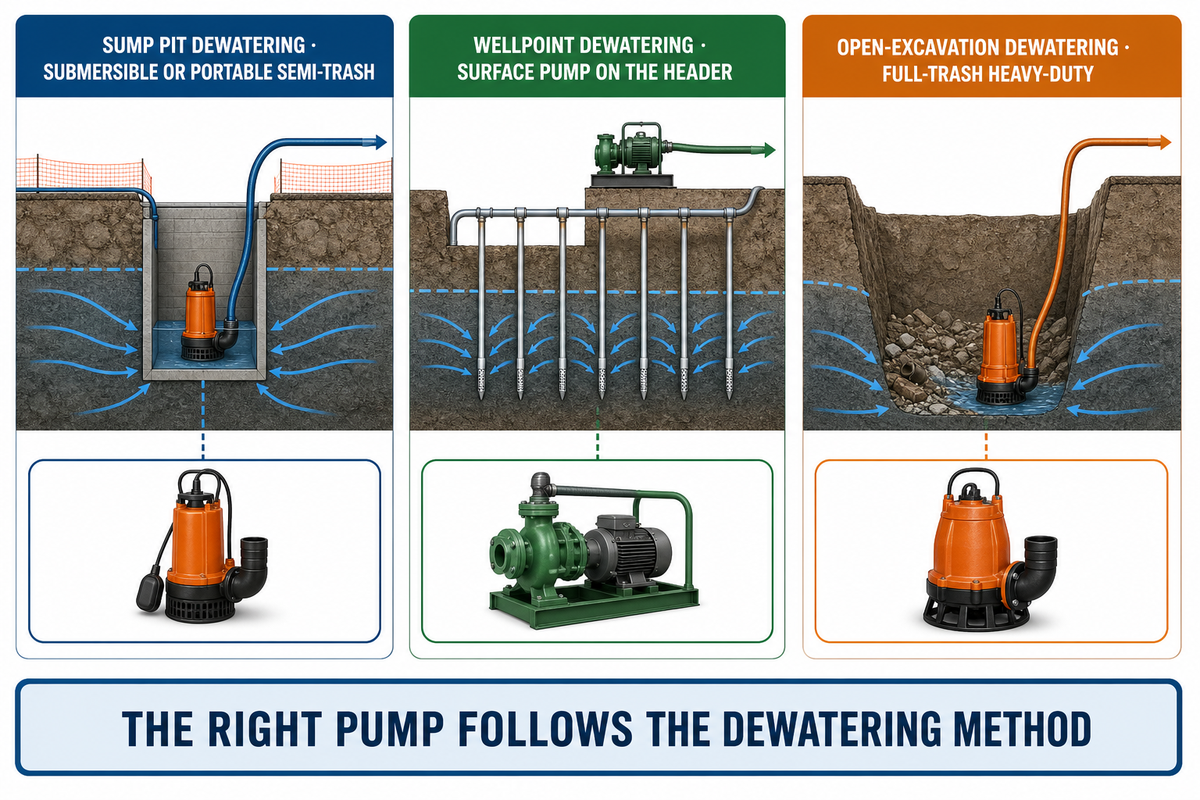
For wellpoint dewatering, sump pits, and open-excavation drainage, the right pump follows the dewatering method itself, not just the flow and head numbers pulled off a spec sheet — the same GPM requirement can call for different pump types depending on how the water actually reaches the pump. A submersible dewatering setup, for example, drops a submersible pump directly into standing groundwater at a sump pit, while a wellpoint system pulls groundwater up through a header from multiple points before it ever reaches a surface-mounted pump.
Across dewatering applications, the goal is the same — lowering water table conditions enough to keep a work area dry — but the method differs by site. A wellpoint system lowers the water table over a broad area through a shared header, using multiple wellpoint pumps rather than one large intake. Sump pumping can be a primary dewatering method for localized low-point collection when site conditions fit; suitability and mobilization cost still depend on the site and quoted equipment. A submersible dewatering pump dropped into standing ground water can serve a localized sump, while a portable pump can be moved among scattered surface water collection points when that arrangement fits the site.
| Dewatering method | Typical condition | Recommended pump type |
|---|---|---|
| Sump pit dewatering | Water collects in a low point; drop-in access | Submersible (T-3SUB/T-4SUB) or portable semi-trash surface pump |
| Wellpoint dewatering | Header system pulling from multiple points to lower a broad water table before excavation | Surface semi-trash pump on the header, sized to combined wellpoint flow |
| Open-excavation dewatering | Standing water with mud, gravel, or debris in an open cut | Full-trash heavy-duty surface pump (T-4HD and up), screened intake |
Wellpoint dewatering requires a check beyond the system’s rated flow: the pump must maintain prime through a header running below atmospheric pressure across multiple suction points. If rain or a high water table interrupts excavation, stage the trash pump before footing or backfill work resumes so the header does not lose prime during the operation.
Buy or Rent, Cost & Lead-Time Considerations
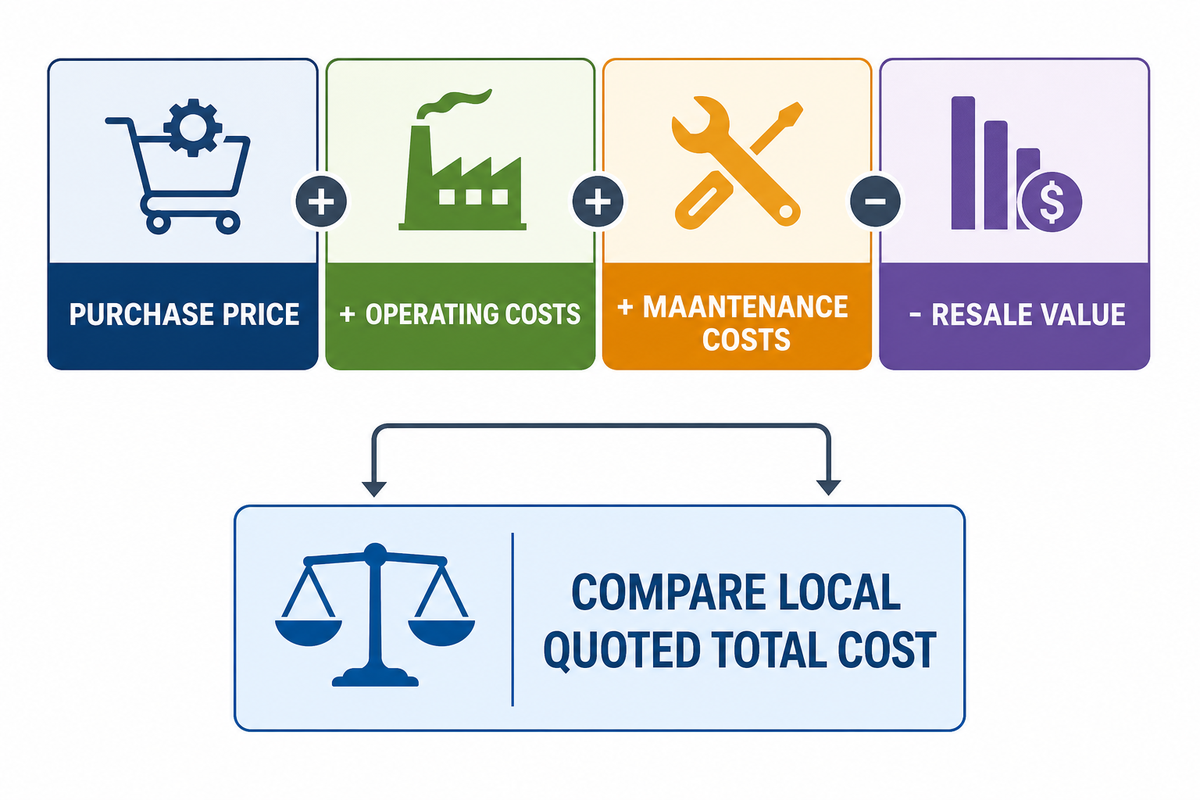
Hydraulic Institute lifecycle-cost guidance gives an illustrative breakdown for a typical medium-size industrial pumping system: about 10% initial price, 40% energy, and 25% maintenance over a 15-to-20-year life. Those percentages are not trash-pump-specific and should not be copied directly into a jobsite budget, but they show why purchase price alone is a poor guide on long-running projects. This source does not substantiate either a 40–60% trash-pump-specific energy share or a 70% combined energy, maintenance, and downtime share.
Use Purchase Price + Operating Costs + Maintenance Costs − Resale Value as the comparison framework, then replace each term with project-specific values for runtime, fuel or electricity, service intervals, rental duration, and expected resale. Operating cost often becomes decisive on longer jobs, but its share depends on the actual duty cycle and energy source.
A 3-week trench-dewatering job and a 14-month site-drainage program can produce different rent-or-buy results, but duration alone does not decide the answer. Compare quoted rental and purchase total cost for both scenarios; the crossover varies with local rates, utilization, transport, maintenance, downtime, financing, and expected resale value.
Before You Buy, The 5-Input Dewatering Quote Brief
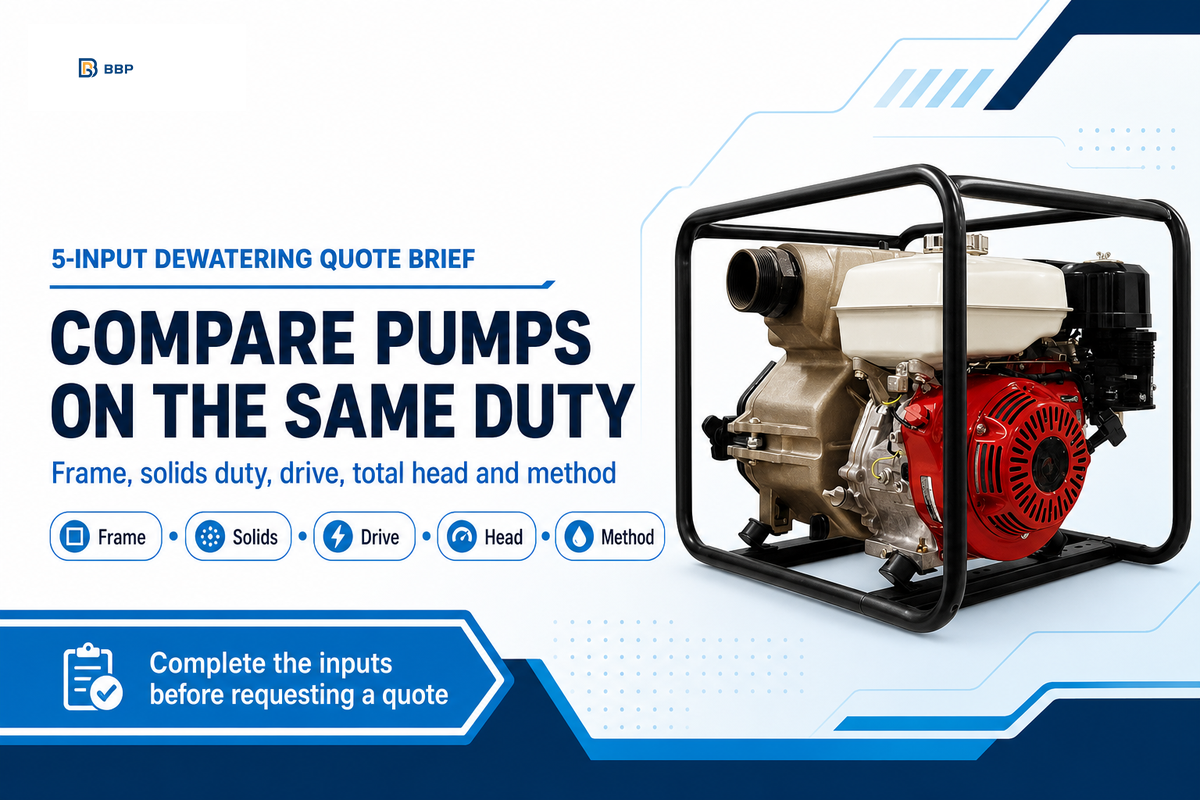
The five inputs are discharge/frame size, solids-handling duty, drive type, total dynamic head, and dewatering method. Together they define the hydraulic duty, debris clearance, installation approach, and power constraints needed to compare candidate pumps and like-for-like quotes.
The 5-Input Dewatering Quote Brief — copy these into your quote request:
| Parameter | Recommended range | Why it matters | How to verify |
|---|---|---|---|
| Discharge/frame size | 2 in – 8 in, matched to peak GPM | Undersizing throttles flow; oversizing can move operation away from the efficient range | Confirm against calculated peak inflow GPM, not pit size |
| Solids-handling duty | Duty tier and maximum solids size matched to the worst expected debris | Insufficient clearance can jam the impeller, accelerate wear, or force constant screening | State worst-case solids size and content; confirm impeller/casing clearance |
| Drive type | Electric/submersible for powered sites; diesel/gas for sites without suitable power | The drive must fit available power, runtime, and site restrictions | Confirm on-site power, model sound data, operating hours, and local rules |
| Total dynamic head | Lift + friction + discharge elevation, in ft | Underestimating head undersizes delivered GPM at your real site | Request the pump curve, not just the “max head” spec |
| Dewatering method | Sump, wellpoint header, or open excavation | The method changes how water reaches the pump and whether a surface or submersible arrangement fits | Describe the collection layout, suction path, access, and expected inflow |
Use the 5-Input Dewatering Quote Brief with the duty and frame tables above, then contact BBP with the completed duty inputs for a like-for-like quote.
FAQ
Q: What size trash pump do I need?
Trash pump size depends on your dewatering flow rate and the largest solid you need to pass; light sump or wellpoint work often starts with a 2-inch semi-trash pump.
It depends on your dewatering flow rate and the largest solid you need to pass. For light sump or wellpoint work, a 2-inch semi-trash pump (roughly 100–200 GPM) is usually enough. For open excavation dewatering with mud, gravel, or debris, a 3-inch to 6-inch full-trash or heavy-duty model handling 1–2 inch solids at higher GPM is the safer choice — match frame size to your worst-case solids content, not just flow volume.
Q: How many psi is a trash pump?
Trash pumps are usually rated in feet of head rather than PSI; use the conversion of 1 PSI to roughly 2.31 feet of head, then account for system losses.
Trash pumps are usually rated in feet of head rather than PSI, but you can convert: 1 PSI equals roughly 2.31 feet of head. Typical construction-duty centrifugal trash pumps generating 60–100 feet of total dynamic head work out to about 26–43 PSI at the discharge port before friction losses in hose and fittings are subtracted — always size against head/GPM curves, not a single PSI number.
Q: What is a full trash pump?
A full trash pump uses a larger impeller eye and wider volute clearance than a semi-trash model, allowing it to pass bigger solids without clogging.
Also called heavy-duty or full-solids, a full trash pump is a centrifugal pump built with a larger impeller eye and wider volute clearance than a semi-trash model, letting it pass bigger solids — often 2 inches or more in diameter — without clogging. It trades some efficiency and head for that clearance, so it’s reserved for muddy, debris-heavy dewatering rather than relatively clear sump water.
Q: How do you size a dewatering pump?
Match required GPM to the site’s inflow rate, confirm total dynamic head from lift, friction, and discharge elevation, then check the frame’s maximum solids rating.
Match required GPM to your site’s inflow rate, confirm total dynamic head (lift plus friction plus discharge elevation), then check that the frame’s max solids rating covers your worst debris case.
Q: What causes dewatering pump failure?
Common dewatering pump failures come from running dry, pulling oversized solids, exceeding suction-lift limits, restricting flow with clogged or undersized hoses, and skipping seal or impeller inspections.
The most common causes are running dry (loss of prime damages the seal), pulling solids larger than the pump’s rated clearance (causing impeller jams or wear), exceeding suction lift limits for the site’s depth, undersized hose or clogged strainers restricting flow, and skipping routine seal/impeller inspection on rental or long-duration jobs. Abrasive slurry accelerates wear on the casing and impeller faster than clear water, so pumps rated for a lower duty tier than the actual jobsite conditions fail prematurely — matching duty tier to real solids content, not just budget, is the single biggest failure-prevention step.
Our Perspective
This guide separates supplier-published data for the eight-model T-series lineup published by BBP from editorial selection guidance, the cited Hydraulic Institute terminology resources, and a non-BBP patent record assigned to The Gorman-Rupp Company.
References & Sources
- Pump FAQs Hydraulic Institute
- Pump Type Reference Tool Hydraulic Institute
- SAVER TechNote: Pumps for Flood Management U.S. Department of Homeland Security
- Dewatering Bag Sizing Procedure Guidance Virginia Department of Transportation
- 29 CFR 1926.52: Occupational Noise Exposure U.S. Occupational Safety and Health Administration
- OSHA Technical Manual, Section III, Chapter 5: Noise U.S. Occupational Safety and Health Administration
- Self-Priming Centrifugal Pump, WO2008036098A2 patent-family record Google Patents; corresponding U.S. record lists The Gorman-Rupp Company as assignee
- Pump Pros Know: Lifecycle Cost Analysis Hydraulic Institute