Get in Touch with BBP

Continuous-Duty Chemical Dosing Pump: Selection Criteria for 24/7 Water Treatment

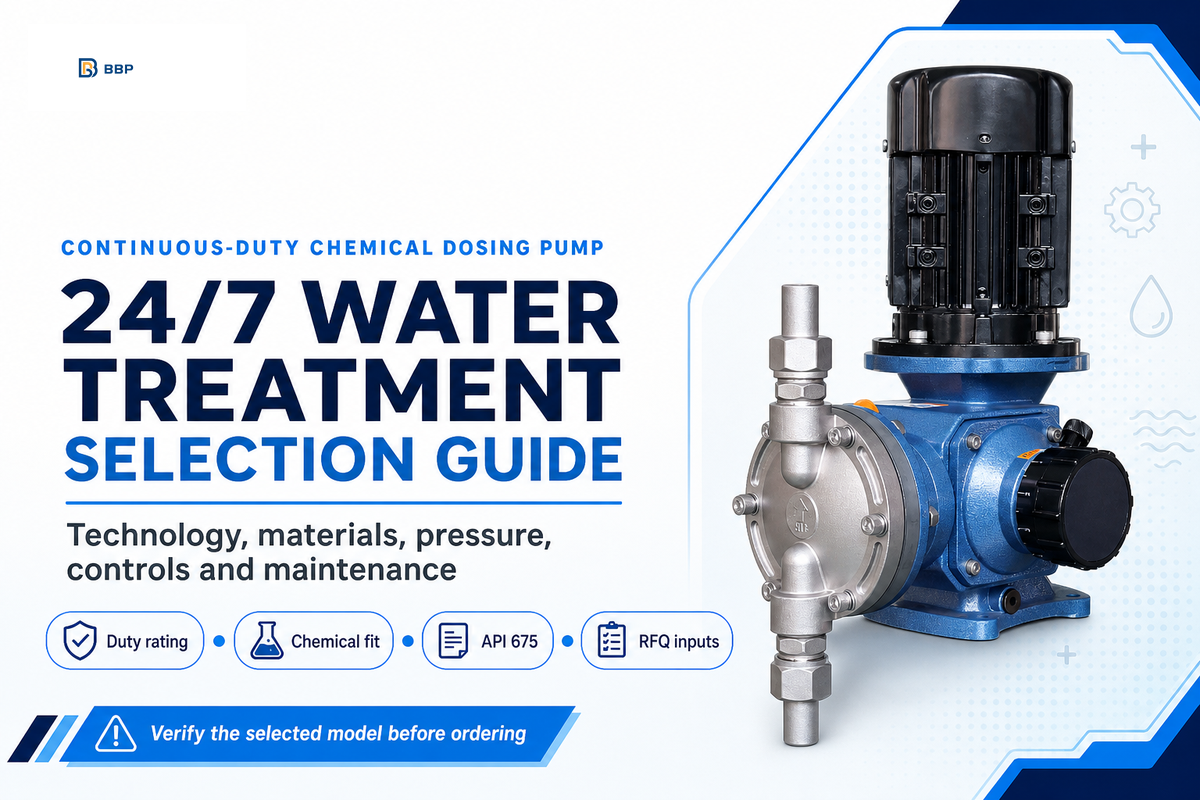
Chemical dosing pump continuous duty water treatment refers to selecting a positive-displacement metering pump built to inject chemical at a fixed rate around the clock, without the scheduled downtime that limits standard-duty designs. In 24/7 water treatment service — disinfection, pH control, corrosion-inhibitor feed — that distinction decides whether a plant holds its permit or drifts out of compliance between shifts.
Quick Specs
| Pump technology | Positive-displacement — solenoid, motor-driven, hydraulic diaphragm, peristaltic |
| Flow capacity range | Model-specific — confirm against the current series datasheet |
| Max discharge pressure | Up to 870 PSI in BBP’s published comparison (Hydraulic Diaphragm series; verify by model) |
| Steady-state accuracy | BBP-published values; confirm the selected model’s datasheet |
| Turndown ratio | BBP-published values; confirm the selected control package |
| Standards and duty claim | BBP states that its Hydraulic Diaphragm series is designed to API 675; verify continuous-duty and compliance documents by model |
| Wetted-parts material options | 14 materials, PVC to Hastelloy C-276 |
What Makes a Chemical Dosing Pump “Continuous Duty”?
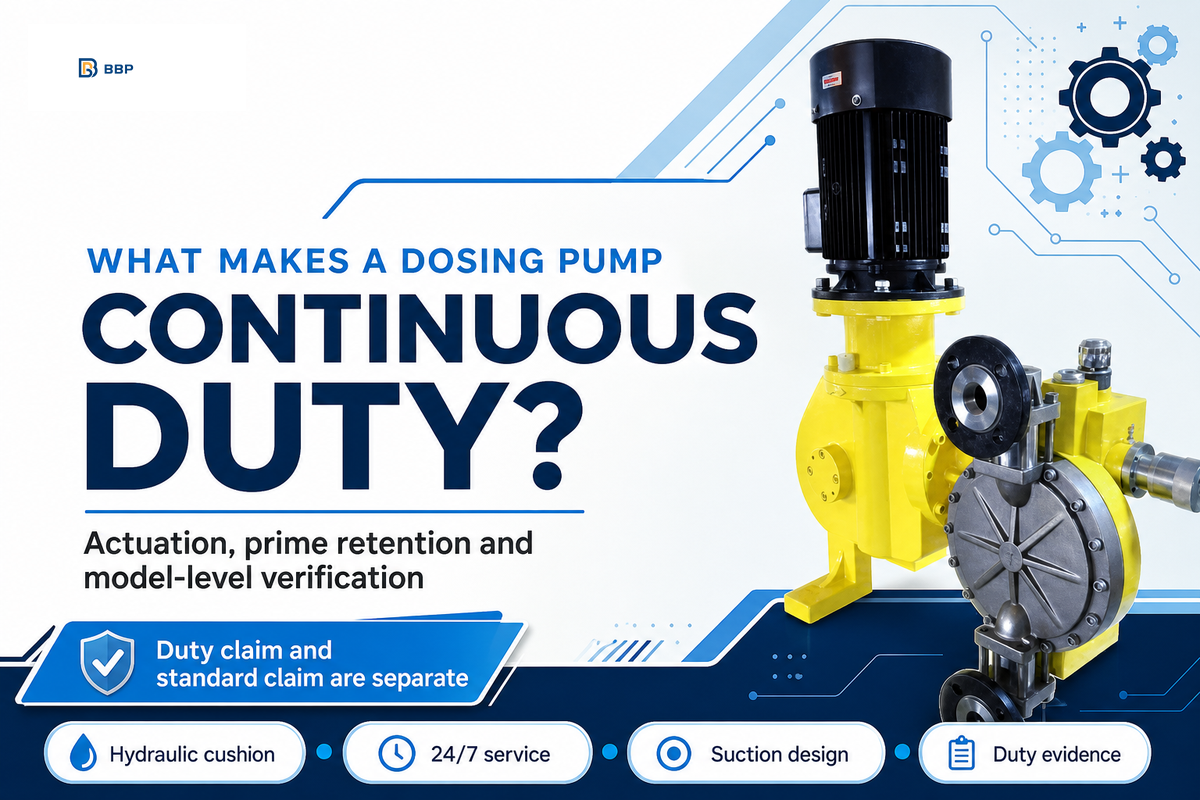
Continuous-duty rating applies when a chemical dosing pump’s actuation mechanism removes the direct stress cycling that limits a standard diaphragm’s service life, allowing 24/7 operation without scheduled downtime for diaphragm or seal replacement. In BBP’s continuous-duty chemical dosing pump lineup, a hydraulic fluid cushion — not a direct mechanical linkage — actuates the diaphragm on the Hydraulic Diaphragm Series, so stress cycling is omitted rather than merely reduced.
By contrast, a standard-duty diaphragm pump running the same 24/7 load is limited by fatigue-driven diaphragm and seal wear that accumulates with every mechanical stroke.
The practical difference shows up first at the suction side, not the diaphragm. In a continuous chemical process, dosing pumps are used to add a controlled amount of chemical without relying on a rest window between production cycles. Intermittent-duty pumps are engineered for scheduled dosing cycles with rest periods between strokes, which gives entrained gas and minor fouling time to clear before the next cycle starts. Without that rest window, a continuous-duty pump faces a prime-retention problem that separates 24/7 water treatment from intermittent batch dosing. This is the dividing line dosing technology buyers should check first: a motor-driven piston stroke and a hydraulic diaphragm cushion both qualify as continuous-duty actuation, while a standard solenoid stroke typically does not.
5 Selection Criteria for a 24/7 Chemical Dosing Pump
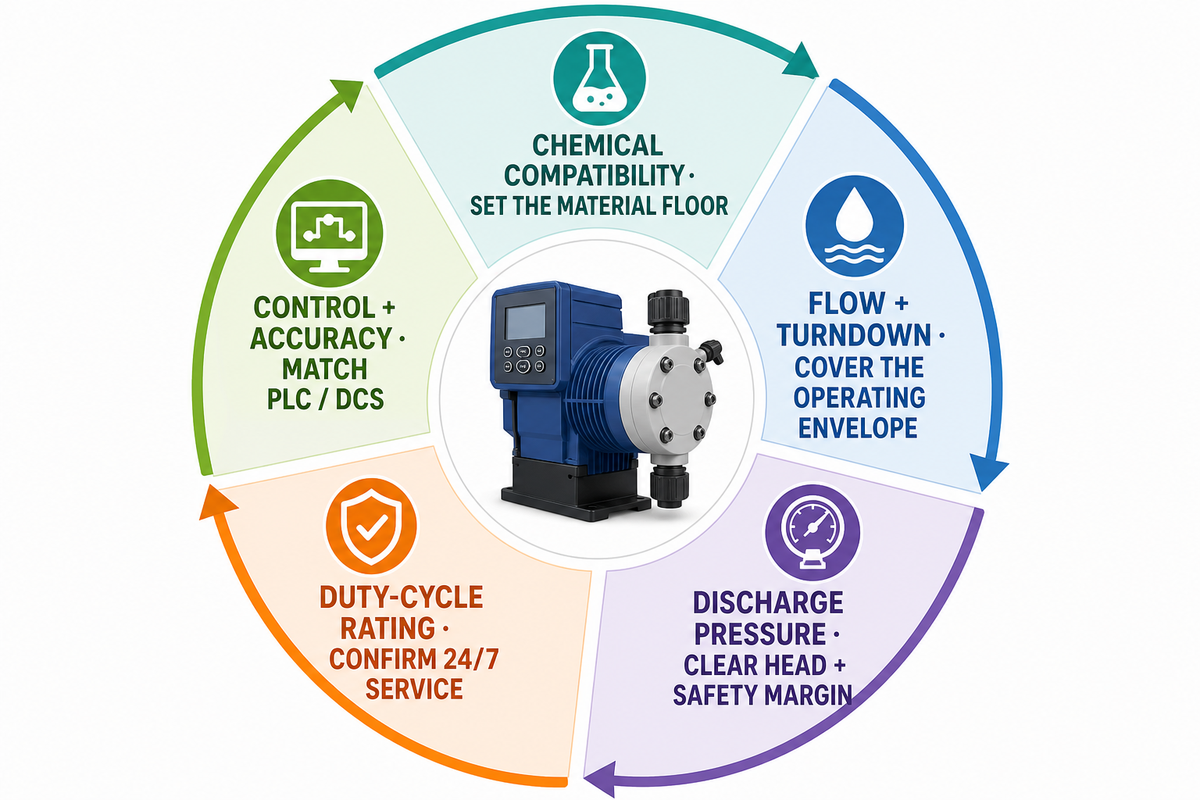
Five criteria determine whether a chemical dosing pump holds up under 24/7 service: chemical compatibility, flow-and-turndown range, maximum discharge pressure, duty-cycle rating, and control/accuracy class. Matching a specific application against these criteria — the 24/7 Duty Qualification Screen — narrows a pump family before a quote request goes out. Skipping any one of them, most often duty-cycle rating, is the most common cause of an oversized or undersized purchase.
Chemical compatibility sets the wetted-material floor before anything else matters — a pump rated for 870 PSI is worthless if the liquid end corrodes in six months. Flow and turndown define the operating envelope: a process that swings from the low end to full design flow needs a pump whose turndown ratio covers that range, not just its rated maximum. Discharge pressure has to clear system head plus a safety margin, not just match the nameplate figure at the injection point. Duty-cycle rating is the criterion competitors’ spec sheets bury — a solenoid pump rated for intermittent service will not survive the same 24/7 load a hydraulic diaphragm pump is designed for. Control and accuracy class ties the pump to the plant’s automation architecture, from a manual keypad up to full PLC/DCS integration. Getting all five right up front means the pump can hold precise flow rates and an accurate chemical dosage as conditions swing, without operators having to babysit the control system during every shift change.
How to Choose a Chemical Dosing Pump for Water Treatment?
For continuous-duty service, BBP’s published series comparison lists 10:1 turndown for its standard configurations and ±1.0% steady-state accuracy for its motor-driven and hydraulic diaphragm series. Treat those figures as BBP shortlist values, not as universal requirements, and confirm them on the selected model’s current datasheet.
That benchmark is consistent with how the Hydraulic Institute’s ANSI/HI 7.1-7.5 standard for controlled-volume metering pumps defines the relationship between accuracy and turndown, but it is not a fixed numeric floor written into API 675 itself — no publicly available standard text mandates a single universal number every compliant pump must hit. Treat 10:1 / ±1.0% as the dosing accuracy shortlist criterion, and verify the specific figure on the vendor’s own datasheet before ordering.
| Selection Driver | Condition | Recommended Series | Limitations / Not Suitable For |
|---|---|---|---|
| Sodium hypochlorite (bleach) | PVC/PVDF liquid end, ≤40°C | Peristaltic or Solenoid | Not suitable: standard check-valve diaphragm designs without an auto-degassing valve |
| Hydrochloric acid (≤35%) | PVDF/PTFE liquid end, ≤60°C | Motor-Driven or Hydraulic Diaphragm | Not suitable: PVC-only liquid ends above 35% concentration |
| Sulfuric acid (≤98%) | 316L SS/Hastelloy C-276, ≤80°C | Hydraulic Diaphragm (API 675) | Not suitable: standard PVC/PTFE liquid ends at high concentration |
| Sodium hydroxide (caustic) | 316L SS/PVDF, EPDM/PTFE, ≤80°C | Motor-Driven or Hydraulic Diaphragm | Not suitable: FKM seals (caustic swelling risk) |
| Polymer flocculant | 316L SS or peristaltic tube, ≤50°C | Peristaltic (viscosity to 1,500 cP) | Not suitable: solenoid series above roughly 6.7 GPH |
| Corrosion inhibitor (boiler) | 316L SS, ≤80°C | Motor-Driven or Hydraulic Diaphragm | Not suitable: PVC liquid ends at boiler-feed temperatures |
| Potable-water additives (fluoride, coagulant) | NSF/ANSI 61-listed PVC or 316L | Solenoid or Peristaltic | Not suitable: non-NSF-listed wetted materials for potable contact |
| Flow <10 GPH, ≤150 PSI | Low-flow, light-industrial duty | Solenoid-Driven Diaphragm | Not suitable: continuous 24/7 duty above roughly 150 PSI |
| Flow 10–80 GPH, up to 290 PSI | Industrial continuous injection | Motor-Driven Mechanical Diaphragm | Not suitable: pressures above 290 PSI |
| Flow 80–150 GPH, up to 870 PSI, high-hazard chemistry | Worst-case continuous conditions | Hydraulic Diaphragm (API 675) | Not suitable: budget-constrained low-pressure applications (cost premium unjustified) |
| Off-gassing, entrained gas, or abrasive slurry, any flow | Check-valve-prone chemistry | Peristaltic | Not suitable: pressures above 150 PSI |
Two tools shorten the path from this matrix to a quote: BBP’s dosing pump sizing calculator for flow-rate and pressure inputs, and the interactive pump type selector for a first pass at series.
Diaphragm vs Peristaltic vs Solenoid Metering Pumps: Which Technology Fits Continuous Duty?
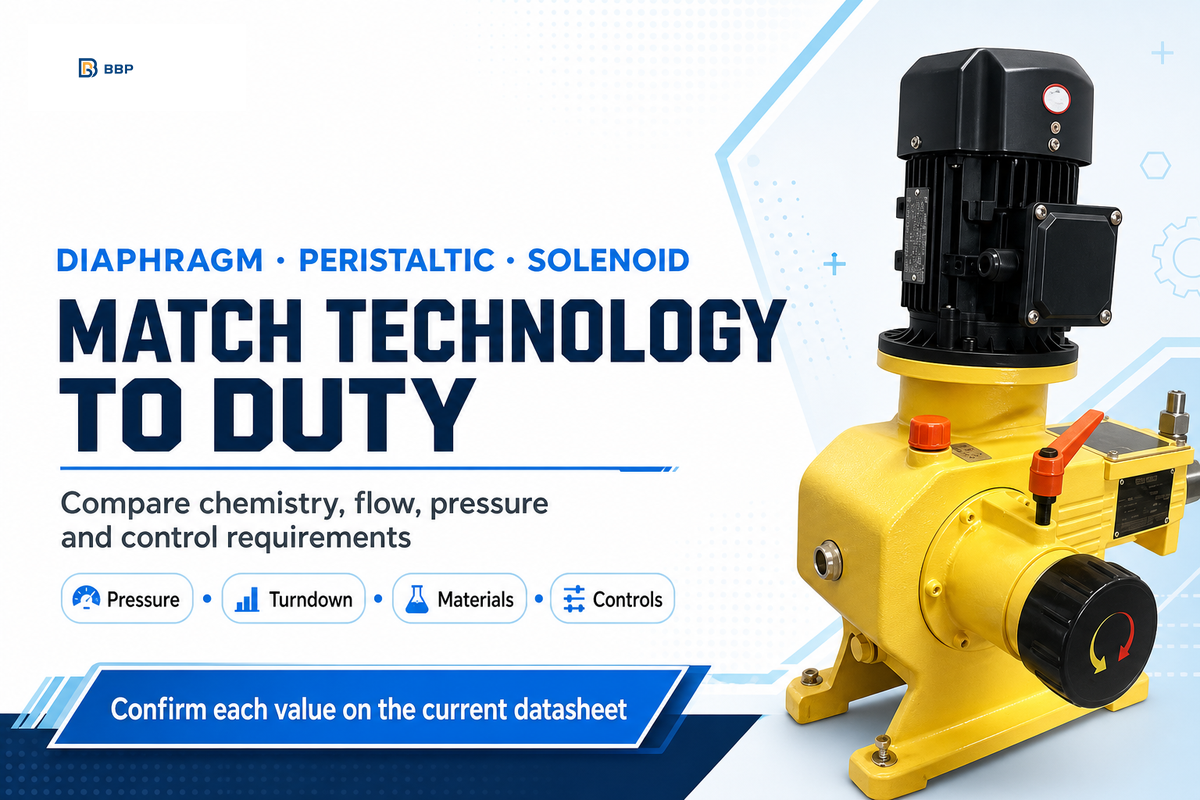
BBP’s Hydraulic Diaphragm Series is the company’s high-pressure continuous-duty option and is described on its product page as designed to API 675, while peristaltic pumps are better suited when the chemistry off-gasses or carries abrasive solids. BBP’s four series use positive displacement pump mechanisms but differ in actuation method, pressure ceiling, and duty-cycle tolerance; confirm every model-specific claim against the current datasheet.
None of the four is universally “best” — the right family depends on chemistry, flow, and pressure, which is why series selection runs off the criteria above rather than off a single preferred technology. What a chemical metering pump buyer is really comparing is the pump mechanism: the actuation method, more than the nameplate flow number, determines whether it survives a 24/7 duty cycle.
“Solenoid pumps won’t stand up to 24/7 service. If the application is critical, you would need a spare for the solenoid pump plus additional parts inventory to repair the solenoid pump.”
| Attribute | Solenoid-Driven Diaphragm | Motor-Driven Mechanical Diaphragm | Hydraulic Diaphragm (API 675) | Peristaltic |
|---|---|---|---|---|
| Flow range | 0.1–6.7 GPH | 1–80 GPH | 0.5–150 GPH | 0.01–50 GPH |
| Max discharge pressure | 150 PSI | 290 PSI | 870 PSI | 150 PSI |
| Turndown ratio | 10:1 | 10:1 std / 100:1 intelligent | 10:1 std / 1000:1 intelligent | 10:1 |
| Steady-state accuracy | ±2% typical | ±1.0% | ±1.0% | ±2% (tube-wear dependent) |
| Control interface | Pulse / 4-20 mA | Local keypad + PLC/DCS | Variable speed + stroke adjust | Pulse / manual stroke |
| Liquid-end materials | PVC, PVDF, PTFE | PVC, 316L SS, PTFE | 316L SS, Hastelloy C-276, PTFE | Santoprene, NBR, PharMed BPT tube |
| Maintenance interval | Confirm by model and chemistry | Confirm by model and chemistry | Confirm by model and chemistry | One vendor-published polymer-dosing case reported a 90-day tube interval; not a universal schedule |
| Continuous-duty (24/7) rating | Not recommended for critical 24/7 service in the cited field discussion | BBP states continuous industrial injection; verify by model | BBP states continuous duty and design to API 675; request model-specific documentation | Confirm the selected model’s continuous-duty rating |
| Typical continuous-duty applications | OEM RO, small municipal, low-pressure pH/chlorination | Cooling-tower/boiler chemistry, polymer to 1,500 cP | Petrochemical, power, fertilizer, high-pressure boiler, ATEX zones | NaOCl off-gassing, abrasive lime slurry, gas-entrained polymer |
Diaphragm dosing pumps cover the widest pressure range of the four, but peristaltic remains the default choice once chemistry turns highly viscous or abrasive — a viscous polymer blend that would stall a diaphragm check valve moves cleanly through a peristaltic tube.
This comparison is drawn from BBP’s own published series specifications, cross-referenced against the field observation above — it is not an independently benchmarked reliability study, and a buyer evaluating a different manufacturer’s lineup should confirm the same attributes against that vendor’s datasheet rather than assume the numbers transfer.
Liquid-End Material Compatibility for Water Treatment Chemicals
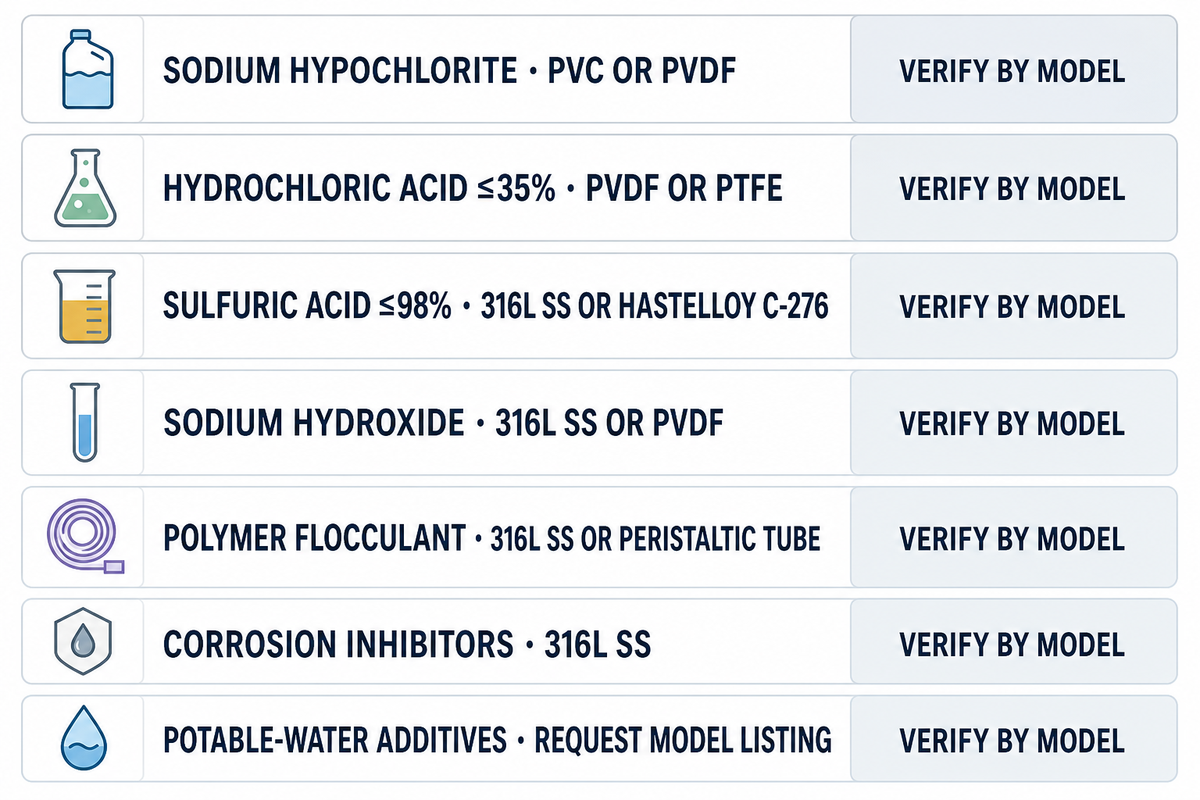
Seven chemical categories drive most liquid-end material decisions in continuous-duty dosing service, and getting the material wrong is one of the fastest routes to an unplanned pump failure. The 7-Chemical Liquid-End Compatibility Matrix below cross-references each category against wetted material, seal/diaphragm, and maximum service temperature. The matrix assumes typical concentration and ambient conditions; unusual chemical blends or elevated ambient heat should be verified against a full manufacturer compatibility chart before ordering. Confirm all chemical substances in a blended feed rather than checking only the blend’s primary ingredient. Most chemical treatment programs mix more than one of these seven chemical solutions on the same skid, so a wetted material chosen for the harshest chemistry in the room is usually the safer default even where the primary dosing duty is milder.
| Chemical Category | Recommended Wetted Material | Seal / Diaphragm | Temperature Band |
|---|---|---|---|
| Sodium hypochlorite (bleach) | PVC or PVDF | FKM / PTFE | ≤ 40°C |
| Hydrochloric acid (≤ 35%) | PVDF or PTFE | PTFE diaphragm | ≤ 60°C |
| Sulfuric acid (≤ 98%) | 316L SS or Hastelloy C-276 | PTFE diaphragm | ≤ 80°C |
| Sodium hydroxide (caustic) | 316L SS or PVDF | EPDM / PTFE | ≤ 80°C |
| Polymer flocculant | 316L SS or peristaltic tube | PTFE diaphragm or Santoprene | ≤ 50°C |
| Corrosion inhibitors (boiler) | 316L SS | PTFE diaphragm | ≤ 80°C |
| Potable water additives (fluoride, coagulant) | NSF/ANSI 61-listed PVC or 316L | NSF-compliant elastomer | ≤ 40°C |
📐 Engineering Note
Factory calibration uses water, not the chemical the pump will actually dose. Industry calibration practice runs a drawdown test — timing the pump’s delivered volume into a graduated cylinder over 10–15 minutes — at high, mid, and low flow settings, then repeats the test with the actual process chemical, since viscosity and specific gravity shift the flow-to-stroke relationship away from the factory-water calibration.
Check-valve faults and restricted suction lines can mimic diaphragm failure, so inspect those components before replacing the diaphragm. Confirming the actual failure point avoids an unnecessary teardown. Use the chemical compatibility material selector or the chemical compatibility checker to confirm wetted material against the specific chemical before specifying a pump.
Chlorine, Acid, and Caustic Dosing: Application-Specific Requirements
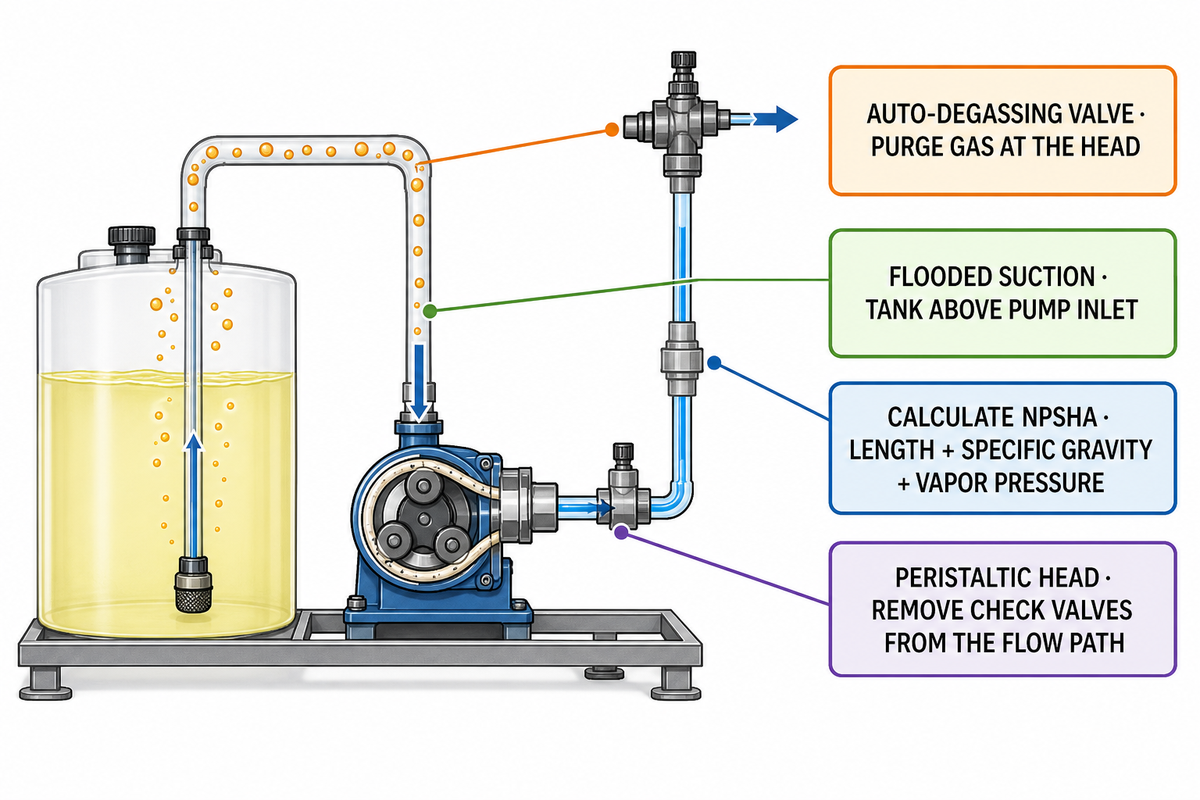
For sodium hypochlorite and other off-gassing chemistries, the dominant continuous-duty failure mode is vapor lock at the suction check valve rather than material corrosion. Reported prime-loss incidents in continuous NaOCl service trace mostly to chlorine off-gassing collecting at the diaphragm valve seats, not to wetted-material attack. Acid and caustic dosing carry a different risk profile — material attack rather than vapor lock — so the mitigation strategy for each chemistry class is not interchangeable, and pairing the wrong fix to the wrong chemistry wastes both engineering time and budget.
Sodium hypochlorite off-gasses chlorine as it decomposes, and the released gas accumulates in suction lines and at diaphragm valve seats, causing the pump to stroke normally while moving gas instead of liquid. Four design responses address this directly: auto-degassing valves on the diaphragm head purge accumulated gas on every cycle; a flooded-suction head — tank mounted above the pump inlet — removes the suction lift that concentrates gas at the pump; an explicit NPSHA calculation based on suction-line length, specific gravity, and vapor pressure replaces guesswork with a sizing number; and, where off-gassing is severe, a peristaltic head removes check valves from the flow path entirely, eliminating the component that gas most often fouls.
⚠️ Important
A metering pump’s nameplate flow rating is an average based on cyclic displacement — actual pulsation peaks can run 2–3× the average figure. Sizing suction-line NPSH margin against the average rather than the peak is a common early-service failure point on acid and caustic dosing skids; a pulsation dampener on the discharge side is a standard mitigation where peak-to-average ratio is high.
Acid and caustic dosing move the risk from the suction side to the liquid end itself: concentration, not off-gassing, drives material selection (see the compatibility matrix above), and a wetted material rated for 35% hydrochloric acid will not necessarily hold up once the chemistry shifts to 98% sulfuric acid, even at an identical operating temperature. The same acid and caustic pumps often double for pH correction and neutralization duty, and on the polymer side for flocculation dosing ahead of clarification — different chemistry, same duty-cycle and material-compatibility logic.
API 675 and Duty-Cycle Compliance Standards
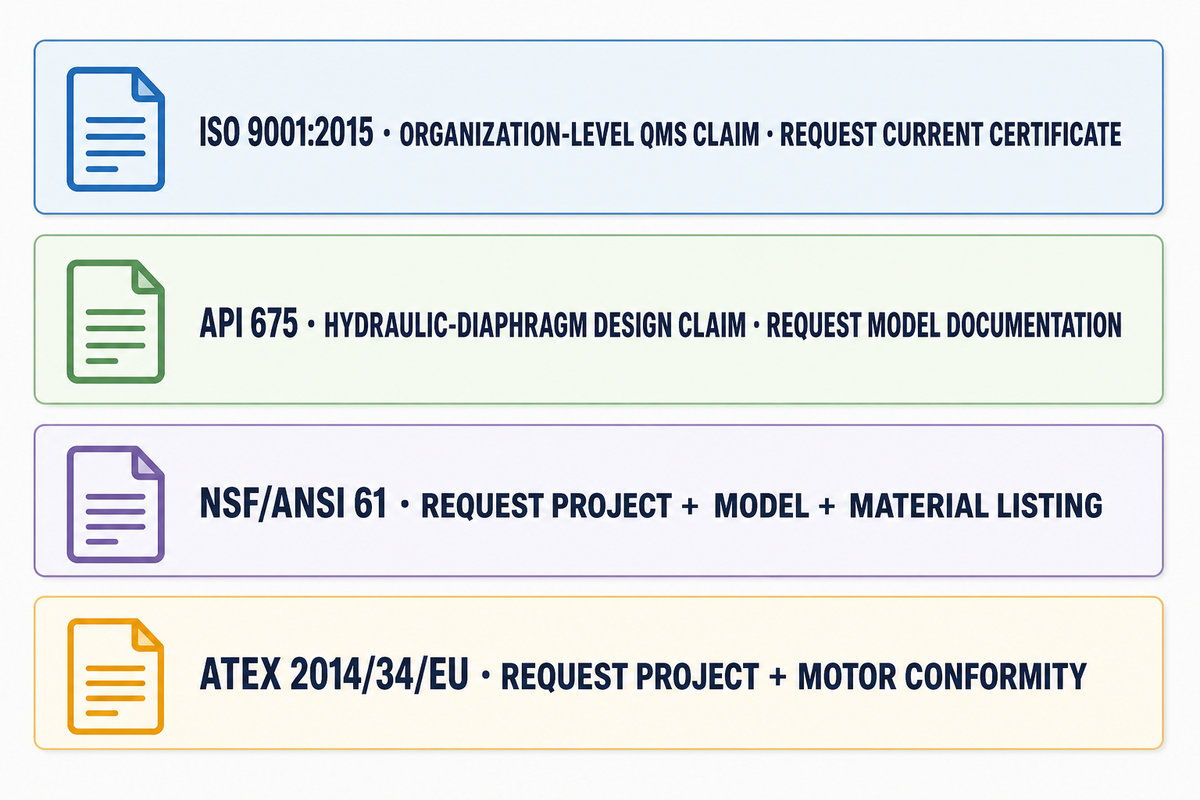
API 675 is the American Petroleum Institute standard covering positive-displacement, controlled-volume metering pumps, and it defines the accuracy, turndown, and linearity terminology used in their specifications. BBP’s product page states that its Hydraulic Diaphragm Series is designed to API 675; request model-specific compliance documentation before treating that statement as an approved project submittal. BBP’s ISO 9001:2015 claim concerns its organization-level quality management system, not a product certification. No site-wide NSF/ANSI 61 listing or ATEX conformity claim should be inferred without model-specific evidence.
A complementary standard from the Hydraulic Institute, the ANSI/HI 7.1-7.5 standard (now in its 2023 edition), covers nomenclature, design, and application considerations for controlled-volume metering pumps. For potable-water materials, NSF/ANSI/CAN 61-2024 and 600-2024 expanded PFAS testing for fluoropolymer materials ahead of a January 1, 2028 compliance deadline. For a potable-water project, request a current model- and material-specific listing rather than assuming a range-wide certification.
| Certification | Scope |
|---|---|
| ISO 9001:2015 | BBP organization-level quality-management claim; request the current certificate |
| API 675 | BBP states that the Hydraulic Diaphragm series is designed to the standard; request model documentation |
| NSF/ANSI 61 | Project-, model-, and material-specific potable-water listing; not evidenced here as BBP-wide |
| ATEX 2014/34/EU | Project- and motor-specific conformity; not evidenced here as BBP-wide |
These documents matter most in high-pressure applications and other regulated industrial applications — petrochemical injection skids, power-plant boiler feed, or effluent-permitted discharge points — where missing project-specific documentation can block commissioning regardless of pump performance.
Total Cost of Ownership: Accuracy, Automation, and Chemical Savings
Across the water treatment industry, whether it’s a municipal water treatment plant expansion or an industrial wastewater treatment retrofit, chemical spend ranks among the largest controllable line items, and cutting chemical waste without compromising water quality is where accuracy pays for itself. Precise doses help a controlled loop maintain the correct concentration while avoiding systematic overdosing.
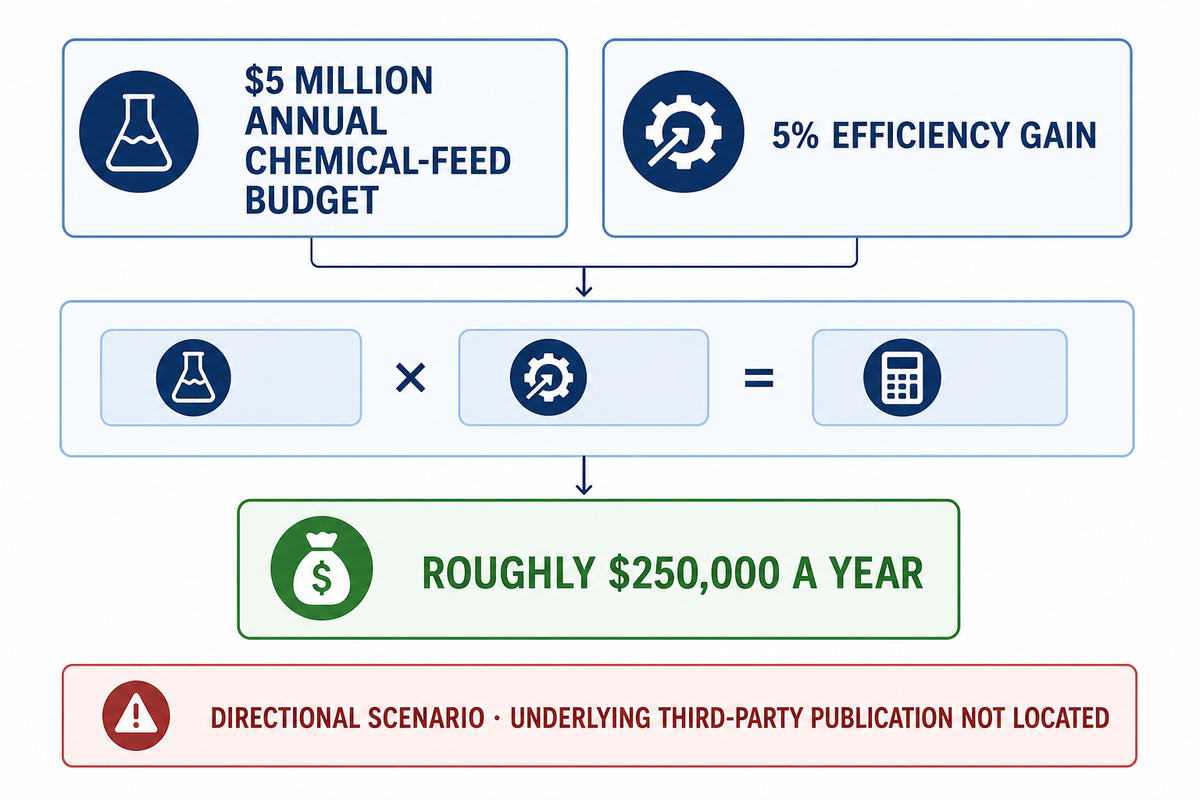
When a plant upgrades from a low-accuracy to a high-accuracy continuous-duty pump, chemical savings — not the pump’s purchase price — usually decide whether the upgrade pays for itself. BBP’s product page relays vendor data attributed to a 2024 Blue-White Industries mining-sector dosing analysis: a 5% efficiency gain on a $5 million annual chemical-feed budget would equal roughly $250,000 a year. Treat that arithmetic as a directional scenario, not a promised return, because the underlying third-party publication could not be independently located.
Other outcome anecdotes relayed on the same BBP page do not provide verifiable source URLs. Use them as questions for supplier due diligence, not as independently verified savings or maintenance benchmarks for a specific site.
Pricing Factors Framework, What Drives Quoted Cost
- Series selection — solenoid is the entry point; API 675-compliant hydraulic diaphragm sits at the top of the range
- Wetted material tier — PVC baseline, stepping up to PVDF, 316 stainless, PTFE, or Hastelloy
- Certification package — NSF/ANSI 61 listing, API 675 documentation, ATEX zone rating, and project-specific material certificates
- Control option — keypad-only, 4-20 mA/pulse input, Modbus RTU, or full PLC integration package
- Drive option — single-phase AC, variable frequency drive, explosion-proof motor, or DC drive for remote sites
- Accessories — pulsation dampeners, calibration columns, injection quills, flow verification sensors
- Quantity tier — single-pump pricing below 10 units; OEM tiers begin at 50 units
- Documentation depth — standard datasheet or a full FAT-grade engineering dossier with P&ID markup
- Incoterms — FOB origin, CIF to major ports, or DDP depending on destination and compliance requirements
Run the reagent spend and duty profile through BBP’s ROI savings calculator before treating the scenario above as indicative for your site.
Installation and Maintenance for Uninterrupted Wastewater Treatment
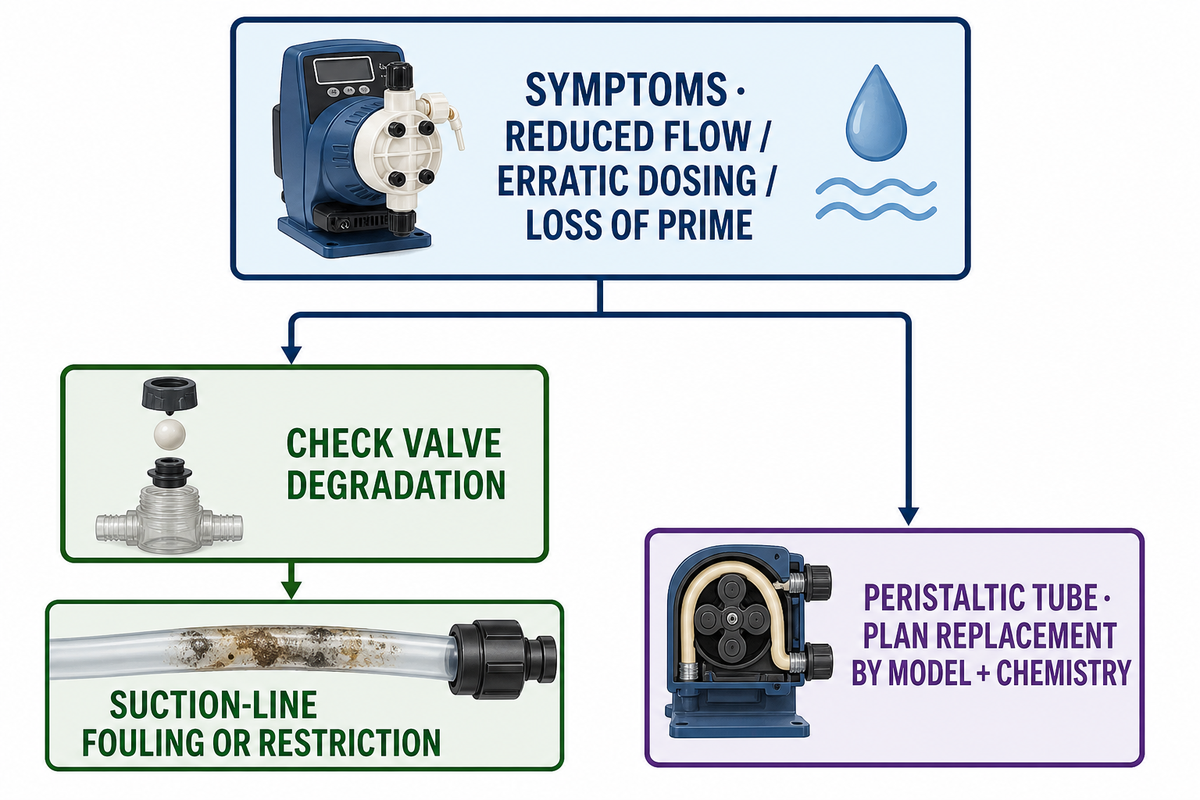
Check-valve degradation and suction-line fouling can produce the same symptoms as diaphragm failure — reduced flow, erratic dosing, and loss of prime — so inspect those components before replacing the diaphragm. Peristaltic systems avoid the check-valve failure mode but require scheduled tube replacement. One vendor-published wastewater polymer-dosing case reported a 90-day tube interval; it is a case-specific observation, not a universal maintenance schedule.
Suction-line design decisions made at installation determine how much of this maintenance burden shows up later. A flooded-suction layout, adequate NPSH margin, a foot valve at the tank outlet to hold prime between cycles, and a suction line free of sharp fittings or dead zones all reduce the frequency of prime-loss events on off-gassing or high-lift applications — retrofitting these after installation is far more disruptive than specifying them at the RFQ stage. Getting these details right at commissioning also cuts the safety risks that come with operators manually topping off prime or clearing a fouled suction line on a live chemical skid.
💡 Pro Tip
Ask for an NPSH calculation with every quote, not just a generic spec-sheet figure. Competent sizing starts with the actual suction-line length, fluid specific gravity, and vapor pressure; the Hydraulic Institute reference index provides the applicable standards context, while those site inputs expose a marginal suction design before it becomes a recurring loss-of-prime service call.
Dosing System Integration Requirements: Power, Controls, and PLC/DCS Compatibility
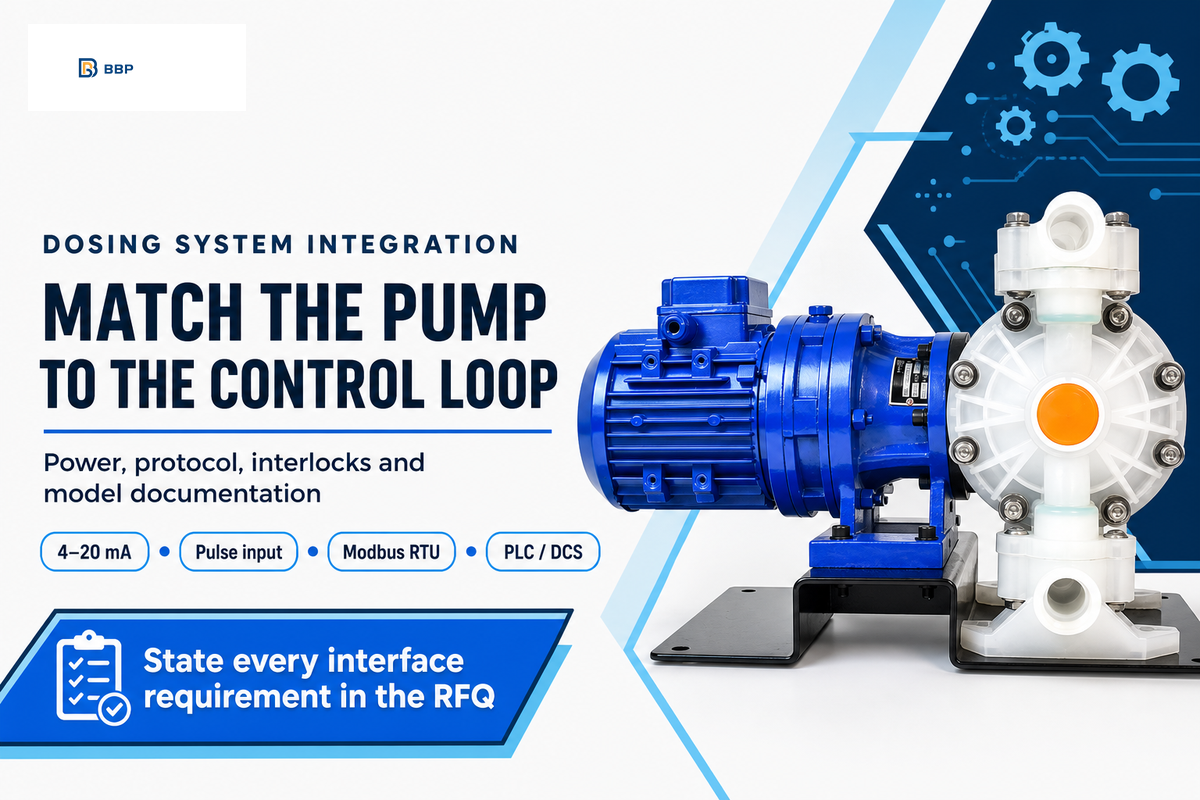
Before an RFQ is worth sending, a continuous-duty dosing pump has to clear one more hurdle: control-protocol compatibility with the plant’s existing PLC or DCS. BBP’s motor-driven and hydraulic diaphragm series support 4-20 mA analog input, pulse input for batch or proportional dosing, dry-contact start/stop interlock, and Modbus RTU. Solenoid-driven series are typically limited to pulse or 4-20 mA input without the closed-loop flow-verification feedback available on the motor-driven and hydraulic families, so a plant standardized on Modbus-based SCADA should confirm protocol support before shortlisting a solenoid pump for a critical loop. Plants across water and wastewater operations increasingly standardize on central control systems that expect this level of integration by default, not as a paid option.
RFQ checklist — copy these into your quote request:
| Parameter | Recommended range | Why it matters | How to verify |
|---|---|---|---|
| Flow range needed | Model-specific | Undersized pump can’t hold turndown at the low end | Cross-check the required range against the current model datasheet |
| Discharge pressure | Up to 870 PSI in BBP’s published comparison | Exceeding a series’ rated PSI risks diaphragm or seal failure | Confirm system head plus safety margin against the selected model’s maximum PSI |
| Control protocol | 4-20 mA / pulse / Modbus RTU | Mismatch causes a PLC integration delay at commissioning | State protocol explicitly at RFQ; request interface module confirmation |
| Wetted material | Match chemical category per compatibility matrix | Wrong material means corrosion or leak within months | Request a material certificate traceable to the foundry heat |
| Certification package | API 675 / NSF-ANSI 61 / ATEX as applicable | Missing certification blocks commissioning at regulated sites | Request model- and project-specific compliance documents before ordering |
| NPSH margin | Site-specific — suction length, specific gravity, vapor pressure | Insufficient NPSH margin can cause suction-side failure | Request a calculated NPSH value for your suction geometry, not a generic spec |
| Duty-cycle rating | Continuous (24/7) vs intermittent | A standard-duty pump under 24/7 load accumulates diaphragm fatigue | Confirm the specific series is continuous-duty rated for your run schedule |
Before an RFQ goes out, BBP’s pre-sales engineering team can help review borderline duty-cycle or control-protocol questions. When the selection is narrowed, browse BBP’s full chemical pump product line or contact BBP’s engineering team for a sizing recommendation and formal quotation.
Frequently Asked Questions
Q: What is a chemical dosing pump in water treatment?
A chemical dosing pump is a positive-displacement device that injects a precise, controlled volume of a chemical into a water or wastewater stream at a known flow rate and pressure.
Unlike a general-purpose transfer pump, it is built to hold that flow rate to a tight tolerance (commonly ±1–2% of set point) so the chemical concentration in the treated water stays within a target range. In municipal and industrial water treatment, dosing pumps cover duties as different as chlorine disinfection and corrosion-inhibitor injection in boiler systems.
Q: Which pump type is commonly used for chemical dosing?
All three major types of dosing pumps are metering-pump subtypes, and the right one depends on the chemical and duty cycle. Mechanical and hydraulic diaphragm pumps suit continuous, higher-pressure dosing because the diaphragm isolates the chemical from moving parts.
Diaphragm pumps (mechanical or hydraulically actuated) dominate continuous, higher-pressure dosing because the diaphragm isolates the chemical from moving parts. Peristaltic pumps are preferred for abrasive slurries, off-gassing chemicals like sodium hypochlorite, or polymers with entrained gas, since the tube is the only wetted part and there are no check valves to foul. Solenoid-driven diaphragm pumps suit lower-pressure, lower-flow applications such as small municipal or OEM reverse-osmosis dosing.
Q: What is a continuous-duty dosing system?
A continuous-duty dosing system is designed to run 24/7 without the scheduled downtime that standard-duty pumps need for diaphragm or seal wear. In hydraulic diaphragm pump designs, a hydraulic fluid cushion — rather than a direct mechanical linkage — actuates the diaphragm, which removes the direct stress cycling that limits a standard diaphragm’s service life under constant operation.
In hydraulic diaphragm pump designs, a hydraulic fluid cushion — rather than a direct mechanical linkage — actuates the diaphragm, which removes the direct stress cycling that limits a standard diaphragm’s service life under constant operation. This construction is what allows some hydraulic diaphragm metering pumps to carry an explicit 24/7 continuous-duty rating, versus intermittent-duty pumps that are only rated for scheduled, interrupted dosing cycles.
Q: Chemical injection pump vs. dosing pump: what’s the difference?
The terms are largely interchangeable in industry use.
“Chemical injection pump” is more common in oil-and-gas and high-pressure process contexts, while “dosing pump” and “metering pump” are the standard terms in water treatment. All three describe the same core function: precise, controlled chemical addition to a process stream.
Q: What is the difference between a chemical dosing pump and a metering pump?
None in practice — “metering pump” is the broader engineering term for any pump that delivers a precise, adjustable flow rate. A “chemical dosing pump” is simply a metering pump applied specifically to chemical-injection duty.
Q: How do you prevent vapor lock when dosing sodium hypochlorite?
Sodium hypochlorite off-gasses over time, and the released oxygen bubbles can collect in the suction line or liquid end and cause vapor lock: the pump strokes normally but stops moving liquid.
The most common mitigations are: sizing the suction line short and with minimal elevation change so gas bubbles migrate back to the tank rather than collecting at the pump head; using a liquid end with a degassing or bleed valve that vents accumulated gas back to the tank; keeping the chemical tank cool and shaded to slow decomposition; and, where off-gassing is severe, switching to a peristaltic pump design, since its single flexible tube has no check valves or narrow internal passages for gas to lodge in.
Q: How often should the wetted parts of a dosing pump be replaced?
It depends on pump type and chemical.
Diaphragm and valve wetted parts on continuous-duty hydraulic diaphragm pumps are generally maintained according to the selected model, chemical, pressure, and inspection history. Peristaltic tubing wears mechanically and is replaced on a planned interval. A vendor-published wastewater polymer-dosing case reported a 90-day interval, but that case is not a universal replacement schedule.
References & Sources
- ANSI/HI 7.1-7.5 Controlled-Volume Metering Pumps for Nomenclature, Application and Operation — Hydraulic Institute
- API Standard 675 Addenda and Errata — American Petroleum Institute
- NSF/ANSI 61 & 600 Updated for PFAS Regulations — Association of State Drinking Water Administrators
- Pump Standards and Reference Index — Hydraulic Institute
- Causes and Solutions for Vapor Locking in Chemical Metering Pumps — Blue-White
Related Articles
- How to Write an RFQ for Industrial Pumps: The Complete Specification Checklist — use alongside the RFQ checklist above when requesting a dosing pump quote.
WHY BUYERS WORK WITH BBP
About BBP Manufacturing
BBP Manufacturing Co., Ltd. is a Beijing-based industrial pump manufacturer with in-house foundry, heat treatment, machining, assembly, coating and inspection capabilities. We support industrial projects across slurry handling, sewage treatment, clean water transfer, chemical service, fire protection, irrigation and OEM pump supply.
Our Engineering Support
We help engineering buyers select and source the right pump configuration, not just compare prices. Send us your flow rate, head, medium, solids content, temperature, pH value, material requirement and installation conditions. BBP engineers will recommend a pump series, material option, duty curve basis, lead time and spare-parts plan for your RFQ.
Company Profile // DATA_SHEET
Name
BBP Manufacturing Co., Ltd.
Brand Name
BBP
Country
China
Headquarters
Beijing, P.R. China
Business Type
Industrial Pump Manufacturer
Model
B2B / OEM / ODM / Project Supply
Main Products
Slurry Pumps, Sewage Pumps, Centrifugal Pumps, Split Case Pumps, Multistage Pumps, Chemical Pumps, Fire Pumps, Irrigation Pumps
Manufacturing Capability
Foundry, Heat Treatment, Machining, Assembly, Coating, Inspection
Certifications
ISO 9001 / CE / SGS / BV / TÜV
Export Reach
90+ Countries & Regions
Standard Lead Time
About 25 Days for Standard Configurations
Contact Person
Wesley · International Sales
Phone / WhatsApp
+86 182 1085 0516
Email
contact@bbpmfg.com
Website
https://bbpmfg.com/
Address
Room 2803, Building 11, Phase II, Nuode Center, Fengtai District, Beijing, P.R. China