Get in Touch with BBP

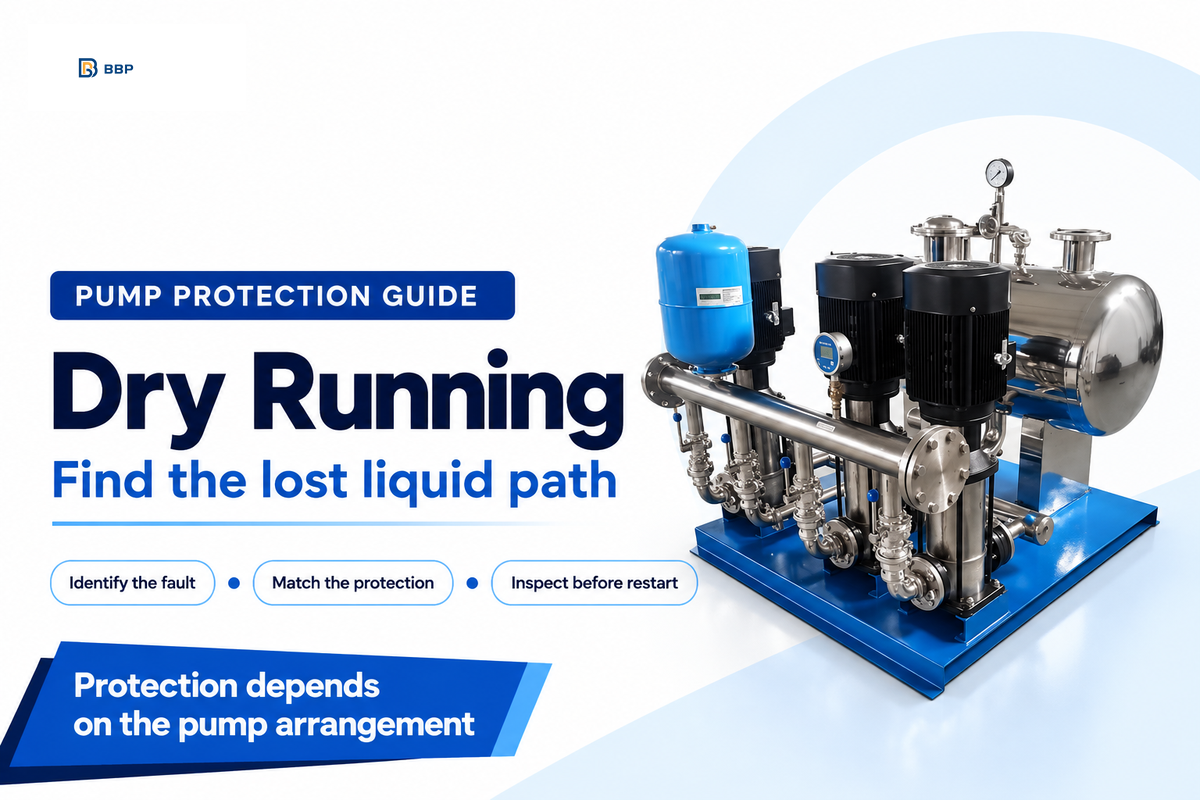
Dry running occurs when a liquid-bearing pump operates without the liquid it needs to cool or lubricate its wetted components. This can lead to damage to the pump. Stop a liquid-dependent pump when dry running is suspected; correct the supply fault and assess damage before restarting. Protection works best when the measured signal matches the failure (low source level, lost delivery, abnormal motor load, or local overheating).
A full tank can coexist with a dry seal chamber. A motor can keep turning even though the pump loses prime. The two cases explain why we examine the liquid path first and then consider the controller’s price when selecting a relay.
Dry running in pumps: what loses lubrication
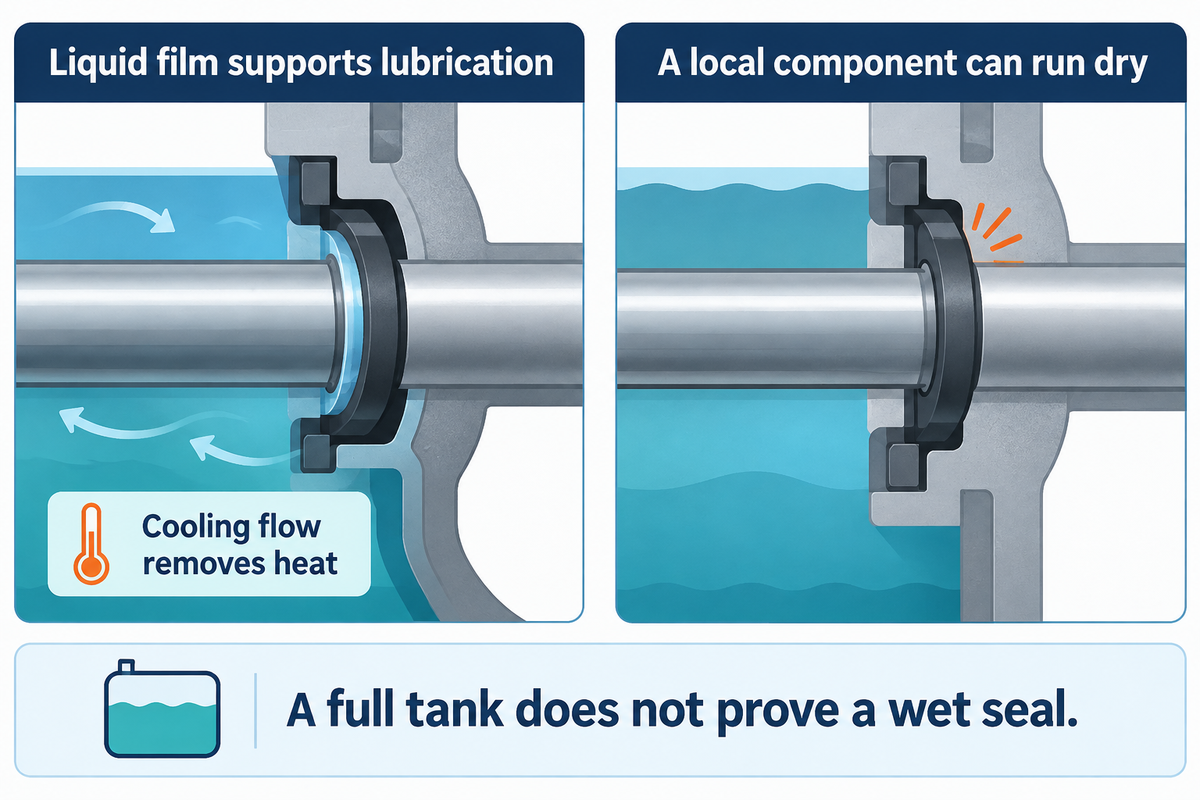
Dry running removes the liquid film or cooling flow that pump parts need during operation. This can cause friction and heat to damage mechanical seal faces and liquid-lubricated bearings. Partial dry running affects a local component even when other parts remain wet. This means that the entire casing doesn’t have to be empty.
KSB’s Dry running pump lexicon describes complete and partial loss of liquid at normally wetted components. Use the example of a bearing that’s dependent upon circulating liquid: what happens when the circulation stops? The shaft keeps turning. Partial liquid remaining elsewhere in the machine offers little help at the rubbing surface. Externally lubricated bearings have a different supply path, so determine the configuration before pinpointing the cause.
In an Eng-Tips discussion, an operator described a vertical sump pump whose impellers stayed submerged while the seal chamber drained during shutdown. He stated the pump started with a squeal. This is an unverified field report, but it raises an important maintenance question: where does liquid remain between starts? For similar installations, the maintenance group would look at the seal chamber’s venting and support with the pump and seal suppliers. Buying a deeper tank level switch leaves this local supply question unanswered. The seal arrangement drawing, together with the pump cross-section, shows the component to protect, since that component may be above the liquid level visible to the operator.
The Hydraulic Institute’s Pump FAQs discusses seal-chamber venting during start-up, operation and shutdown. Include those states when evaluating the liquid path.
Dry running, cavitation and deadheading compared
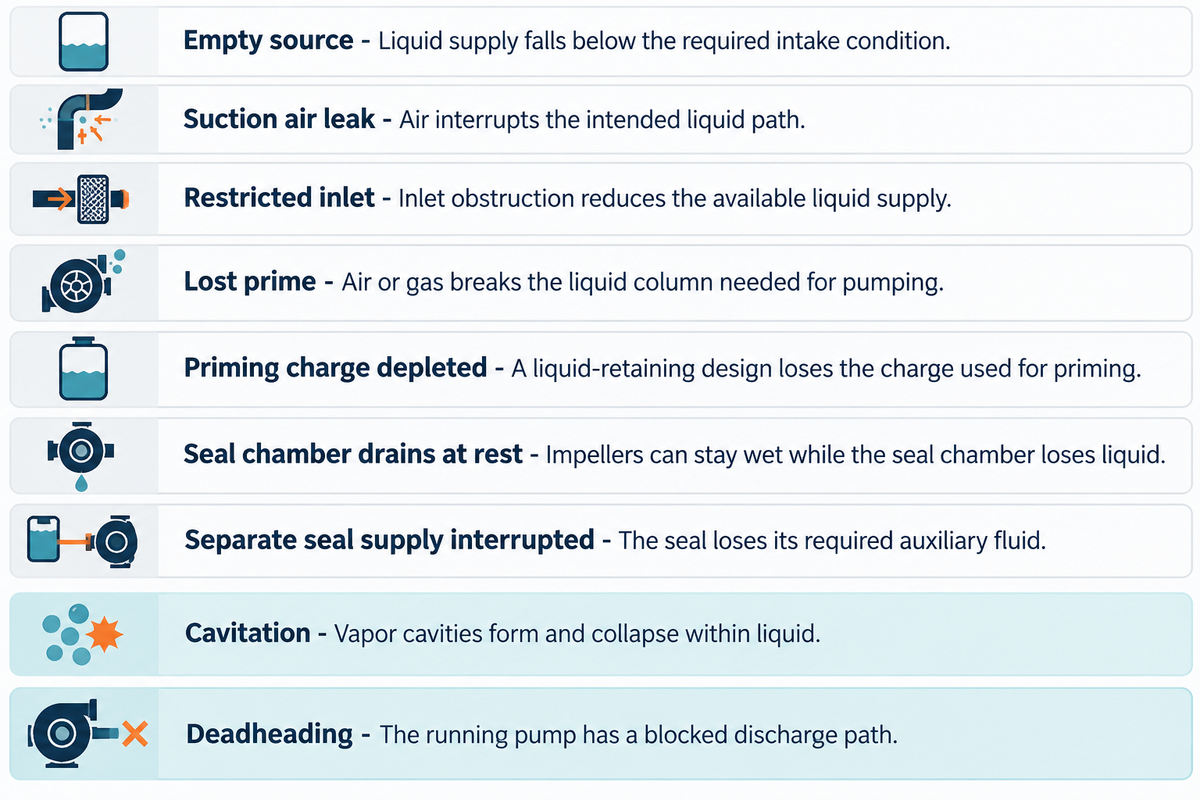
Dry running occurs when there’s insufficient liquid at dependent parts of the pump. Cavitation occurs when vapor bubbles form and collapse in the liquid. A running pump can also have a blocked discharge path and be dead headed. Lost prime interrupts the liquid needed for pumping and can lead to dry running. These conditions can overlap; however, they require different analysis.
The Liquid-Flow-Load Fault Map below is organized to assist with planning maintenance work. Use the observations and your knowledge of the pumps and the operating history to diagnose possible faults.
| Fault category | Liquid and flow | Useful observation | Where to investigate |
|---|---|---|---|
| Empty source | Liquid supply falls below the required intake condition. | Source depletion before loss of delivery. | Source level and stopping arrangement. |
| Suction air leak | Air interrupts the intended liquid path. | Priming or delivery changes after suction work. | Opened joints and suction tightness. |
| Restricted inlet | Inlet obstruction reduces the available liquid supply. | Restricted suction with poor or unstable delivery. | Inlet route, strainer and suction conditions. |
| Lost prime | Air or gas breaks the liquid column needed for pumping. | Delivery fails to recover after a stop. | Priming arrangement and retained liquid. |
| Priming charge depleted | A liquid-retaining design loses the charge used for priming. | Prolonged unsuccessful priming and heating. | Initial filling and the cause of failed priming. |
| Seal chamber drains at rest | Impellers can stay wet while the seal chamber loses liquid. | Startup symptoms after a shutdown. | Seal position, venting and the support arrangement. |
| Separate seal supply interrupted | The seal loses its required auxiliary fluid. | A support-circuit fault despite main pump delivery. | The seal circuit and its intended monitoring. |
| Cavitation | Vapor cavities form and collapse within liquid. | Noise or unstable performance associated with suction conditions. | Available suction conditions versus the pump requirement. |
| Deadheading | The running pump has a blocked discharge path. | Closed discharge path and zero external delivery. | Valve position and minimum-flow arrangement. |
Source basis: KSB’s pump lexicon, Hydraulic Institute guidance, Michael Smith Engineers’ Self-Priming Pumps technical guide and the attributed Eng-Tips seal-chamber report.
Zero discharge flow is a symptom shared by many possibilities, including pump deadheading among others. So, for a liquid-filled pump with a closed outlet, considering a low-level switch isn’t the best choice. A protection purchase should address the identified cause: a source-level sensor cannot detect every closed discharge valve.
Dry running causes along the suction path
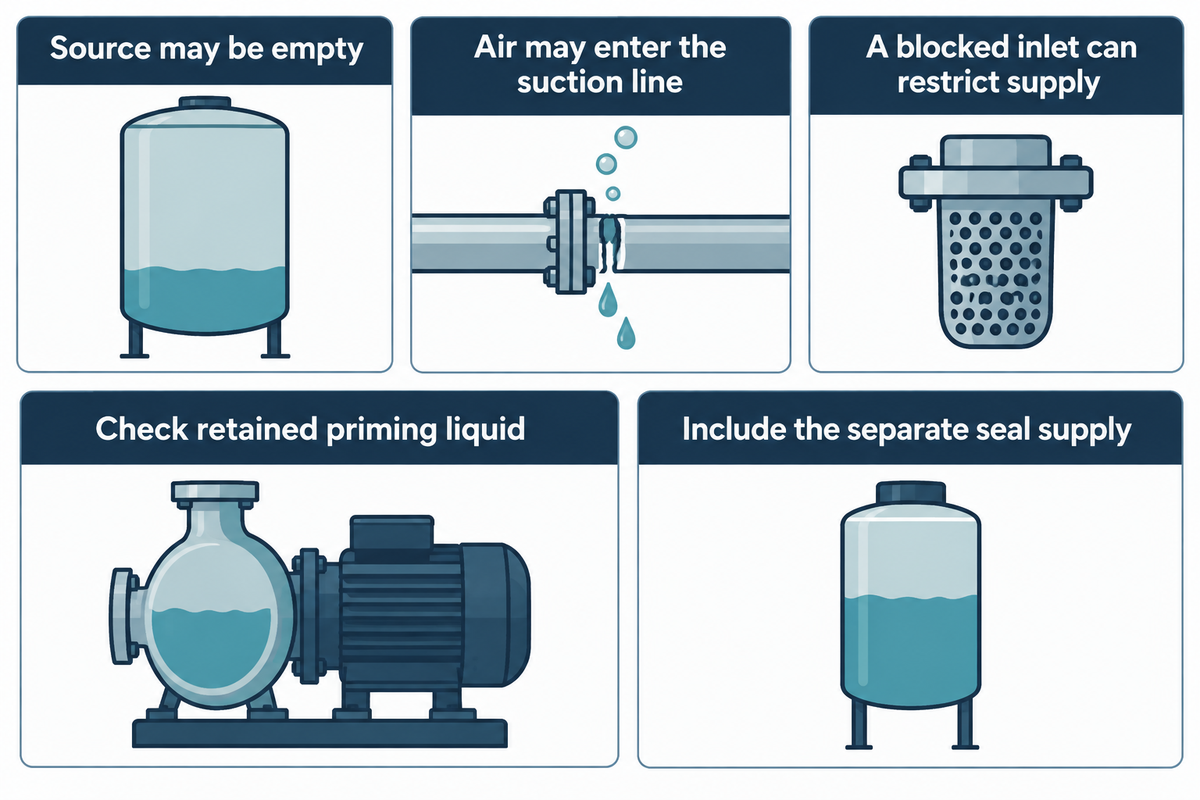
Dry running may result from an empty source, blocked inlet, lost prime or interrupted seal-support flow. It may also result from air entering the suction line. Trace the route from the source to the affected component. A visible water level at the source indicates little, if anything, about a blockage or air leak along that route.
Causes of failed priming listed in the Michael Smith Engineers’ self-priming guide include suction leaks, excessive priming times, wear, and incorrect assembly. In liquid-retaining centrifugal designs, prolonged unsuccessful priming can also cause evaporation and heating of the charged liquid.
Consider a maintenance team returning a self-priming transfer pump to service after suction-pipe work. The source tank is full, but delivery isn’t building up. A useful comparison is between the last successful start and the current one: which joints were opened, was the priming charge restored, and is the suction line airtight? Prolonging the starting time further exposes the retained charge to more heat. An air leak introduced during the maintenance wouldn’t be detected by a low-level alarm. Once the equipment is isolated and safe to inspect, the team can compare the assembly with the maker’s filling and venting instructions before planning another start.
Combine the review of self-priming pump requirements and pump suction piping. In the case of an external supply seal, include that circuit in the fault analysis as well.
Dry running protection: choose the right signal
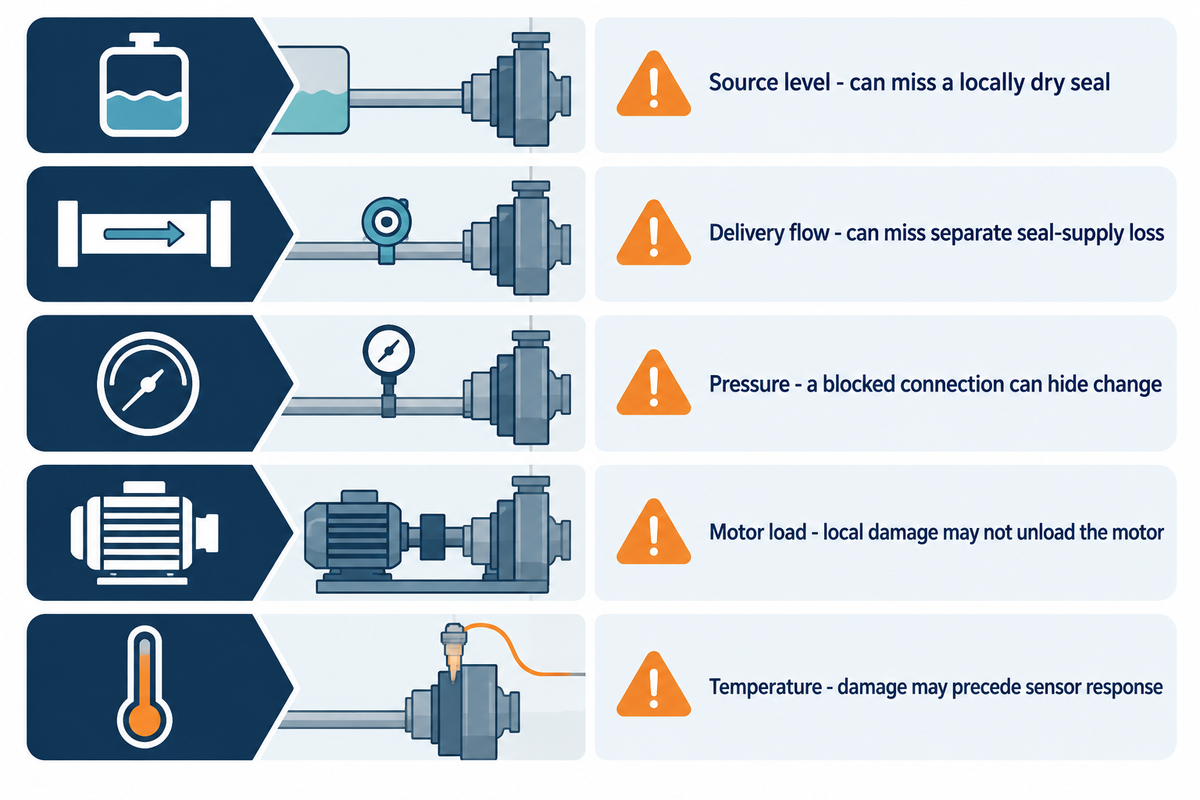
Dry running protection should determine the condition that threatens the pump and shut it down before the protected component is damaged. Level sensing addresses source depletion. Other symptoms may be addressed by flow, pressure, motor load or temperature monitoring. Each method leaves different failures uncovered, and selection requires the operating range of the pump and the location of the sensing element.
| Signal | Useful application | Failure it can miss | Selection question |
|---|---|---|---|
| Source level | Stop before the source is depleted. | Blocked suction or a locally dry seal chamber. | Does the stopping level preserve the required submergence? |
| Delivery flow | Detect lost delivery during a permitted operating state. | Loss of a separate seal-support supply. | Where is flow measured, including any bypass? |
| Pressure | Detect a pressure change tied to the intended duty. | Conditions outside the calibrated pressure pattern. | Can a blocked or isolated connection hide the process change? |
| Motor load | Detect a characteristic unloading of a compatible pump. | Local damage without the expected load decrease. | How do speed and normal duty changes affect the threshold? |
| Local temperature | Detect heating at the monitored component. | Damage that develops before heat reaches the sensor. | Is the sensor response fast enough for this arrangement? |
This comparison draws on HSE sensing guidance, Franklin Electric’s Pumptec documentation, and Valmet’s sponsored discussion of progressive cavity pumps in Pumps & Systems. The temperature lag and sticky media discussions in that article pertain to progressive cavity pumps.
How to Protect a Submersible Pump Against Dry Running?
A low-water-level control, or a compatible dry-run monitoring system that’s specific to the submersible pump, should be used. Settings should be adjusted to stop and restart the pump as required for the application. Grundfos’ SQ/SQE support guidance describes protection based on power consumption, with the dry-running threshold tied to the particular pump’s performance.
Another model-specific example can be found in Franklin Electric’s Pumptec range. Their published ratings distinguish the following single-phase devices:
| Device and part number | Published supply | Published motor range |
|---|---|---|
| Pumptec 5800020610 | 115/230 V, 60/50 Hz | 1/3–1.5 hp |
| Pumptec-Plus 5800060502 | 220 V, 50 Hz | 1/2–5 hp |
| Pumptec-Plus 5800060100 | 230 V, 60 Hz | 1/2–5 hp |
These are Franklin Electric device ratings, not BBP pump ratings. A three-phase installation requires a separately suitable protection arrangement. For a load-based selection, it’s necessary to distinguish pump power and motor load from the general assumption that each damaging event increases the current.
Dry running damage: inspect before restarting
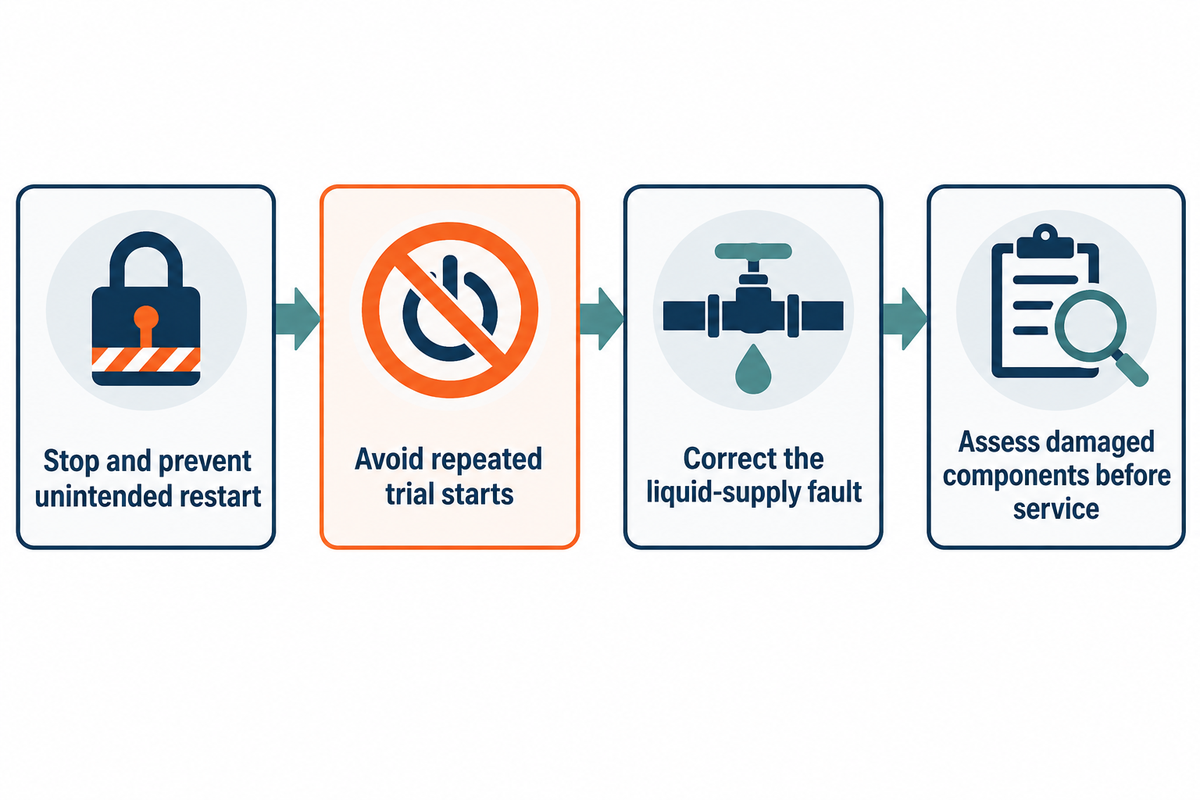
After suspected dry running, stop the pump and prevent unintended restart under the site’s isolation procedure. Correct the liquid-supply fault, then assess the affected seal, bearings and other components before returning the pump to service. Overheated parts may break down or wear out, and may require repair or replacement.
A burning smell, new leakage, abnormal noise or a seized shaft calls for fault investigation. Before investigating further, repeated trial starts and unintended restarts must be avoided. The chemical hazards and the temperature of the fluid, as well as any pressure in the system, must be controlled by qualified personnel before opening equipment; manage electrical isolation and pressure release.
Can you fix a pump that ran dry?
Yes, a pump can often be repaired by correcting the supply fault and replacing damaged parts; the repair scope follows inspection. Replacement of a seal, for example, may require the replacement of other parts, like a shaft or bearing, that are worn or damaged from rubbing. Keep all parts that are removed for inspection, and record the condition of the parts before they’re cleaned.
In Causes & Solutions for Leaking Pump Mechanical Seals, Vogel discusses the importance of examining sealing surfaces and preserving information about the installation. The announcement of the first edition of the API RP 697 describes guidance for field and shop repair of pumps. Use the repair record to distinguish the initiating fault from the resulting damage.
For a pump recently converted from packing to a mechanical seal, review the adequacy of the chamber fit, venting and heat removal. Issues associated with these conversions are addressed in Hydraulic Institute’s seal guidance. If the seal chamber is still gas-bearing, replacing the seals with the same part leaves the cause in place. The relevant pump bearing arrangement is also critical in determining which bearings are dependent on the process liquid.
Pumps that can run dry: check the exact design
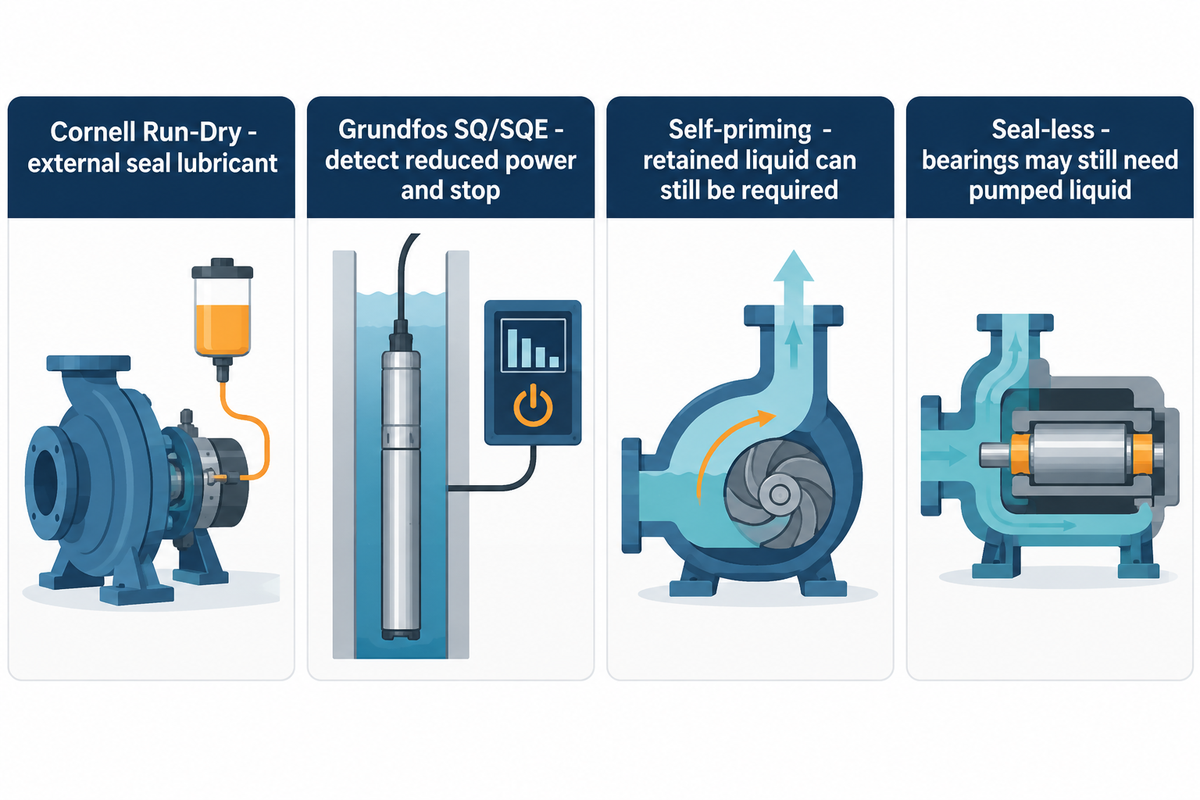
Pumps designed for dry operation provide an adequate seal, bearing, or lubrication arrangement to protect the vulnerable components. An automatic dry-run trip instead automatically stops a pump when the monitored fault appears. Self-priming and seal-less describe other design features; neither term alone gives a liquid-dependent pump permission to operate empty.
Cornell’s Run-Dry brochure describes an external lubricant reservoir that circulates lubricant through ports at the seal. Grundfos’ SQ/SQE pump protection against dry running relies on detection of reduced power consumption. The first example changes how a component receives lubrication, while the second relies on detecting a condition and stopping the process.
For a self-priming centrifugal pump, the retained liquid charge is part of the priming process. A seal-less pump may still have bearings that are dependent on the fluid that’s being pumped. Removing the shaft seal doesn’t always eliminate all surfaces that are lubricated by the liquid.
When sourcing dry-run-tolerant pumps, it’s important to specify the permitted operating states and required auxiliary supplies. A quotation for a dry-run-tolerant pump should spell out the components that enable this capability. Match the fluid and the duty through chemical pump selection and compare the protection packages.
Dry run protection cost: compare complete quotations
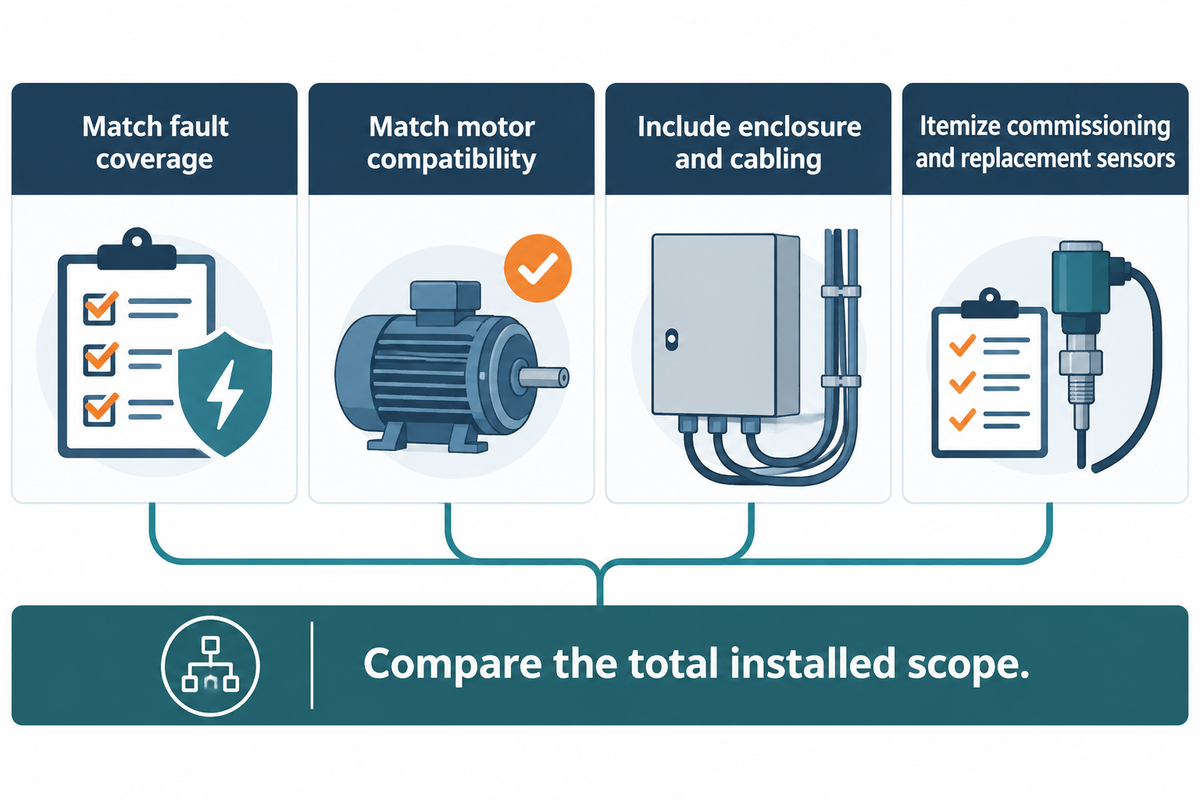
Compare the quotations for dry run protection on an installed basis. The lowest cost device may not include the work required to provide the function. Treat each bidder even-handedly by providing the same pump duty and failure condition and let finance evaluate the packages.
Imagine a buyer gets a quotation for a motor-load relay and for a level sensor with commissioning and some changes to the control panel. The relay quotation seems cheaper, but these quotes address different issues and contain different work. Maintenance first determines if the issue is an empty source or if the loss of liquid is somewhere else. Once that’s determined, both suppliers are asked to give a price for the fault coverage, motor compatibility and enclosure and cabling. Finance can then compare the total scope. Franklin’s separate voltage, frequency and motor-power ratings show why a device name alone is too vague for a purchase order.
Place the required shutdown action, restart policy and acceptance test in the industrial pump quotation request. Ask for itemized commissioning and replacement-sensor costs rather than a claimed savings figure without an operating baseline.
Dry running protection tests and operating limits
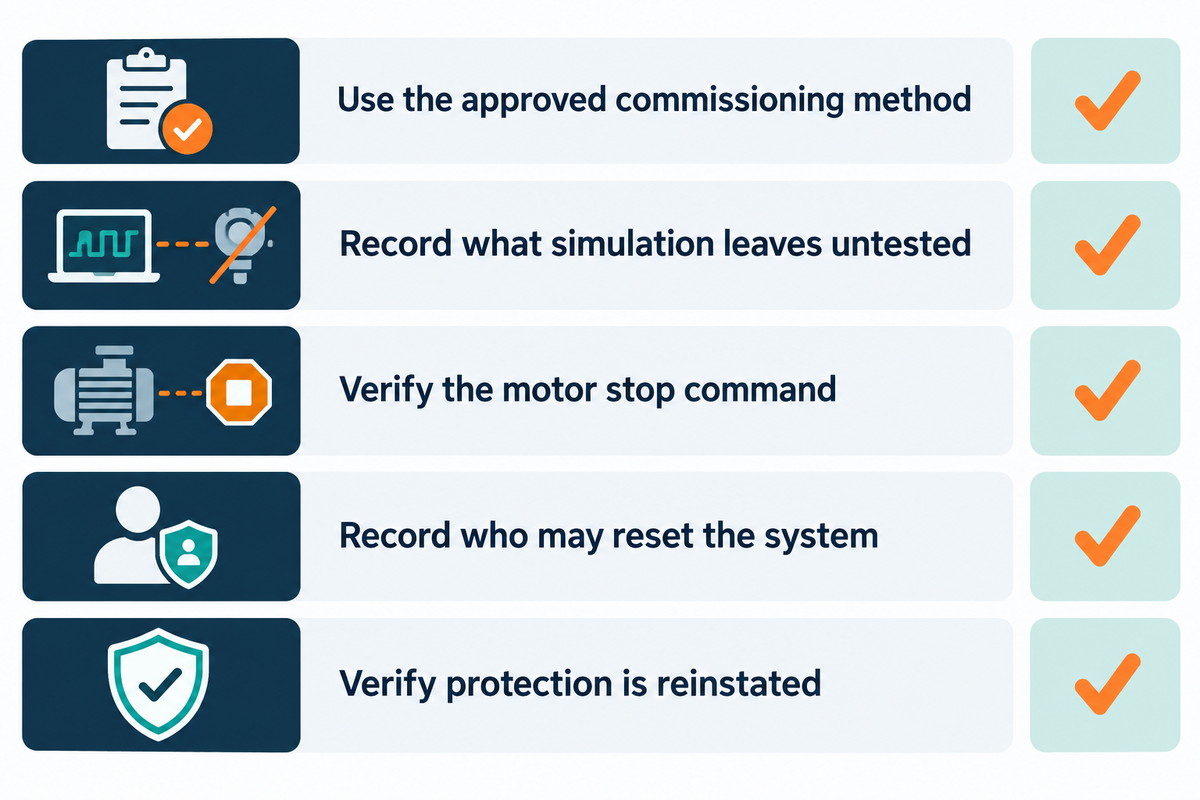
Test dry-run protection using the manufacturer-approved commissioning method, including the signal path, motor shutdown and reset behavior. Signal simulation can test controls while leaving the sensor or its process connection untested. Document how a test signal is entered, how components not tested are checked, and how the test is done without purposely running the pump dry.
“End to end tests at appropriate intervals, including proving sample/impulse lines.”
HSE’s major-hazard control-system guidance calls for end-to-end tests, because a successful logic test might not reveal a blocked sensing connection. HSE also advises verification of reinstatement after testing.
Before commissioning, record the sensor location and operating range, approved trip settings, permitted startup behavior and who may reset the system. Confirm that the final stop command reaches the motor and that normal protection is reinstated after the test. Operator training should address the difference between acknowledging an alarm and authorizing a restart.
Equipment for use in explosive atmospheres should be checked for its applicability. In October 2026, the ISO catalogue entry for ISO/CD 80079-37 listed the second edition as in preparation. A committee draft is not a new operating requirement. Record the applicable published edition and equipment documentation in the commissioning file.
Send BBP the pump model and fluid for which it’s being used, the pump’s duty point, and the current control system for the enquiry. Include the fault you need to prevent and the required restart policy.
Dry running FAQs
What is dry running of a pump?
Dry running means operation without enough liquid at the pump components that need it.
The loss can affect the whole pump or a local part such as the seal chamber. Liquid normally removes heat or lubricates those surfaces. A small amount remaining in the casing may leave another component dry, so investigation follows the supply to the affected part rather than the visible water level alone.
What happens if you run a well dry?
A falling well level can starve a pump of water, interrupt delivery and damage liquid-dependent parts unless suitable protection stops operation.
Recovery requires an adequate water supply and a pump fit for service. A dry-run controller may attempt automatic recovery according to its model-specific settings. Repeated trips call for investigation of the well supply and pump condition, rather than repeated manual resets that keep exposing the equipment to the same fault.
Does a thermal overload protect a pump from dry running?
A motor thermal overload isn’t a substitute for pump dry-running protection.
The overload responds to motor conditions, while the seal or liquid-lubricated bearing may lose cooling first. Load-based dry-run protection often looks for unloading, which differs from motor overloading. Retain the required motor protection and select dry-run sensing for the vulnerable component and its failure pattern across the intended operating range.
Can a self-priming pump start completely dry?
Many self-priming centrifugal pumps need an initial liquid charge.
Michael Smith Engineers describes retained liquid as part of the priming process in those designs. Fill and vent according to the exact pump instructions. Self-priming describes the ability to clear air from the suction line under the specified conditions.
How should a dry-run trip be reset?
Reset a dry-run trip after the supply fault is corrected and the pump meets its inspection and restart requirements.
Use the controller’s approved manual or automatic sequence. The installation may require a manual reset when an unexplained trip, hazardous fluid or suspected damage calls for inspection. An automatic recovery sequence needs the correct supply-recovery conditions and pump-specific settings. Keep the cause of the trip in the maintenance record so the next operator doesn’t inherit an unexplained recurring fault.
Is a dry-run relay enough when the tank is full?
Not necessarily: a full tank can coexist with lost prime or a locally dry seal, and the relay must detect the fault threatening the pump.
A full tank can feed a blocked suction line or a pump that has lost prime. Motor-load monitoring may detect unloading in a compatible installation; a locally dry seal can require different sensing. Match coverage to the actual liquid path.
Is dry running the same as a dry run rehearsal?
No. A dry run rehearsal tests a procedure; pump dry running describes a loss of required liquid during operation.
Keep those meanings separate in the commissioning plan. A controls technician can use an approved simulation to test part of a protection circuit without draining the pump. The test record should state the injection point and remaining checks, including the sensor, process connection, final shutdown and reinstatement. Calling a procedure a rehearsal doesn’t authorize operating a liquid-dependent pump without its required supply.
Related pump maintenance guides
References & Sources
- Hydraulic Institute, Pump FAQs: seal chambers, venting and pump operating guidance.
- HSE, Control systems: sensing connections, proof testing and reinstatement.
- API, RP 697 announcement: first-edition pump repair guidance.
- ISO, ISO/CD 80079-37 catalogue entry: development status of the second edition.
- Eugene Vogel, Causes & Solutions for Leaking Pump Mechanical Seals.
- Simo Rounela, sponsored discussion of dry-run protection for progressive cavity pumps, Valmet sponsored article.
Manufacturer technical references: KSB, Dry running; Michael Smith Engineers, Self-Priming Pumps; Franklin Electric, Pumptec, Single-Phase Pump Protection; Grundfos, How can the SQ/SQE be protected against dry running?; Cornell Pump, Run-Dry. The local seal-chamber example is attributed to the Eng-Tips discussion Plan 13 seal running dry at startup.