Get in Touch with BBP

Face Bearing Arrangements for Pumps: Load Lines, Preload and Thermal Growth

For angular contact bearings, “face bearing” usually refers to a face-to-face arrangement. For a pump, that orientation changes the load path: back-to-back and face-to-face pairs resist axial loads in both directions, while a tandem pair supports thrust in one direction. The correct choice also depends on how the complete shaft moves as it heats up.
Start with the arrangement drawing, not the bearing’s visible shield. A pair can have the right outside dimensions and still provide the wrong thrust support, preload or axial freedom. This guide separates those choices so you can discuss an existing assembly or a new pump duty with the correct information.
Face bearing meaning and the three arrangements
In an angular-contact discussion, “face bearing” generally indicates a face-to-face bearing arrangement instead of another bearing type. The important distinction is between back-to-back, face-to-face and tandem mountings. Their load lines determine how the bearing set handles thrust and tilting, even when the individual bearings look the same.
What is the arrangement of angular contact bearings?
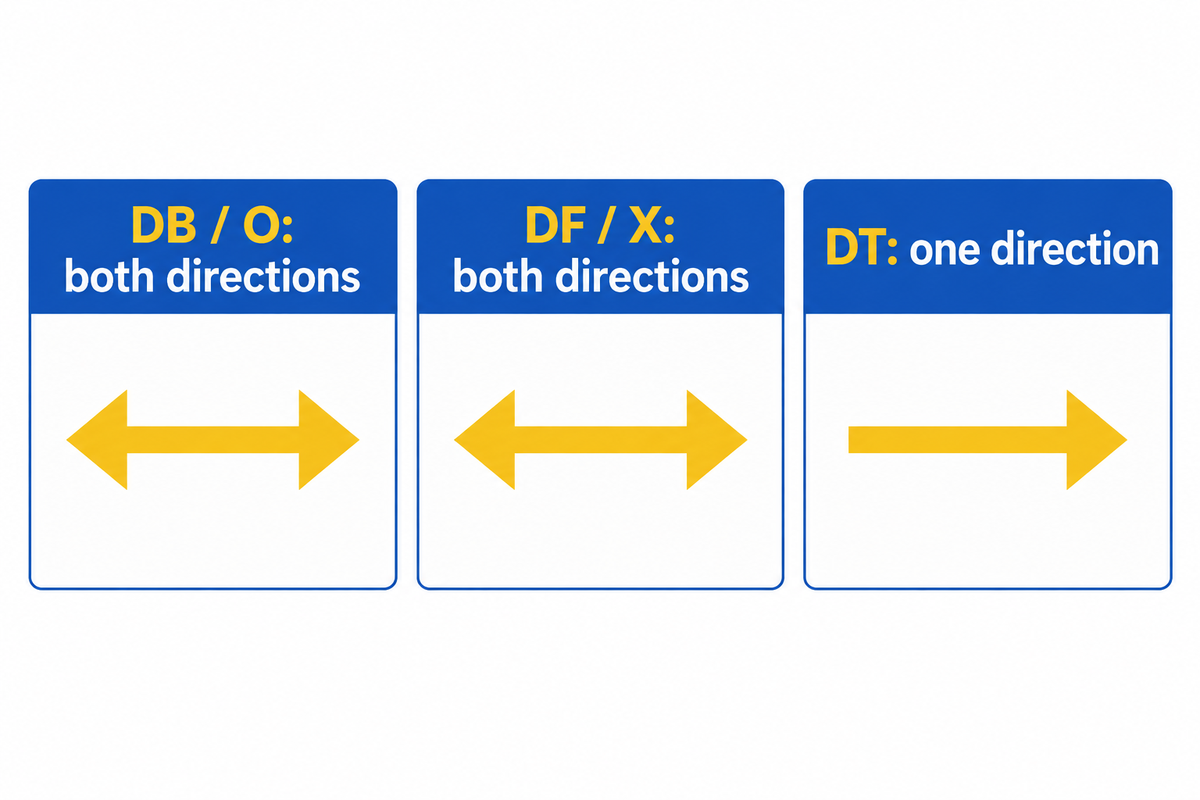
Back-to-back and face-to-face arrangements oppose the bearings to support axial load in both directions, while a tandem arrangement supports thrust in one direction. A conventional single-row angular contact ball bearing carries radial load and axial load in one direction; the arrangement combines those individual load directions.
The contact angle is the angle between the line connecting the ball contact points on the inner and outer raceways and a plane that’s perpendicular to the shaft axis. The inner race and outer race transmit force along this inclined line, and therefore radial force can also generate an axial component. NSK’s angular contact guide addresses this phenomenon and provides arrangement codes. Keep the code beside the actual drawing: supplier conventions for larger groups can differ.
| Arrangement | Load-line pattern | Axial support | First check |
|---|---|---|---|
| Back-to-back, DB or O | Lines diverge outward | Both directions | Moment duty and installed preload |
| Face-to-face, DF or X | Lines converge between bearings | Both directions | Relative alignment and moment requirements |
| Tandem, DT | Lines run in the same direction | One direction | Opposing support for reverse thrust |
Use the broader guide to pump bearing types and replacements for lubrication, damage and general bearing selection. The decision here concerns the relationship between bearings rather than every bearing that could be used in a pump.
Back-to-back vs face-to-face: load lines and moment stiffness
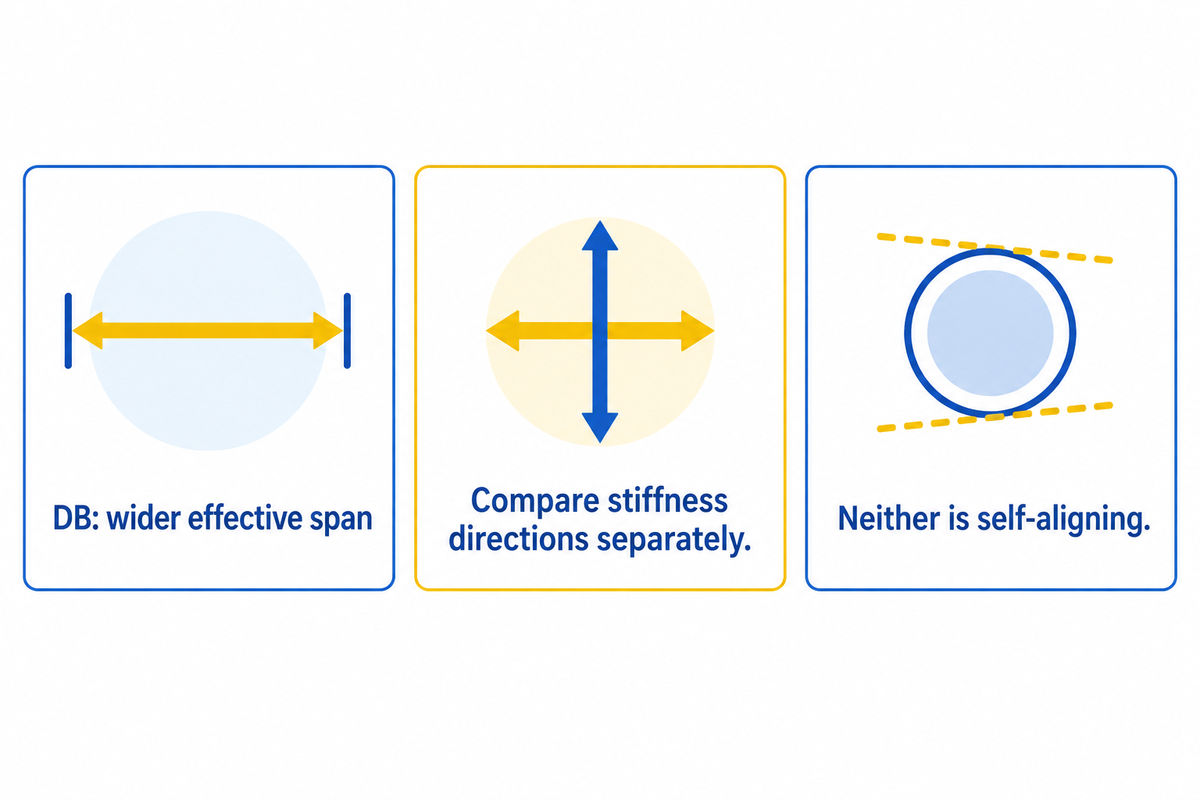
Generally, a back-to-back arrangement gives better resistance to moments than a comparable face-to-face arrangement because in the former, the effective pressure centers are farther apart. This is true for tilting resistance under similar conditions. It does not mean every measure of stiffness improves, or that a DF pair has no moment capacity.
What is the back to back and face to face bearing arrangement?
In a back-to-back pair, the reaction load lines diverge outward to form an O, while in a face-to-face pair they converge toward the shaft centerline to form an X. Reversing the bearings therefore changes the effective support span without changing their physical spacing.
Locate the contact lines from ball contacts to bearing axis. Do not substitute the distance between housing shoulders for the distance between effective load centers. The wider DB span helps resist moments in the shaft, such as those associated with an overhung impeller or a pulley load. DF is generally more accommodating of small alignment differences in a comparable assembly.
For comparable bearings and preload, Abhijeet Keer explains that face-to-face arrangements “cannot support moment loads as effectively as back-to-back arrangements”.
Abhijeet Keer, Pump Design Engineer, Pumps & Systems.
The qualifier is important. A theoretical and experimental grinding-spindle study by Hideo Uchida and Shigeo Shimizu reported favorable DF axial stiffness under its tested misalignment conditions. That doesn’t negate the comparison of moment resistance in terms of span; axial, radial and tilting stiffness describe different responses. Neither arrangement becomes a self-aligning bearing.
For a drawing review, mark the external force, its offset and the resulting moment, then compare bearing positions. Compare radial and axial stiffness separately. A general request for “more rigidity” leaves the engineer unsure which displacement matters to the seal, impeller or coupling. Machine tools illustrate the importance of the required direction of stiffness, even though their settings shouldn’t be applied to a pump.
When tandem bearings need an opposing bearing
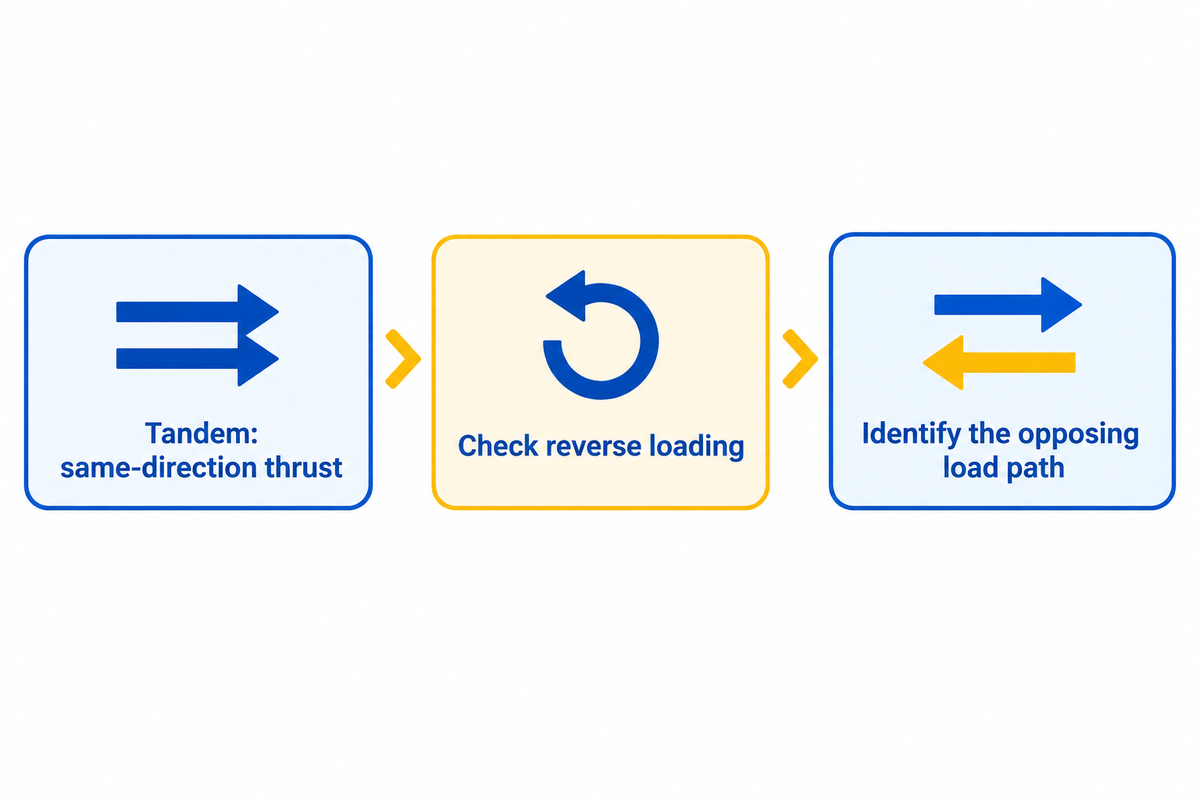
A tandem arrangement brings thrust-carrying directions together. It can allow for large axial load in that direction, but two bearings in the same direction don’t provide bidirectional thrust support. Check reverse loading across the complete pump and driver system before selecting an unopposed tandem set.
The Hydraulic Institute’s guide to hydraulic loads explains that axial thrust may change sign. In a vertically suspended pump, upthrust can load a motor bearing; in a horizontal machine, an abrupt operating change can also matter. The opposing bearing need not sit immediately adjacent to the tandem pair, but its load path must be identified and rated.
If thrust can reverse and the existing supports cannot carry it, the pump needs an opposing thrust bearing or a bidirectional locating arrangement. In this hypothetical example, separate from any BBP installation, a maintenance team sees 2 bearings together and assumes they restrain the shaft axially in both directions. The drawing shows angular contact bearings mounted in tandem and a rear bearing intended mainly for radial support. Trace the reverse thrust path through the assembly, including any driver thrust bearings. If a bearing carries reverse thrust, check its rating and allowable movement. Reversing one bearing alters how the pair shares load and alters preload. Treat that change as a design modification requiring review.
Matched load sharing relies on specified bearings and their mounting. Don’t suppose adding one bearing doubles the assembly’s capacity and/or service life.
Preload, contact angle and the clamp path
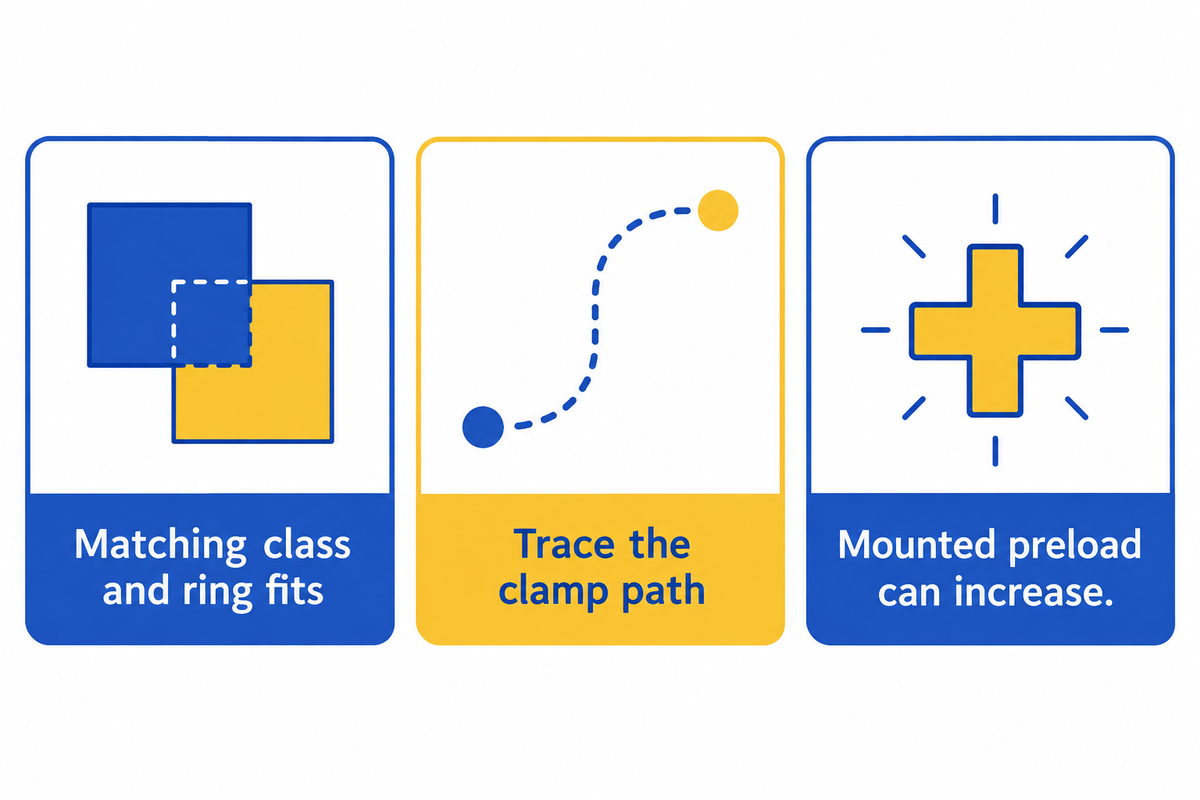
Preloading is the internal loading established prior to applying the external service loading. It’s mainly influenced by the geometry and the matching of the bearings, together with fits and axial restraint. Tightening a locknut may complete the clamp path, but its torque isn’t a universal measurement of the operating preload within the assembled bearing set.
NSK lists 15°, 25°, 30° and 40° as single-row contact angles. These are different product options, and aren’t recommended settings for all centrifugal pumps. A larger angle changes the balance of axial capacity, radial behavior and speed capability. The specified angular contact bearing must therefore be identified by its complete designation, not bore size alone.
Confirm how preload is achieved before removing the retaining parts. Follow the force through the shoulder, inner ring, spacer if fitted, opposing inner ring and retaining nut. The outer ring restraint through the housing and cover should also be considered. For a correctly specified assembly, precisely machined faces are designed to establish the required relationship when clamped together. That relationship can be altered by an improvised shim or by a cover that contacts the wrong face.
SKF’s preload guidance distinguishes factory-set classes from preload after mounting: interference fits can increase it. This same guidance states that heavier preloads increase the operating temperature of the components, and high speed spindle examples are provided to explain this. The preload forces described in these spindle examples do not specify settings for pumps.
Research on optimum preload also considers skidding and thermal behavior. The ASME paper by Fang and colleagues uses a model and a variable-preload experiment, supporting a balance between adequate loading and heat generation rather than a “tighter is always better” rule.
If an assembly runs hot after replacement, check the supplied matching class, ring fits, clamp path and type of lubrication together. Incorrect installation, excess lubricant and abnormal external loading can all produce similar symptoms. To determine the exact preload, locknut torque and allowable temperature, consult the assembly instructions from the bearing and pump manufacturers.
Shaft thermal growth needs a locating and non-locating plan
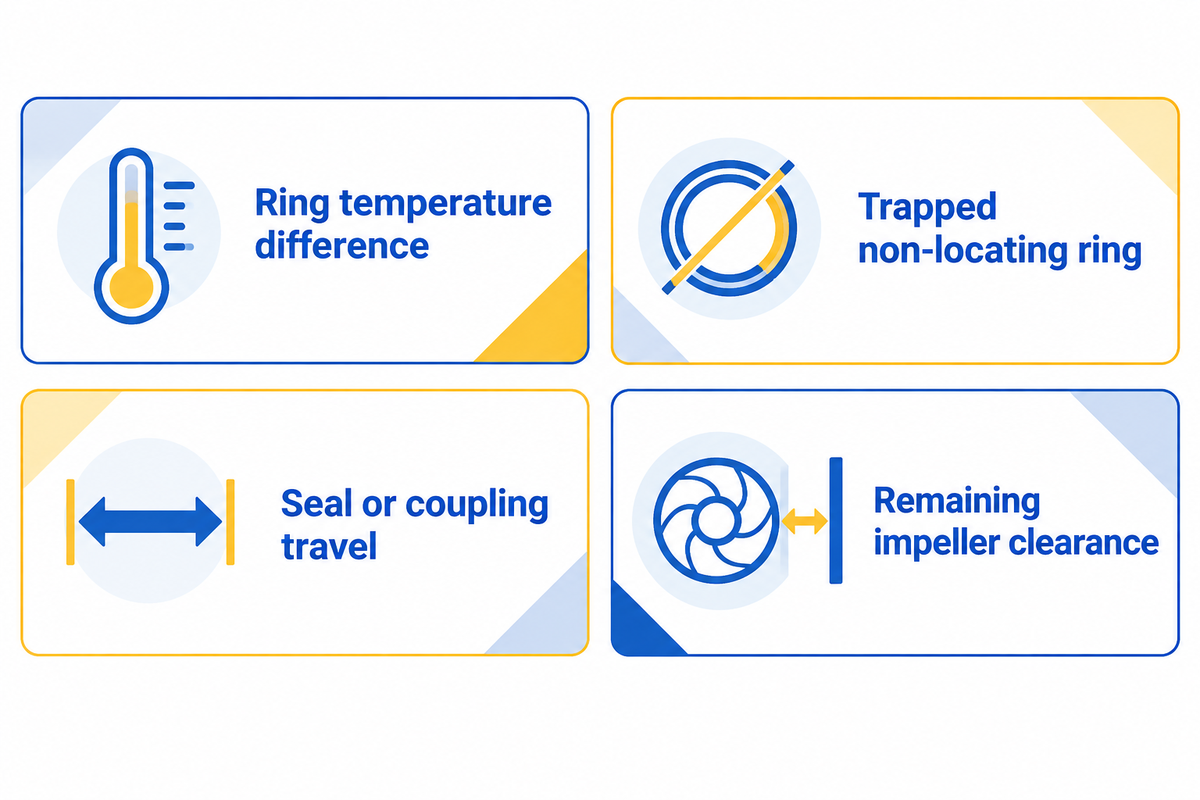
Changing DB to DF doesn’t by itself give an outlet for shaft thermal growth. Pair orientation governs local load transmission. The whole machine still needs a defined axial location and sufficient movement elsewhere, including compatible bearing fits, seal travel and coupling movement.
What are the differences between fixed and floating bearings?
A locating bearing sets the shaft’s axial position and carries the required axial forces, while a non-locating support allows axial movement as the distance between shaft and housing bearing seats changes. Depending on the design, that movement may occur within a suitable cylindrical roller bearing or through a deliberately selected ring fit.
Schaeffler’s arrangement guidance identifies N and NU cylindrical roller bearings as designs that accommodate axial movement within the bearing. When a deep groove ball bearing is used as a non-locating support, one ring must be able to slide in its seat. If the drawing shows that the floating support relies on a sliding ring, confirm that the seat fit permits axial movement after assembly. The Hydraulic Institute notes that deep-set pumps over 40 feet (12.2 meters) may need special machining for clearance where shaft stretch exceeds available axial clearance. Their concern is contact between the impeller and the bowl. This check is distinct from internal clearance of the bearing.
| Hidden bottleneck | Possible consequence | Input to obtain | Responsible role and next action |
|---|---|---|---|
| Differential inner and outer ring temperatures | Operating clearance or preload changes | Actual fits and temperature distribution | Engineer: evaluate the hot assembly, not uniform heating alone |
| Non-locating ring trapped by a cover, fit or distorted seat | Unintended axial bracing or shaft deflection | Seat condition, restraint drawing and available travel | Maintenance: verify the intended displacement path during an approved inspection |
| Bearing permits movement but seal or coupling does not | Another component becomes the axial stop | Seal setting and coupling movement limits | Engineer: reconcile the entire axial travel budget |
| Shaft movement consumes impeller clearance | Impeller contact with a stationary component | Thermal growth, load-induced elongation and remaining axial clearance | Engineer: verify impeller clearance across the operating envelope |
Published pump case: Shet, Kumar and Singh describe a single-stage API BB2 pump in a Texas A&M Turbomachinery Laboratory case study. The pump handled VGO at 355 °C (671 °F). Uneven casing expansion during warm-up misaligned its drive-end deep-groove floating bearing and restricted displacement. The shaft’s thermal growth was then constrained, leading to deflection and rubbing at the throat bushes. The reported solution used an NU cylindrical roller bearing to permit the required movement. The useful lesson is to investigate the whole restraint path, including warm-up behavior. This particular correction isn’t a universal instruction to convert hot pumps to NU bearings.
In discussing boiler-feed pump operating conditions, both cold and stabilized operating data should be brought to the design review. One housing-temperature reading cannot establish the shaft’s available axial freedom.
Choose the bearing arrangement for your pump duty
Identify candidate arrangements based on load direction, moment requirement and overall shaft movement, then size the bearings. The table below converts those inputs into a next engineering action. The final selection of the bearings depends on the actual loading conditions, speed, fits, lubrication and travel limits of the component, and the remaining axial clearance of the impeller.
| Duty category | Candidate to evaluate | Reason | Exclusion or required next input |
|---|---|---|---|
| Overhung load with significant tilting moment | DB opposed pair | Wider effective pressure-center span | Engineer: quantify moments and shaft deflection; do not choose from geometry alone |
| Opposed thrust with alignment sensitivity | DF opposed pair | More accommodating of small misalignment than comparable DB | Engineer: check remaining moment and alignment limits |
| Dominant thrust in one direction | Matched tandem group with an identified opposing support | Same-direction thrust sharing | Engineer: establish reverse and transient loads across pump and driver |
| Hot shaft with constrained rear support | Retain an appropriate locator; investigate the non-locating path | Orientation alone does not release whole-shaft growth | Maintenance: inspect the actual fit, shoulders and covers before proposing a conversion |
| Replacement proposed because bore sizes match | Compare complete assembly dimensions and specification | Same bore can hide different width, angle and matching | Purchasing: request the complete designation and approved equivalence evidence |
| Restricted axial envelope | Compare a specified double-row design with the proposed pair | A common bore does not imply a common width | Engineer: check axial packaging and ratings using the exact catalog variants |
| External belt or pulley load | Recalculate the shaft support reactions before choosing the pair | The added force and its offset affect bearing reactions | Engineer: obtain belt force, direction and overhang dimensions |
| Large temperature difference between rings | Evaluate operating preload for the chosen arrangement | Uniform-temperature assumptions miss local fit and clearance changes | Engineer: obtain ring temperatures and actual interference fits |
| Unknown matching class on a replacement set | Resolve the manufacturer’s matching rules before ordering | Assembly preload cannot be inferred from the base number | Purchasing: obtain matching and preload documentation |
A pair of angular contact bearings should be specified as an assembly rather than leaving the type of arrangement as an afterthought. End-suction pumps are commonly configured with an overhung impeller, while horizontal multistage pump duties require an assessment of residual thrust. The assembly drawing of the specified model should be used.
Worked catalog comparison: NSK compares a 5206 double-row bearing with a 7206ADB(M) pair. Both have a 30 mm bore and 62 mm outside diameter. The width of the bearing assembly differs: 23.8 mm versus 32 mm, a calculated 8.2 mm difference. Their listed contact angles also differ, 25° versus 30°. A buyer only comparing bore and outside diameter would miss the difference in the axial package. The replacement pair must fit the shaft shoulders and retaining parts, preserve the seal position, and meet the load rating and specified axial clearance or preload. The clearance of the bearing changes its installed behavior. These figures describe the cited NSK versions, not all double-row angular contact ball bearings; they establish a packaging difference rather than interchangeability.
Angular contact ball bearings and tapered roller bearings use related opposed-arrangement concepts, but their setup instructions differ. An O pattern on both drawings does not mean the preload values are the same for both bearing types.
Replacement price, bearing suppliers and matching rules
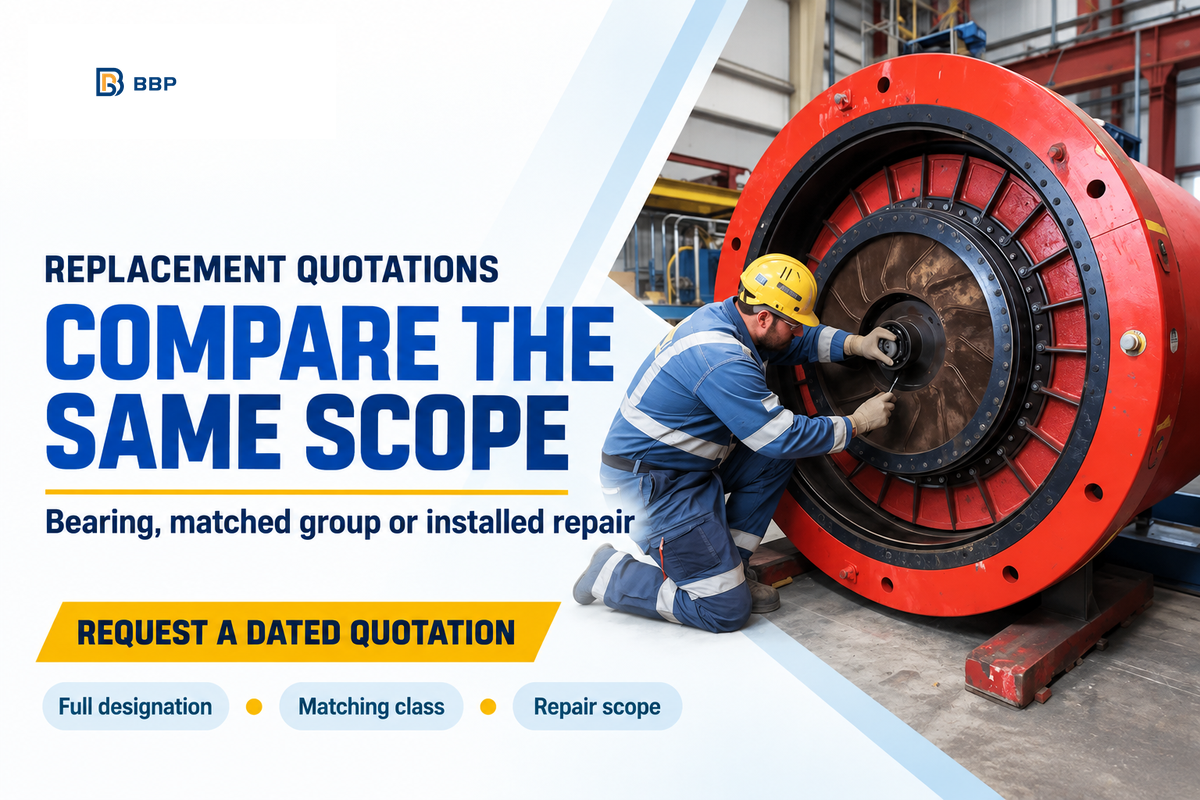
Use the parts-only quotation for the complete specified bearing pair as its purchase price, with installation and shaft or housing repairs priced separately. A loose bearing, a manufacturer-defined matched pair, and an installed pump repair are all different transactions. A useful quotation should identify the designation, arrangement, matching or preload class and scope; without those details, a low unit price cannot demonstrate equivalent value.
SKF offers manufacturer-defined matched sets and universally matchable products; NSK documents paired arrangements such as 7206ADB(M). Potential customers can use specific products from these bearing companies to evaluate supplier offers. Schaeffler also offers arrangement guidance. Examine the exact product against the specification of the pump. SKF’s universally matchable products achieve the specified clearance or preload without individual adjustment when the manufacturer’s matching rules are followed. That doesn’t sanction the use of mixed brands or unrelated duplex bearings.
SKF’s preload guide lists multiple preload options for a matched set of 7014 CE bearings. A quote for this set should define both the bearings and the preload option.
| Quotation | Must identify | Common mismatch to resolve |
|---|---|---|
| Individual bearing | Full suffix, brand, quantity and delivery condition | A unit price being compared with a complete bearing set |
| Matched or universally matchable group | Arrangement, matching rules and preload or clearance class | Same base number with different assembly behavior |
| Installed repair | Parts, inspection, shaft/housing work, assembly and verification | Parts-only pricing compared with a complete repair |
For a parts-only price, use a dated quotation for the complete pair in the specified arrangement and preload or clearance class. Price installation and shaft or housing repairs separately. The bearing block quotation should also state whether the price includes the bearing.
BBP manufactures pumps. For a replacement bearing enquiry, include the manufacturer and full designation from the existing set or the pump’s parts list. To request a pump, first provide the appropriate centrifugal pump configuration, the duty and existing assembly details.
Keep the bearing specification current

Keep the bearing design specification aligned to the machine and the relevant documentation. Temperature and vibration trends can help reveal changes in operating conditions, but monitoring does not confirm that preload, axial location or the lubrication system was selected correctly. Compare readings with load, speed and warm-up state.
Regarding dimensional tolerances, ISO 492:2023 addresses dimensional and geometrical characteristics at radial rolling-bearing interfaces. In the pump’s assembly requirements, specify the selected bearing arrangement and its required preload or clearance separately from the dimensional tolerances. A purchase specification should distinguish bearing tolerances from assembly and acceptance requirements.
For rotating equipment records, retain the entire designation, approved drawing, supplied matching information and baseline operating observations. Should temperatures rise after a change, compare the changed part(s) and the operating state before attributing the result to face-to-face vs back-to-back orientation.
Face bearing FAQs
Does it matter which way bearings face?
Yes, for single row conventional angular contact bearings. Their axial load direction follows the internal geometry, so orientation determines whether a pair is opposed or tandem. Verify the complete designation, arrangement marks, and the assembly drawing. A shield, seal or the visible height of one ring does not always indicate proper installation.
Should I replace the whole bearing set?
Replace an individually matched set as a unit to preserve its specified combination and orientation, following the manufacturer’s replacement instructions. For universally matchable bearings, the matching rules differ. Before ordering, identify which matching category the existing duplex set belongs to and investigate why it failed; replacing parts alone may leave the damaging fit or load unchanged.
Is your arrangement spring or rigidly preloaded?
A calibrated spring on the drawing indicates spring preload; a specified displacement through the assembly establishes rigid or position preload. The two methods respond differently to heat and differ in stiffness. Check the assembly drawing rather than infer the method from the DB or DF code, and don’t alter a spring or spacer without the specified design information.
Do bearings need lubrication?
Yes, but both the lubricant and the replenishment method must be suitable for the bearing design, speed, temperature, seals and service. Check the pump’s lubrication instructions rather than applying a general grease quantity to every bearing.
Does face bearing mean a face-mounted bearing unit?
Not necessarily. A face-mounted unit describes how hardware attaches to a machine; face-to-face describes the relationship between bearing load directions. “Bearing face” can also describe a surface. Identify the actual part type before referring to this guide. A bearing block or a mounting flange doesn’t reveal the internal arrangement.
Is face-to-face mounting self-aligning?
No. Relative tolerance of small misalignment does not make a DF pair self-aligning. The bearing manufacturer’s alignment limits still apply.
Discuss a pump duty: contact BBP with the pump model, fluid, duty point, speed and available assembly drawing. For an existing machine, provide the full bearing designation and the operating condition associated with the problem.
Written by CYH. Bearing dimensions are from NSK’s catalog comparison; the hot-pump case is from Shet, Kumar and Singh’s published study.
References & Sources
- Understanding Back-to-Back and Face-to-Face Bearing Arrangements Abhijeet Keer, Pumps & Systems.
- Misalignment Characteristics of Spindle System Supported by Angular Contact Ball Bearings Hideo Uchida and Shigeo Shimizu, Japan Society for Precision Engineering.
- Basic Hydraulic Loads in Rotodynamic Pumps Hydraulic Institute.
- Determination of Optimum Preload Considering the Skidding and Thermal Characteristic of High-Speed Angular Contact Ball Bearing Fang and colleagues, American Society of Mechanical Engineers, Journal of Mechanical Design.
- High Vibration Problem Resolution in Centrifugal Pump through Design Change Shet, Kumar and Singh, Texas A&M University Turbomachinery Laboratory.
- ISO 492:2023, Rolling bearings: Radial bearings: Geometrical product specifications (GPS) and tolerance values International Organization for Standardization.
WHY BUYERS WORK WITH BBP
About BBP Manufacturing
BBP Manufacturing Co., Ltd. is a Beijing-based industrial pump manufacturer with in-house foundry, heat treatment, machining, assembly, coating and inspection capabilities. We support industrial projects across slurry handling, sewage treatment, clean water transfer, chemical service, fire protection, irrigation and OEM pump supply.
Our Engineering Support
We help engineering buyers select and source the right pump configuration, not just compare prices. Send us your flow rate, head, medium, solids content, temperature, pH value, material requirement and installation conditions. BBP engineers will recommend a pump series, material option, duty curve basis, lead time and spare-parts plan for your RFQ.
Company Profile // DATA_SHEET
Name
BBP Manufacturing Co., Ltd.
Brand Name
BBP
Country
China
Headquarters
Beijing, P.R. China
Business Type
Industrial Pump Manufacturer
Model
B2B / OEM / ODM / Project Supply
Main Products
Slurry Pumps, Sewage Pumps, Centrifugal Pumps, Split Case Pumps, Multistage Pumps, Chemical Pumps, Fire Pumps, Irrigation Pumps
Manufacturing Capability
Foundry, Heat Treatment, Machining, Assembly, Coating, Inspection
Certifications
ISO 9001 / CE / SGS / BV / TÜV
Export Reach
90+ Countries & Regions
Standard Lead Time
About 25 Days for Standard Configurations
Contact Person
Wesley · International Sales
Phone / WhatsApp
+86 182 1085 0516
Email
contact@bbpmfg.com
Website
https://bbpmfg.com/
Address
Room 2803, Building 11, Phase II, Nuode Center, Fengtai District, Beijing, P.R. China